Classic of Changes, Hexagram 30: Li 離 (Ming print of 1596)
Introduction
Li 離 is hexagram 30 in the received order of the Classic of Changes (周易 Zhouyi, also called 易經 Yijing). Its figure joins the trigram 離 Li (fire) below and 離 Li (fire) above. The text of each hexagram has two layers: a short statement on the hexagram as a whole (卦辭, which Legge calls the Thwan and ascribes to King Wen) and one statement for each of its six lines (爻辭, ascribed to the Duke of Zhou). The statements were used for divination and are generally dated to the Western Zhou period (roughly the 9th century BCE or earlier); the commentaries known as the Ten Wings were added later.
The photographs are of the first volume of a Five Classics printed in Nanjing with the main text only and punctuation circles, with a postface by Li Deng dated Wanli 24 (1596); the National Diet Library, Tokyo, holds the only known copy of these five volumes (call no. WA35-19). It follows the arrangement of Wang Bi's edition: after each hexagram figure come the statement, the commentaries on it (彖 Tuan and 大象 Great Image), and each line statement followed by its Small Image (小象). Those commentaries are not given here. In this copy the hexagram runs from canvas 55, left-hand page to canvas 56, left-hand page. Each section gathers the statements that begin on one page and links to that page and to any page the last statement runs onto; the page boundaries were found by reading the first characters of every column on the photographs.
The Chinese is the received text from Wikisource. The English is James Legge's translation in Sacred Books of the East, volume 16 (1882), The Text, hexagram 30 (Lî), pages 120-122; his notes are not reproduced. Legge adds words in parentheses to make the sense plain; they are his.
How was this verified? (Provenance)
Where on the image
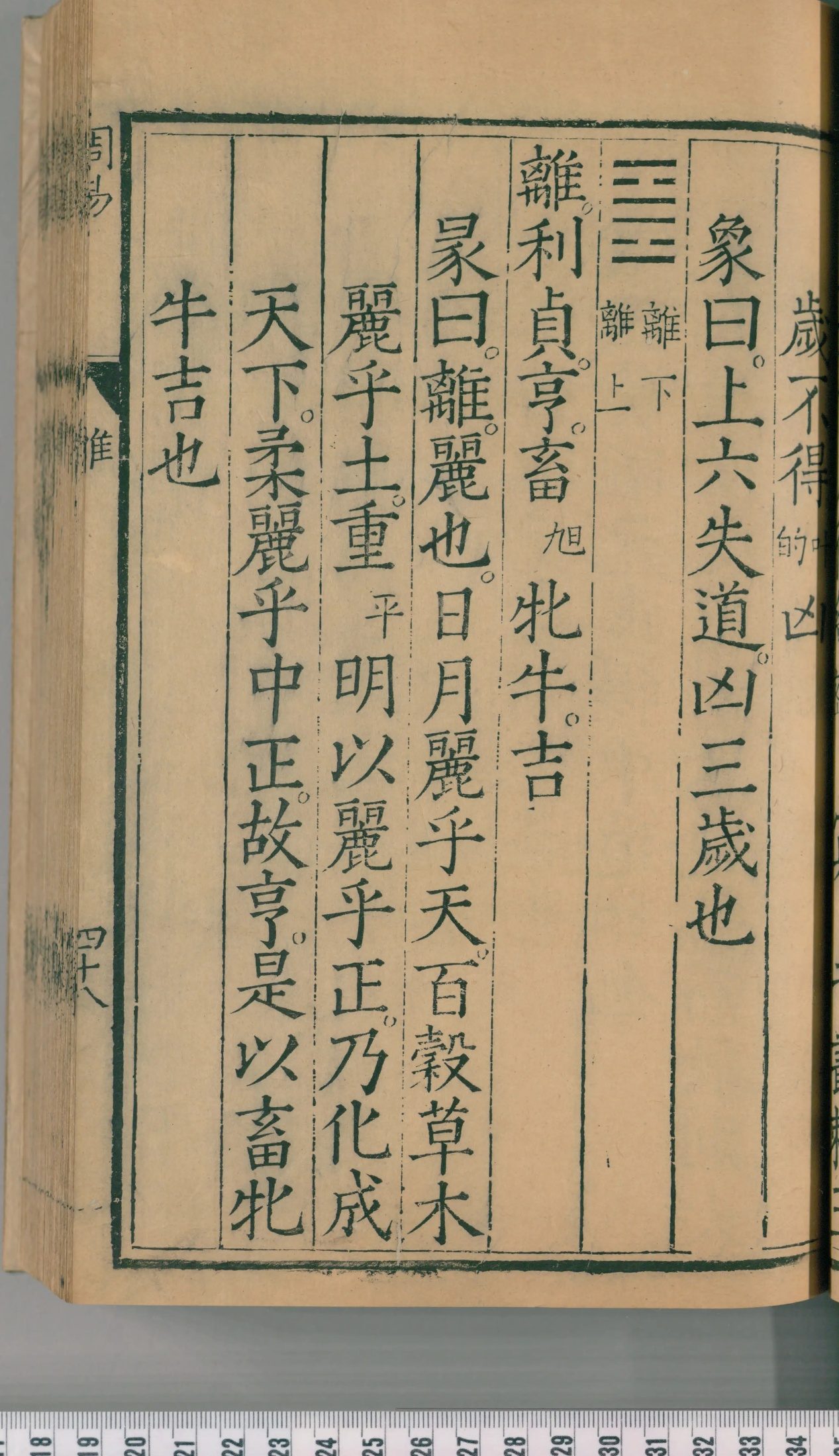
National Diet Library WA35-19 [五經白文], vol. 1 (周易), IIIF canvas 55, left-hand page: 8 columns, main text with punctuation circles and small sound glosses. Column 3 carries the hexagram figure with the trigram names 離下離上. Checked on the image: the hexagram statement opens column 4 ‹離利貞亨›. Between the statements the print gives the commentaries of the Ten Wings (彖曰, 象曰), which are not part of this section. The Chinese shown is the received text from Wikisource, not a transcription of this print.
離:利貞。亨。畜牝牛,吉。
Lî indicates that, (in regard to what it denotes), it will be advantageous to be firm and correct, and that thus there will be free course and success. Let (its subject) also nourish (a docility like that of) the cow, and there will be good fortune.
Where on the image
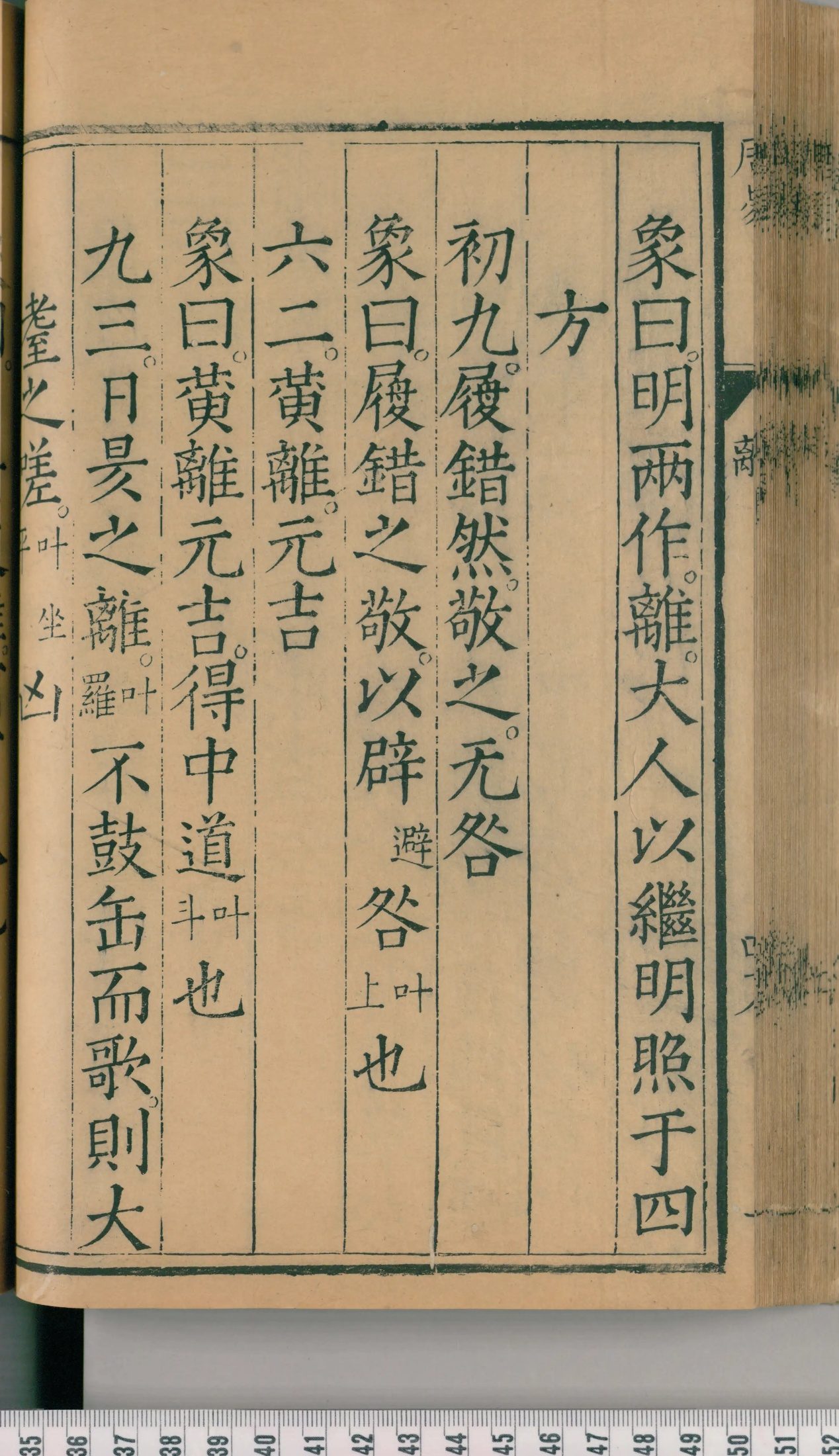
National Diet Library WA35-19 [五經白文], vol. 1 (周易), IIIF canvas 56, right-hand page: 8 columns, main text with punctuation circles and small sound glosses. Checked on the image: line statement 1 opens column 3 ‹初九履錯›; line statement 2 opens column 5 ‹六二黃離›; line statement 3 opens column 7 ‹九三日昃›. Between the statements the print gives the commentaries of the Ten Wings (彖曰, 象曰), which are not part of this section. The Chinese shown is the received text from Wikisource, not a transcription of this print.
1初九:履錯然,敬之无咎。
2六二:黃離,元吉。
3九三:日昃之離,不鼓缶而歌,則大耋之嗟,凶。
1The first line, undivided, shows one ready to move with confused steps. But he treads at the same time reverently, and there will be no mistake.
2The second line, divided, shows its subject in his place in yellow. There will be great good fortune.
3The third line, undivided, shows its subject in a position like that of the declining sun. Instead of playing on his instrument of earthenware, and singing to it, he utters the groans of an old man of eighty. There will be evil.
Where on the image
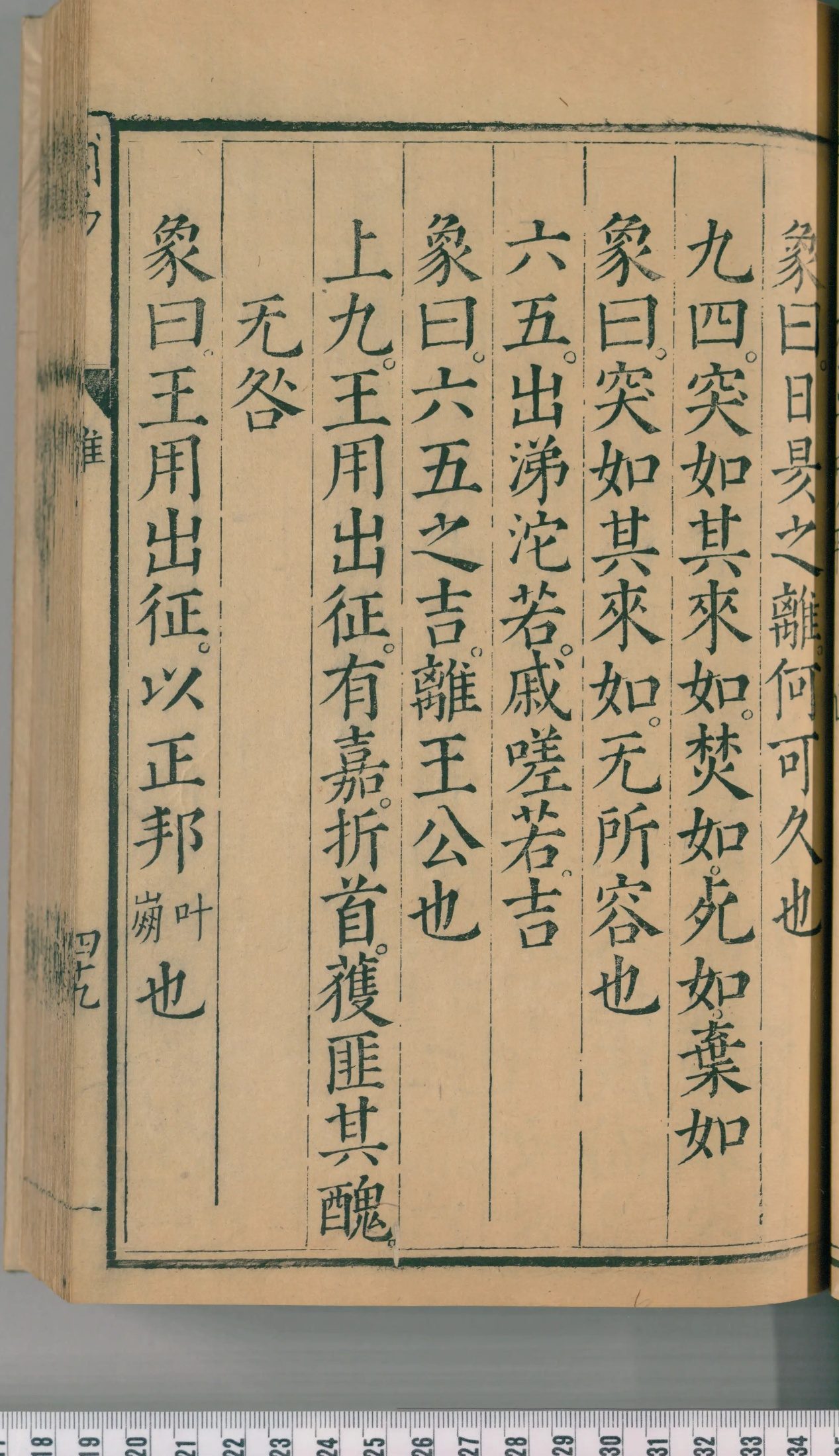
National Diet Library WA35-19 [五經白文], vol. 1 (周易), IIIF canvas 56, left-hand page: 8 columns, main text with punctuation circles and small sound glosses. Checked on the image: line statement 4 opens column 2 ‹九四突如›; line statement 5 opens column 4 ‹六五出涕›; line statement 6 opens column 6 ‹上九王用›. Between the statements the print gives the commentaries of the Ten Wings (彖曰, 象曰), which are not part of this section. The Chinese shown is the received text from Wikisource, not a transcription of this print.
4九四:突如其來如,焚如,死如,棄如。
5六五:出涕沱若,戚嗟若,吉。
6上九:王用出征,有嘉折首,獲匪其醜,无咎。
4The fourth line, undivided, shows the manner of its subject's coming. How abrupt it is, as with fire, with death, to be rejected (by all)!
5The fifth line, divided, shows its subject as one with tears flowing in torrents, and groaning in sorrow. There will be good fortune.
6The topmost line, undivided, shows the king employing its subject in his punitive expeditions. Achieving admirable (merit), he breaks (only) the chiefs (of the rebels). Where his prisoners were not their associates, he does not punish. There will be no error.
Notes
- English: James Legge, The Yî King, Sacred Books of the East vol. 16 (1882), The Text, hexagram 30 (Lî). The hexagram statement is unnumbered; the line statements are numbered from the bottom line up, as in Legge.
- Legge's footnotes and his notes under each hexagram are left out.
Cite
Sources
- Source: National Diet Library WA35-19 (Ming Five Classics print with postface of 1596, vol. 1, Zhouyi) + Wikisource received text + James Legge, Sacred Books of the East 16 (1882) (holding institution)
- Critical edition: Received text (Wikisource)
← previous · → next · v cycle view · l back to library