Classic of Changes, Hexagram 38: Kui 睽 (Ming print of 1596)
Introduction
Kui 睽 is hexagram 38 in the received order of the Classic of Changes (周易 Zhouyi, also called 易經 Yijing). Its figure joins the trigram 兌 Dui (lake) below and 離 Li (fire) above. The text of each hexagram has two layers: a short statement on the hexagram as a whole (卦辭, which Legge calls the Thwan and ascribes to King Wen) and one statement for each of its six lines (爻辭, ascribed to the Duke of Zhou). The statements were used for divination and are generally dated to the Western Zhou period (roughly the 9th century BCE or earlier); the commentaries known as the Ten Wings were added later.
The photographs are of the first volume of a Five Classics printed in Nanjing with the main text only and punctuation circles, with a postface by Li Deng dated Wanli 24 (1596); the National Diet Library, Tokyo, holds the only known copy of these five volumes (call no. WA35-19). It follows the arrangement of Wang Bi's edition: after each hexagram figure come the statement, the commentaries on it (彖 Tuan and 大象 Great Image), and each line statement followed by its Small Image (小象). Those commentaries are not given here. In this copy the hexagram runs from canvas 67, right-hand page to canvas 68, left-hand page. Each section gathers the statements that begin on one page and links to that page and to any page the last statement runs onto; the page boundaries were found by reading the first characters of every column on the photographs.
The Chinese is the received text from Wikisource. The English is James Legge's translation in Sacred Books of the East, volume 16 (1882), The Text, hexagram 38 (Khwei), pages 139-140; his notes are not reproduced. Legge adds words in parentheses to make the sense plain; they are his.
How was this verified? (Provenance)
Where on the image
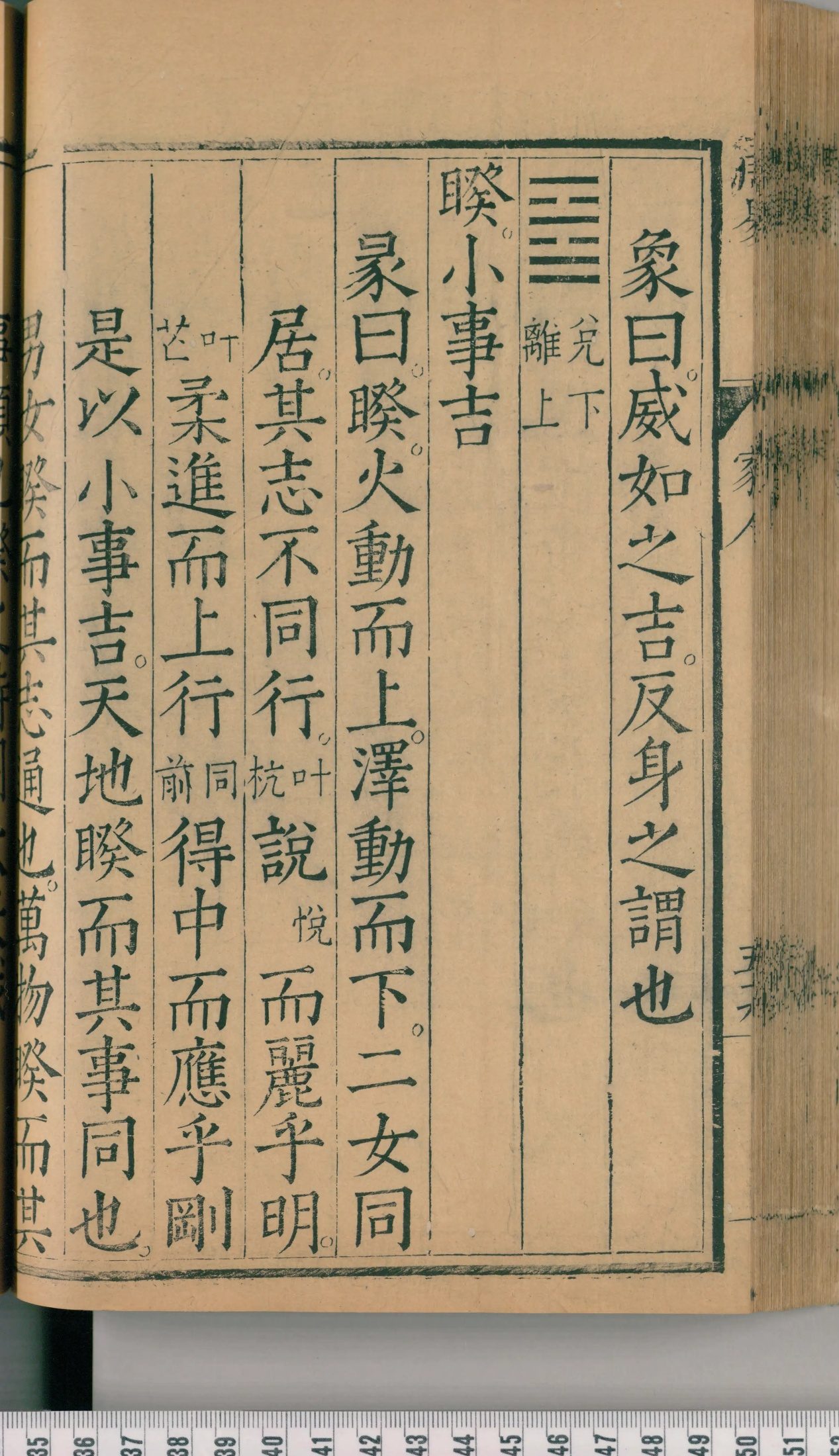
National Diet Library WA35-19 [五經白文], vol. 1 (周易), IIIF canvas 67, right-hand page: 8 columns, main text with punctuation circles and small sound glosses. Column 2 carries the hexagram figure with the trigram names 兌下離上. Checked on the image: the hexagram statement opens column 3 ‹睽小事吉›. Between the statements the print gives the commentaries of the Ten Wings (彖曰, 象曰), which are not part of this section. The Chinese shown is the received text from Wikisource, not a transcription of this print.
睽:小事吉。
Khwei indicates that, (notwithstanding the condition of things which it denotes), in small matters there will (still) be good success.
Where on the image
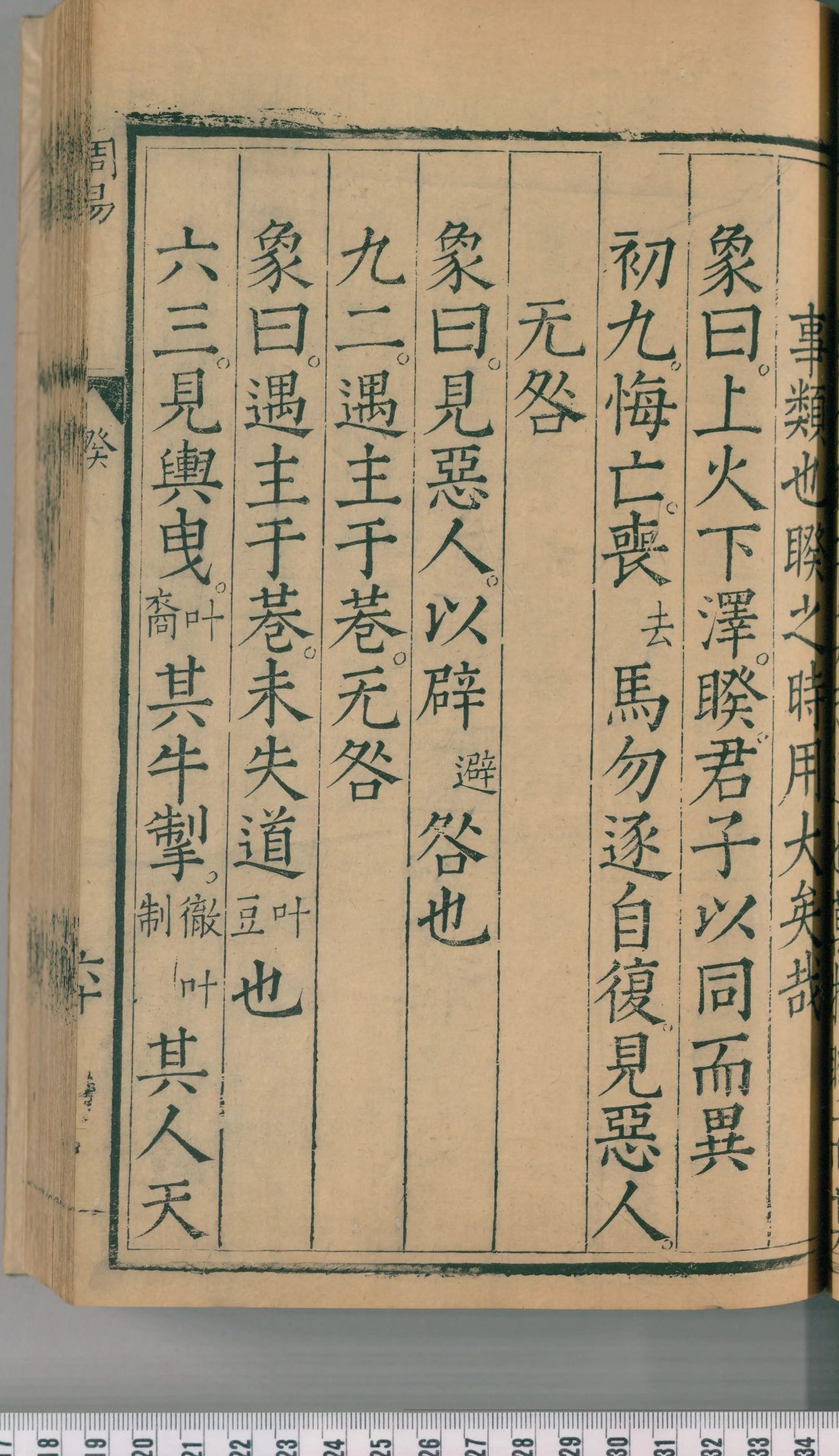
National Diet Library WA35-19 [五經白文], vol. 1 (周易), IIIF canvas 67, left-hand page: 8 columns, main text with punctuation circles and small sound glosses. Checked on the image: line statement 1 opens column 3 ‹初九悔亡›; line statement 2 opens column 6 ‹九二遇主›; line statement 3 opens column 8 ‹六三見輿›. Between the statements the print gives the commentaries of the Ten Wings (彖曰, 象曰), which are not part of this section. Line statement 3 runs on to canvas 68, right-hand page (first column ‹且劓无初›). The Chinese shown is the received text from Wikisource, not a transcription of this print.
1初九:悔亡,喪馬勿逐,自復;見惡人无咎。
2九二:遇主于巷,无咎。
3六三:見輿曳,其牛掣,其人天且劓,无初有終。
1The first line, undivided, shows that (to its subject) occasion for repentance will disappear. He has lost his horses, but let him not seek for them;—they will return of themselves. Should he meet with bad men, he will not err (in communicating with them).
2The second line, undivided, shows its subject happening to meet with his lord in a bye-passage. There will be no error.
3In the third line, divided, we see one whose carriage is dragged back, while the oxen in it are pushed back, and he is himself subjected to the shaving of his head and the cutting off of his nose. There is no good beginning, but there will be a good end.
Where on the image
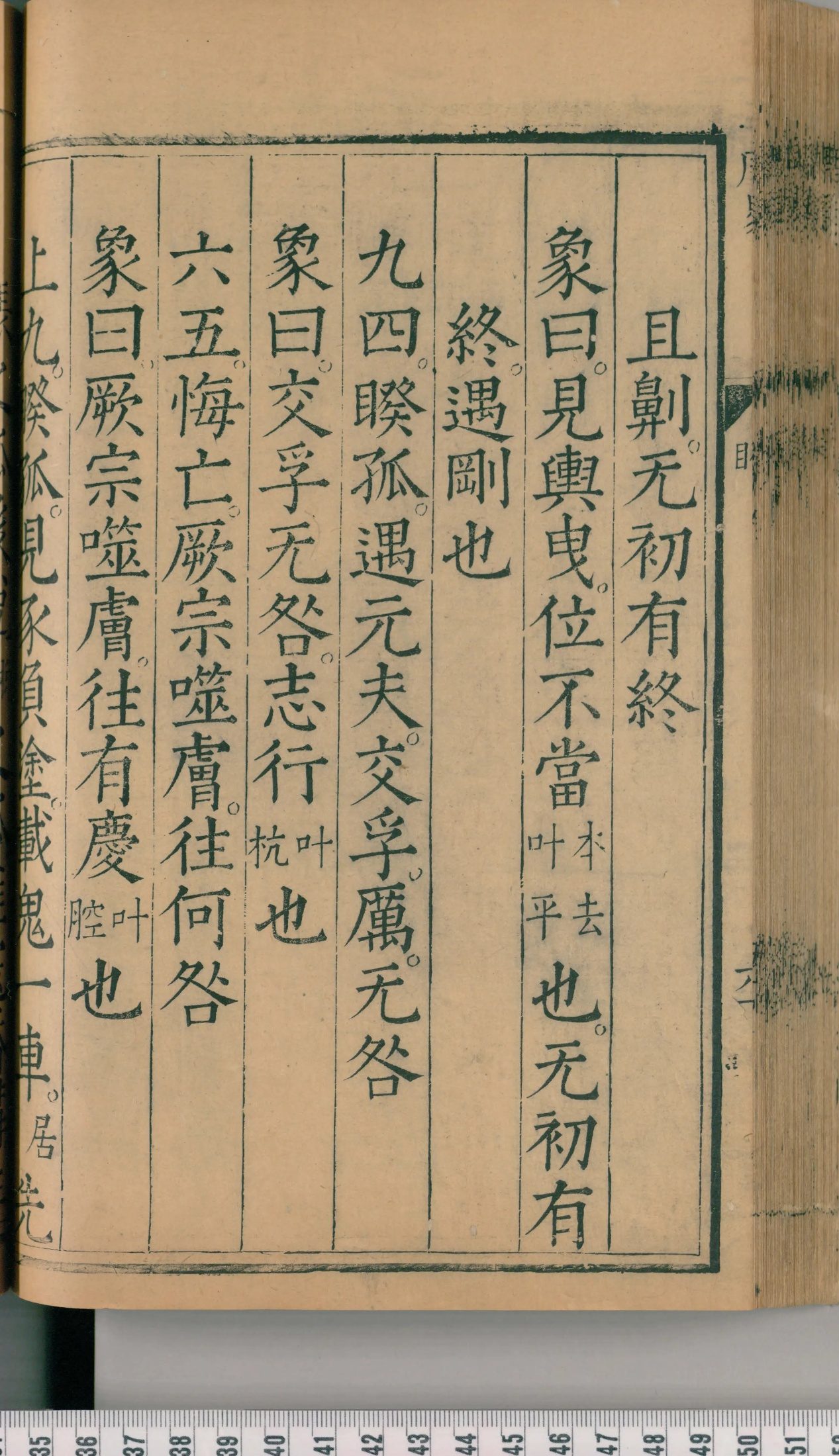
National Diet Library WA35-19 [五經白文], vol. 1 (周易), IIIF canvas 68, right-hand page: 8 columns, main text with punctuation circles and small sound glosses. Checked on the image: line statement 4 opens column 4 ‹九四睽孤›; line statement 5 opens column 6 ‹六五悔亡›; line statement 6 opens column 8 ‹上九睽孤›. Between the statements the print gives the commentaries of the Ten Wings (彖曰, 象曰), which are not part of this section. Line statement 6 runs on to canvas 68, left-hand page (first column ‹張之弧後›). The Chinese shown is the received text from Wikisource, not a transcription of this print.
4九四:睽孤,遇元夫,交孚,厲无咎。
5六五:悔亡,厥宗噬膚,往何咎。
6上九:睽孤, 見豕負涂,載鬼一車, 先張之弧,後說之弧,匪寇婚媾,往遇雨則吉。
4The fourth line, undivided, shows its subject solitary amidst the (prevailing) disunion. (But) he meets with the good man (represented by the first line), and they blend their sincere desires together. The position is one of peril, but there will be no mistake.
5The fifth line, divided, shows that (to its subject) occasion for repentance will disappear. With his relative (and minister he unites closely and readily) as if he were biting through a piece of skin. When he goes forward (with this help), what error can there be?
6The topmost line, undivided, shows its subject solitary amidst the (prevailing) disunion. (In the subject of the third line, he seems to) see a pig bearing on its back a load of mud, (or fancies) there is a carriage full of ghosts. He first bends his bow against him, and afterwards unbends it, (for he discovers) that he is not an assailant to injure, but a near relative. Going forward, he shall meet with (genial) rain, and there will be good fortune.
Notes
- English: James Legge, The Yî King, Sacred Books of the East vol. 16 (1882), The Text, hexagram 38 (Khwei). The hexagram statement is unnumbered; the line statements are numbered from the bottom line up, as in Legge.
- Legge's footnotes and his notes under each hexagram are left out.
Cite
Sources
- Source: National Diet Library WA35-19 (Ming Five Classics print with postface of 1596, vol. 1, Zhouyi) + Wikisource received text + James Legge, Sacred Books of the East 16 (1882) (holding institution)
- Critical edition: Received text (Wikisource)
← previous · → next · v cycle view · l back to library