Classic of Changes, Hexagram 41: Sun 損 (Ming print of 1596)
Introduction
Sun 損 is hexagram 41 in the received order of the Classic of Changes (周易 Zhouyi, also called 易經 Yijing). Its figure joins the trigram 兌 Dui (lake) below and 艮 Gen (mountain) above. The text of each hexagram has two layers: a short statement on the hexagram as a whole (卦辭, which Legge calls the Thwan and ascribes to King Wen) and one statement for each of its six lines (爻辭, ascribed to the Duke of Zhou). The statements were used for divination and are generally dated to the Western Zhou period (roughly the 9th century BCE or earlier); the commentaries known as the Ten Wings were added later.
The photographs are of the first volume of a Five Classics printed in Nanjing with the main text only and punctuation circles, with a postface by Li Deng dated Wanli 24 (1596); the National Diet Library, Tokyo, holds the only known copy of these five volumes (call no. WA35-19). It follows the arrangement of Wang Bi's edition: after each hexagram figure come the statement, the commentaries on it (彖 Tuan and 大象 Great Image), and each line statement followed by its Small Image (小象). Those commentaries are not given here. In this copy the hexagram runs from canvas 71, left-hand page to canvas 72, left-hand page. Each section gathers the statements that begin on one page and links to that page and to any page the last statement runs onto; the page boundaries were found by reading the first characters of every column on the photographs.
The Chinese is the received text from Wikisource. The English is James Legge's translation in Sacred Books of the East, volume 16 (1882), The Text, hexagram 41 (Sun), pages 146-148; his notes are not reproduced. Legge adds words in parentheses to make the sense plain; they are his.
How was this verified? (Provenance)
Where on the image
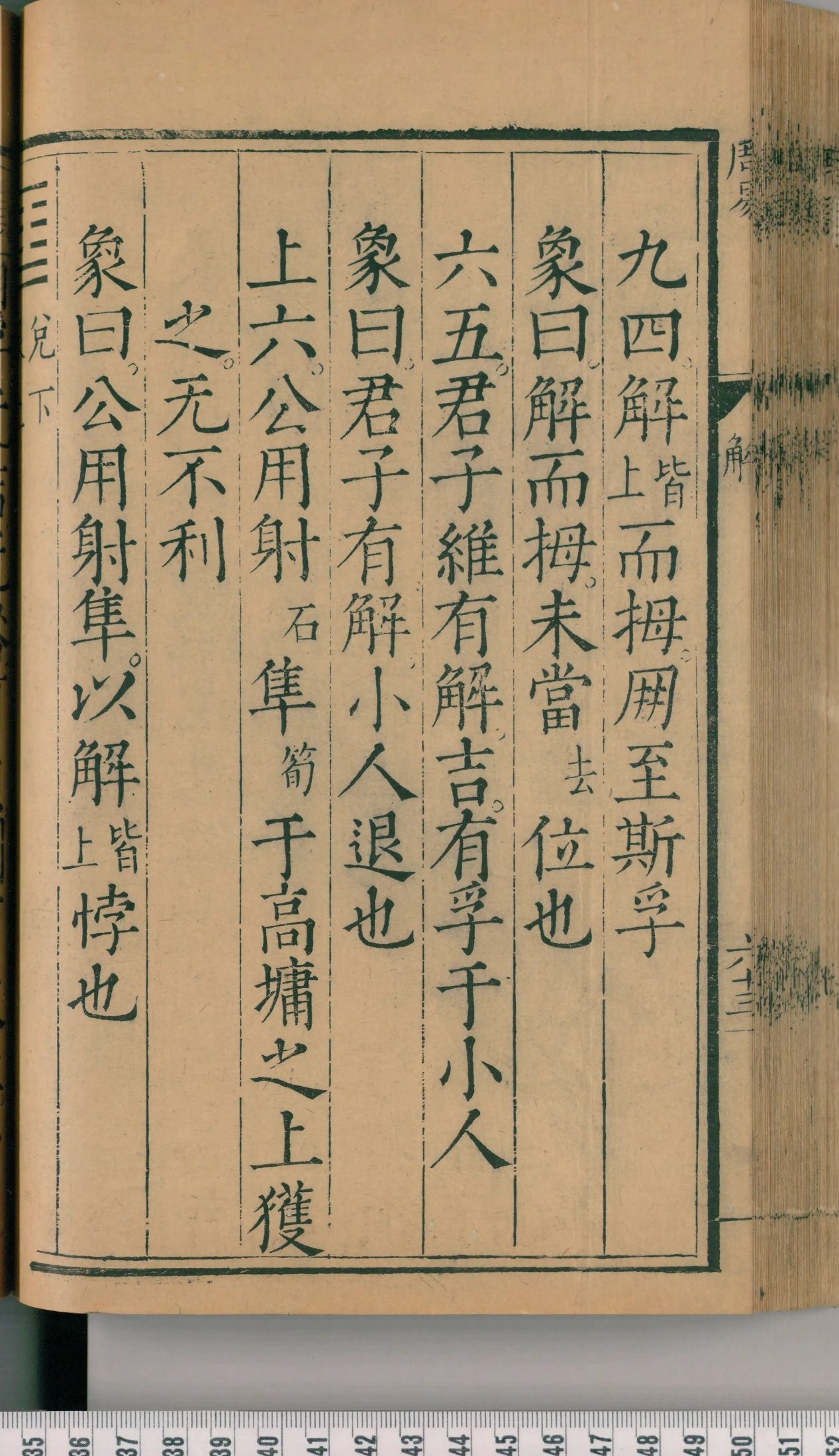
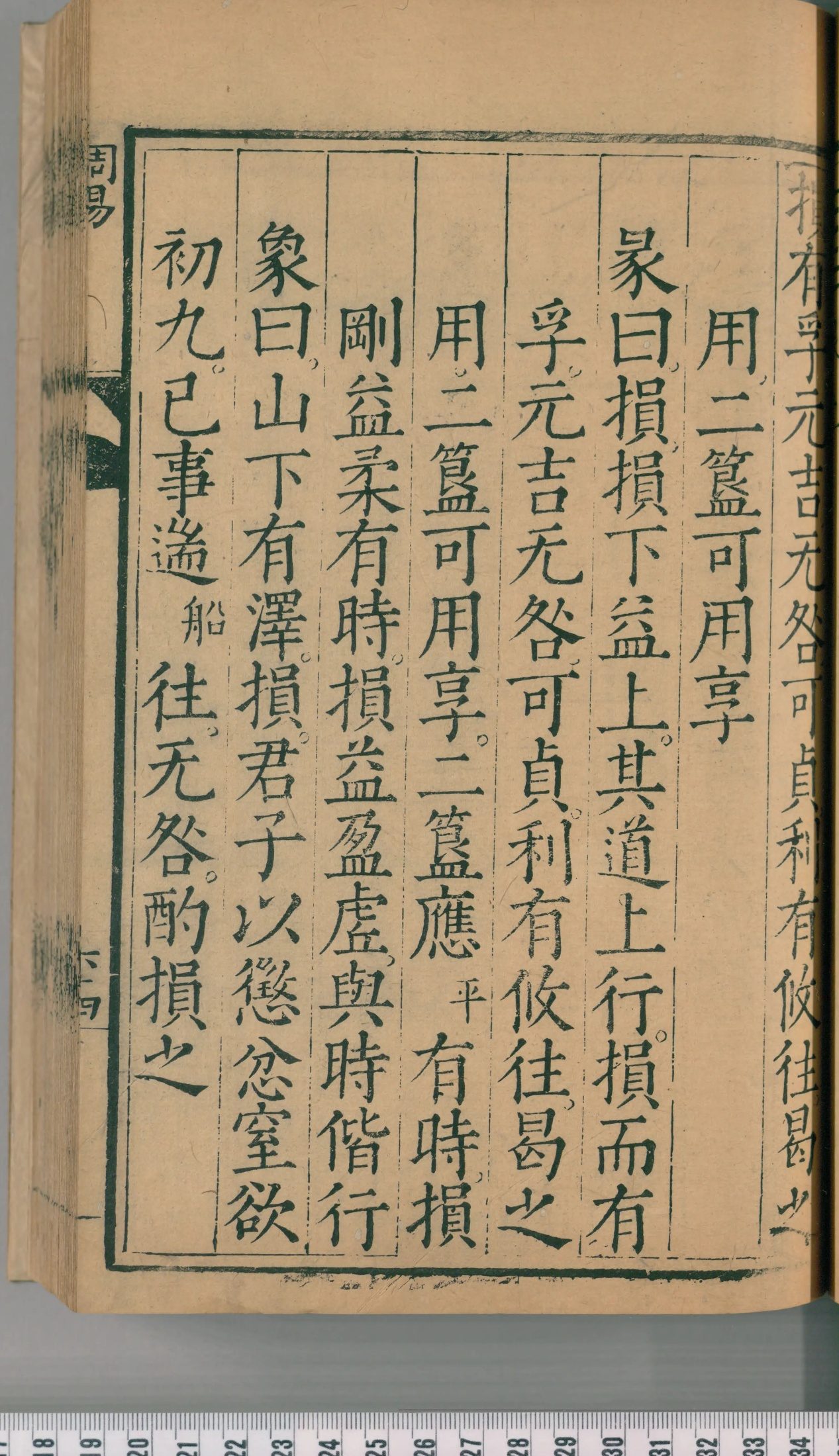
National Diet Library WA35-19 [五經白文], vol. 1 (周易), IIIF canvas 71, left-hand page: 8 columns, main text with punctuation circles and small sound glosses. The hexagram figure with the trigram names 兌下艮上 stands in the last column (column 8) of the facing canvas 71, right-hand page, which is listed first. Checked on the image: the hexagram statement opens column 1 ‹損有孚元›; line statement 1 opens column 8 ‹初九已事›. Between the statements the print gives the commentaries of the Ten Wings (彖曰, 象曰), which are not part of this section. The Chinese shown is the received text from Wikisource, not a transcription of this print.
損:有孚,元吉。无咎,可貞,利有攸往。曷之用?二簋可用享。
1初九:已事遄往,无咎,酌損之。
In (what is denoted by) Sun, if there be sincerity (in him who employs it), there will be great good fortune:—freedom from error; firmness and correctness that can be maintained; and advantage in every movement that shall be made. In what shall this (sincerity in the exercise of Sun) be employed? (Even) in sacrifice two baskets of grain, (though there be nothing else), may be presented.
1The first line, undivided, shows its subject suspending his own affairs, and hurrying away (to help the subject of the fourth line). He will commit no error, but let him consider how far he should contribute of what is his (for the other).
Where on the image
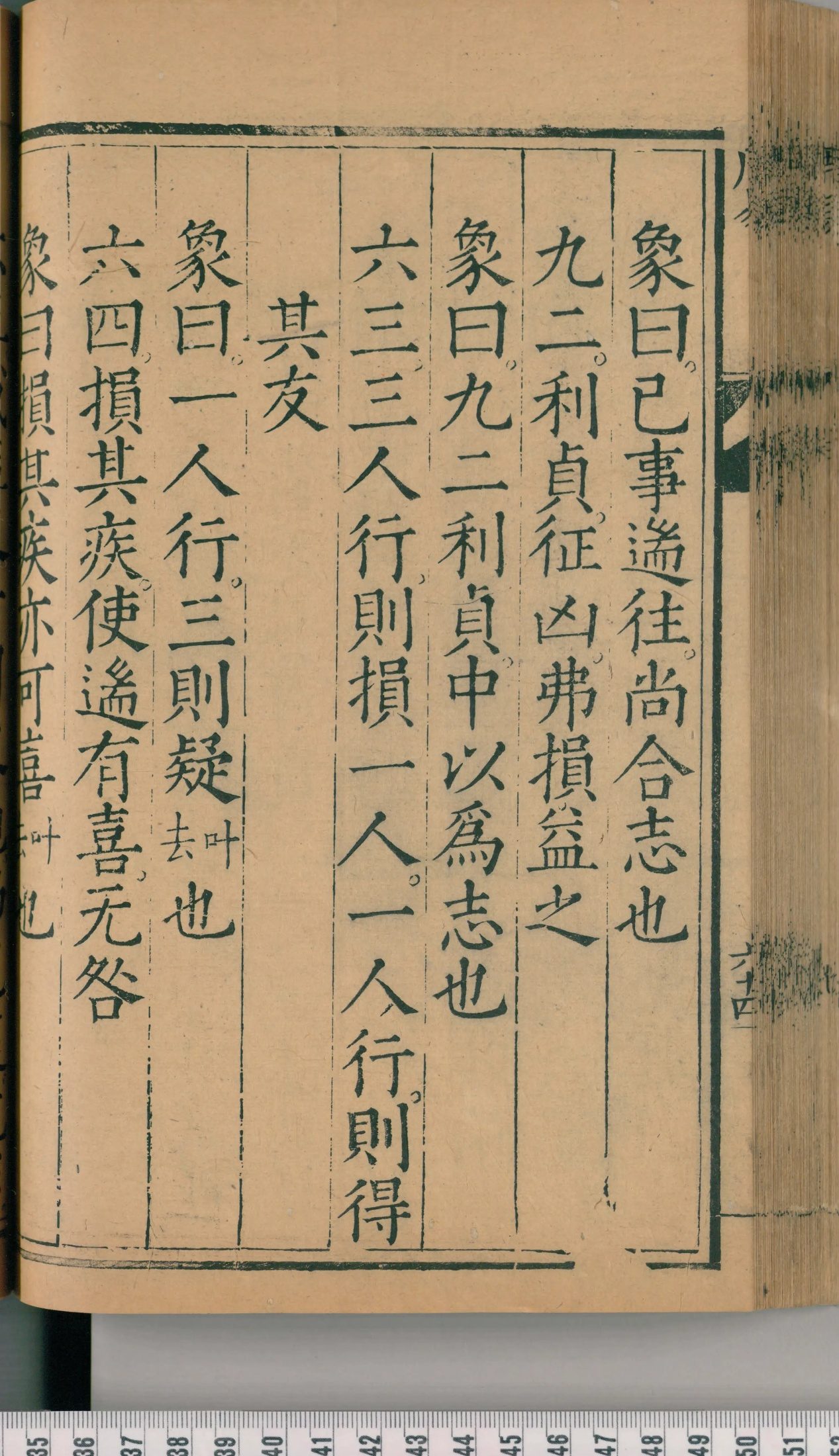
National Diet Library WA35-19 [五經白文], vol. 1 (周易), IIIF canvas 72, right-hand page: 8 columns, main text with punctuation circles and small sound glosses. Checked on the image: line statement 2 opens column 2 ‹九二利貞›; line statement 3 opens column 4 ‹六三三人›; line statement 4 opens column 7 ‹六四損其›. Between the statements the print gives the commentaries of the Ten Wings (彖曰, 象曰), which are not part of this section. The Chinese shown is the received text from Wikisource, not a transcription of this print.
2九二:利貞,征凶,弗損益之。
3六三:三人行,則損一人;一人行,則得其友。
4六四:損其疾,使遄有喜,无咎。
2The second line, undivided, shows that it will be advantageous for its subject to maintain a firm correctness, and that action on his part will be evil. He can give increase (to his correlate) without taking from himself.
3The third line, divided, shows how of three men walking together, the number is diminished by one; and how one, walking, finds his friend.
4The fourth line, divided, shows its subject diminishing the ailment under which he labours by making (the subject of the first line) hasten (to his help), and make him glad. There will be no error.
Where on the image
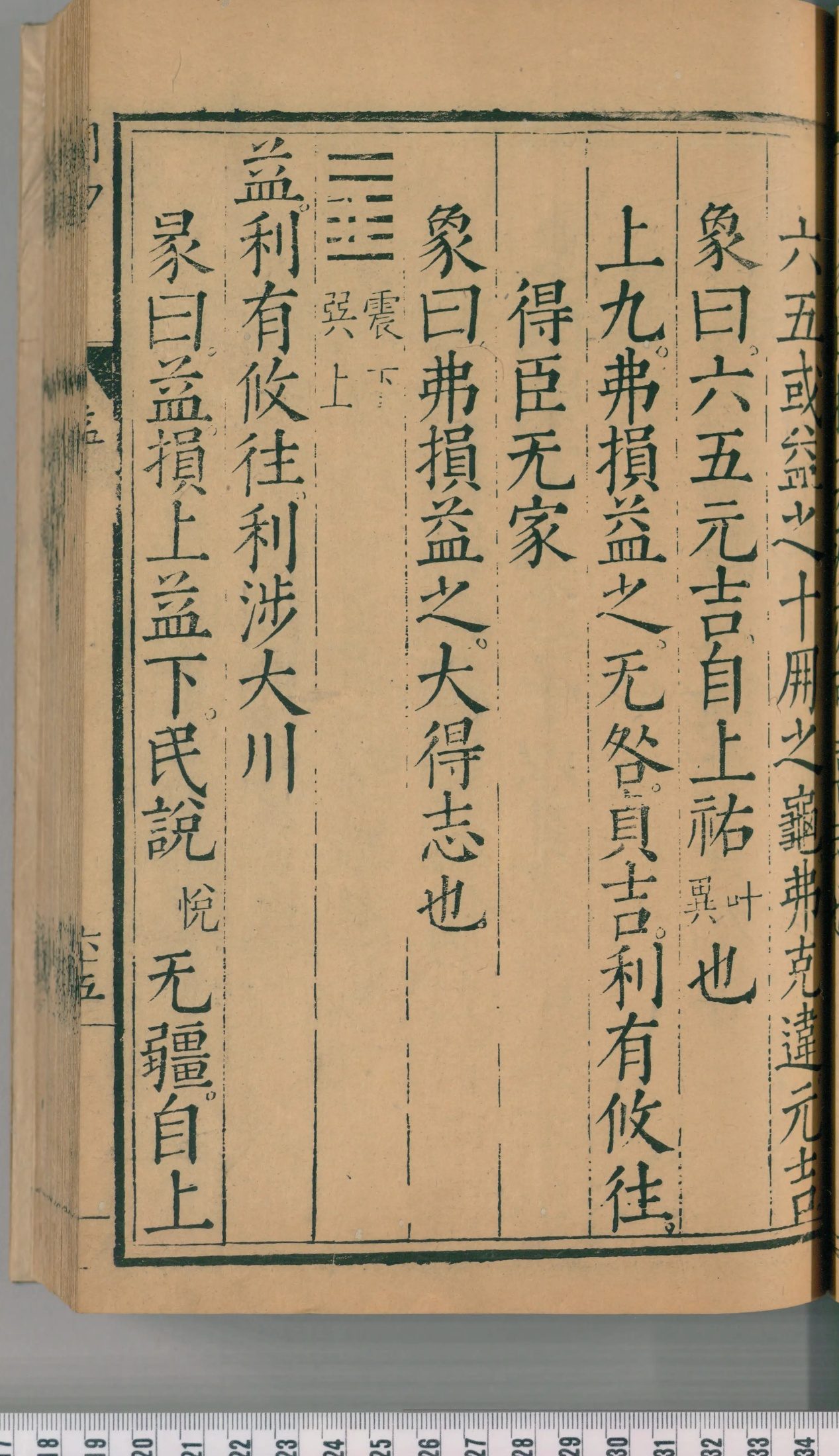
National Diet Library WA35-19 [五經白文], vol. 1 (周易), IIIF canvas 72, left-hand page: 8 columns, main text with punctuation circles and small sound glosses. Checked on the image: line statement 5 opens column 1 ‹六五或益›; line statement 6 opens column 3 ‹上九弗損›. Between the statements the print gives the commentaries of the Ten Wings (彖曰, 象曰), which are not part of this section. The Chinese shown is the received text from Wikisource, not a transcription of this print.
5六五:或益之,十朋之龜弗克違,元吉。
6上九:弗損益之,无咎,貞吉,利有攸往,得臣无家。
5The fifth line, divided, shows parties adding to (the stores of) its subject ten pairs of tortoise shells, and accepting no refusal. There will be great good fortune.
6The topmost line, undivided, shows its subject giving increase to others without taking from himself. There will be no error. With firm correctness there will be good fortune. There will be advantage in every movement that shall be made. He will find ministers more than can be counted by their clans.
Notes
- English: James Legge, The Yî King, Sacred Books of the East vol. 16 (1882), The Text, hexagram 41 (Sun). The hexagram statement is unnumbered; the line statements are numbered from the bottom line up, as in Legge.
- Legge's footnotes and his notes under each hexagram are left out.
Cite
Sources
- Source: National Diet Library WA35-19 (Ming Five Classics print with postface of 1596, vol. 1, Zhouyi) + Wikisource received text + James Legge, Sacred Books of the East 16 (1882) (holding institution)
- Critical edition: Received text (Wikisource)
← previous · → next · v cycle view · l back to library