Classic of Changes, Hexagram 43: Guai 夬 (Ming print of 1596)
Introduction
Guai 夬 is hexagram 43 in the received order of the Classic of Changes (周易 Zhouyi, also called 易經 Yijing). Its figure joins the trigram 乾 Qian (heaven) below and 兌 Dui (lake) above. The text of each hexagram has two layers: a short statement on the hexagram as a whole (卦辭, which Legge calls the Thwan and ascribes to King Wen) and one statement for each of its six lines (爻辭, ascribed to the Duke of Zhou). The statements were used for divination and are generally dated to the Western Zhou period (roughly the 9th century BCE or earlier); the commentaries known as the Ten Wings were added later.
The photographs are of the first volume of a Five Classics printed in Nanjing with the main text only and punctuation circles, with a postface by Li Deng dated Wanli 24 (1596); the National Diet Library, Tokyo, holds the only known copy of these five volumes (call no. WA35-19). It follows the arrangement of Wang Bi's edition: after each hexagram figure come the statement, the commentaries on it (彖 Tuan and 大象 Great Image), and each line statement followed by its Small Image (小象). Those commentaries are not given here. In this copy the hexagram runs from canvas 74, left-hand page to canvas 75, left-hand page. Each section gathers the statements that begin on one page and links to that page and to any page the last statement runs onto; the page boundaries were found by reading the first characters of every column on the photographs.
The Chinese is the received text from Wikisource. The English is James Legge's translation in Sacred Books of the East, volume 16 (1882), The Text, hexagram 43 (Kwâi), pages 151-153; his notes are not reproduced. Legge adds words in parentheses to make the sense plain; they are his.
How was this verified? (Provenance)
Where on the image
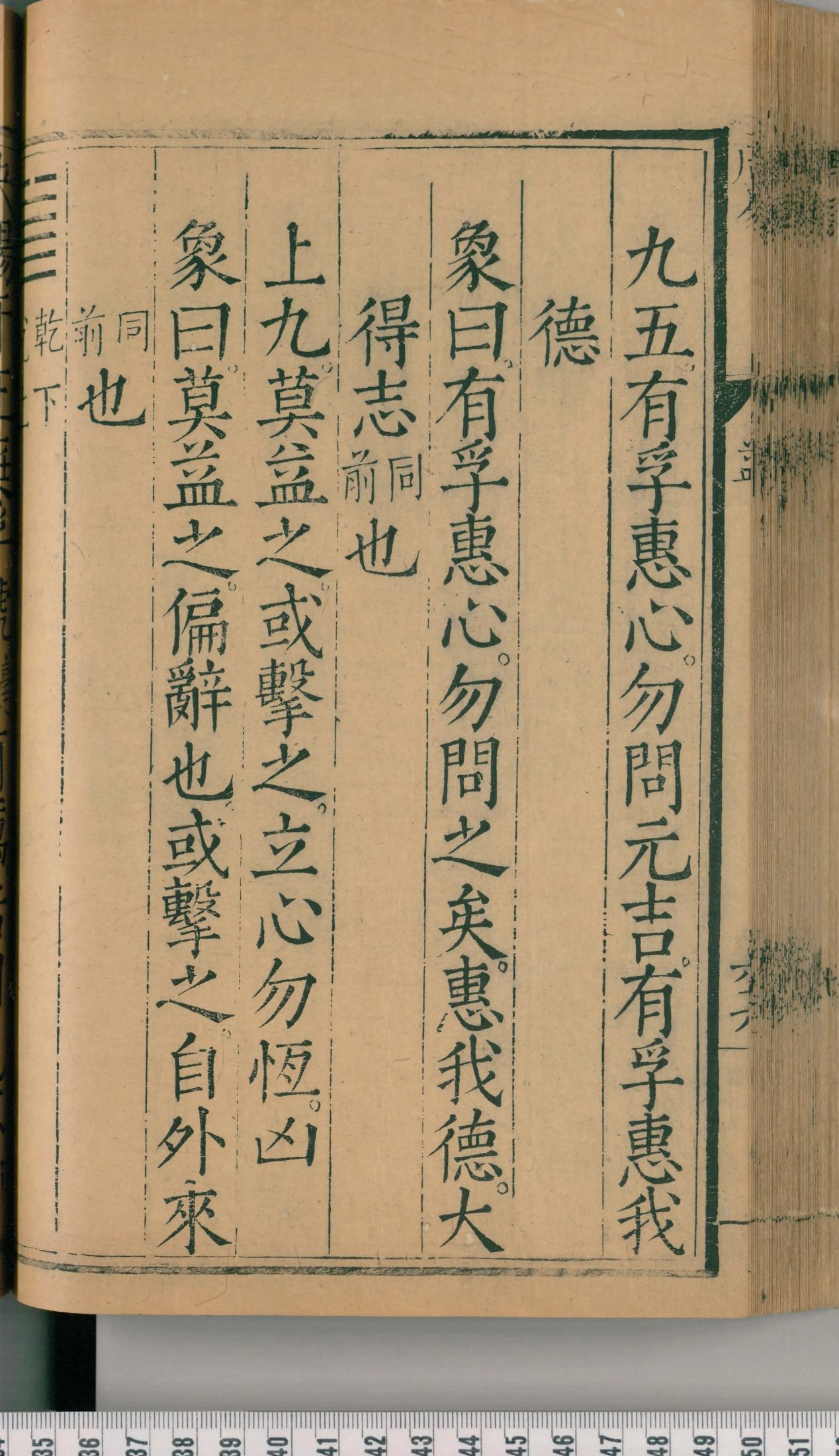
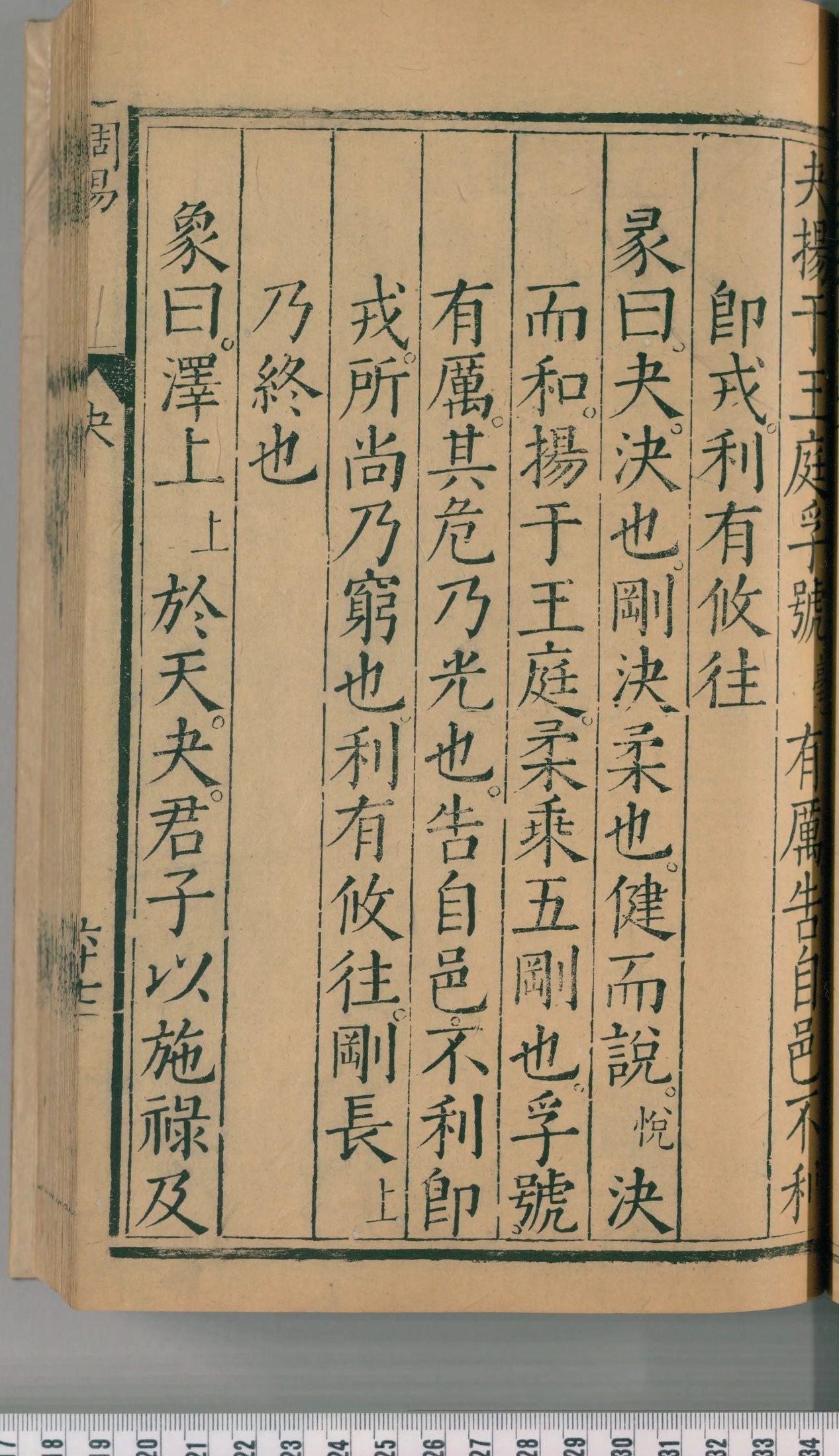
National Diet Library WA35-19 [五經白文], vol. 1 (周易), IIIF canvas 74, left-hand page: 8 columns, main text with punctuation circles and small sound glosses. The hexagram figure with the trigram names 乾下兌上 stands in the last column (column 8) of the facing canvas 74, right-hand page, which is listed first. Checked on the image: the hexagram statement opens column 1 ‹夬揚于王›. Between the statements the print gives the commentaries of the Ten Wings (彖曰, 象曰), which are not part of this section. The Chinese shown is the received text from Wikisource, not a transcription of this print.
夬:揚于王庭,孚號,有厲,告自邑,不利即戎,利有攸往。
Kwâi requires (in him who would fulfil its meaning) the exhibition (of the culprit's guilt) in the royal court, and a sincere and earnest appeal (for sympathy and support), with a consciousness of the peril (involved in cutting off the criminal). He should (also) make announcement in his own city, and show that it will not be well to have recourse at once to arms. (In this way) there will be advantage in whatever he shall go forward to.
Where on the image
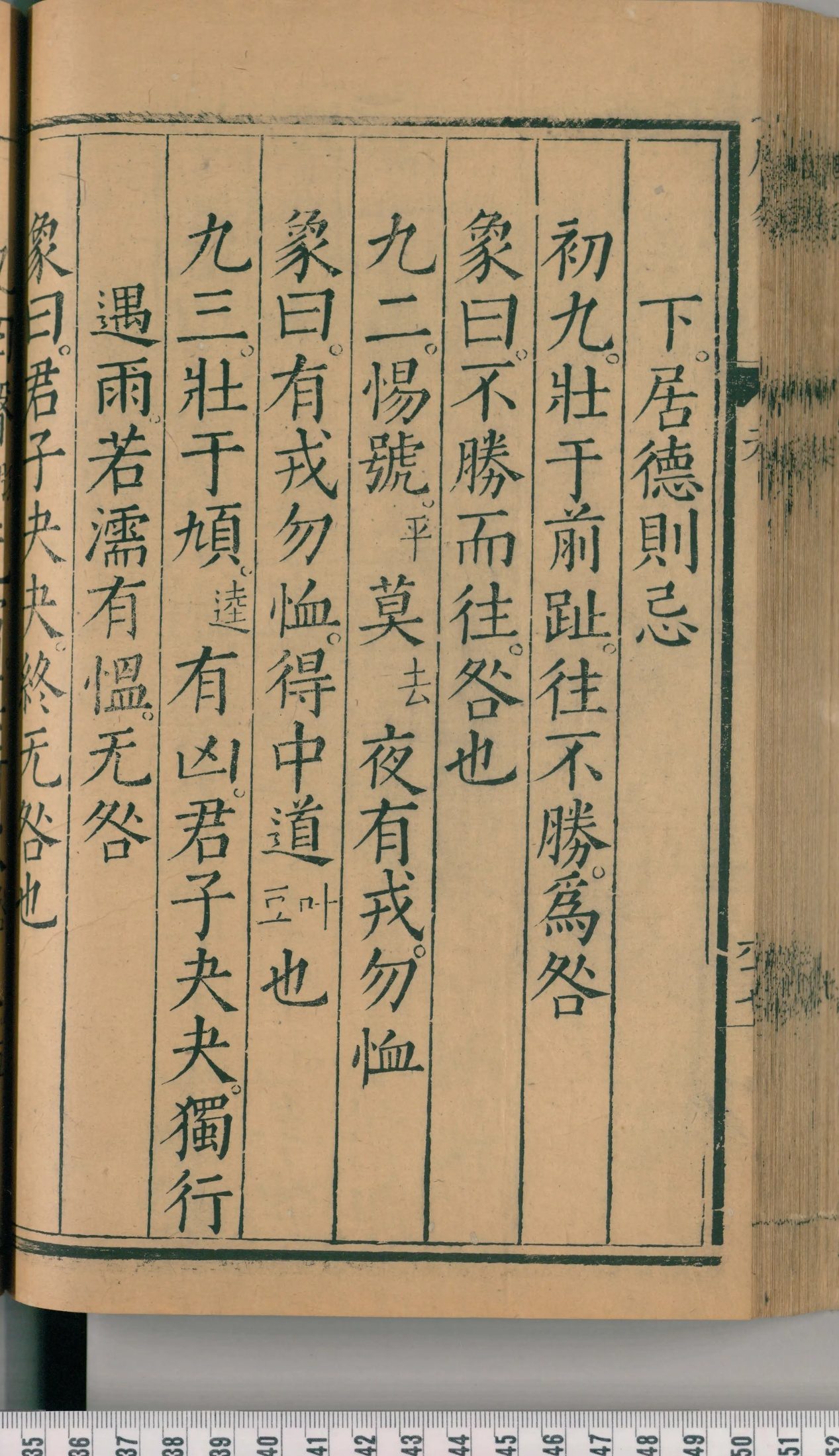
National Diet Library WA35-19 [五經白文], vol. 1 (周易), IIIF canvas 75, right-hand page: 8 columns, main text with punctuation circles and small sound glosses. Checked on the image: line statement 1 opens column 2 ‹初九壯于›; line statement 2 opens column 4 ‹九二惕號›; line statement 3 opens column 6 ‹九三壯于›. Between the statements the print gives the commentaries of the Ten Wings (彖曰, 象曰), which are not part of this section. The Chinese shown is the received text from Wikisource, not a transcription of this print.
1初九:壯于前趾,往不勝為咎。
2九二:惕號,莫夜有戎,勿恤。
3九三:壯于頄,有凶。君子夬夬,獨行遇雨,若濡有慍,无咎。
1The first line, undivided, shows its subject in (the pride of) strength advancing with his toes. He goes forward, but will not succeed. There will be ground for blame.
2The second line, undivided, shows its subject full of apprehension and appealing (for sympathy and help). Late at night hostile measures may be (taken against him), but he need not be anxious about them.
3The third line, undivided, shows its subject (about to advance) with strong (and determined) looks. There will be evil. (But) the superior man, bent on cutting off (the criminal), will walk alone and encounter the rain, (till he be hated by his proper associates) as if he were contaminated (by the others). (In the end) there will be no blame against him.
Where on the image
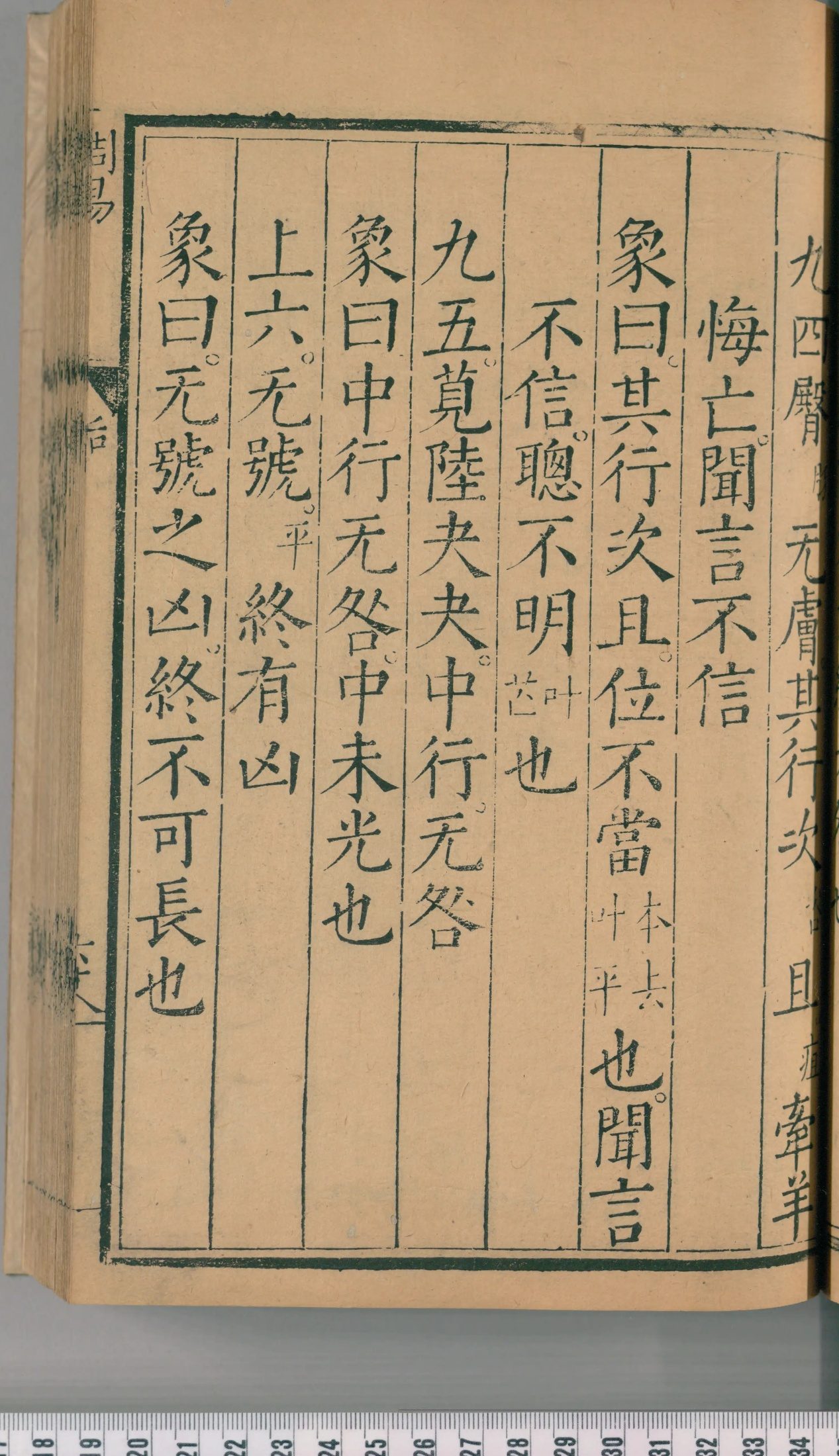
National Diet Library WA35-19 [五經白文], vol. 1 (周易), IIIF canvas 75, left-hand page: 8 columns, main text with punctuation circles and small sound glosses. Checked on the image: line statement 4 opens column 1 ‹九四臀无›; line statement 5 opens column 5 ‹九五莧陸›; line statement 6 opens column 7 ‹上六无號›. Between the statements the print gives the commentaries of the Ten Wings (彖曰, 象曰), which are not part of this section. The Chinese shown is the received text from Wikisource, not a transcription of this print.
4九四:臀无膚,其行次且。牽羊悔亡,聞言不信。
5九五:莧陸夬夬,中行无咎。
6上六:无號,終有凶。
4The fourth line, undivided, shows one from whose buttocks the skin has been stripped, and who walks slowly and with difficulty. (If he could act) like a sheep led (after its companions), occasion for repentance would disappear. But though he hear these words, he will not believe them.
5The fifth line, undivided, shows (the small men like) a bed of purslain, which ought to be uprooted with the utmost determination. (The subject of the line having such determination), his action, in harmony with his central position, will lead to no error or blame.
6The sixth line, divided, shows its subject without any (helpers) on whom to call. His end will be evil.
Notes
- English: James Legge, The Yî King, Sacred Books of the East vol. 16 (1882), The Text, hexagram 43 (Kwâi). The hexagram statement is unnumbered; the line statements are numbered from the bottom line up, as in Legge.
- Legge's footnotes and his notes under each hexagram are left out.
Cite
Sources
- Source: National Diet Library WA35-19 (Ming Five Classics print with postface of 1596, vol. 1, Zhouyi) + Wikisource received text + James Legge, Sacred Books of the East 16 (1882) (holding institution)
- Critical edition: Received text (Wikisource)
← previous · → next · v cycle view · l back to library