Classic of Changes, Great Treatise, Part 2, Chapter 12 (Ming print of 1596)
Introduction
The Great Treatise (繫辭傳 Xici zhuan, "Commentary on the Appended Statements"; Legge's "Great Appendix") is the longest of the Ten Wings, the commentaries attached to the Classic of Changes. It is an essay in two parts on how the hexagrams were made, how the yarrow stalks are counted, and how the book reflects the workings of heaven and earth. Tradition ascribed it to Confucius; it is now generally dated to the late Warring States period (4th to 3rd century BCE), and part of it is preserved on the Mawangdui silk manuscript of 168 BCE. This is chapter 12 of part 2 (下), in the chapter division of Zhu Xi (1130-1200), which Legge follows; Legge numbers his paragraphs straight through each part (here 66-72).
The photographs are of the first volume of a Five Classics printed in Nanjing with the main text only and punctuation circles, with a postface by Li Deng dated Wanli 24 (1596); the National Diet Library, Tokyo, holds the only known copy of these five volumes (call no. WA35-19). The Great Treatise follows the 64 hexagrams in this volume, from canvas 106 to canvas 128, and its passages stand in the order of Zhu Xi's edition. In this copy the chapter runs from canvas 127, left-hand page to canvas 128, left-hand page. Each section gathers the paragraphs that begin on one page and links to that page and to any page the last paragraph runs onto; the page boundaries were found by reading the first characters of every column on the photographs and aligning them to the text.
The Chinese is the received text from Wikisource. The English is James Legge's translation in Sacred Books of the East, volume 16 (1882), Appendix III, Section II, Chapter 12; his notes are not reproduced. Legge adds words in parentheses to make the sense plain; they are his.
How was this verified? (Provenance)
Where on the image
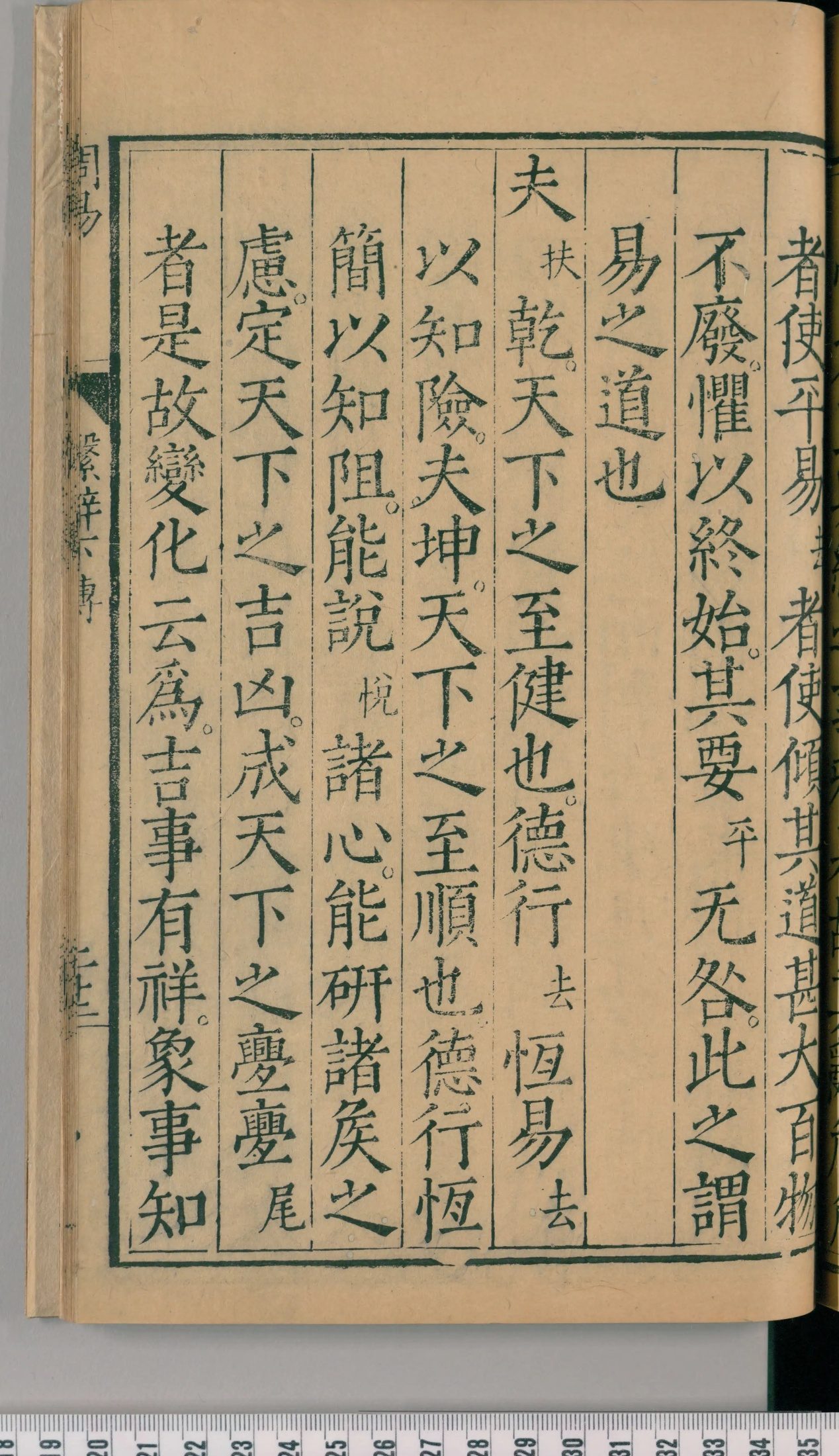
National Diet Library WA35-19 [五經白文], vol. 1 (周易), IIIF canvas 127, left-hand page: 8 columns, main text with punctuation circles and small sound glosses. Checked on the image (column openings aligned to the text): paragraph 66 opens column 4 ‹夫乾天下›; paragraph 67 begins within column 6, which opens ‹簡以知阻›; paragraph 68 begins within column 8, which opens ‹者是故變›. Paragraph 68 runs on to canvas 128, right-hand page (first column ‹器占事知›). The Chinese shown is the received text from Wikisource, not a transcription of this print.
66夫乾,天下之至健也;德行恒易以知險。夫坤,天下之至順也;德行恒簡以知阻。
67能說諸心,能研諸侯之慮,定天下之吉凶,成天下之亹亹者。
68是故變化云為,吉事有祥,象事知器,占事知來。
66(The hexagram) Khien represents the strongest of all under the sky. Through this quality its operations are always manifested with ease, for it knows where there would be peril and embarrassment. (The hexagram) Khwăn represents the most docile of all under the sky. Through this quality its operations are always manifested with the promptest decision, for it knows where there would be obstruction.
67(The sages, who are thus represented, and who made the Yî,) were able to rejoice in heart (in the absolute truth of things), and were able (also) to weigh carefully all matters that could occasion anxiety; (thus) they fixed the good and bad fortune (of all things) under the sky, and could accomplish the things requiring strenuous efforts.
68Therefore amid the changes and transformations (taking place in heaven and earth), and the words and deeds of men, events that are to be fortunate have their happy omens. (The sages) knew the definite principles underlying the prognostications of the former class, and the future of those of the latter, (now to be) ascertained by divination.
Where on the image
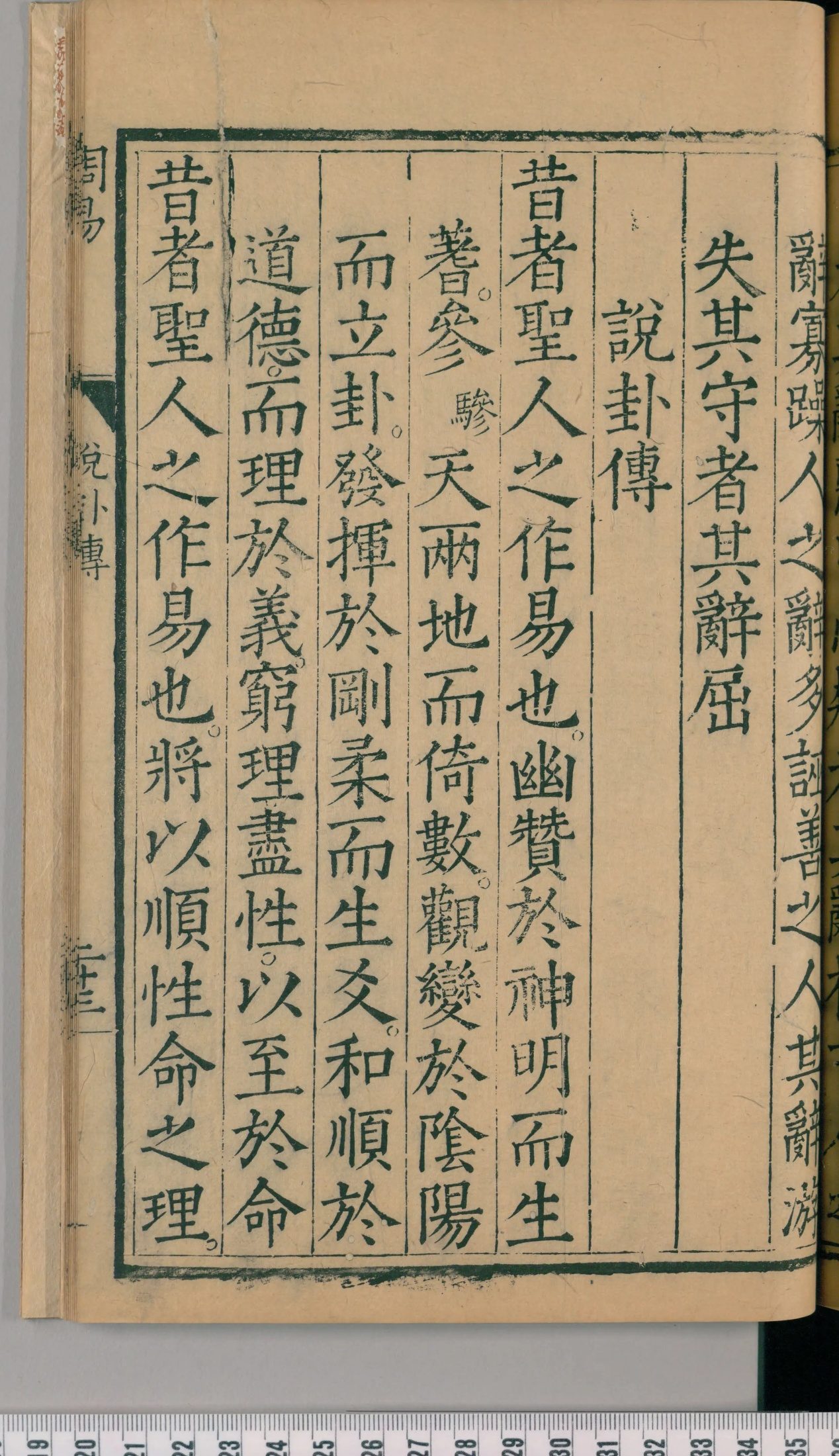
National Diet Library WA35-19 [五經白文], vol. 1 (周易), IIIF canvas 128, right-hand page: 8 columns, main text with punctuation circles and small sound glosses. Checked on the image (column openings aligned to the text): paragraph 69 begins within column 1, which opens ‹器占事知›; paragraph 70 begins within column 2, which opens ‹謀鬼謀百›; paragraph 71 opens column 4 ‹變動以利›; paragraph 72 begins within column 7, which opens ‹而不相得›. Paragraph 72 runs on to canvas 128, left-hand page (first column ‹辭寡躁人›). The Chinese shown is the received text from Wikisource, not a transcription of this print.
69天地設位,聖人成能;人謀鬼謀,百姓與能。
70八卦以象告,爻彖以情言,剛柔雜居,而吉凶可見矣。
71變動以利言,吉凶以情遷。是故愛惡相攻而吉凶生,遠近相取而悔吝生,情偽相感而利害生。凡易之情,近而不相得,則凶或害之,悔且吝。
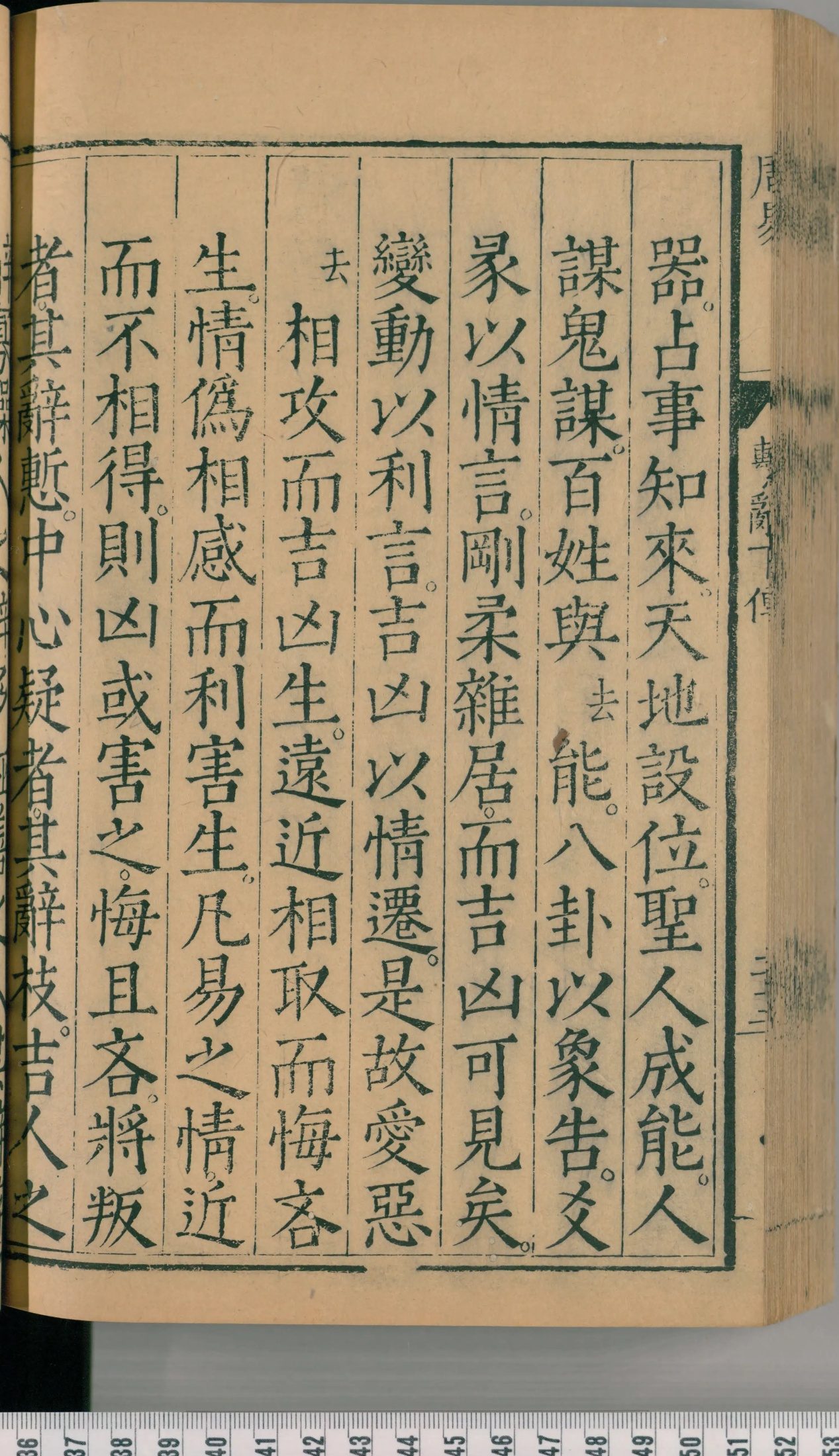
72將叛者其辭慚,中心疑者其辭枝;吉人之辭寡,躁人之辭多;誣善之人其辭游,失其守者其辭屈。
69The places of heaven and earth (in the diagrams) having been determined, the sages were able (by means of the Yî) to carry out and complete their ability. (In this way even) the common people were able to share with them in (deciding about) the counsels of men and the counsels of spiritual beings.
70The eight trigrams communicate their information by their emblematic figures. The explanations appended to the lines and the completed figures tell how the contemplation of them affected (the makers). The strong and the weak lines appear mixed in them, and (thus) the good and the evil (which they indicate) can be seen.
71The changes and movements (which take place in the manipulation of the stalks and the formation of the diagrams) speak as from the standpoint of what is advantageous. The (intimations of) good and evil vary according to the place and nature (of the lines). Thus they may indicate a mutual influence (in any two of them) of love or hatred, and good or evil is the result; or that mutual influence may be affected by the nearness of the lines to, or their distance from, each other, and then repentance or regret is the result; or the influence may be that of truth or of hypocrisy, and then the result is what is advantageous, or what is injurious. In all these relations of the (lines in the) Yî, if two are near and do not blend harmoniously, there may be (all these results),—evil, or what is injurious, or occasion for repentance and regret.
72The language of him who is meditating a revolt (from the right) betrays his inward shame; that of him whose inward heart doubts about it diverges to other topics. The words of a good man are few; those of a coarse man are many. The words of one who slanders what is good are unsubstantial; those of him who is losing what he ought to keep are crooked.
Notes
- English: James Legge, The Yî King, Sacred Books of the East vol. 16 (1882), Appendix III (The Great Appendix), Section II, Chapter 12, paragraphs 66-72.
- Legge's notes after each chapter are left out. Where one numbered paragraph is printed as several paragraphs, they are kept as printed.
Cite
Sources
- Source: National Diet Library WA35-19 (Ming Five Classics print with postface of 1596, vol. 1, Zhouyi) + Wikisource received text + James Legge, Sacred Books of the East 16 (1882), Appendix III (holding institution)
- Critical edition: Received text (Wikisource)
← previous · → next · v cycle view · l back to library