1 Enoch 1-32 in Greek (Akhmim codex, pages 21-66)
Introduction
The Book of the Watchers (1 Enoch 1-36) tells how the angels called Watchers came down to the daughters of men, taught forbidden arts and fathered the giants, and how Enoch, taken up before God, carried the sentence against them and was shown the places of the earth, of punishment and of paradise. It was written in Aramaic in the 3rd century BC; the whole of 1 Enoch survives only in Ethiopic (shown in this library under 1 Enoch, Ethiopic). The Akhmim codex preserves the Greek translation of chapters 1-32, the longest Greek witness.
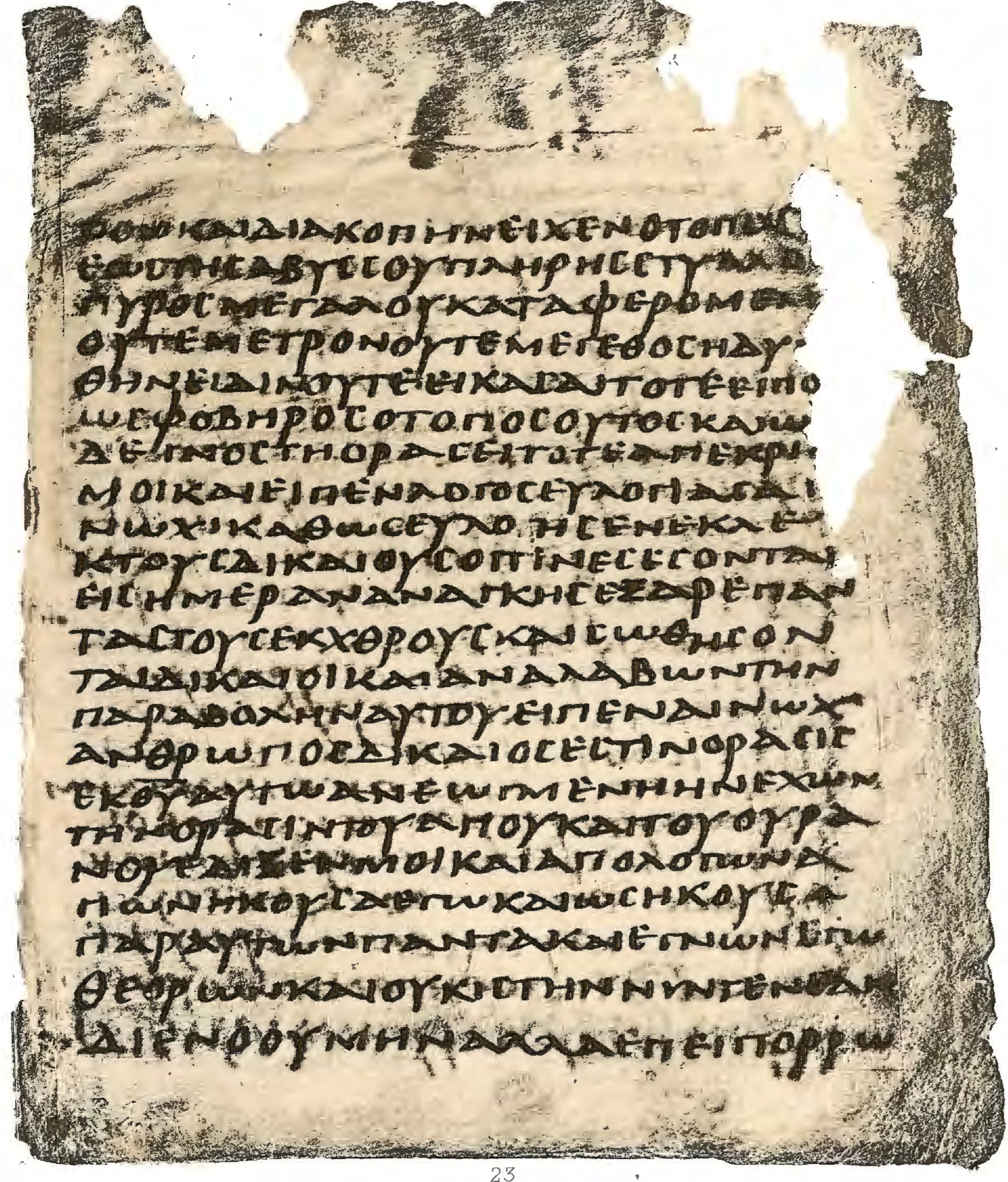
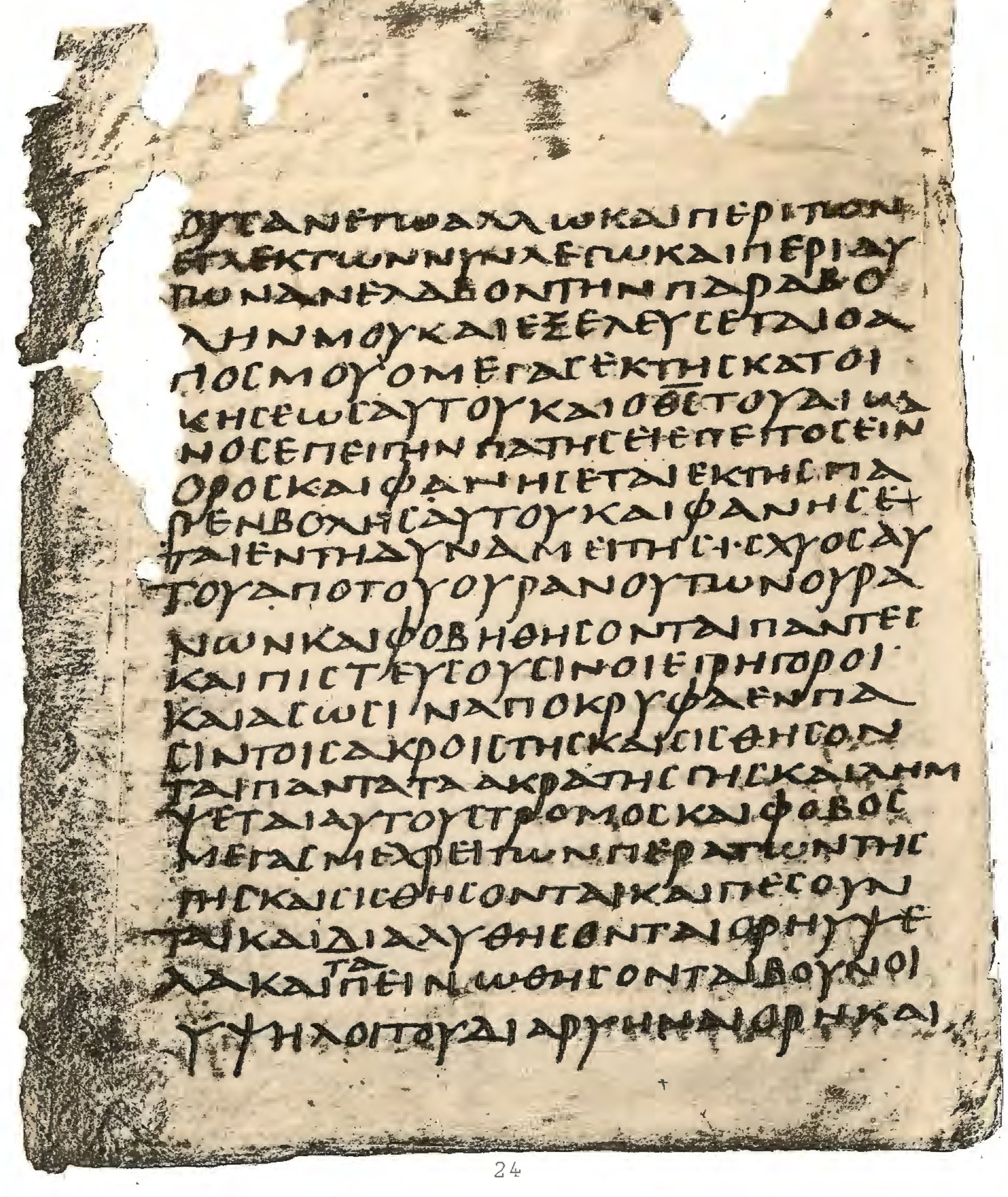
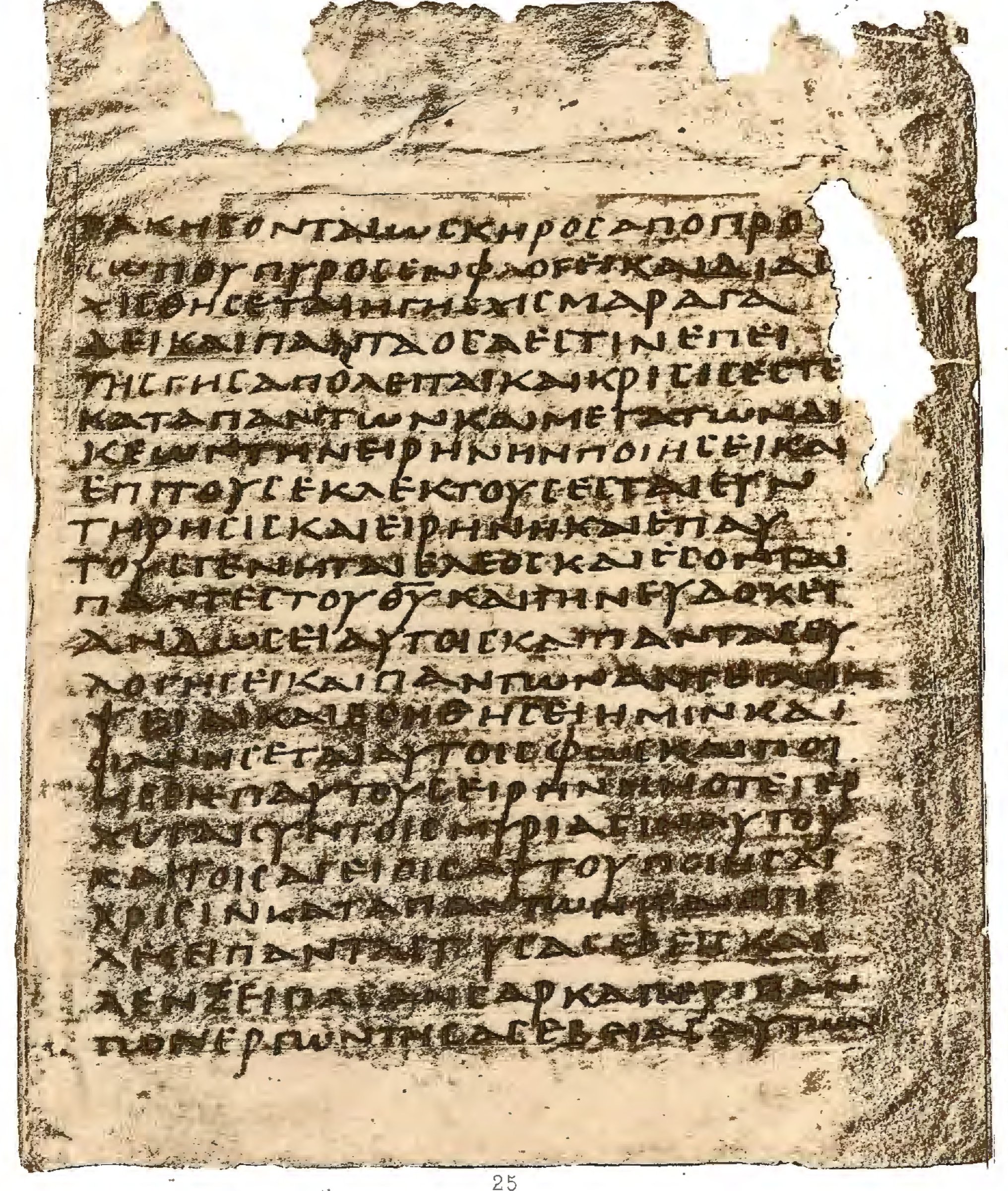
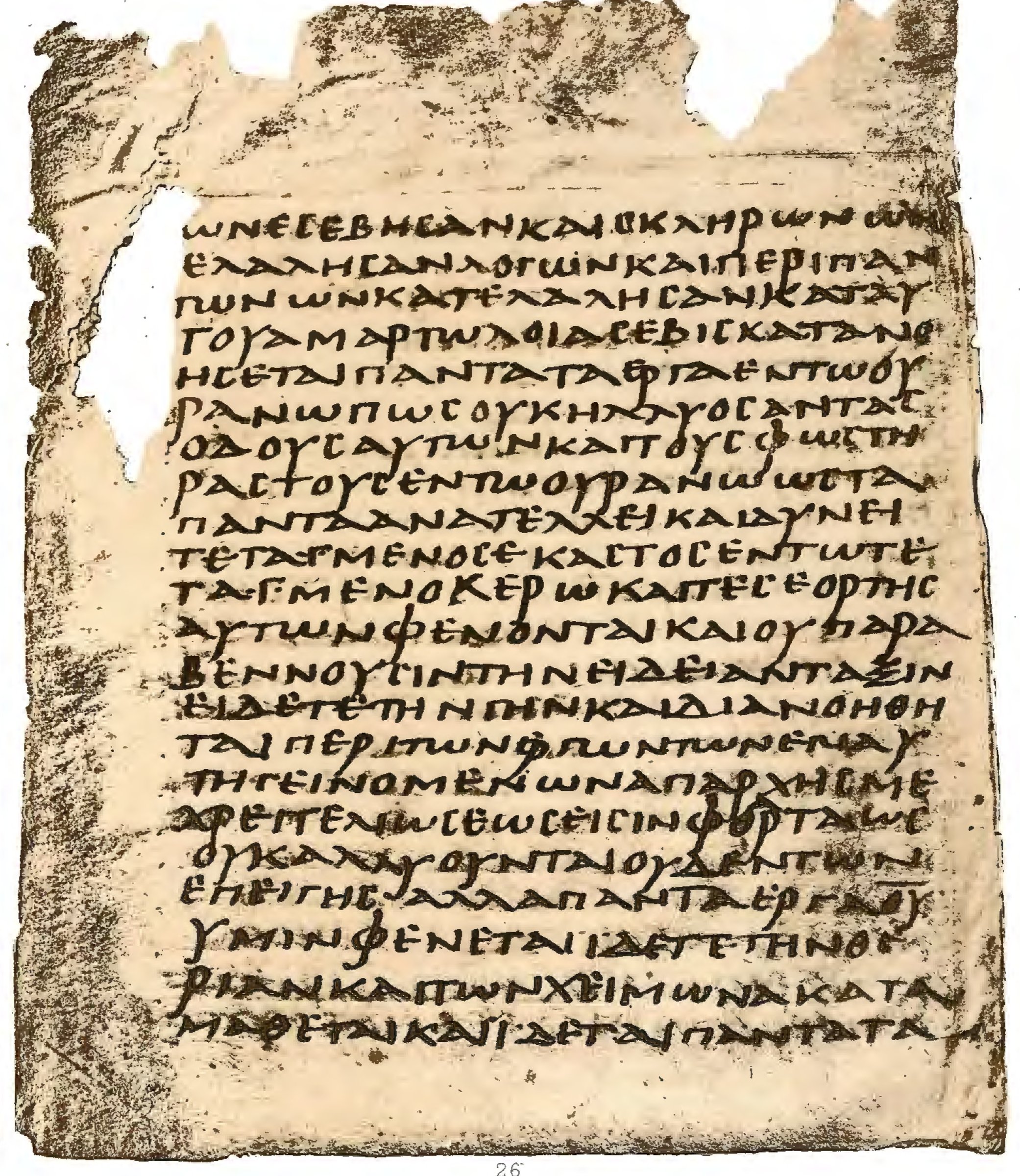
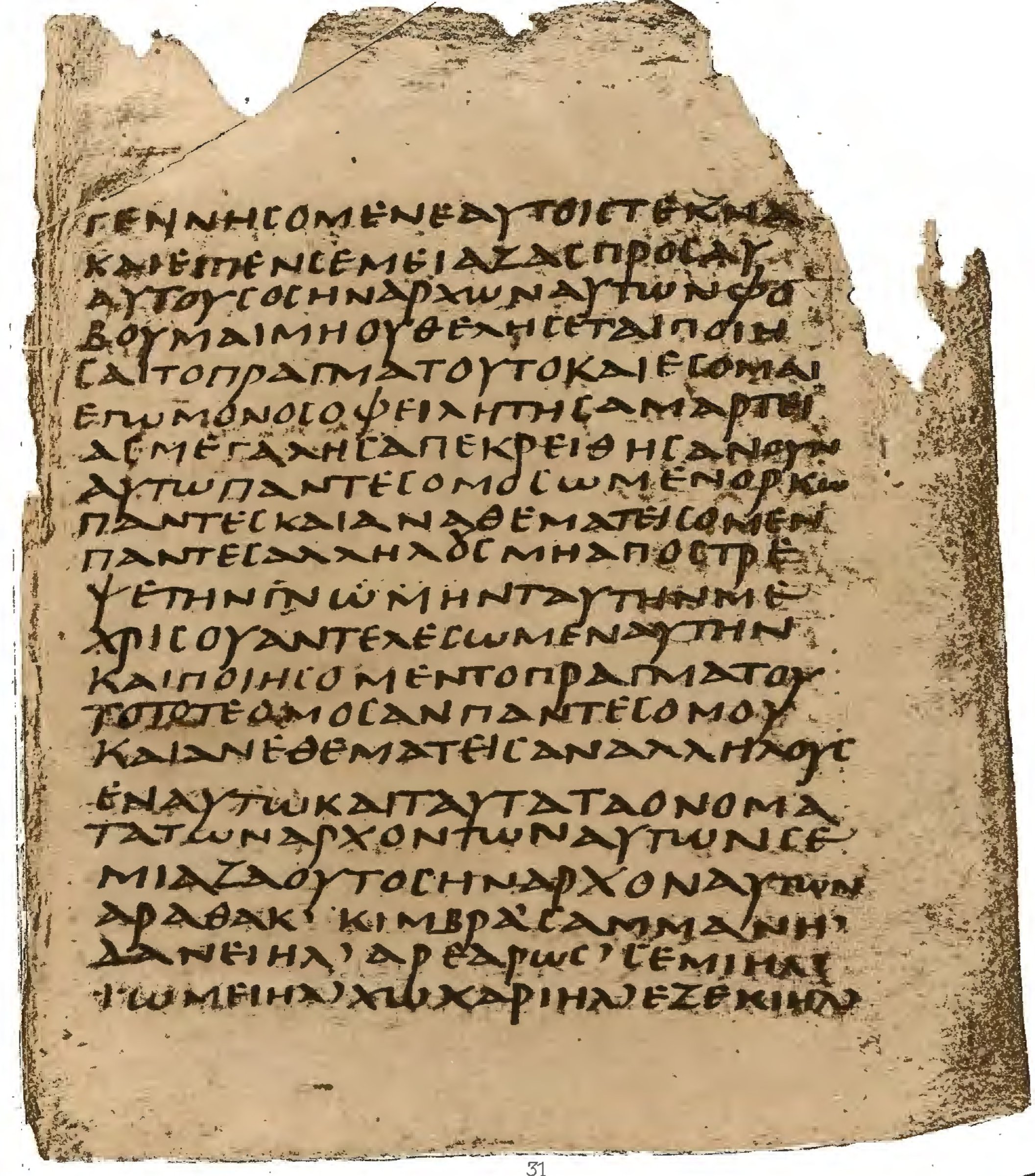
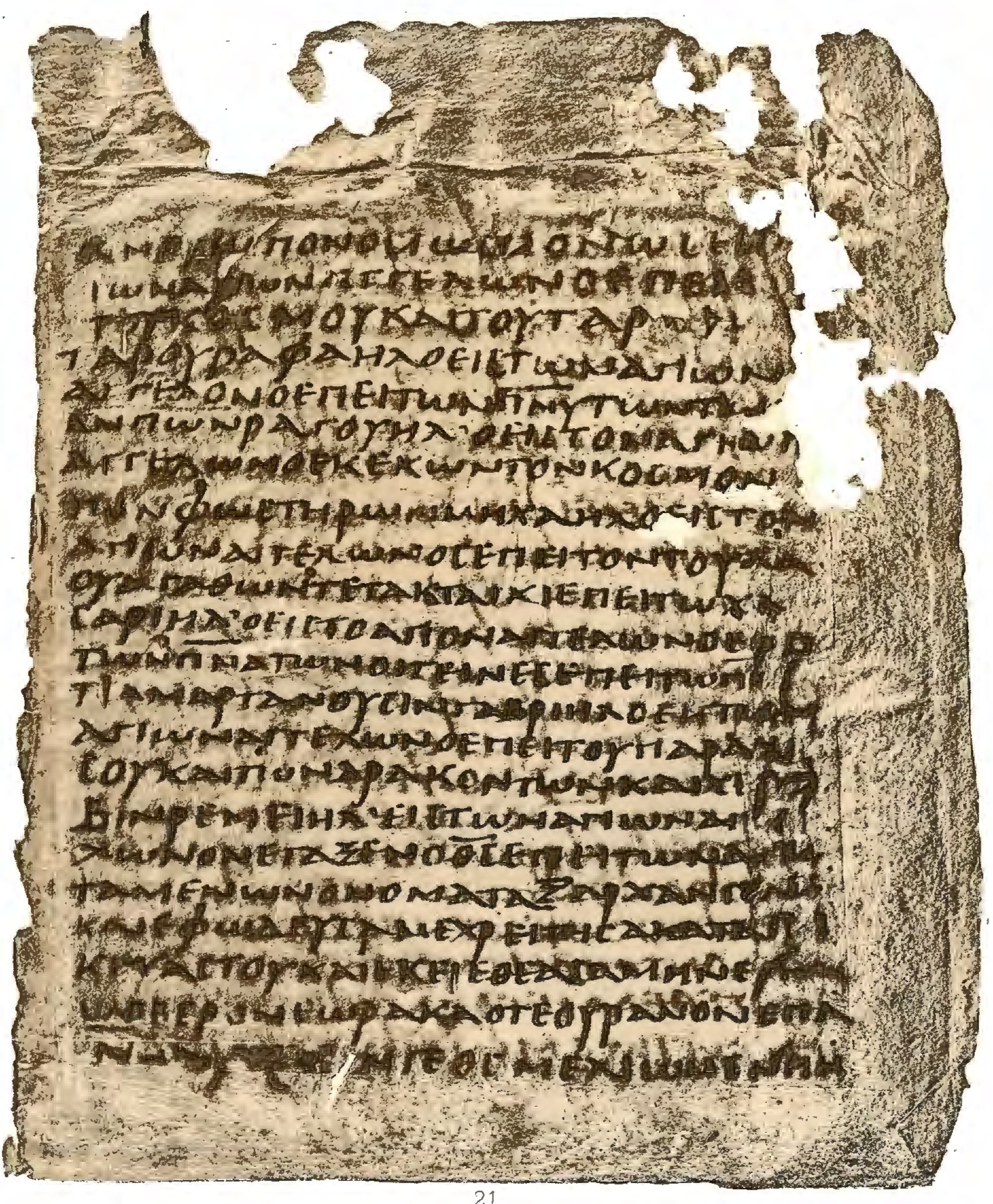
The manuscript. In the Akhmim codex (Cairo, Egyptian Museum, P. Cair. 10759) the Enoch text fills pages 21-66 after the Apocalypse of Peter, in two hands: a larger sloping uncial on pages 21-50 and a smaller, closer one on pages 51-66. The first scribe began on page 21 with a passage from the middle of the book (19.3-21.9) and then started the book itself on page 23, line 8; the passage was copied again in its place on pages 57-59. Chapter 4 and the opening of 5.1 are missing: the copyist went straight on from 3.1 to 5.1. The pages are shown from A. Lods's heliogravure plates of 1893.
Texts and mapping. The Greek is H. B. Swete's edited text of the Akhmim manuscript (1905), from the First1KGreek digital edition, proofread here against Swete's printed pages (137 digitisation errors corrected). It is an edited text, not a line-by-line transcription. Each section is one chapter. The page or pages carrying each chapter were found by reading the first words of every page on the plates and by Lods's list of page, line, chapter and verse (1893). The English is R. H. Charles's translation (1917), made from the Ethiopic with the Greek compared (and, for some verses of chapters 22, 27 and 32, his separate translation of the Greek), so it does not always match the Greek word for word. The manuscript stops in the middle of 32.6; the English of that verse goes on to its end with Charles's translation of the Ethiopic, which is not on the page.
How was this verified? (Provenance)
Where on the image
Akhmim codex pages 23, 24, 25, 26 (Lods's page numbers, printed under each plate page). Checked on the plates: p. 23 begins ‹line 8: [θη] μοι και ειπεν λογος ευλογιας ε- (1.1 begins at λογος, after the end of the second copy of 21.7-21.9 in lines 1-8); line 9: νωχ καθως ευλογησεν εκλε-›; p. 24 begins ‹ουσαν εγω λαλω και περι των εκλεκτων νυν λεγω›; p. 25 begins ‹[τ]ακησονται ως κηρος απο προσωπου πυρος›; p. 26 begins ‹ων ησεβησαν και σκληρων ων ελαλησαν λογων›. Chapter 1 runs from verse 1 to 9 in Swete's numbering; page spans follow the first words of each page, read on the plates, and Lods's page/line/chapter/verse list (1893, pp. 230-232). The English is Charles's translation of the Ethiopic version; words he marks ⌜ ⌝ are in the Greek but not the Ethiopic, words in 〚 〛 are in the Ethiopic but not the Greek.
1ΛΟΓΟΣ εὐλογίας Ἑνώχ, καθὼς εὐλόγησεν ἐκλεκτοὺς δικαίους οἵτινες ἔσονται εἰς ἡμέραν ἀνάγκης ἐξᾶραι πάντας τοὺς ἐχθρούς, καὶ σωθήσονται δίκαιοι. 2Καὶ ἀναλαβὼν τὴν παραβολὴν αὐτοῦ εἶπεν Ἑνώχ Ἄνθρωπος δίκαιός ἐστιν, ὅρασις ἐκ θεοῦ αὐτῷ ἀνεῳγμένη ἦν· ἔχων τὴν ὅρασιν τοῦ ἁγίου καὶ τοῦ οὐρανοῦ. ἔδειξέν μοι, καὶ ἁγιολόγων ἁγίων ἤκουσα ἐγώ, καὶ ὡς ἤκουσα παρʼ αὐτῶν πάντα καὶ ἔγνων ἐγὼ θεωρῶν· καὶ οὐκ ἐς τὴν νῦν γενεὰν διενοούμην, ἀλλὰ ἐπὶ πόρρω οὖσαν ἐγὼ λαλῶ. 3Καὶ περὶ τῶν ἐκλεκτῶν νῦν λέγω καὶ περὶ αὐτῶν ἀνέλαβον τὴν παραβολήν μου. καὶ ἐξελεύσεται ὁ ἅγιός μου ὁ μέγας ἐκ τῆς κατοικήσεως αὐτοῦ, 4καὶ ὁ θεὸς τοῦ αἰῶνος ἐπὶ γῆν πατήσει ἐπὶ τὸ Σεινὰ ὄρος καὶ φανήσεται ἐκ τῆς παρενβολῆς αὐτοῦ, καὶ φανήσεται ἐν τῇ δυνάμει τῆς ἰσχύος αὐτοῦ ἀπὸ τοῦ οὐρανοῦ τῶν οὐρανῶν. 5καὶ φοβηθήσονται πάντες καὶ πιστεύσουσιν οἱ ἐγρήγοροι, καὶ ᾄσουσιν ἀπόκρυφα ἐν πᾶσιν τοῖς ἄκροις τῆς [γῆς]· καὶ σεισθήσονται πάντα τὰ ἄκρα τῆς γῆς, καὶ λήμψεται αὐτοὺς τρόμος καὶ φόβος μέγας μέχρι τῶν περάτων τῆς γῆς. 6καὶ σεισθήσονται καὶ πεσοῦνται καὶ διαλυθήσονται ὄρη ὑψηλά, καὶ ταπεινωθήσονται βουνοὶ ὑψηλοὶ τοῦ διαρυῆναι ὄρη, καὶ τακήσονται ὡς κηρὸς ἀπὸ προσώπου πυρὸς ἐν φλογί. 7καὶ διασχισθήσεται ἡ γῆ σχίσμα ῥαγῶδες, καὶ πάντα ὅσα ἐστὶν ἐπὶ τῆς γῆς ἀπολεῖται, καὶ κρίσις ἔσται κατὰ πάντων. 8καὶ μετὰ τῶν δικαίων τὴν εἰρήνην ποιήσει, καὶ ἐπὶ τοὺς ἐκλεκτοὺς ἔσται συντήρησις καὶ εἰρήνη, καὶ ἐπ αὐτοὺς γενήσεται ἔλεος, καὶ ἔσονται πάντες τοῦ θεοῦ, καὶ τὴν εὐδοκίαν δώσει αὐτοῖς καὶ πάντας εὐλογήσει καὶ πάντων ἀντιλήμψεται καὶ βοηθήσει ἡμῖν, καὶ φανήσεται αὐτοῖς φῶς καὶ ποιήσει ἐπʼ αὐτοὺς εἰρήνην. 9ὅτι ἔρχεται σὺν ταῖς μυριάσιν αὐτοῦ καὶ τοῖς ἁγίοις αὐτοῦ, ποιῆσαι κρίσιν κατὰ πάντων, καὶ ἀπολέσει πάντας τοὺς ἀσεβεῖς, καὶ ἐλέγξει πᾶσαν σάρκα περὶ πάντων ἔργων τῆς ἀσεβείας αὐτῶν ὧν ἠσέβησαν καὶ σκληρῶν ὧν ἐλάλησαν λόγων, καὶ περὶ πάντων ὧν κατελάλησαν κατʼ αὐτοῦ ἁμαρτωλοὶ ἀσεβεῖς.
1 The words of the blessing of Enoch, wherewith he blessed the elect 〚and〛 righteous, who will be living in the day of tribulation, when all the wicked 〚and godless〛 are to be removed. 2 And he took up his parable and said—Enoch a righteous man, whose eyes were opened by God, saw the vision of the Holy One in the heavens, 〚which〛 the angels showed me, and from them I heard everything, and from them I understood as I saw, but not for this generation, but for a remote one which is for to come. 3 Concerning the elect I said, and took up my parable concerning them:
The Holy Great One will come forth from His dwelling,
4 And the eternal God will tread upon the earth, (even) on Mount Sinai,
[And appear from His camp]
And appear in the strength of His might from the heaven ⌜of heavens⌝.
5 And all shall be smitten with fear,
And the Watchers shall quake,
And great fear and trembling shall seize them unto the ends of the earth.
6 And the high mountains shall be shaken,
And the high hills shall be made low,
And shall melt like wax before the flame
7 And the earth shall be ⌜wholly⌝ rent in sunder,
And all that is upon the earth shall perish,
And there shall be a judgement upon all (men).
8 But with the righteous He will make peace,
And will protect the elect,
And mercy shall be upon them.
And they shall all belong to God,
And they shall be prospered,
And they shall ⌜all⌝ be blessed.
⌜And He will help them all⌝,
And light shall appear unto them,
⌜And He will make peace with them⌝.
9 And behold! He cometh with ten thousands of ⌜His⌝ holy ones
To execute judgement upon all,
And to destroy ⌜all⌝ the ungodly:
And to convict all flesh
Of all the works ⌜of their ungodliness⌝ which they have ungodly committed,
⌜And of all the hard things which⌝ ungodly sinners ⌜have spoken⌝ against Him.
Where on the image
Akhmim codex page 26 (Lods's page numbers, printed under each plate page). Checked on the plates: p. 26 begins ‹ων ησεβησαν και σκληρων ων ελαλησαν λογων›. Chapter 2 runs from verse 1 to 3 in Swete's numbering; page spans follow the first words of each page, read on the plates, and Lods's page/line/chapter/verse list (1893, pp. 230-232). The English is Charles's translation of the Ethiopic version; words he marks ⌜ ⌝ are in the Greek but not the Ethiopic, words in 〚 〛 are in the Ethiopic but not the Greek.
1Κατανοήσατε πάντα τὰ ἔργα ἐν τῷ οὐρανῷ, πῶς οὐκ ἠλλοίωσαν τὰς ὁδοὺς αὐτῶν, καὶ τοὺς φωστῆρας τοὺς ἐν τῷ οὐρανῷ, ὡς τὰ πάντα ἀνατέλλει καὶ δύνει, τεταγμένος ἕκαστος ἐν τῷ τεταγμένῳ καιρῷ, καὶ ταῖς ἑορταῖς αὐτῶν φαίνονται, καὶ οὐ παραβαίνουσιν τὴν ἰδίαν τάξιν. 2ἴδετε τὴν γῆν καὶ διανοήθητε περὶ τῶν ἔργων τῶν ἐν αὐτῇ γινομένων ἀπʼ ἀρχῆς μέχρι τελειώσεως, ὥς εἰσιν φθαρτά, ὡς οὐκ ἀλλοιοῦνται, οὐδὲν τῶν ἐπὶ γῆς, ἀλλὰ πάντα ἔργα θεοῦ ὑμῖν φαίνεται. 3ἴδετε τὴν θερείαν καὶ τὸν χειμῶνα.
1 Observe ye every thing that takes place in the heaven, how they do not change their orbits, ⌜and⌝ the luminaries which are in the heaven, how they all rise and set in order each in its season, and transgress not against their appointed order. 2 Behold ye the earth, and give heed to the things which take place upon it from first to last, ⌜how steadfast they are⌝, how ⌜none of the things upon earth⌝ change, ⌜but⌝ all the works of God appear ⌜to you⌝. 3 Behold the summer and the winter, 〚how the whole earth is filled with water, and clouds and dew and rain lie upon it〛.
Where on the image
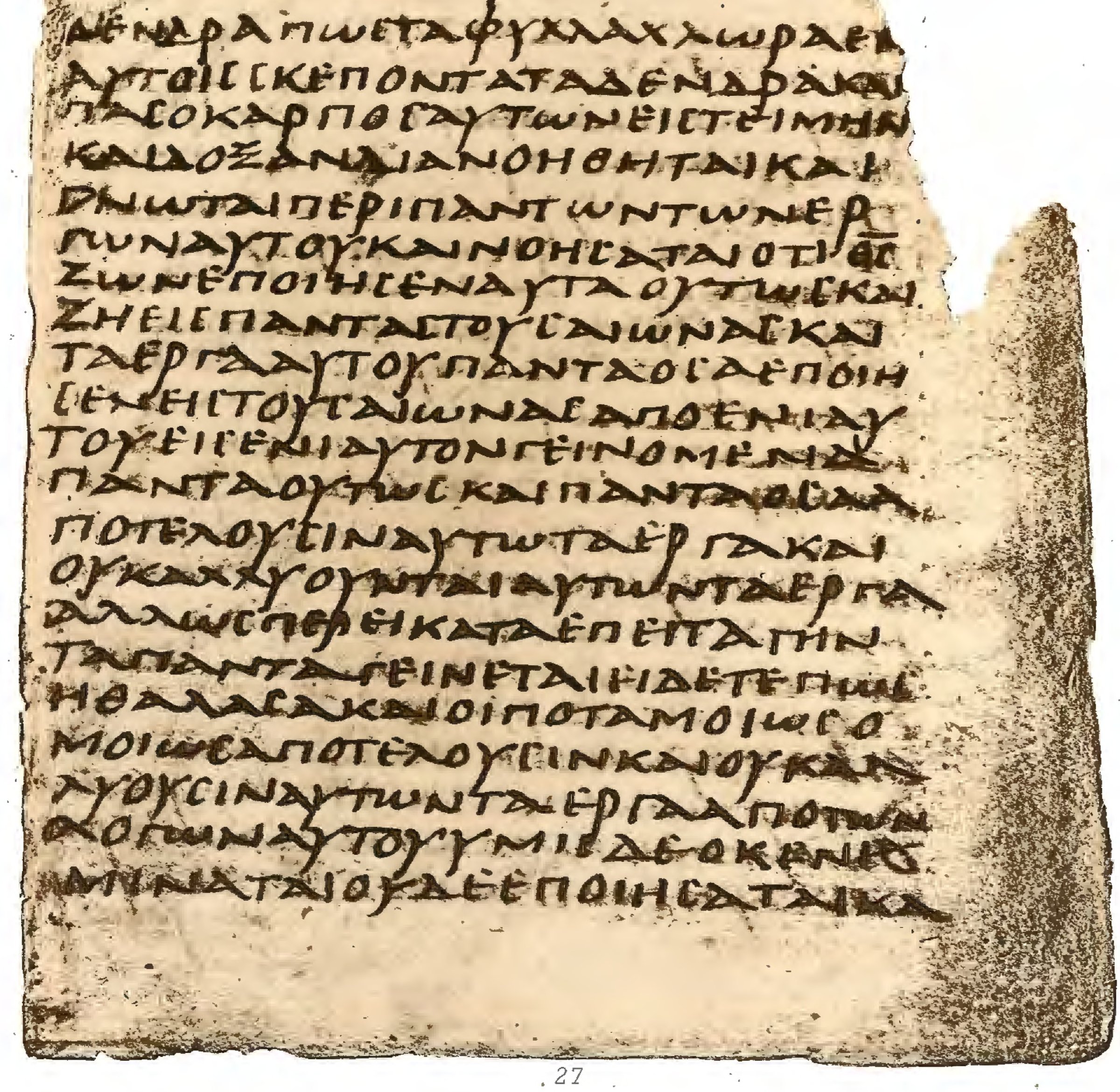
Akhmim codex pages 26, 27 (Lods's page numbers, printed under each plate page). Checked on the plates: p. 26 begins ‹ων ησεβησαν και σκληρων ων ελαλησαν λογων›; p. 27 begins ‹δενδρα πως τα φυλλα χλωρα εν αυτοις (the text runs from 3.1 straight into 5.1)›. Chapter 3 runs from verse 1 to 1 in Swete's numbering; page spans follow the first words of each page, read on the plates, and Lods's page/line/chapter/verse list (1893, pp. 230-232). The manuscript goes straight on from 3.1 to 5.1: chapter 4 and the opening of 5.1 in the Ethiopic are not in this Greek text. The English is Charles's translation of the Ethiopic version; words he marks ⌜ ⌝ are in the Greek but not the Ethiopic, words in 〚 〛 are in the Ethiopic but not the Greek.
1καταμάθετε καὶ ἴδετε πάντα τὰ δένδρα,
Observe and see how (in the winter) all the trees 〚seem〛 as though they had withered and shed all their leaves, except fourteen trees, which do not lose their foliage but retain the old foliage from two to three years till the new comes.
Where on the image
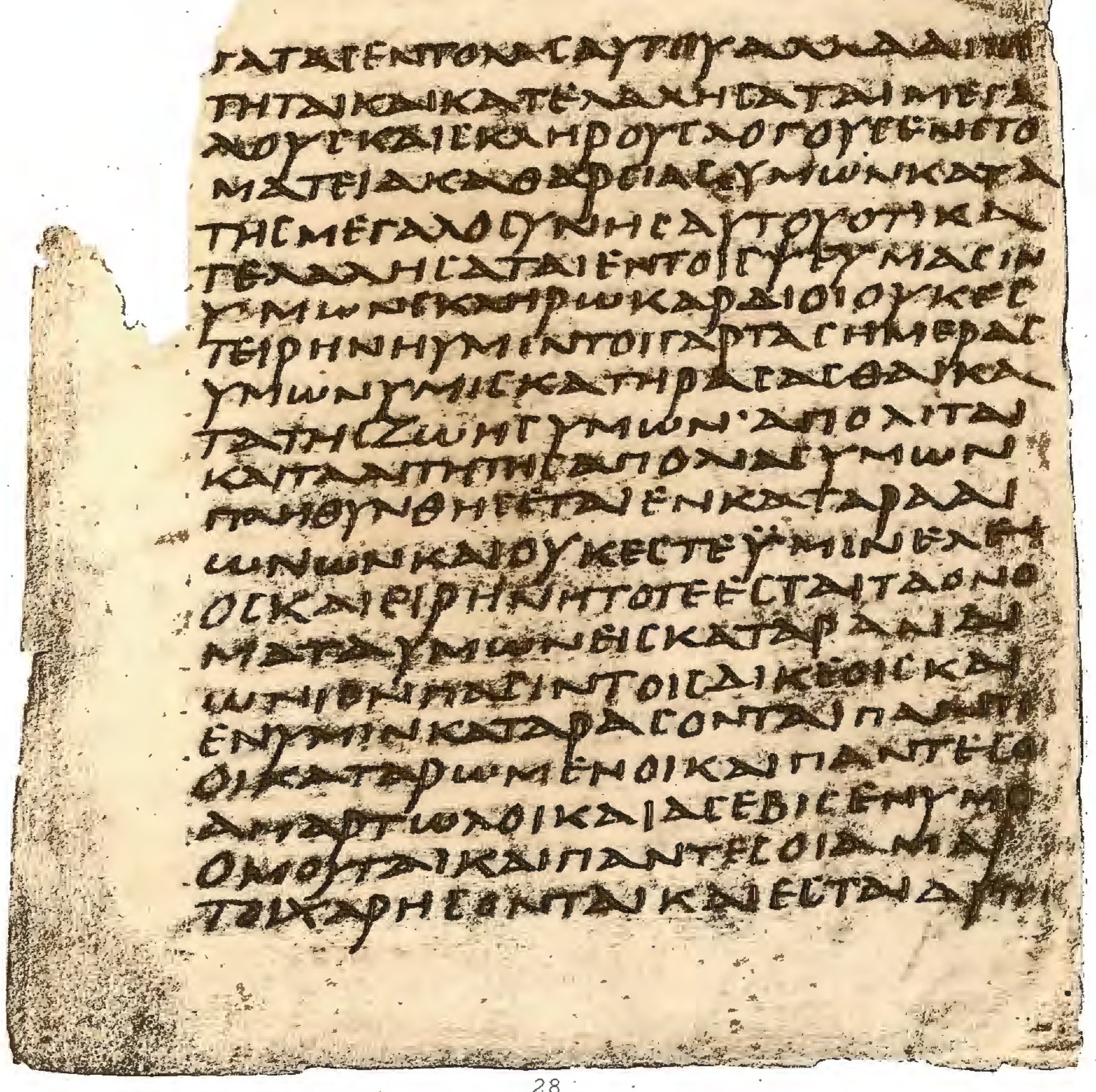
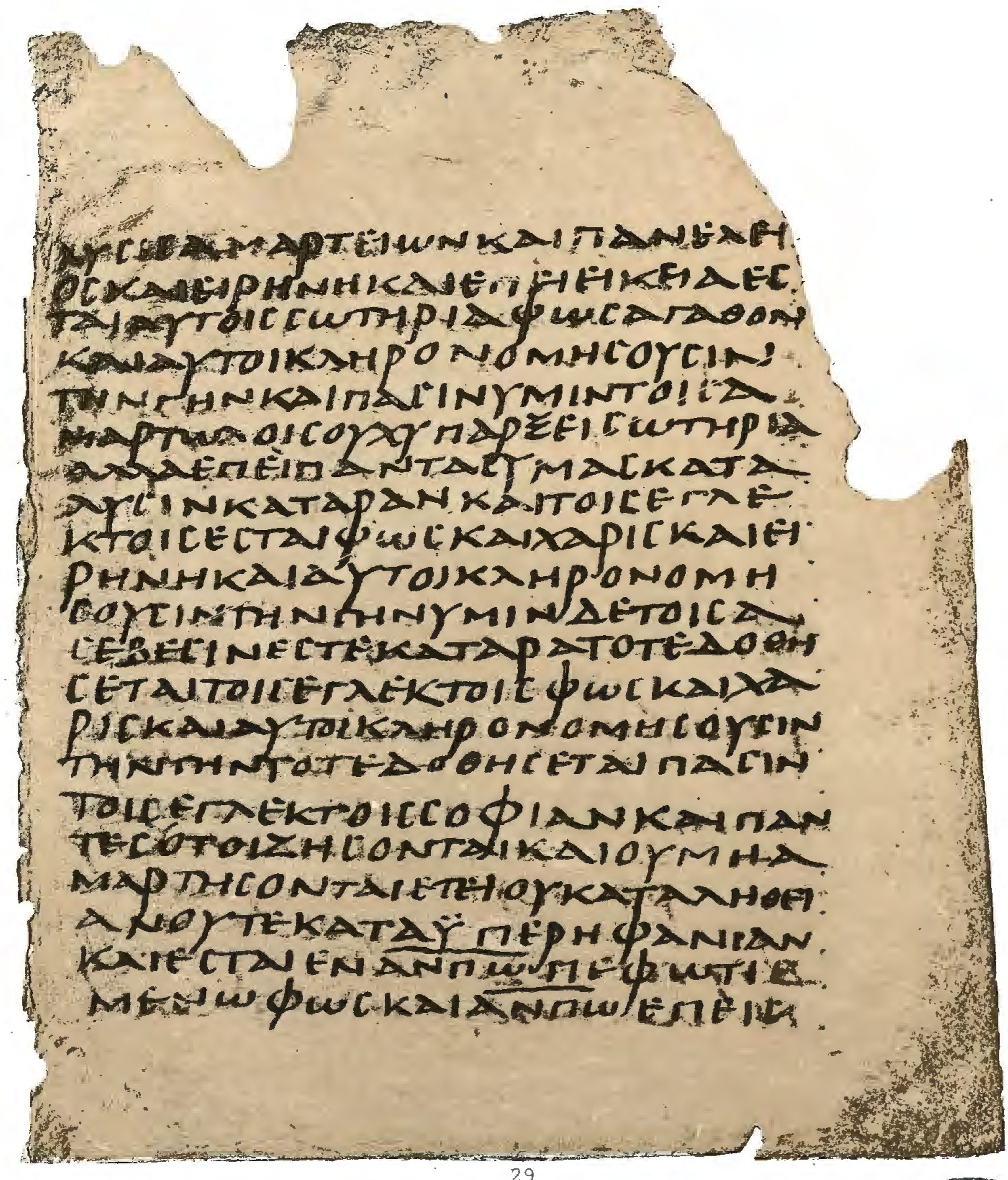
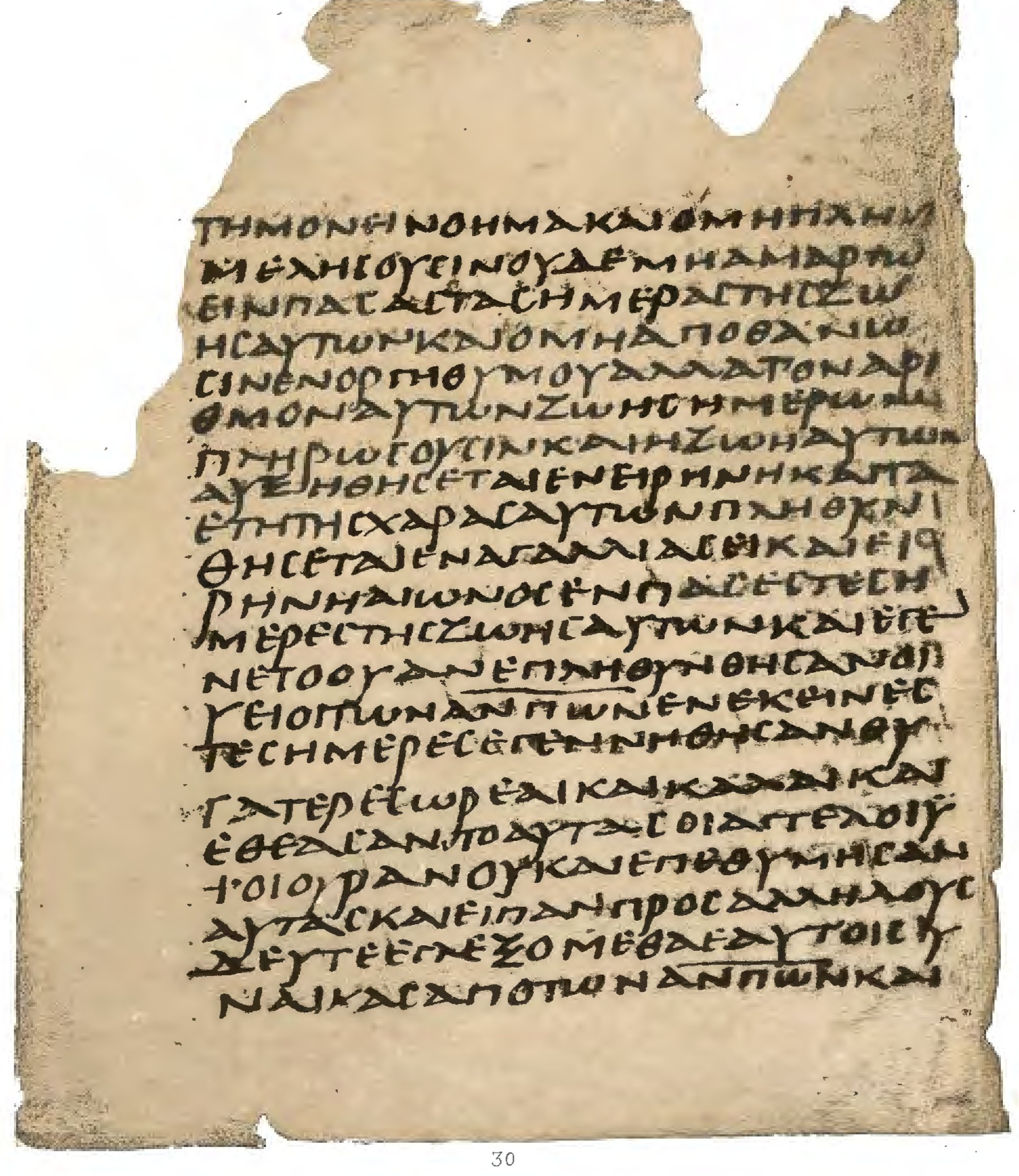
Akhmim codex pages 27, 28, 29, 30 (Lods's page numbers, printed under each plate page). Checked on the plates: p. 27 begins ‹δενδρα πως τα φυλλα χλωρα εν αυτοις (the text runs from 3.1 straight into 5.1)›; p. 28 begins ‹[στο]ματι ακαθαρσιας υμων κατα της μεγαλοσυνης›; p. 29 begins ‹αμαρτιων και παν ελεος και ειρηνη και επιεικεια›; p. 30 begins ‹(top damaged) ... ουδε μη πλημμελησουσιν ... μη αποθανωσιν›. Chapter 5 runs from verse 1 to 9 in Swete's numbering; page spans follow the first words of each page, read on the plates, and Lods's page/line/chapter/verse list (1893, pp. 230-232). The English is Charles's translation of the Ethiopic version; words he marks ⌜ ⌝ are in the Greek but not the Ethiopic, words in 〚 〛 are in the Ethiopic but not the Greek.
1πῶς τὰ φύλλα χλωρὰ ἐν αὐτοῖς σκέποντα τὰ δένδρα, καὶ πᾶς ὁ καρπὸς αὐτῶν εἰς τιμὴν καὶ δόξαν. διανοήθητε καὶ γνῶτε περὶ πάντων τῶν ἔργων αὐτοῦ, καὶ νοήσατε ὅτι θεὸς ζῶν ἐποίησεν αὐτὰ οὕτως, καὶ ζῇ εἰς πάντας τοὺς αἰῶνας· 2καὶ τὰ ἔργα αὐτοῦ πάντα ὅσα ἐποίησεν εἰς τοὺς αἰῶνας, ἀπὸ ἐνιαυτοῦ εἰς ἐνιαυτὸν γινόμενα πάντα οὕτως, καὶ πάντα ὅσα ἀποτελοῦσιν αὐτῷ τὰ ἔργα, καὶ οὐκ ἀλλοιοῦνται αὐτῶν τὰ ἔργα, ἀλλʼ ὡσπερεὶ κατὰ ἐπιταγὴν τὰ πάντα γίνεται. 3ἴδετε πῶς ἡ λασσα καὶ οἱ ποταμοὶ ὡς ὁμοίως ἀποτελοῦσιν, καὶ οὐκ ἀλλοιοῦσιν αὐτῶν τὰ ἔργα ἀπὸ τῶν λόγων αὐτοῦ. 4Ὑμεῖς δὲ οὐκ ἐνεμείνατε οὐδὲ ἐποιήσατε κατὰ τὰς ἐντολὰς αὐτοῦ, ἀλλὰ ἀπέστητε καὶ κατελαλήσατε μεγάλους καὶ σκληροὺς λόγους ἐν στόματι ἀκαθαρσίας ὑμῶν κατὰ τῆς μεγαλοσύνης αὐτοῦ. ὅτι κατελαλήσατε ἐν τοῖς ψεύμασιν ὑμῶν, σκληροκάρδιοι, οὐκ ἔστιν εἰρήνη ὑμῖν. 5τοιγὰρ τὰς ἡμέρας ὑμῶν ὑμεῖς κατηράσασθε, καὶ τὰ ἔτη τῆς ζωῆς ὑμῶν ἀπολεῖται, καὶ τὰ ἔτη τῆς ἀπωλείας ὑμῶν πληθυνθήσεται ἐν κατάρᾳ αἰώνων, καὶ οὐκ ἔσται ὑμῖν ἔλεος καὶ εἰρήνη. 6Τότε ἔσται τὰ ὀνόματα ὑμῶν εἰς κατάραν αἰώνιον πᾶσιν τοῖς δικαίοις, καὶ ἐν ὑμῖν καταράσονται πάντες οἱ καταρώμενοι, καὶ πάντες οἱ ἁμαρτωλοὶ καὶ ἀσεβεῖς ἐν ὑμῖν ὀμοῦνται, καὶ πάντες οἱ ἀναμάρτητοι χαρήσονται, καὶ ἔσται αὐτοῖς λύσις ἁμαρτιῶν καὶ πᾶν ἔλεος καὶ εἰρήνη καὶ ἐπιείκεια, ἔσται αὐτοῖς σωτηρία, φῶς ἀγαθόν, καὶ αὐτοὶ κληρονομήσουσιν τὴν γῆν· καὶ πᾶσιν ὑμῖν τοῖς ἁμαρτωλοῖς οὐχ ὑπάρξει σωτηρία, ἀλλὰ ἐπὶ πάντας ὑμᾶς κατάλυσις, κατάρα. 7καὶ τοῖς ἐκλεκτοῖς ἔσται φῶς καὶ χάρις καὶ εἰρήνη, καὶ αὐτοὶ κληρονομήσουσιν τὴν γῆν, ὑμῖν δὲ τοῖς ἀσεβέσιν ἔσται κατάρα. 8τότε δοθήσεται τοῖς ἐκλεκτοῖς φῶς καὶ χάρις, καὶ αὐτοὶ κληρονομήσουσιν τὴν γῆν. τότε δοθήσεται πᾶσιν τοῖς ἐκλεκτοῖς σοφία, καὶ πάντες οὗτοι ζήσονται, καὶ οὐ μὴ ἁμαρτήσονται ἔτι οὐ κατʼ ἀλήθειαν οὔτε κατὰ ὑπερηφανίαν, καὶ ἔσται ἐν ἀνθρώπῳ πεφωτισμένῳ φῶς καὶ ἀνθρώπῳ ἐπιστήμονι νόημα, καὶ οὐ μὴ πλημμελήσουσιν 9οὐδὲ μὴ ἁμάρτωσιν πάσας τὰς ἡμέρας τῆς ζωῆς αὐτῶν, καὶ οὐ μὴ ἀποθάνωσιν ἐν ὀργῇ θυμοῦ, ἀλλὰ τὸν ἀριθμὸν αὐτῶν ζωῆς ἡμερῶν πληρώσουσιν, καὶ ἡ ζωὴ αὐτῶν αὐξηθήσεται ἐν εἰρήνῃ, καὶ τὰ ἔτη τῆς χαρᾶς αὐτῶν πληθυνθήσεται ἐν ἀγαλλιάσει καὶ εἰρήνῃ αἰῶνος ἐν πάσαις ταῖς ἡμέραις τῆς ζωῆς αὐτῶν.
1 Observe 〚ye〛 how the trees cover themselves with green leaves and bear fruit: wherefore give ye heed ⌜and know⌝ with regard to all ⌜His works⌝, and recognize how He that liveth for ever hath made them so.
2 And ⌜all⌝ His works go on ⌜thus⌝ from year to year ⌜for ever⌝, and all the tasks ⌜which⌝ they accomplish for Him, and ⌜their tasks⌝ change not, but according as 〚God〛 hath ordained so is it done.
3 And behold how the sea and the rivers in like manner accomplish ⌜and change not⌝ their tasks ⌜from His commandments⌝.
4 But ye—ye have not been steadfast, nor done the commandments of the Lord,
But ye have turned away and spoken proud and hard words
With your impure mouths against His greatness.
Oh, ye hard-hearted, ye shall find no peace.
5 Therefore shall ye execrate your days,
And the years of your life shall perish,
And ⌜the years of your destruction⌝ shall be multiplied in eternal execration,
And ye shall find no mercy.
6a In those days ye shall make your names an eternal execration unto all the righteous,
b And by you shall ⌜all⌝ who curse, curse.
c ⌜And all⌝ the sinners ⌜and godless⌝ shall imprecate by you,
7c And for you, the godless, there shall be a curse.
6d ⌜And all the ... shall rejoice,
e And there shall be forgiveness of sins,
f And every mercy and peace and forbearance:
g There shall be salvation unto them, a goodly light.
i And for all of you sinners there shall be no salvation,
j But on you all shall abide a curse⌝.
7a But for the elect there shall be light and grace and peace,
b And they shall inherit the earth.
8 And then there shall be bestowed upon the elect wisdom,
And they shall all live and never again sin,
Either through ungodliness or through pride;
But they who are wise shall be humble.
9 And they shall not again transgress,
Nor shall they sin all the days of their life,
Nor shall they die of (the divine) anger or wrath,
But they shall complete the number of the days of their life.
And their lives shall be increased in peace,
And the years of their joy shall be multiplied,
In eternal gladness and peace,
All the days of their life.
Where on the image
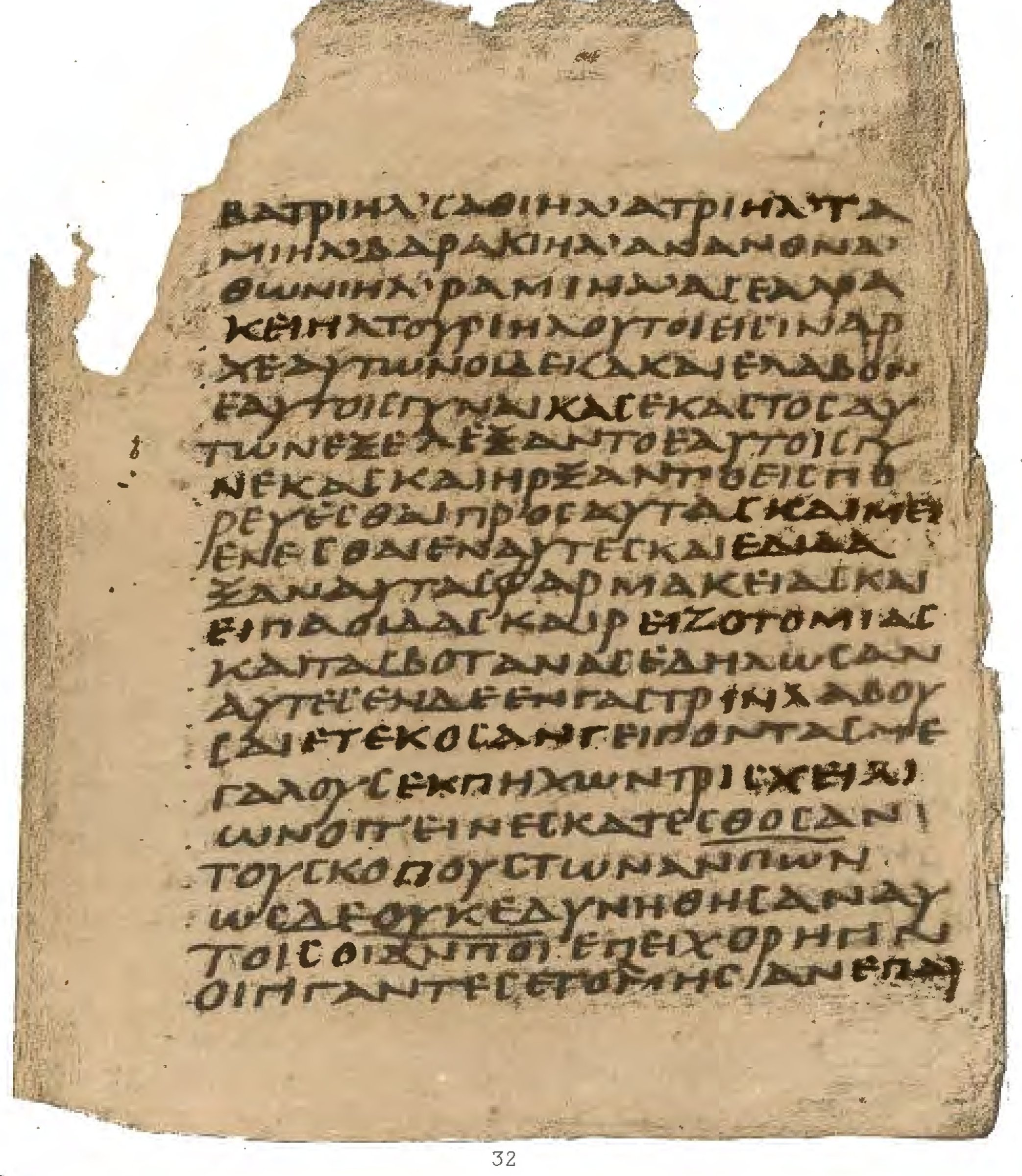
Akhmim codex pages 30, 31, 32 (Lods's page numbers, printed under each plate page). Checked on the plates: p. 30 begins ‹(top damaged) ... ουδε μη πλημμελησουσιν ... μη αποθανωσιν›; p. 31 begins ‹γεννησομεν εαυτοις τεκνα και ειπεν σεμιαζας›; p. 32 begins ‹βατριηλ σαθιηλ ατριηλ ταμιηλ βαρακιηλ›. Chapter 6 runs from verse 1 to 8 in Swete's numbering; page spans follow the first words of each page, read on the plates, and Lods's page/line/chapter/verse list (1893, pp. 230-232). The English is Charles's translation of the Ethiopic version; words he marks ⌜ ⌝ are in the Greek but not the Ethiopic, words in 〚 〛 are in the Ethiopic but not the Greek.
1Καὶ ἐγένετο οὗ ἂν ἐπληθύνθησαν οἱ υἱοὶ τῶν ἀνθρώπων, ἐν ἐκείναις ταῖς ἡμέραις ἐγεννήθησαν θυγατέρες ὡραῖαι καὶ καλαί. 2καὶ ἐθεάσαντο αὐτὰς οἱ ἅγγελοι υἱοὶ οὐρανοῦ καὶ ἐπεθύμησαν αὐτάς, καὶ εἶπαν πρὸς ἀλλήλους Δεῦτε ἐκλεξώμεθα ἑαυτοῖς γυναῖκας ἀπὸ τῶν ἀνθρώπων, καὶ γεννήσομεν ἑαυτοῖς τέκνα. 3καὶ εἶπεν Σεμειαζᾶς πρὸς αὐτούς, ὃς ἦν ἄρχων αὐτῶν Φοβοῦμαι μὴ οὐ θελήσετε ποιῆσαι τὸ πρᾶγμα τοῦτο, καὶ ἔσομαι ἐγὼ μόνος ὀφειλέτης ἁμαρτίας μεγάλης. 4ἀπεκρίθησαν οὖν αὐτῷ πάντες Ὀμόσωμεν ὅρκῳ πάντες καὶ ἀναθεματίσωμεν πάντες ἀλλήλους μὴ ἀποστρέψαι τὴν γνώμην ταύτην, μέχρις οὗ ἂν τελέσωμεν αὐτὴν καὶ ποιήσωμεν τὸ πρᾶγμα τοῦτο. 5τότε ὄμοσαν πάντες ὁμοῦ καὶ ἀνεθεμάτισαν ἀλλήλους ἐν αὐτῷ. 7Καὶ ταῦτα τὰ ὀνόματα τῶν ἀρχόντων αὐτῶν· Σεμιαζά, οὗτος ἦν ἄρχων αὐτῶν· Ἀραθάκ, Κιμβρά, Σαμμανή, Δανειήλ, Ἀρεαρώς, Σεμιήλ, Ἰωμειήλ, Χωχαριήλ, Ἑζεκιήλ, Βατριήλ, Σαθιήλ, Ἀτριήλ, Ταμιήλ, Βαρακιήλ, Ἀνανθνά, Θωνιήλ, Ῥαμιήλ, Ἀσεάλ, Ῥακειήλ, Τουριήλ. 8οὗτοί εἰσιν αὐτῶν οἱ δεκα[δ]άρχαι.
1 And it came to pass when the children of men had multiplied that in those days were born unto them beautiful and comely daughters. 2 And the angels, the children of the heaven, saw and lusted after them, and said to one another: ‘Come, let us choose us wives from among the children of men and beget us children.’ 3 And Semjâzâ, who was their leader, said unto them: ‘I fear ye will not indeed agree to do this deed, and I alone shall have to pay the penalty of a great sin.’ 4 And they all answered him and said: ‘Let us all swear an oath, and all bind ourselves by mutual imprecations not to abandon this plan but to do this thing.’ 5 Then sware they all together and bound themselves by mutual imprecations upon it. 6 And they were in all two hundred; who descended ⌜in the days⌝ of Jared on the summit of Mount Hermon, and they called it Mount Hermon, because they had sworn and bound themselves by mutual imprecations upon it. 7 And these are the names of their leaders: Sêmîazâz, their leader, Arâkîba, Râmêêl, Kôkabîêl, Tâmîêl, Râmîêl, Dânêl, Êzêqêêl, Barâqîjâl, Asâêl, Armârôs, Batârêl, Anânêl, Zaqîêl, Samsâpêêl, Satarêl, Tûrêl, Jômjâêl, Sariêl. 8 These are their chiefs of tens.
Where on the image
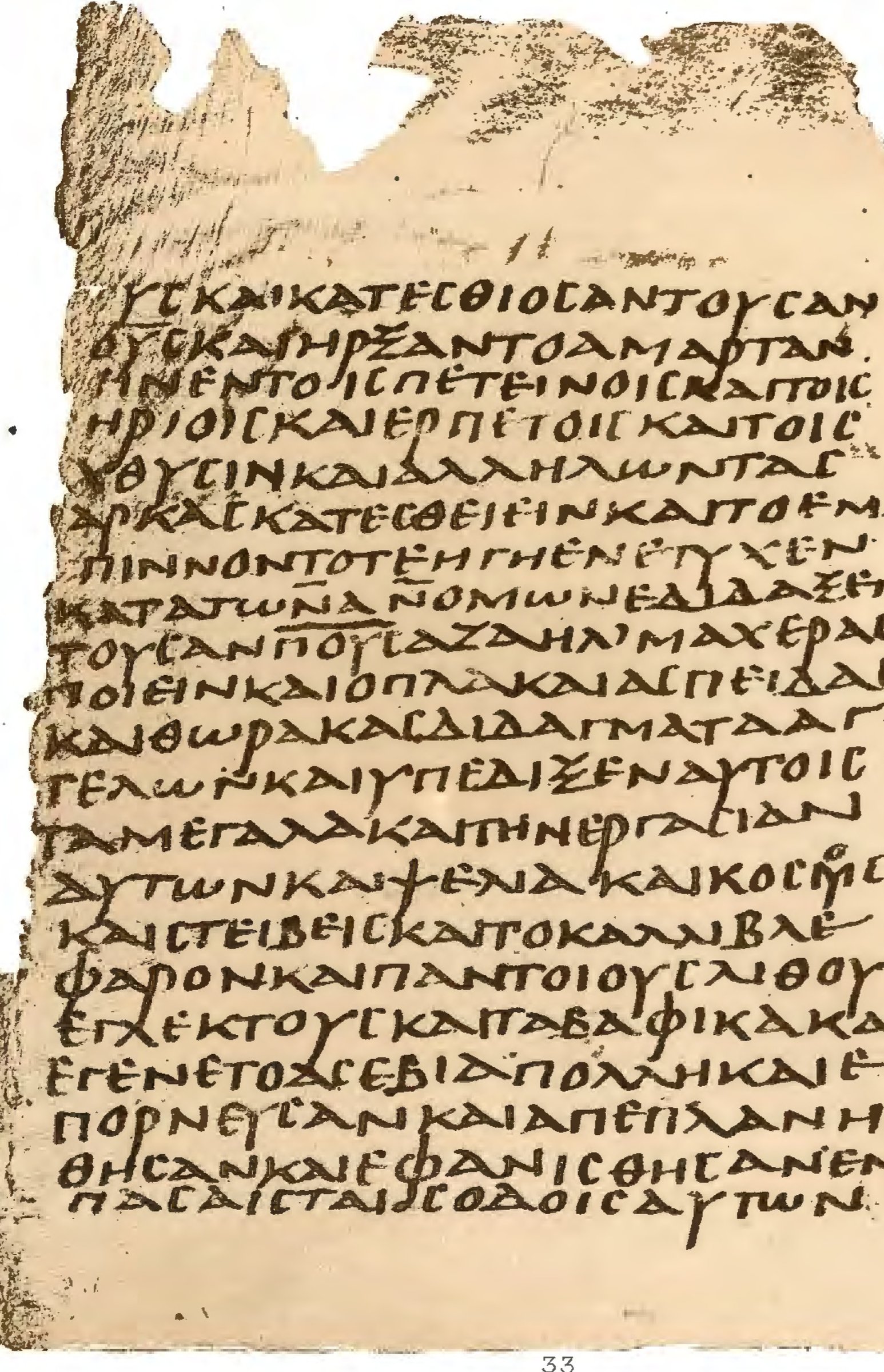
Akhmim codex pages 32, 33 (Lods's page numbers, printed under each plate page). Checked on the plates: p. 32 begins ‹βατριηλ σαθιηλ ατριηλ ταμιηλ βαρακιηλ›; p. 33 begins ‹[αυ]τους και κατεσθιοσαν τους ανους›. Chapter 7 runs from verse 1 to 6 in Swete's numbering; page spans follow the first words of each page, read on the plates, and Lods's page/line/chapter/verse list (1893, pp. 230-232). The English is Charles's translation of the Ethiopic version; words he marks ⌜ ⌝ are in the Greek but not the Ethiopic, words in 〚 〛 are in the Ethiopic but not the Greek.
1Καὶ ἔλαβον ἑαυτοῖς γυναῖκας· ἕκαστος αὐτῶν ἐξελέξαντο ἑαυτοῖς γυναῖκας, καὶ ἤρξαντο εἰσπορεύεσθαι πρὸς αὐτὰς καὶ μιαίνεσθαι ἐν αὐταῖς· καὶ ἐδίδαξαν αὐτὰς φαρμακείας καὶ ἐπαοιδὰς καὶ ῥιζοτομίας, καὶ τὰς βοτάνας ἐδήλωσαν αὐταῖς. 2Αἱ δὲ ἐν γαστρὶ λαβοῦσαι ἐτέκοσαν γίγαντας μεγάλους ἐκ πηχῶν τρισχιλίων, 3οἵτινες κατέσθοσαν τοὺς κόπους τῶν ἀνθρώπων. ὡς δὲ οὐκ ἐδυνήθησαν αὐτοῖς οἱ ἄνθρωποι ἐπιχορηγεῖν, 4οἱ γίγαντες ἐτόλμησαν ἐπʼ αὐτούς, καὶ κατεσθίοσαν τοὺς ἀνθρώπους. 5καὶ ἤρξαντο ἁμαρτάνειν ἐν τοῖς πετεινοῖς καὶ τοῖς [θ]ηρίοις καὶ ἑρπετοῖς καὶ τοῖς [ἰ]χθύσιν, καὶ ἀλλήλων τὰς σάρκας κατεσθίειν, καὶ τὸ αἶμα ἔπινον. 6τότε ἡ γῆ ἐνέτυχεν κατὰ τῶν ἀνόμων.
1 And all the others together with them took unto themselves wives, and each chose for himself one, and they began to go in unto them and to defile themselves with them, and they taught them charms and enchantments, and the cutting of roots, and made them acquainted with plants. 2 And they became pregnant, and they bare great giants, whose height was three thousand ells: 3 Who consumed all the acquisitions of men. And when men could no longer sustain them, 4 The giants turned against them and devoured mankind. 5 And they began to sin against birds, and beasts, and reptiles, and fish, and to devour one another’s flesh, and drink the blood. 6 Then the earth laid accusation against the lawless ones.
Where on the image
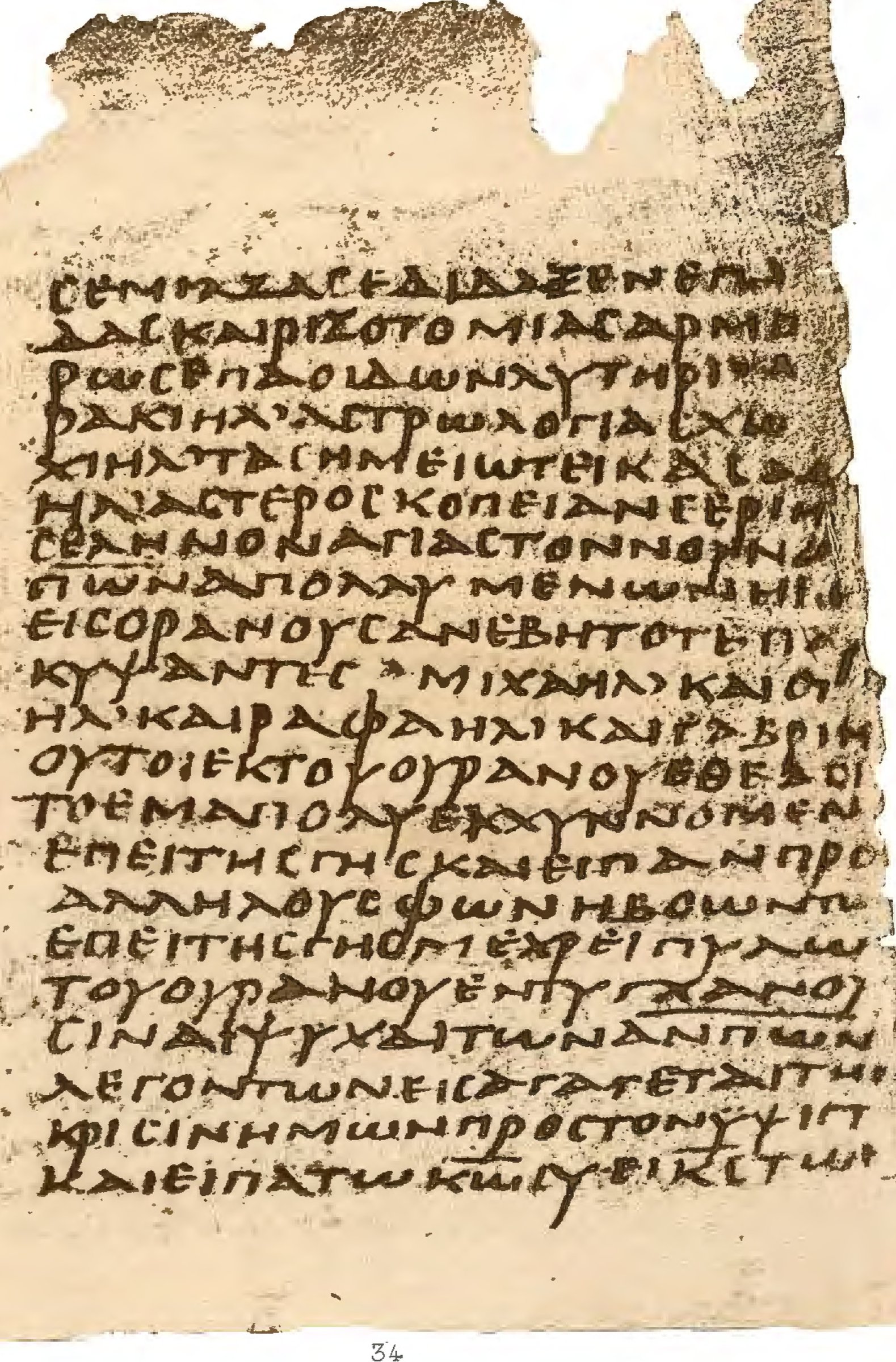
Akhmim codex pages 33, 34 (Lods's page numbers, printed under each plate page). Checked on the plates: p. 33 begins ‹[αυ]τους και κατεσθιοσαν τους ανους›; p. 34 begins ‹σεμιαζας εδιδαξεν επαοιδας και ριζοτομιας›. Chapter 8 runs from verse 1 to 4 in Swete's numbering; page spans follow the first words of each page, read on the plates, and Lods's page/line/chapter/verse list (1893, pp. 230-232). The English is Charles's translation of the Ethiopic version; words he marks ⌜ ⌝ are in the Greek but not the Ethiopic, words in 〚 〛 are in the Ethiopic but not the Greek.
1Ἐδίδαξεν τοὺς ἀνθρώπους Ἀζαὴλ μαχαίρας ποιεῖν καὶ ὅπλα καὶ ἀσπίδας καὶ θώρακας, διδάγματα ἀγγέλων, καὶ ὑπέδειξεν αὐτοῖς τὰ μέταλλα καὶ τὴν ἐργασίαν αὐτῶν, καὶ ψέλια καὶ κόσμους καὶ στί βεις καὶ τὸ καλλιβλέφαρον καὶ παντοίους λίθους ἐκλεκτοὺς καὶ τὰ βαφικά. 2καὶ ἐγένετο ἀσέβεια πολλή, καὶ ἐπόρνευσαν καὶ ἀπεπλανήθησαν καὶ ἠφανίσθησαν ἐν πάσαις ταῖς ὁδοῖς αὐτῶν. 3Σεμιαζᾶς ἐδίδαξεν ἐπαοιδὰς καὶ ῥιζοτομίας· Ἀρμαρὼς ἐπαοιδῶν λυτήριον· Ῥακιὴλ ἀστρολογίας· Χωχιὴλ τὰ σημειωτικά· Σαθιήλ ἀστεροσκοπίαν· Σεριὴλ σεληναγωγίας. 4τῶν οὖν ἀνθρώπων ἀπολλυμένων ἡ βο[ὴ] εἰς οὐρανοὺς ἀνέβη.
1 And Azâzêl taught men to make swords, and knives, and shields, and breastplates, and made known to them the metals ‹of the earth› and the art of working them, and bracelets, and ornaments, and the use of antimony, and the beautifying of the eyelids, and all kinds of costly stones, and all colouring tinctures. 2 And there arose much godlessness, and they committed fornication, and they were led astray, and became corrupt in all their ways. 3 Semjâzâ taught enchantments, and root-cuttings, Armârôs the resolving of enchantments, Barâqîjâl, (taught) astrology, Kôkabêl the constellations, Ezêqêêl the knowledge of the clouds, ‹Araqiêl the signs of the earth, Shamsiêl the signs of the sun›, and Sariêl the course of the moon. 4 And as men perished, they cried, and their cry went up to heaven....
Where on the image
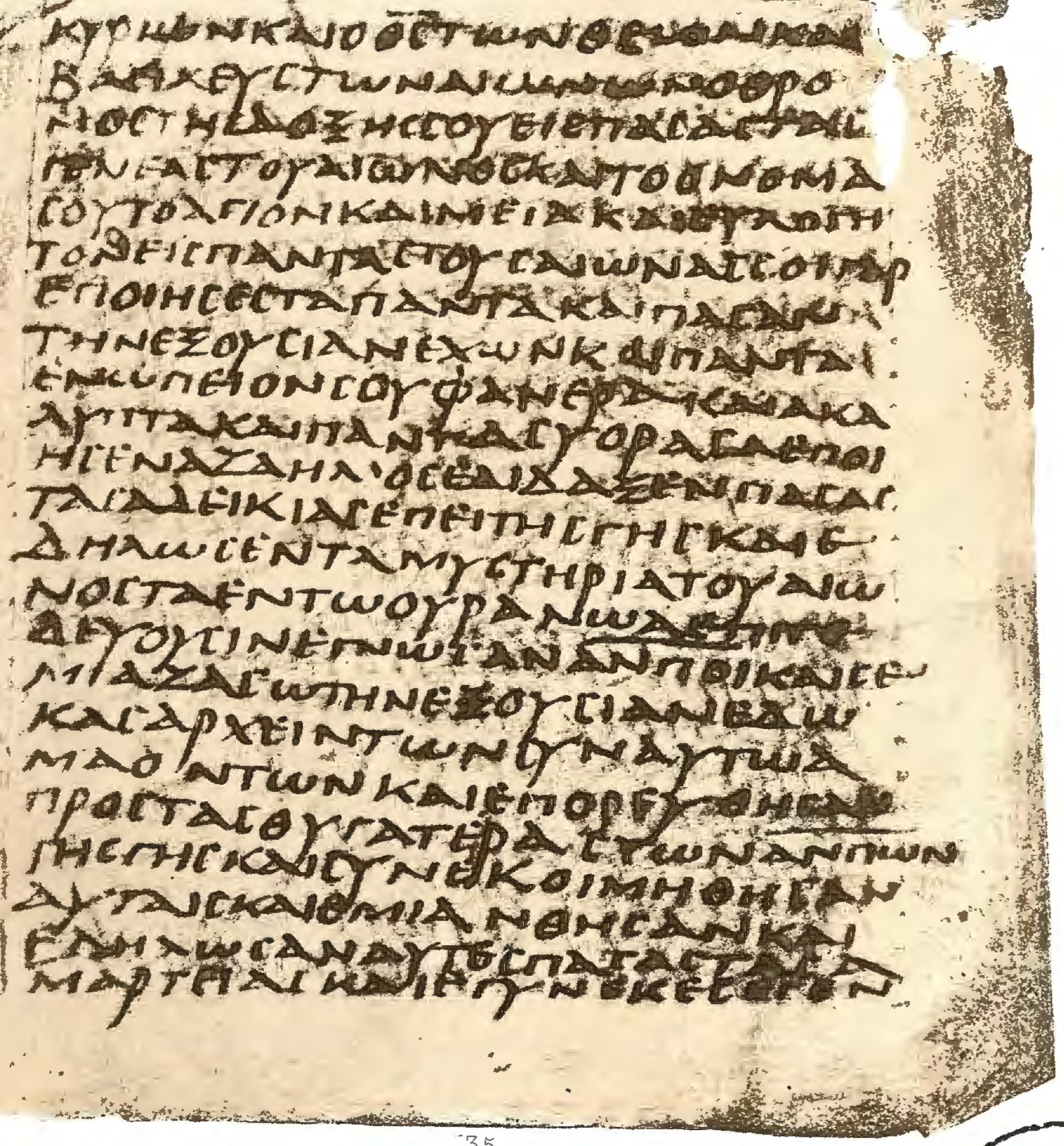
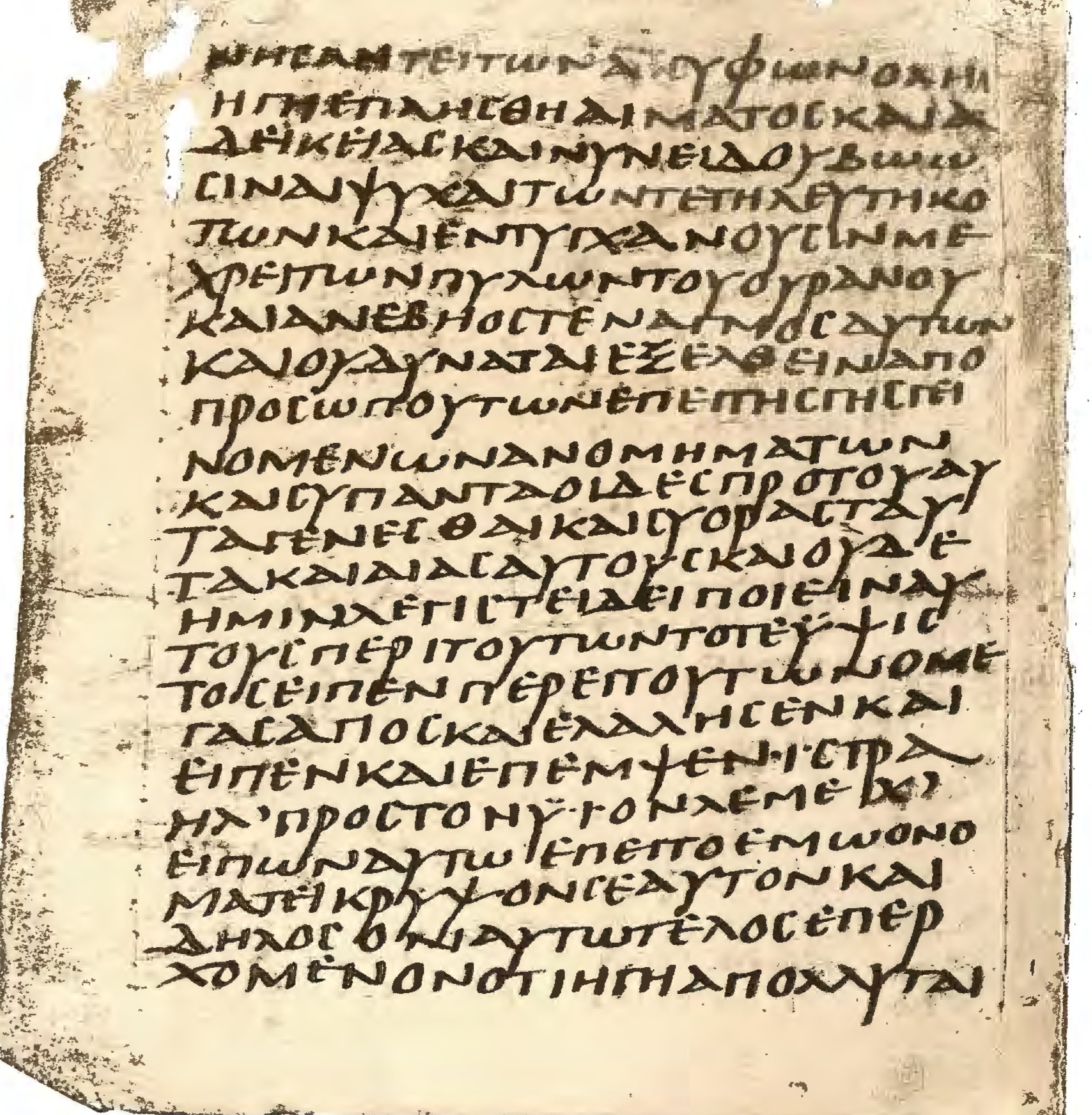
Akhmim codex pages 34, 35, 36 (Lods's page numbers, printed under each plate page). Checked on the plates: p. 34 begins ‹σεμιαζας εδιδαξεν επαοιδας και ριζοτομιας›; p. 35 begins ‹της δοξης σου εις πασας τας γενεας του αιωνος›; p. 36 begins ‹αιματος και αδικιας ... αι ψυχαι των τετελευτηκοτων›. Chapter 9 runs from verse 1 to 11 in Swete's numbering; page spans follow the first words of each page, read on the plates, and Lods's page/line/chapter/verse list (1893, pp. 230-232). The English is Charles's translation of the Ethiopic version; words he marks ⌜ ⌝ are in the Greek but not the Ethiopic, words in 〚 〛 are in the Ethiopic but not the Greek.
1Τότε παρ[α]κύψαντες Μιχαὴλ καὶ Οὐ[ρι]ὴλ καὶ Ῥαφαὴλ καὶ Γαβριή[λ], οὗτοι ἐκ τοῦ οὐρανοῦ ἐθεάσ[αν]το αἶμα πολὺ ἐκχυννόμεν[ον] ἐπὶ τῆς γῆς· 2καὶ εἶπαν πρὸς ἀλλήλους Φωνὴ βοώντων ἐπὶ τῆς γῆς μέχρι πυλῶν τοῦ οὐρανοῦ. 3ἐντυγχάνουσιν αἱ ψυχαὶ τῶν ἀνθρώπων λεγόντων Εἰσαγάγετε τὴν κρίσιν ἡμῶν πρὸς τὸν ὕψιστον. 4Καὶ εἶπα[ν] τῷ κυρίῳ Σὺ εἶ κύριος τῶν κυρίων καὶ ὁ θεὸς τῶν θεῶν καὶ βασιλεὺς τῶν αἰώνων· ὁ θρόνος τῆς δόξης σου εἰς πάσας τὰς γενεὰς τοῦ αἰῶνος, καὶ τὸ ὄνομά σου τὸ ἅγιον καὶ μέγα καὶ εὐλογητὸν εἰς πάντας τοὺς αἰῶνας. 5σὺ γὰρ ἐποίησας τὰ πάντα, καὶ πᾶσαν τὴν ἐξουσίαν ἔχων, καὶ πάντα ἐνώπιόν σου φανερὰ καὶ ἀκάλυπτα. 6καὶ πάντα σὺ ὁρᾷς ἃ ἐποίησεν Ἀζαήλ, ὃς ἐδίδαξεν πάσας τὰς ἀδικίας ἐπὶ τῆς γῆς καὶ ἐδήλωσεν τὰ μυστήρια τοῦ αἰῶνος τὰ ἐν τῷ οὐρανῷ ἃ ἐπιτηδεύουσιν [καὶ] ἔγνωσαν ἄνθρωποι· 7καὶ Σεμιαζᾶς. ᾧ τὴν ἐξουσίαν ἔδωκας ἄρχειν τῶν σὺν αὐτῷ ἅμα ὄντων. 8καὶ ἐπορεύθησαν πρὸς τὰς θυγατέρας τῶν ἀνθρώπων τῆς γῆς καὶ συνεκοιμήθησαν αὐταῖς καὶ ἐμιάνθησαν, καὶ ἐδήλωσαν αὐταῖς πάσας τὰς ἁμαρτίας. 9καὶ αἱ νυναῖκες ἐγέννησαν τιτᾶνας, ὑφʼ ὧν ὅλη ἡ γῆ ἐπλήσθη αἵματος καὶ ἀδικίας. 10καὶ νῦν ἰδοὺ βοῶσιν αἱ ψυχαὶ τῶν τετελευτηκότων καὶ ἐντυγχάνουσιν μέχρι τῶν πυλῶν τοῦ οὐρανοῦ, καὶ ἀνέβη ὁ στεναγμὸς αὐτῶν καὶ οὐ δύναται ἐξελθεῖν ἀπὸ προσώπου τῶν ἐπὶ τῆς γῆς γινομένων ἀνομημάτων. 11καὶ σὺ πάντα οἶδας πρὸ τοῦ αὐτὰ γενέσθαι, καὶ σὺ ὁρᾷς ταῦτα καὶ ἐᾷς αὐτούς, καὶ οὐδὲ ἡμῖν λέγεις τί δεῖ ποιεῖν αὐτοὺς περὶ τούτων.
1 And then Michael, Uriel, Raphael, and Gabriel looked down from heaven and saw much blood being shed upon the earth, and all lawlessness being wrought upon the earth. 2 And they said one to another: ‘The earth, made †without inhabitant, cries the voice of their crying† up to the gates of heaven. 3 〚And now to you, the holy ones of heaven〛, the souls of men make their suit, saying, “Bring our cause before the Most High”.’ 4 And they said to the Lord of the ages: ‘Lord of lords, God of gods, King of kings ‹and God of the ages›, the throne of Thy glory (standeth) unto all the generations of the ages, and Thy name holy and glorious and blessed unto all the ages! 5 Thou hast made all things, and power over all things hast Thou: and all things are naked and open in Thy sight, and all things Thou seest, and nothing can hide itself from Thee. 6 Thou seest what Azâzêl hath done, who hath taught all unrighteousness on earth and revealed the eternal secrets which were (preserved) in heaven, which men were striving to learn: 7 And Semjâzâ, to whom Thou hast given authority to bear rule over his associates. 8 And they have gone to the daughters of men upon the earth, and have slept with the women, and have defiled themselves, and revealed to them all kinds of sins. 9 And the women have borne giants, and the whole earth has thereby been filled with blood and unrighteousness. 10 And now, behold, the souls of those who have died are crying and making their suit to the gates of heaven, and their lamentations have ascended: and cannot cease because of the lawless deeds which are wrought on the earth. 11 And Thou knowest all things before they come to pass, and Thou seest these things and Thou dost suffer them, and Thou dost not say to us what we are to do to them in regard to these.’
Where on the image
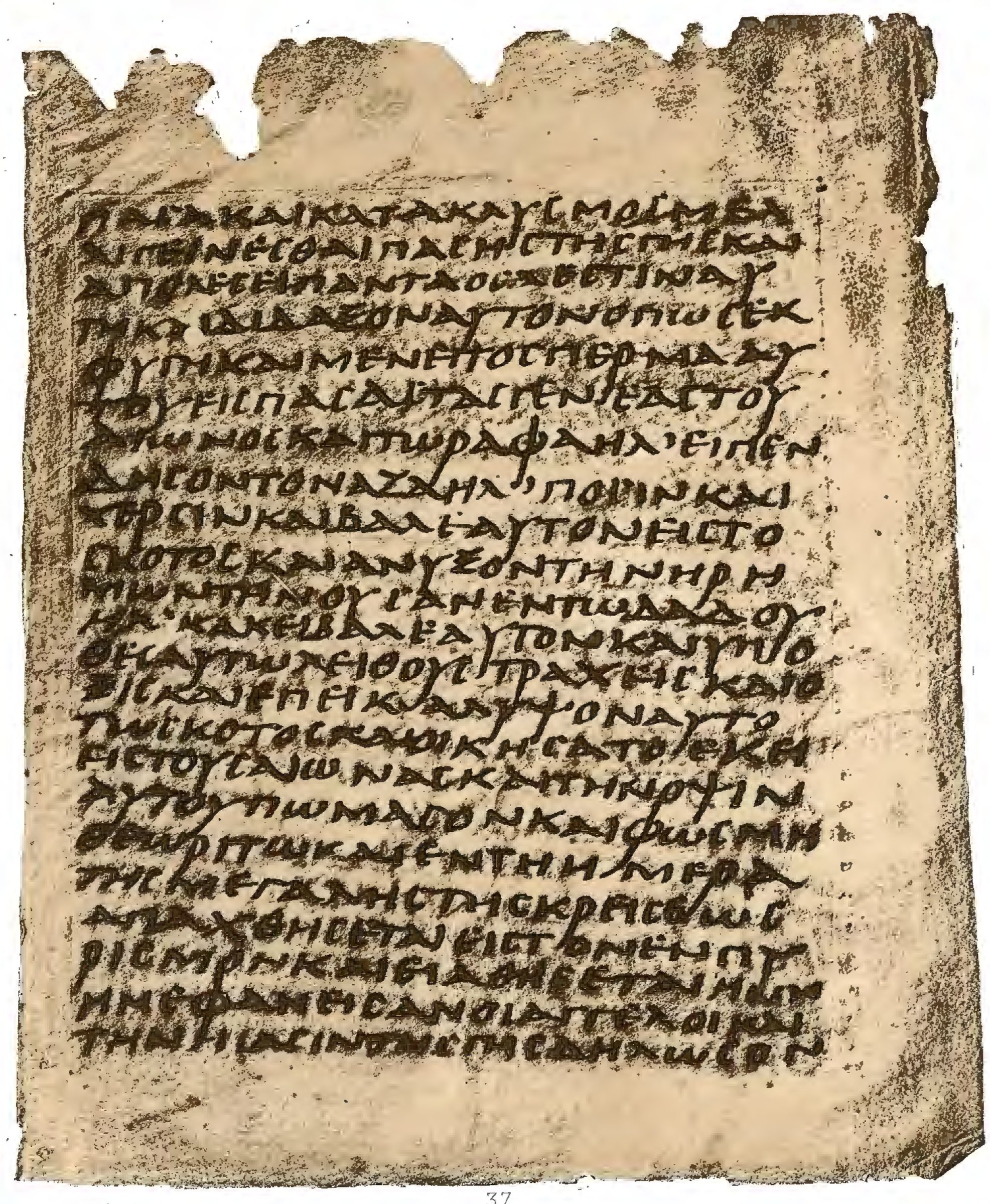
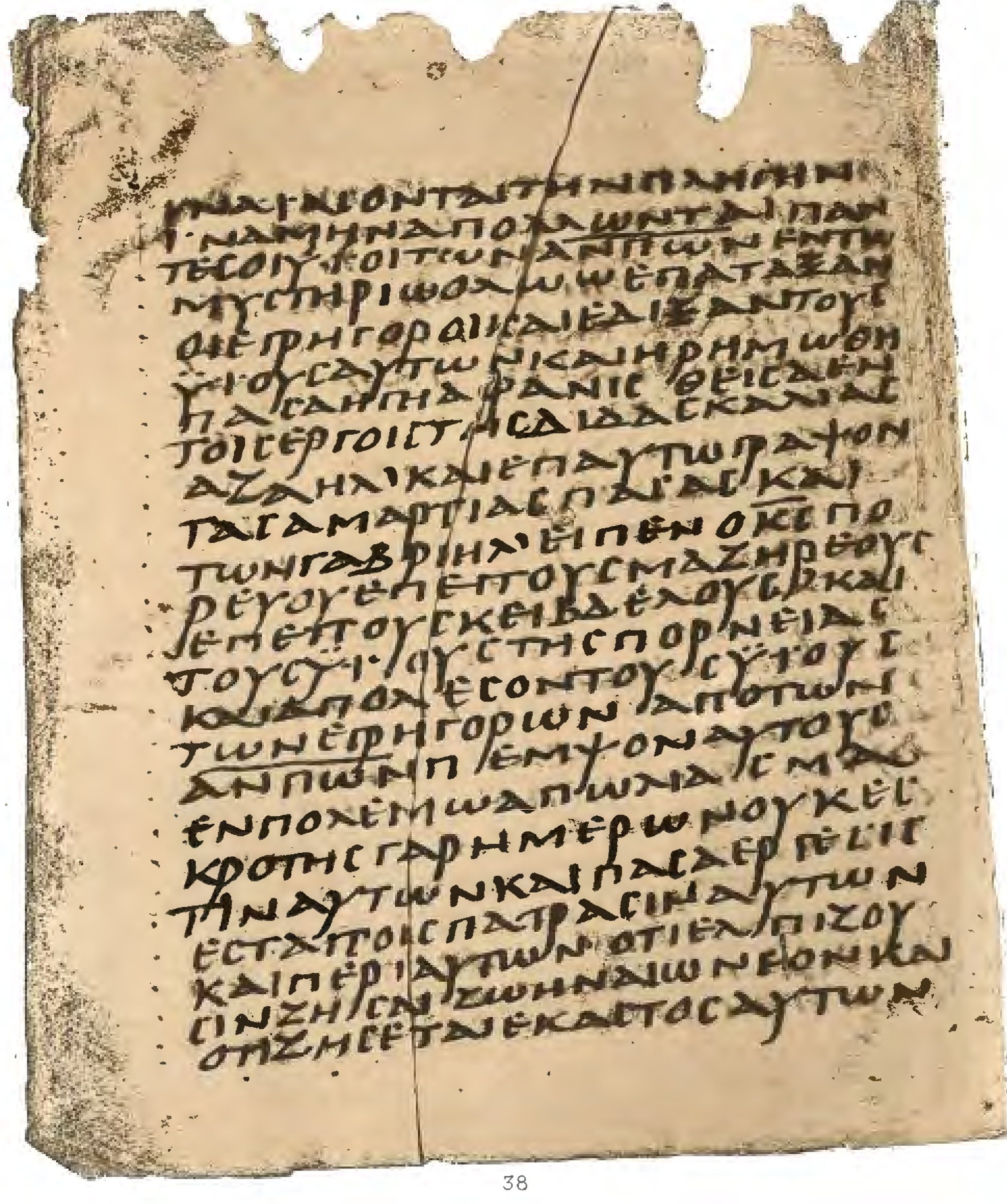
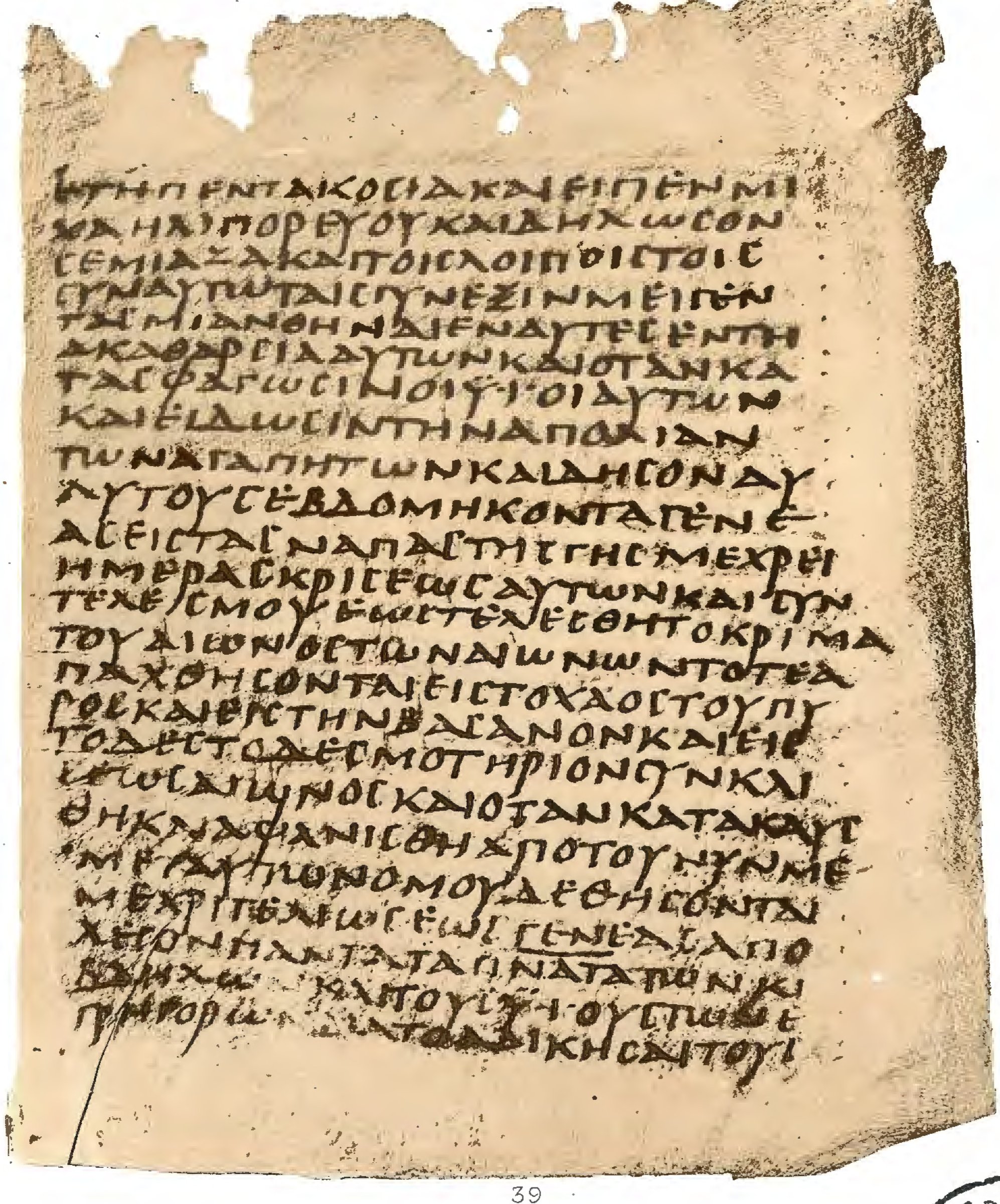
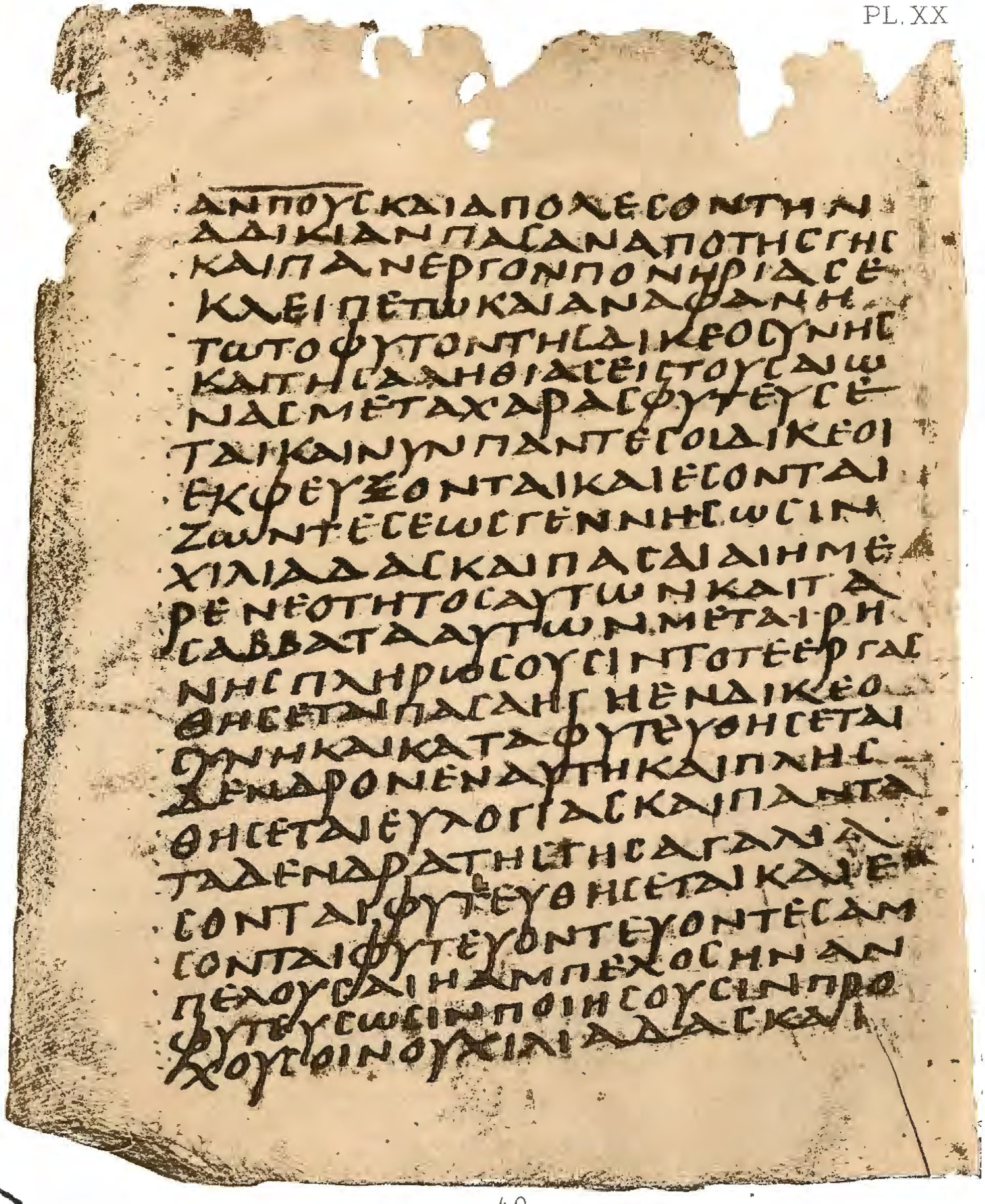
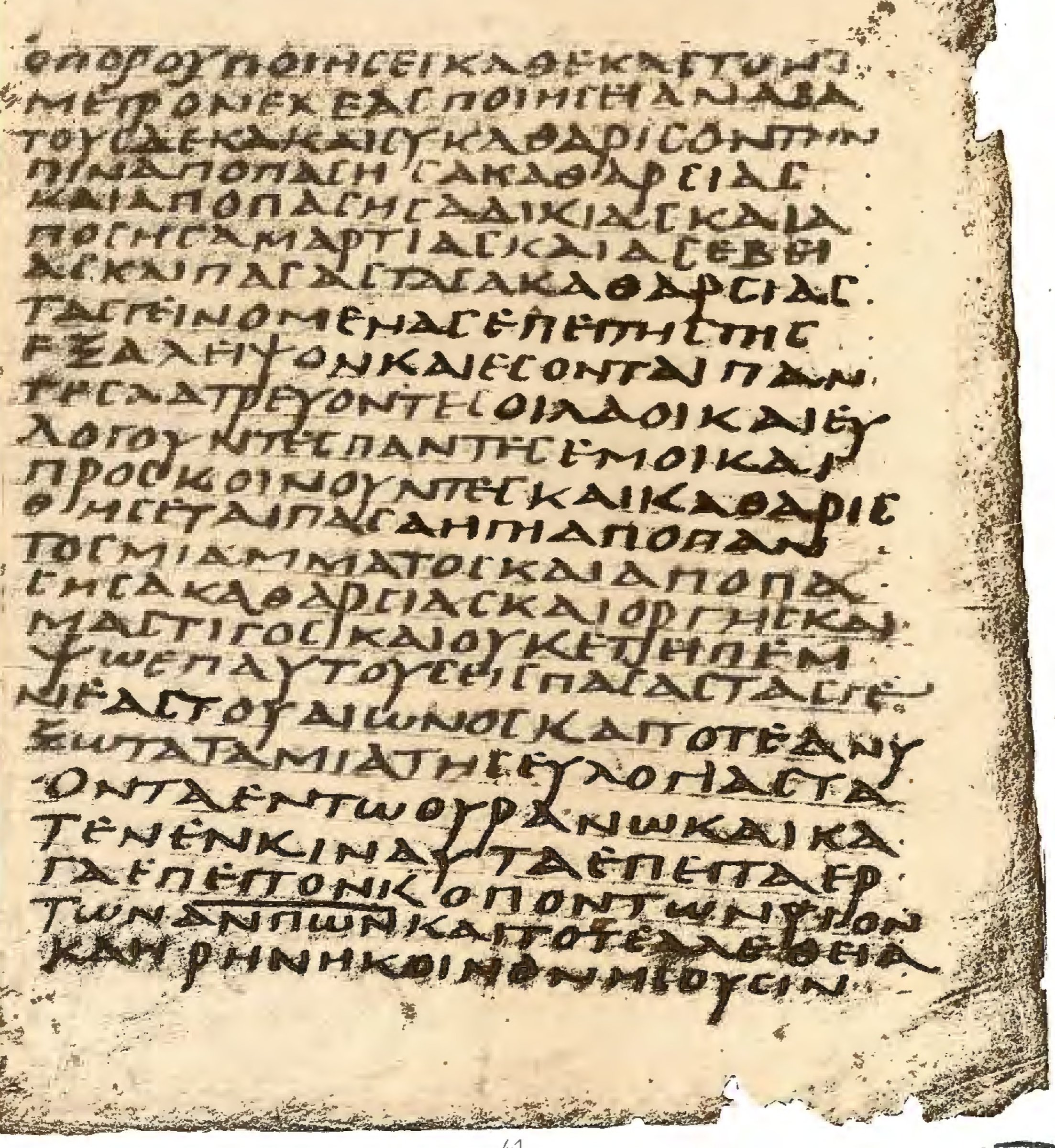
Akhmim codex pages 36, 37, 38, 39, 40, 41 (Lods's page numbers, printed under each plate page). Checked on the plates: p. 36 begins ‹αιματος και αδικιας ... αι ψυχαι των τετελευτηκοτων›; p. 37 begins ‹[κατα]κλυσμος μελλει απολλυσθαι πασης της γης›; p. 38 begins ‹... εν τω μυστηριω ολω ω επαταξαν οι εγρηγοροι›; p. 39 begins ‹ετη πεντακοσια και ειπεν μιχαηλ πορευου›; p. 40 begins ‹[τους] ανους και απολεσον την αδικιαν πασαν›; p. 41 begins ‹[υπ ορ]ους σε και συ καθαρισον την γην›. Chapter 10 runs from verse 1 to 22 in Swete's numbering; page spans follow the first words of each page, read on the plates, and Lods's page/line/chapter/verse list (1893, pp. 230-232). The English is Charles's translation of the Ethiopic version; words he marks ⌜ ⌝ are in the Greek but not the Ethiopic, words in 〚 〛 are in the Ethiopic but not the Greek.
1Τότε Ὕψιστος εἶπεν περὶ τούτων, ὁ μέγας Ἅγιος, καὶ ἐλάλησεν καὶ εἶπεν καὶ ἔπεμψεν Ἰστραὴλ πρὸς τὸν υἱὸν Λέμεχ 2Εἶπον αὐτῷ ἐπὶ τῷ ἐμῷ ὀνόματι Κρύψον σεαυτόν, καὶ δήλωσον αὐτῷ τέλος ἐπερχόμενον, ὅτι ἡ γῆ ἀπόλλυται πᾶσα, καὶ κατακλυσμὸς μέλλει γίνεσθαι πάσης τῆς γῆς καὶ ἀπολέσει πάντα ὅσα ἐστὶν αὐτῇ. 3καὶ δίδαξον αὐτὸν ὅπως ἐκφύγῃ, καὶ μενεῖ τὸ σπέρμα αὐτοῦ εἰς πάσας τὰς γενεὰς τοῦ αἰῶνος. 4Καὶ τῷ Ῥαφαὴλ εἶπεν Δῆσον τὸν Ἀζαὴλ ποσὶν καὶ χερσίν, καὶ βάλε αὐτὸν εἰς τὸ σκότος, καὶ ἄνοιξον τὴν ἔρημον τὴν οὖσαν ἐν τῷ Δαδουὴλ κἀκεῖ βάλε αὐτόν, 5καὶ ὑπόθες αὐτῷ λίθους τραχεῖς καὶ ὀξεῖς καὶ ἐπικάλυψον αὐτῷ τὸ σκότος, καὶ οἰκησάτω ἐκεῖ εἰς τοὺς αἰῶνας, καὶ τὴν ὄψιν αὐτοῦ πώμασον καὶ φῶς μὴ θεωρείτω· 6καὶ ἐν τῇ ἡμέρᾳ τῆς μεγάλης τῆς κρίσεως ἀπαχθήσεται εἰς τὸν ἐνπυρισμόν. 7καὶ ἰαθήσεται ἡ γῆ, ἣν ἠφάνισαν οἱ ἄγγελοι, καὶ τὴν ἴασιν τῆς γῆς δήλωσον, ἵνα ἰάσωνται τὴν πληγήν, ἵνα μὴ ἀπόλωνται πάντες οἱ υἱοὶ τῶν ἀνθρώπων ἐν τῷ μυστηρίῳ ὅλῳ ᾧ ἐπέταξαν οἱ ἐγρήγοροι καὶ ἔδειξαν τοὺς υἱοὺς αὐτῶν, 8καὶ ἠρημώθη πᾶσα ἡ γῆ ἀφανισθεῖσα ἐν τοῖς ἔργοις τῆς διδασκαλίας Ἀζαήλ καὶ ἐπʼ αὐτῷ γράψον τὰς ἁμαρτίας πάσας. 9Καὶ τῷ Γαβριὴλ εἶπεν ὁ κύριος Πορεύου ἐπὶ τοὺς μαζηρέους, ἐπὶ τοὺς κιβδήλους καὶ τοὺς υἱοὺς τῆς πορνείας, καὶ ἀπόλεσον τοὺς υἱοὺς τῶν ἐγρηγόρων ἀπὸ τῶν ἀνθρώπων· πέμψον αὐτοὺς ἐν πολέμῳ ἀπωλείας. μακρότης γὰρ ἡμερῶν οὐκ ἔστιν αὐτῶν, 10καὶ πᾶσα ἐρώτησις [οὐκ] ἔσται τοῖς πατράσιν αὐτῶν καὶ περὶ αὐτῶν, ὅτι ἐλπίζουσιν ζῆσαι ζωὴν αἰώνιον, καὶ ὅτι ζήσεται ἕκαστος αὐτῶν ἔτη πεντακόσια. 11Καὶ εἶπεν Μιχαὴλ Πορεύου καὶ δήλωσον Σεμιαζᾷ καὶ τοῖς λοιποῖς τοῖς σὺν αὐτῷ ταῖς γυναιξὶν μιγεῖσιν, μιανθῆναι ἐν αὐταῖς ἐν τῇ ἀκαθαρσίᾳ αὐτῶν· 12καὶ ὅταν κατασφαγῶσιν οἱ υἱοὶ αὐτῶν καὶ ἴδωσιν τὴν ἀπώλειαν τῶν ἀγαπητῶν, καὶ δῆσον αὐτοὺς ἑβδομήκοντα γενεὰς εἰς τὰς νάπας τῆς γῆς μέχρι ἡμέρας κρίσεως αὐτῶν καὶ συντελεσμοῦ, ἕως τελεσθῇ τὸ κρίμα τοῦ αἰῶνος τῶν αἰώνων. 13τότε ἀπαχθήσονται εἰς τὸ χάος τοῦ πυρὸς καὶ εἰς τὴν βάσανον καὶ εἰς τὸ δεσμωτήριον συγκλείσεως αἰῶνος. 14καὶ ὃς ἂν κατακαυθῇ καὶ ἀφανισθῇ ἀπὸ τοῦ νῦν, μετʼ αὐτῶν ὁμοῦ δεθήσονται μέχρι τελειώσεως γενεᾶς. 15ἀπόλεσον πάντα τὰ πνεύματα τῶν κιβδήλων καὶ τοὺς υἱοὺς τῶν ἐγρηγόρων διὰ τὸ ἀδικῆσαι τοὺς ἀνθρώπους. 16καὶ ἀπόλεσον τὴν ἀδικίαν πᾶσαν ἀπὸ τῆς γῆς, καὶ πᾶν ἔργον πονηρίας ἐκλειπέτω, καὶ ἀναφανήτω τὸ φυτὸν τῆς δικαιοσύνης καὶ τῆς ἀληθείας εἰς τοὺς αἰῶνας· μετὰ χαρᾶς φυτευθήσεται. 17Καὶ νῦν πάντες οἱ δίκαιοι ἐκφεύξονται, καὶ ἔσονται ζῶντες ἕως γεννήσωσιν χιλιάδας, καὶ πᾶσαι αἱ ἡμέραι νεότητος αὐτῶν, καὶ τὰ σάββατα αὐτῶν μετὰ εἰρήνης πληρώσουσιν. 18τότε ἐργασθήσεται πᾶσα ἡ γῆ ἐν δικαιοσύνῃ καὶ καταφυτευθήσεται δένδρον ἐν αὐτῇ, καὶ πλησθήσεται εὐλογίας. 19καὶ πάντα τὰ δένδρα τῆς γῆς ἀγαλλιάσονται· φυτευθήσεται, καὶ ἔσονται φυτεύοντες ἀμπέλους, καὶ ἡ ἄμπελος ἣν ἂν φυτεύσωσιν, ποιήσουσιν προχοῦς οἴνου· χιλιάδας καὶ σπόρου ποιήσει καθʼ ἕκαστον μέτρον, ἐλαίας ποιήσει ἀνὰ βάτους δέκα. 20καὶ σὺ καθάρισον τὴν γῆν ἀπὸ πάσης ἀκαθαρσίας καὶ ἀπὸ πάσης ἀδικίας καὶ ἀπὸ πάσης ἁμαρτίας καὶ ἀσεβείας, καὶ πάσας τὰς ἀκαθαρσίας τὰς γινομένας ἐπὶ τῆς γῆς ἐξάλειψον. 21καὶ ἔσονται πάντες λατρεύοντες οἱ λαοὶ καὶ εὐλογοῦντες πάντες ἐμοὶ καὶ προσκυνοῦντες. 22καὶ καθαρισθήσεται πᾶσα ἡ γῆ ἀπὸ παντὸς μιάμματος καὶ ἀπὸ πάσης ἀκαθαρσίας καὶ ὀργῆς καὶ μάστιγος, καὶ οὐκέτι πέμψω ἐπʼ αὐτοὺς εἰς πάσας τὰς γενεὰς τοῦ αἰῶνος.
1 Then said the Most High, the Holy and Great One spake, and sent Uriel to the son of Lamech, and said to him: 2 ‘‹Go to Noah and› tell him in my name “Hide thyself!”, and reveal to him the end that is approaching: that the whole earth will be destroyed, and a deluge is about to come upon the whole earth, and will destroy all that is on it. 3 And now instruct him that he may escape and his seed may be preserved for all the generations of the world.’ 4 And again the Lord said to Raphael: ‘Bind Azâzêl hand and foot, and cast him into the darkness: and make an opening in the desert, which is in Dûdâêl, and cast him therein. 5 And place upon him rough and jagged rocks, and cover him with darkness, and let him abide there for ever, and cover his face that he may not see light. 6 And on the day of the great judgement he shall be cast into the fire. 7 And heal the earth which the angels have corrupted, and proclaim the healing of the earth, that they may heal the plague, and that all the children of men may not perish through all the secret things that the Watchers have disclosed and have taught their sons. 8 And the whole earth has been corrupted through the works that were taught by Azâzêl: to him ascribe all sin.’ 9 And to Gabriel said the Lord: ‘Proceed against the bastards and the reprobates, and against the children of fornication: and destroy [the children of fornication and] the children of the Watchers from amongst men: [and cause them to go forth]: send them one against the other that they may destroy each other in battle: for length of days shall they not have. 10 And no request that they (i. e. their fathers) make of thee shall be granted unto their fathers on their behalf; for they hope to live an eternal life, and that each one of them will live five hundred years.’ 11 And the Lord said unto Michael: ‘Go, bind Semjâzâ and his associates who have united themselves with women so as to have defiled themselves with them in all their uncleanness. 12 And, when their sons have slain one another, and they have seen the destruction of their beloved ones, bind them fast for seventy generations in the valleys of the earth, till the day of their judgement and of their consummation, till the judgement that is for ever and ever is consummated. 13 In those days they shall be led off to the abyss of fire: ‹and› to the torment and the prison in which they shall be confined for ever. 14 And whosoever shall be condemned and destroyed will from thenceforth be bound together with them to the end of all generations. 15 And destroy all the spirits of the reprobate, and the children of the Watchers, because they have wronged mankind. 16 Destroy all wrong from the face of the earth, and let every evil work come to an end: and let the plant of righteousness and truth appear: ⌜and it shall prove a blessing: the works of righteousness and truth⌝ shall be planted in truth and joy for evermore.
17 And then shall all the righteous escape,
And shall live till they beget thousands of children,
And all the days of their youth and their old age shall they complete in peace.
18 And then shall the whole earth be tilled in righteousness, and shall all be planted with trees and be full of blessing. 19 And all desirable trees shall be planted on it, and they shall plant vines on it: and the vine which they plant thereon shall yield wine in abundance, and as for all the seed which is sown thereon each measure (of it) shall bear a thousand, and each measure of olives shall yield ten presses of oil. 20 And cleanse thou the earth from all oppression, and from all unrighteousness, and from all sin, and from all godlessness: and all the uncleanness that is wrought upon the earth destroy from off the earth. 21 ⌜And all the children of men shall become righteous⌝, and all nations shall offer adoration and shall praise Me, and all shall worship Me. 22 And the earth shall be cleansed from all defilement, and from all sin, and from all punishment, and from all torment, and I will never again send (them) upon it from generation to generation and for ever.
Where on the image
Akhmim codex page 41 (Lods's page numbers, printed under each plate page). Checked on the plates: p. 41 begins ‹[υπ ορ]ους σε και συ καθαρισον την γην›. Chapter 11 runs from verse 1 to 2 in Swete's numbering; page spans follow the first words of each page, read on the plates, and Lods's page/line/chapter/verse list (1893, pp. 230-232). The English is Charles's translation of the Ethiopic version; words he marks ⌜ ⌝ are in the Greek but not the Ethiopic, words in 〚 〛 are in the Ethiopic but not the Greek.
1καὶ τότε ἀνοίξω τὰ ταμεῖα τῆς εὐλογίας τὰ ὄντα ἐν τῷ οὐρανῷ, καὶ κατενεγκεῖν αὐτὰ ἐπὶ τὰ ἔργα, ἐπὶ τὸν κόπον τῶν υἱῶν τῶν ἀνθρώπων. 2καὶ τότε ἀλήθεια καὶ εἰρήνη κοινωνήσουσιν ὁμοῦ εἰς πάσας τὰς ἡμέρας τοῦ αἰῶνος καὶ εἰς πάσας τὰς γενεὰς τῶν ἀνθρώπων.
1 And in those days I will open the store chambers of blessing which are in the heaven, so as to send them down ⌜upon the earth⌝ over the work and labour of the children of men. 2 And truth and peace shall be associated together throughout all the days of the world and throughout all the generations of men.’
Where on the image
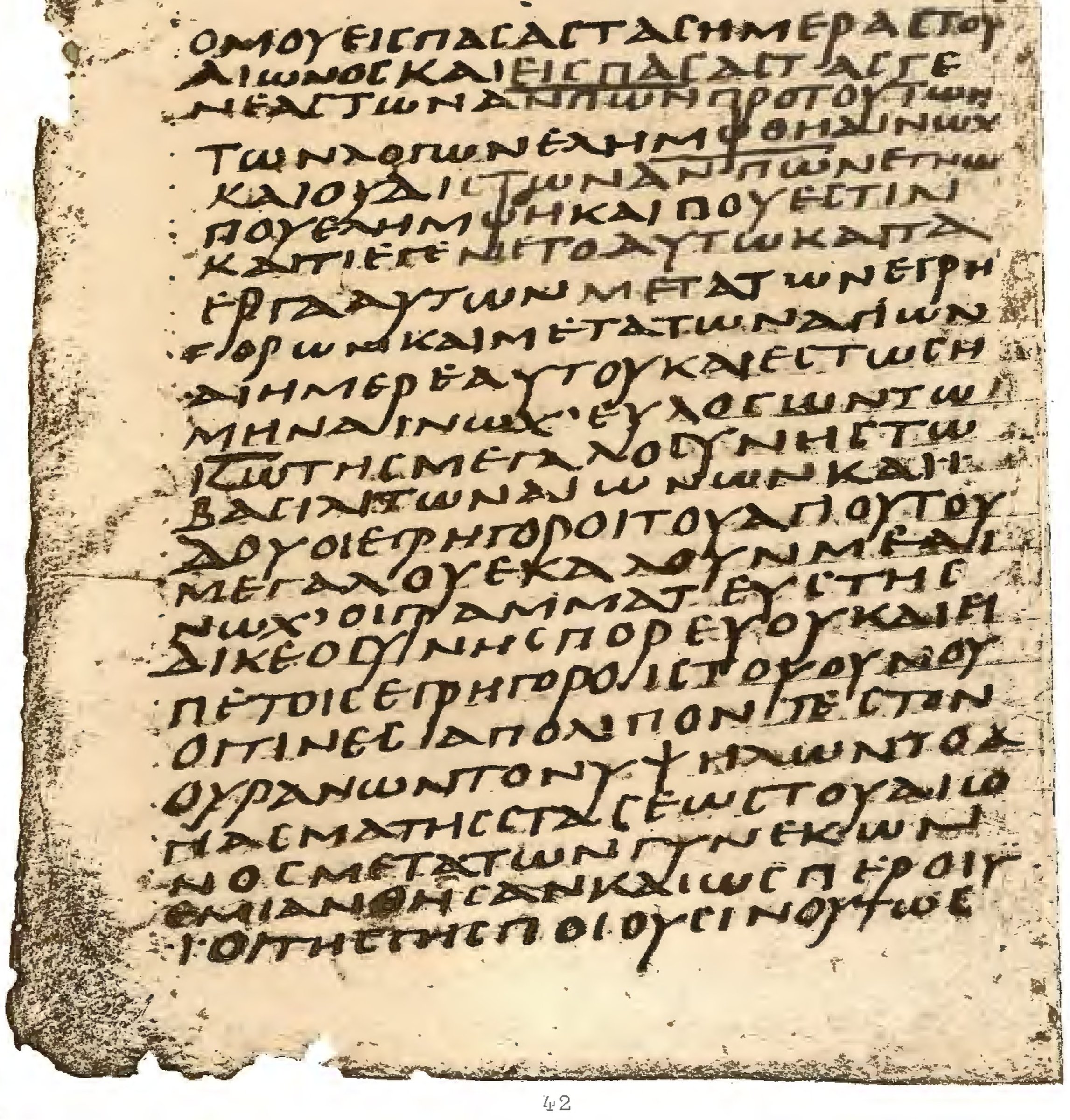
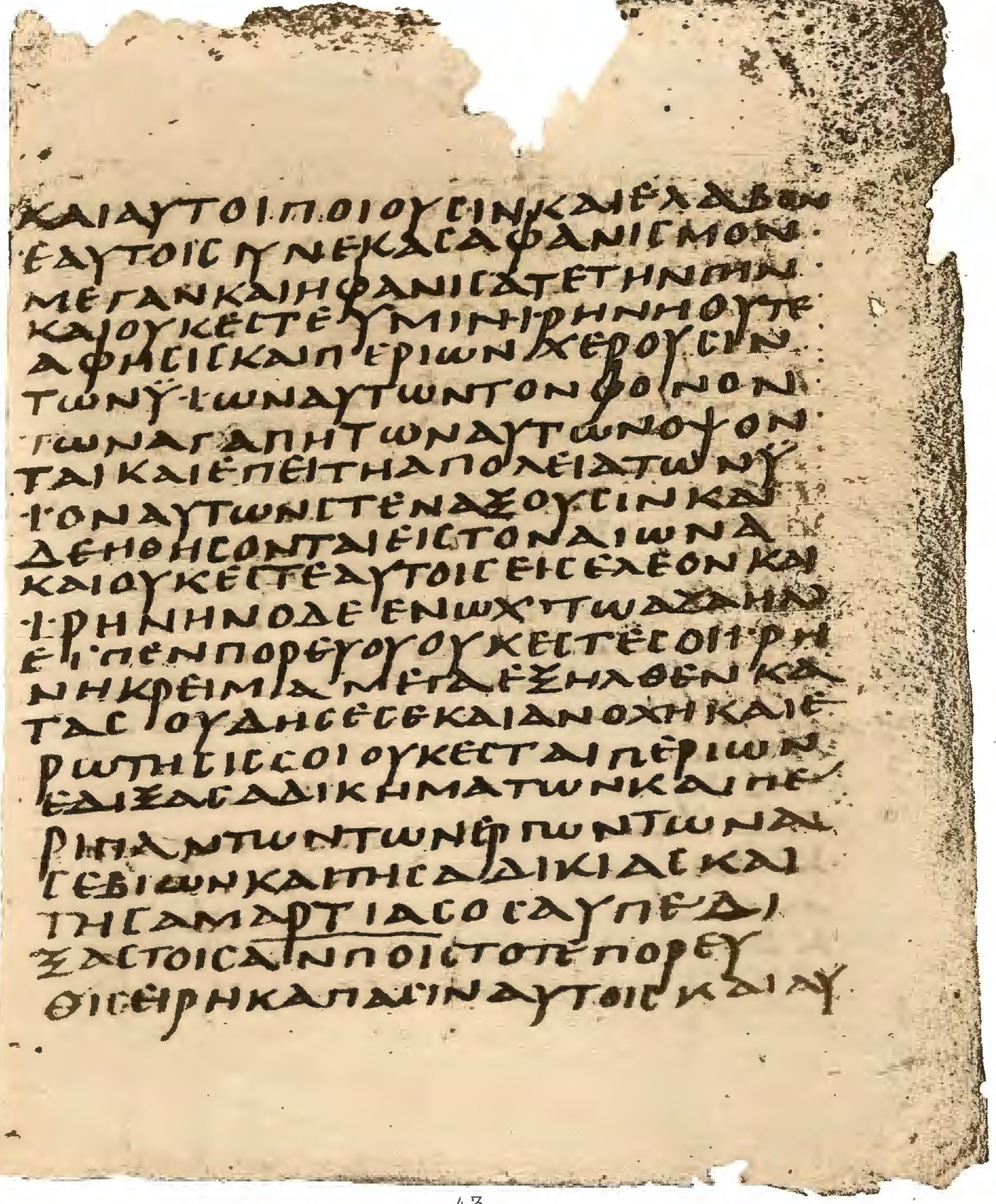
Akhmim codex pages 41, 42, 43 (Lods's page numbers, printed under each plate page). Checked on the plates: p. 41 begins ‹[υπ ορ]ους σε και συ καθαρισον την γην›; p. 42 begins ‹των λογων ελημφθη ενωχ και ουδεις των ανων›; p. 43 begins ‹και αυτοι ποιουσιν και ελαβον εαυτοις γυναικας›. Chapter 12 runs from verse 1 to 6 in Swete's numbering; page spans follow the first words of each page, read on the plates, and Lods's page/line/chapter/verse list (1893, pp. 230-232). The English is Charles's translation of the Ethiopic version; words he marks ⌜ ⌝ are in the Greek but not the Ethiopic, words in 〚 〛 are in the Ethiopic but not the Greek.
1Πρὸ τούτων τῶν λόγων ἐλήμφθη Ἑνώχ, καὶ οὐδεὶς τῶν ἀνθρώπων ἔγνω ποῦ ἐλήμφθη καὶ ποῦ ἐστιν καὶ τί ἐγένετο αὐτῷ. 2καὶ τὰ ἔργα αὐτοῦ μετὰ τῶν ἐγρηγόρων, καὶ μετὰ τῶν ἁγίων αἱ ἡμέραι αὐτοῦ. 3Καὶ ἑστὼς ἤμην Ἑνὼχ εὐλογῶν τῷ κυρίῳ τῆς μεγαλοσύνης, τῷ βασιλεῖ τῶν αἰώνων. καὶ ἰδοὺ οἱ ἐγρήγοροι τοῦ ἁγίου τοῦ μεγάλου ἐκάλουν με 4Ἑνώχ. ὁ γραμματεὺς τῆς δικαιοσύνης, πορεύου καὶ εἰπὲ τοῖς ἐγρηγόροις τοῦ οὐρανοῦ οἵτινες ἀπολιπόντες τὸν οὐρανὸν τὸν ὑψηλόν, τὸ ἁγίασμα τῆς στάσεως τοῦ αἰῶνος, μετὰ τῶν γυναικῶν ἐμιάνθησαν, καὶ ὥσπερ οἱ υἱοὶ τῆς γῆς ποιοῦσιν, οὕτως καὶ αὐτοὶ ποιοῦσιν, καὶ ἔλαβον ἑαυτοῖς γυναῖκας Ἀφανισμὸν μέγαν ἠφανίσατε τὴν γῆν, 5καὶ οὐκ ἔσται ὑμῖν εἰρήνη οὔτε ἄφεσις. καὶ περὶ ὧν χαίρουσιν τῶν υἱῶν αὐτῶν, 6τὸν φόνον τῶν ἀγαπητῶν αὐτῶν ὄψονται, καὶ ἐπὶ τῇ ἀπωλείᾳ τῶν υἱῶν αὐτῶν στενάξουσιν καὶ δεηθήσονται εἰς τὸν αἰῶνα, καὶ οὐκ ἔσται αὐτοῖς εἰς ἔλεον καὶ εἰρήνην.
1 Before these things Enoch was hidden, and no one of the children of men knew where he was hidden, and where he abode, and what had become of him. 2 And his activities had to do with the Watchers, and his days were with the holy ones.
3 And I, Enoch, was blessing the Lord of majesty and the King of the ages, and lo! the Watchers called me—Enoch the scribe—and said to me: 4 ‘Enoch, thou scribe of righteousness, go, †declare† to the Watchers of the heaven who have left the high heaven, the holy eternal place, and have defiled themselves with women, and have done as the children of earth do, and have taken unto themselves wives: “Ye have wrought great destruction on the earth: 5 And ye shall have no peace nor forgiveness of sin: and inasmuch as †they† delight themselves in †their† children, 6 The murder of †their† beloved ones shall †they† see, and over the destruction of †their† children shall †they† lament, and shall make supplication unto eternity, but mercy and peace shall ye not attain.”’
Where on the image
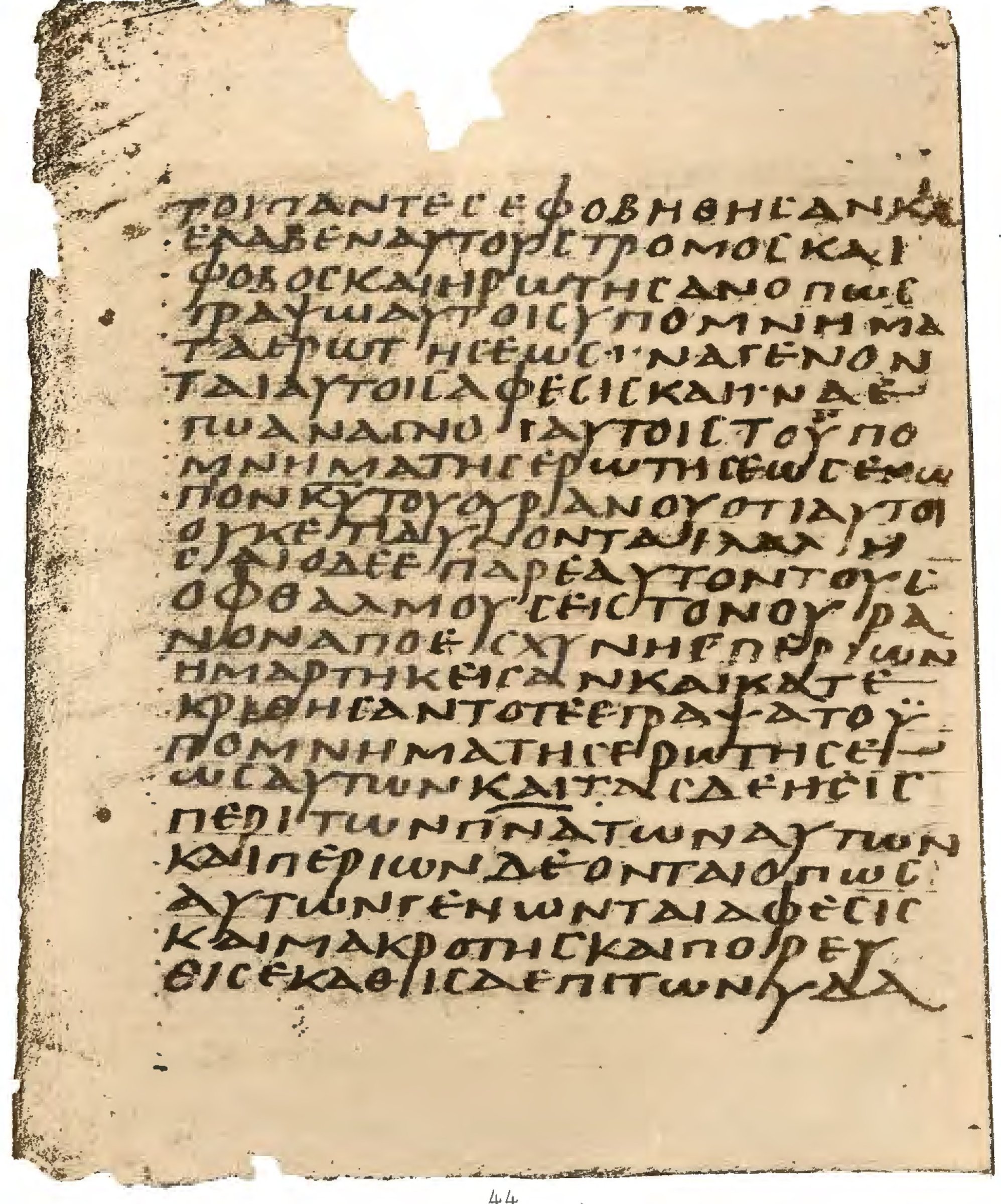
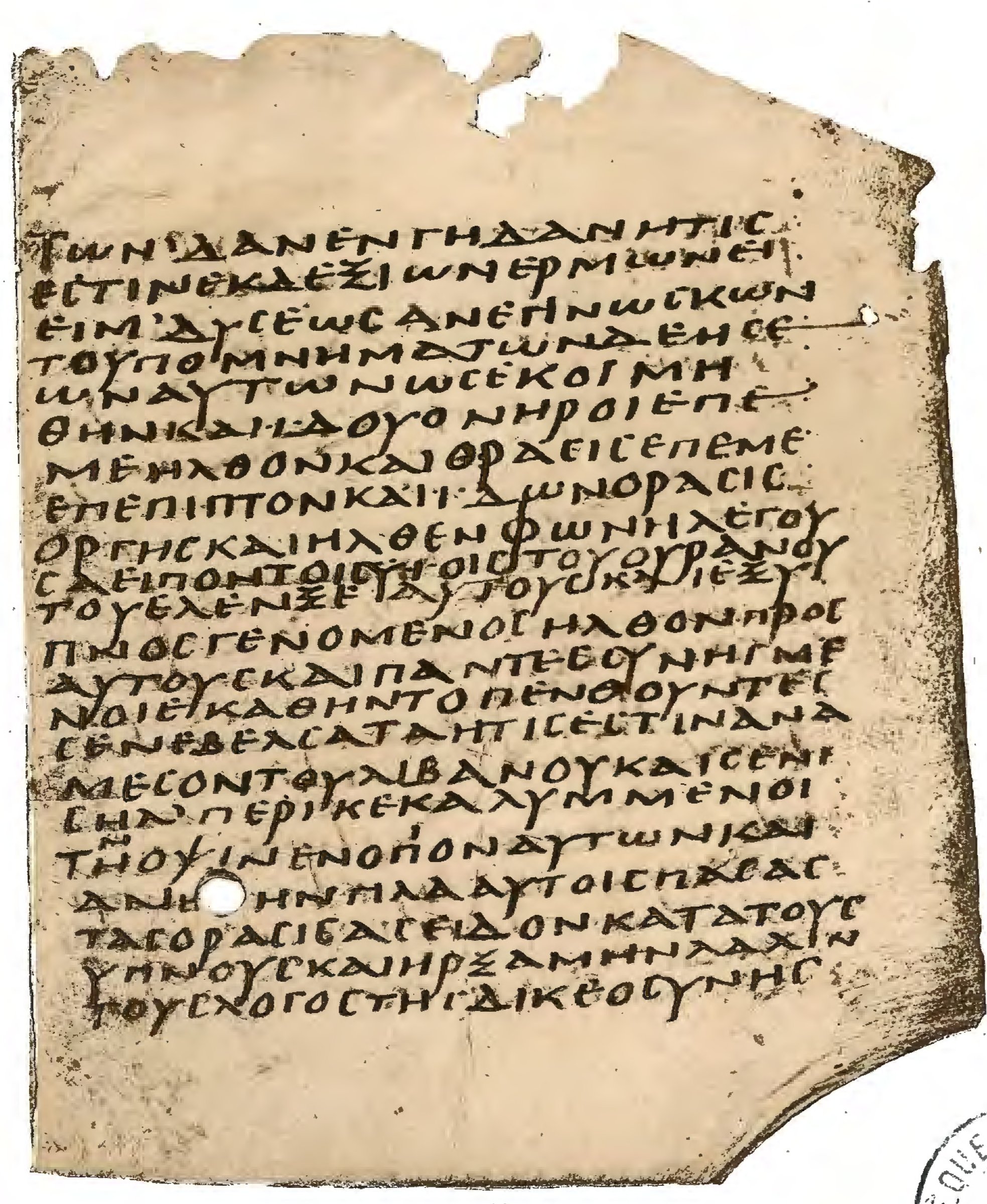
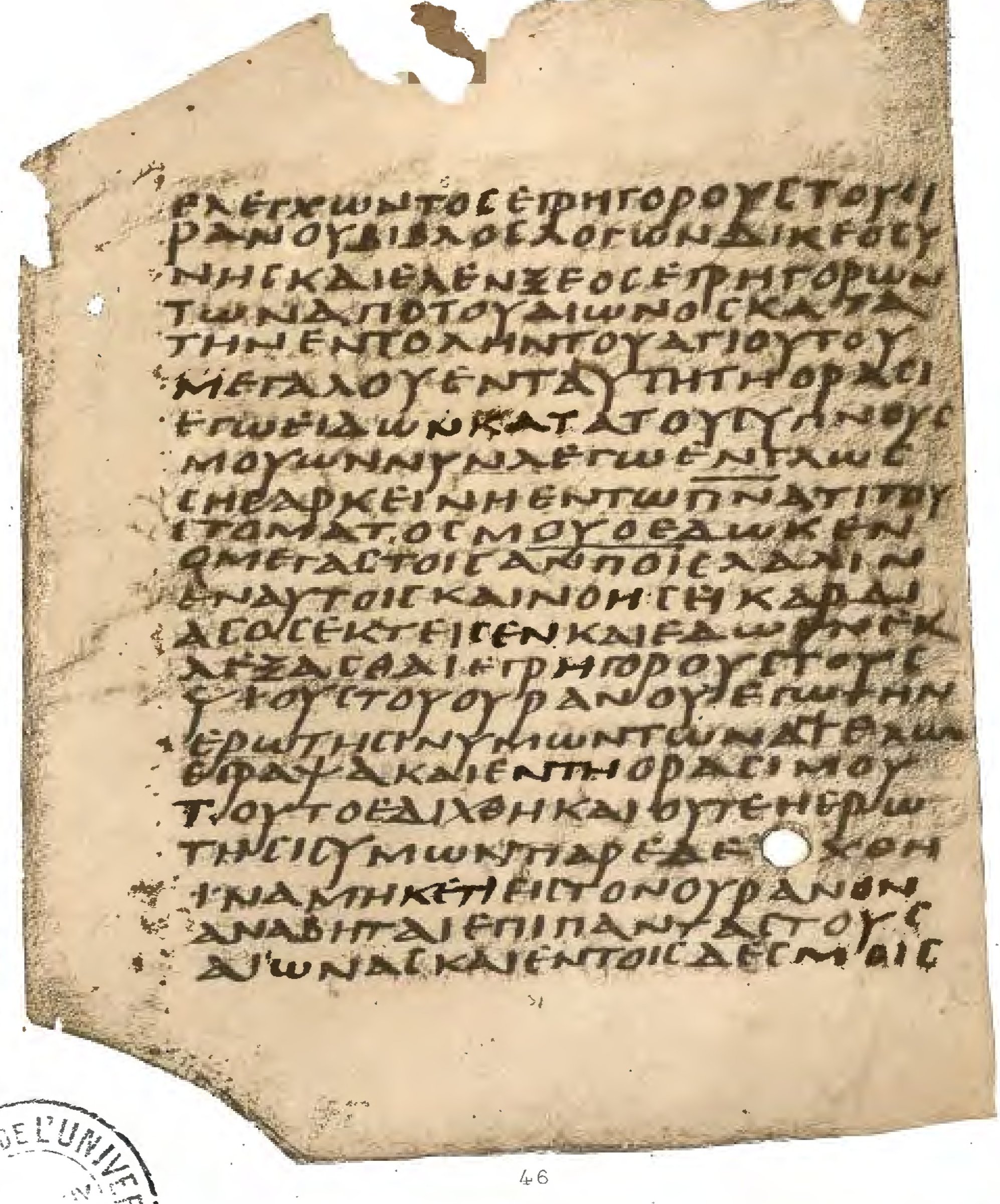
Akhmim codex pages 43, 44, 45, 46 (Lods's page numbers, printed under each plate page). Checked on the plates: p. 43 begins ‹και αυτοι ποιουσιν και ελαβον εαυτοις γυναικας›; p. 44 begins ‹[αυ]τοι παντες εφοβηθησαν και ελαβεν αυτους τρομος›; p. 45 begins ‹των υδατων δαν εν γη δαν ητις εστιν›; p. 46 begins ‹ελεγχων τους εγρηγορους του ουρανου βιβλος λογων›. Chapter 13 runs from verse 1 to 10 in Swete's numbering; page spans follow the first words of each page, read on the plates, and Lods's page/line/chapter/verse list (1893, pp. 230-232). The English is Charles's translation of the Ethiopic version; words he marks ⌜ ⌝ are in the Greek but not the Ethiopic, words in 〚 〛 are in the Ethiopic but not the Greek.
1Ὁ δὲ Ἑνὼχ τῷ Ἀζαὴλ εἶπεν Πορεύου· οὐκ ἔσται σοι εἰρήνη. κρίμα μέγα ἐξῆλθεν κατὰ σοῦ δῆσαί σε, 2καὶ ἀνοχὴ καὶ ἐρώτησίς σοι οὐκ ἔσται περὶ ὧν ἔδειξας ἀδικημάτων καὶ περὶ πάντων τῶν ἔργων τῶν ἀσεβειῶν καὶ τῆς ἀδικίας καὶ τῆς ἁμαρτίας, ὅσα ὑπέδειξας τοῖς ἀνθρώποις. 3Τότε πορευθεὶς εἴρηκα πᾶσιν αὐτοῖς, καὶ αὐτοὶ πάντες ἐφοβήθησαν, καὶ ἔλαβεν αὐτοὺς τρόμος καὶ φόβος. 4καὶ ἠρώτησαν ὅπως γράψω αὐτοῖς ὑπομνήματα ἐρωτήσεως, ἵνα γένηται αὐτοῖς ἄφεσις, καὶ ἵνα ἐγὼ ἀναγνῶ αὐτοῖς τὸ ὑπόμνημα τῆς ἐρωτήσεως ἐνώπιον Κυρίου τοῦ οὐρανοῦ, 5ὅτι αὐτοὶ οὐκ ἔτι δύνανται λαλῆσαι, οὐδὲ ἐπᾶραι αὐτῶν τοὺς ὀφθαλμοὺς εἰς τὸν οὐρανὸν ἀπὸ αἰσχύνης περὶ ὧν ἡμαρτήκεισαν καὶ κατεκρίθησαν. 6Τότε ἔγραψα τὸ ὑπόμνημα τῆς ἐρωτήσεως αὐτῶν καὶ τὰς δεήσεις περὶ τῶν πνευμάτων αὐτῶν καὶ περὶ ὧν δέονται, ὅπως αὐτῶν γένωνται ἄφεσις καὶ μακρότης. 7καὶ πορευθεὶς ἐκάθισα ἐπὶ τῶν ὑδάτων Δὰν ἐν γῇ Δάν, ἥτις ἐστὶν ἐκ δεξιῶν Ἑρμωνειεὶμ δύσεως· ἀνεγίγνωσκον τὸ ὑπόμνημα τῶν δεήσεων αὐτῶν. 8ὡς ἐκοιμήθην, καὶ ἰδοὺ ὄνειροι ἐπʼ ἐμὲ ἦλθον καὶ ὁράσεις ἐπʼ ἐμὲ ἐπέπιπτον, καὶ ἴδον ὁράσεις ὀργῆς, καὶ ἦλθεν φωνὴ λέγουσα Εἶπον τοῖς υἱοῖς τοῦ οὐρανοῦ τοῦ ἐλέγξαι αὐτούς. 9καὶ ἔξυπνος γενόμενος ἦλθον πρὸς αὐτούς, καὶ πάντες συνηγμένοι ἐκάθηντο πενθοῦντες ἐν Ἐβελσατά, ἥτις ἐστὶν ἀνὰ μέσον τοῦ Λιβάνου καὶ Σενισήλ, περικεκαλυμμένοι τὴν ὄψιν. 10ἐνώπιον αὐτῶν καὶ ἀνήγγειλα αὐτοῖς πάσας τὰς ὁράσεις ἂς εἶδον κατὰ τοὺς ὕπνους, καὶ ἠρξάμην λαλεῖν τοὺς λόγους τῆς δικαιοσύνης, ἐλέγχων τοὺς ἐγρηγόρους τοῦ οὐρανοῦ.
1 And Enoch went and said: ‘Azâzêl, thou shalt have no peace: a severe sentence has gone forth against thee to put thee in bonds: 2 And thou shalt not have toleration nor †request† granted to thee, because of the unrighteousness which thou hast taught, and because of all the works of godlessness and unrighteousness and sin which thou hast shown to men.’ 3 Then I went and spoke to them all together, and they were all afraid, and fear and trembling seized them. 4 And they besought me to draw up a petition for them that they might find forgiveness, and to read their petition in the presence of the Lord of heaven. 5 For from thenceforward they could not speak (with Him) nor lift up their eyes to heaven for shame of their sins for which they had been condemned. 6 Then I wrote out their petition, and the prayer †in regard to their spirits and their deeds individually and in regard to their requests that they should have forgiveness and length ‹of days›†. 7 And I went off and sat down at the waters of Dan, in the land of Dan, to the south of the west of Hermon: I read their petition till I fell asleep. 8 And behold a dream came to me, and visions fell down upon me, and I saw visions of chastisement, ⌜and a voice came bidding (me)⌝ to tell it to the sons of heaven, and reprimand them. 9 And when I awaked, I came unto them, and they were all sitting gathered together, weeping in ’Abelsjâîl, which is between Lebanon and Sênêsêr, with their faces covered. 10 And I recounted before them all the visions which I had seen in sleep, and I began to speak the words of righteousness, and to reprimand the heavenly Watchers.
Where on the image
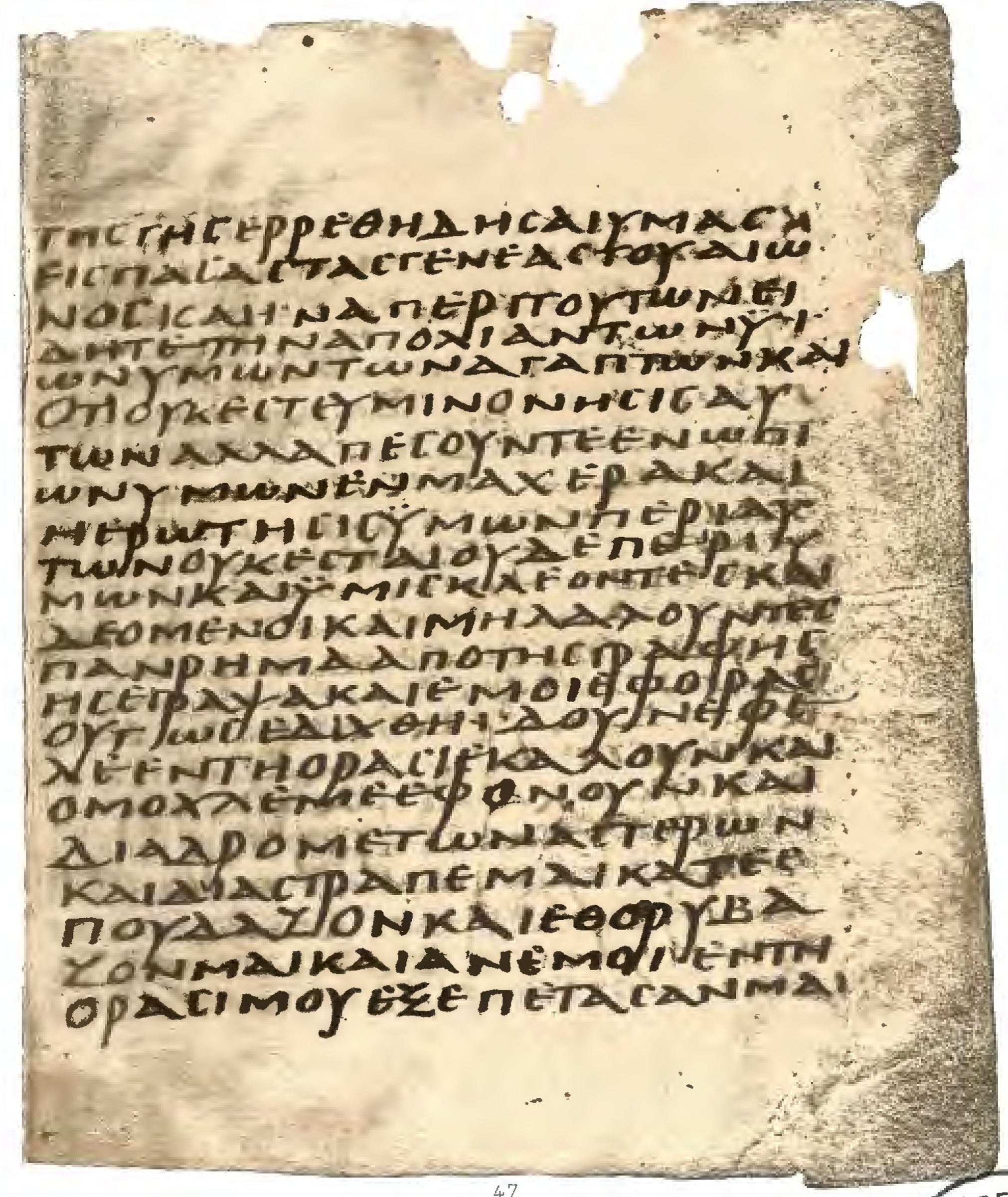
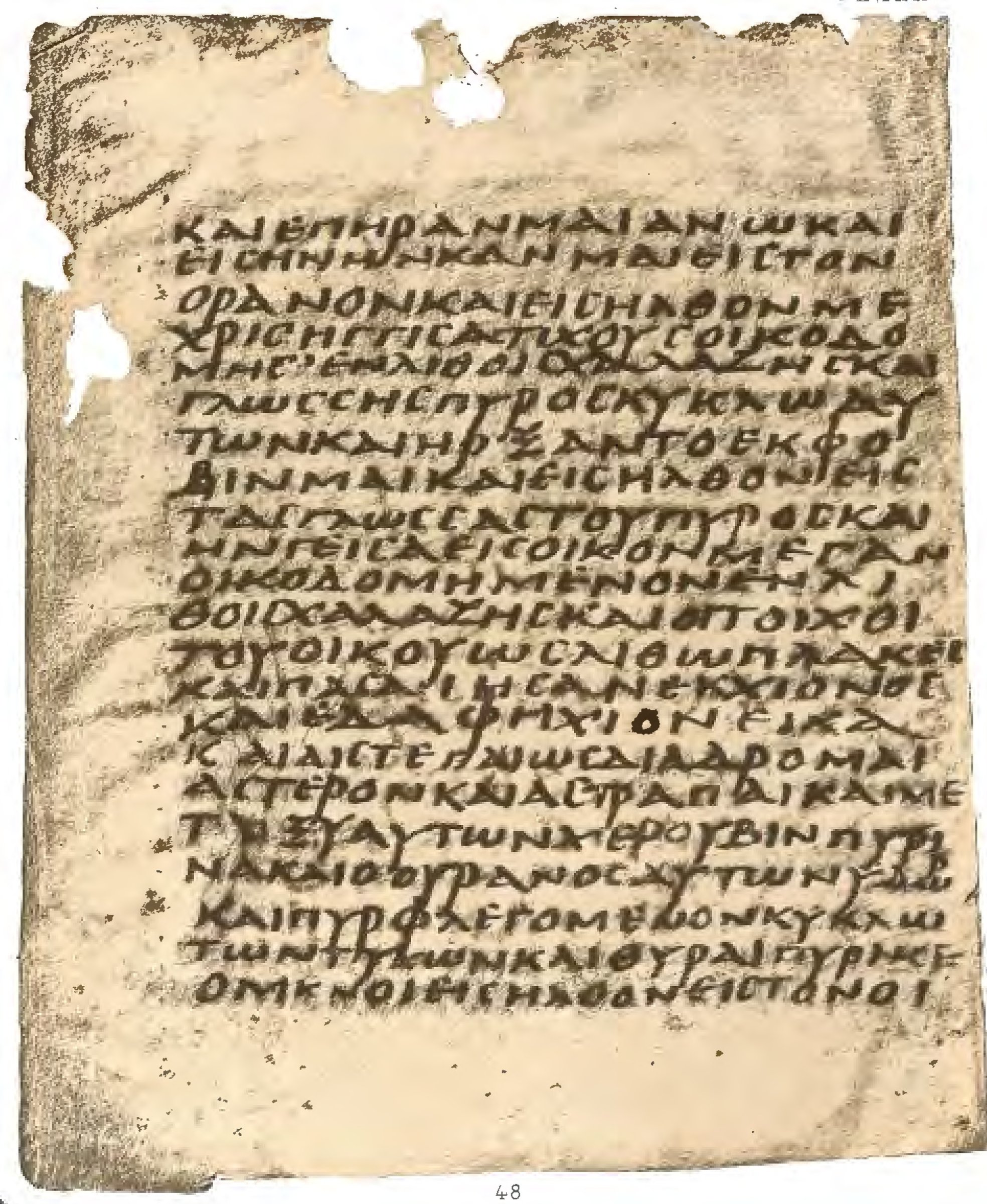
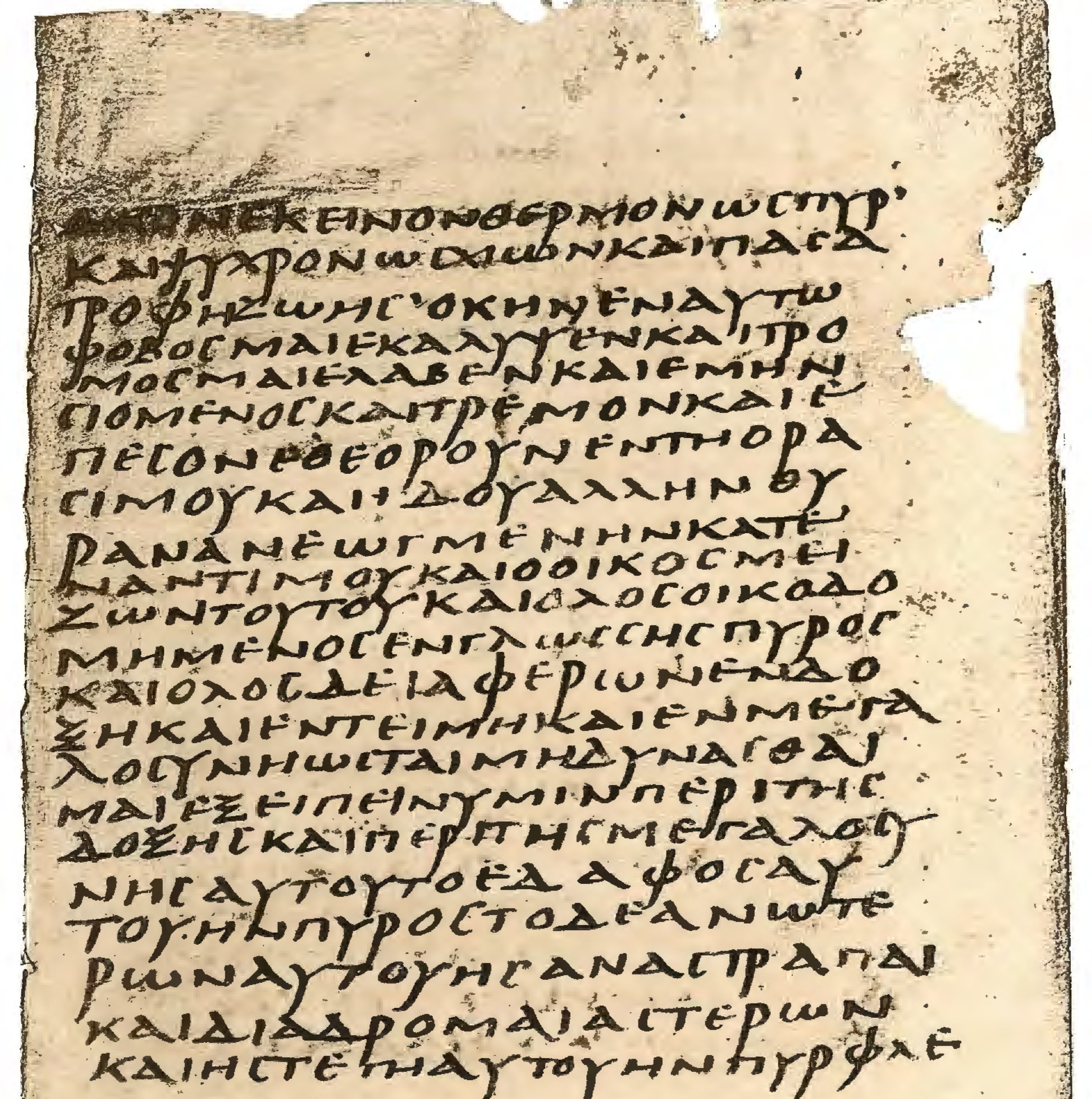
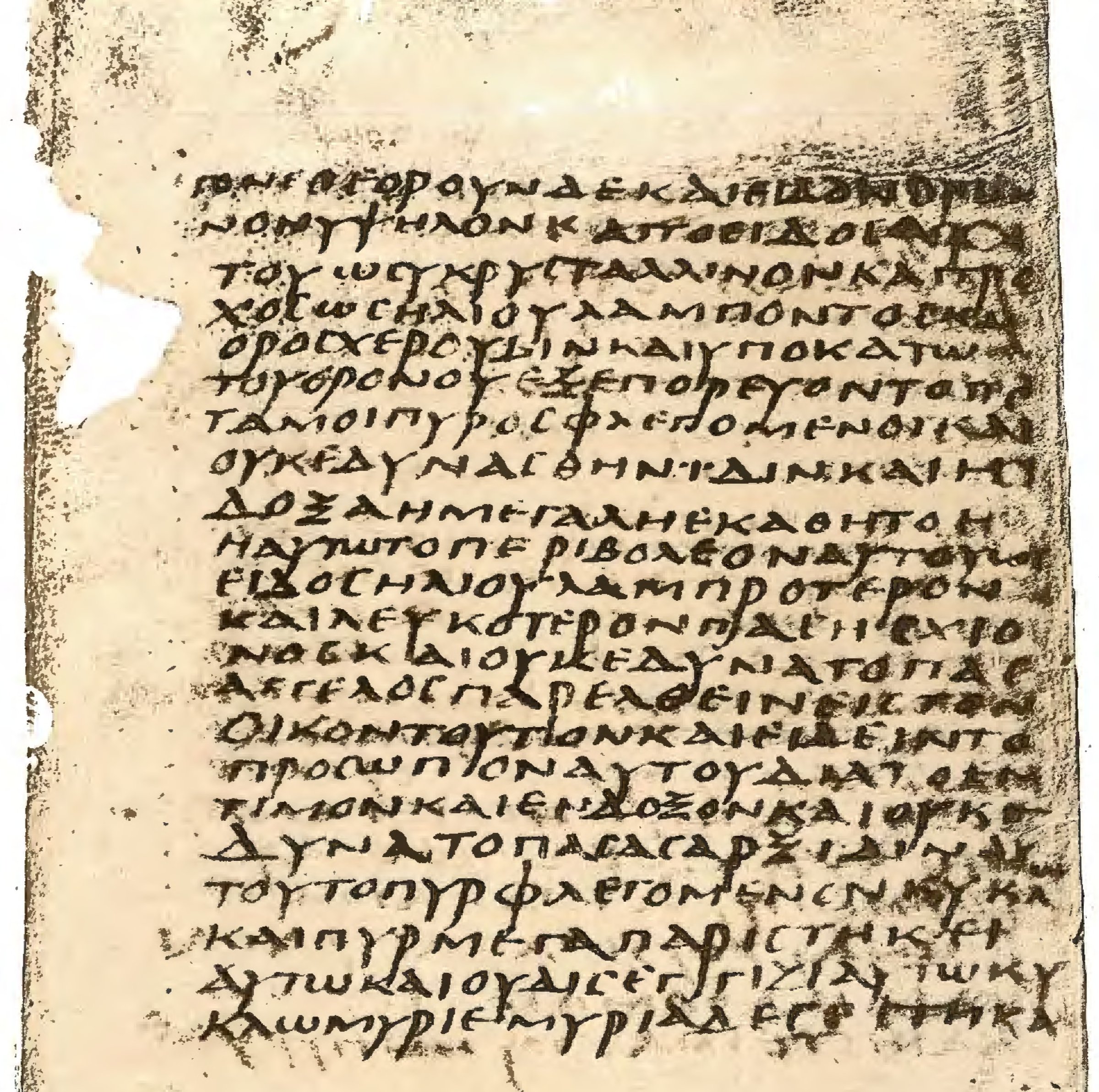
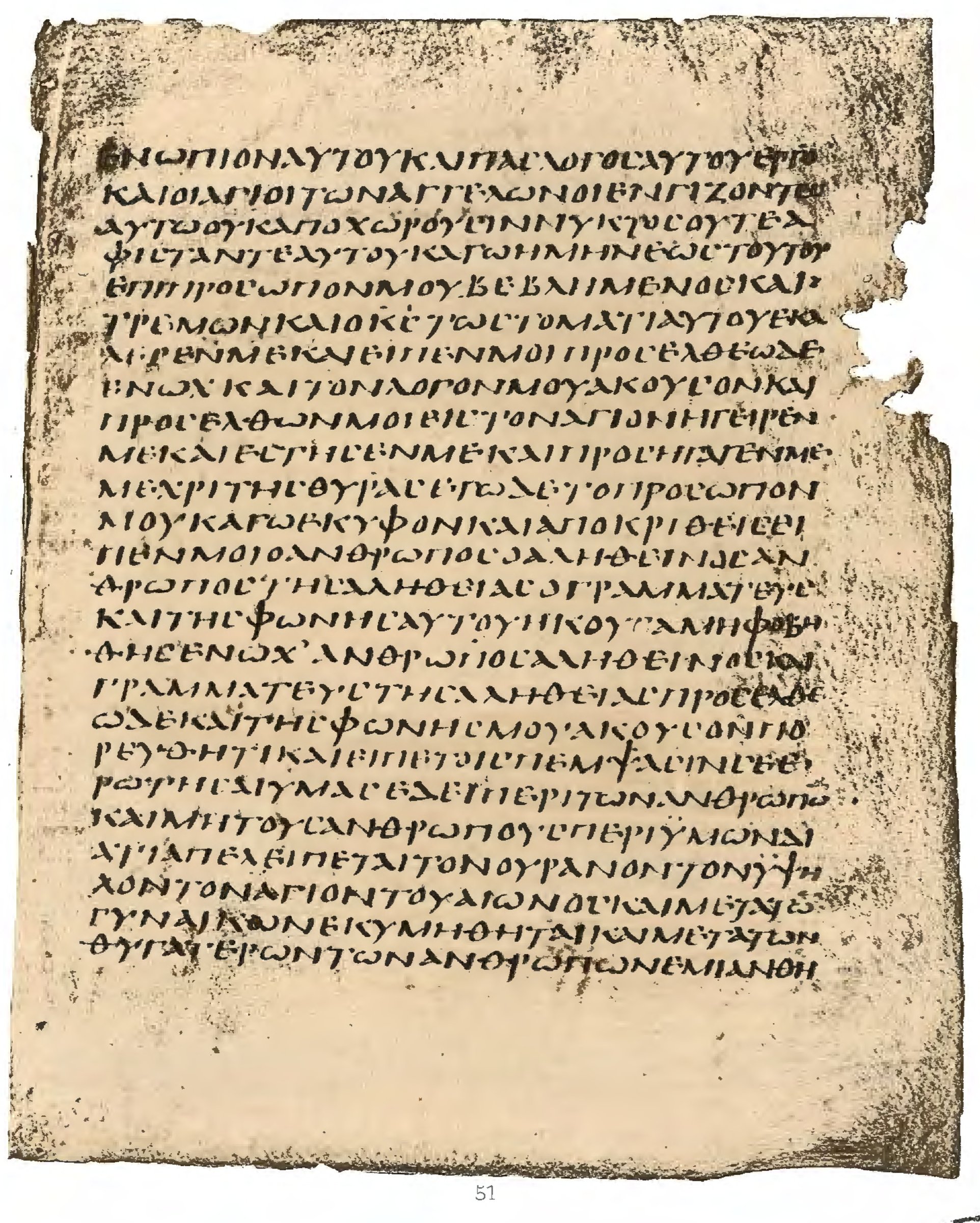
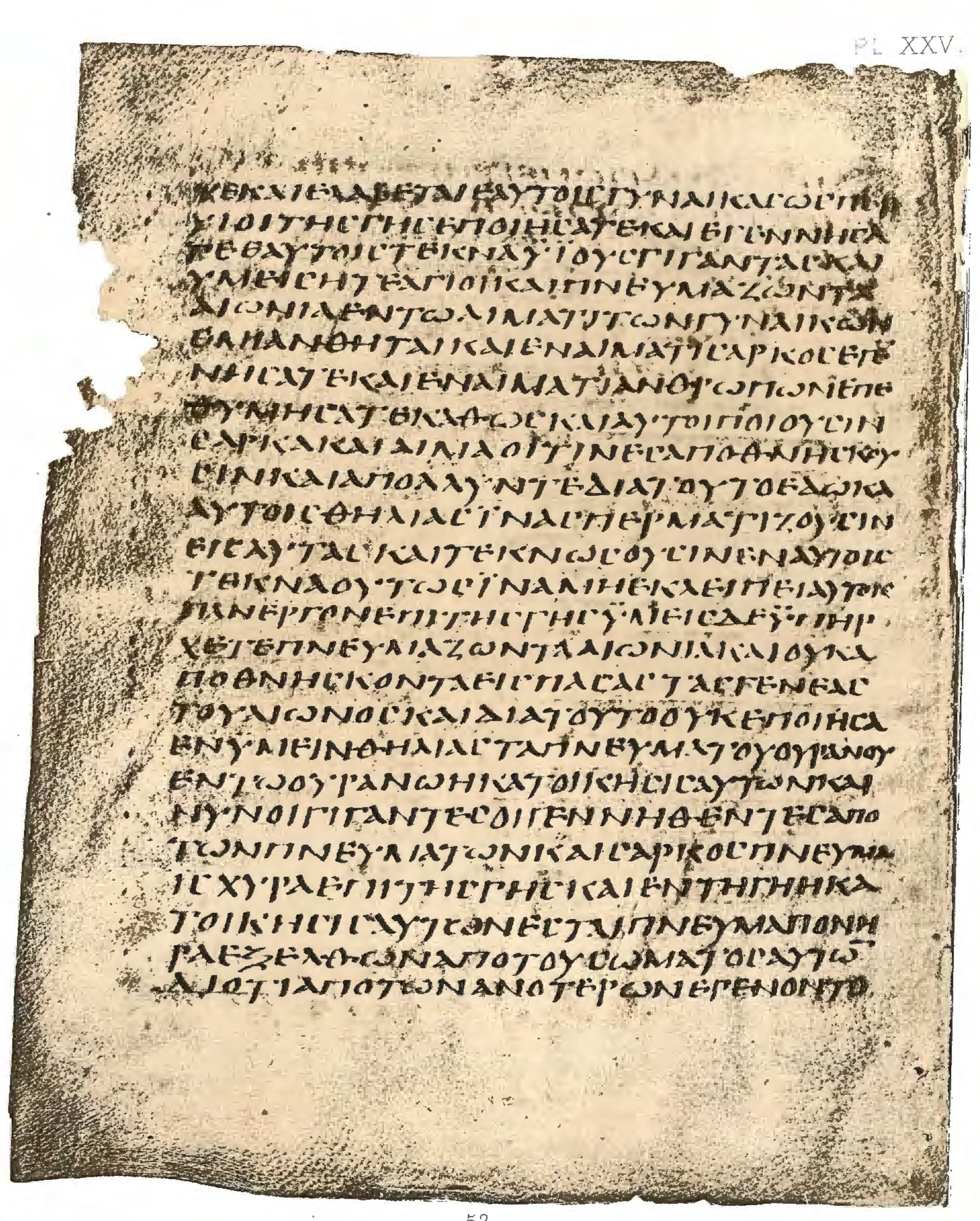
Akhmim codex pages 46, 47, 48, 49, 50, 51 (Lods's page numbers, printed under each plate page). Checked on the plates: p. 46 begins ‹ελεγχων τους εγρηγορους του ουρανου βιβλος λογων›; p. 47 begins ‹της γης ερρεθη ... εις πασας τας γενεας του αιωνος›; p. 48 begins ‹και επηραν με και ανω και εισηνεγκαν με εις τον ουρανον›; p. 49 begins ‹[εν]εκεινον θερμον ως πυρ και ψυχρον ως χιων›; p. 50 begins ‹[θρο]νον υψηλον και το ειδος αυτου ωσει κρυσταλλινον›; p. 51 begins ‹ενωπιον αυτου ... (second hand, smaller script)›. Chapter 14 runs from verse 1 to 25 in Swete's numbering; page spans follow the first words of each page, read on the plates, and Lods's page/line/chapter/verse list (1893, pp. 230-232). The English is Charles's translation of the Ethiopic version; words he marks ⌜ ⌝ are in the Greek but not the Ethiopic, words in 〚 〛 are in the Ethiopic but not the Greek.
1Βίβλος λόγων δικαιοσύνης καὶ ἐλέγξεως ἐγρηγόρων τῶν ἀπὸ τοῦ αἰῶνος, κατὰ τὴν ἐντολὴν τοῦ ἁγίου τοῦ μεγάλου ἐν ταύτῃ τῇ ὁράσει. 2Ἐγὼ εἶδον κατὰ τοὺς ὕπνους μου ἃ νῦν λέγω ἐν γλώσσῃ σαρκίνῃ ἐν τῷ πνεύματι τοῦ στόματός μου, ὃ ἔδωκεν ὁ μέγας τοῖς ἀνθρώποις λαλεῖν ἐν αὐτοῖς καὶ νοήσει καρδίας· 3ὃς ἔκτισεν καὶ ἔδωκεν ἐλέγξασθαι ἐγρηγόρους τοὺς υἱοὺς τοῦ οὐρανοῦ. 4Ἐγὼ τὴν ἐρώτησιν ὑμῶν τῶν ἀγγέλων ἔγραψα, καὶ ἐν τῇ ὁράσει μου τοῦτο ἐδείχθη· καὶ οὔτε ἡ ἐρώτησις ὑμῶν παρεδέχθη, 5ἵνα μηκέτι εἰς τὸν οὐρανὸν ἀναβῆτε ἐπὶ πάντας τοὺς αἰῶνας, καὶ ἐν τοῖς δεσμοῖς τῆς γῆς ἐρρέθη δῆσαι ὑμᾶς εἰς πάσας τὰς γενεάς τοῦ αἰῶνος, 6καὶ ἵνα περὶ τούτων ἴδητε τὴν ἀπώλειαν τῶν υἱῶν ὑμῶν τῶν ἀγαπητῶν, καὶ ὅτι οὐκ ἔσται ὑμῖν ὄνησις αὐτῶν, ἀλλὰ πεσοῦνται ἐνώπιον ὑμῶν ἐν μαχαίρᾳ. 7καὶ ἡ ἐρώτησις ὑμῶν περὶ αὐτῶν οὐκ ἔσται οὐδὲ περὶ ὑμῶν· καὶ ὑμεῖς κλαίοντες καὶ δεόμενοι καὶ μὴ λαλοῦντες πᾶν ῥῆμα ἀπὸ τῆς γραφῆς ἧς ἔγραψα. 8Καὶ ἐμοὶ ἐφʼ ὁράσει οὕτως ἐδείχθη· ἰδοὺ νεφέλαι ἐν τῇ ὁράσει ἐκάλουν καὶ ὁμίχλαι με ἐφώνουν, καὶ διαδρομαὶ τῶν ἀστέρων καὶ διαστραπαί με κατεσπούδαζον καὶ ἐθορύβαζόν με, καὶ ἄνεμοι ἐν τῇ ὁράσει μου ἐξεπέτασάν με 9καὶ ἐπῆράν με ἄνω καὶ εἰσήνεγκάν με εἰς τὸν οὐρανόν, καὶ εἰσῆλθον μέχρις ἤγγισα τείχους οἰκοδομῆς ἐν λίθοις χαλάζης καὶ γλώσσης πυρὸς κύκλῳ αὐτῶν· καὶ ἤρξαντο ἐκφοβεῖν με. 10Καὶ εἰσῆλθον εἰς τὰς γλῶσσας τοῦ πυρός, καὶ ἤγγισα εἰς οἶκον μέγαν οἰκοδομημένον ἐν λίθοις χαλάζης, καὶ οἱ τοῖχοι τοῦ οἴκου ὡς λιθόπλακες, καὶ πᾶσαι ἦσαν ἐκ χιόνος, καὶ ἐδάφη χιονικά, 11καὶ αἱ στέγαι ὡς διαδρομαὶ ἀστέρων καὶ ἀστραπαί, καὶ μεταξὺ αὐτῶν χερουβὶν πύρινα, καὶ οὐρανὸς αὐτῶν ὕδωρ, 12καὶ πῦρ φλεγόμενον κύκλῳ τῶν τειχῶν, καὶ θύραι πυρὶ καιόμεναι. 13εἰσῆλθον εἰς τὸν οἶκον ἐκεῖνον, θερμὸν ὡς πῦρ καὶ ψυχρὸν ὡς χιών, καὶ πᾶσα τροφὴ ζωῆς οὐκ ἦν ἐν αὐτῷ· φόβος με ἐκάλυψεν καὶ τρόμος με ἔλαβεν. 14καὶ ἥμην σειόμενος καὶ τρέμων, καὶ ἔπεσον. ἐθεώρουν ἐν τῇ ὁράσει μου, 15καὶ ἰδοὺ ἄλλη θύρα ἀνεῳγμένη κατέναντί μου, καὶ ὁ οἶκος μείζων τούτου, καὶ ὅλος οἰκοδομημένος ἐν γλώσσαις πυρός, 16καὶ ὅλος διαφέρων ἐν δόξῃ καὶ ἐν τιμῇ καὶ ἐν μεγαλοσύνῃ, ὥστε μὴ δύνασθαί με ἐξειπεῖν ὑμῖν περὶ τῆς δόξης καὶ περὶ τῆς μεγαλοσύνης αὐτοῦ. 17τὸ ἔδαφος αὐτοῦ ἦν πυρός, τὸ δὲ ἀνώτερον αὐτοῦ ἦσαν ἀστραπαὶ καὶ διαδρομαὶ ἀστέρων, καὶ ἡ στέγη αὐτοῦ ἦν πῦρ φλέγον. 18Ἐθεώρουν δὲ καὶ εἶδον θρόνον ὑψηλόν, καὶ τὸ εἶδος αὐτοῦ ὡσεὶ κρυστάλλινον, καὶ τροχὸς ὡς ἡλίου λάμποντος καὶ ὄρος χερουβίν. 19καὶ ὑποκάτω τοῦ θρόνου ἐξεπορεύοντο ποταμοὶ πυρὸς φλεγόμενοι, καὶ οὐκ ἐδυνάσθην ἰδεῖν. 20καὶ ἡ δόξα ἡ μεγάλη ἐκάθητο ἐπʼ αὐτῷ· τὸ περιβόλαιον αὐτοῦ ὡς εἶδος ἡλίου, λαμπρότερον καὶ λευκότερον πάσης χιόνος. 21καὶ οὐκ ἐδύνατο πᾶς ἄγγελος παρελθεῖν εἰς τὸν οἶκον τοῦτον καὶ ἰδεῖν τὸ πρόσωπον αὐτοῦ διὰ τὸ ἔντιμον καὶ ἔνδοξον, καὶ οὐκ ἐδύνατο πᾶσα σὰρξ ἰδεῖν αὐτοῦ 22τὸ πῦρ φλεγόμενον κύκλῳ· καὶ πῦρ μέγα παριστήκει αὐτῷ, καὶ οὐδεὶς ἐγγίζει αὐτῷ. κύκλῳ μύριαι μυριάδες ἑστήκασιν ἐνώπιον αὐτοῦ, καὶ πᾶς λόγος αὐτοῦ ἔργον. 23καὶ οἱ ἅγιοι τῶν ἀγγέλων οἱ ἐγγίζοντες αὐτῷ οὐκ ἀποχωροῦσιν νυκτὸς οὔτε ἀφίστανται αὐτοῦ. 24Κἀγὼ ἤμην ἕως τούτου ἐπὶ πρόσωπόν μου βεβλημένος καὶ τρέμων, καὶ ὁ κύριος τῷ στόματι αὐτοῦ ἐκάλεσέν με καὶ εἶπέν μοι Πρόσελθε ὦδε, Ἑνώχ, καὶ τὸν λόγον μου ἄκουσον. 25καὶ προσελθών μοι εἷς τῶν ἁγίων ἤγειρέν με καὶ ἔστησέν με, καὶ προσήγαγέν με μέχρι τῆς θύρας· ἐγὼ δὲ τὸ πρόσωπόν μου κάτω ἔκυφον.
1 The book of the words of righteousness, and of the reprimand of the eternal Watchers in accordance with the command of the Holy Great One in that vision. 2 I saw in my sleep what I will now say with a tongue of flesh and with the breath of my mouth: which the Great One has given to men to converse therewith and understand with the heart. 3 As He hath created and given 〚to man the power of understanding the word of wisdom, so hath He created me also and given〛 me the power of reprimanding the Watchers, the children of heaven. 4 I wrote out your petition, and in my vision it appeared thus, that your petition will not be granted unto you 〚throughout all the days of eternity, and that judgement has been finally passed upon you: yea (your petition) will not be granted unto you〛. 5 And from henceforth you shall not ascend into heaven unto all eternity, and ⌜in bonds⌝ of the earth the decree has gone forth to bind you for all the days of the world. 6 And (that) previously you shall have seen the destruction of your beloved sons and you shall have no pleasure in them, but they shall fall before you by the sword. 7 And your petition on their behalf shall not be granted, nor yet on your own: even though you weep and pray and speak all the words contained in the writing which I have written. 8 And the vision was shown to me thus: Behold, in the vision clouds invited me and a mist summoned me, and the course of the stars and the lightnings sped and hastened me, and the winds in the vision caused me to fly and lifted me upward, and bore me into heaven. 9 And I went in till I drew nigh to a wall which is built of crystals and surrounded by tongues of fire: and it began to affright me. 10 And I went into the tongues of fire and drew nigh to a large house which was built of crystals: and the walls of the house were like a tesselated floor (made) of crystals, and its groundwork was of crystal. 11 Its ceiling was like the path of the stars and the lightnings, and between them were fiery cherubim, and their heaven was (clear as) water. 12 A flaming fire surrounded the walls, and its portals blazed with fire. 13 And I entered into that house, and it was hot as fire and cold as ice: there were no delights of life therein: fear covered me, and trembling gat hold upon me. 14 And as I quaked and trembled, I fell upon my face. And I beheld a vision, 15 And lo! there was a second house, greater than the former, and the entire portal stood open before me, and it was built of flames of fire. 16 And in every respect it so excelled in splendour and magnificence and extent that I cannot describe to you its splendour and its extent. 17 And its floor was of fire, and above it were lightnings and the path of the stars, and its ceiling also was flaming fire. 18 And I looked and saw 〚therein〛 a lofty throne: its appearance was as crystal, and the wheels thereof as the shining sun, and there was the vision of cherubim. 19 And from underneath the throne came streams of flaming fire so that I could not look thereon. 20 And the Great Glory sat thereon, and His raiment shone more brightly than the sun and was whiter than any snow. 21 None of the angels could enter and could behold His face by reason of the magnificence and glory, and no flesh could behold Him. 22 The flaming fire was round about Him, and a great fire stood before Him, and none around could draw nigh Him: ten thousand times ten thousand (stood) before Him, yet He needed no counsellor. 23 And the most holy ones who were nigh to Him did not leave by night nor depart from Him. 24 And until then I had been prostrate on my face, trembling: and the Lord called me with His own mouth, and said to me: ‘Come hither, Enoch, and hear my word.’ 25 ⌜And one of the holy ones came to me and waked me⌝, and He made me rise up and approach the door: and I bowed my face downwards.
Where on the image
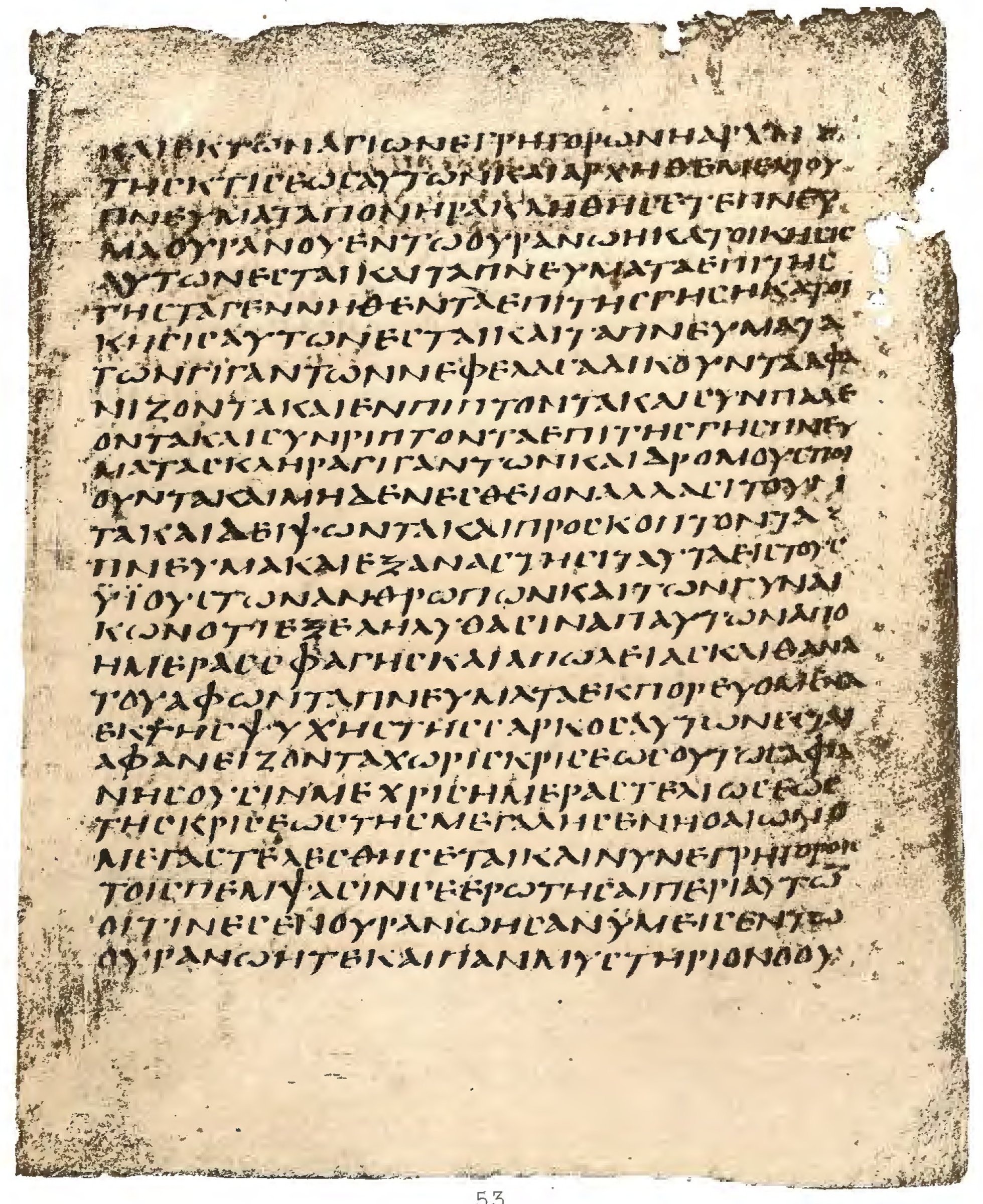
Akhmim codex pages 51, 52, 53 (Lods's page numbers, printed under each plate page). Checked on the plates: p. 51 begins ‹ενωπιον αυτου ... (second hand, smaller script)›; p. 52 begins ‹και ελαβετε εαυτοις γυναικας ωσπερ οι υιοι της γης›; p. 53 begins ‹και εκ των αγιων εγρηγορων η αρχη της κτισεως αυτων›. Chapter 15 runs from verse 1 to 12 in Swete's numbering; page spans follow the first words of each page, read on the plates, and Lods's page/line/chapter/verse list (1893, pp. 230-232). The English is Charles's translation of the Ethiopic version; words he marks ⌜ ⌝ are in the Greek but not the Ethiopic, words in 〚 〛 are in the Ethiopic but not the Greek.
1Καὶ ἀποκριθεὶς εἶπέν μοι Ὁ ἄνθρωπος ὁ ἀληθινός, ἄνθρωπος τῆς ἀληθείας, ὁ γραμματεύς· καὶ τῆς φωνῆς αὐτοῦ ἤκουσα· μὴ φοβηθῇς, Ἑνώχ, ἄνθρωπος ἀληθινὸς καὶ γραμματεὺς τῆς ἀληθείας· πρόσελθε ὧδε, καὶ τῆς φωνῆς μου ἄκουσον. 2πορεύθητι καὶ εἰπὲ τοῖς πέμψασίν σε Ἐρωτῆσαι ὑμᾶς ἔδει περὶ τῶν ἀνθρώπων, καὶ μὴ τοὺς ἀνθρώπους περὶ ὑμῶν. 3διὰ τί ἀπελίπετε τὸν οὐρανὸν τὸν ὑψηλὸν τὸν ἅγιον τοῦ αἰῶνος, καὶ μετὰ τῶν γυναικῶν ἐκοιμήθητε καὶ μετὰ τῶν θυγατέρων τῶν ἀνθρώπων ἐμιάνθητε καὶ ἐλάβετε ἑαυτοῖς γυναῖκας; ὥσπερ υἱοὶ τῆς γῆς ἐποιήσατε καὶ ἐγεννήσατε ἑαυτοῖς τέκνα, υἱοὺς γίγαντας. 4καὶ ὑμεῖς ἦτε ἅγιοι καὶ πνεύματα ζῶντα αἰώνια· ἐν τῷ αἵματι τῶν γυναικῶν ἐμιάνθητε, καὶ ἐν αἵματι σαρκὸς ἐγεννήσατε καὶ ἐν αἵματι ἀνθρώπων ἐπεθυμήσατε, καθὼς καὶ αὐτοὶ ποιοῦσιν σάρκα καὶ αἷμα, οἵτινες ἀποθνήσκουσιν καὶ ἀπόλλυνται. 5διὰ τοῦτο ἔδωκα αὐτοῖς θηλείας, ἵνα σπερματίζουσιν εἰς αὐτὰς καὶ τεκνώσουσιν ἐν αὐταῖς τέκνα οὕτως, ἵνα μὴ ἐκλείπῃ αὐτοῖς πᾶν ἔργον ἐπὶ τῆς γῆς. 6ὑμεῖς δὲ ὑπήρχετε πνεύματα ζῶντα αἰώνια καὶ οὐκ ἀποθνήσκοντα εἰς πάσας τὰς γενεὰς τοῦ αἰῶνος. 7καὶ διὰ τοῦτο οὐκ ἐποίησα ἐν ὑμῖν θηλείας· τὰ πνεύματα τοῦ οὐρανοῦ, ἐν τῷ οὐρανῷ ἡ κατοίκησις αὐτῶν. 8καὶ νῦν οἱ γίγαντες οἱ γεννηθέντες ἀπὸ τῶν πνευμάτων καὶ σαρκὸς πνεύματα ἰσχυρὰ ἐπὶ τῆς γῆς, καὶ ἐν τῇ γῇ ἡ κατοίκησις αὐτῶν ἔσται. 9πνεύματα πονηρὰ ἐξῆλθον ἀπὸ τοῦ σώματος αὐτῶν, διότι ἀπὸ τῶν ἀνωτέρων ἐγένοντο, καὶ ἐκ τῶν ἁγίων ἐγρηγόρων ἡ ἀρχὴ τῆς κτίσεως αὐτῶν καὶ ἀρχὴ θεμελίου· πνεύματα πονηρὰ κληθήσεται. 10πνεύματα οὐρανοῦ, ἐν τῷ οὐρανῷ ἡ κατοίκησις αὐτῶν ἔσται· καὶ τὰ πνεύματα ἐπὶ τῆς γῆς τὰ γεννηθέντα, ἐπὶ τῆς γῆς ἡ κατοίκησις αὐτῶν ἔσται. 11καὶ τὰ πνεύματα τῶν γιγάντων νεφέλας ἀδικοῦντα, ἀφανίζοντα καὶ ἐνπίπτοντα καὶ συνπαλαίοντα καὶ συνρίπτοντα ἐπὶ τῆς γῆς, πνεύματα σκληρὰ γιγάντων, καὶ δρόμους ποιοῦντα καὶ μηδὲν ἐσθίοντα, ἀλλʼ ἀσιτοῦντα καὶ διψῶντα καὶ προσκόπτοντα πνεύματα. 12καὶ ἐξαναστήσει ταῦτα εἰς τοὺς υἱοὺς τῶν ἀνθρώπων καὶ τῶν γυναικῶν, ὅτι ἐξεληλύθασιν ἀπʼ αὐτῶν,
1 And He answered and said to me, and I heard His voice: ‘Fear not, Enoch, thou righteous man and scribe of righteousness: approach hither and hear my voice. 2 And go, say to 〚the Watchers of heaven〛, who have sent thee to intercede 〚for them: “You should intercede〛 for men, and not men for you: 3 Wherefore have ye left the high, holy, and eternal heaven, and lain with women, and defiled yourselves with the daughters of men and taken to yourselves wives, and done like the children of earth, and begotten giants (as your) sons. 4 And though ye were holy, spiritual, living the eternal life, you have defiled yourselves with the blood of women, and have begotten (children) with the blood of flesh, and, as the children of men, have lusted after flesh and blood as those ⌜also⌝ do who die and perish. 5 Therefore have I given them wives also that they might impregnate them, and beget children by them, that thus nothing might be wanting to them on earth. 6 But you were ⌜formerly⌝ spiritual, living the eternal life, and immortal for all generations of the world. 7 And therefore I have not appointed wives for you; for as for the spiritual ones of the heaven, in heaven is their dwelling. 8 And now, the giants, who are produced from the spirits and flesh, shall be called evil spirits upon the earth, and on the earth shall be their dwelling. 9 Evil spirits have proceeded from their bodies; because they are born from men, 〚and〛 from the holy Watchers is their beginning and primal origin; ⌜they shall be evil spirits on earth, and⌝ evil spirits shall they be called. [10 As for the spirits of heaven, in heaven shall be their dwelling, but as for the spirits of the earth which were born upon the earth, on the earth shall be their dwelling.] 11 And the spirits of the giants afflict, oppress, destroy, attack, do battle, and work destruction on the earth, and cause trouble: they take no food, ⌜but nevertheless hunger⌝ and thirst, and cause offences. 12 And these spirits shall rise up against the children of men and against the women, because they have proceeded ⌜from them⌝.
Where on the image
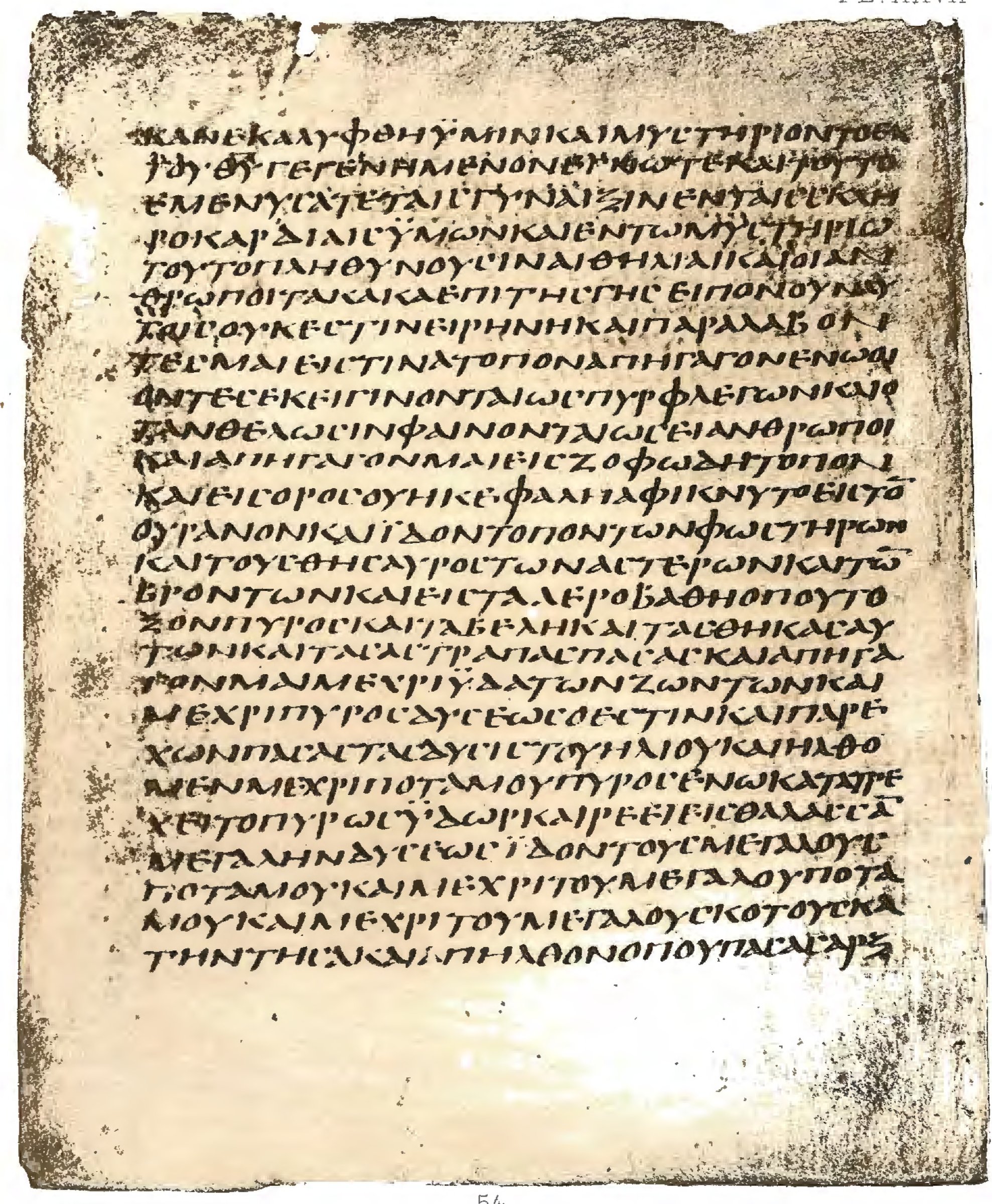
Akhmim codex pages 53, 54 (Lods's page numbers, printed under each plate page). Checked on the plates: p. 53 begins ‹και εκ των αγιων εγρηγορων η αρχη της κτισεως αυτων›; p. 54 begins ‹ανεκαλυφθη υμιν και μυστηριον το εκ του θεου γεγενημενον›. Chapter 16 runs from verse 1 to 4 in Swete's numbering; page spans follow the first words of each page, read on the plates, and Lods's page/line/chapter/verse list (1893, pp. 230-232). The English is Charles's translation of the Ethiopic version; words he marks ⌜ ⌝ are in the Greek but not the Ethiopic, words in 〚 〛 are in the Ethiopic but not the Greek.
1ἀπὸ ἡμέρας σφαγῆς καὶ ἀπωλείας καὶ θανάτου, ἀφʼ ὧν τὰ πνεύματα ἐκπορευόμενα ἐκ τῆς ψυχῆς τῆς σαρκὸς αὐτῶν ἔσται ἀφανίζοντα χωρὶς κρίσεως· οὕτως ἀφανίσουσιν μέχρις ἡμέρας τελειώσεως, τῆς κρίσεως τῆς μεγάλης, ἐν ᾗ ὁ αἰὼν ὁ μέγας τελεσθήσεται. 2Καὶ νῦν ἐγρηγόροις τοῖς πέμψασίν σε ἐρωτῆσαι περὶ αὐτῶν, οἵτινες ἐν οὐρανῷ ἦσαν 3Ὑμεῖς ἐν τῷ οὐρανῷ ἦτε, καὶ πᾶν μυστήριον ὃ οὐκ ἀνεκαλύφθη ὑμῖν καὶ μυστήριον τὸ ἐκ τοῦ θεοῦ γεγενημένον ἔγνωτε, καὶ τοῦτο ἐμηνύσατε ταῖς γυναιξὶν ἐν ταῖς σκληροκαρδίαις ὑμῶν, καὶ ἐν τῷ μυστηρίῳ τούτῳ πληθύνουσιν αἱ θήλειαι καὶ οἱ ἄνθρωποι τὰ κακὰ ἐπὶ τῆς γῆς. 4εἰπὸν οὖν αὐτοῖς Οὐκ ἔστιν εἰρήνη.
1 From the days of the slaughter and destruction and death ⌜of the giants⌝, from the souls of whose flesh the spirits, having gone forth, shall destroy without incurring judgement—thus shall they destroy until the day of the consummation, the great ⌜judgement⌝ in which the age shall be consummated over the Watchers and the godless, yea, shall be wholly consummated.” 2 And now as to the Watchers who have sent thee to intercede for them, who had been 〚aforetime〛 in heaven, (say to them): 3 “You have been in heaven, but ⌜all⌝ the mysteries had not yet been revealed to you, and you knew worthless ones, and these in the hardness of your hearts you have made known to the women, and through these mysteries women and men work much evil on earth.” 4 Say to them therefore: “You have no peace.”’
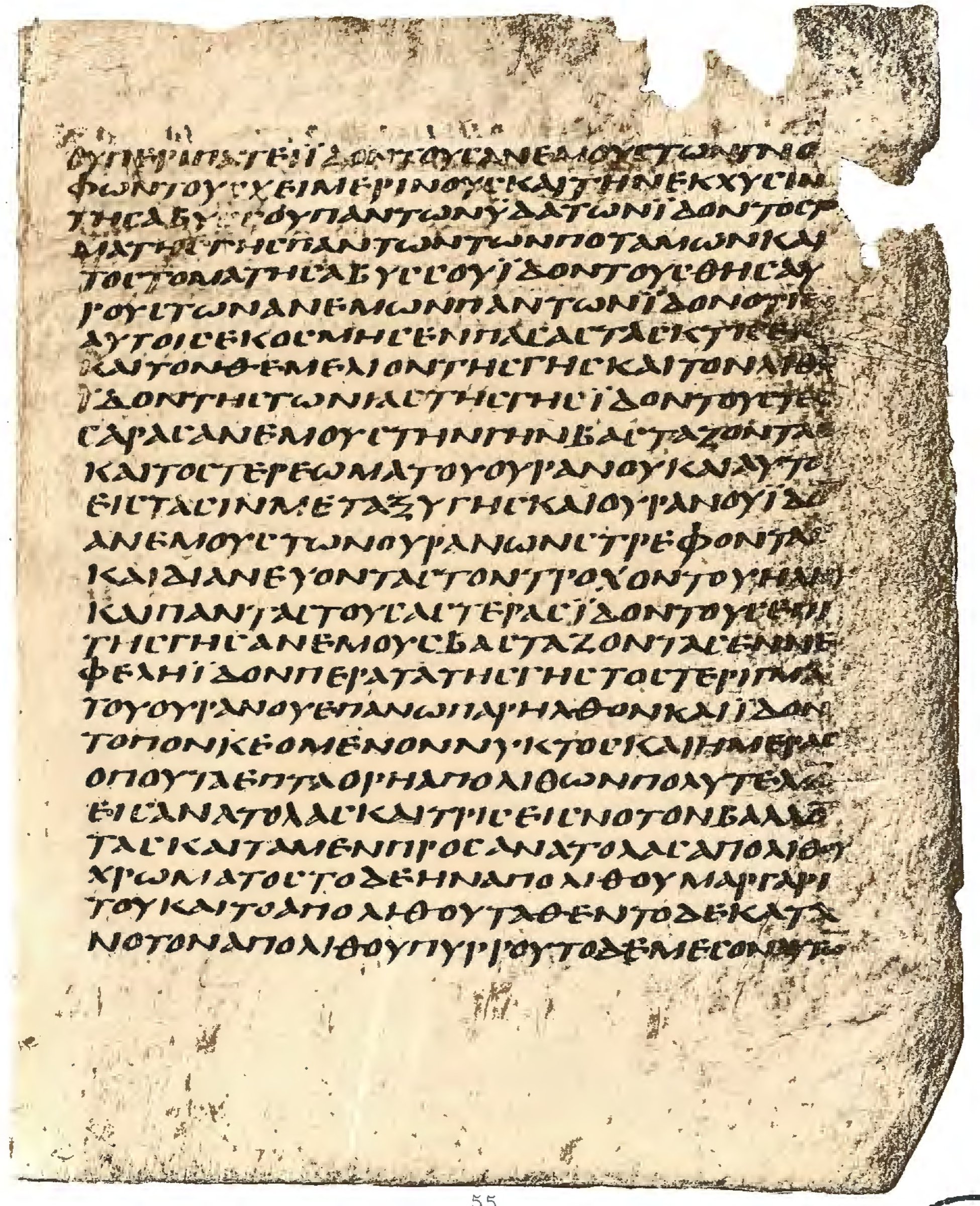
Where on the image
Akhmim codex pages 54, 55 (Lods's page numbers, printed under each plate page). Checked on the plates: p. 54 begins ‹ανεκαλυφθη υμιν και μυστηριον το εκ του θεου γεγενημενον›; p. 55 begins ‹... επι τους ανεμους ... ιδον τους θησαυρους των ανεμων›. Chapter 17 runs from verse 1 to 8 in Swete's numbering; page spans follow the first words of each page, read on the plates, and Lods's page/line/chapter/verse list (1893, pp. 230-232). The English is Charles's translation of the Ethiopic version; words he marks ⌜ ⌝ are in the Greek but not the Ethiopic, words in 〚 〛 are in the Ethiopic but not the Greek.
1Καὶ παραλαβόντες με εἰς τινα τόπον ἀπήγαγον, ἐν ᾧ οἱ ὄντες ἐκεῖ γίνονται ὡς πῦρ φλέγον καί, ὅταν θέλωσιν, φαίνονται ὡσεὶ ἄνθρωποι. 2Καὶ ἀπήγαγόν με εἰς ζοφώδη τόπον καὶ εἰς ὄρος οὗ ἡ κεφαλὴ ἀφικνεῖτο εἰς τὸν οὐρανόν. 3καὶ εἶδον τόπον τῶν φωστήρων καὶ τοὺς θησαυροὺς τῶν ἀστέρων καὶ τῶν βροντῶν, καὶ εἰς τὰ ἀεροβαθῆ, ὅπου τόξον πυρὸς καὶ τὰ βέλη καὶ αἱ θῆκαι αὐτῶν καὶ αἱ ἀστραπαὶ πᾶσαι. 4Καὶ ἀπήγαγόν με μέχρι ὑδάτων ζώντων καὶ μέχρι πυρὸς δύσεως, ὅ ἐστιν καὶ παρέχον πάσας τὰς δύσεις τοῦ ἡλίου. 5καὶ ἤλθομεν μέχρι ποταμοῦ πυρός, ἐν ᾧ κατατρέχει τὸ πῦρ ὡς ὕδωρ καὶ ῥέει εἰς θάλασσαν μεγάλην δύσεως. 6ἴδον τοὺς μεγάλους ποταμούς, καὶ μέχρι τοῦ μεγάλου ποταμοῦ καὶ μέχρι τοῦ μεγάλου σκότους κατήντησα, καὶ ἀπῆλθον ὅπου πᾶσα σὰρξ οὐ περιπατεῖ 7ἴδον τοὺς ἀνέμους τῶν γνόφων τοὺς χειμερινοὺς καὶ τὴν ἔκχυσιν τῆς ἀβύσσου πάντων ὑδάτων. 8ἴδον τὸ στόμα τῆς γῆς πάντων τῶν ποταμῶν καὶ τὸ στόμα τῆς ἀβύσσου.
1 And they took ⌜and⌝ brought me to a place in which those who were there were like flaming fire, and when they wished, they appeared as men. 2 And they brought me to the place of darkness, and to a mountain the point of whose summit reached to heaven. 3 And I saw the places of the luminaries ⌜and the treasuries of the stars⌝ and of the thunder, ⌜and⌝ in the uttermost depths, where were a fiery bow and arrows and their quiver, 〚and a fiery sword〛 and all the lightnings. 4 And they took me to the living waters, and to the fire of the west, which receives every setting of the sun. 5 And I came to a river of fire in which the fire flows like water and discharges itself into the great sea towards the west. 6 I saw the great rivers and came to the great ⌜river and to the great⌝ darkness, and went to the place where no flesh walks. 7 I saw the mountains of the darkness of winter and the place whence all the waters of the deep flow. 8 I saw the mouths of all the rivers of the earth and the mouth of the deep.
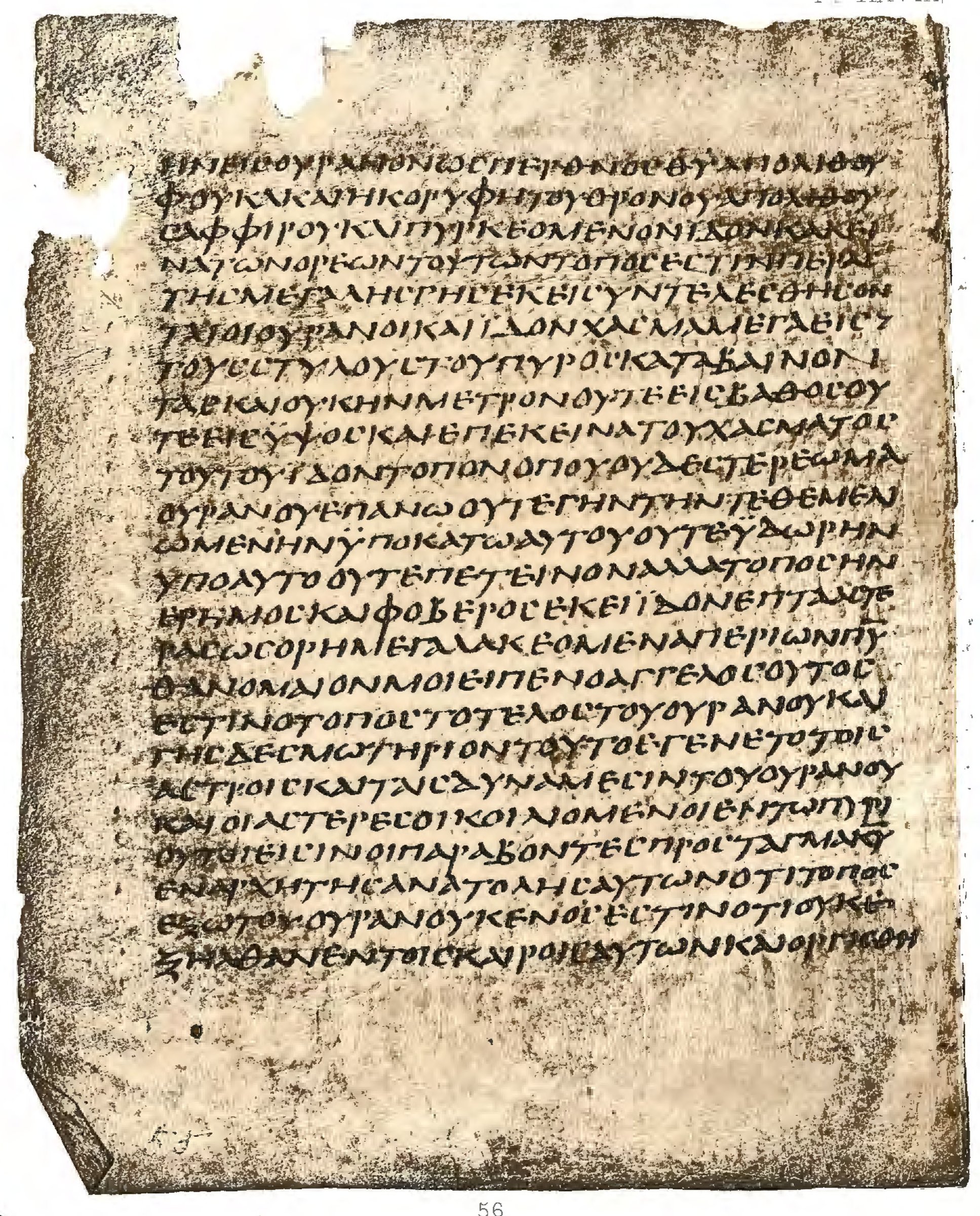
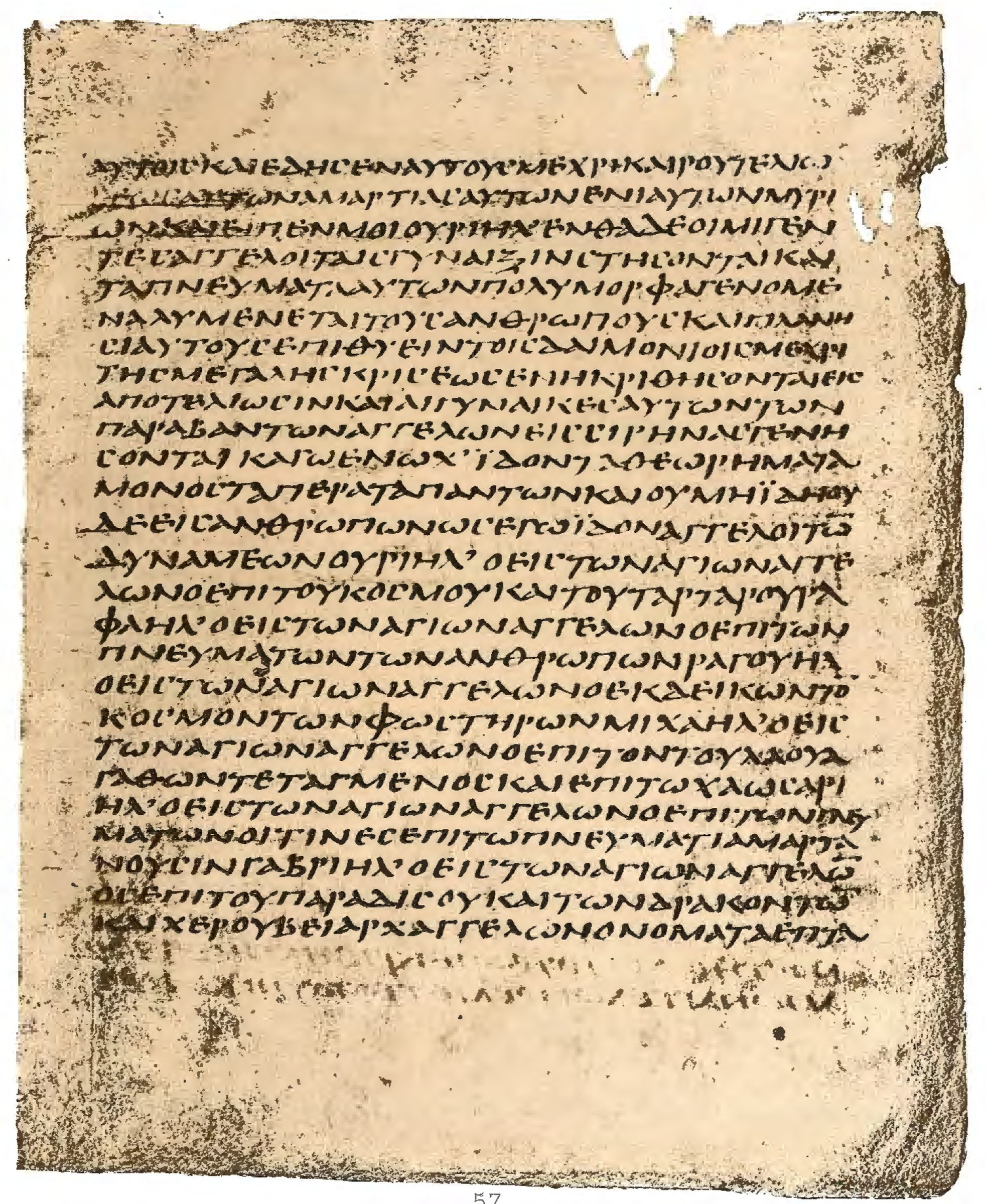
Where on the image
Akhmim codex pages 55, 56, 57 (Lods's page numbers, printed under each plate page). Checked on the plates: p. 55 begins ‹... επι τους ανεμους ... ιδον τους θησαυρους των ανεμων›; p. 56 begins ‹θρονου θεου ... απο λιθου σαπφειρου›; p. 57 begins ‹... ειπεν μοι ουριηλ ενθαδε οι μιγεντες αγγελοι›. Chapter 18 runs from verse 1 to 16 in Swete's numbering; page spans follow the first words of each page, read on the plates, and Lods's page/line/chapter/verse list (1893, pp. 230-232). The English is Charles's translation of the Ethiopic version; words he marks ⌜ ⌝ are in the Greek but not the Ethiopic, words in 〚 〛 are in the Ethiopic but not the Greek.
1ἴδον τοὺς θησαυροὺς τῶν ἀνέμων πάντων, ἴδον ὅτι ἐν αὐτοῖς ἐκόσμησεν πάσας τὰς κτίσεις καὶ τὸν θεμέλιον τῆς γῆς, 2καὶ τὸν λίθον ἴδον τῆς γωνίας τῆς γῆς. ἴδον τοὺς τέσσαρας ἀνέμους τὴν γῆν βαστάζοντας, καὶ τὸ στερέωμα τοῦ οὐρανοῦ, 3καὶ αὐτοὶ ἱστᾶσιν μεταξὺ γῆς καὶ οὐρανοῦ. 4ἴδον ἀνέμους τῶν οὐρανῶν στρέφοντας καὶ διανύοντας τὸν τροχὸν τοῦ ἡλίου, καὶ πάντας τοὺς ἀστέρας. 5ἴδον τοὺς ἐπὶ τῆς γῆς ἀνέμους βαστάζοντας ἐν νεφέλῃ. ἴδον πέρατα τῆς γῆς, τὸ στήριγμα τοῦ οὐρανοῦ ἐπάνω. 6Παρῆλθον καὶ ἴδον τόπον καιόμενον νυκτὸς καὶ ἡμέρας, ὅπου τὰ ἑπτὰ ὄρη ἀπὸ λίθων πολυτελῶν, τρία εἰς ἀνατολὰς καὶ τρία εἰς νότον βάλλοντα. 7καὶ τὰ μὲν πρὸς ἀνατολὰς ἀπὸ λίθου χρώματος, τὸ δὲ ἦν ἀπὸ λίθου μαργαρίτου, καὶ τὸ ἀπὸ λίθου ταθέν, τὸ δὲ κατὰ νότον ἀπὸ λίθου πυρροῦ· 8τὸ δὲ μέσον αὐτῶν ἦν εἰς οὐρανόν, ὥσπερ θρόνος θεοῦ ἀπὸ λίθου φουκά, καὶ ἡ κορυφὴ τοῦ θρόνου ἀπὸ λίθου σαπφείρου· 9καὶ πῦρ καιόμενον ἴδον. κἀπέκεινα τῶν ὀρέων τούτων 10τόπος ἐστὶν πέρας τῆς μεγάλης γῆς· ἐκεῖ συντελεσθήσονται οἱ οὐρανοί. 11καὶ ἴδον χάσμα μέγα εἰς τοὺς στύλους τοῦ πυρὸς καταβαίνοντας καὶ οὐκ ἦν μέτρον οὔτε εἰς βάθος οὔτε εἰς ὕψος. 12καὶ ἐπέκεινα τοῦ χάσματος τούτου ἴδον τόπον ὅπου οὐδὲ στερέωμα οὐρανοῦ ἐπάνω, οὔτε γῆ ἡ τεθεμελιωμένη ὑποκάτω αὐτοῦ οὔτε ὕδωρ ἦν ὑπὸ αὐτὸ οὔτε πετεινόν, ἀλλὰ τόπος ἦν ἔρημος καὶ φοβερός. 13ἐκεῖ ἴδον ἑπτὰ ἀστέρας ὡς ὄρη μεγάλα καιόμενα, περὶ ὧν πυνθανομένῳ μοι 14εἶπεν ὁ ἄγγελος Οὗτός ἐστιν ὁ τόπος τὸ τέλος τοῦ οὐρανοῦ καὶ γῆς· δεσμωτήριον τοῦτο ἐγένετο τοῖς ἄστροις καὶ ταῖς δυνάμεσιν τοῦ οὐρανοῦ. 15καὶ οἱ ἀστέρες οἱ κυλιόμενοι ἐν τῷ πυρί, οὗτοί εἰσιν οἱ παραβάντες πρόσταγμα Κυρίου ἐν ἀρχῇ τῆς ἀνατολῆς αὐτῶν (ὅτι τόπος ἔξω τοῦ οὐρανοῦ κενός ἐστιν, ὅτι οὐκ ἐξῆλθαν ἐν τοῖς καιροῖς αὐτῶν· 16καὶ ὀργίσθη αὐτοῖς καὶ ἔδησεν αὐτοὺς μέχρι καιροῦ τελειώσεως αὐτῶν ἁμαρτίας, ἐνιαυτῶν μυρίων.
1 I saw the treasuries of all the winds; I saw how He had furnished with them the whole creation and the firm foundations of the earth. 2 And I saw the corner-stone of the earth: I saw the four winds which bear [the earth and] the firmament of the heaven. 3 〚And I saw how the winds stretch out the vaults of heaven〛, and have their station between heaven and earth: 〚these are the pillars of the heaven〛. 4 I saw the winds of heaven which turn and bring the circumference of the sun and all the stars to their setting. 5 I saw the winds on the earth carrying the clouds: I saw 〚the paths of the angels: I saw〛 at the end of the earth the firmament of the heaven above. 6 And I proceeded and saw a place which burns day and night, where there are seven mountains of magnificent stones, three towards the east, and three towards the south. 7 And as for those towards the east ‹one› was of coloured stone, and one of pearl, and one of jacinth, and those towards the south of red stone. 8 But the middle one reached to heaven like the throne of God, of alabaster, and the summit of the throne was of sapphire. 9 And I saw a flaming fire. And beyond these mountains 10 is a region, the end of the great earth: there the heavens were completed. 11 And I saw a deep abyss, with columns 〚of heavenly fire, and among them I saw columns〛 of fire fall, which were beyond measure alike towards the height and towards the depth. 12 And beyond that abyss I saw a place which had no firmament of the heaven above, and no firmly founded earth beneath it: there was no water upon it, and no birds, but it was a waste and horrible place. 13 I saw there seven stars like great burning mountains, and to me, when I inquired regarding them, 14 The angel said: ‘This place is the end of heaven and earth: this has become a prison for the stars and the host of heaven. 15 And the stars which roll over the fire are they which have transgressed the commandment of the Lord in the beginning of their rising, because they did not come forth at their appointed times. 16 And He was wroth with them, and bound them till the time when their guilt should be consummated (even) ⌜for ten thousand years⌝.’
Where on the image
Akhmim codex page 57 (Lods's page numbers, printed under each plate page). Checked on the plates: p. 57 begins ‹... ειπεν μοι ουριηλ ενθαδε οι μιγεντες αγγελοι›. Chapter 19 runs from verse 1 to 3 in Swete's numbering; page spans follow the first words of each page, read on the plates, and Lods's page/line/chapter/verse list (1893, pp. 230-232). Pages 21 carry a second copy of 19.3-21.9 that the scribe wrote before 1.1 (Lods's list: 21,5 = 20.3; 21,19 = 21.1; 22,2 = 21.3; 23,7 = 21.9); its wording differs in places from the main copy, whose Greek is shown. The English is Charles's translation of the Ethiopic version; words he marks ⌜ ⌝ are in the Greek but not the Ethiopic, words in 〚 〛 are in the Ethiopic but not the Greek.
1καὶ εἶπέν μοι Οὐριήλ Ἐνθάδε οἱ μιγέντες ἄγγελοι ταῖς γυναιξὶν στήσονται, καὶ τὰ πνεύματα αὐτῶν πολύμορφα γενόμενα λυμαίνεται τοὺς ἀνθρώπους καὶ πλανήσει αὐτοὺς ἐπιθύειν τοῖς δαιμονίοις μέχρι τῆς μεγάλης κρίσεως, ἐν ᾗ κριθήσονται εἰς ἀποτελείωσιν. 2καὶ αἱ γυναῖκες αὐτῶν τῶν παραβάντων ἀγγέλων εἰς σειρῆνας γενήσονται. 3κἀγὼ Ἑνὼχ ἴδον τὰ θεωρήματα μόνος, τὰ πέρατα πάντων, καὶ οὐ μὴ ἴδῃ οὐδὲ εἷς ἀνθρώπων ὡς ἐγὼ ἴδον.
1 And Uriel said to me: ‘Here shall stand the angels who have connected themselves with women, and their spirits, assuming many different forms, are defiling mankind, and shall lead them astray into sacrificing to demons 〚as gods〛, (here shall they stand), till 〚the day of〛 the great judgement in which they shall be judged till they are made an end of. 2 And the women also of the angels who went astray shall become sirens.’ 3 And I, Enoch, alone saw the vision, the ends of all things: and no man shall see as I have seen.
Where on the image
Akhmim codex page 57 (Lods's page numbers, printed under each plate page). Checked on the plates: p. 57 begins ‹... ειπεν μοι ουριηλ ενθαδε οι μιγεντες αγγελοι›. Chapter 20 runs from verse 1 to 7 in Swete's numbering; page spans follow the first words of each page, read on the plates, and Lods's page/line/chapter/verse list (1893, pp. 230-232). Pages 21 carry a second copy of 19.3-21.9 that the scribe wrote before 1.1 (Lods's list: 21,5 = 20.3; 21,19 = 21.1; 22,2 = 21.3; 23,7 = 21.9); its wording differs in places from the main copy, whose Greek is shown. The English is Charles's translation of the Ethiopic version; words he marks ⌜ ⌝ are in the Greek but not the Ethiopic, words in 〚 〛 are in the Ethiopic but not the Greek.
1Ἄγγελοι τῶν δυνάμεων. 2Οὐριήλ, ὁ εἷς τῶν ἁγίων ἀγγέλων ὁ ἐπὶ τοῦ κόσμου καὶ τοῦ ταρτάρου. 3Ῥαφαήλ, ὁ εἷς τῶν ἁγίων ἀγγέλων ὁ ἐπὶ τῶν πνευμάτων τῶν ἀνθρώπων. 4Ῥαγουήλ, ὁ εἷς τῶν ἁγίων ἀγγέλων ὁ ἐκδικῶν τὸν κόσμον τῶν φωστήρων. 5Μιχαήλ, ὁ εἷς τῶν ἁγίων ἀγγέλων ὁ ἐπὶ τῶν τοῦ λαοῦ ἀγαθῶν τεταγμένος καὶ ἐπὶ τῷ χάῳ. 6Σαριήλ, ὁ εἷς τῶν ἁγίων ἀγγέλων ὁ ἐπὶ τῶν πνευμάτων οἵτινες ἐπὶ τῷ πνεύματι ἁμαρτάνουσιν. 7Γαβριήλ, ὁ εἷς τῶν ἁγίων ἀγγέλων ὁ ἐπὶ τοῦ παραδείσου καὶ τῶν δρακόντων καὶ χερουβείν. ἀρχαγγέλων ὀνόματα ἑπτά.
1 And these are the names of the holy angels who watch. 2 Uriel, one of the holy angels, who is over the world and over Tartarus. 3 Raphael, one of the holy angels, who is over the spirits of men. 4 Raguel, one of the holy angels who †takes vengeance on† the world of the luminaries. 5 Michael, one of the holy angels, to wit, he that is set over the best part of mankind 〚and〛 over chaos. 6 Saraqâêl, one of the holy angels, who is set over the spirits, who sin in the spirit. 7 Gabriel, one of the holy angels, who is over Paradise and the serpents and the Cherubim. 8 Remiel, one of the holy angels, whom God set over those who rise.
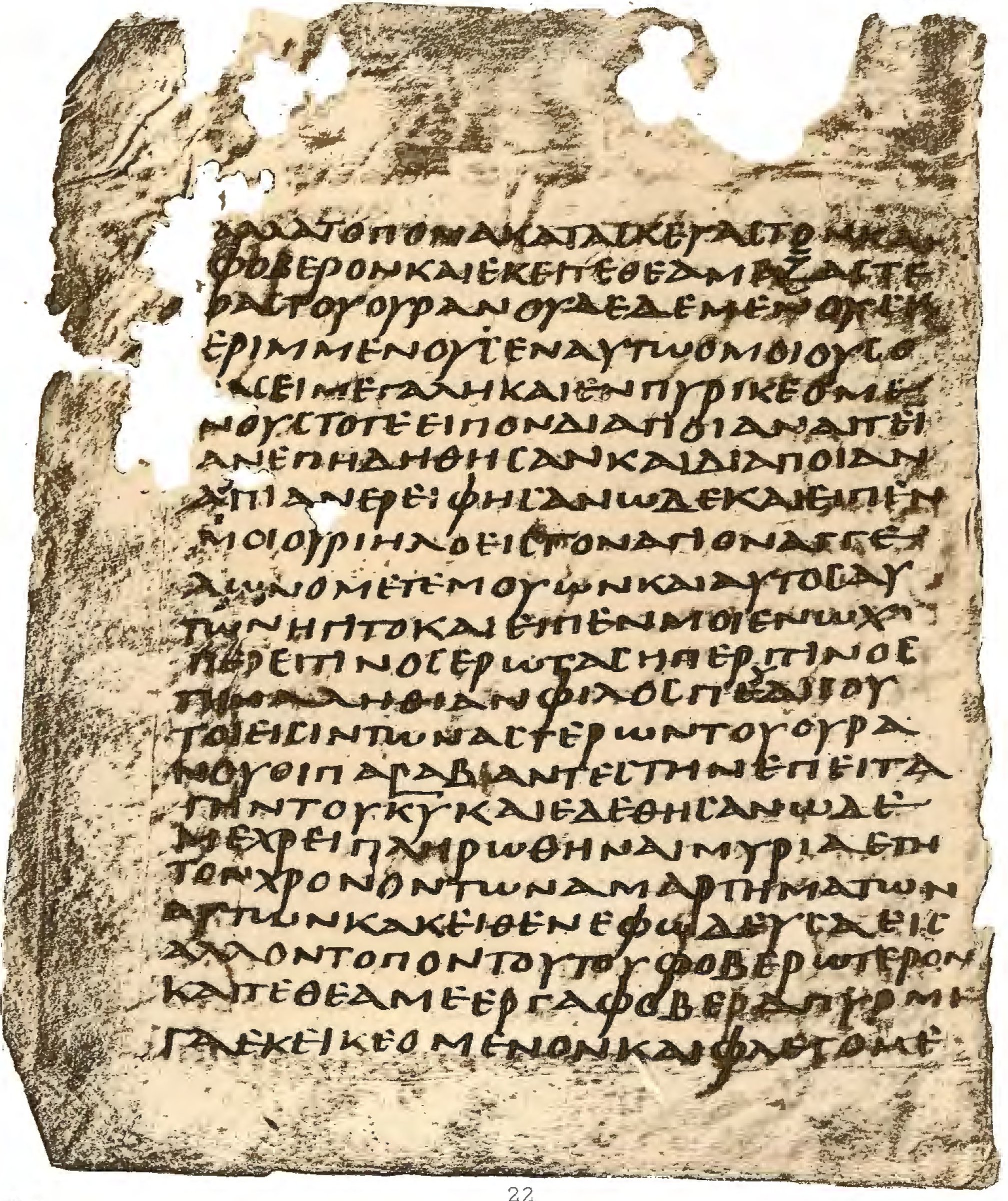
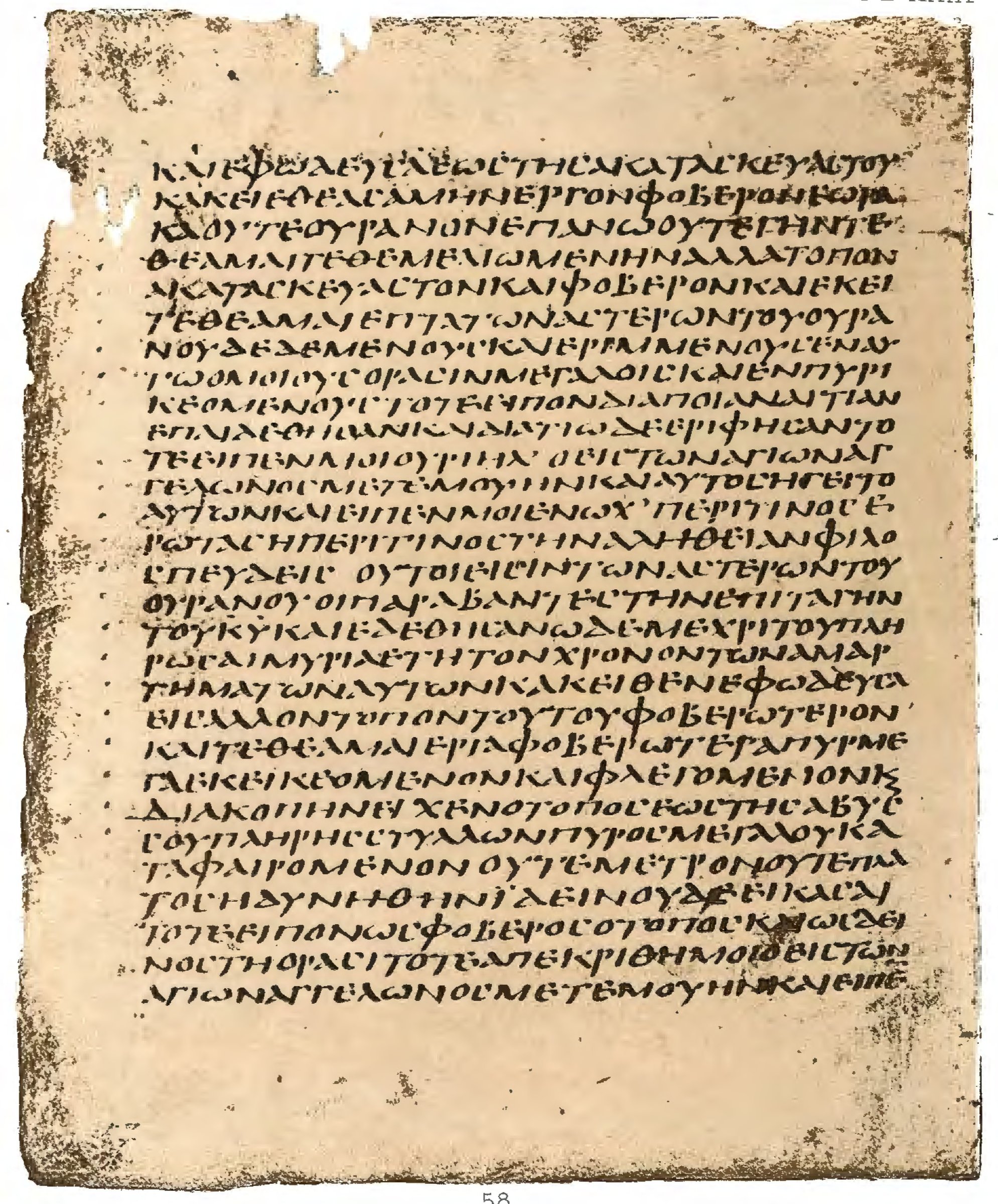
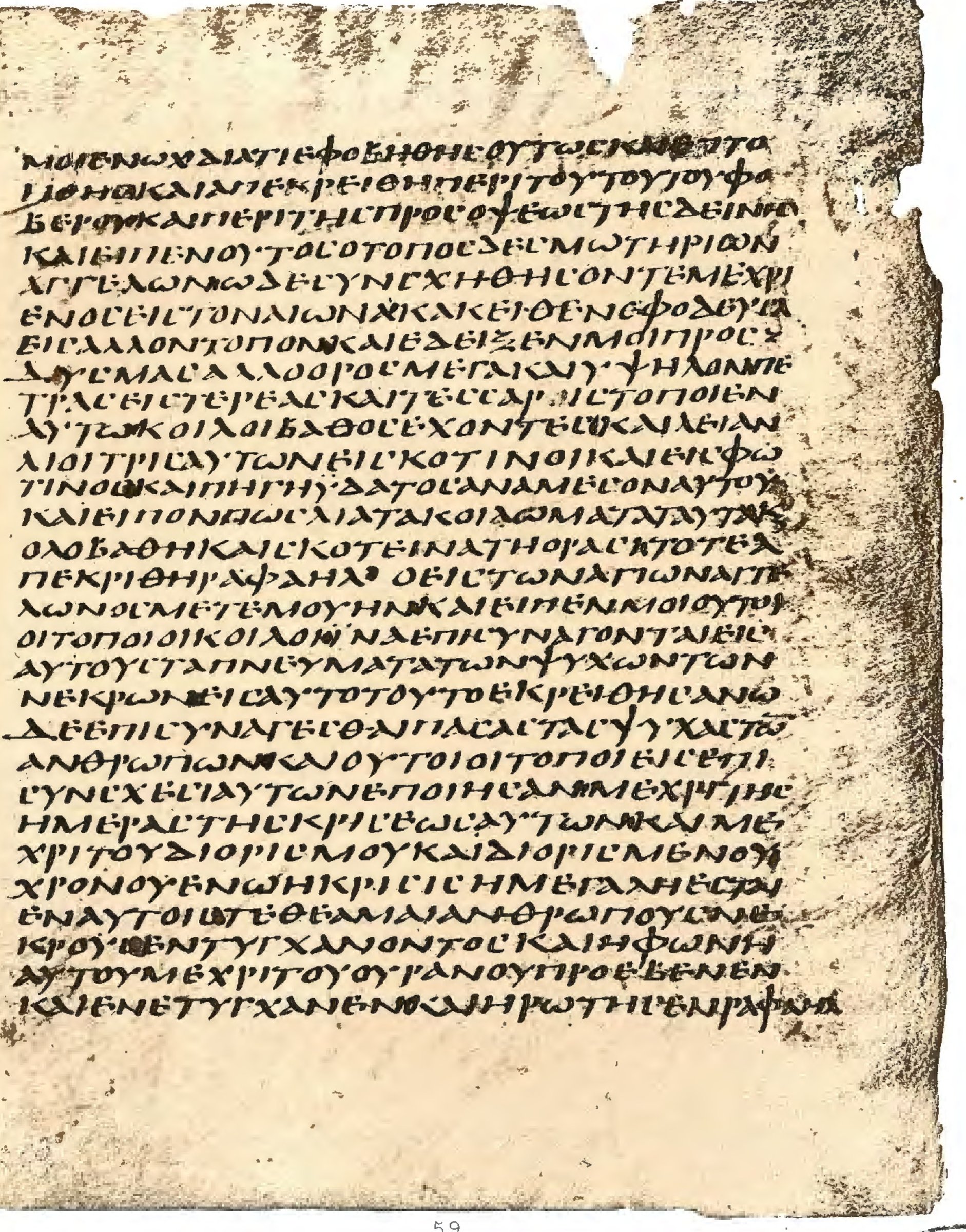
Where on the image
Akhmim codex pages 58, 59 (Lods's page numbers, printed under each plate page). Checked on the plates: p. 58 begins ‹και εφωδευσα εως της ακατασκευαστου›; p. 59 begins ‹μοι ενωχ δια τι εφοβηθης ουτως›. Chapter 21 runs from verse 1 to 10 in Swete's numbering; page spans follow the first words of each page, read on the plates, and Lods's page/line/chapter/verse list (1893, pp. 230-232). Pages 21, 22, 23 carry a second copy of 19.3-21.9 that the scribe wrote before 1.1 (Lods's list: 21,5 = 20.3; 21,19 = 21.1; 22,2 = 21.3; 23,7 = 21.9); its wording differs in places from the main copy, whose Greek is shown. The English is Charles's translation of the Ethiopic version; words he marks ⌜ ⌝ are in the Greek but not the Ethiopic, words in 〚 〛 are in the Ethiopic but not the Greek.
1Καὶ ἐφώδευσα ἕως τῆς ἀκατασκευάστου. 2κἀκεῖ ἐθεασάμην ἔργον φοβερόν· ἑώρακα οὔτε οὐρανὸν ἐπάνω, οὔτε γῆν τεθέαμαι τεθεμελιωμένην, ἀλλὰ τόπον ἀκατασκεύαστον καὶ φοβερόν. 3καὶ ἐκεῖ τεθέαμαι ἑπτὰ τῶν ἀστέρων τοῦ οὐρανοῦ δεδεμένους καὶ ἐριμμένους ἐν αὐτῷ, ὁμοίους ὄρεσιν μεγάλοις καὶ ἐν πυρὶ καιομένους. 4τότε εἶπον Διὰ ποίαν αἰτίαν ἐπεδέθησαν, καὶ διὰ τί ὧδε ἐρίφησαν 5τότε εἶπέν μοι Οὐριήλ, ὁ εἷς τῶν ἁγίων ἀγγέλων ὃς μετʼ ἐμοῦ ἦν (καὶ αὐτὸς ἡγεῖτο αὐτῶν), καὶ εἶπέν μοι Ἑνώχ, περὶ τίνος ἐρωτᾷς, ἢ περὶ τίνος τὴν ἀλήθειαν φιλοσπευδεῖς; 6οὗτοί εἰσιν τῶν ἀστέρων τοῦ οὐρανοῦ οἱ παραβάντες τὴν ἐπιταγὴν τοῦ κυρίου, καὶ ἐδέθησαν ὧδε μέχρι τοῦ πληρῶσαι μύρια ἔτη, τὸν χρόνον τῶν ἁμαρτημάτων αὐτῶν. 7Κἀκεῖθεν ἐφώδευσα εἰς ἄλλον τόπον τούτου φοβερώτερον, καὶ τεθέαμαι ἔργα φοβερώτερα, πῦρ μέγα ἐκεῖ καιόμενον καὶ φλεγόμενον, καὶ διακοπὴν εἶχεν ὁ τόπος ἕως τῆς ἀβύσσου, πλήρης στύλων πυρὸς μεγάλων καταφερομένων· οὕτε μέτρον οὕτε πλάτος ἠδυνήθην ἰδεῖν οὐδὲ εἰκάσαι. 8τότε εἶπον Ὡς φοβερὸς ὁ τόπος καὶ ὡς δεινὸς τῇ ὁράσει. 9τότε ἀπεκρίθη μοι ὁ εἷς τῶν ἁγίων ἀγγέλων ὃς μετʼ ἐμοῦ ἦν, καὶ εἶπέν μοι Ἑνώχ, διὰ τί ἐφοβήθης οὕτως καὶ ἐπτοήθης; καὶ ἀπεκρίθην Περὶ τούτου τοῦ φοβεροῦ καὶ περὶ τῆς προσόψεως τῆς δεινῆς. 10καὶ εἶπεν Οὗτος ὁ τόπος δεσμωτήριον ἀγγέλων· ὦδε συνσχεθήσονται μέχρι αἰῶνος εἰς τὸν αἰῶνα.
1 And I proceeded to where things were chaotic. 2 And I saw there something horrible: I saw neither a heaven above nor a firmly founded earth, but a place chaotic and horrible. 3 And there I saw seven stars of the heaven bound together in it, like great mountains and burning with fire. 4 Then I said: ‘For what sin are they bound, and on what account have they been cast in hither?’ 5 Then said Uriel, one of the holy angels, who was with me, and was chief over them, and said: ‘Enoch, why dost thou ask, and why art thou eager for the truth? 6 These are of the number of the stars ⌜of heaven⌝ which have transgressed the commandment of the Lord, and are bound here till ten thousand years, the time entailed by their sins, are consummated.’ 7 And from thence I went to another place, which was still more horrible than the former, and I saw a horrible thing: a great fire there which burnt and blazed, and the place was cleft as far as the abyss, being full of great descending columns of fire: neither its extent or magnitude could I see, nor could I conjecture. 8 Then I said: ‘How fearful is the place and how terrible to look upon!’ 9 Then Uriel answered me, one of the holy angels who was with me, and said unto me: ‘Enoch, why hast thou such fear and affright?’ And I answered: ‘Because of this fearful place, and because of the spectacle of the pain.’ 10 And he said 〚unto me〛: ‘This place is the prison of the angels, and here they will be imprisoned for ever.’
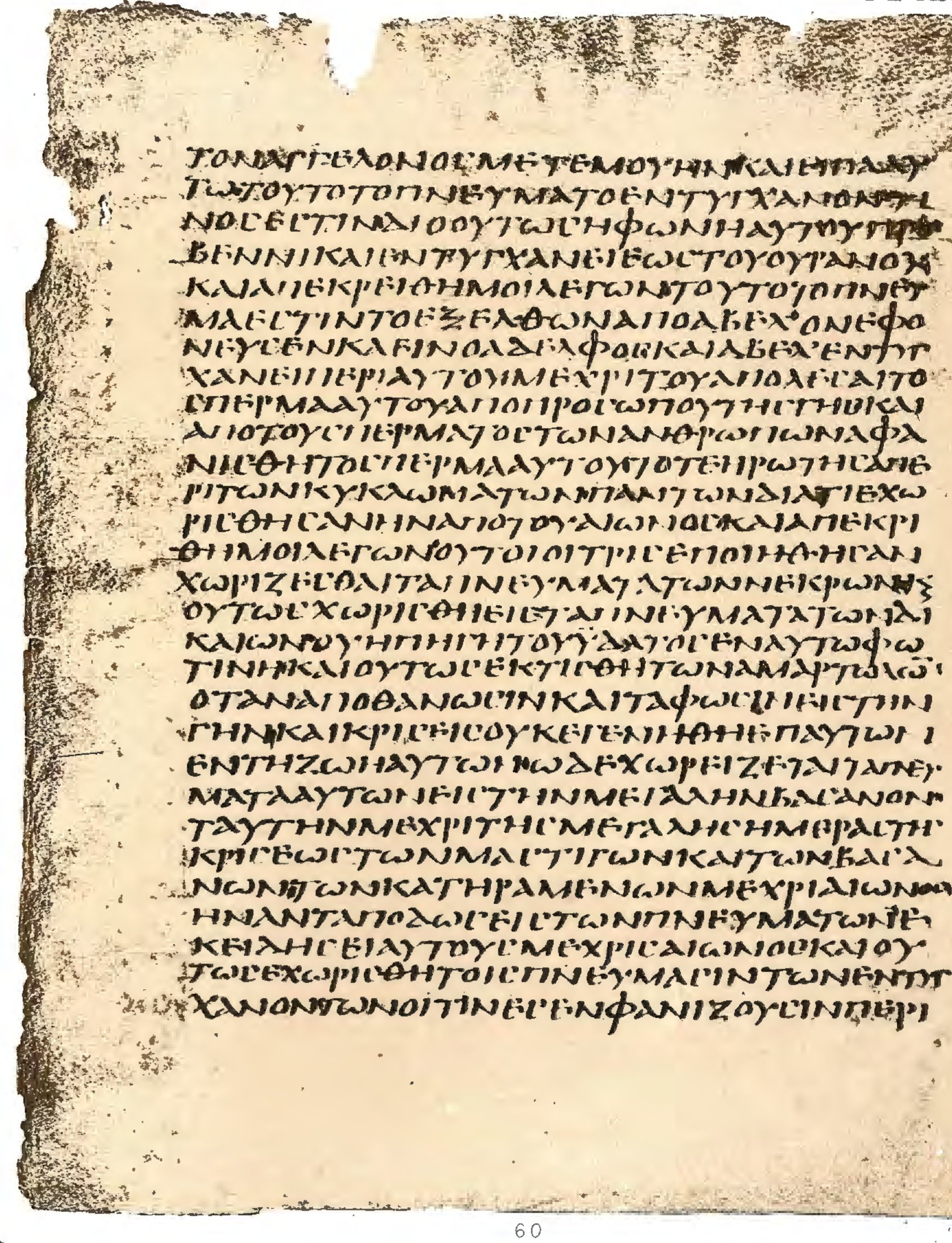
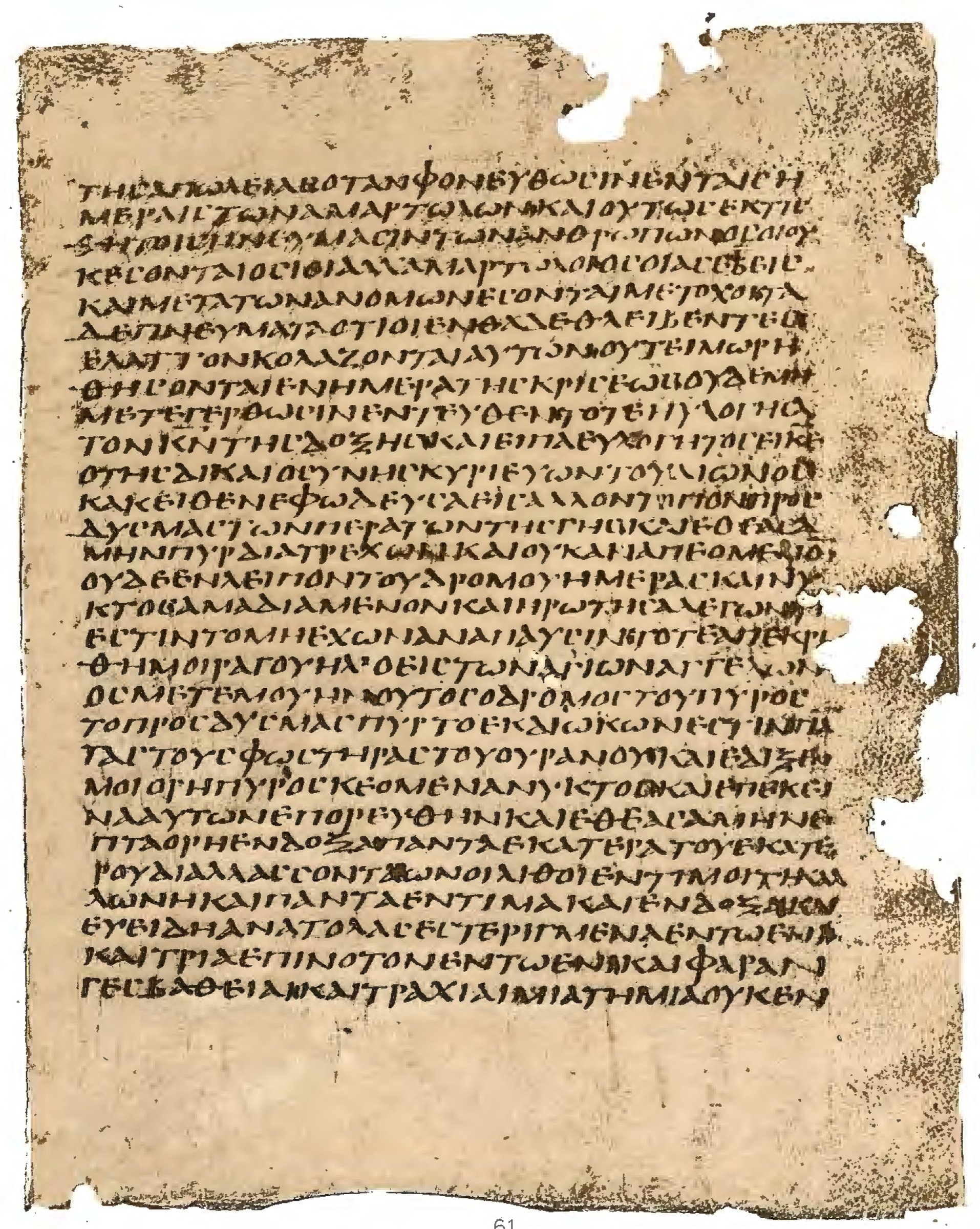
Where on the image
Akhmim codex pages 59, 60, 61 (Lods's page numbers, printed under each plate page). Checked on the plates: p. 59 begins ‹μοι ενωχ δια τι εφοβηθης ουτως›; p. 60 begins ‹των αγγελων ος μετ εμου ην και ειπα αυτω›; p. 61 begins ‹φονευθεντες εν ταις ημεραις των αμαρτωλων›. Chapter 22 runs from verse 1 to 14 in Swete's numbering; page spans follow the first words of each page, read on the plates, and Lods's page/line/chapter/verse list (1893, pp. 230-232). Charles prints a separate translation of the Akhmim Greek for verses 2, 5, 6, 8, 9, 10, 11, 12, 13, 14 of this chapter, and that is the English shown there; for verses 1, 3, 4, 7 he gives one translation, made from the Ethiopic, in which ⌜ ⌝ mark words that are in the Greek but not the Ethiopic and 〚 〛 words that are in the Ethiopic but not the Greek.
1Κἀκεῖθεν ἐφόδευσα εἰς ἄλλον τόπον, καὶ ἔδειξέν μοι πρὸς δυσμὰς ἄλλο ὄρος μέγα καὶ ὑψηλόν, πέτρας στερεάς. 2καὶ τέσσαρες τόποι ἐν αὐτῷ κοῖλοι, βάθος ἔχοντες καὶ λίαν λεῖοι, τρεῖς αὐτῶν σκοτινοὶ καὶ εἷς φωτινός, καὶ πηγὴ ὕδατος ἀνὰ μέσον αὐτοῦ. καὶ εἶπον Πῶς λεῖα τὰ κοιλώματα ταῦτα καὶ ὁλοβαθῆ καὶ σκοτινὰ τῇ ὁράσει. 3τότε ἀπεκρίθη Ῥαφαήλ, ὁ εἷς τῶν ἁγίων ἀγγέλων ὃς μετʼ ἐμοῦ ἦν, καὶ εἶπέν μοι Οὗτοι οἱ τόποι οἱ κοῖλοι, ἵνα ἐπισυνάγωνται εἰς αὐτοὺς τὰ πνεύματα τῶν ψυχῶν τῶν νεκρῶν. εἰς αὐτὸ τοῦτο ἐκρίθησαν, ὦδε ἐπισυνάγεσθαι πάσας τὰς ψυχὰς τῶν ἀνθρώπων. 4καὶ οὗτοι οἱ τόποι εἰς ἐπισύνσχεσιν αὐτῶν ἐποίησαν μέχρι . τῆς ἡμέρας τῆς κρίσεως αὐτῶν καὶ μέχρι τοῦ διορισμοῦ καὶ διορισμένου χρόνου, ἐν ᾧ ἡ κρίσις ἡ μεγάλη ἔσται ἐν αὐτοῖς. 5Τεθέαμαι ἀνθρώπους νεκροὺς ἐντυγχάνοντας, καὶ ἡ φωνὴ αὐτοῦ μέχρι τοῦ οὐρανοῦ προέβαινεν καὶ ἐνετύγχανεν. 6καὶ ἠρώτησα Ῥαφαὴλ τὸν ἄγγελον ὃς μετʼ ἐμοῦ ἤν, καὶ εἶπα αὐτῷ Τοῦτο τὸ πνεῦμα τὸ ἐντυγχάνον τίνος ἐστίν, δι᾿ ὃ οὕτως ἡ φωνὴ αὐτοῦ προβαίνει καὶ ἐντυγχάνει ἕως τοῦ οὐρανοῦ; 7καὶ ἀπεκρίθη μοι λέγων Τοῦτο τὸ πνεῦμά ἐστιν τὸ ἐξελθὸν ἀπὸ Ἅβελ ὃν ἐφόνευσε Κάειν ὁ ἀδελφός, καὶ Ἅβελ ἐντυγχάνει περὶ αὐτοῦ μέχρι τοῦ ἀπολέσαι τὸ σπέρμα αὐτοῦ ἀπὸ προσώπου τῆς γῆς, καὶ ἀπὸ τοῦ σπέρματος τῶν ἀνθρώπων ἀφανισθῇ τὸ σπέρμα αὐτοῦ. 8Τότε ἠρώτησα περὶ τῶν κυκλωμάτων πάντων, διὰ τί ἐχωρίσθησαν ἓν ἀπὸ τοῦ ἑνός. 9καὶ ἀπεκρίθη μοι λέγων Οὗτοι οἱ τρεῖς ἐποιήθησαν χωρίζεσθαι τὰ πνεύματα τῶν νεκρῶν· καὶ οὕτως ἐχωρίσθη εἰς τὰ πνεύματα τῶν δικαίων, οὗ ἡ πηγὴ τοῦ ὕδατος ἐν αὐτῷ φωτινή· 10καὶ οὕτως ἐκτίσθη τῶν ἁμαρτωλῶν, ὅταν ἀποθάνωσιν καὶ ταφῶσιν εἰς τὴν γῆν, καὶ κρίσις οὐκ ἐγενήθη ἐπʼ αὐτῶν ἐν τῇ ζωῇ αὐτῶν, 11ὧδε χωρίζεσθαι τὰ πνεύματα αὐτῶν εἰς τὴν μεγάλην βάσανον ταύτην, μέχρι τῆς μεγάλης ἡμέρας τῆς κρίσεως, τῶν μαστίγων καὶ τῶν βασάνων τῶν κατηραμένων· μέχρι αἰῶνος ἦν ἀνταπόδοσις τῶν πνευμάτων· ἐκεῖ δήσει αὐτοὺς μέχρις αἰῶνος. 12καὶ οὕτως ἐχωρίσθη τοῖς πνεύμασιν τῶν ἐντυγχανόντων, οἵτινες ἐνφανίζουσιν περὶ τῆς ἀπωλείας, ὅταν φονευθῶσιν ἐν ταῖς ἡμέραις τῶν ἁμαρτωλῶν. 13καὶ οὕτως ἐκτίσθη τοῖς πνεύμασιν τῶν ἀνθρώπων, ὅσοι οὐκ ἔσονται ὅσιοι ἀλλὰ ἁμαρτωλοί, ὅσοι ἀσεβεῖς, καὶ μετὰ τῶν ἀνόμων ἔσονται μέτοχοι. τὰ δὲ πνεύματα, ὅτι οἱ ἐνθάδε θλιβέντες ἔλαττον κολάζονται αὐτῶν, οὐ τιμωρηθήσονται ἐν ἡμέρᾳ τῆς κρίσεως, οὐδὲ μὴ μετεγερθῶσιν ἐντεῦθεν. 14Τότε ηὐλόγησα τὸν κύριον τῆς δόξης, καὶ εἶπα Εὐλογητὸς εἶ, Κύριε ὁ τῆς δικαιοσύνης, κυριεύων τοῦ αἰῶνος.
1 And thence I went to another place, and he showed me in the west ⌜another⌝ great and high mountain [and] of hard rock.
2 And there were †four† hollow places in it, deep and very smooth: †three† of them were dark and one bright; and there was a fountain of water in its midst. And I said: ‘†How† smooth are these hollow places, and deep and dark to view.’
3 Then Raphael answered, one of the holy angels who was with me, and said unto me: ‘These hollow places have been created for this very purpose, that the spirits of the souls of the dead should assemble therein, yea that all the souls of the children of men should assemble here. 4 And these places have been made to receive them till the day of their judgement and till their appointed period [till the period appointed], till the great judgement (comes) upon them.’
5 I saw ‹the spirit of› a dead man making suit, and his voice went forth to heaven and made suit. 6 And I asked Raphael the angel who was with me, and I said unto him: ‘This spirit which maketh suit, whose is it, whose voice goeth forth and maketh suit to heaven?’
7 And he answered me saying: ‘This is the spirit which went forth from Abel, whom his brother Cain slew, and he makes his suit against him till his seed is destroyed from the face of the earth, and his seed is annihilated from amongst the seed of men.’
8 Then I asked regarding all the hollow places: ‘Why is one separated from the other?’
9 And he answered me saying: ‘These three have been made that the spirits of the dead might be separated. And this division has been made for the spirits of the righteous, in which there is the bright spring of water. 10 And this has been made for sinners when they die and are buried in the earth and judgement has not been executed upon them in their lifetime. 11 Here their spirits shall be set apart in this great pain, till the great day of judgement, scourgings, and torments of the accursed for ever, so that (there may be) retribution for their spirits. There He shall bind them for ever. 12 And this division has been made for the spirits of those who make their suit, who make disclosures concerning their destruction, when they were slain in the days of the sinners. 13 And this has been made for the spirits of men who shall not be righteous but sinners, who are godless, and of the lawless they shall be companions: but their spirits shall not be punished in the day of judgement nor shall they be raised from thence.’ 14 Then I blessed the Lord of Glory and said: ‘Blessed art Thou, Lord of righteousness, who rulest over the world.’
Where on the image
Akhmim codex page 61 (Lods's page numbers, printed under each plate page). Checked on the plates: p. 61 begins ‹φονευθεντες εν ταις ημεραις των αμαρτωλων›. Chapter 23 runs from verse 1 to 4 in Swete's numbering; page spans follow the first words of each page, read on the plates, and Lods's page/line/chapter/verse list (1893, pp. 230-232). The English is Charles's translation of the Ethiopic version; words he marks ⌜ ⌝ are in the Greek but not the Ethiopic, words in 〚 〛 are in the Ethiopic but not the Greek.
1Κἀκεῖθεν ἐφώδευσα εἰς ἄλλον τόπον πρὸς δυσμὰς τῶν περάτων τῆς γῆς. 2καὶ ἐθεασάμην πῦρ διατρέχον καὶ οὐκ ἀναπαυόμενον οὐδὲ ἐνλεῖπον τοῦ δρόμου, ἡμέρας καὶ νυκτὸς ἄμα διαμένον. 3καὶ ἠρώτησα λέγων Τί ἐστιν τὸ μὴ ἔχον ἀνάπαυσιν; 4τότε ἀπεκρίθη μοι Ῥαγουήλ, ὁ εἷς τῶν ἁγίων ἀγγέλων ὃς μετʼ ἐμοῦ ἦν Οὗτος ὁ δρόμος τοῦ πυρὸς τὸ πρὸς δυσμὰς πῦρ τὸ ἐκδιῶκόν ἐστιν πάντας τοὺς φωστῆρας τοῦ οὐρανοῦ.
1 From thence I went to another place to the west of the ends of the earth. 2 And I saw a 〚burning〛 fire which ran without resting, and paused not from its course day or night but (ran) regularly. 3 And I asked saying: ‘What is this which rests not?’ 4 Then Raguel, one of the holy angels who was with me, answered me 〚and said unto me〛: ‘This course ⌜of fire⌝ 〚which thou hast seen〛 is the fire in the west which †persecutes† all the luminaries of heaven.’
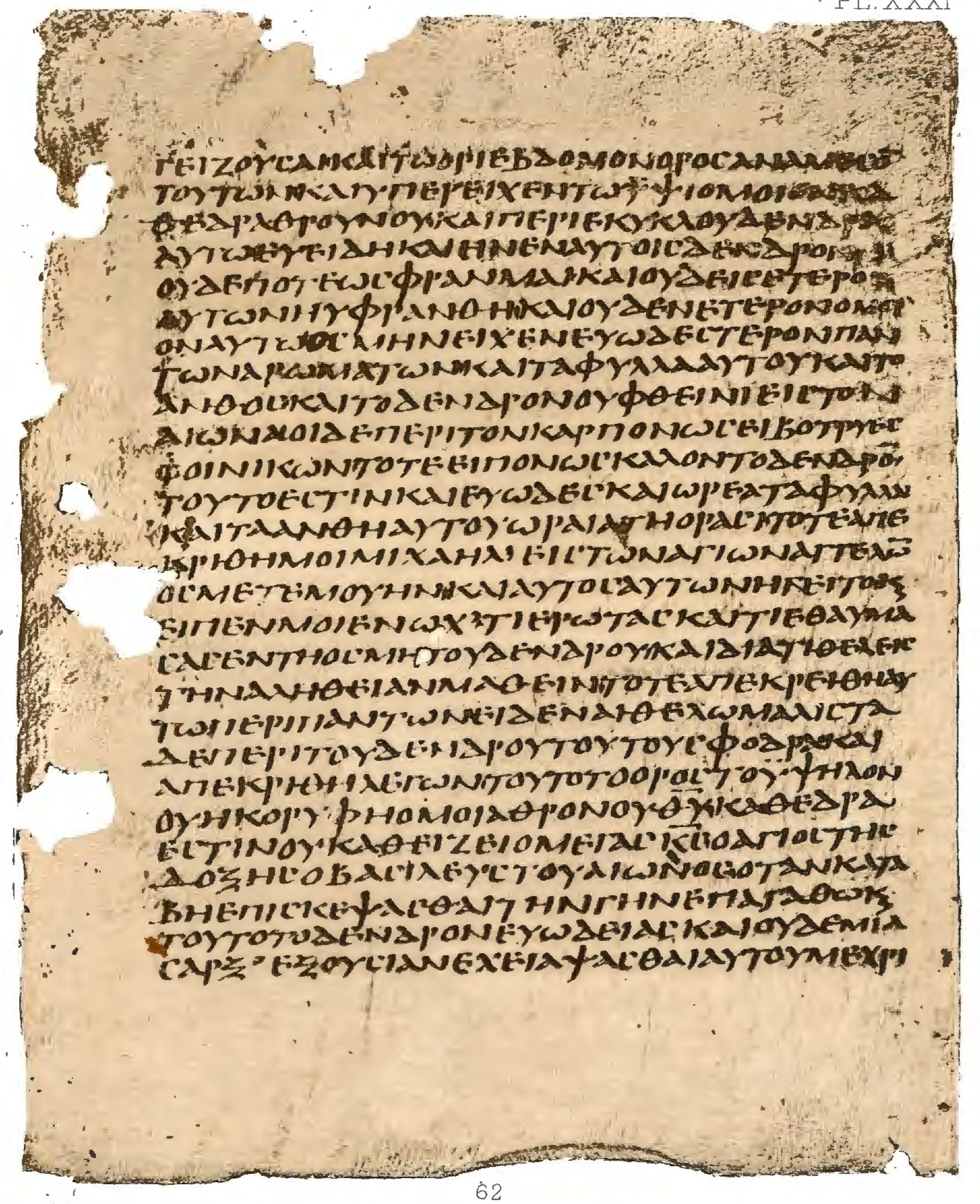
Where on the image
Akhmim codex pages 61, 62 (Lods's page numbers, printed under each plate page). Checked on the plates: p. 61 begins ‹φονευθεντες εν ταις ημεραις των αμαρτωλων›; p. 62 begins ‹[ε]γγιζουσαι και τω ορει εβδομον ορος›. Chapter 24 runs from verse 1 to 6 in Swete's numbering; page spans follow the first words of each page, read on the plates, and Lods's page/line/chapter/verse list (1893, pp. 230-232). The English is Charles's translation of the Ethiopic version; words he marks ⌜ ⌝ are in the Greek but not the Ethiopic, words in 〚 〛 are in the Ethiopic but not the Greek.
1Καὶ ἔδειξέν μοι ὄρη πυρὸς καιόμενα νυκτός. 2καὶ ἐπέκεινα αὐτῶν ἐπορεύθην καὶ ἐθεασάμην ἑπτὰ ὄρη, ἔνδοξα πάντα, ἑκάτερα τοῦ ἑκατέρου διαλλάσσοντα, ὧν οἱ λίθοι ἔντιμοι τῇ καλλονῇ, καὶ πάντα ἔντιμα καὶ ἔνδοξα καὶ εὐειδῆ, τρία ἐπʼ ἀνατολὰς ἐστηριγμένα ἐν τῷ ἐνί, καὶ τρία ἐπὶ νότον ἐν τῷ ἐνί καὶ φάραγγες βαθεῖαι καὶ τραχεῖαι, μία τῇ μιᾷ οὐκ ἐγγίζουσαι, 3καὶ τῷ ὄρει ἕβδομον ὄρος ἀνὰ μέσον τούτων, καὶ ὑπερεῖχεν τῷ ὕψει, ὅμοιον καθέδρᾳ θρόνου, καὶ περιεκύκλου δένδρα αὐτῷ εὐειδῆ. 4καὶ ἦν ἐν αὐτοῖς δένδρον ὃ οὐδέποτε ὤσφρανμαι καὶ οὐδεὶς ἕτερος αὐτῷ ηὐφράνθη, καὶ οὐδὲν ἕτερον ὅμοιον αὐτῷ· ὀσμὴν εἶχεν εὐωδεστέραν πάντων ἀρωμάτων, καὶ τὰ φύλλα αὐτοῦ καὶ τὸ ἄνθος καὶ τὸ δένδρον οὐ φθίνει εἰς τὸν αἰῶνα· οἱ δέ περὶ τὸν καρπὸν ὡσεὶ βότρυες φοινίκων. 5τότε εἶπον Ὡς καλὸν τὸ δένδρον τοῦτό ἐστιν καὶ εὐῶδες, καὶ ὡραῖα τὰ φύλλα, καὶ τὰ ἄνθη αὐτοῦ ὡραῖα τῇ ὁράσει. 6τότε ἀπεκρίθη μοι Μιχαήλ, εἷς τῶν ἁγίων ἀγγέλων ὃς μετʼ ἐμοῦ ἦν (καὶ αὐτὸς αὐτῶν ἡγεῖτο),
1 〚And from thence I went to another place of the earth〛, and he showed me a mountain range of fire which burnt 〚day and〛 night. 2 And I went beyond it and saw seven magnificent mountains all differing each from the other, and the stones (thereof) were magnificent and beautiful, magnificent as a whole, of glorious appearance and fair exterior: 〚three towards〛 the east, 〚one〛 founded on the other, and three towards the south, 〚one〛 upon the other, and deep rough ravines, no one of which joined with any other. 3 And the seventh mountain was in the midst of these, and it excelled them in height, resembling the seat of a throne: and fragrant trees encircled the throne. 4 And amongst them was a tree such as I had never yet smelt, neither was any amongst them nor were others like it: it had a fragrance beyond all fragrance, and its leaves and blooms and wood wither not for ever: and its fruit 〚is beautiful, and its fruit〛 resembles the dates of a palm. 5 Then I said: ‘⌜How⌝ beautiful is this tree, and fragrant, and its leaves are fair, and its blooms 〚very〛 delightful in appearance.’ 6 Then answered Michael, one of the holy 〚and honoured〛 angels who was with me, and was their leader,
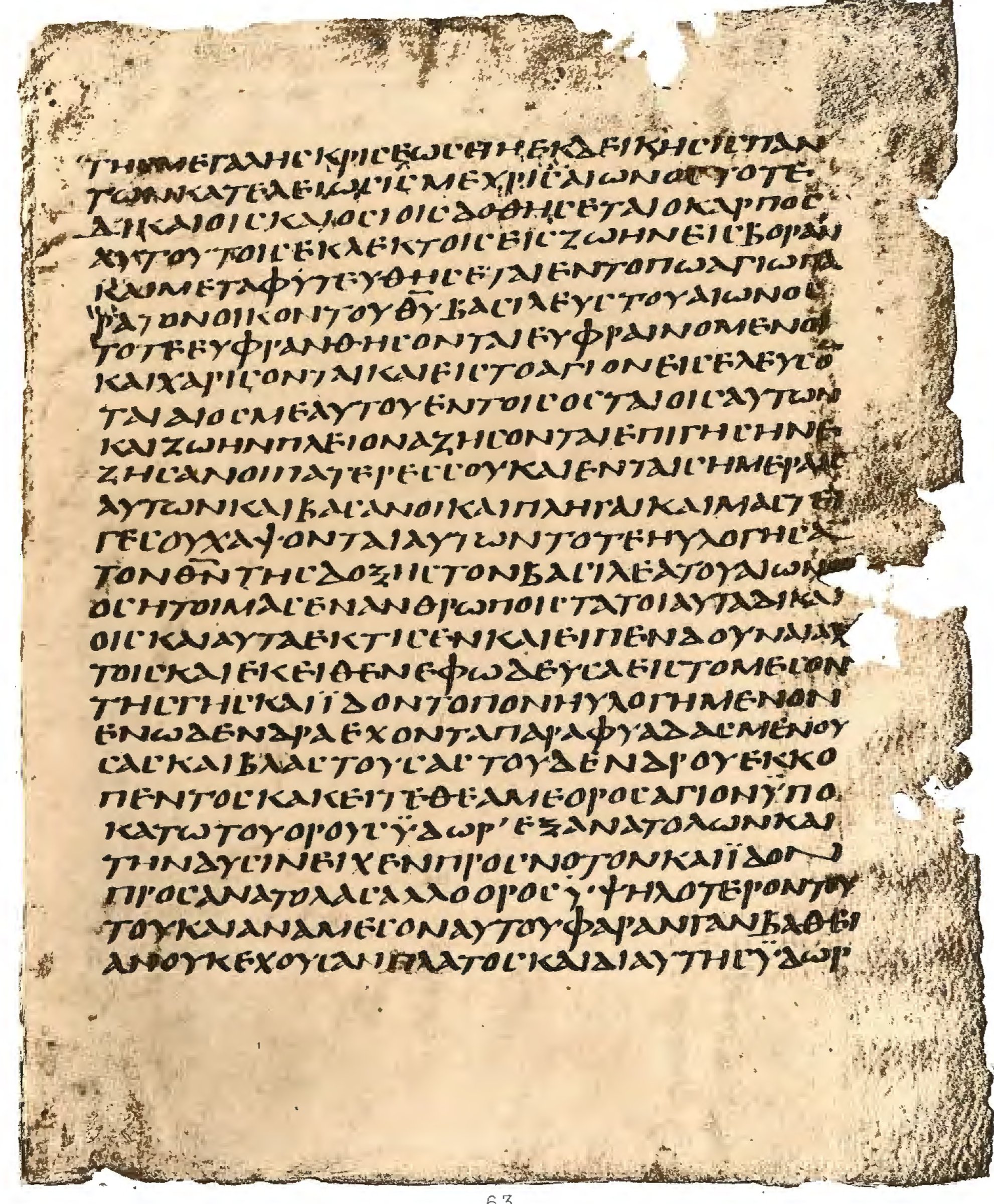
Where on the image
Akhmim codex pages 62, 63 (Lods's page numbers, printed under each plate page). Checked on the plates: p. 62 begins ‹[ε]γγιζουσαι και τω ορει εβδομον ορος›; p. 63 begins ‹της μεγαλης κρισεως εν η εκδικησις παντων›. Chapter 25 runs from verse 1 to 7 in Swete's numbering; page spans follow the first words of each page, read on the plates, and Lods's page/line/chapter/verse list (1893, pp. 230-232). The English is Charles's translation of the Ethiopic version; words he marks ⌜ ⌝ are in the Greek but not the Ethiopic, words in 〚 〛 are in the Ethiopic but not the Greek.
1καὶ εἶπέν μοι Ἑνώχ. τί ἐρωτᾷς καὶ τί ἐθαύμασας ἐν τῇ ὀσμῇ τοῦ δένδρου, καὶ διὰ τί θέλεις τὴν ἀλήθειαν μαθεῖν; 2τότε ἀπεκρίθην αὐτῷ Περὶ πάντων εἰδέναι θέλω, μάλιστα δὲ περὶ τοῦ δένδρου τούτου σφόδρα. 3καὶ ἀπεκρίθη λέγων Τοῦτο τὸ ὄρος τὸ ὑψηλόν, οὗ ἡ κορυφὴ ὁμοία θρόνου θεοῦ, καθέδρα ἐστὶν οὗ καθίζει ὁ μέγας κύριος, ὁ ἅγιος τῆς δόξης, ὁ βασιλεὺς τοῦ αἰῶνος, ὅταν καταβῇ ἐπισκέψασθαι τὴν γῆν ἐπʼ ἀγαθῷ. 4καὶ τοῦτο τὸ δένδρον εὐωδίας, καὶ οὐδεμία σὰρξ ἐξουσίαν ἔχει ἅψασθαι αὐτοῦ μέχρι τῆς μεγάλης κρίσεως, ἐν ᾗ ἐκδίκησις πάντων καὶ τελείωσις μέχρις αἰῶνος· τότε δικαίοις καὶ ὁσίοις δοθήσεται 5ὁ καρπὸς αὐτοῦ τοῖς ἐκλεκτοῖς εἰς ζωὴν εἰς βοράν, καὶ μεταφυτευθήσεται ἐν τόπῳ ἁγίῳ παρὰ τὸν οἶκον τοῦ θεοῦ βασιλέως τοῦ αἰῶνος. 6τότε εὐφρανθήσονται εὐφραινόμενοι καὶ χαρήσονται καὶ εἰς τὸ ἅγιον εἰσελεύσονται· αἱ ὀσμαὶ αὐτοῦ ἐν τοῖς ὀστέοις αὐτῶν, καὶ ζωὴν πλείονα ζήσονται ἐπὶ γῆς ἣν ἔζησαν οἱ πατέρες σου, καὶ ἐν ταῖς ἡμέραις αὐτῶν καὶ βάσανοι καὶ πληγαὶ καὶ μάστιγες οὐχ ἅψονται αὐτῶν. 7Τότε ηὐλόγησα τὸν θεὸν τῆς δόξης, τὸν βασιλέα τοῦ αἰῶνος, ὃς ἡτοίμασεν ἀνθρώποις τὰ τοιαῦτα δικαίοις, καὶ αὐτὰ ἔκτισεν καὶ εἶπεν δοῦναι αὐτοῖς.
1 And he said unto me: ‘Enoch, why dost thou ask me regarding the fragrance of the tree, and ⌜why⌝ dost thou wish to learn the truth?’ 2 Then I answered him, 〚saying〛: ‘I wish to know about everything, but especially about this tree.’ 3 And he answered, saying: ‘This high mountain 〚which thou hast seen〛, whose summit is like the throne of God, is His throne, where the Holy Great One, the Lord of Glory, the Eternal King will sit, when He shall come down to visit the earth with goodness. 4 And as for this fragrant tree no mortal is permitted to touch it till the great judgement, when He shall take vengeance on all and bring (everything) to its consummation for ever. It shall then be given to the righteous and holy. 5 Its fruit shall be for food to the elect: it shall be transplanted to the holy place, to the temple of the Lord, the Eternal King.
6 Then shall they rejoice with joy and be glad.
And into the holy place shall they enter;
And its fragrance shall be in their bones,
And they shall live a long life on earth,
Such as thy fathers lived:
And in their days shall no 〚sorrow or〛 plague
Or torment or calamity touch them.’
7 Then blessed I the God of Glory, the Eternal King, who hath prepared such things for the righteous, and hath created them and promised to give to them.
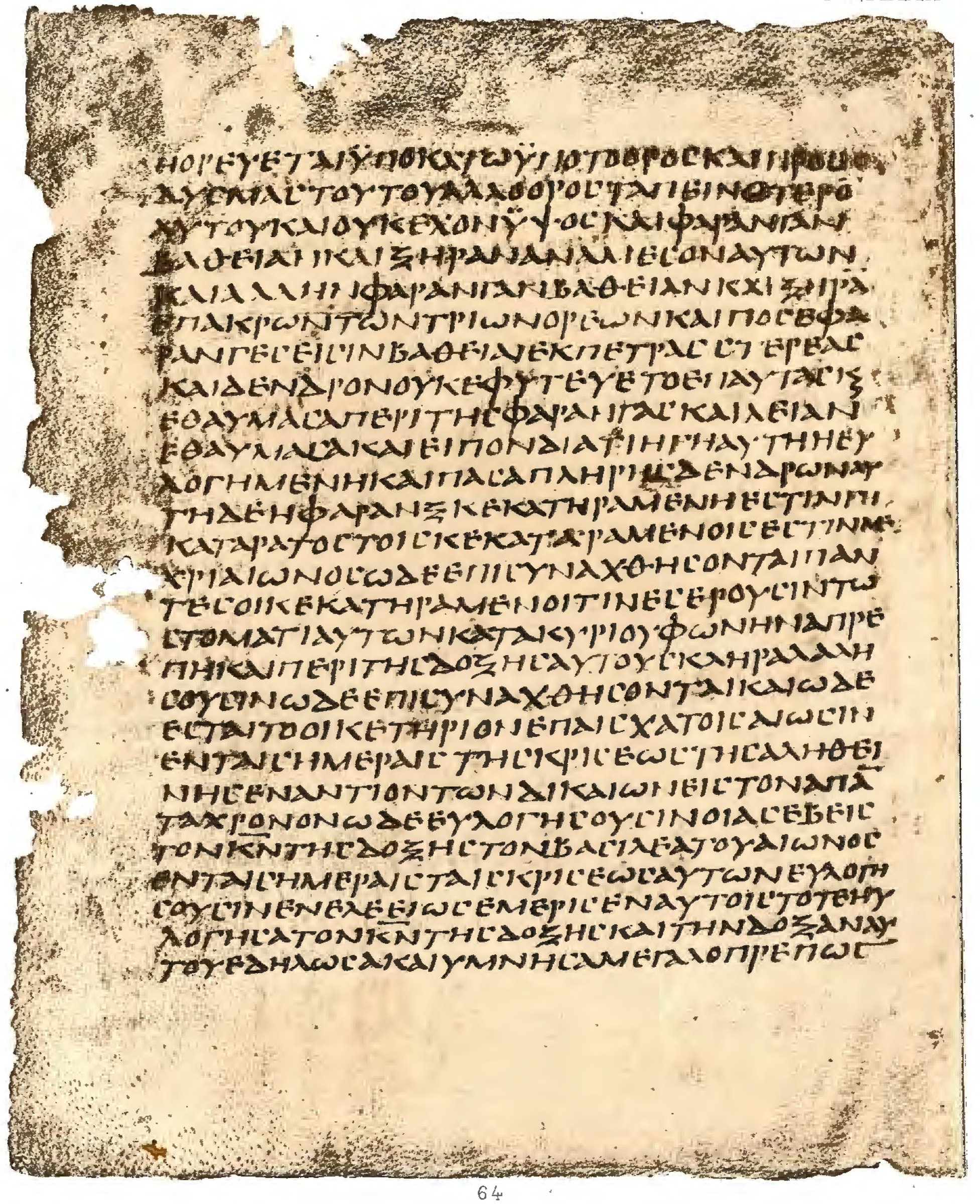
Where on the image
Akhmim codex pages 63, 64 (Lods's page numbers, printed under each plate page). Checked on the plates: p. 63 begins ‹της μεγαλης κρισεως εν η εκδικησις παντων›; p. 64 begins ‹πορευεται υποκατω του ορους ... φαραγγα βαθειαν›. Chapter 26 runs from verse 1 to 6 in Swete's numbering; page spans follow the first words of each page, read on the plates, and Lods's page/line/chapter/verse list (1893, pp. 230-232). The English is Charles's translation of the Ethiopic version; words he marks ⌜ ⌝ are in the Greek but not the Ethiopic, words in 〚 〛 are in the Ethiopic but not the Greek.
1Καὶ ἐκεῖθεν ἐφώδευσα εἰς τὸ μέσον τῆς γῆς, καὶ ἴδον τόπον ηὐλογημένον, ἐν ᾧ δένδρα ἔχοντα παραφυάδας μενούσας καὶ βλαστούσας τοῦ δένδρου ἐκκοπέντος. 2κἀκεῖ τεθέαμαι ὄρος ἅγιον· ὑποκάτω τοῦ ὄρους ὕδωρ ἐξ ἀνατολῶν, καὶ τὴν δύσιν εἶχεν πρὸς νότον. 3καὶ ἴδον πρὸς ἀνατολὰς ἄλλο ὄρος ὑψηλότερον τούτου, καὶ ἀνὰ μέσον αὐτοῦ φάραγγα βαθεῖαν, οὐκ ἔχουσαν πλάτος, καὶ δι᾿ αὐτῆς ὕδωρ πορεύεται ὑποκάτω ὑπὸ τὸ ὄρος. 4καὶ πρὸς δυσμὰς τούτου ἄλλο ὄρος ταπεινότερον αὐτοῦ καὶ οὐκ ἔχον ὕψος, καὶ φάραγγα βαθεῖαν καὶ ξηρὰν ἀνὰ μέσον αὐτῶν, καὶ ἄλλην φάραγγα βαθεῖαν καὶ ξηρὰν ἐπʼ ἄκρων τῶν τριῶν ὀρέων. 5καὶ πόσαι φάραγγές εἰσιν βαθεῖαι ἐκ πέτρας στερεᾶς, καὶ δένδρον οὐκ ἐφυτεύετο ἐπʼ αὐτάς. 6καὶ ἐθαύμασα περὶ τῆς φάραγγος. καὶ λίαν ἐθαύμασα.
1 And I went from thence to the middle of the earth, and I saw a blessed place ⌜in which there were trees⌝ with branches abiding and blooming [of a dismembered tree]. 2 And there I saw a holy mountain, 〚and〛 underneath the mountain to the east there was a stream and it flowed towards the south. 3 And I saw towards the east another mountain higher than this, and between them a deep and narrow ravine: in it also ran a stream ⌜underneath⌝ the mountain. 4 And to the west thereof there was another mountain, lower than the former and of small elevation, and a ravine ⌜deep and dry⌝ between them: and another deep and dry ravine was at the extremities of the three ⌜mountains⌝. 5 And all the ravines were deep 〚and narrow〛, (being formed) of hard rock, and trees were not planted upon them. 6 And I marvelled 〚at the rocks, and I marvelled〛 at the ravine, yea, I marvelled very much.
Where on the image
Akhmim codex page 64 (Lods's page numbers, printed under each plate page). Checked on the plates: p. 64 begins ‹πορευεται υποκατω του ορους ... φαραγγα βαθειαν›. Chapter 27 runs from verse 1 to 5 in Swete's numbering; page spans follow the first words of each page, read on the plates, and Lods's page/line/chapter/verse list (1893, pp. 230-232). Charles prints a separate translation of the Akhmim Greek for verses 2, 3 of this chapter, and that is the English shown there; for verses 1, 4, 5 he gives one translation, made from the Ethiopic, in which ⌜ ⌝ mark words that are in the Greek but not the Ethiopic and 〚 〛 words that are in the Ethiopic but not the Greek.
1καὶ εἶπον Διὰ τί ἡ γῆ αὕτη ἡ εὐλογημένη καὶ πᾶσα πλήρης δένδρων, αὐτὴ δὲ ἡ φάραγξ κεκατηραμένη ἐστίν; 2γῆ κατάρατος τοῖς κεκαταραμένοις ἐστὶν μέχρι αἰῶνος. ὧδε ἐπισυναχθήσονται πάντες οἱ κεκατηραμένοι οἵτινες ἐροῦσίν τῷ στόματι αὐτῶν κατὰ Κυρίου φωνὴν ἀπρεπῆ, καὶ περὶ τῆς δόξης αὐτοῦ σκληρὰ λαλήσουσιν. ὧδε ἐπισυναχθήσονται, καὶ ὧδε ἔσται τὸ οἰκητήριον. 3ἐπ ἐσχάτοις αἰῶσιν, ἐν ταῖς ἡμέραις τῆς κρίσεως τῆς ἀληθινῆς ἐναντίον τῶν δικαίων εἰς τὸν ἅπαντα χρόνον, ὧδε εὐλογήσουσιν οἱ εὐσεβεῖς τὸν κύριον τῆς δόξης, τὸν βασιλέα τοῦ αἰῶνος· 4ἐν ταῖς ἡμέραις τῆς κρίσεως αὐτῶν εὐλογήσουσιν ἐν ἐλέει, ὡς ἐμέρισεν αὐτοῖς. 5Τότε ηὐλόγησα τὸν κύριον τῆς δόξης, καὶ τὴν δόξαν αὐτοῦ ἐδήλωσα καὶ ὕμνησα μεγαλοπρεπῶς.
1 Then said I: ‘For what object is this blessed land, which is entirely filled with trees, and this accursed valley 〚between?〛’ 2 〚Then Uriel, one of the holy angels who was with me, answered and said: ‘This〛 valley is for those who are accursed for ever: here shall all ⌜the accursed⌝ be gathered together who utter with their lips against the Lord unseemly words and of His glory speak hard things.
Here shall they be gathered together, and here shall be the place of their habitation. 3 In the last times, in the days of the true judgement in the presence of the righteous for ever: here shall the godly bless the Lord of Glory, the Eternal King.
4 In the days of judgement over the former, they shall bless Him for the mercy in accordance with which He has assigned them (their lot).’ 5 Then I blessed the Lord of Glory and set forth His ⌜glory⌝ and lauded Him gloriously.
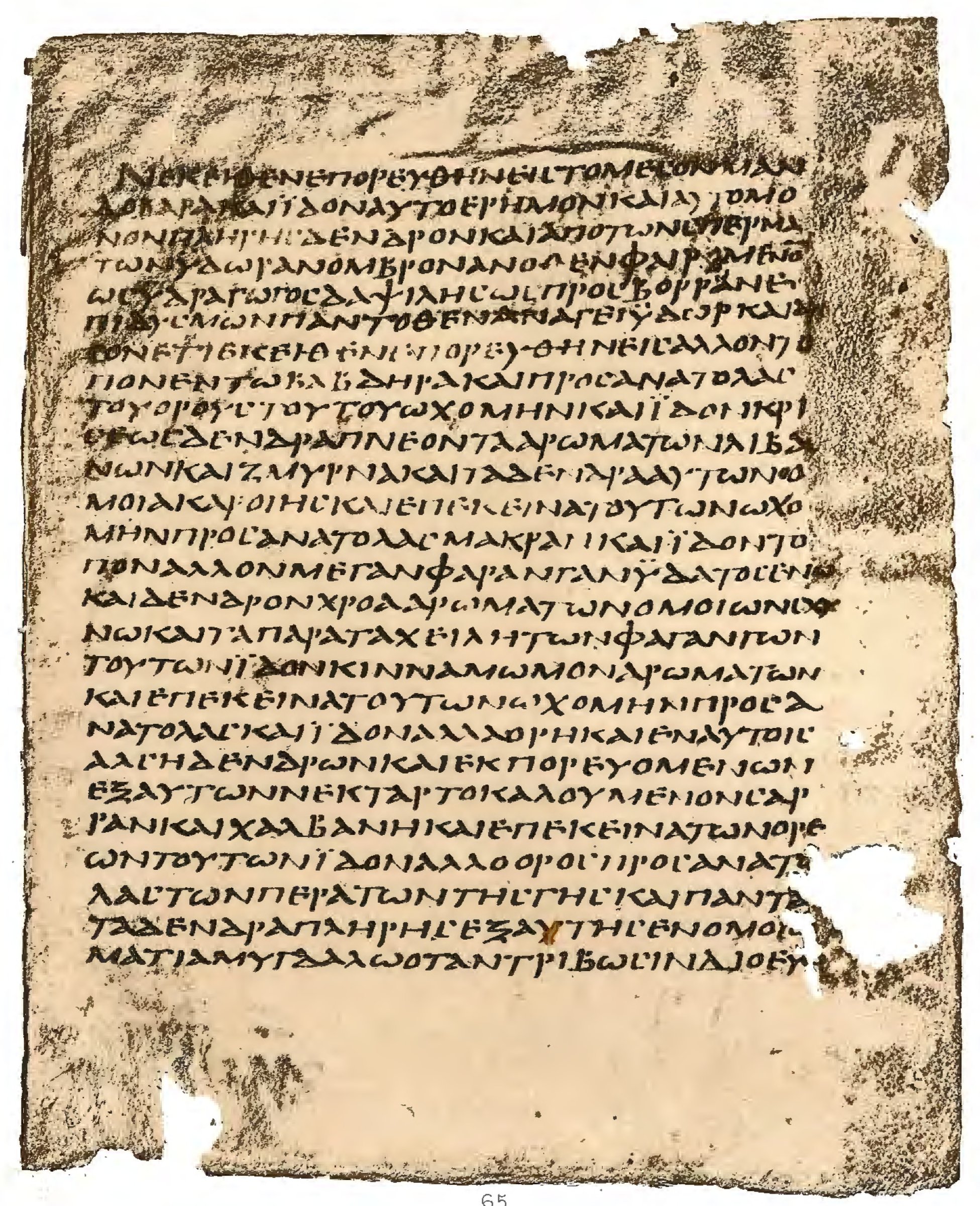
Where on the image
Akhmim codex page 65 (Lods's page numbers, printed under each plate page). Checked on the plates: p. 65 begins ‹και εκειθεν επορευθην εις το μεσον [μαν]δοβαρα›. Chapter 28 runs from verse 1 to 3 in Swete's numbering; page spans follow the first words of each page, read on the plates, and Lods's page/line/chapter/verse list (1893, pp. 230-232). The English is Charles's translation of the Ethiopic version; words he marks ⌜ ⌝ are in the Greek but not the Ethiopic, words in 〚 〛 are in the Ethiopic but not the Greek.
1Καὶ ἐκεῖθεν ἐπορεύθην εἰς τὸ μέσον Μανδοβαρά, καὶ ἴδον αὐτὸ ἔρημον· καὶ αὐτὸ μόνον, 2πλῆρες δένδρων· καὶ ἀπὸ τῶν σπερμάτων ὕδωρ ἄνομβρον ἄνωθεν φερόμενον, 3ὡς ὑδραγωγὸς δαψιλὴς ὡς πρὸς βορρᾶν ἐπὶ δυσμῶν πάντοθεν ἀνάγει ὕδωρ καὶ δρόσον.
1 And thence I went 〚towards the east〛, into the midst 〚of the mountain range〛 of the desert, and I saw a wilderness and it was solitary, full of trees and plants. 2 〚And〛 water gushed forth from above. 3 Rushing like a copious watercourse [which flowed] towards the north-west it caused clouds and dew to ascend on every side.
Where on the image
Akhmim codex page 65 (Lods's page numbers, printed under each plate page). Checked on the plates: p. 65 begins ‹και εκειθεν επορευθην εις το μεσον [μαν]δοβαρα›. Chapter 29 runs from verse 1 to 2 in Swete's numbering; page spans follow the first words of each page, read on the plates, and Lods's page/line/chapter/verse list (1893, pp. 230-232). The English is Charles's translation of the Ethiopic version; words he marks ⌜ ⌝ are in the Greek but not the Ethiopic, words in 〚 〛 are in the Ethiopic but not the Greek.
1Ἔτι ἐκεῖθεν ἐπορεύθην εἰς ἄλλον τόπον ἐν τῷ Βαβδηρά, καὶ πρὸς ἀνατολὰς τοῦ ὄρους τούτου ᾠχόμην, 2καὶ ἴδον κρίσεως δένδρα πνέοντα ἀρωμάτων, λιβάνων καὶ ζμύρνας, καὶ τὰ δένδρα αὐτῶν ὅμοια καρύαις.
1 And thence I went to another place in the desert, and approached to the east of this mountain range. 2 And 〚there〛 I saw aromatic trees exhaling the fragrance of frankincense and myrrh, and the trees also were similar to the almond tree.
Where on the image
Akhmim codex page 65 (Lods's page numbers, printed under each plate page). Checked on the plates: p. 65 begins ‹και εκειθεν επορευθην εις το μεσον [μαν]δοβαρα›. Chapter 30 runs from verse 1 to 3 in Swete's numbering; page spans follow the first words of each page, read on the plates, and Lods's page/line/chapter/verse list (1893, pp. 230-232). The English is Charles's translation of the Ethiopic version; words he marks ⌜ ⌝ are in the Greek but not the Ethiopic, words in 〚 〛 are in the Ethiopic but not the Greek.
1Καὶ ἐπέκεινα τούτων ᾠχόμην πρὸς ἀνατολὰς μακράν, καὶ ἴδον τόπον ἄλλον μέγαν, φάραγγα ὕδατος, 2ἐν ᾧ καὶ δένδρον χρόα ἀρωμάτων ὁμοίων σχίνῳ, 3καὶ τὰ παρὰ τὰ χείλη τῶν φαράγγων τούτων ἴδον κιννάμωμον ἀρωμάτων· καὶ ἐπέκεινα τούτων ᾠχόμην πρὸς ἀνατολάς.
1 And beyond these, I went afar to the east, and I saw another place, a valley (full) of water. 2 And ⌜therein there was⌝ a tree, the colour (?) of fragrant trees such as the mastic. 3 And on the sides of those valleys I saw fragrant cinnamon. And beyond these I proceeded to the east.
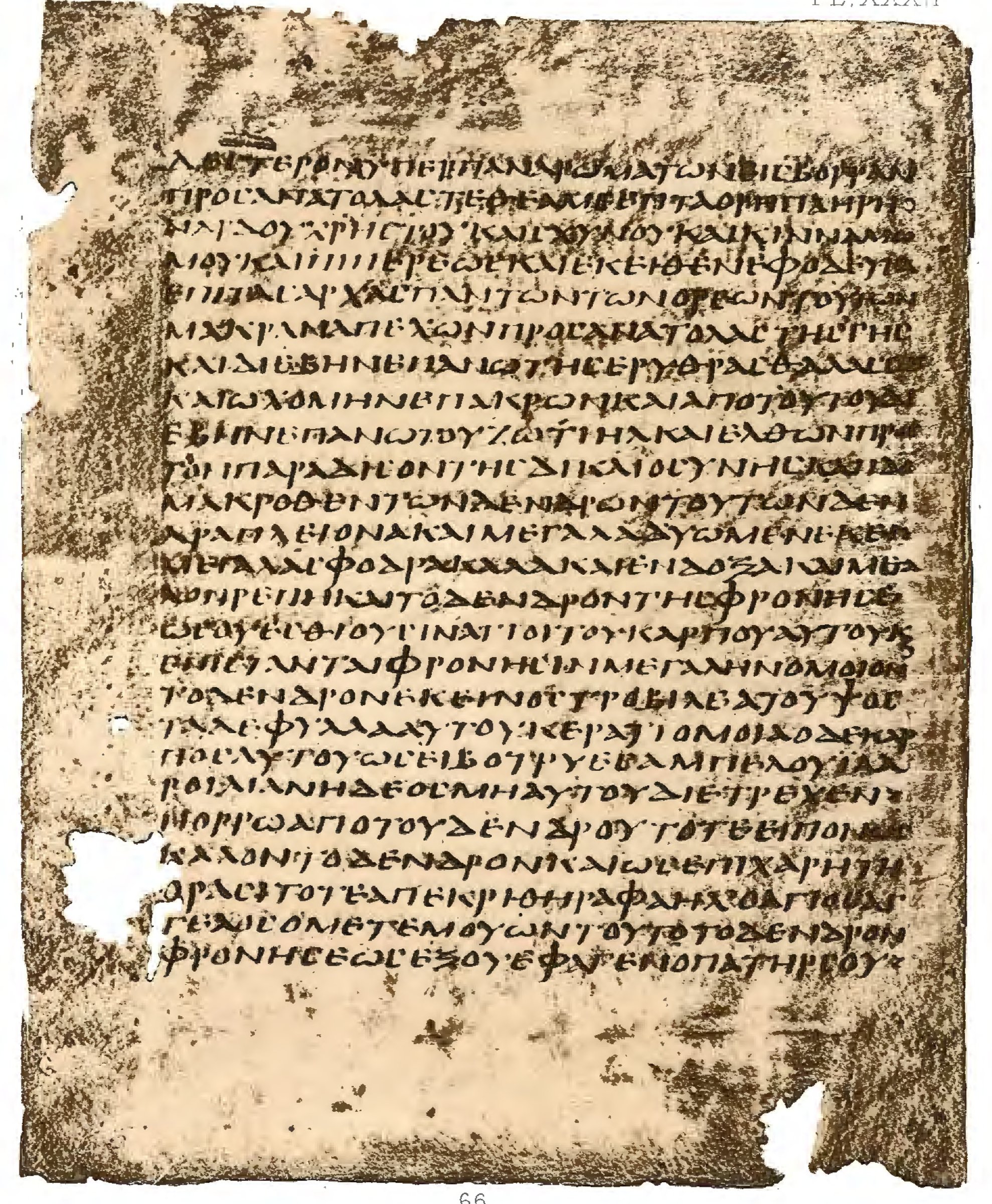
Where on the image
Akhmim codex pages 65, 66 (Lods's page numbers, printed under each plate page). Checked on the plates: p. 65 begins ‹και εκειθεν επορευθην εις το μεσον [μαν]δοβαρα›; p. 66 begins ‹(Lods: 65,26-66,1 = 31.3) ... των ορεων τουτων›. Chapter 31 runs from verse 1 to 2 in Swete's numbering; page spans follow the first words of each page, read on the plates, and Lods's page/line/chapter/verse list (1893, pp. 230-232). The English is Charles's translation of the Ethiopic version; words he marks ⌜ ⌝ are in the Greek but not the Ethiopic, words in 〚 〛 are in the Ethiopic but not the Greek.
1καὶ ἴδον ἄλλα ὄρη καὶ ἐν αὐτοῖς ἄλση δένδρων, καὶ ἐκπορευόμενον ἐξ αὐτῶν νέκταρ τὸ καλούμενον σαρρὰν καὶ χαλβάνη. 2καὶ ἐπέκεινα τῶν ὀρέων τούτων ἴδον ἄλλο ὄρος πρὸς ἀνατολὰς τῶν περάτων τῆς γῆς, καὶ πάντα τὰ δένδρα πλήρη ἐξαυτῆς ἐν ὁμοιώματι ἀμυγδάλων, ὅταν τριβῶσιν· διὸ εὐωδέστερον ὑπὲρ πᾶν ἄρωμα.
1 And I saw other mountains, and amongst them were ⌜groves of⌝ trees, and there flowed forth from them nectar, which is named sarara and galbanum. 2 And beyond these mountains I saw another mountain ⌜to the east of the ends of the earth⌝, 〚whereon were aloe trees〛, and all the trees were full of stacte, being like almond trees. 3 And when one burnt it, it smelt sweeter than any fragrant odour.
Where on the image
Akhmim codex page 66 (Lods's page numbers, printed under each plate page). Checked on the plates: p. 66 begins ‹(Lods: 65,26-66,1 = 31.3) ... των ορεων τουτων›. Chapter 32 runs from verse 1 to 6 in Swete's numbering; page spans follow the first words of each page, read on the plates, and Lods's page/line/chapter/verse list (1893, pp. 230-232). Charles prints a separate translation of the Akhmim Greek for verses 1, 3 of this chapter, and that is the English shown there; for verses 2, 4, 5, 6 he gives one translation, made from the Ethiopic, in which ⌜ ⌝ mark words that are in the Greek but not the Ethiopic and 〚 〛 words that are in the Ethiopic but not the Greek. The manuscript's text stops in 32.6 on the last written line of p. 66, ‹φρονησεως εξ ου εφαγεν ο πατηρ σου› (“of which thy father ate”), and the rest of the page is blank. The English of verse 6 goes on past that point with Charles's translation of the Ethiopic (“old (in years) and thy aged mother, who were before thee, have eaten, and they learnt wisdom ... and they were driven out of the garden”); those words are not on the page.
1εἰς βορρᾶν πρὸς ἀνατολὰς τεθέαμαι ἑπτὰ ὄρη πλήρη νάρδου χρηστοῦ καὶ σχίνου καὶ κινναμώμου καὶ πιπέρεως. 2Καὶ ἐκεῖθεν ἐφόδευσα ἐπὶ τὰς ἀρχὰς πάντων τῶν ὀρέων τούτων, μακρὰν ἀπέχων πρὸς ἀνατολὰς τῆς γῆς, καὶ διέβην ἐπάνω τῆς ἐρυθρᾶς θάλασσης, καὶ ᾠχόμην ἐπʼ ἄκρων, καὶ ἀπὸ τούτου διέβην ἐπάνω τοῦ Ζωτιήλ. 3καὶ ἦλθον πρὸς τὸν παράδεισον τῆς δικαιοσύνης, καὶ ἴδον μακρόθεν τῶν δένδρων τούτων δένδρα πλείονα καὶ μεγάλα δύω μὲν ἐκεῖ, μεγάλα σφόδρα καλὰ καὶ ἔνδοξα καὶ μεγαλοπρεπῆ, καὶ τὸ δένδρον τῆς φρονήσεως, οὗ ἐσθίουσιν ἅγιοι τοῦ καρποῦ αὐτοῦ καὶ ἐπίστανται φρόνησιν μεγάλην. 4ὅμοιον τὸ δένδρον ἐκεῖνο στροβιλέᾳ τὸ ὕψος, τὰ δὲ φύλλα αὐτοῦ κερατίᾳ ὅμοια, ὁ δὲ καρπὸς αὐτοῦ ὡσεὶ βότρυες ἀμπέλου ἱλαροὶ λίαν, ἡ δὲ ὀσμὴ αὐτοῦ διέτρεχεν πόρρω ἀπὸ τοῦ δένδρου. 5τότε εἶπον Ὡς καλὸν τὸ δένδρον, καὶ ὡς ἐπίχαρι τῇ ὁράσει. 6τότε ἀπεκρίθη Ῥαφαήλ, ὁ ἅγιος ἄγγελος ὁ μετʼ ἐμοῦ ὢν Τοῦτο τὸ δένδρον φρονήσεως, ἐξ οὗ ἔφαγεν ὁ πατήρ σου. …
1 To the north-east I beheld seven mountains full of choice nard and mastic and cinnamon and pepper.
2 And thence I went over the summits of ⌜all⌝ these mountains, far towards the east ⌜of the earth⌝, and passed above the Erythraean sea, and went far from it, and passed over 〚the angel〛 Zotîêl.
3 And I came to the Garden of Righteousness, and from afar off trees more numerous than these trees and great—†two† trees there, very great, beautiful, and glorious, and magnificent, and the tree of knowledge, whose holy fruit they eat and know great wisdom.
4 ⌜That tree is in height like the fir, and its leaves are⌝ like (those of) the Carob tree: and its fruit is like the clusters of the vine, very beautiful: and the fragrance of the tree penetrates afar. 5 Then I said: ‘⌜How⌝ beautiful is the tree, and how attractive is its look!’ 6 Then Raphael, the holy angel who was with me, answered me 〚and said〛: ‘This is the tree of wisdom, of which thy father old (in years) and thy aged mother, who were before thee, have eaten, and they learnt wisdom and their eyes were opened, and they knew that they were naked and they were driven out of the garden.’
Notes
- Greek: H. B. Swete, The Old Testament in Greek according to the Septuagint III (Cambridge 1905), Enoch 1-32, digital text of the First1KGreek project (tlg1463.tlg001.1st1K-grc1, CC BY-SA 4.0). Swete's apparatus and the parallel texts of Syncellus are not shown; his square brackets are kept.
- Proofreading: every page of Swete's Greek (archive.org theoldtestamenti03swetuoft, leaves 813-832) was read by OCR twice and aligned with the digital text; every word that neither OCR reading confirmed was looked up on the page image. These digitisation errors were corrected to Swete's print: 1.1 'οἶτινες' to 'οἵτινες'; 1.2 'πόρραυ' to 'πόρρω'; 1.2 'οὗσαν' to 'οὖσαν'; 1.3 'ὁ ἄγιός' to 'ὁ ἅγιός'; 1.5 'ἄκουσιν' to 'ᾄσουσιν'; 1.7 'όαγῶδες' to 'ῥαγῶδες'; 1.9 'σκληρῶν ὡν' to 'σκληρῶν ὧν'; 2.2 'ἕτε τὴν' to 'ἴδετε τὴν'; 2.2 'ἀλλοιοῦντα,' to 'ἀλλοιοῦνται,'; 2.3 'δετε τὴν' to 'ἴδετε τὴν'; 3.1 'καὶ δετε' to 'καὶ ἴδετε'; 5.1 'τά φύλλα χλωρά' to 'τὰ φύλλα χλωρὰ'; 5.2 'τἀ ἔργα' to 'τὰ ἔργα'; 5.2 'ὁὡσπερεὶ κατά' to 'ὡσπερεὶ κατὰ'; 5.4 'κατὰ τάς' to 'κατὰ τὰς'; 5.4 'ὑμίν.' to 'ὑμῖν.'; 5.6 'ἁμαρταωλοὶ' to 'ἁμαρτωλοὶ'; 5.6 'ἐυ ὑμῖν' to 'ἐν ὑμῖν'; 5.6 'ὑπαάρξει' to 'ὑπάρξει'; 5.6 'σατηρία' to 'σωτηρία'; 5.8 'τοῖς ἐκλεκτο σοφία' to 'τοῖς ἐκλεκτοῖς σοφία'; 5.8 'ἔτ οὐ' to 'ἔτι οὐ'; 5.8 'ἀλήθειαν οὕτε' to 'ἀλήθειαν οὔτε'; 5.8 'ἐν ἀνθρώπ πεφωτισμένῳ' to 'ἐν ἀνθρώπῳ πεφωτισμένῳ'; 5.8 'οὐ μ πλημμελήσουσιν' to 'οὐ μὴ πλημμελήσουσιν'; 5.9 'ἐν ἀργῇ' to 'ἐν ὀργῇ'; 6.1 'ἐγένετο οδ ἂν' to 'ἐγένετο οὗ ἂν'; 6.1 'ἐκεί ναις' to 'ἐκείναις'; 6.3 'πρδγμα' to 'πρᾶγμα'; 6.3 'μυνος' to 'μόνος'; 6.4 'οὕν αὐτῷ' to 'οὖν αὐτῷ'; 6.4 'μόσωμεν' to 'Ὀμόσωμεν'; 6.4 'ταὺτην, μέχρις οὐ ἂν τελέσσομεν' to 'ταύτην, μέχρις οὗ ἂν τελέσωμεν'; 6.7 'Κωχαριήλ, Ἐζεκιήλ,' to 'Χωχαριήλ, Ἑζεκιήλ,'; 6.7 'Γαμιήλ,' to 'Ταμιήλ,'; 6.7 'Ἀρεαρώς. Σεμιήλ' to 'Ἀρεαρώς, Σεμιήλ'; 6.7 'ᵇωνιήλ, Ῥαμιήλ. Ασεάλ, Ῥακειήλ, Γουριήλ.' to 'Θωνιήλ, Ῥαμιήλ, Ἀσεάλ, Ῥακειήλ, Τουριήλ.'; 6.8 'οδτοί' to 'οὗτοί'; 7.1 'καὶ ὀιζοτομίας,' to 'καὶ ῥιζοτομίας,'; 7.2 'πηχίῶν' to 'πηχῶν'; 7.2 'AI δὲ' to 'Αἱ δὲ'; 7.3 'ἳτινες' to 'οἵτινες'; 8.3 'καὶ ὸιζοτομίας·' to 'καὶ ῥιζοτομίας·'; 8.3 'Κωχιὴλ' to 'Χωχιὴλ'; 8.3 'ἅστεροσκοπίαν·' to 'ἀστεροσκοπίαν·'; 8.4 'τῶν οὗν' to 'τῶν οὖν'; 9.1 'Γότε παρζακύψαντες' to 'Τότε παρ[α]κύψαντες'; 9.1 'Οὐζριὴλ' to 'Οὐ[ρι]ὴλ'; 9.1 'Γαβριήζλ],' to 'Γαβριή[λ],'; 9.1 'ἐθεάσ|αντο' to 'ἐθεάσ[αν]το'; 9.4 'κυρίῳ Σύ εἶ' to 'κυρίῳ Σὺ εἶ'; 9.6 'σὺ ὁρῖς' to 'σὺ ὁρᾷς'; 9.6 'Ἀζαήλ, ὸς' to 'Ἀζαήλ, ὃς'; 9.9 'αἵθματος' to 'αἵματος'; 10.1 'Ὕψστος' to 'Ὕψιστος'; 10.8 'ἀφανισθεῖτα' to 'ἀφανισθεῖσα'; 10.9 'ἐγρηγρόων' to 'ἐγρηγόρων'; 10.13 'δεσμωτήριρν' to 'δεσμωτήριον'; 10.13 'συνκλείσεως' to 'συγκλείσεως'; 10.16 'μετά χαρᾶς' to 'μετὰ χαρᾶς'; 10.18 'θένδρον' to 'δένδρον'; 10.19 'πρόχους' to 'προχοῦς'; 11.2 'ἡμέρας τὸν αἰῶνος' to 'ἡμέρας τοῦ αἰῶνος'; 11.2 'τὰς γενεάς' to 'τὰς γενεὰς'; 12.2 'καὶ τά ἔργα' to 'καὶ τὰ ἔργα'; 12.2 'αὐτοῦ μετά τῶν' to 'αὐτοῦ μετὰ τῶν'; 12.3 'ἑστὼς ἢμην' to 'ἑστὼς ἤμην'; 12.4 'καὶ εἰπέ τοῖς' to 'καὶ εἰπὲ τοῖς'; 12.4 'αἰῶνος, μετά τῶν' to 'αἰῶνος, μετὰ τῶν'; 12.5 'περὶ ὦν χαίρουσιν' to 'περὶ ὧν χαίρουσιν'; 13.1 'εἶπεν ορεύου·' to 'εἶπεν Πορεύου·'; 13.4 'ὅπαως' to 'ὅπως'; 13.5 'περὶ ὦν ἡμαρτήκεισαν' to 'περὶ ὧν ἡμαρτήκεισαν'; 14.2 'Ἐγὰλ εἶδον' to 'Ἐγὼ εἶδον'; 14.5 'ἴνα μηκέτι' to 'ἵνα μηκέτι'; 14.7 'μὴρλαλοῦντες' to 'μὴ λαλοῦντες'; 14.10 'τὰς γλώσσας' to 'τὰς γλῶσσας'; 14.16 'καί ὅλος' to 'καὶ ὅλος'; 15.2 'καὶ εἰπέ τοῖς' to 'καὶ εἰπὲ τοῖς'; 15.4 'οἵτιυες' to 'οἵτινες'; 15.7 'αὐ τῶν' to 'αὐτῶν'; 15.11 'καὶ μηδέν' to 'καὶ μηδὲν'; 16.1 'ἀφʼ ὦν' to 'ἀφʼ ὧν'; 16.1 'μέ χρις' to 'μέχρις'; 16.1 'ἐν ἦ ὁ' to 'ἐν ᾗ ὁ'; 16.2 'οἵτινετῖ' to 'οἵτινες'; 16.3 'ἤτε,' to 'ἦτε,'; 16.4 'εἰπὸν οὗν' to 'εἰπὸν οὖν'; 18.7 'τὰ μέν πρὸς' to 'τὰ μὲν πρὸς'; 18.7 'δὲ ἦυ ἀπὸ' to 'δὲ ἦν ἀπὸ'; 18.12 'ἐπάνω, οὕτε γῆ' to 'ἐπάνω, οὔτε γῆ'; 18.12 'τεθεμελιαωμένη' to 'τεθεμελιωμένη'; 18.12 'ὕδωρ ὖν ὑπὸ' to 'ὕδωρ ἦν ὑπὸ'; 18.16 'μυρίαον.' to 'μυρίων.'; 19.1 'ἐν ᾖ κριθήσονται' to 'ἐν ᾗ κριθήσονται'; 19.3 'οὐδὲ εἰς ἀνθρώπων' to 'οὐδὲ εἷς ἀνθρώπων'; 20.2 'ὁ εἰς τῶν' to 'ὁ εἷς τῶν'; 20.3 'Ραφαήλ, ὁ εἶς' to 'Ῥαφαήλ, ὁ εἷς'; 20.4 'Ῥαγουήλ, ὁ' to 'Ῥαγουήλ, ὁ εἷς τῶν ἁγίων ἀγγέλων ὁ ἐκδικῶν τὸν κόσμον τῶν φωστήρων.'; 20.5 'Μιχαὴλ, ὁ εἰς' to 'Μιχαήλ, ὁ εἷς'; 20.6 'οἵτιυες' to 'οἵτινες'; 20.7 'ὀνόρατα' to 'ὀνόματα'; 20.7 'Γαβριὴλ, ὁ εἶς' to 'Γαβριήλ, ὁ εἷς'; 21.2 'ἑώρακα οὕτε' to 'ἑώρακα οὔτε'; 21.2 'ἐπάνω, οὕτε γῆν' to 'ἐπάνω, οὔτε γῆν'; 21.5 'ἐρωτᾶς' to 'ἐρωτᾷς'; 21.5 'ἐμοῖ ἧν' to 'ἐμοῦ ἦν'; 21.7 'πυρὸς μεγάλου' to 'πυρὸς μεγάλων'; 21.8 'εἶπον Ὠς' to 'εἶπον Ὡς'; 21.9 'ὁ εἶς τῶν' to 'ὁ εἷς τῶν'; 21.9 'ἀγγέλων ὂς μετʼ' to 'ἀγγέλων ὃς μετʼ'; 22.3 'ἐμοῦ ἧν, καὶ' to 'ἐμοῦ ἦν, καὶ'; 22.3 'ἐπισυνάγαονται' to 'ἐπισυνάγωνται'; 22.5 'Τε θέομαι' to 'Τεθέαμαι'; 22.8 'ἔν ἀπὸ' to 'ἓν ἀπὸ'; 22.11 'ὦδῆ' to 'ὧδε'; 22.11 'κατηραμέναων· μέ χρι' to 'κατηραμένων· μέχρι'; 22.12 'ἐχαωρίσθη' to 'ἐχωρίσθη'; 22.13 'οὐδέ μὴ μετεγρθῶσιν' to 'οὐδὲ μὴ μετεγερθῶσιν'; 23.4 'ἐμοῦ ἶν' to 'ἐμοῦ ἦν'; 24.3 'ὄμὅιον' to 'ὅμοιον'; 24.4 'καὶ ἧν ἐν' to 'καὶ ἦν ἐν'; 24.6 'μοι Μιχαὴλ,' to 'μοι Μιχαήλ,'; 25.2 'ΙΙερὶ' to 'Περὶ'; 26.2 'δύσν εἰχεν' to 'δύσιν εἶχεν'; 26.4 'τριῶν ὁρέων.' to 'τριῶν ὀρέων.'; 26.5 'ἐπʼ αὐτας.' to 'ἐπʼ αὐτάς.'; 27.2 'καὶ ὦδε ἔσται' to 'καὶ ὧδε ἔσται'; 27.3 'ἐυ ταῖς' to 'ἐν ταῖς'; 29.1 'πρὸς ἀνατολὸς' to 'πρὸς ἀνατολὰς'; 29.2 'τὰ δἐνδρα' to 'τὰ δένδρα'; 31.2 'εὐωδέστερον ὑπέρ πᾶν' to 'εὐωδέστερον ὑπὲρ πᾶν'; 32.1 'πιπέρεαρς.' to 'πιπέρεως.'; 32.3 'δύω μέν ἐκεῖ' to 'δύω μὲν ἐκεῖ'; 32.4 'ὄμοια,' to 'ὅμοια,'; 32.6 'ἐμοῦ ὤν' to 'ἐμοῦ ὢν'; 32.6 'ἐξ οἶ' to 'ἐξ οὗ'.
- English: R. H. Charles, The Book of Enoch (SPCK, London 1917), Project Gutenberg #77935, as prepared for the 1 Enoch (Ethiopic) entries of this library. Charles's signs: ⌜ ⌝ words in the Greek but not the Ethiopic; 〚 〛 words in the Ethiopic but not the Greek; [ ] interpolations; ( ) words supplied; † † corrupt text.
- Verse numbers in the Greek are Swete's and in the English Charles's; they differ in a few places.
Cite
Sources
- Source: Akhmim codex (P. Cair. 10759) pages 21-66 in A. Lods's heliogravure plates (1893, Internet Archive) + Greek of H. B. Swete, The Old Testament in Greek III (1905; First1KGreek, proofread against the print) + English of R. H. Charles (1917, public domain) (holding institution)
- Critical edition: A. Lods, diplomatic transcription and heliogravure facsimile (1893)
← previous · → next · v cycle view · l back to library