Apocalypse of Peter (Akhmim codex, pages 19-13)
Introduction
The Apocalypse of Peter is an early Christian revelation, probably of the first half of the 2nd century, in which Christ shows Peter the glory of the righteous and the punishments of sinners. It was read in some churches in the 2nd and 3rd centuries (the Muratorian fragment names it, with reservations, beside the Apocalypse of John). The fuller form survives only in an Ethiopic version; the Greek fragment shown here was found in 1886-87 in the Akhmim codex, in the same small parchment book as the Gospel of Peter.
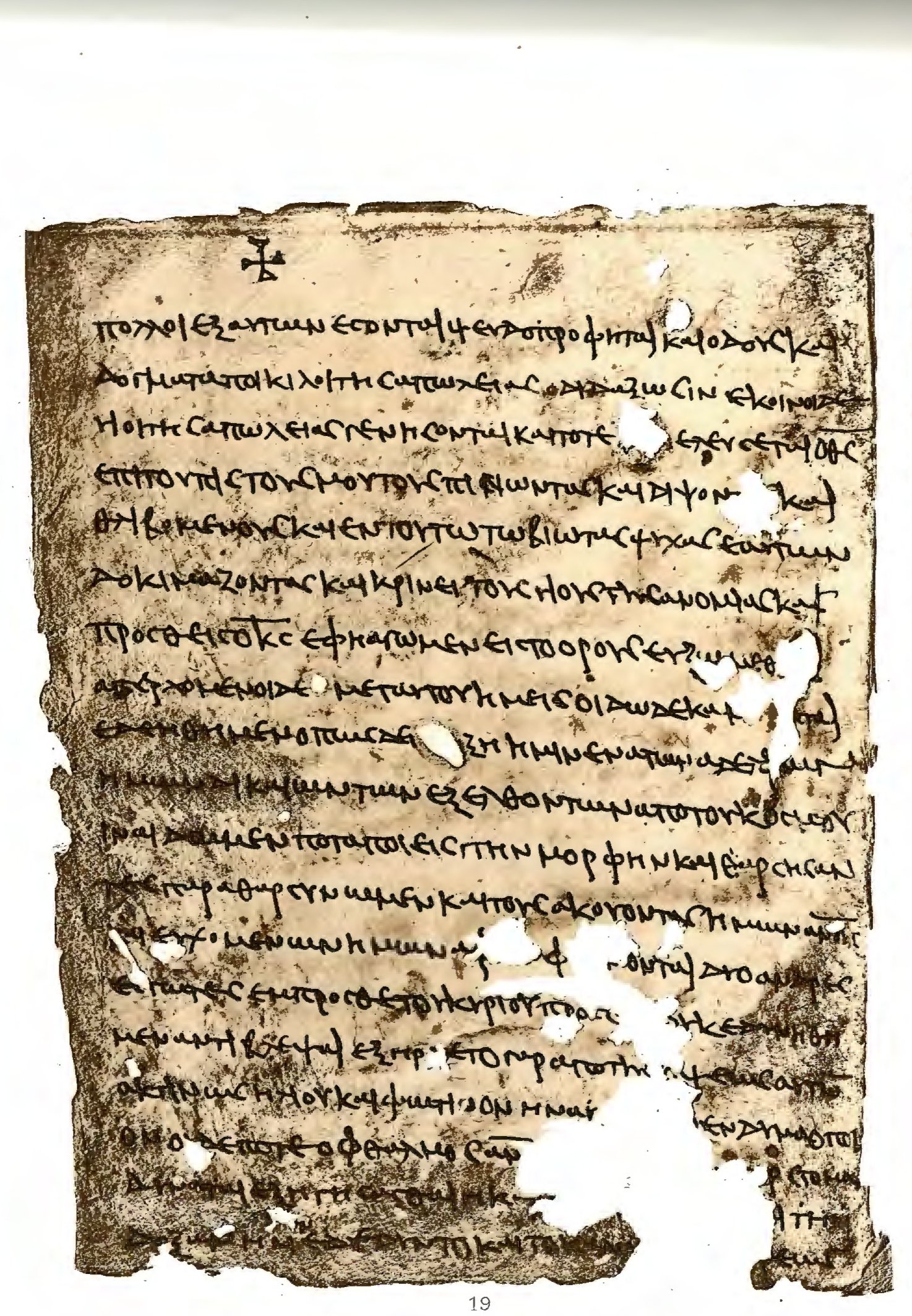
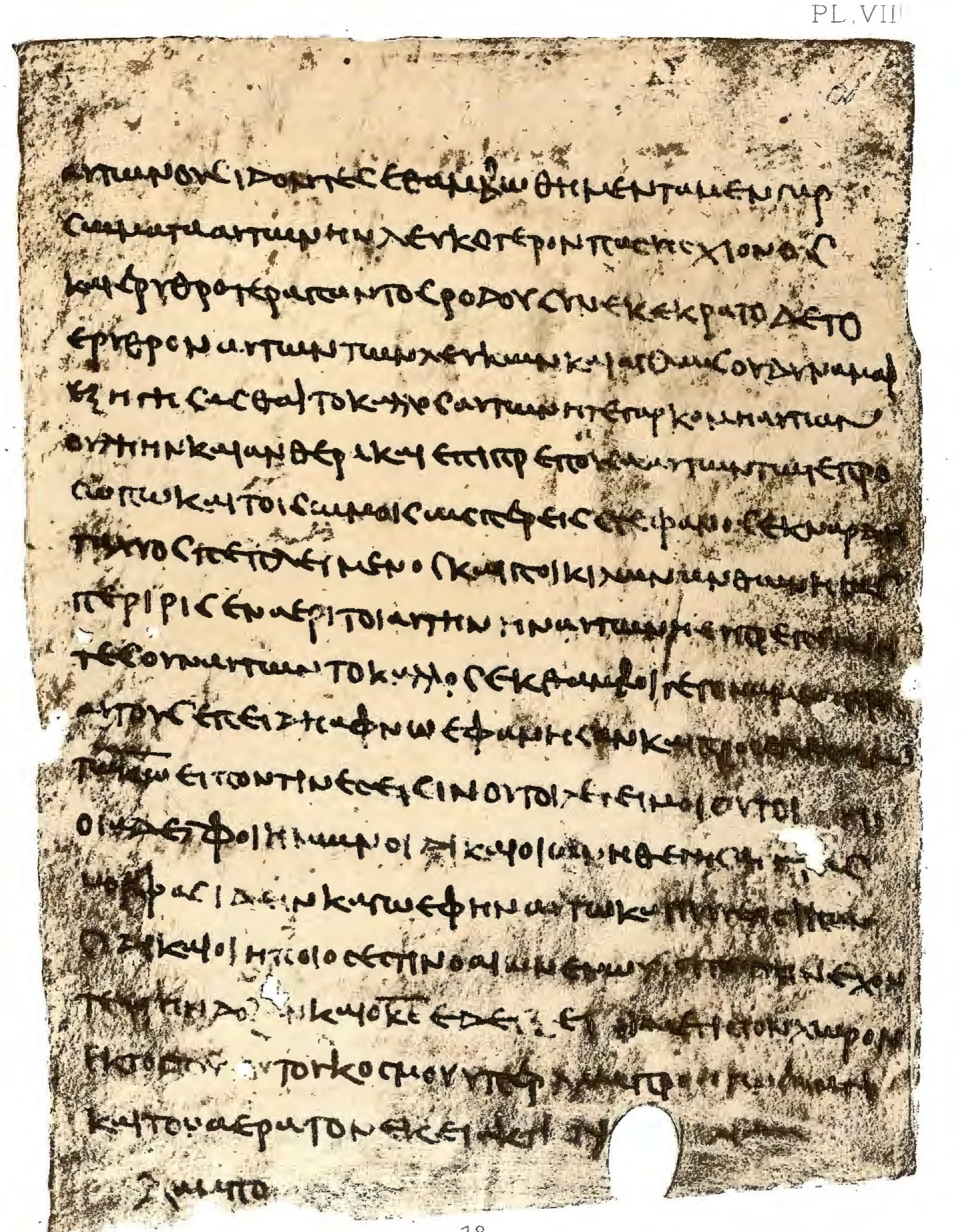
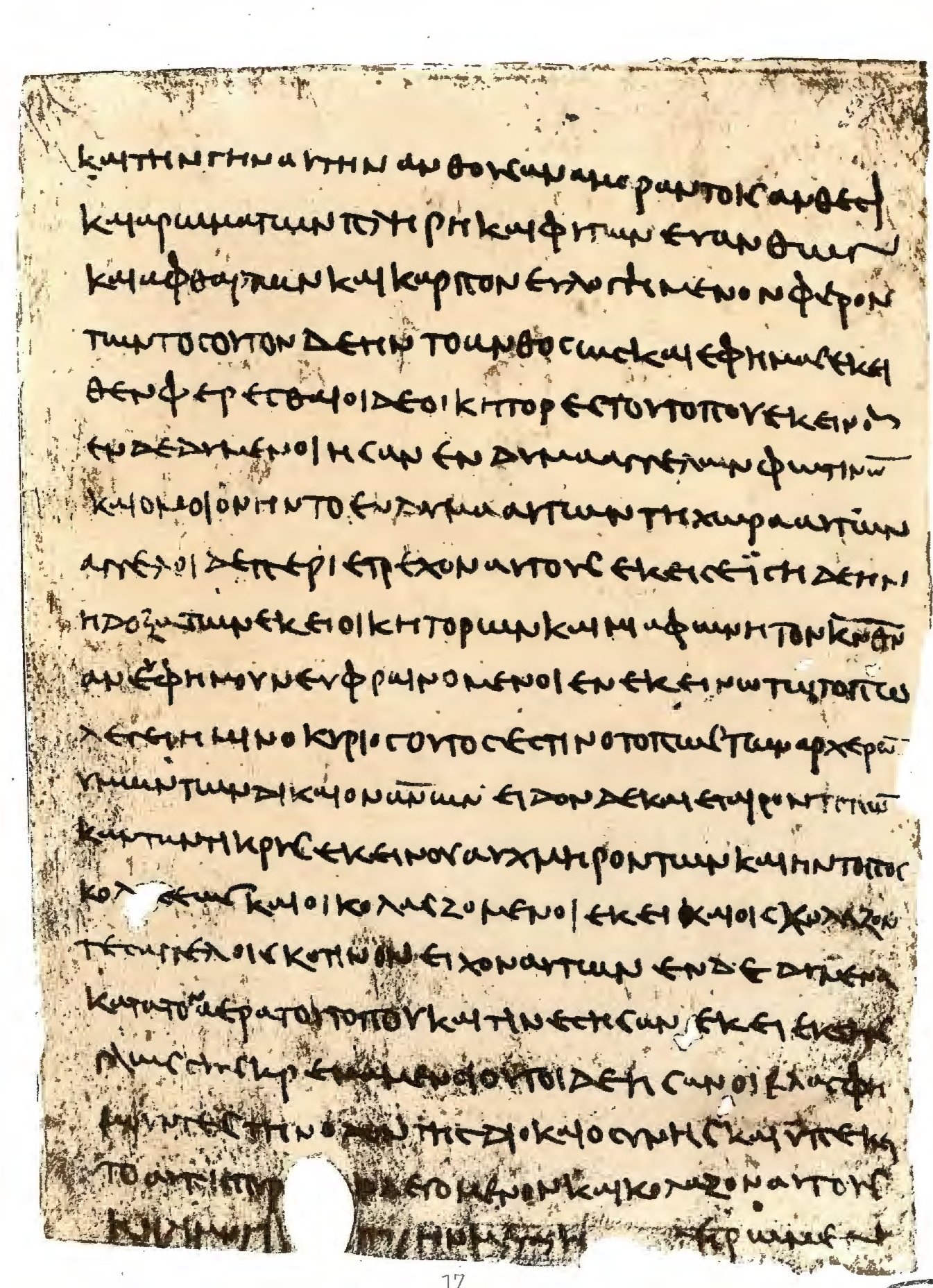
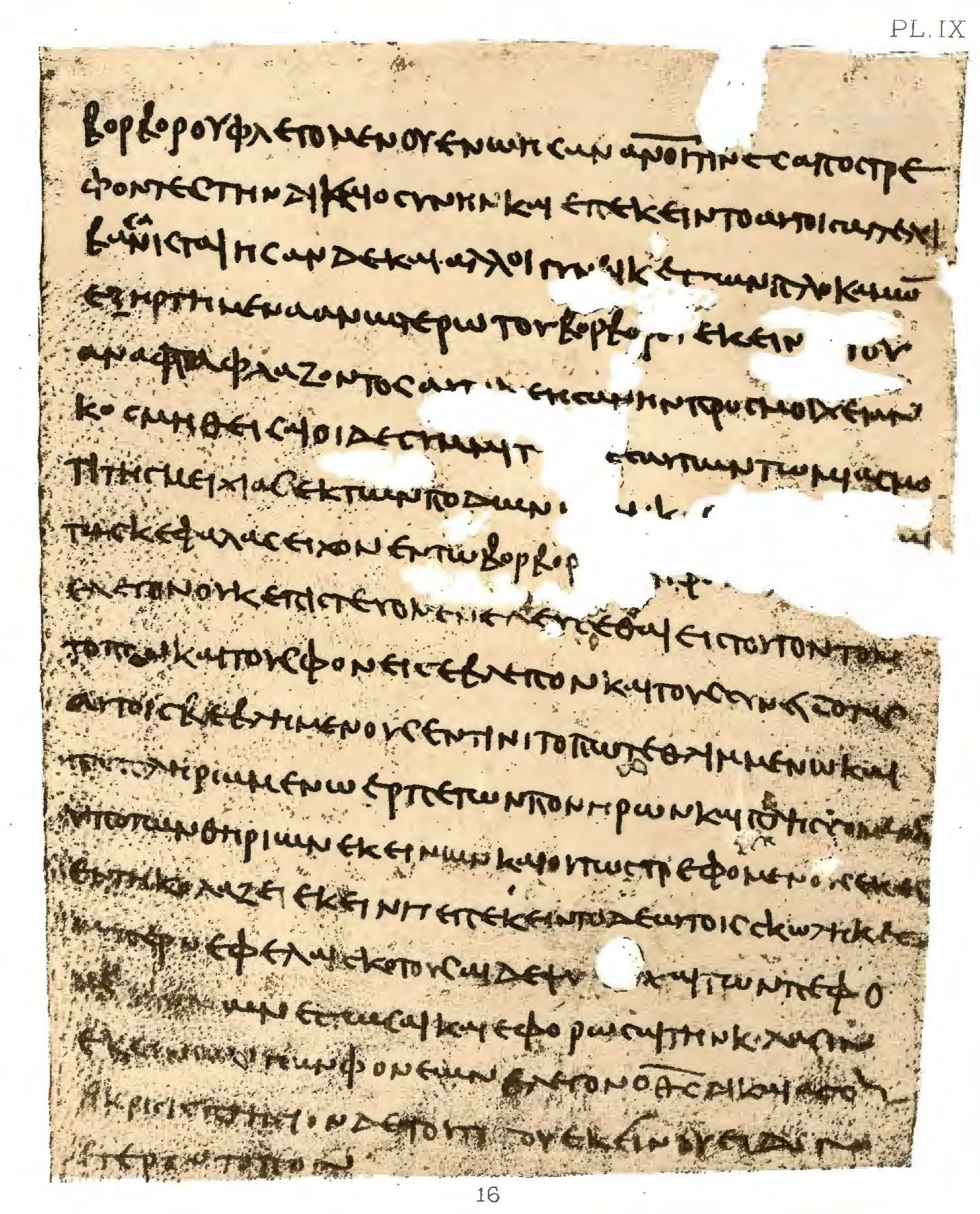
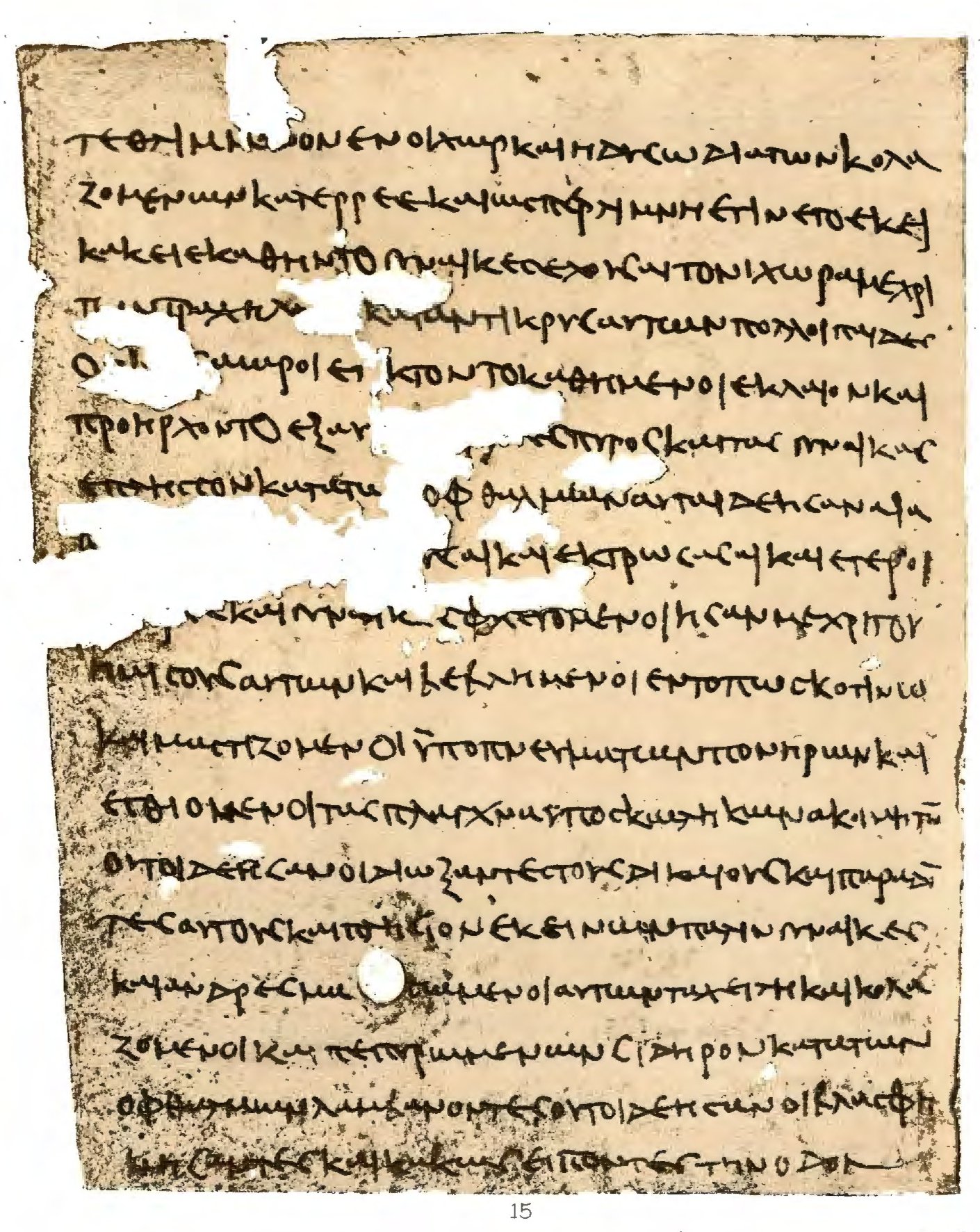
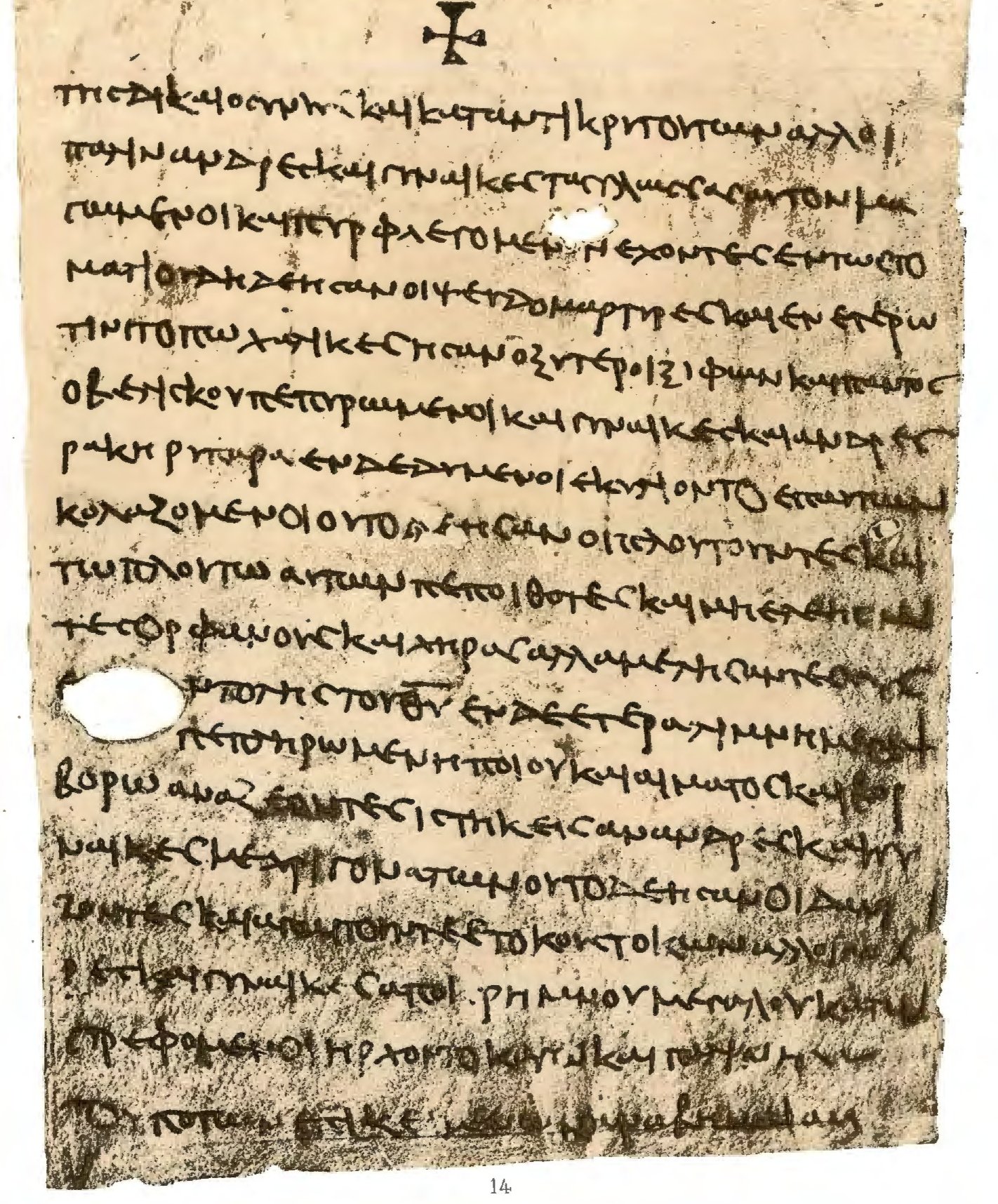
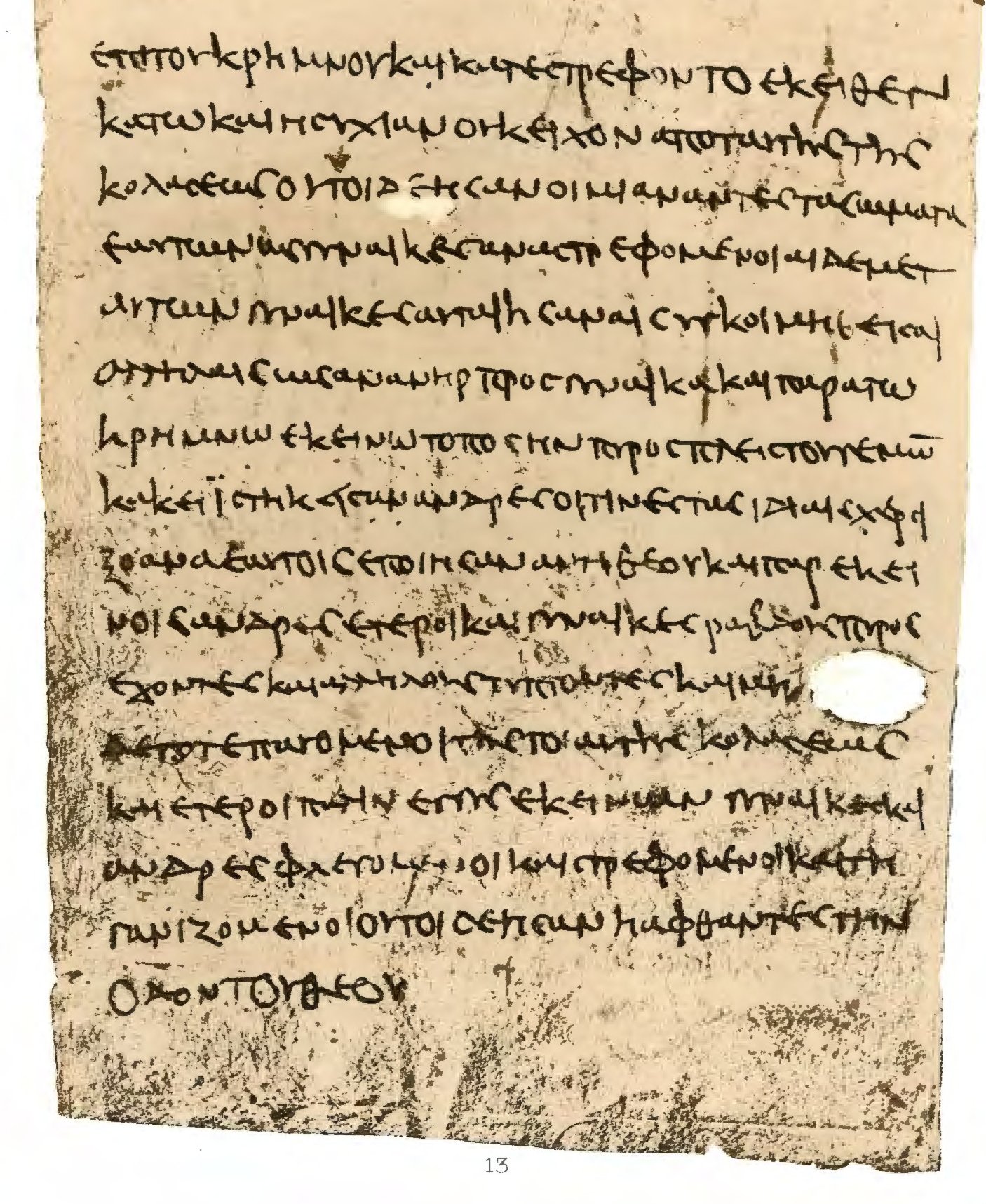
The manuscript. In the Akhmim codex (Cairo, Egyptian Museum, P. Cair. 10759) the fragment fills pages 19 to 13: the leaves were bound so that the text runs backwards through Lods's page numbers, 19, 18, 17, 16, 15, 14, 13. Pages 19 and 14 have a small cross above the first line. The text begins and ends in mid-discourse. The pages shown are A. Lods's heliogravure plates VII-X (1893), made from photographs of the manuscript, cut out of the plates and turned upright.
Texts and mapping. The Greek is Lods's line-by-line diplomatic transcription, with his page and line numbers (page.line); dots are letters Lods could not read (one dot per letter), brackets are letters he took from Bouriant's first copy or that were already lost when the text was copied. Each section is one verse of M. R. James's translation (1924), whose openings were located in Lods's lines by their Greek words. James translated a critical text, so where the manuscript is damaged his English gives the restored sense.
How was this verified? (Provenance)
Where on the image
Akhmim codex p. 19, line 1 to p. 19, line 2, page and line numbers as printed by Lods (1893), whose heliogravure plates are shown; the codex pages carry the text in the order 19, 18, 17, 16, 15, 14, 13. Checked on the plates: p. 19 begins ‹a cross above the text; line 1 πολλοι εξ αυτων εσονται ψευδοπροφηται και οδους και; line 3 ends ελευσεται ο̅θ̅ς̅›. The verse opening was located in Lods's lines by its Greek words (‹πολλοι εξ αυτων›).
19.1 πολλοι εξ αυτων εσονται ψευδοπροφηται και οδους και
19.2 δογματα ποικιλοι της απωλειας διδαξωσιν
1 Many of them shall be false prophets, and shall teach ways and diverse doctrines of perdition.
Where on the image
Akhmim codex p. 19, line 2 to p. 19, line 3, page and line numbers as printed by Lods (1893), whose heliogravure plates are shown; the codex pages carry the text in the order 19, 18, 17, 16, 15, 14, 13. Checked on the plates: p. 19 begins ‹a cross above the text; line 1 πολλοι εξ αυτων εσονται ψευδοπροφηται και οδους και; line 3 ends ελευσεται ο̅θ̅ς̅›. The verse opening was located in Lods's lines by its Greek words (‹εκοινοι δε›).
19.2 εκοινοι δε
19.3 υιοι της απωλειας γενησονται
2 And they shall become sons of perdition.
Where on the image
Akhmim codex p. 19, line 3 to p. 19, line 6, page and line numbers as printed by Lods (1893), whose heliogravure plates are shown; the codex pages carry the text in the order 19, 18, 17, 16, 15, 14, 13. Checked on the plates: p. 19 begins ‹a cross above the text; line 1 πολλοι εξ αυτων εσονται ψευδοπροφηται και οδους και; line 3 ends ελευσεται ο̅θ̅ς̅›. The verse opening was located in Lods's lines by its Greek words (‹και τοτε ελευσεται›).
19.3 και τοτε ελευσεται ο̅θ̅ς̅
19.4 επι του πιστους μου τους πινωντας και διψον. . . και
19.5 θλιβομενους και εν τουτω τω βιω τας ψυχας εαυτων
19.6 δοκιμαζοντας και κρινει τους υιους της ανομιας
3 And then shall God come unto my faithful ones that hunger and thirst and are afflicted and prove their souls in this life, and shall judge the sons of iniquity.
Where on the image
Akhmim codex p. 19, line 6 to p. 19, line 7, page and line numbers as printed by Lods (1893), whose heliogravure plates are shown; the codex pages carry the text in the order 19, 18, 17, 16, 15, 14, 13. Checked on the plates: p. 19 begins ‹a cross above the text; line 1 πολλοι εξ αυτων εσονται ψευδοπροφηται και οδους και; line 3 ends ελευσεται ο̅θ̅ς̅›. The verse opening was located in Lods's lines by its Greek words (‹ανομιας και›).
19.6 και
19.7 προσθεις ο̅κ̅ς̅ εφη αγωμεν εις το ορους ευξωμεθ.
4 And the Lord added and said: Let us go unto the mountain (and) pray.
Where on the image
Akhmim codex p. 19, line 8 to p. 19, line 12, page and line numbers as printed by Lods (1893), whose heliogravure plates are shown; the codex pages carry the text in the order 19, 18, 17, 16, 15, 14, 13. Checked on the plates: p. 19 begins ‹a cross above the text; line 1 πολλοι εξ αυτων εσονται ψευδοπροφηται και οδους και; line 3 ends ελευσεται ο̅θ̅ς̅›. The verse opening was located in Lods's lines by its Greek words (‹απερχομενοι δε›).
19.8 απερχομενοι δε μετ αυτου ημεις οι δωδεκα μ . θ . ται
19.9 εδεηθημεν οπως δειξη ημιν ενα των αδελφων
19.10 ημων δικαιων των εξελθοντων απο του κοσμου
19.11 ινα ιδωμεν ποταποι εισι την μορφην και θαρσησαν
19.12 τες παραθαρσυνωμεν και τους ακουντας ημων α̅ν̅ο̅υ̅ς̅
5 And going with him, we the twelve disciples besought him that he would show us one of our righteous brethren that had departed out of the world, that we might see what manner of men they are in their form, and take courage, and encourage also the men that should hear us.
Where on the image
Akhmim codex p. 19, line 13 to p. 19, line 15, page and line numbers as printed by Lods (1893), whose heliogravure plates are shown; the codex pages carry the text in the order 19, 18, 17, 16, 15, 14, 13. Checked on the plates: p. 19 begins ‹a cross above the text; line 1 πολλοι εξ αυτων εσονται ψευδοπροφηται και οδους και; line 3 ends ελευσεται ο̅θ̅ς̅›. The verse opening was located in Lods's lines by its Greek words (‹και ευχομενων›).
19.13 και ευχομενων ημων αφ. . φ. . . ονται δυο ανδρες
19.14 ἑστωτες εμπροσθε του κυριου προς ο . . ουκ εδυνηθη
19.15 μεν αντιβλεψαι
6 And as we prayed, suddenly there appeared two men standing before the Lord (perhaps add, to the east) upon whom we were not able to look.
Where on the image
Akhmim codex p. 19, line 15 to p. 18, line 1, page and line numbers as printed by Lods (1893), whose heliogravure plates are shown; the codex pages carry the text in the order 19, 18, 17, 16, 15, 14, 13. Checked on the plates: p. 19 begins ‹a cross above the text; line 1 πολλοι εξ αυτων εσονται ψευδοπροφηται και οδους και; line 3 ends ελευσεται ο̅θ̅ς̅›; p. 18 begins ‹αυτων ους ιδοντες εθαμβωθημεν τα μεν γαρ›. The verse opening was located in Lods's lines by its Greek words (‹αντιβλεψαι εξηρ›).
19.15 εξηρ . ετο γαρ απο της οψεως αυτω̅
19.16 ακτιν ως ηλιου και φωτινον ην αυ . . . . . ενδυμα οποι
19.17 ον ουδεποτε οφθαλμος α̅ν̅. . . . . . . . . . . . . ρ στομα
19.18 δυναται εξηγησασθαι η κ. . . . . . . . . . . . . ι την
19.19 δοξαν ην .νεδεδυντο και το καλ . . . . . . . . εως
18.1 αυτων
7 For there issued from their countenance a ray as of the sun, and their raiment was shining so as the eye of man never saw the like: for no mouth is able to declare nor heart to conceive the glory wherewith they were clad and the beauty of their countenance.
Where on the image
Akhmim codex p. 18, line 1 to p. 18, line 3, page and line numbers as printed by Lods (1893), whose heliogravure plates are shown; the codex pages carry the text in the order 19, 18, 17, 16, 15, 14, 13. Checked on the plates: p. 18 begins ‹αυτων ους ιδοντες εθαμβωθημεν τα μεν γαρ›. The verse opening was located in Lods's lines by its Greek words (‹αυτων ους ιδοντες›).
18.1 ους ιδοντες εθαμβωθημεν τα μεν γαρ
18.2 σωματα αυτων ην λευκοτερον πασης χιονος
18.3 και ερυθροτερα παντος ροδου
8 Whom when we saw we were astonied, for their bodies were whiter than any snow and redder than any rose.
Where on the image
Akhmim codex p. 18, line 3 to p. 18, line 5, page and line numbers as printed by Lods (1893), whose heliogravure plates are shown; the codex pages carry the text in the order 19, 18, 17, 16, 15, 14, 13. Checked on the plates: p. 18 begins ‹αυτων ους ιδοντες εθαμβωθημεν τα μεν γαρ›. The verse opening was located in Lods's lines by its Greek words (‹ροδου συνεκεκρατο›).
18.3 συνεκεκρατο δε το
18.4 ερυθρον αυτων των λευκων και απλως ου δυναμαι
18.5 εξηγησασθαι το καλλος αυτων
9 And the redness of them was mingled with the whiteness, and, in a word, I am not able to declare their beauty.
Where on the image
Akhmim codex p. 18, line 5 to p. 18, line 9, page and line numbers as printed by Lods (1893), whose heliogravure plates are shown; the codex pages carry the text in the order 19, 18, 17, 16, 15, 14, 13. Checked on the plates: p. 18 begins ‹αυτων ους ιδοντες εθαμβωθημεν τα μεν γαρ›. The verse opening was located in Lods's lines by its Greek words (‹αυτων η τε γαρ›).
18.5 η τε γαρ κομη αυτων
18.6 ουλη ην και ανθερα και επιπρεπουσα αυτων τω τε προ
18.7 σωπω και τοις ωμοις ωσπερ εις στεφανος εκ ναρδου σ
18.8 ταχυος πεπλεγμενος και ποικιλων ανθων η ωσ
18.9 περ ιρις εν αερι τοιαυτην ην αυτων η ευπρεπεια
10 For their hair was curling and flourishing (flowery), and fell comely about their countenance and their shoulders like a garland woven of nard and various flowers, or like a rainbow in the air: such was their comeliness.
Where on the image
Akhmim codex p. 18, line 9 to p. 18, line 11, page and line numbers as printed by Lods (1893), whose heliogravure plates are shown; the codex pages carry the text in the order 19, 18, 17, 16, 15, 14, 13. Checked on the plates: p. 18 begins ‹αυτων ους ιδοντες εθαμβωθημεν τα μεν γαρ›. The verse opening was located in Lods's lines by its Greek words (‹ευπρεπεια ιδο›).
18.9 ιδο̅
18.10 τες ουν αυτων το καλλος εκθαμβοι γεγοναμεν προς
18.11 αυτους επειδη αφνω εφανησαν
11 We, then, seeing the beauty of them were astonied at them, for they appeared suddenly.
Where on the image
Akhmim codex p. 18, line 11 to p. 18, line 12, page and line numbers as printed by Lods (1893), whose heliogravure plates are shown; the codex pages carry the text in the order 19, 18, 17, 16, 15, 14, 13. Checked on the plates: p. 18 begins ‹αυτων ους ιδοντες εθαμβωθημεν τα μεν γαρ›. The verse opening was located in Lods's lines by its Greek words (‹εφανησαν και προσελθων›).
18.11 και προσελθων
18.12 τω κ̅ω̅ ειπον τινες εισιν ουτοι
12 And I drew near to the Lord and said: Who are these?
Where on the image
Akhmim codex p. 18, line 12 to p. 18, line 14, page and line numbers as printed by Lods (1893), whose heliogravure plates are shown; the codex pages carry the text in the order 19, 18, 17, 16, 15, 14, 13. Checked on the plates: p. 18 begins ‹αυτων ους ιδοντες εθαμβωθημεν τα μεν γαρ›. The verse opening was located in Lods's lines by its Greek words (‹ουτοι λεγει μοι›).
18.12 λεγει μοι ουτοι [ε]ισιν
18.13 οι αδελφοι ημων οι δικαιοι ων ηθελησατε τας
18.14 μορφας ιδειν
13 He saith to me: These are your (our) righteous brethren whose appearance ye did desire to see.
Where on the image
Akhmim codex p. 18, line 14 to p. 18, line 16, page and line numbers as printed by Lods (1893), whose heliogravure plates are shown; the codex pages carry the text in the order 19, 18, 17, 16, 15, 14, 13. Checked on the plates: p. 18 begins ‹αυτων ους ιδοντες εθαμβωθημεν τα μεν γαρ›. The verse opening was located in Lods's lines by its Greek words (‹ιδειν καγω εφην›).
18.14 καγω εφην αυτω και που εισι παντες
18.15 οι δικαιοι η ποιος εστιν ο αιων εν ω εισι ταυτην εχον
18.16 τες την δοξαν
14 And I said unto him: And where are all the righteous? or of what sort is the world wherein they are, and possess this glory?
Where on the image
Akhmim codex p. 18, line 16 to p. 17, line 4, page and line numbers as printed by Lods (1893), whose heliogravure plates are shown; the codex pages carry the text in the order 19, 18, 17, 16, 15, 14, 13. Checked on the plates: p. 18 begins ‹αυτων ους ιδοντες εθαμβωθημεν τα μεν γαρ›; p. 17 begins ‹και την γην αυτην ανθουσαν αμαραντοις ανθεσι›. The verse opening was located in Lods's lines by its Greek words (‹δοξαν και›).
18.16 και ο̅κ̅ς̅ εδειξε μοι μεγιστον χωρον
18.17 εκτος τουτου του κοσμου υπερλαμπρον τω φωτι
18.18 και τον αερα τον εκει ἀκτ[ισιν ηλιου] κατα
18.19 λαμπομενον
17.1 και την γην αυτην ανθουσαν αμαραντοις ανθεσι
17.2 και αρωματων πληρη και φυτων ευανθων
17.3 και αφθαρτων και καρπον ευλογημενον φερον
17.4 των
15 And the Lord showed me a very great region outside this world exceeding bright with light, and the air of that place illuminated with the beams of the sun, and the earth of itself flowering with blossoms that fade not, and full of spices and plants, fair-flowering and incorruptible, and bearing blessed fruit.
Where on the image
Akhmim codex p. 17, line 4 to p. 17, line 5, page and line numbers as printed by Lods (1893), whose heliogravure plates are shown; the codex pages carry the text in the order 19, 18, 17, 16, 15, 14, 13. Checked on the plates: p. 17 begins ‹και την γην αυτην ανθουσαν αμαραντοις ανθεσι›. The verse opening was located in Lods's lines by its Greek words (‹των τοσουτον›).
17.4 τοσουτον δε ην το ανθος ως και εφ ημας εκει
17.5 θεν φερεσθαι
16 And so great was the blossom that the odour thereof was borne thence even unto us.
Where on the image
Akhmim codex p. 17, line 5 to p. 17, line 7, page and line numbers as printed by Lods (1893), whose heliogravure plates are shown; the codex pages carry the text in the order 19, 18, 17, 16, 15, 14, 13. Checked on the plates: p. 17 begins ‹και την γην αυτην ανθουσαν αμαραντοις ανθεσι›. The verse opening was located in Lods's lines by its Greek words (‹φερεσθαι οι δε›).
17.5 οι δε οικητορες του τοπου εκεινου
17.6 ενδεδυμενοι ησαν ενδυμα αγγελων φωτινω̅
17.7 και ομοιον ην το ενδυμα αυτων τη χωρα αυτων
17 And the dwellers in that place were clad with the raiment of shining angels, and their raiment was like unto their land.
Where on the image
Akhmim codex p. 17, line 8, page and line numbers as printed by Lods (1893), whose heliogravure plates are shown; the codex pages carry the text in the order 19, 18, 17, 16, 15, 14, 13. Checked on the plates: p. 17 begins ‹και την γην αυτην ανθουσαν αμαραντοις ανθεσι›. The verse opening was located in Lods's lines by its Greek words (‹αγγελοι δε›).
17.8 αγγελοι δε περιετρεχον αυτους εκεισε
18 And angels ran round about them there.
Where on the image
Akhmim codex p. 17, line 8 to p. 17, line 10, page and line numbers as printed by Lods (1893), whose heliogravure plates are shown; the codex pages carry the text in the order 19, 18, 17, 16, 15, 14, 13. Checked on the plates: p. 17 begins ‹και την γην αυτην ανθουσαν αμαραντοις ανθεσι›. The verse opening was located in Lods's lines by its Greek words (‹εκεισε ϊση›).
17.8 ϊση δε ην
17.9 η δοξα των εκει οικητορων και μια φωνη τον κ̅ν̅θ̅ν̅
17.10 ανευφημουν ευφραινομενοι εν εκεινω τω τοπω
19 And the glory of them that dwelt there was all equal, and with one voice they praised the Lord God, rejoicing in that place.
Where on the image
Akhmim codex p. 17, line 11 to p. 17, line 12, page and line numbers as printed by Lods (1893), whose heliogravure plates are shown; the codex pages carry the text in the order 19, 18, 17, 16, 15, 14, 13. Checked on the plates: p. 17 begins ‹και την γην αυτην ανθουσαν αμαραντοις ανθεσι›. The verse opening was located in Lods's lines by its Greek words (‹λεγει ημιν›).
17.11 λεγει ημιν ο κυριος ουτος εστιν ο τοπως των αρχερω̅
17.12 υμων των δικαιον α̅ν̅ω̅ν̅
20 The Lord saith unto us: This is the place of your leaders (or, high priests), the righteous men.
Where on the image
Akhmim codex p. 17, line 12 to p. 17, line 16, page and line numbers as printed by Lods (1893), whose heliogravure plates are shown; the codex pages carry the text in the order 19, 18, 17, 16, 15, 14, 13. Checked on the plates: p. 17 begins ‹και την γην αυτην ανθουσαν αμαραντοις ανθεσι›. The verse opening was located in Lods's lines by its Greek words (‹ειδον δε›).
17.12 ειδον δε και εταιρον τοπω̅
17.13 κανταντικρυς εκεινου αυχμηροντων και ην τοπος
17.14 κολ. . σεως και οι κολασζομενοι εκει και οι σχολαζον
17.15 τες αγγελοι σκοτινον ειχον αυτων ενδεδυμενα
17.16 κατα τον αερα του τοπου
21 And I saw also another place over against that one, very squalid; and it was a place of punishment, and they that were punished and the angels that punished them had their raiment dark, according to the air of the place.
Where on the image
Akhmim codex p. 17, line 16 to p. 17, line 19, page and line numbers as printed by Lods (1893), whose heliogravure plates are shown; the codex pages carry the text in the order 19, 18, 17, 16, 15, 14, 13. Checked on the plates: p. 17 begins ‹και την γην αυτην ανθουσαν αμαραντοις ανθεσι›. The verse opening was located in Lods's lines by its Greek words (‹τοπου και τινες›).
17.16 και τινες ησαν εκει εκ της
17.17 γλωσσης κρεμαμενοι ουτοι δε ησαν οι βλασφη
17.18 μουντες την οδον της διοκαιοσυνης και υ̅πεκει
17.19 το αυτοις πυρ φλεγομενον και κολαζον αυτους
22 And some there were there hanging by their tongues; and these were they that blasphemed the way of righteousness, and under them was laid fire flaming and tormenting them.
Where on the image
Akhmim codex p. 17, line 20 to p. 16, line 3, page and line numbers as printed by Lods (1893), whose heliogravure plates are shown; the codex pages carry the text in the order 19, 18, 17, 16, 15, 14, 13. Checked on the plates: p. 17 begins ‹και την γην αυτην ανθουσαν αμαραντοις ανθεσι›; p. 16 begins ‹βορβορου φλεγομενου εν ω ησαν α̅ν̅ο̅ι̅ τινες αποστρε›. The verse opening was located in Lods's lines by its Greek words (‹και λιμνη›).
17.20 και λιμνη τις ην μεγαλη πεπληρωμενη
16.1 βορβορου φλεγομενου εν ω ησαν α̅ν̅ο̅ι̅ τινες αποστρε
16.2 φοντες την δικαιοσυνην και επεκειντο αυτοις αγγελοι
16.3 βασανισται
23 And there was a great lake full of flaming mire, wherein were certain men that turned away from righteousness; and angels, tormentors, were set over them.
Where on the image
Akhmim codex p. 16, line 3 to p. 16, line 10, page and line numbers as printed by Lods (1893), whose heliogravure plates are shown; the codex pages carry the text in the order 19, 18, 17, 16, 15, 14, 13. Checked on the plates: p. 16 begins ‹βορβορου φλεγομενου εν ω ησαν α̅ν̅ο̅ι̅ τινες αποστρε›. The verse opening was located in Lods's lines by its Greek words (‹βασανισται ησαν δε›).
16.3 ησαν δε και αλλοι γυναικες των πλοκαμω̅
16.4 εξηρτημενα ανωτερω του βορβορου εκειν . . του
16.5 αναπαφλαζοντος αυτ . . . ε ησαν ην προς μοιχειαν
16.6 κοσμηθεισαι οι δε συμμιγ . . . ες αυτων τω μιασμα
16.7 τι της μειχιας εκ των ποδων . . . . κ . . . . . . . . . . . αι
16.8 τας κεφαλας ειχον εν τω βορβορ . . . . . ρ . . . . . . . . . .
16.9 ελεγον ουκ επιστευομεν ελευσεθαι εις τουτον τον
16.10 τοπον
24 And there were also others, women, hanged by their hair above that mire which boiled up; and these were they that adorned themselves for adultery. And the men that were joined with them in the defilement of adultery were hanging by their feet, and had their heads hidden in the mire, and said: We believed not that we should come unto this place.
Where on the image
Akhmim codex p. 16, line 10 to p. 16, line 18, page and line numbers as printed by Lods (1893), whose heliogravure plates are shown; the codex pages carry the text in the order 19, 18, 17, 16, 15, 14, 13. Checked on the plates: p. 16 begins ‹βορβορου φλεγομενου εν ω ησαν α̅ν̅ο̅ι̅ τινες αποστρε›. The verse opening was located in Lods's lines by its Greek words (‹τοπον και τους φονεις›).
16.10 και τους φονεις εβλεπον και τους συνειδοτας
16.11 αυτοις βεβλημενους εν τινι τοπω τεθλιμμενω και
16.12 πεπληρωμενω ερπετων πονηρων και πλησσομενους
16.13 υπο των θηριων εκεινων και ουτω στρεφομενους εκει
16.14 εν τη κολαζει εκεινη επεκειντο δε αυτοις σκωληκες
16.15 ωσπερ νεφελαι σκοτους αι δε ψυχαι των πεφο
16.16 νευμενων εστωσαι και εφορωσαι την κολασιν
16.17 εκεινων των φονεων ελεγον ο̅θ̅ς̅ δικαια σου
16.18 η κρισις
25 And I saw the murderers and them that were consenting to them cast into a strait place full of evil, creeping things, and smitten by those beasts, and so turning themselves about in that torment. And upon them were set worms like clouds of darkness. And the souls of them that were murdered stood and looked upon the torment of those murderers and said: O God, righteous is thy judgement.
Where on the image
Akhmim codex p. 16, line 18 to p. 15, line 8, page and line numbers as printed by Lods (1893), whose heliogravure plates are shown; the codex pages carry the text in the order 19, 18, 17, 16, 15, 14, 13. Checked on the plates: p. 16 begins ‹βορβορου φλεγομενου εν ω ησαν α̅ν̅ο̅ι̅ τινες αποστρε›; p. 15 begins ‹τεθλιμμ.νον εν ο ιχωρ και η δυσωδια των κολα›. The verse opening was located in Lods's lines by its Greek words (‹κρισις πλησιον›).
16.18 πλησιον δε του τοπου εκεινου ειδον
16.19 ετερον τοπον
15.1 τεθλιμμ . νον εν ο ιχωρ και η δυσωδια των κολα
15.2 ζομενων κατερρεε και ωσπερ λιμνη εγινετο εκει
15.3 κακει εκαθηντο γυναικες εχουσαι τον ιχωρα μεχρι
15.4 των τραχηλ . . και αντικρυς αυτων πολλοι παιδες
15.5 ο . . . . . . αωροι ετ . κτοντο καθημενοι εκλαιον και
15.6 προηρχοντο εξ αυ . . . . . . . ες πυρος και τας γυναικας
15.7 επλησσον κατα τω.·οφθαλμων αυται δε ησαν αι α
15.8 . . . . . . . . . . . . . . . υσαι και εκτρωσασαι
26 And hard by that place I saw another strait place wherein the discharge and the stench of them that were in torment ran down, and there was as it were a lake there. And there sat women up to their necks in that liquor, and over against them many children which were born out of due time sat crying: and from them went forth rays of fire and smote the women in the eyes: and these were they that conceived out of wedlock (?) and caused abortion.
Where on the image
Akhmim codex p. 15, line 8 to p. 15, line 14, page and line numbers as printed by Lods (1893), whose heliogravure plates are shown; the codex pages carry the text in the order 19, 18, 17, 16, 15, 14, 13. Checked on the plates: p. 15 begins ‹τεθλιμμ.νον εν ο ιχωρ και η δυσωδια των κολα›. The verse opening was located in Lods's lines by its Greek words (‹εκτρωσασαι και ετεροι›).
15.8 και ετεροι
15.9 . . . . . . και γυναικες φλεγομενοι ησαν μεχρι του
15.10 ημισους αυτων και βεβλημενοι εν τοπω σκοτινω
15.11 και μαστιζομενοι υ̅πο πνευματων πονηρων και
15.12 εσθιομενοι τα σπλαγχα ϋπο σκωληκων ακοιμητω̅
15.13 ουτοι δε ησαν οι διωξαντες τους δικαιους και παραδο̅
15.14 τες αυτους
27 And other men and women were being burned up to their middle and cast down in a dark place and scourged by evil spirits, and having their entrails devoured by worms that rested not. And these were they that had persecuted the righteous and delivered them up.
Where on the image
Akhmim codex p. 15, line 14 to p. 14, line 1, page and line numbers as printed by Lods (1893), whose heliogravure plates are shown; the codex pages carry the text in the order 19, 18, 17, 16, 15, 14, 13. Checked on the plates: p. 15 begins ‹τεθλιμμ.νον εν ο ιχωρ και η δυσωδια των κολα›; p. 14 begins ‹a cross above the text; line 1 της δικαιοσυνης και καταντικρυ τουτων αλλοι›. The verse opening was located in Lods's lines by its Greek words (‹αυτους και πλησιον›).
15.14 και πλησιον εκεινων παλιν γυναικες
15.15 και ανδρες μασωμενοι αυτων τα χειλη και κολα
15.16 ζομενοι και πεπυρωμενων σιδηρον κατα των
15.17 οφθαλμων λαμβανοντες ουτοι δε ησαν οι βλασφη
15.18 μησαντες και κακως ειποντες την οδον
14.1 της δικαιοσυνης
28 And near to them again were women and men gnawing their lips and in torment, and having iron heated in the fire set against their eyes. And these were they that did blaspheme and speak evil of the way of righteousness.
Where on the image
Akhmim codex p. 14, line 1 to p. 14, line 4, page and line numbers as printed by Lods (1893), whose heliogravure plates are shown; the codex pages carry the text in the order 19, 18, 17, 16, 15, 14, 13. Checked on the plates: p. 14 begins ‹a cross above the text; line 1 της δικαιοσυνης και καταντικρυ τουτων αλλοι›. The verse opening was located in Lods's lines by its Greek words (‹δικαιοσυνης και καταντικρυ›).
14.1 και καταντικρυ τουτων αλλοι
14.2 παλιν ανδρες και γυναικες τας γλωσσας αυτον μα
14.3 σωμενοι και πυρ φλεγομεν.ν εχοντες εν τω στο
14.4 ματι ουδη δε ησαν οι ψευδομαρτυρες
29 And over against these were yet others, men and women, gnawing their tongues and having flaming fire in their mouths. And these were the false witnesses.
Where on the image
Akhmim codex p. 14, line 4 to p. 14, line 11, page and line numbers as printed by Lods (1893), whose heliogravure plates are shown; the codex pages carry the text in the order 19, 18, 17, 16, 15, 14, 13. Checked on the plates: p. 14 begins ‹a cross above the text; line 1 της δικαιοσυνης και καταντικρυ τουτων αλλοι›. The verse opening was located in Lods's lines by its Greek words (‹ψευδομαρτυρες και εν›).
14.4 και εν ετερω
14.5 τινι τοπω χαλικες ησαν οξυτεροι ξιφων και παντος
14.6 οβελισκου πεπυρωμενοι και γυναικες και ανδρες
14.7 ρακη ρυπαρα ενδεδυμενοι εκυλιοντο επ αυτων
14.8 κολαζομενοι ουτο δε ησαν οι πλουτουντες και
14.9 τω πλουτω αυτων πεποιθοτες και μη ελεησ[αν]
14.10 τες ορφανους και χηρας αλλ αμελησαντες της
14.11 εντολης του θ̅υ̅
30 And in another place were gravel-stones sharper than swords or any spit, heated with fire, and men and women clad in filthy rags rolled upon them in torment. And these were they that were rich and trusted in their riches, and had no pity upon orphans and widows but neglected the commandments of God.
Where on the image
Akhmim codex p. 14, line 11 to p. 14, line 15, page and line numbers as printed by Lods (1893), whose heliogravure plates are shown; the codex pages carry the text in the order 19, 18, 17, 16, 15, 14, 13. Checked on the plates: p. 14 begins ‹a cross above the text; line 1 της δικαιοσυνης και καταντικρυ τουτων αλλοι›. The verse opening was located in Lods's lines by its Greek words (‹εν δε ετερα›).
14.11 εν δε ετερα λιμνη μεγαλη
14.12 πεπληρωμενη ποιου και αιματος και βορ
14.13 βορω αναζεοντες ιστηκεισαν ανδρες και γυ
14.14 ναικες μεχρι γονατων ουτο δε ησαν οι δαν[ι]
14.15 ζοντες και απαιτουντες τοκους τοκων
31 And in another great lake full of foul matter (pus) and blood and boiling mire stood men and women up to their knees And these were they that lent money and demanded usury upon usury.
Where on the image
Akhmim codex p. 14, line 15 to p. 13, line 6, page and line numbers as printed by Lods (1893), whose heliogravure plates are shown; the codex pages carry the text in the order 19, 18, 17, 16, 15, 14, 13. Checked on the plates: p. 14 begins ‹a cross above the text; line 1 της δικαιοσυνης και καταντικρυ τουτων αλλοι›; p. 13 begins ‹επι του κρημνου και κατεστρεφοντο εκειθεν; the text ends with οδον του θεου in larger letters›. The verse opening was located in Lods's lines by its Greek words (‹τοκων αλλοι›).
14.15 αλλοι [ανδ]
14.16 ρες και γυναικες απο κρημνου μεγαλου κατα
14.17 στρεφομενοι ηρχοντο καγω και παλιν ηλαυν[ον]
14.18 το υπο των επικειμενων αναβηναι ανω
13.1 επι του κρημνου και κατεστρεφοντο εκειθεν
13.2 κατω και ησυχιαν ουκ ειχον απο ταυτης της
13.3 κολασεως ουτοι δε ησαν οι μιαναντες τα σωματα
13.4 εαυτων ως γυναικες αναστρεφομενοι αι δε μετ
13.5 αυτων γυναικες αυται ησαν αι συγκοιμηθεισαι
13.6 αλληλαις ως αν ανηρ προς γυναικα
32 And other men and women being cast down from a great rock (precipice) fell (came) to the bottom, and again were driven by them that were set over them, to go up upon the rock, and thence were cast down to the bottom and had no rest from this torment. And these were they that did defile their bodies behaving as women: and the women that were with them were they that lay with one another as a man with a woman.
Where on the image
Akhmim codex p. 13, line 6 to p. 13, line 12, page and line numbers as printed by Lods (1893), whose heliogravure plates are shown; the codex pages carry the text in the order 19, 18, 17, 16, 15, 14, 13. Checked on the plates: p. 13 begins ‹επι του κρημνου και κατεστρεφοντο εκειθεν; the text ends with οδον του θεου in larger letters›. The verse opening was located in Lods's lines by its Greek words (‹γυναικα και παρα›).
13.6 και παρα τω
13.7 κρημνω εκεινω τοπος ην πυρος πλειστου γεμω̅
13.8 κακει ϊστηκεισαν ανδρες οιτινες τας ιδιαις χερσι
13.9 ξοανα εαυτοις εποιησαν αντι θεου και παρ εκει
13.10 νοις ανδρες ετεροι και γυναικες ραβδους πυρος
13.11 εχοντες και αλληλους τυπτοντες και μη
13.12 δεποτε παυομενοι της τοιαυτης κολασεως
33 And beside that rock was a place full of much fire, and there stood men which with their own hands had made images for themselves instead of God, [And beside them other men and women] having rods of fire and smiting one another and never resting from this manner of torment....
Where on the image
Akhmim codex p. 13, line 13 to p. 13, line 16, page and line numbers as printed by Lods (1893), whose heliogravure plates are shown; the codex pages carry the text in the order 19, 18, 17, 16, 15, 14, 13. Checked on the plates: p. 13 begins ‹επι του κρημνου και κατεστρεφοντο εκειθεν; the text ends with οδον του θεου in larger letters›. The verse opening was located in Lods's lines by its Greek words (‹και ετεροι παλιν›).
13.13 και ετεροι παλιν εγγυς εκεινων γυναικες και
13.14 ανδρες φλεγομενοι και στρεφομενοι και τη
13.15 γανιζομενοι ουτοι δε ησαν η αφθαντες την
13.16 οδον του θεου
34 And yet others near unto them, men and women, burning and turning themselves about and roasted as in a pan. And these were they that forsook the way of God.
Notes
- Lods's signs: dots = lost or illegible letters (one per letter); [ ] = letters not legible on the photographs, given from Bouriant's copy, or (18.18-19, 17.19-20, 15.15, 14.11 in his notes) gaps that were already in the exemplar. Bars over nomina sacra (ο̅θ̅ς̅, ο̅κ̅ς̅, κ̅ω̅, α̅ν̅ο̅υ̅ς̅) and over a final letter for a dropped nu are combining overlines, placed over every letter Lods's bar covers.
- Lods prints the manuscript's spelling (e.g. 19.4 πινωντας, 17.11 τοπως, 17.14 σχολαζον, 16.9 ελευσεθαι, 14.17 καγω) and almost no accents; the transcription follows his print.
- English: M. R. James, The Apocryphal New Testament (Oxford 1924), 'The Akhmim Fragment', verses 1-34, as transcribed at earlychristianwritings.com. James's alternative renderings in parentheses are kept. His comment at verse 30 is moved here: This is suggested by the LXX of two passages in Job: xli. 30, his bed is of sharp spits; viii. 17, on an heap of stones doth he rest, and shall live in the midst of gravel-stones.
Cite
Sources
- Source: Akhmim codex (P. Cair. 10759) pages 19-13 in A. Lods's heliogravure plates (1893, Internet Archive) + Lods's diplomatic transcription + English of M. R. James, The Apocryphal New Testament (1924, public domain) (holding institution)
- Critical edition: A. Lods, diplomatic transcription and heliogravure facsimile (1893)
← previous · → next · v cycle view · l back to library