1 Corinthians, Chapter 11 (Codex Alexandrinus)
Introduction
1 Corinthians 11 from Codex Alexandrinus (GA 02), a fifth-century Greek Bible held by the British Library (Royal MS 1 D. VIII). In the New Testament it is the chief witness to the Byzantine text in the Gospels and to the Alexandrian text in the rest of the New Testament. Its New Testament volume lacks Matthew 1:1-25:5, John 6:50-8:52 and 2 Corinthians 4:13-12:6.
This entry meets the strict three-criteria standard of the Theosis Library:
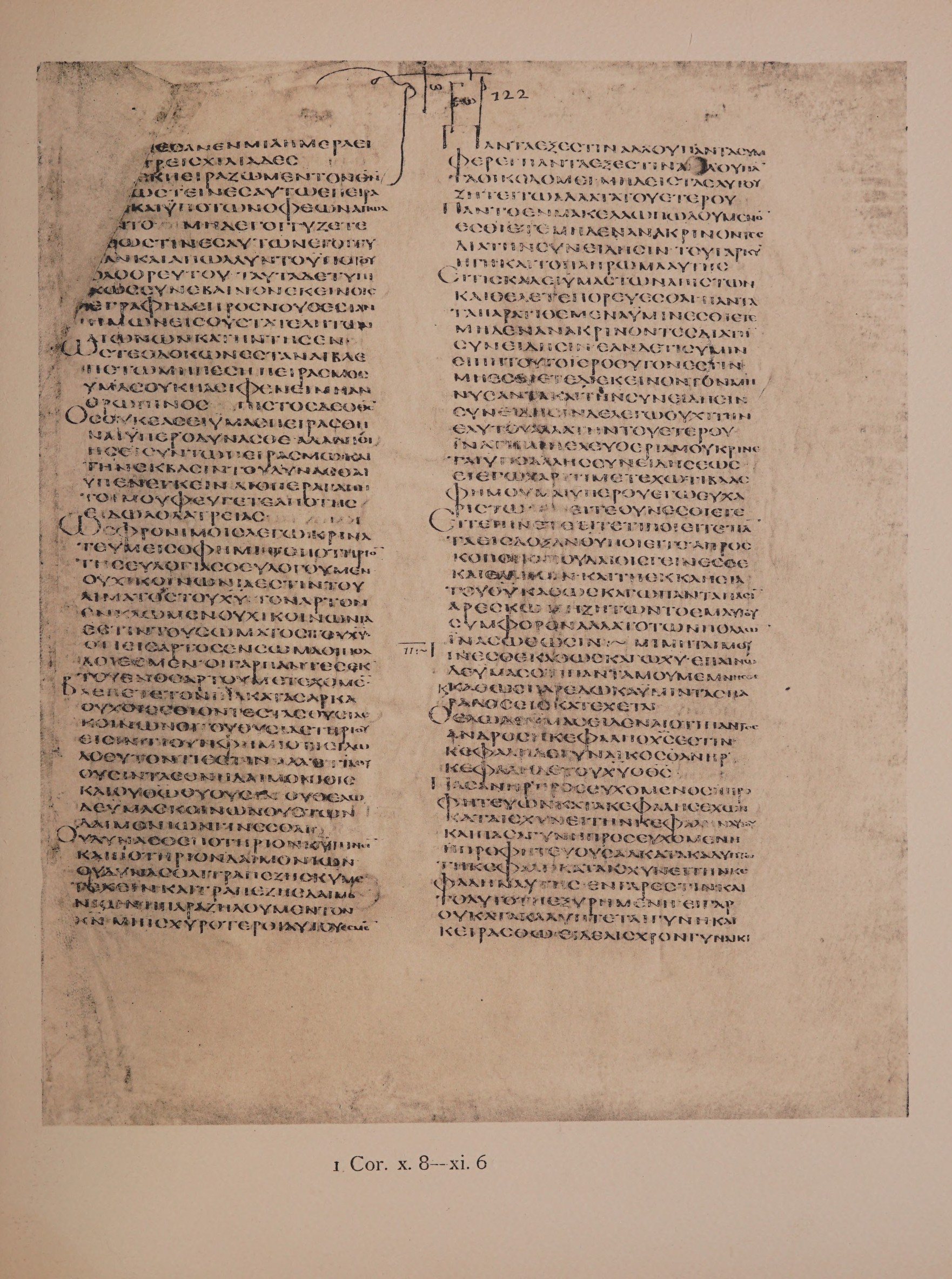
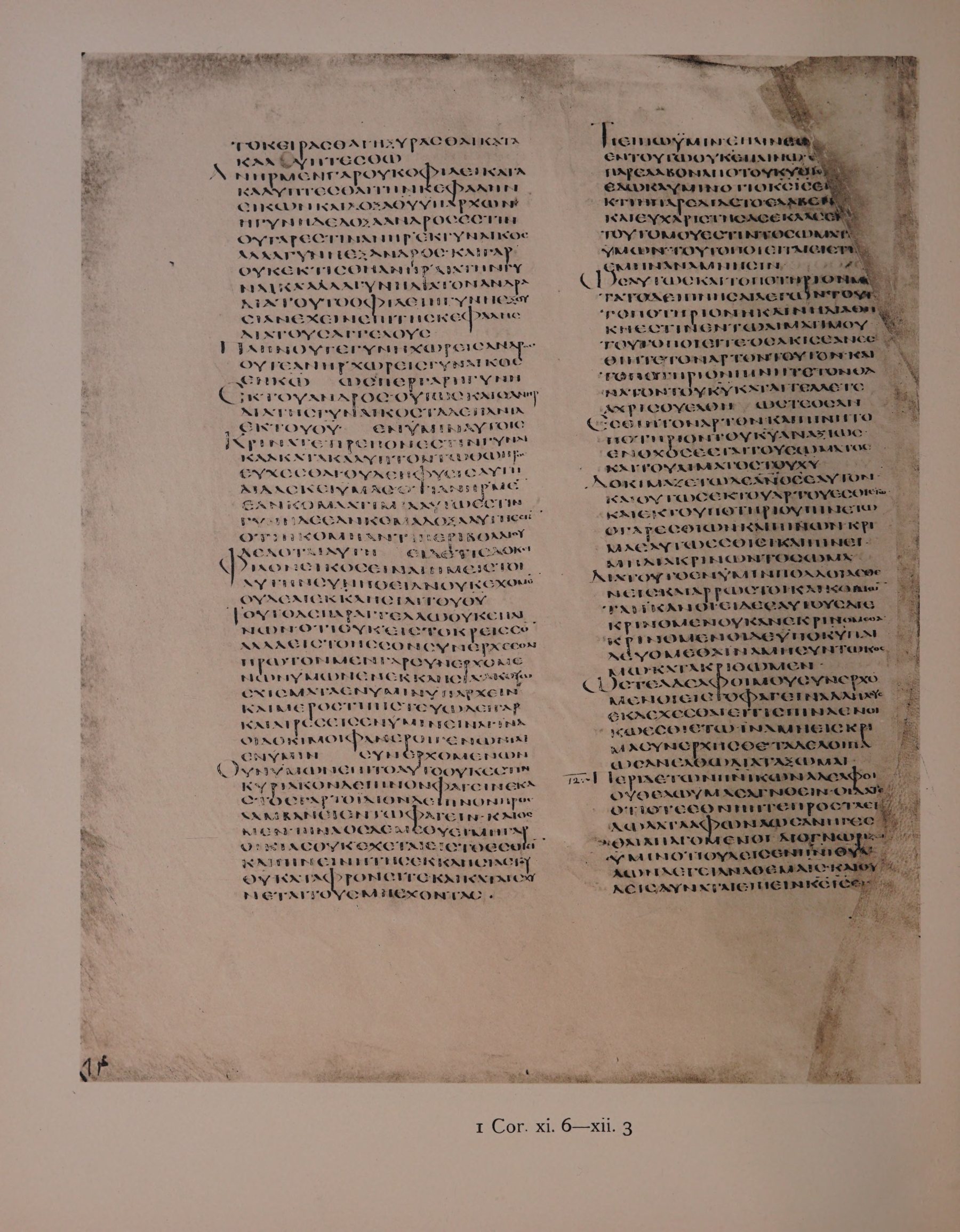
- Manuscript scan: the actual page(s) of Codex Alexandrinus containing this passage (folios 122r, 122v), reproduced from the British Museum's 1909 photographic facsimile edited by F. G. Kenyon, as digitised by the Getty Research Institute for the Internet Archive. The facsimile prints the verse range beneath each plate; that printed range was read for every page used and agrees with the INTF's NTVMR verse-level page index (CC BY 4.0). The page for each section now comes from the NTVMR transcription itself, which records the page and column on which every verse is written.
- Original text: the manuscript's own text, from a diplomatic transcription (see Greek text below), with Tischendorf's 8th critical edition (1869) for comparison.
- English translation: the King James Version (1611), retrieved verbatim from the public-domain bible-api.com endpoint.
Greek text: a diplomatic transcription of Codex Alexandrinus made by the Institut für Neutestamentliche Textforschung (INTF), Münster, for the New Testament Virtual Manuscript Room (NTVMR), published under a Creative Commons Attribution 4.0 licence. It gives the letters as the first scribe wrote them: no accents or breathings, the scribe's own spelling, and the sacred names in their contracted form (θς for θεος, ις for ιησους, κς for κυριος; the overline is not reproduced). Corrections by later hands are not shown. Letters in square brackets are not legible on the page and were restored by the transcribers, a dot under a letter marks an uncertain reading, and [...] marks text lost to damage. Beneath each section, for comparison, is Tischendorf's 8th critical edition (1869). Where the two differ, the transcription is what the manuscript says. Each section is shown with the page on which the transcription places its verses.
How was this verified? (Provenance)
Where on the image
Page from the NTVMR transcription (docID 20002): verses 1-6 on fol. 122r (facsimile leaf 205), col. 2; verse 6 continues on fol. 122v (facsimile leaf 206), col. 1 (which begins 'το κειρασθαι ·').
1μιμηται μου γινεσθε καθως καγω χυ · 2επαινω δε υμας οτι παντα μου μεμνησθε καθως παρεδωκα υμιν τας παραδοσεις κατεχεται 3θελω δε υμας ειδεναι οτι παντος ανδρος η κεφαλη ο χς εστιν κεφαλη δε γυναικος ο ανηρ κεφαλη δε του χυ ο θς · 4πας ανηρ προσευχομενος η προφητευων · κατα κεφαλης εχων καταισχυνει την κεφαλην αυτου 5και πασα γυνη προσευχομενη η προφητευουσα ακατακαλυπτω τη κεφαλη καταισχυνει την κεφαλην αυτης · εν γαρ εστιν · και το αυτο τη εξυρημενη · 6ει γαρ ου κατακαλυπτεται γυνη και κειρασθω · ει δε αισχρον γυναικι το κειρασθαι · η ξυρασθαι κατακαλυπτεσθω
Compare: Tischendorf 8th edition (1869)
1Μιμηταί μου γίνεσθε, καθὼς κἀγὼ Χριστοῦ. 2Ἐπαινῶ δὲ ὑμᾶς, ὅτι πάντα μου μέμνησθε καὶ καθὼς παρέδωκα ὑμῖν τὰς παραδόσεις κατέχετε. 3θέλω δὲ ὑμᾶς εἰδέναι ὅτι παντὸς ἀνδρὸς ἡ κεφαλὴ ὁ Χριστός ἐστιν, κεφαλὴ δὲ γυναικὸς ὁ ἀνήρ, κεφαλὴ δὲ τοῦ Χριστοῦ ὁ θεός. 4πᾶς ἀνὴρ προσευχόμενος ἢ προφητεύων κατὰ κεφαλῆς ἔχων καταισχύνει τὴν κεφαλὴν αὐτοῦ· 5πᾶσα δὲ γυνὴ προσευχομένη ἢ προφητεύουσα ἀκατακαλύπτῳ τῇ κεφαλῇ καταισχύνει τὴν κεφαλὴν αὐτῆς· ἓν γάρ ἐστιν καὶ τὸ αὐτὸ τῇ ἐξυρημένῃ. 6εἰ γὰρ οὐ κατακαλύπτεται γυνή, καὶ κειράσθω· εἰ δὲ αἰσχρὸν γυναικὶ τὸ κείρασθαι ἢ ξυρᾶσθαι, κατακαλυπτέσθω.
1Be ye followers of me, even as I also am of Christ. 2Now I praise you, brethren, that ye remember me in all things, and keep the ordinances, as I delivered them to you. 3But I would have you know, that the head of every man is Christ; and the head of the woman is the man; and the head of Christ is God. 4Every man praying or prophesying, having his head covered, dishonoureth his head. 5But every woman that prayeth or prophesieth with her head uncovered dishonoureth her head: for that is even all one as if she were shaven. 6For if the woman be not covered, let her also be shorn: but if it be a shame for a woman to be shorn or shaven, let her be covered.
Where on the image
Page from the NTVMR transcription (docID 20002): verses 7-14 on fol. 122v (facsimile leaf 206), col. 1.
7ανηρ μεν γαρ ουκ οφιλει κατακαλυπτεσθαι την κεφαλην εικων και δοξα θυ υπαρχων η γυνη δε δοξα ανδρος εστιν 8ου γαρ εστιν ανηρ · εκ γυναικος αλλα γυνη εξ ανδρος · 9και γαρ ουκ εκτισθη ανηρ · δια την γυναικα · αλλα γυνη δια τον ανδρα 10δια τουτο οφιλει η γυνη εξουσιαν εχειν επι της κεφαλης δια τους αγγελους 11πλην ουτε γυνη χωρεις ανδρος ουτε ανηρ · χωρεις γυναικος εν κω 12ωσπερ γαρ η γυνη εκ του ανδρος · ουτως και ο ανηρ δια της γυναικος τα δε παντα εκ του θυ · 13εν υμιν αυτοις κρινατε πρεπον εστιν γυναικα ακατακαλυπτον τω θω προσευχεσθαι · 14ουδε η φυσις αυτη διδασκει υμας · οτι ανηρ μεν εαν κομα ατιμια αυτω εστιν
Compare: Tischendorf 8th edition (1869)
7ἀνὴρ μὲν γὰρ οὐκ ὀφείλει κατακαλύπτεσθαι τὴν κεφαλήν, εἰκὼν καὶ δόξα θεοῦ ὑπάρχων· ἡ γυνὴ δὲ δόξα ἀνδρός ἐστιν. 8οὐ γάρ ἐστιν ἀνὴρ ἐκ γυναικός, ἀλλὰ γυνὴ ἐξ ἀνδρός· 9καὶ γὰρ οὐκ ἐκτίσθη ἀνὴρ διὰ τὴν γυναῖκα, ἀλλὰ γυνὴ διὰ τὸν ἄνδρα. 10διὰ τοῦτο ὀφείλει ἡ γυνὴ ἐξουσίαν ἔχειν ἐπὶ τῆς κεφαλῆς διὰ τοὺς ἀγγέλους. 11πλὴν οὔτε γυνὴ χωρὶς ἀνδρὸς οὔτε ἀνὴρ χωρὶς γυναικὸς ἐν κυρίῳ· 12ὥσπερ γὰρ ἡ γυνὴ ἐκ τοῦ ἀνδρός, οὕτως καὶ ὁ ἀνὴρ διὰ τῆς γυναικός· τὰ δὲ πάντα ἐκ τοῦ θεοῦ. 13ἐν ὑμῖν αὐτοῖς κρίνατε· πρέπον ἐστὶν γυναῖκα ἀκατακάλυπτον τῷ θεῷ προσεύχεσθαι; 14οὐδὲ ἡ φύσις αὐτὴ διδάσκει ὑμᾶς ὅτι ἀνὴρ μὲν ἐὰν κομᾷ ἀτιμία αὐτῷ ἐστιν,
7For a man indeed ought not to cover his head, forasmuch as he is the image and glory of God: but the woman is the glory of the man. 8For the man is not of the woman; but the woman of the man. 9Neither was the man created for the woman; but the woman for the man. 10For this cause ought the woman to have power on her head because of the angels. 11Nevertheless neither is the man without the woman, neither the woman without the man, in the Lord. 12For as the woman is of the man, even so is the man also by the woman; but all things of God. 13Judge in yourselves: is it comely that a woman pray unto God uncovered? 14Doth not even nature itself teach you, that, if a man have long hair, it is a shame unto him?
Where on the image
Page from the NTVMR transcription (docID 20002): verses 15-22 on fol. 122v (facsimile leaf 206), col. 1.
15γυνη δε εαν κομα δοξα αυτη εστιν οτι η κομη αντι περιβολαιου δεδοται αυτη · 16ει δε τις δοκει φιλονεικος ειναι ημεις τοιαυτην συνηθειαν ουκ εχομεν ουδε αι εκκλησιαι του θυ · 17τουτο δε παραγγελλω ουκ επαινων · οτι ουκ εις το κρεισσον αλλα εις το ησσον συνερχεσθαι 18πρωτον μεν γαρ συνερχομενων υμων εν εκκλησια · ακουω σχισματα εν υμιν υπαρχειν και μερος τι πιστευω · 19δει γαρ και αιρεσεις εν υμιν ειναι · ινα οι δοκιμοι φανεροι γενωνται εν υμιν · 20συνερχομενων ουν υμων επι το αυτο ουκ εστιν κυριακον δειπνον φαγειν 21εκαστος γαρ το ιδιον δειπνον προσλαμβανει εν τω φαγειν · και ος μεν · πινα ος δε μεθυει · 22μη γαρ οικιας ουκ εχεται εις το εσθιειν και πινειν η της εκκλησιας του θυ · καταφρονειτε · και καταισχυνεται τους μη εχοντας τι ειπω υμιν · επαινεσ̣[ω] [υμας] εν τουτω ουκ επαινω ·
Compare: Tischendorf 8th edition (1869)
15γυνὴ δὲ ἐὰν κομᾷ δόξα αὐτῇ ἐστιν; ὅτι ἡ κόμη ἀντὶ περιβολαίου δέδοται αὐτῇ. 16Εἰ δέ τις δοκεῖ φιλόνεικος εἶναι, ἡμεῖς τοιαύτην συνήθειαν οὐκ ἔχομεν, οὐδὲ αἱ ἐκκλησίαι τοῦ θεοῦ. 17Τοῦτο δὲ παραγγέλλων οὐκ ἐπαινῶ ὅτι οὐκ εἰς τὸ κρεῖσσον ἀλλὰ εἰς τὸ ἧσσον συνέρχεσθε. 18πρῶτον μὲν γὰρ συνερχομένων ὑμῶν ἐν ἐκκλησίᾳ ἀκούω σχίσματα ἐν ὑμῖν ὑπάρχειν, καὶ μέρος τι πιστεύω. 19δεῖ γὰρ καὶ αἱρέσεις ἐν ὑμῖν εἶναι, ἵνα οἱ δόκιμοι φανεροὶ γένωνται ἐν ὑμῖν. 20συνερχομένων οὖν ὑμῶν ἐπὶ τὸ αὐτὸ οὐκ ἔστιν κυριακὸν δεῖπνον φαγεῖν, 21ἕκαστος γὰρ τὸ ἴδιον δεῖπνον προλαμβάνει ἐν τῷ φαγεῖν, καὶ ὃς μὲν πεινᾷ, ὃς δὲ μεθύει. 22μὴ γὰρ οἰκίας οὐκ ἔχετε εἰς τὸ ἐσθίειν καὶ πίνειν; ἢ τῆς ἐκκλησίας τοῦ θεοῦ καταφρονεῖτε, καὶ καταισχύνετε τοὺς μὴ ἔχοντας; τί εἴπω ὑμῖν; ἐπαινέσω ὑμᾶς; ἐν τούτῳ οὐκ ἐπαινῶ.
15But if a woman have long hair, it is a glory to her: for her hair is given her for a covering. 16But if any man seem to be contentious, we have no such custom, neither the churches of God. 17Now in this that I declare unto you I praise you not, that ye come together not for the better, but for the worse. 18For first of all, when ye come together in the church, I hear that there be divisions among you; and I partly believe it. 19For there must be also heresies among you, that they which are approved may be made manifest among you. 20When ye come together therefore into one place, this is not to eat the Lord’s supper. 21For in eating every one taketh before other his own supper: and one is hungry, and another is drunken. 22What? have ye not houses to eat and to drink in? or despise ye the church of God, and shame them that have not? What shall I say to you? shall I praise you in this? I praise you not.
Where on the image
Page from the NTVMR transcription (docID 20002): verses 23-34 on fol. 122v (facsimile leaf 206), col. 2.
23[εγω] [γαρ] παρελαβον απο του κυ ο κ̣[αι] [παρ]εδωκα υμιν οτι ο κς ις εν̣ [τη] [νυ]κτι η παρεδιδετο · ελαβεν [αρτον] 24και ευχαριστησας εκλασεν̣ [και] [ειπεν] τουτο μου εστιν το σωμα τ[ο] [υπερ] υμων · τουτο ποιειται εις τη̣[ν] εμην αναμνησιν 25ωσαυτως και το ποτηριον μ[ε]τα το δειπνησαι λεγων · τουτ[ο] το ποτηριον η καινη διαθηκη εστιν εν τω αιματι μου τουτο ποιειτε · 26οσακις εαν εσθιητε τον αρτον τουτον · και το ποτηριον πινητε τον θανατον του κυ καταγγελλετε αχρις ου ελθη 27ωστε ος αν εσθιη τον αρτον · και πινη το ποτηριον του κυ αναξιως ενοχος εσται του σωματος και του αιματος του χυ 28δοκιμαζετω δε ανος εαυτον και ουτως εκ του αρτου εσθιετω · και εκ του ποτηριου πινετω 29ο γαρ εσθιων και πινων κριμα εαυτω εσθιει · και πινει μη διακρινων το σωμα · 30δια τουτο εν υμιν πολλοι ασθενεις και αρρωστοι · και κοιμωνται ικανοι · 31ει δε εαυτους διεκρινομεν ουκ αν εκρινομεθα 32κρινομενοι δε υπο κυ παιδευομεθα · ινα μη συν τω κοσμω κατακριθωμεν · 33ωστε αδελφοι μου συνερχομενοι εις το φαγειν αλληλους εκδεχεσθαι · 34ει τις πινα εν οικω εσθιετω · ινα μη εις κριμα συνερχησθε · τα δε λοιπα ως αν ελθω διαταξωμαι ·
Compare: Tischendorf 8th edition (1869)
23ἐγὼ γὰρ παρέλαβον ἀπὸ τοῦ κυρίου, ὃ καὶ παρέδωκα ὑμῖν, ὅτι ὁ κύριος Ἰησοῦς ἐν τῇ νυκτὶ ᾗ παρεδίδετο ἔλαβεν ἄρτον 24καὶ εὐχαριστήσας ἔκλασεν καὶ εἶπεν, τοῦτό μού ἐστιν τὸ σῶμα τὸ ὑπὲρ ὑμῶν· τοῦτο ποιεῖτε εἰς τὴν ἐμὴν ἀνάμνησιν. 25ὡσαύτως καὶ τὸ ποτήριον μετὰ τὸ δειπνῆσαι, λέγων, τοῦτο τὸ ποτήριον ἡ καινὴ διαθήκη ἐστὶν ἐν τῷ ἐμῷ αἵματι· τοῦτο ποιεῖτε, ὁσάκις ἐὰν πίνητε, εἰς τὴν ἐμὴν ἀνάμνησιν. 26ὁσάκις γὰρ ἐὰν ἐσθίητε τὸν ἄρτον τοῦτον καὶ τὸ ποτήριον πίνητε, τὸν θάνατον τοῦ κυρίου καταγγέλλετε, ἄχρι οὗ ἔλθῃ. 27ὥστε ὃς ἂν ἐσθίῃ τὸν ἄρτον ἢ πίνῃ τὸ ποτήριον τοῦ κυρίου ἀναξίως, ἔνοχος ἔσται τοῦ σώματος καὶ τοῦ αἵματος τοῦ κυρίου. 28δοκιμαζέτω δὲ ἄνθρωπος ἑαυτόν, καὶ οὕτως ἐκ τοῦ ἄρτου ἐσθιέτω καὶ ἐκ τοῦ ποτηρίου πινέτω· 29ὁ γὰρ ἐσθίων καὶ πίνων κρίμα ἑαυτῷ ἐσθίει καὶ πίνει μὴ διακρίνων τὸ σῶμα. 30διὰ τοῦτο ἐν ὑμῖν πολλοὶ ἀσθενεῖς καὶ ἄρρωστοι καὶ κοιμῶνται ἱκανοί. 31εἰ δὲ ἑαυτοὺς διεκρίνομεν, οὐκ ἂν ἐκρινόμεθα· 32κρινόμενοι δὲ ὑπὸ τοῦ κυρίου παιδευόμεθα, ἵνα μὴ σὺν τῷ κόσμῳ κατακριθῶμεν. 33ὥστε, ἀδελφοί μου, συνερχόμενοι εἰς τὸ φαγεῖν ἀλλήλους ἐκδέχεσθε. 34εἴ τις πεινᾷ, ἐν οἴκῳ ἐσθιέτω, ἵνα μὴ εἰς κρίμα συνέρχησθε. τὰ δὲ λοιπὰ ὡς ἂν ἔλθω διατάξομαι.
23For I have received of the Lord that which also I delivered unto you, That the Lord Jesus the same night in which he was betrayed took bread: 24And when he had given thanks, he brake it, and said, Take, eat: this is my body, which is broken for you: this do in remembrance of me. 25After the same manner also he took the cup, when he had supped, saying, This cup is the new testament in my blood: this do ye, as oft as ye drink it, in remembrance of me. 26For as often as ye eat this bread, and drink this cup, ye do shew the Lord’s death till he come. 27Wherefore whosoever shall eat this bread, and drink this cup of the Lord, unworthily, shall be guilty of the body and blood of the Lord. 28But let a man examine himself, and so let him eat of that bread, and drink of that cup. 29For he that eateth and drinketh unworthily, eateth and drinketh damnation to himself, not discerning the Lord’s body. 30For this cause many are weak and sickly among you, and many sleep. 31For if we would judge ourselves, we should not be judged. 32But when we are judged, we are chastened of the Lord, that we should not be condemned with the world. 33Wherefore, my brethren, when ye come together to eat, tarry one for another. 34And if any man hunger, let him eat at home; that ye come not together unto condemnation. And the rest will I set in order when I come.
Cite
Sources
- Source: Codex Alexandrinus page images + NTVMR transcription (CC BY 4.0) + Tischendorf 8th edition + KJV (holding institution)
- Critical edition: Codex Alexandrinus transcription, NTVMR (INTF Münster, CC BY 4.0); Tischendorf 8th edition for comparison
← previous · → next · v cycle view · l back to library