1 Corinthians, Chapter 14 (Codex Alexandrinus)
Introduction
1 Corinthians 14 from Codex Alexandrinus (GA 02), a fifth-century Greek Bible held by the British Library (Royal MS 1 D. VIII). In the New Testament it is the chief witness to the Byzantine text in the Gospels and to the Alexandrian text in the rest of the New Testament. Its New Testament volume lacks Matthew 1:1-25:5, John 6:50-8:52 and 2 Corinthians 4:13-12:6.
This entry meets the strict three-criteria standard of the Theosis Library:
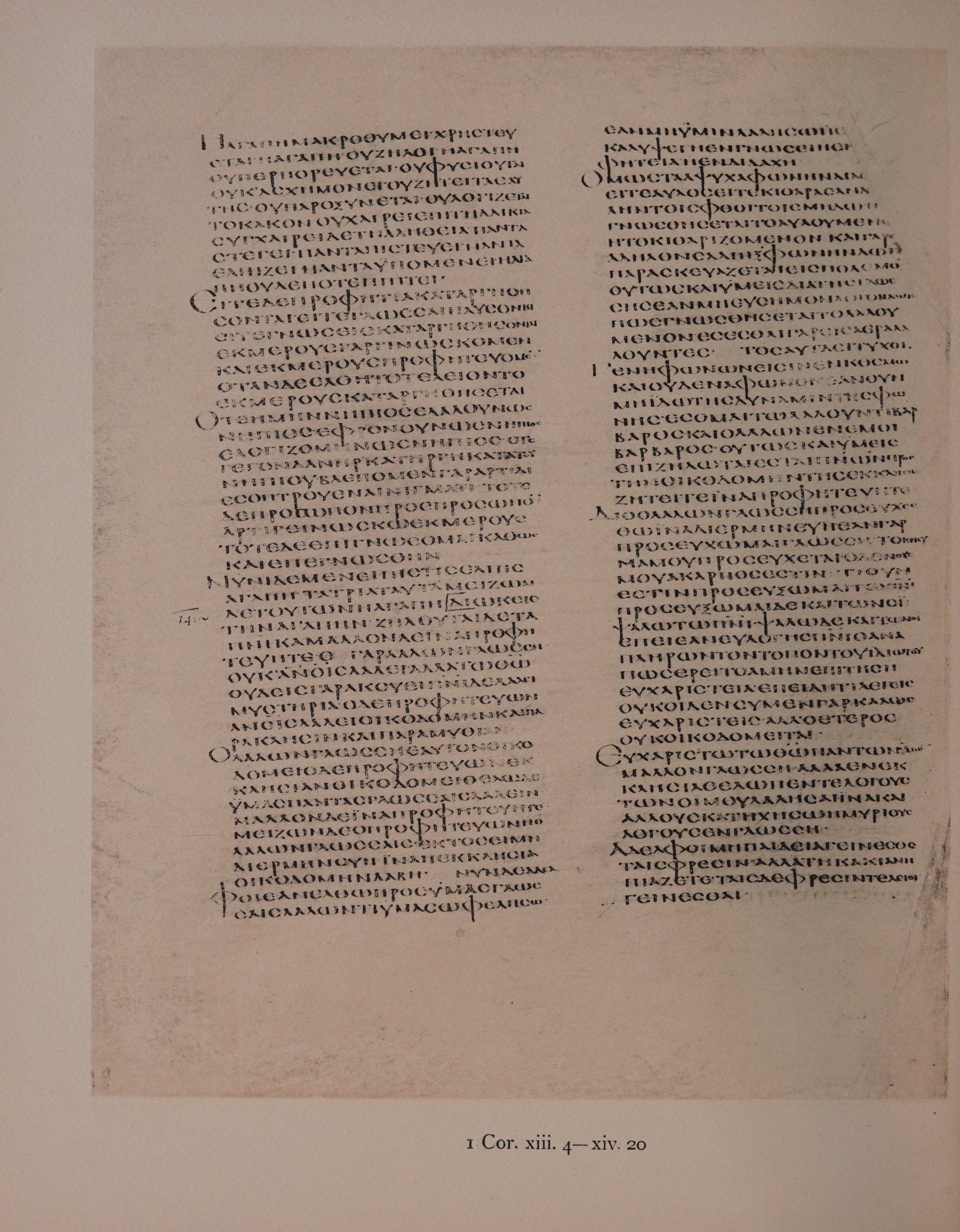
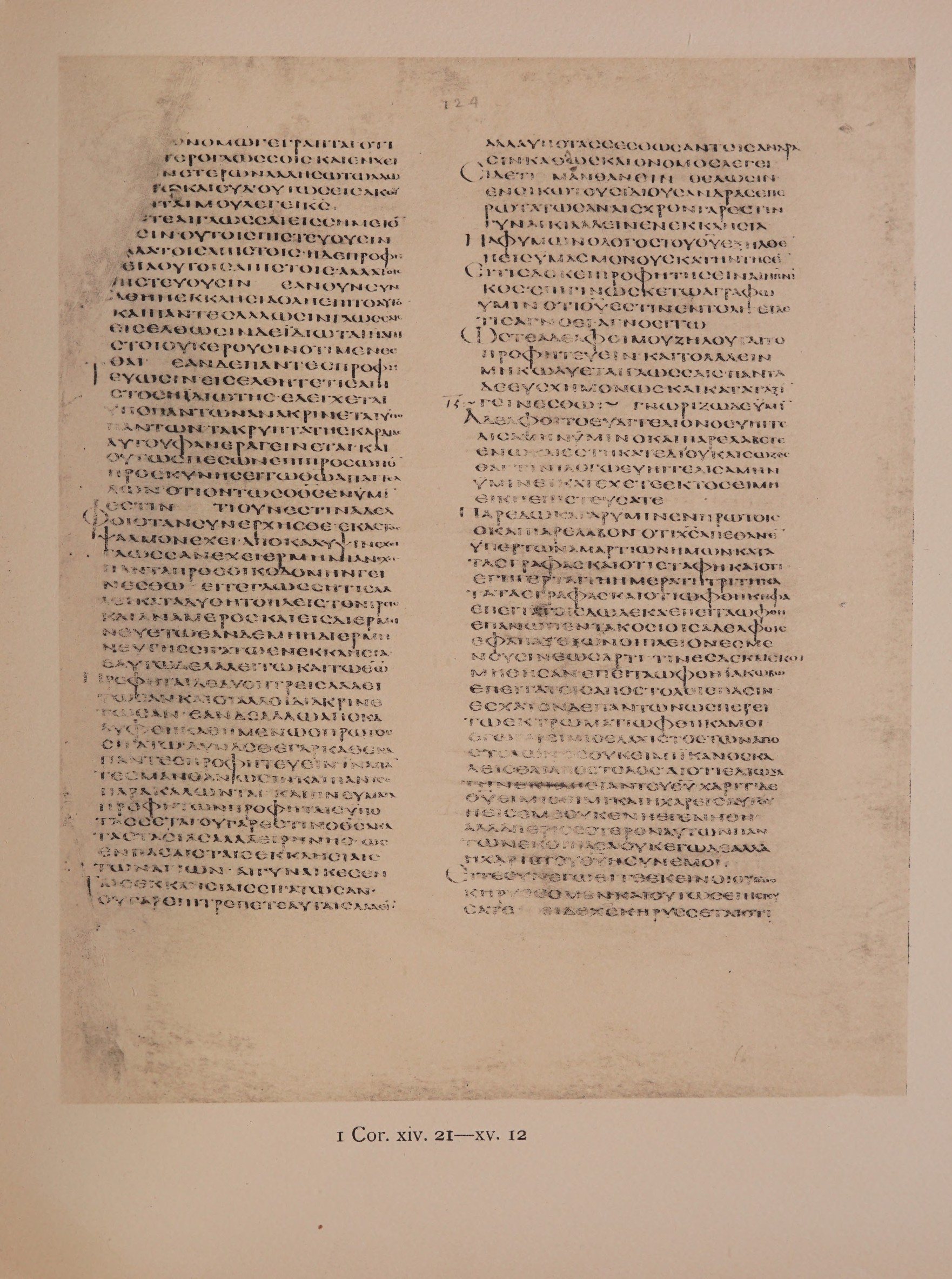
- Manuscript scan: the actual page(s) of Codex Alexandrinus containing this passage (folios 123v, 124r), reproduced from the British Museum's 1909 photographic facsimile edited by F. G. Kenyon, as digitised by the Getty Research Institute for the Internet Archive. The facsimile prints the verse range beneath each plate; that printed range was read for every page used and agrees with the INTF's NTVMR verse-level page index (CC BY 4.0). The page for each section now comes from the NTVMR transcription itself, which records the page and column on which every verse is written.
- Original text: the manuscript's own text, from a diplomatic transcription (see Greek text below), with Tischendorf's 8th critical edition (1869) for comparison.
- English translation: the King James Version (1611), retrieved verbatim from the public-domain bible-api.com endpoint.
Greek text: a diplomatic transcription of Codex Alexandrinus made by the Institut für Neutestamentliche Textforschung (INTF), Münster, for the New Testament Virtual Manuscript Room (NTVMR), published under a Creative Commons Attribution 4.0 licence. It gives the letters as the first scribe wrote them: no accents or breathings, the scribe's own spelling, and the sacred names in their contracted form (θς for θεος, ις for ιησους, κς for κυριος; the overline is not reproduced). Corrections by later hands are not shown. Letters in square brackets are not legible on the page and were restored by the transcribers, a dot under a letter marks an uncertain reading, and [...] marks text lost to damage. Beneath each section, for comparison, is Tischendorf's 8th critical edition (1869). Where the two differ, the transcription is what the manuscript says. Each section is shown with the page on which the transcription places its verses.
How was this verified? (Provenance)
Where on the image
Page from the NTVMR transcription (docID 20002): verses 1-6 on fol. 123v (facsimile leaf 208), col. 1.
1διωκετε την αγαπην · ζηλουται δε τα πνικα μαλλον δε ινα προφητευητε · 2ου γαρ λαλων γλωσση ουκ ανοις λαλει · αλλα τω θω · ουδεις γαρ ακουει πνι δε λαλει μυστηρια · 3ο δε προφητευων ανοις λαλει οικοδομην και παρακλησιν και παραμυθιαν · 4ο λαλων γλωσση εαυτον οικοδομει · ο δε προφητευων εκκλησιαν οικοδομει · 5θελω δε υμας παντας γλωσσαις λαλειν μαλλον δε ινα προφητευητε μειζων δε ο προφητευων η ο λαλων γλωσσαις · εκτος ει μη διερμηνευη · ινα η εκκλησια οικοδομην λαβη · 6νυν δε αδελφοι εαν ελθω προς υμας γλωσσαις λαλων τι υμας ωφελησω · εαν μη υμιν λαλησω η ε[ν] [απο]καλυψει · η εν γνωσει η εν̣ [προ]φητεια · η εν διδαχη ·
Compare: Tischendorf 8th edition (1869)
1Διώκετε τὴν ἀγάπην, ζηλοῦτε δὲ τὰ πνευματικά, μᾶλλον δὲ ἵνα προφητεύητε. 2ὁ γὰρ λαλῶν γλώσσῃ οὐκ ἀνθρώποις λαλεῖ ἀλλὰ θεῷ, οὐδεὶς γὰρ ἀκούει, πνεύματι δὲ λαλεῖ μυστήρια· 3ὁ δὲ προφητεύων ἀνθρώποις λαλεῖ οἰκοδομὴν καὶ παράκλησιν καὶ παραμυθίαν. 4ὁ λαλῶν γλώσσῃ ἑαυτὸν οἰκοδομεῖ· ὁ δὲ προφητεύων ἐκκλησίαν οἰκοδομεῖ. 5θέλω δὲ πάντας ὑμᾶς λαλεῖν γλώσσαις, μᾶλλον δὲ ἵνα προφητεύητε· μείζων δὲ ὁ προφητεύων ἢ ὁ λαλῶν γλώσσαις, ἐκτὸς εἰ μὴ διερμηνεύῃ, ἵνα ἡ ἐκκλησία οἰκοδομὴν λάβῃ. 6νῦν δέ, ἀδελφοί, ἐὰν ἔλθω πρὸς ὑμᾶς γλώσσαις λαλῶν, τί ὑμᾶς ὠφελήσω, ἐὰν μὴ ὑμῖν λαλήσω ἢ ἐν ἀποκαλύψει ἢ ἐν γνώσει ἢ ἐν προφητείᾳ ἢ διδαχῇ;
1Follow after charity, and desire spiritual gifts, but rather that ye may prophesy. 2For he that speaketh in an unknown tongue speaketh not unto men, but unto God: for no man understandeth him; howbeit in the spirit he speaketh mysteries. 3But he that prophesieth speaketh unto men to edification, and exhortation, and comfort. 4He that speaketh in an unknown tongue edifieth himself; but he that prophesieth edifieth the church. 5I would that ye all spake with tongues, but rather that ye prophesied: for greater is he that prophesieth than he that speaketh with tongues, except he interpret, that the church may receive edifying. 6Now, brethren, if I come unto you speaking with tongues, what shall I profit you, except I shall speak to you either by revelation, or by knowledge, or by prophesying, or by doctrine?
Where on the image
Page from the NTVMR transcription (docID 20002): verses 7-13 on fol. 123v (facsimile leaf 208), col. 2.
7ομως τα αψυχα φωνην διδο̣[ντα] ειτε αυλος ειτε κιθαρα εαν δ[ιαστο]λην τοις φθογγοις μη δω π[ως] γνωσθησεται το αυλουμενο̣[ν] η το κιθαριζομενον · 8και γαρ ε̣[αν] αδηλον σαλπιξ φωνην δω τι̣[ς] παρασκευαζεται εις πολεμον̣ 9ουτως και υμεις δια της γλωσσης εαν μη ευσημον λογον δωτε πως γνωσθησεται το λαλουμενον · εσεσθαι γαρ εις αερα λαλουντες · 10τοσαυτα ει τυχοι γενη φωνων εισιν εν κοσμω και ουδεν αφωνον 11εαν ουν μη ιδω της δυναμιν της φωνης · εσομαι τω λαλουντι βαρβαρος · και ο λαλων εν εμοι βαρβαρος · 12ουτως και υμεις επι ζηλωται εσται πνων προς την οικοδομην της εκκλησιας ζητειτε ινα προφητευητε · 13διο ο λαλων γλωσση προσευχεσθω ινα διερμηνευη ·
Compare: Tischendorf 8th edition (1869)
7ὅμως τὰ ἄψυχα φωνὴν διδόντα, εἴτε αὐλὸς εἴτε κιθάρα, ἐὰν διαστολὴν τοῖς φθόγγοις μὴ δῷ, πῶς γνωσθήσεται τὸ αὐλούμενον ἢ τὸ κιθαριζόμενον; 8καὶ γὰρ ἐὰν ἄδηλον σάλπιγξ φωνὴν δῷ, τίς παρασκευάσεται εἰς πόλεμον; 9οὕτως καὶ ὑμεῖς διὰ τῆς γλώσσης ἐὰν μὴ εὔσημον λόγον δῶτε, πῶς γνωσθήσεται τὸ λαλούμενον; ἔσεσθε γὰρ εἰς ἀέρα λαλοῦντες. 10τοσαῦτα εἰ τύχοι γένη φωνῶν εἰσιν ἐν κόσμῳ, καὶ οὐδὲν ἄφωνον· 11ἐὰν οὖν μὴ εἰδῶ τὴν δύναμιν τῆς φωνῆς, ἔσομαι τῷ λαλοῦντι βάρβαρος καὶ ὁ λαλῶν ἐν ἐμοὶ βάρβαρος. 12οὕτως καὶ ὑμεῖς, ἐπεὶ ζηλωταί ἐστε πνευμάτων, πρὸς τὴν οἰκοδομὴν τῆς ἐκκλησίας ζητεῖτε ἵνα περισσεύητε. 13διὸ ὁ λαλῶν γλώσσῃ προσευχέσθω ἵνα διερμηνεύῃ.
7And even things without life giving sound, whether pipe or harp, except they give a distinction in the sounds, how shall it be known what is piped or harped? 8For if the trumpet give an uncertain sound, who shall prepare himself to the battle? 9So likewise ye, except ye utter by the tongue words easy to be understood, how shall it be known what is spoken? for ye shall speak into the air. 10There are, it may be, so many kinds of voices in the world, and none of them is without signification. 11Therefore if I know not the meaning of the voice, I shall be unto him that speaketh a barbarian, and he that speaketh shall be a barbarian unto me. 12Even so ye, forasmuch as ye are zealous of spiritual gifts, seek that ye may excel to the edifying of the church. 13Wherefore let him that speaketh in an unknown tongue pray that he may interpret.
Where on the image
Page from the NTVMR transcription (docID 20002): verses 14-20 on fol. 123v (facsimile leaf 208), col. 2.
14εαν γαρ προσευχωμαι γλωσση · το π̣νευμα μου προσευχεται · ο δε νους μου ακαρπος εστιν · 15τι ουν εστιν προσευξωμαι τω πνι προσευξωμαι δε και τω νοι · ψαλω τω πνι · ψαλω δε και τω νοι 16επει εαν ευλογης πνι ο αναπληρων τον τοπον του ιδιωτου πως ερει το αμην επι τη ση ευχαριστεια · επειδη τι λεγεις ουκ οιδεν · 17συ μεν γαρ καλως ευχαριστεις · αλλ ο ετερος ουκ οικοδομειται · 18ευχαριστω τω θω παντων υμων μαλλον γλωσση · 19αλλα εν εκκλησια θελω πεντε λογους τω νοι μου λαλησαι ινα και αλλους κατηχησω η μυριους λογους εν γλωσση · 20αδελφοι · μη παιδεια γεινεσθε ταις φρεσιν · αλλα τη κακια νηπιαζετε ταις δε φρεσιν τελειοι γεινεσθαι ·
Compare: Tischendorf 8th edition (1869)
14ἐὰν γὰρ προσεύχωμαι γλώσσῃ, τὸ πνεῦμά μου προσεύχεται, ὁ δὲ νοῦς μου ἄκαρπός ἐστιν. 15τί οὖν ἐστιν; προσεύξομαι τῷ πνεύματι, προσεύξομαι δὲ καὶ τῷ νοΐ· ψαλῶ τῷ πνεύματι, ψαλῶ δὲ καὶ τῷ νοΐ. 16ἐπεὶ ἐὰν εὐλογῇς πνεύματι, ὁ ἀναπληρῶν τὸν τόπον τοῦ ἰδιώτου πῶς ἐρεῖ τὸ ἀμήν ἐπὶ τῇ σῇ εὐχαριστίᾳ, ἐπειδὴ τί λέγεις οὐκ οἶδεν; 17σὺ μὲν γὰρ καλῶς εὐχαριστεῖς, ἀλλ’ ὁ ἕτερος οὐκ οἰκοδομεῖται. 18εὐχαριστῶ τῷ θεῷ, πάντων ὑμῶν μᾶλλον γλώσσῃ λαλῶ· 19ἀλλὰ ἐν ἐκκλησίᾳ θέλω πέντε λόγους τῷ νοΐ μου λαλῆσαι, ἵνα καὶ ἄλλους κατηχήσω, ἢ μυρίους λόγους ἐν γλώσσῃ. 20Ἀδελφοί, μὴ παιδία γίνεσθε ταῖς φρεσίν, ἀλλὰ τῇ κακίᾳ νηπιάζετε, ταῖς δὲ φρεσὶν τέλειοι γίνεσθε.
14For if I pray in an unknown tongue, my spirit prayeth, but my understanding is unfruitful. 15What is it then? I will pray with the spirit, and I will pray with the understanding also: I will sing with the spirit, and I will sing with the understanding also. 16Else when thou shalt bless with the spirit, how shall he that occupieth the room of the unlearned say Amen at thy giving of thanks, seeing he understandeth not what thou sayest? 17For thou verily givest thanks well, but the other is not edified. 18I thank my God, I speak with tongues more than ye all: 19Yet in the church I had rather speak five words with my understanding, that by my voice I might teach others also, than ten thousand words in an unknown tongue. 20Brethren, be not children in understanding: howbeit in malice be ye children, but in understanding be men.
Where on the image
Page from the NTVMR transcription (docID 20002): verses 21-27 on fol. 124r (facsimile leaf 209), col. 1.
21[εν] [τ]ω̣ νομω γεγραπται · οτι [εν] [ε]τ̣ερογλωσσοις και εν χει[λεσι]ν ετερων λαλησω τω λαω [του]τ̣ω και ουδ ουτως εισακου[σο]ν̣ται μου λεγει κς · 22[ω]σ̣τε αι γλωσσαι εις σημειον [ει]σιν · ου τοις πιστευουσιν [α]λ̣λα τοις απιστοις · η δε προφη[τ]εια ου τοις απιστοις · αλλα τοις π̣ιστευουσιν · 23εαν ουν συνε̣λθη η εκκλησια ολη επι το αυτο και παντες λαλωσιν γλωσσαις εισελθωσιν δε ιδιωται η απιστοι ουκ ερουσιν οτι μενεσθαι · 24εαν δε παντες προφητευωσιν · εισελθη τε τις απιστος η ιδιωτης · ελεγχεται υ̣πο παντων ανακρινεται υπο παντων · 25τα κρυπτα της καρδιας αυτου φανερα γεινεται · και ουτως πεσων επι προσωπον προσκυνησει τω θω απαγγελλων · οτι οντως ο θς εν υμιν εστιν · 26τι ουν εστιν αδελφοι οταν συνερχησθε · εκαστος ψαλμον εχει · αποκαλυψιν εχει γλωσσαν εχει · ερμηνιαν εχει · παντα προς οικοδομην γεινεσθω · 27ειτε γλωσση τις λαλει κατα δυο η το πλειστον τρεις και ανα μερος · και εις διερμηνευετω ·
Compare: Tischendorf 8th edition (1869)
21ἐν τῷ νόμῳ γέγραπται ὅτι ἐν ἑτερογλώσσοις καὶ ἐν χείλεσιν ἑτέρων λαλήσω τῷ λαῷ τούτῳ, καὶ οὐδ’ οὕτως εἰσακούσονταί μου, λέγει κύριος. 22ὥστε αἱ γλῶσσαι εἰς σημεῖόν εἰσιν οὐ τοῖς πιστεύουσιν ἀλλὰ τοῖς ἀπίστοις, ἡ δὲ προφητεία οὐ τοῖς ἀπίστοις ἀλλὰ τοῖς πιστεύουσιν. 23ἐὰν οὖν συνέλθῃ ἡ ἐκκλησία ὅλη ἐπὶ τὸ αὐτὸ καὶ πάντες λαλῶσιν γλώσσαις, εἰσέλθωσιν δὲ ἰδιῶται ἢ ἄπιστοι, οὐκ ἐροῦσιν ὅτι μαίνεσθε; 24ἐὰν δὲ πάντες προφητεύωσιν, εἰσέλθῃ δέ τις ἄπιστος ἢ ἰδιώτης, ἐλέγχεται ὑπὸ πάντων, ἀνακρίνεται ὑπὸ πάντων, 25τὰ κρυπτὰ τῆς καρδίας αὐτοῦ φανερὰ γίνεται, καὶ οὕτως πεσὼν ἐπὶ πρόσωπον προσκυνήσει τῷ θεῷ, ἀπαγγέλλων ὅτι ὄντως θεὸς ἐν ὑμῖν ἐστιν. 26Τί οὖν ἐστίν, ἀδελφοί; ὅταν συνέρχησθε, ἕκαστος ψαλμὸν ἔχει, διδαχὴν ἔχει, ἀποκάλυψιν ἔχει, γλῶσσαν ἔχει, ἑρμηνείαν ἔχει· πάντα πρὸς οἰκοδομὴν γινέσθω. 27εἴτε γλώσσῃ τις λαλεῖ, κατὰ δύο ἢ τὸ πλεῖστον τρεῖς, καὶ ἀνὰ μέρος, καὶ εἷς διερμηνευέτω·
21In the law it is written, With men of other tongues and other lips will I speak unto this people; and yet for all that will they not hear me, saith the Lord. 22Wherefore tongues are for a sign, not to them that believe, but to them that believe not: but prophesying serveth not for them that believe not, but for them which believe. 23If therefore the whole church be come together into one place, and all speak with tongues, and there come in those that are unlearned, or unbelievers, will they not say that ye are mad? 24But if all prophesy, and there come in one that believeth not, or one unlearned, he is convinced of all, he is judged of all: 25And thus are the secrets of his heart made manifest; and so falling down on his face he will worship God, and report that God is in you of a truth. 26How is it then, brethren? when ye come together, every one of you hath a psalm, hath a doctrine, hath a tongue, hath a revelation, hath an interpretation. Let all things be done unto edifying. 27If any man speak in an unknown tongue, let it be by two, or at the most by three, and that by course; and let one interpret.
Where on the image
Page from the NTVMR transcription (docID 20002): verses 28-34 on fol. 124r (facsimile leaf 209), col. 1.
28εαν δε μη η διερμηνευτης σιγατω εν εκκλησια εαυτω δε λαλειτω και τω θω 29προφηται δε δυο η τρεις λαλειτωσαν και οι αλλοι διακρινετωσαν · 30εαν δε αλλω αποκαλυφθη καθημενω ο πρωτος σιγατω · 31δυνασθε γαρ καθ ενα παντες προφητευειν · ινα παντες μανθανωσιν · και παντες παρακαλωνται · 32και πνευματα προφητων προφηταις υποτασσεται · 33ου γαρ εστιν ο θς ακαταστασιας αλλα ειρηνης · ως εν πασαις ταις εκκλησιαις των αγιων · 34αι γυναικες εν ταις εκκλησιαις σιγατωσαν · ου γαρ επιτρεπετε αυταις λαλειν · αλλα υποτασσεσθωσαν τοις ανδρασιν καθως και ο νομος λεγει
Compare: Tischendorf 8th edition (1869)
28ἐὰν δὲ μὴ ᾖ διερμηνευτής, σιγάτω ἐν ἐκκλησίᾳ, ἑαυτῷ δὲ λαλείτω καὶ τῷ θεῷ. 29προφῆται δὲ δύο ἢ τρεῖς λαλείτωσαν, καὶ οἱ ἄλλοι διακρινέτωσαν· 30ἐὰν δὲ ἄλλῳ ἀποκαλυφθῇ καθημένῳ, ὁ πρῶτος σιγάτω. 31δύνασθε γὰρ καθ’ ἕνα πάντες προφητεύειν, ἵνα πάντες μανθάνωσιν καὶ πάντες παρακαλῶνται, 32καὶ πνεύματα προφητῶν προφήταις ὑποτάσσεται· 33οὐ γάρ ἐστιν ἀκαταστασίας ὁ θεὸς ἀλλὰ εἰρήνης. Ὡς ἐν πάσαις ταῖς ἐκκλησίαις τῶν ἁγίων, 34αἱ γυναῖκες ἐν ταῖς ἐκκλησίαις σιγάτωσαν, οὐ γὰρ ἐπιτρέπεται αὐταῖς λαλεῖν· ἀλλὰ ὑποτασσέσθωσαν, καθὼς καὶ ὁ νόμος λέγει.
28But if there be no interpreter, let him keep silence in the church; and let him speak to himself, and to God. 29Let the prophets speak two or three, and let the other judge. 30If any thing be revealed to another that sitteth by, let the first hold his peace. 31For ye may all prophesy one by one, that all may learn, and all may be comforted. 32And the spirits of the prophets are subject to the prophets. 33For God is not the author of confusion, but of peace, as in all churches of the saints. 34Let your women keep silence in the churches: for it is not permitted unto them to speak; but they are commanded to be under obedience, as also saith the law.
Where on the image
Page from the NTVMR transcription (docID 20002): verses 35-40 on fol. 124r (facsimile leaf 209), col. 2.
35ει δε τις̣ μανθαν[...] θελωσιν εν οικω τους ιδιους ανδρας επερωτατωσαν · αισχρον γαρ εστιν γυναικι λαλειν εν εκκλησια · 36η αφ υμων ο λογος του θυ εξηλθεν η εις υμας μονους κατηντησεν 37ει τις δοκει προφητης ειναι η πνικος · επιγινωσκετω α γραφω υμιν οτι θυ εστιν εντολη · 38ει δε τις αγνοει · α̣γ̣ν̣ο̣ε̣ι̣τ̣α̣ι̣ 39ωστε αδελφοι μου ζηλουται το προφητευειν · και το λαλειν μη κωλυεται γλωσσαις · 40παντα δε ευσχημονως · και κατα ταξιν γεινεσθω ·
Compare: Tischendorf 8th edition (1869)
35Εἰ δέ τι μαθεῖν θέλουσιν, ἐν οἴκῳ τοὺς ἰδίους ἄνδρας ἐπερωτάτωσαν, αἰσχρὸν γάρ ἐστιν γυναικὶ λαλεῖν ἐν ἐκκλησίᾳ. 36ἢ ἀφ’ ὑμῶν ὁ λόγος τοῦ θεοῦ ἐξῆλθεν, ἢ εἰς ὑμᾶς μόνους κατήντησεν; 37Εἴ τις δοκεῖ προφήτης εἶναι ἢ πνευματικός, ἐπιγινωσκέτω ἃ γράφω ὑμῖν ὅτι κυρίου ἐστίν· 38εἰ δέ τις ἀγνοεῖ, ἀγνοεῖται. 39ὥστε, ἀδελφοί μου, ζηλοῦτε τὸ προφητεύειν, καὶ τὸ λαλεῖν μὴ κωλύετε γλώσσαις· 40πάντα δὲ εὐσχημόνως καὶ κατὰ τάξιν γινέσθω.
35And if they will learn any thing, let them ask their husbands at home: for it is a shame for women to speak in the church. 36What? came the word of God out from you? or came it unto you only? 37If any man think himself to be a prophet, or spiritual, let him acknowledge that the things that I write unto you are the commandments of the Lord. 38But if any man be ignorant, let him be ignorant. 39Wherefore, brethren, covet to prophesy, and forbid not to speak with tongues. 40Let all things be done decently and in order.
Cite
Sources
- Source: Codex Alexandrinus page images + NTVMR transcription (CC BY 4.0) + Tischendorf 8th edition + KJV (holding institution)
- Critical edition: Codex Alexandrinus transcription, NTVMR (INTF Münster, CC BY 4.0); Tischendorf 8th edition for comparison
← previous · → next · v cycle view · l back to library