1 Corinthians, Chapter 13 (Codex Alexandrinus)
Introduction
1 Corinthians 13 from Codex Alexandrinus (GA 02), a fifth-century Greek Bible held by the British Library (Royal MS 1 D. VIII). In the New Testament it is the chief witness to the Byzantine text in the Gospels and to the Alexandrian text in the rest of the New Testament. Its New Testament volume lacks Matthew 1:1-25:5, John 6:50-8:52 and 2 Corinthians 4:13-12:6.
This entry meets the strict three-criteria standard of the Theosis Library:
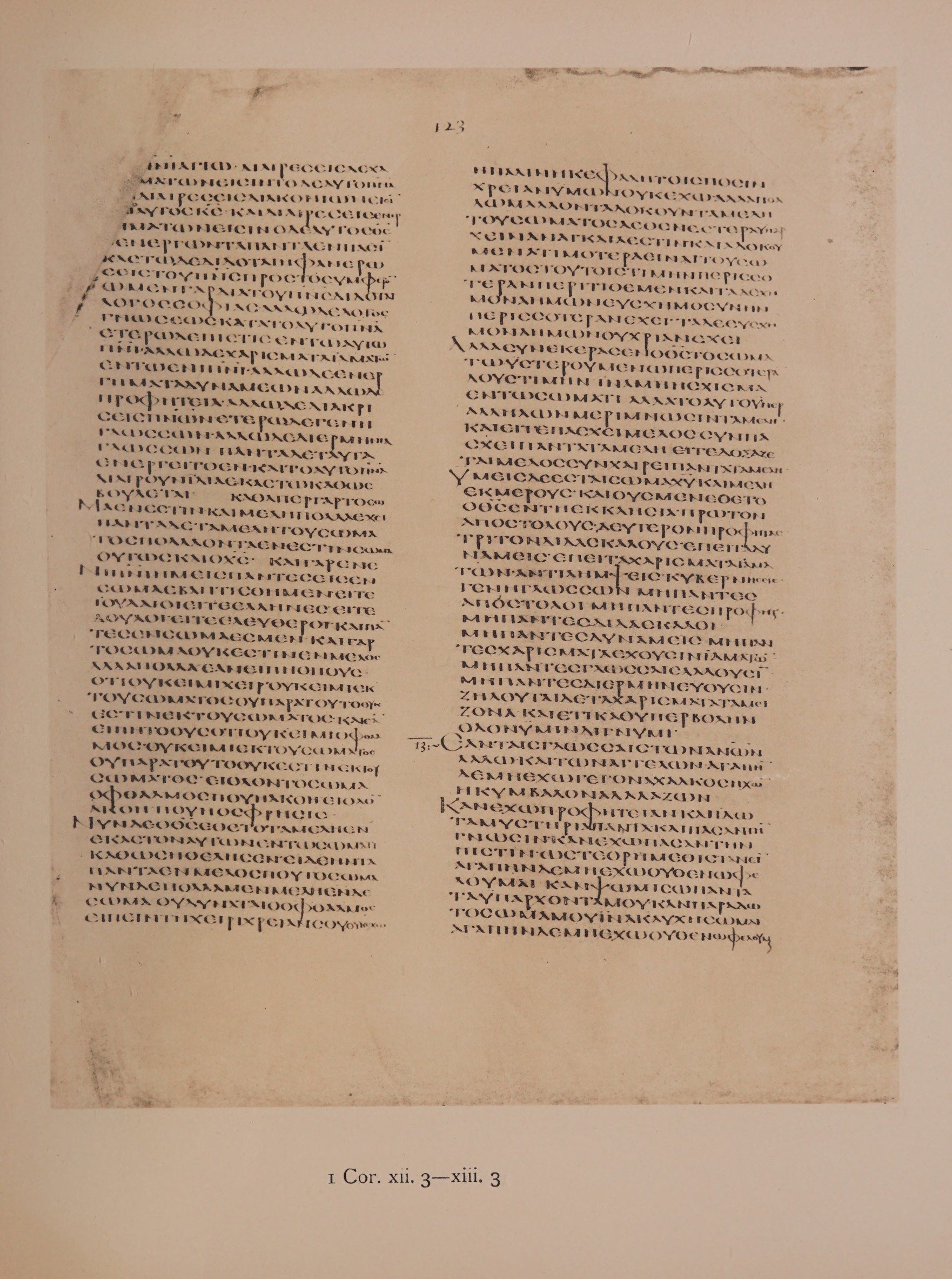
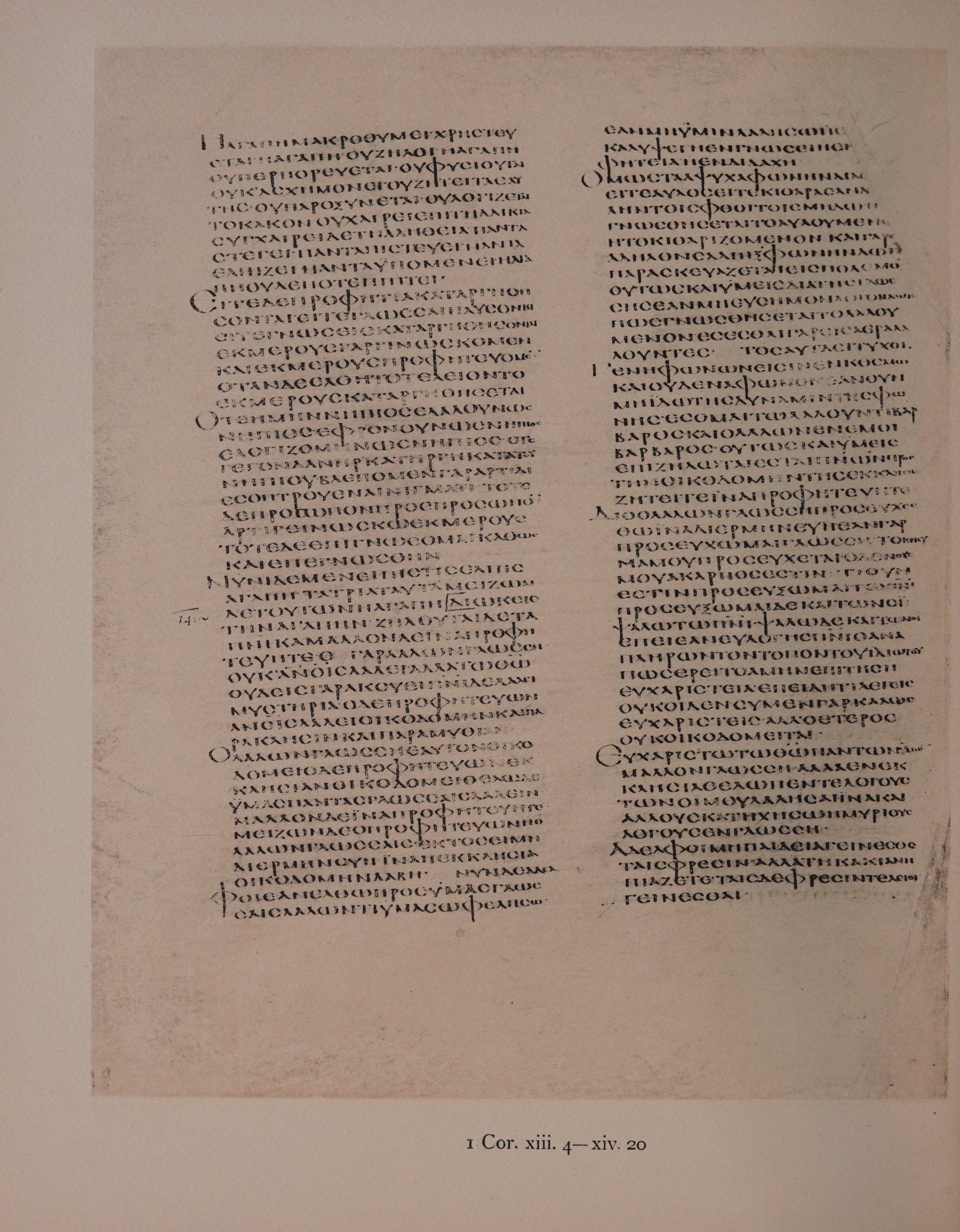
- Manuscript scan: the actual page(s) of Codex Alexandrinus containing this passage (folios 123r, 123v), reproduced from the British Museum's 1909 photographic facsimile edited by F. G. Kenyon, as digitised by the Getty Research Institute for the Internet Archive. The facsimile prints the verse range beneath each plate; that printed range was read for every page used and agrees with the INTF's NTVMR verse-level page index (CC BY 4.0). The page for each section now comes from the NTVMR transcription itself, which records the page and column on which every verse is written.
- Original text: the manuscript's own text, from a diplomatic transcription (see Greek text below), with Tischendorf's 8th critical edition (1869) for comparison.
- English translation: the King James Version (1611), retrieved verbatim from the public-domain bible-api.com endpoint.
Greek text: a diplomatic transcription of Codex Alexandrinus made by the Institut für Neutestamentliche Textforschung (INTF), Münster, for the New Testament Virtual Manuscript Room (NTVMR), published under a Creative Commons Attribution 4.0 licence. It gives the letters as the first scribe wrote them: no accents or breathings, the scribe's own spelling, and the sacred names in their contracted form (θς for θεος, ις for ιησους, κς for κυριος; the overline is not reproduced). Corrections by later hands are not shown. Letters in square brackets are not legible on the page and were restored by the transcribers, a dot under a letter marks an uncertain reading, and [...] marks text lost to damage. Beneath each section, for comparison, is Tischendorf's 8th critical edition (1869). Where the two differ, the transcription is what the manuscript says. Each section is shown with the page on which the transcription places its verses.
How was this verified? (Provenance)
Where on the image
Page from the NTVMR transcription (docID 20002): verses 1-3 on fol. 123r (facsimile leaf 207), col. 2.
1εαν ταις γλωσσαις των ανων λαλω · και των αγγελων · αγαπην δε μη εχω γεγονα χαλκος ηχων η κυμβαλον αλαλαζων 2καν εχω προφητειαν και ιδω τα μυστηρια τ̣αυ̣τα · · και πασαν την γνωσιν · καν εχω πασαν την πιστιν · ωστε ορη μεθιστανειν αγαπην δε μη εχω ουθεν ωφελουμαι · 3καν ψωμισω παντα τα υπαρχοντα μου · καν παραδω το σωμα μου ινα καυχησωμαι αγαπην δε μη εχω ουθεν ωφελουμαι ·
Compare: Tischendorf 8th edition (1869)
1Ἐὰν ταῖς γλώσσαις τῶν ἀνθρώπων λαλῶ καὶ τῶν ἀγγέλων, ἀγάπην δὲ μὴ ἔχω, γέγονα χαλκὸς ἠχῶν ἢ κύμβαλον ἀλαλάζον. 2καὶ ἐὰν ἔχω προφητείαν καὶ εἰδῶ τὰ μυστήρια πάντα καὶ πᾶσαν τὴν γνῶσιν, καὶ ἐὰν ἔχω πᾶσαν τὴν πίστιν ὥστε ὄρη μεθιστάναι, ἀγάπην δὲ μὴ ἔχω, οὐθέν εἰμι. 3καὶ ἐὰν ψωμίσω πάντα τὰ ὑπάρχοντά μου, καὶ ἐὰν παραδῶ τὸ σῶμά μου ἵνα καυθήσομαι, ἀγάπην δὲ μὴ ἔχω, οὐθὲν ὠφελοῦμαι.
1Though I speak with the tongues of men and of angels, and have not charity, I am become as sounding brass, or a tinkling cymbal. 2And though I have the gift of prophecy, and understand all mysteries, and all knowledge; and though I have all faith, so that I could remove mountains, and have not charity, I am nothing. 3And though I bestow all my goods to feed the poor, and though I give my body to be burned, and have not charity, it profiteth me nothing.
Where on the image
Page from the NTVMR transcription (docID 20002): verses 4-13 on fol. 123v (facsimile leaf 208), col. 1.
4η αγαπη μακροθυμει · χρηστευεται · η αγαπη ου ζηλοι η αγαπη ου περπορευεται · ου φυσιουται · 5ουκ ασχημονει · ου ζητει τα εαυτης · ου παροξυνεται · ου λογιζεται το κακον · 6ου χαιρει επι τη αδικια συγχαιρει δε τη αληθεια · 7παντα στεγει · παντα πιστευει · παντα ελπιζει · παντα υπομενει · 8η αγαπη ουδεποτε πιπτει · ειτε δε προφητια καταργηθησονται · ειτε γλωσσαι παυσονται ειτε γνωσεις καταργηθησονται 9εκ μερους γαρ γινωσκομεν και εκ μερους προφητευομεν · 10οταν δε ελθη το τελειον το εκ μερους καταργηθησεται 11οτε ημην νηπιος ελαλουν ως νηπιος · εφρονουν ως νηπιος ελογιζομην ως νηπιος · οτε γεγονα ανηρ κατηργηκα τα του νηπιου · 12βλεπομεν γαρ αρτι δι εσοπτρου εν αινιγματι · τοτε δε προσωπον προς προσωπον αρτι γεινωσκω εκ μερους τοτε δε επιγνωσομαι καθως και επεγνωσθην · 13νυνι δε μενει πιστις ελπις αγαπη · τα τρια ταυτα · μειζων δε τουτων η αγαπη
Compare: Tischendorf 8th edition (1869)
4ἡ ἀγάπη μακροθυμεῖ, χρηστεύεται ἡ ἀγάπη, οὐ ζηλοῖ, ἡ ἀγάπη οὐ περπερεύεται, οὐ φυσιοῦται, 5οὐκ ἀσχημονεῖ, οὐ ζητεῖ τὰ ἑαυτῆς, οὐ παροξύνεται, οὐ λογίζεται τὸ κακόν, 6οὐ χαίρει ἐπὶ τῇ ἀδικίᾳ, συνχαίρει δὲ τῇ ἀληθείᾳ· 7πάντα στέγει, πάντα πιστεύει, πάντα ἐλπίζει, πάντα ὑπομένει. 8Ἡ ἀγάπη οὐδέποτε πίπτει· εἴτε δὲ προφητεῖαι, καταργηθήσονται· εἴτε γλῶσσαι, παύσονται· εἴτε γνῶσις, καταργηθήσεται. 9ἐκ μέρους γὰρ γινώσκομεν καὶ ἐκ μέρους προφητεύομεν· 10ὅταν δὲ ἔλθῃ τὸ τέλειον, τὸ ἐκ μέρους καταργηθήσεται. 11ὅτε ἤμην νήπιος, ἐλάλουν ὡς νήπιος, ἐφρόνουν ὡς νήπιος, ἐλογιζόμην ὡς νήπιος· ὅτε γέγονα ἀνήρ, κατήργηκα τὰ τοῦ νηπίου. 12βλέπομεν γὰρ ἄρτι δι’ ἐσόπτρου ἐν αἰνίγματι, τότε δὲ πρόσωπον πρὸς πρόσωπον· ἄρτι γινώσκω ἐκ μέρους, τότε δὲ ἐπιγνώσομαι καθὼς καὶ ἐπεγνώσθην. 13νυνὶ δὲ μένει πίστις, ἐλπίς, ἀγάπη, τὰ τρία ταῦτα· μείζων δὲ τούτων ἡ ἀγάπη.
4Charity suffereth long, and is kind; charity envieth not; charity vaunteth not itself, is not puffed up, 5Doth not behave itself unseemly, seeketh not her own, is not easily provoked, thinketh no evil; 6Rejoiceth not in iniquity, but rejoiceth in the truth; 7Beareth all things, believeth all things, hopeth all things, endureth all things. 8Charity never faileth: but whether there be prophecies, they shall fail; whether there be tongues, they shall cease; whether there be knowledge, it shall vanish away. 9For we know in part, and we prophesy in part. 10But when that which is perfect is come, then that which is in part shall be done away. 11When I was a child, I spake as a child, I understood as a child, I thought as a child: but when I became a man, I put away childish things. 12For now we see through a glass, darkly; but then face to face: now I know in part; but then shall I know even as also I am known. 13And now abideth faith, hope, charity, these three; but the greatest of these is charity.
Cite
Sources
- Source: Codex Alexandrinus page images + NTVMR transcription (CC BY 4.0) + Tischendorf 8th edition + KJV (holding institution)
- Critical edition: Codex Alexandrinus transcription, NTVMR (INTF Münster, CC BY 4.0); Tischendorf 8th edition for comparison
← previous · → next · v cycle view · l back to library