1 Corinthians, Chapter 5 (Codex Alexandrinus)
Introduction
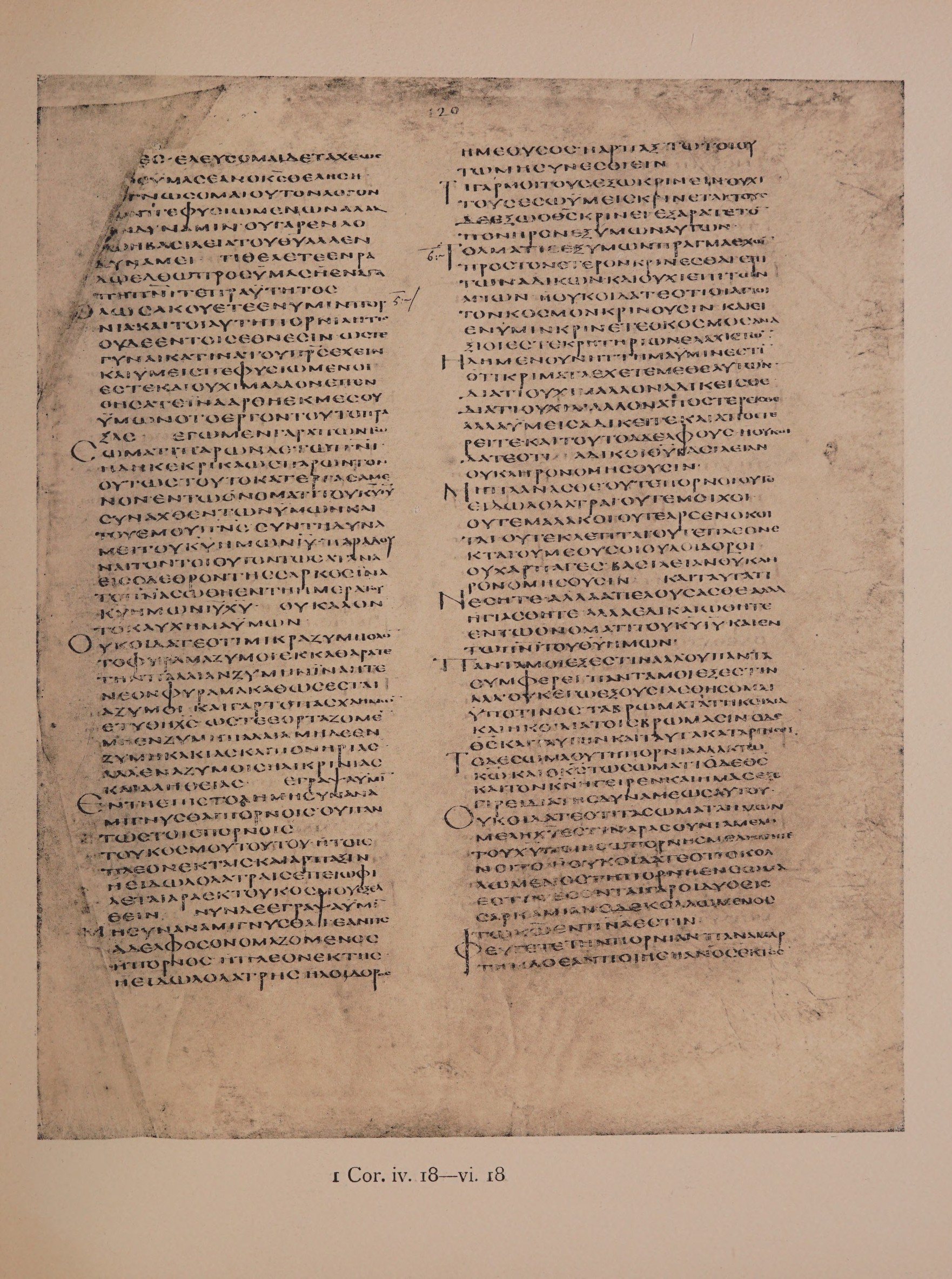
1 Corinthians 5 from Codex Alexandrinus (GA 02), a fifth-century Greek Bible held by the British Library (Royal MS 1 D. VIII). In the New Testament it is the chief witness to the Byzantine text in the Gospels and to the Alexandrian text in the rest of the New Testament. Its New Testament volume lacks Matthew 1:1-25:5, John 6:50-8:52 and 2 Corinthians 4:13-12:6.
This entry meets the strict three-criteria standard of the Theosis Library:
- Manuscript scan: the actual page(s) of Codex Alexandrinus containing this passage (folio 120r), reproduced from the British Museum's 1909 photographic facsimile edited by F. G. Kenyon, as digitised by the Getty Research Institute for the Internet Archive. The facsimile prints the verse range beneath each plate; that printed range was read for every page used and agrees with the INTF's NTVMR verse-level page index (CC BY 4.0). The page for each section now comes from the NTVMR transcription itself, which records the page and column on which every verse is written.
- Original text: the manuscript's own text, from a diplomatic transcription (see Greek text below), with Tischendorf's 8th critical edition (1869) for comparison.
- English translation: the King James Version (1611), retrieved verbatim from the public-domain bible-api.com endpoint.
Greek text: a diplomatic transcription of Codex Alexandrinus made by the Institut für Neutestamentliche Textforschung (INTF), Münster, for the New Testament Virtual Manuscript Room (NTVMR), published under a Creative Commons Attribution 4.0 licence. It gives the letters as the first scribe wrote them: no accents or breathings, the scribe's own spelling, and the sacred names in their contracted form (θς for θεος, ις for ιησους, κς for κυριος; the overline is not reproduced). Corrections by later hands are not shown. Letters in square brackets are not legible on the page and were restored by the transcribers, a dot under a letter marks an uncertain reading, and [...] marks text lost to damage. Beneath each section, for comparison, is Tischendorf's 8th critical edition (1869). Where the two differ, the transcription is what the manuscript says. Each section is shown with the page on which the transcription places its verses.
How was this verified? (Provenance)
Where on the image
Page from the NTVMR transcription (docID 20002): verses 1-11 on fol. 120r (facsimile leaf 201), col. 1.
1ο̣λως ακουετε εν υμιν πορνια · και τοιαυτη πορνια ητις ουδε εν τοις εθνεσιν ωστε γυναικα τινα του πρς εχειν 2και υμεις πεφυσιωμενοι εστε · και ουχι μαλλον επενθησατε · ινα αρθη εκ μεσου υμων ο το εργον τουτο πραξας · 3εγω μεν γαρ απων τω σωματι παρων δε τω πνι ηδη κεκρικα ως παρων τον ουτως τουτο κατεργασαμενον · 4εν τω ονοματι του κυ ιυ συναχθεντων υμων και του εμου πνς · συν τη δυναμει του κυ ημων ιυ · 5παραδουναι τον τοιουτον τω σατανα εις ολεθρον της σαρκος ινα το πνα σωθη εν τη ημερα του κυ ημων ιυ χυ · 6ου καλον το καυχημα υμων · ουκ οιδατε οτι μικρα ζυμη ολον το φυραμα ζυμοι · 7εκκαθαρατε την παλαιαν ζυμην ινα ητε νεον φυραμα καθως εσται αζυμοι · και γαρ το πασχα ημων ετυθη χς · 8ωστε εορταζομεν μη εν ζυμη παλαια μηδε εν ζυμη κακιας και πονηριας αλλ εν αζυμοις ηλικρινιας και αληθειας · 9εγραψα υμιν εν τη επιστολη μη συναναμιγνυσθαι πορνοις · 10ου παντως τοις πορνοις [...] του κοσμου τουτου · η τοις πλεονεκταις · και αρπαξιν η ειδωλολατραις επει ωφιλεται αρα εκ του κοσμου εξελθειν · 11νυν δε εγραψα υμιν μη συναναμιγνυσθαι · εαν τις αδελφος ονομαζομενος η πορνος · η πλεονεκτης · η ειδωλολατρης η λοιδορος η μεθυσος · η αρπαξ · τω τοιουτω μη συνεσθιειν
Compare: Tischendorf 8th edition (1869)
1Ὅλως ἀκούεται ἐν ὑμῖν πορνεία, καὶ τοιαύτη πορνεία ἥτις οὐδὲ ἐν τοῖς ἔθνεσιν, ὥστε γυναῖκά τινα τοῦ πατρὸς ἔχειν. 2καὶ ὑμεῖς πεφυσιωμένοι ἐστέ, καὶ οὐχὶ μᾶλλον ἐπενθήσατε, ἵνα ἀρθῇ ἐκ μέσου ὑμῶν ὁ τὸ ἔργον τοῦτο πράξας; 3ἐγὼ μὲν γάρ, ἀπὼν τῷ σώματι παρὼν δὲ τῷ πνεύματι, ἤδη κέκρικα ὡς παρὼν τὸν οὕτως τοῦτο κατεργασάμενον 4ἐν τῷ ὀνόματι τοῦ κυρίου Ἰησοῦ, συναχθέντων ὑμῶν καὶ τοῦ ἐμοῦ πνεύματος σὺν τῇ δυνάμει τοῦ κυρίου ἡμῶν Ἰησοῦ, 5παραδοῦναι τὸν τοιοῦτον τῷ σατανᾷ εἰς ὄλεθρον τῆς σαρκός, ἵνα τὸ πνεῦμα σωθῇ ἐν τῇ ἡμέρᾳ τοῦ κυρίου Ἰησοῦ. 6Οὐ καλὸν τὸ καύχημα ὑμῶν. οὐκ οἴδατε ὅτι μικρὰ ζύμη ὅλον τὸ φύραμα ζυμοῖ; 7ἐκκαθάρατε τὴν παλαιὰν ζύμην, ἵνα ἦτε νέον φύραμα, καθώς ἐστε ἄζυμοι· καὶ γὰρ τὸ πάσχα ἡμῶν ἐτύθη Χριστός· 8ὥστε ἑορτάζωμεν, μὴ ἐν ζύμῃ παλαιᾷ μηδὲ ἐν ζύμῃ κακίας καὶ πονηρίας, ἀλλ’ ἐν ἀζύμοις εἰλικρινίας καὶ ἀληθείας. 9Ἔγραψα ὑμῖν ἐν τῇ ἐπιστολῇ μὴ συναναμίγνυσθαι πόρνοις, 10οὐ πάντως τοῖς πόρνοις τοῦ κόσμου τούτου ἢ τοῖς πλεονέκταις καὶ ἅρπαξιν ἢ εἰδωλολάτραις, ἐπεὶ ὠφείλετε ἄρα ἐκ τοῦ κόσμου ἐξελθεῖν. 11νυνὶ δὲ ἔγραψα ὑμῖν μὴ συναναμίγνυσθαι ἐάν τις ἀδελφὸς ὀνομαζόμενος ᾖ πόρνος ἢ πλεονέκτης ἢ εἰδωλολάτρης ἢ λοίδορος ἢ μέθυσος ἢ ἅρπαξ, τῷ τοιούτῳ μηδὲ συνεσθίειν.
1It is reported commonly that there is fornication among you, and such fornication as is not so much as named among the Gentiles, that one should have his father’s wife. 2And ye are puffed up, and have not rather mourned, that he that hath done this deed might be taken away from among you. 3For I verily, as absent in body, but present in spirit, have judged already, as though I were present, concerning him that hath so done this deed, 4In the name of our Lord Jesus Christ, when ye are gathered together, and my spirit, with the power of our Lord Jesus Christ, 5To deliver such an one unto Satan for the destruction of the flesh, that the spirit may be saved in the day of the Lord Jesus. 6Your glorying is not good. Know ye not that a little leaven leaveneth the whole lump? 7Purge out therefore the old leaven, that ye may be a new lump, as ye are unleavened. For even Christ our passover is sacrificed for us: 8Therefore let us keep the feast, not with old leaven, neither with the leaven of malice and wickedness; but with the unleavened bread of sincerity and truth. 9I wrote unto you in an epistle not to company with fornicators: 10Yet not altogether with the fornicators of this world, or with the covetous, or extortioners, or with idolaters; for then must ye needs go out of the world. 11But now I have written unto you not to keep company, if any man that is called a brother be a fornicator, or covetous, or an idolater, or a railer, or a drunkard, or an extortioner; with such an one no not to eat.
Where on the image
Page from the NTVMR transcription (docID 20002): verses 12-13 on fol. 120r (facsimile leaf 201), col. 2.
12τι γαρ μοι τους εξω κρινειν · ουχι τους εσω υμεις κρινεται · 13τους δε εξω ο θς κρινει εξαρατε τον πονηρον εξ υμων αυτων ·
Compare: Tischendorf 8th edition (1869)
12τί γάρ μοι τοὺς ἔξω κρίνειν; οὐχὶ τοὺς ἔσω ὑμεῖς κρίνετε; 13τοὺς δὲ ἔξω ὁ θεὸς κρινεῖ. ἐξάρατε τὸν πονηρὸν ἐξ ὑμῶν αὐτῶν.
12For what have I to do to judge them also that are without? do not ye judge them that are within? 13But them that are without God judgeth. Therefore put away from among yourselves that wicked person.
Cite
Sources
- Source: Codex Alexandrinus page images + NTVMR transcription (CC BY 4.0) + Tischendorf 8th edition + KJV (holding institution)
- Critical edition: Codex Alexandrinus transcription, NTVMR (INTF Münster, CC BY 4.0); Tischendorf 8th edition for comparison
← previous · → next · v cycle view · l back to library