1 Corinthians, Chapter 4 (Codex Alexandrinus)
Introduction
1 Corinthians 4 from Codex Alexandrinus (GA 02), a fifth-century Greek Bible held by the British Library (Royal MS 1 D. VIII). In the New Testament it is the chief witness to the Byzantine text in the Gospels and to the Alexandrian text in the rest of the New Testament. Its New Testament volume lacks Matthew 1:1-25:5, John 6:50-8:52 and 2 Corinthians 4:13-12:6.
This entry meets the strict three-criteria standard of the Theosis Library:
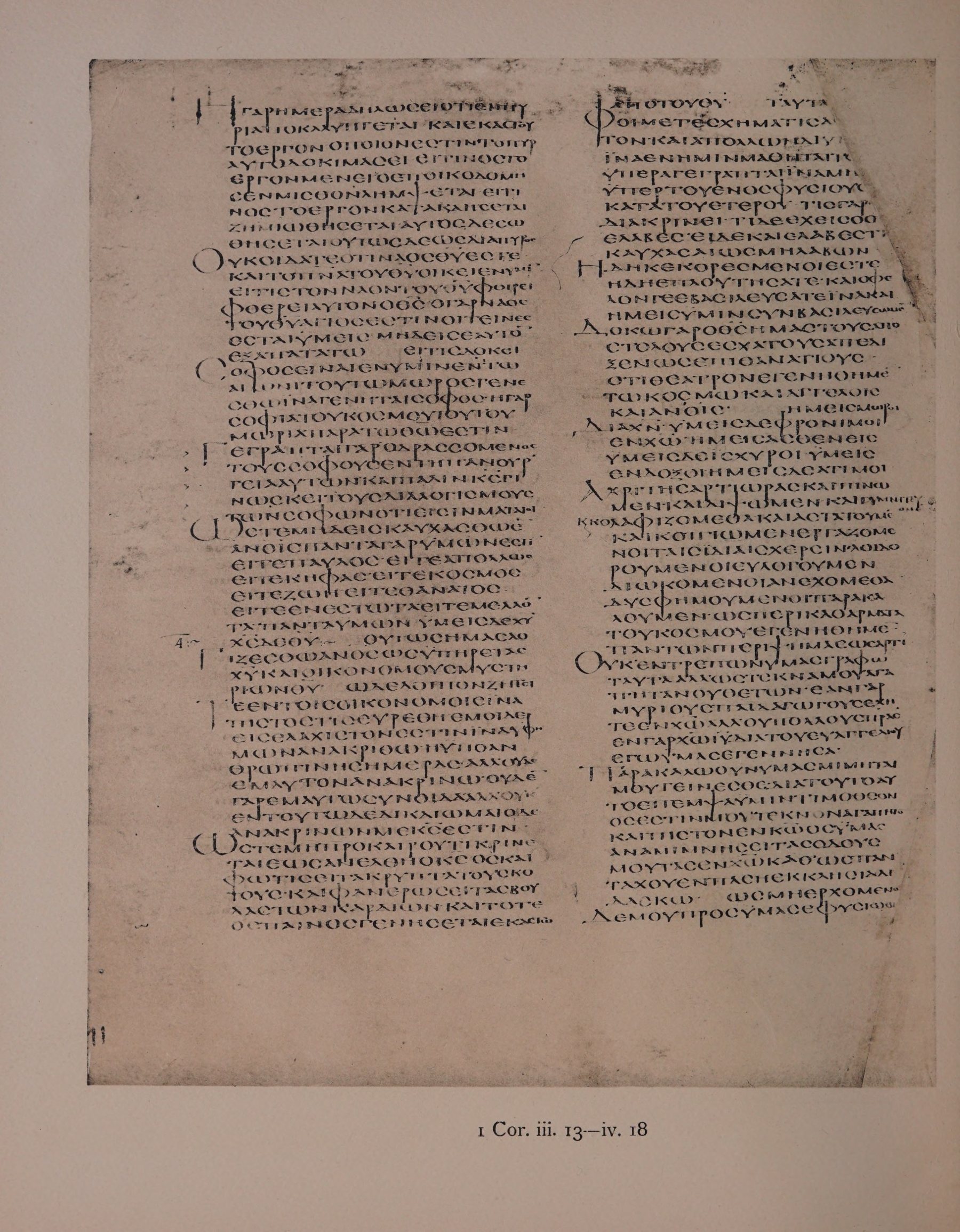
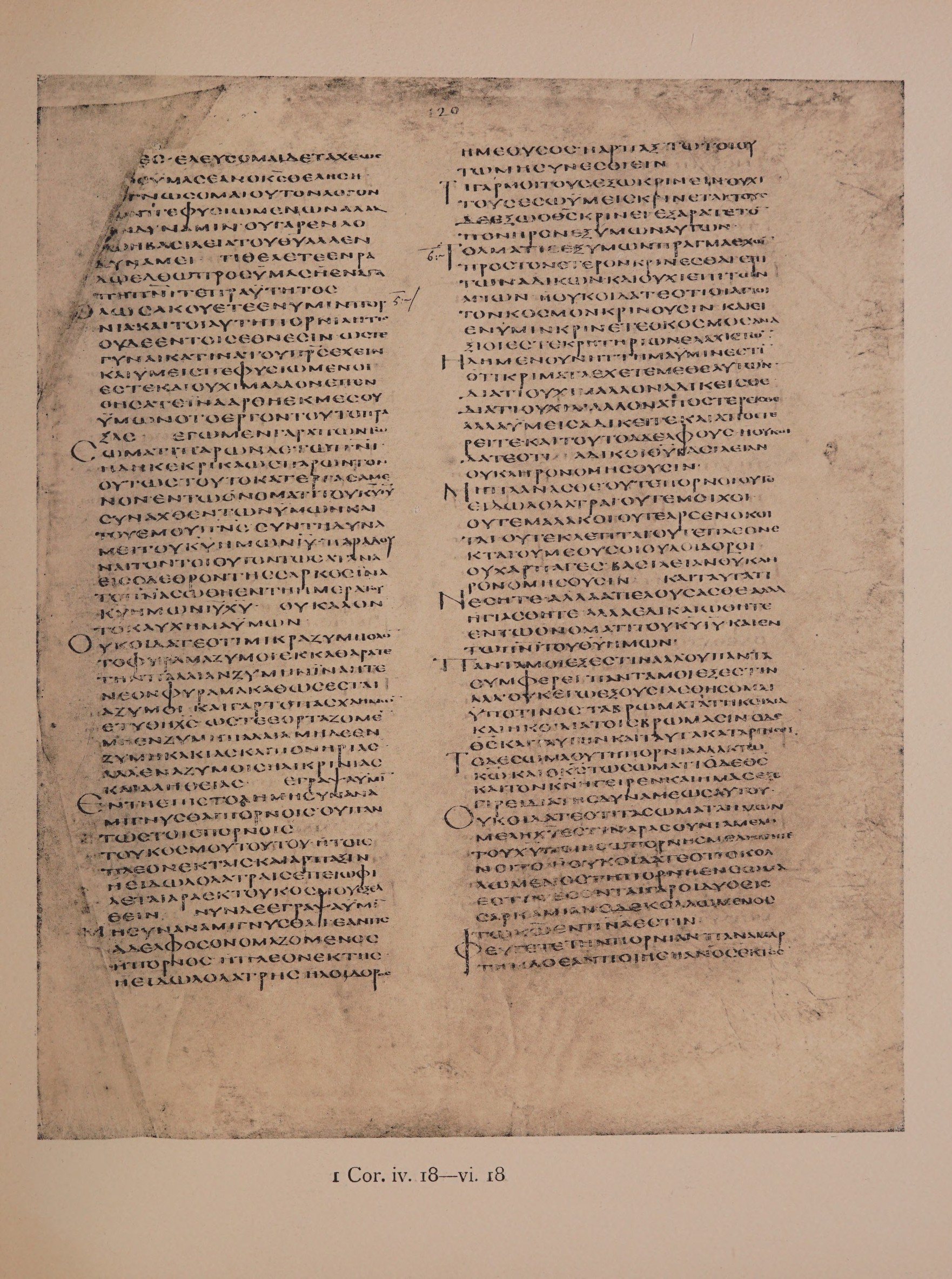
- Manuscript scan: the actual page(s) of Codex Alexandrinus containing this passage (folios 119v, 120r), reproduced from the British Museum's 1909 photographic facsimile edited by F. G. Kenyon, as digitised by the Getty Research Institute for the Internet Archive. The facsimile prints the verse range beneath each plate; that printed range was read for every page used and agrees with the INTF's NTVMR verse-level page index (CC BY 4.0). The page for each section now comes from the NTVMR transcription itself, which records the page and column on which every verse is written.
- Original text: the manuscript's own text, from a diplomatic transcription (see Greek text below), with Tischendorf's 8th critical edition (1869) for comparison.
- English translation: the King James Version (1611), retrieved verbatim from the public-domain bible-api.com endpoint.
Greek text: a diplomatic transcription of Codex Alexandrinus made by the Institut für Neutestamentliche Textforschung (INTF), Münster, for the New Testament Virtual Manuscript Room (NTVMR), published under a Creative Commons Attribution 4.0 licence. It gives the letters as the first scribe wrote them: no accents or breathings, the scribe's own spelling, and the sacred names in their contracted form (θς for θεος, ις for ιησους, κς for κυριος; the overline is not reproduced). Corrections by later hands are not shown. Letters in square brackets are not legible on the page and were restored by the transcribers, a dot under a letter marks an uncertain reading, and [...] marks text lost to damage. Beneath each section, for comparison, is Tischendorf's 8th critical edition (1869). Where the two differ, the transcription is what the manuscript says. Each section is shown with the page on which the transcription places its verses.
How was this verified? (Provenance)
Where on the image
Page from the NTVMR transcription (docID 20002): verses 1-5 on fol. 119v (facsimile leaf 200), col. 1.
1ουτως ημας λογιζεσθω ανος ως υπηρετας χυ · και οικονομους μυστηριων θυ · 2ωδε λοιπον ζητειτε εν τοις οικονομοις ινα πιστος τις ευρεθη · 3εμοι δε εις ελαχιστον εστιν ινα υφ ημων ανακριθω · η υπο ανθρωπινης ημερας · αλλ ουδε εμαυτον ανακρινω · 4ουδεν γαρ εμαυτω συνοιδα · αλλ ουκ εν τουτω δεδικαιωμαι ο δε ανακρινων με κς εστιν · 5ωστε μη προ καιρου τι κρινεται εως αν ελθη ο κς · ος και φωτισει τα κρυπτα του σκοτους · και φανερωσει τας βουλας των καρδιων · και τοτε ο επαινος γενησεται εκαστω απο του θυ ·
Compare: Tischendorf 8th edition (1869)
1Οὕτως ἡμᾶς λογιζέσθω ἄνθρωπος ὡς ὑπηρέτας Χριστοῦ καὶ οἰκονόμους μυστηρίων θεοῦ. 2ὧδε λοιπὸν ζητεῖται ἐν τοῖς οἰκονόμοις ἵνα πιστός τις εὑρεθῇ. 3ἐμοὶ δὲ εἰς ἐλάχιστόν ἐστιν ἵνα ὑφ’ ὑμῶν ἀνακριθῶ ἢ ὑπὸ ἀνθρωπίνης ἡμέρας· ἀλλ’ οὐδὲ ἐμαυτὸν ἀνακρίνω· 4οὐδὲν γὰρ ἐμαυτῷ σύνοιδα, ἀλλ’ οὐκ ἐν τούτῳ δεδικαίωμαι, ὁ δὲ ἀνακρίνων με κύριός ἐστιν. 5ὥστε μὴ πρὸ καιροῦ τι κρίνετε, ἕως ἂν ἔλθῃ ὁ κύριος, ὃς καὶ φωτίσει τὰ κρυπτὰ τοῦ σκότους καὶ φανερώσει τὰς βουλὰς τῶν καρδιῶν· καὶ τότε ὁ ἔπαινος γενήσεται ἑκάστῳ ἀπὸ τοῦ θεοῦ.
1Let a man so account of us, as of the ministers of Christ, and stewards of the mysteries of God. 2Moreover it is required in stewards, that a man be found faithful. 3But with me it is a very small thing that I should be judged of you, or of man’s judgment: yea, I judge not mine own self. 4For I know nothing by myself; yet am I not hereby justified: but he that judgeth me is the Lord. 5Therefore judge nothing before the time, until the Lord come, who both will bring to light the hidden things of darkness, and will make manifest the counsels of the hearts: and then shall every man have praise of God.
Where on the image
Page from the NTVMR transcription (docID 20002): verses 6-12 on fol. 119v (facsimile leaf 200), col. 2.
6ταυτα [δε] [αδελ]φοι μετεσχηματισα ε̣[ις] [εμαυ]τον · και απολλων δι υ[μας] ινα εν ημιν μαθηται το̣ [μη] υπερ α γεγραπται ινα μη [εις] υπερ του ενος φυσιουσ[θε] κατα του ετερου · 7τις γαρ [σε] διακρινει · τι δε εχεις ο ο[υκ] ελαβες · ει δε και ελαβες τι καυχασαι ως μη λαβων 8ηδη κεκορεσμενοι εστε ηδη επλουτησατε · και οφελον γε εβασιλευσατε ινα και ημεις υμιν συνβασιλευσωμεν 9δοκω γαρ ο θς ημας τους αποστολους εσχατους απεδιξεν ως επιθανατιους οτι θεατρον εγενηθημεν τω κοσμω και αγγελοις και ανοις · 10ημεις μωροι δια χν · υμεις δε φρονιμοι εν χω · ημεις ασθενεις υμεις δε ισχυροι · υμεις ενδοξοι · ημεις δε ατιμοι 11αχρι της αρτι ωρας και πινωμεν · και διψωμεν · και κολαφιζομεθα · και αστατουμεν 12και κοπιωμεν εργαζομενοι ταις ιδιαις χερσιν · λοιδορουμενοι ευλογουμεν διωκομενοι ανεχομεθα
Compare: Tischendorf 8th edition (1869)
6Ταῦτα δέ, ἀδελφοί, μετεσχημάτισα εἰς ἐμαυτὸν καὶ Ἀπολλῶν δι’ ὑμᾶς, ἵνα ἐν ἡμῖν μάθητε τὸ μὴ ὑπὲρ ἃ γέγραπται, ἵνα μὴ εἷς ὑπὲρ τοῦ ἑνὸς φυσιοῦσθε κατὰ τοῦ ἑτέρου. 7τίς γάρ σε διακρίνει; τί δὲ ἔχεις ὃ οὐκ ἔλαβες; εἰ δὲ καὶ ἔλαβες, τί καυχᾶσαι ὡς μὴ λαβών; 8ἤδη κεκορεσμένοι ἐστέ· ἤδη ἐπλουτήσατε· χωρὶς ἡμῶν ἐβασιλεύσατε· καὶ ὄφελόν γε ἐβασιλεύσατε, ἵνα καὶ ἡμεῖς ὑμῖν συμβασιλεύσωμεν. 9δοκῶ γάρ, ὁ θεὸς ἡμᾶς τοὺς ἀποστόλους ἐσχάτους ἀπέδειξεν ὡς ἐπιθανατίους, ὅτι θέατρον ἐγενήθημεν τῷ κόσμῳ καὶ ἀγγέλοις καὶ ἀνθρώποις. 10ἡμεῖς μωροὶ διὰ Χριστόν, ὑμεῖς δὲ φρόνιμοι ἐν Χριστῷ· ἡμεῖς ἀσθενεῖς, ὑμεῖς δὲ ἰσχυροί· ὑμεῖς ἔνδοξοι, ἡμεῖς δὲ ἄτιμοι. 11ἄχρι τῆς ἄρτι ὥρας καὶ πεινῶμεν καὶ διψῶμεν καὶ γυμνιτεύομεν καὶ κολαφιζόμεθα καὶ ἀστατοῦμεν 12καὶ κοπιῶμεν ἐργαζόμενοι ταῖς ἰδίαις χερσίν· λοιδορούμενοι εὐλογοῦμεν, διωκόμενοι ἀνεχόμεθα,
6And these things, brethren, I have in a figure transferred to myself and to Apollos for your sakes; that ye might learn in us not to think of men above that which is written, that no one of you be puffed up for one against another. 7For who maketh thee to differ from another? and what hast thou that thou didst not receive? now if thou didst receive it, why dost thou glory, as if thou hadst not received it? 8Now ye are full, now ye are rich, ye have reigned as kings without us: and I would to God ye did reign, that we also might reign with you. 9For I think that God hath set forth us the apostles last, as it were appointed to death: for we are made a spectacle unto the world, and to angels, and to men. 10We are fools for Christ’s sake, but ye are wise in Christ; we are weak, but ye are strong; ye are honourable, but we are despised. 11Even unto this present hour we both hunger, and thirst, and are naked, and are buffeted, and have no certain dwellingplace; 12And labour, working with our own hands: being reviled, we bless; being persecuted, we suffer it:
Where on the image
Page from the NTVMR transcription (docID 20002): verses 13-18 on fol. 119v (facsimile leaf 200), col. 2; verse 18 continues on fol. 120r (facsimile leaf 201), col. 1 (which begins '[τιν]ες ·').
13δυσφημουμενοι παρακαλουμεν · ως περικαθαρματα του κοσμου εγενηθημεν παντων περιψημα εως αρτι 14ουκ εντρεπων υμας γραφω ταυτα αλλ ως τεκνα μου αγαπητα νουθετων · 15εαν γαρ μυριους παιδαγωγους εχητε εν χω αλλ ου πολλους πρας εν γαρ χω ιυ δια του ευαγγελιου εγω υμας εγεννησα · 16παρακαλω ουν υμας μιμηται μου γεινεσθε · 17δια τουτο αυτο επεμψα υμιν τιμοθεον ος εστιν μου τεκνον αγαπητον και πιστον εν κω ος υμας αναμιμνησει τας οδους μου τας εν χω καθως πανταχου εν παση εκκλησια διδασκω · 18ως μη ερχομενο[υ] δε μου προς υμας εφυσιωθη̣[σαν] [τιν]ες ·
Compare: Tischendorf 8th edition (1869)
13δυσφημούμενοι παρακαλοῦμεν· ὡς περικαθάρματα τοῦ κόσμου ἐγενήθημεν, πάντων περίψημα, ἕως ἄρτι. 14Οὐκ ἐντρέπων ὑμᾶς γράφω ταῦτα, ἀλλ’ ὡς τέκνα μου ἀγαπητὰ νουθετῶν. 15ἐὰν γὰρ μυρίους παιδαγωγοὺς ἔχητε ἐν Χριστῷ, ἀλλ’ οὐ πολλοὺς πατέρας· ἐν γὰρ Χριστῷ Ἰησοῦ διὰ τοῦ εὐαγγελίου ἐγὼ ὑμᾶς ἐγέννησα. 16παρακαλῶ οὖν ὑμᾶς, μιμηταί μου γίνεσθε. 17διὰ τοῦτο αὐτὸ ἔπεμψα ὑμῖν Τιμόθεον, ὅς ἐστίν μου τέκνον ἀγαπητὸν καὶ πιστὸν ἐν κυρίῳ, ὃς ὑμᾶς ἀναμνήσει τὰς ὁδούς μου τὰς ἐν Χριστῷ Ἰησοῦ, καθὼς πανταχοῦ ἐν πάσῃ ἐκκλησίᾳ διδάσκω. 18ὡς μὴ ἐρχομένου δέ μου πρὸς ὑμᾶς ἐφυσιώθησάν τινες·
13Being defamed, we intreat: we are made as the filth of the world, and are the offscouring of all things unto this day. 14I write not these things to shame you, but as my beloved sons I warn you. 15For though ye have ten thousand instructers in Christ, yet have ye not many fathers: for in Christ Jesus I have begotten you through the gospel. 16Wherefore I beseech you, be ye followers of me. 17For this cause have I sent unto you Timotheus, who is my beloved son, and faithful in the Lord, who shall bring you into remembrance of my ways which be in Christ, as I teach every where in every church. 18Now some are puffed up, as though I would not come to you.
Where on the image
Page from the NTVMR transcription (docID 20002): verses 19-21 on fol. 120r (facsimile leaf 201), col. 1.
19ελευσομαι δε ταχεως [πρ]ο̣ς υμας εαν ο κς θεληση · [και] γνωσομαι ου τον λογον [τ]ω̣ν̣ πεφυσιωμενων αλλα [τ]η̣ν δυναμιν · 20ου γαρ εν λο[γ]ω η βασιλεια του θυ αλλ εν δ̣υναμει · 21τι θελετε εν ρα[β]δω ελθω προς υμας η εν αγαπη πνι τε πραυτητος
Compare: Tischendorf 8th edition (1869)
19ἐλεύσομαι δὲ ταχέως πρὸς ὑμᾶς, ἐὰν ὁ κύριος θελήσῃ, καὶ γνώσομαι οὐ τὸν λόγον τῶν πεφυσιωμένων ἀλλὰ τὴν δύναμιν, 20οὐ γὰρ ἐν λόγῳ ἡ βασιλεία τοῦ θεοῦ ἀλλ’ ἐν δυνάμει. 21τί θέλετε; ἐν ῥάβδῳ ἔλθω πρὸς ὑμᾶς, ἢ ἐν ἀγάπῃ πνεύματί τε πραΰτητος;
19But I will come to you shortly, if the Lord will, and will know, not the speech of them which are puffed up, but the power. 20For the kingdom of God is not in word, but in power. 21What will ye? shall I come unto you with a rod, or in love, and in the spirit of meekness?
Cite
Sources
- Source: Codex Alexandrinus page images + NTVMR transcription (CC BY 4.0) + Tischendorf 8th edition + KJV (holding institution)
- Critical edition: Codex Alexandrinus transcription, NTVMR (INTF Münster, CC BY 4.0); Tischendorf 8th edition for comparison
← previous · → next · v cycle view · l back to library