1 John, Chapter 2 (Codex Alexandrinus)
Introduction
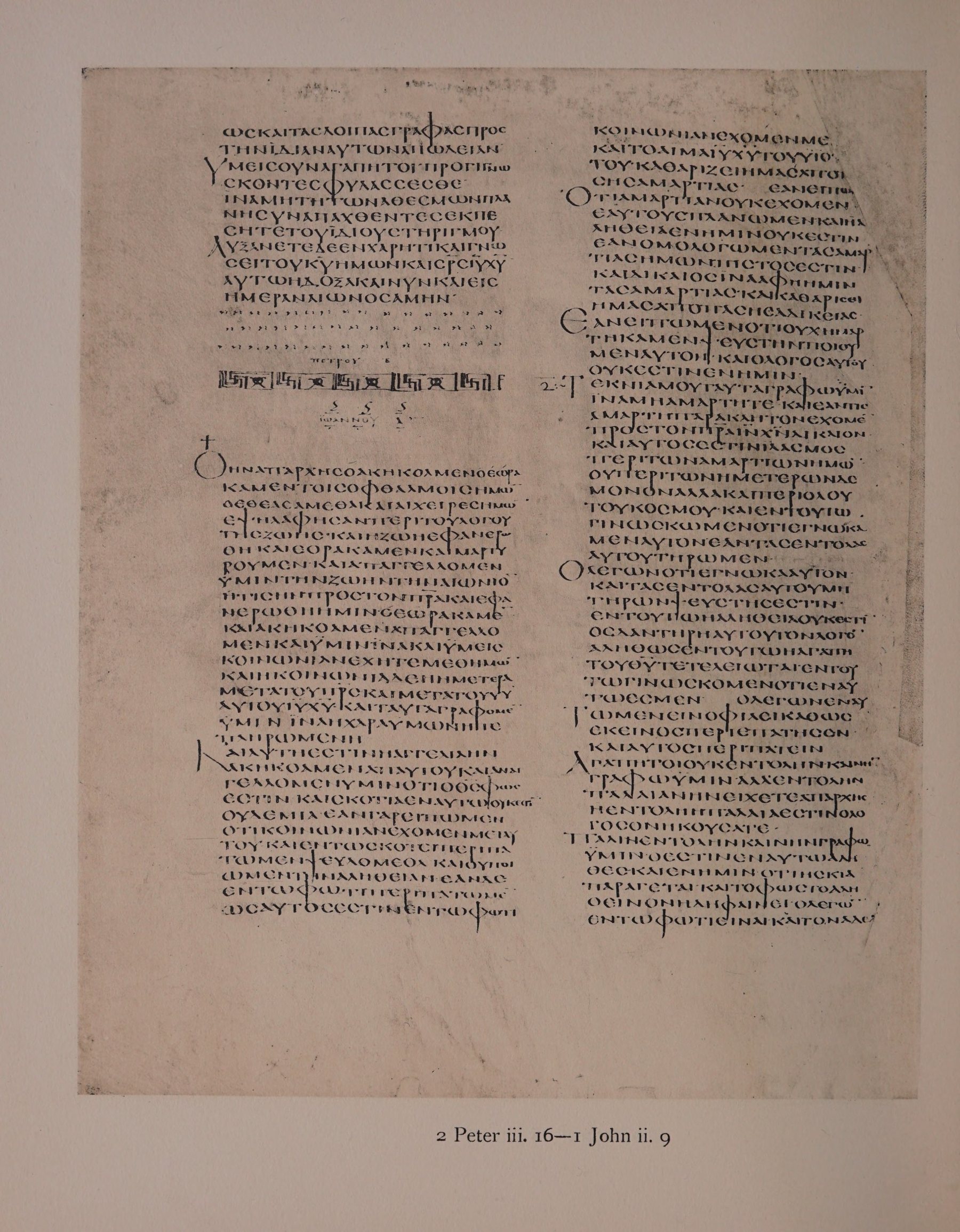
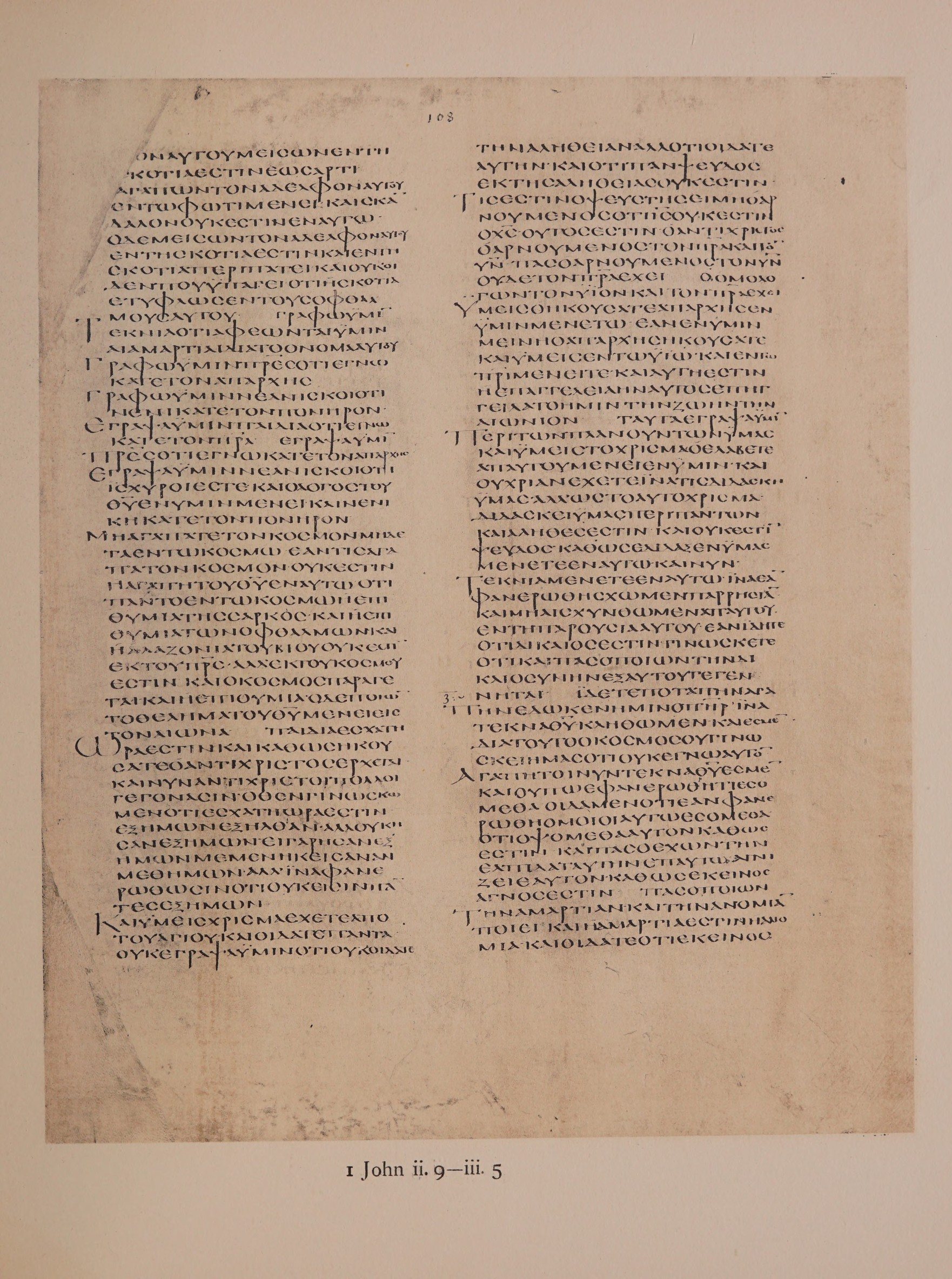
1 John 2 from Codex Alexandrinus (GA 02), a fifth-century Greek Bible held by the British Library (Royal MS 1 D. VIII). In the New Testament it is the chief witness to the Byzantine text in the Gospels and to the Alexandrian text in the rest of the New Testament. Its New Testament volume lacks Matthew 1:1-25:5, John 6:50-8:52 and 2 Corinthians 4:13-12:6.
This entry meets the strict three-criteria standard of the Theosis Library:
- Manuscript scan: the actual page(s) of Codex Alexandrinus containing this passage (folios 107v, 108r), reproduced from the British Museum's 1909 photographic facsimile edited by F. G. Kenyon, as digitised by the Getty Research Institute for the Internet Archive. The facsimile prints the verse range beneath each plate; that printed range was read for every page used and agrees with the INTF's NTVMR verse-level page index (CC BY 4.0). The page for each section now comes from the NTVMR transcription itself, which records the page and column on which every verse is written.
- Original text: the manuscript's own text, from a diplomatic transcription (see Greek text below), with Tischendorf's 8th critical edition (1869) for comparison.
- English translation: the King James Version (1611), retrieved verbatim from the public-domain bible-api.com endpoint.
Greek text: a diplomatic transcription of Codex Alexandrinus made by the Institut für Neutestamentliche Textforschung (INTF), Münster, for the New Testament Virtual Manuscript Room (NTVMR), published under a Creative Commons Attribution 4.0 licence. It gives the letters as the first scribe wrote them: no accents or breathings, the scribe's own spelling, and the sacred names in their contracted form (θς for θεος, ις for ιησους, κς for κυριος; the overline is not reproduced). Corrections by later hands are not shown. Letters in square brackets are not legible on the page and were restored by the transcribers, a dot under a letter marks an uncertain reading, and [...] marks text lost to damage. Beneath each section, for comparison, is Tischendorf's 8th critical edition (1869). Where the two differ, the transcription is what the manuscript says. Each section is shown with the page on which the transcription places its verses.
How was this verified? (Provenance)
Where on the image
Page from the NTVMR transcription (docID 20002): verses 1-9 on fol. 107v (facsimile leaf 176), col. 3; verse 9 continues on fol. 108r (facsimile leaf 177), col. 1 (which begins '[φ]ον αυτου μεισων').
1τεκνια μου ταυτα γραφω υμιν ινα μη αμαρτητε · και εαν τις αμαρτη παρακλητον εχομεν προς τον πρα ιν χν δικαιον · 2και αυτος εστιν ιλασμος περι των αμαρτιων ημων · ου περι των ημετερων δε μονον αλλα και περι ολου του κοσμου · 3και εν τουτω γινωσκωμεν οτι εγνωκαμεν αυτον · εαν τας εντολας αυτου τηρωμεν · 4ο λεγων οτι εγνωκα αυτον · και τας εντολας αυτου μη τηρων ψευστης εστιν · εν τουτω η αληθεια ουκ εστιν 5ος δ αν τηρη αυτου τον λογον αληθως εν τουτω η αγαπη του θυ τετελειωται · εν τουτω γινωσκομεν οτι εν αυτω εσμεν · 6ο λεγων εν αυτω μενειν οφιλει καθως εκεινος περιεπατησεν · και αυτος περιπατειν 7αγαπητοι ουκ εντολην · καινην γραφω υμιν · αλλ εντολην παλαιαν ην ειχετε απ αρχης η εντολη η παλαια εστιν ο λογος ον ηκουσατε · 8παλιν εντολην καινην γραφω υμιν · ο εστιν εν αυτω αληθες · και εν ημιν · οτι η σκια παραγεται · και το φως το αληθεινον ηδη φαινει · 9ο λεγων εν τω φωτι ειναι · και τον αδελ[φ]ον αυτου μεισων εν τη σ̣κοτια εστιν εως αρτι ·
Compare: Tischendorf 8th edition (1869)
1Τεκνία μου, ταῦτα γράφω ὑμῖν ἵνα μὴ ἁμάρτητε. καὶ ἐάν τις ἁμάρτῃ, παράκλητον ἔχομεν πρὸς τὸν πατέρα, Ἰησοῦν Χριστὸν δίκαιον· 2καὶ αὐτὸς ἱλασμός ἐστιν περὶ τῶν ἁμαρτιῶν ἡμῶν, οὐ περὶ τῶν ἡμετέρων δὲ μόνον ἀλλὰ καὶ περὶ ὅλου τοῦ κόσμου. 3καὶ ἐν τούτῳ γινώσκομεν ὅτι ἐγνώκαμεν αὐτόν, ἐὰν τὰς ἐντολὰς αὐτοῦ τηρῶμεν. 4ὁ λέγων ὅτι ἔγνωκα αὐτόν, καὶ τὰς ἐντολὰς αὐτοῦ μὴ τηρῶν, ψεύστης ἐστίν, καὶ ἐν τούτῳ ἡ ἀλήθεια οὐκ ἔστιν· 5ὃς δ’ ἂν τηρῇ αὐτοῦ τὸν λόγον, ἀληθῶς ἐν τούτῳ ἡ ἀγάπη τοῦ θεοῦ τετελείωται. ἐν τούτῳ γινώσκομεν ὅτι ἐν αὐτῷ ἐσμεν· 6ὁ λέγων ἐν αὐτῷ μένειν ὀφείλει καθὼς ἐκεῖνος περιεπάτησεν καὶ αὐτὸς οὕτως περιπατεῖν. 7Ἀγαπητοί, οὐκ ἐντολὴν καινὴν γράφω ὑμῖν, ἀλλ’ ἐντολὴν παλαιὰν ἣν εἴχετε ἀπ’ ἀρχῆς· ἡ ἐντολὴ ἡ παλαιά ἐστιν ὁ λόγος ὃν ἠκούσατε. 8πάλιν ἐντολὴν καινὴν γράφω ὑμῖν, ὅ ἐστιν ἀληθὲς ἐν αὐτῷ καὶ ἐν ὑμῖν, ὅτι ἡ σκοτία παράγεται καὶ τὸ φῶς τὸ ἀληθινὸν ἤδη φαίνει. 9ὁ λέγων ἐν τῷ φωτὶ εἶναι καὶ τὸν ἀδελφὸν αὐτοῦ μισῶν ἐν τῇ σκοτίᾳ ἐστὶν ἕως ἄρτι.
1My little children, these things write I unto you, that ye sin not. And if any man sin, we have an advocate with the Father, Jesus Christ the righteous: 2And he is the propitiation for our sins: and not for ours only, but also for the sins of the whole world. 3And hereby we do know that we know him, if we keep his commandments. 4He that saith, I know him, and keepeth not his commandments, is a liar, and the truth is not in him. 5But whoso keepeth his word, in him verily is the love of God perfected: hereby know we that we are in him. 6He that saith he abideth in him ought himself also so to walk, even as he walked. 7Brethren, I write no new commandment unto you, but an old commandment which ye had from the beginning. The old commandment is the word which ye have heard from the beginning. 8Again, a new commandment I write unto you, which thing is true in him and in you: because the darkness is past, and the true light now shineth. 9He that saith he is in the light, and hateth his brother, is in darkness even until now.
Where on the image
Page from the NTVMR transcription (docID 20002): verses 10-21 on fol. 108r (facsimile leaf 177), col. 1.
10[ο] αγαπων τον αδελφον αυτου εν τω φωτι μενει · και σκανδαλον ουκ εστιν εν αυτω · 11ο δε μεισων τον αδελφον αυτου εν τη σκοτια εστιν και εν τη σκοτια περιπατει · και ουκ οιδεν που υπαγει · οτι η σκοτια ετυφλωσεν τους οφθαλμους αυτου · 12γραφω υμιν τεκνια οτι αφεωνται υμιν αι αμαρτιαι δια το ονομα αυτου 13γραφω υμιν πρες οτι εγνωκατε τον απ αρχης γραφω υμιν νεανισκοι οτι νενικατε τον πονηρον · 14εγραψα υμιν παιδια οτι εγνωκατε τον πρα · εγραψα υμιν πρες οτι εγνωκατε τον απ αρχης · εγραψα υμιν νεανισκοι οτι ισχυροι εστε · και ο λογος του θυ εν υμιν μενει · και νενικηκατε τον πονηρον · 15μη αγαπατε τον κοσμον μηδε τα εν τω κοσμω εαν τις αγαπα τον κοσμον · ουκ εστιν η αγαπη του θυ εν αυτω · 16οτι παν το εν τω κοσμω η επιθυμια της σαρκος · και η επιθυμια των οφθαλμων και η αλαζονια του βιου ουκ εστιν εκ του πρς · αλλ εκ του κοσμου εστιν · 17και ο κοσμος παραγεται · και η επιθυμια · ο δε ποιων το θελημα του θυ μενει εις τον αιωνα · 18παιδια εσχατη ωρα εστιν και καθως ηκουσατε ο αντιχριστος ερχεται · και νυν αντιχριστοι πολλοι γεγονασιν · οθεν γινωσκωμεν οτι εσχατη ωρα εστιν · 19εξ ημων εξηλθαν · αλλ ουκ ησαν εξ ημων · ει γαρ ησαν εξ ημων μεμενηκεισαν αν μεθ ημων · αλλ ινα φανερωθωσιν οτι ουκ εισιν παντες εξ ημων 20και υμεις χρισμα εχετε απο του αγιου · και οιδατε παντα · 21ουκ εγραψα υμιν οτι ουκ οιδατε την αληθειαν · αλλ οτι οιδατε αυτην · και οτι παν ψευδος εκ της αληθειας ουκ εστιν ·
Compare: Tischendorf 8th edition (1869)
10ὁ ἀγαπῶν τὸν ἀδελφὸν αὐτοῦ ἐν τῷ φωτὶ μένει, καὶ σκάνδαλον οὐκ ἔστιν ἐν αὐτῷ· 11ὁ δὲ μισῶν τὸν ἀδελφὸν αὐτοῦ ἐν τῇ σκοτίᾳ ἐστὶν καὶ ἐν τῇ σκοτίᾳ περιπατεῖ, καὶ οὐκ οἶδεν ποῦ ὑπάγει, ὅτι ἡ σκοτία ἐτύφλωσεν τοὺς ὀφθαλμοὺς αὐτοῦ. 12Γράφω ὑμῖν, τεκνία, ὅτι ἀφέωνται ὑμῖν αἱ ἁμαρτίαι διὰ τὸ ὄνομα αὐτοῦ. 13γράφω ὑμῖν, πατέρες, ὅτι ἐγνώκατε τὸν ἀπ’ ἀρχῆς. γράφω ὑμῖν, νεανίσκοι, ὅτι νενικήκατε τὸν πονηρόν. ἔγραψα ὑμῖν, παιδία, ὅτι ἐγνώκατε τὸν πατέρα. 14ἔγραψα ὑμῖν, πατέρες, ὅτι ἐγνώκατε τὸν ἀπ’ ἀρχῆς. ἔγραψα ὑμῖν, νεανίσκοι, ὅτι ἰσχυροί ἐστε καὶ ὁ λόγος τοῦ θεοῦ ἐν ὑμῖν μένει καὶ νενικήκατε τὸν πονηρόν. 15μὴ ἀγαπᾶτε τὸν κόσμον μηδὲ τὰ ἐν τῷ κόσμῳ. ἐάν τις ἀγαπᾷ τὸν κόσμον, οὐκ ἔστιν ἡ ἀγάπη τοῦ πατρὸς ἐν αὐτῷ· 16ὅτι πᾶν τὸ ἐν τῷ κόσμῳ, ἡ ἐπιθυμία τῆς σαρκὸς καὶ ἡ ἐπιθυμία τῶν ὀφθαλμῶν καὶ ἡ ἀλαζονία τοῦ βίου, οὐκ ἔστιν ἐκ τοῦ πατρὸς ἀλλ’ ἐκ τοῦ κόσμου ἐστίν. 17καὶ ὁ κόσμος παράγεται καὶ ἡ ἐπιθυμία αὐτοῦ, ὁ δὲ ποιῶν τὸ θέλημα τοῦ θεοῦ μένει εἰς τὸν αἰῶνα. 18Παιδία, ἐσχάτη ὥρα ἐστίν, καὶ καθὼς ἠκούσατε ὅτι ἀντίχριστος ἔρχεται, καὶ νῦν ἀντίχριστοι πολλοὶ γεγόνασιν· ὅθεν γινώσκομεν ὅτι ἐσχάτη ὥρα ἐστίν. 19ἐξ ἡμῶν ἐξῆλθαν, ἀλλ’ οὐκ ἦσαν ἐξ ἡμῶν· εἰ γὰρ ἦσαν ἐξ ἡμῶν, μεμενήκεισαν ἂν μεθ’ ἡμῶν· ἀλλ’ ἵνα φανερωθῶσιν ὅτι οὐκ εἰσὶν πάντες ἐξ ἡμῶν. 20καὶ ὑμεῖς χρῖσμα ἔχετε ἀπὸ τοῦ ἁγίου, καὶ οἴδατε πάντες. 21οὐκ ἔγραψα ὑμῖν ὅτι οὐκ οἴδατε τὴν ἀλήθειαν, ἀλλ’ ὅτι οἴδατε αὐτήν, καὶ ὅτι πᾶν ψεῦδος ἐκ τῆς ἀληθείας οὐκ ἔστιν.
10He that loveth his brother abideth in the light, and there is none occasion of stumbling in him. 11But he that hateth his brother is in darkness, and walketh in darkness, and knoweth not whither he goeth, because that darkness hath blinded his eyes. 12I write unto you, little children, because your sins are forgiven you for his name’s sake. 13I write unto you, fathers, because ye have known him that is from the beginning. I write unto you, young men, because ye have overcome the wicked one. I write unto you, little children, because ye have known the Father. 14I have written unto you, fathers, because ye have known him that is from the beginning. I have written unto you, young men, because ye are strong, and the word of God abideth in you, and ye have overcome the wicked one. 15Love not the world, neither the things that are in the world. If any man love the world, the love of the Father is not in him. 16For all that is in the world, the lust of the flesh, and the lust of the eyes, and the pride of life, is not of the Father, but is of the world. 17And the world passeth away, and the lust thereof: but he that doeth the will of God abideth for ever. 18Little children, it is the last time: and as ye have heard that antichrist shall come, even now are there many antichrists; whereby we know that it is the last time. 19They went out from us, but they were not of us; for if they had been of us, they would no doubt have continued with us: but they went out, that they might be made manifest that they were not all of us. 20But ye have an unction from the Holy One, and ye know all things. 21I have not written unto you because ye know not the truth, but because ye know it, and that no lie is of the truth.
Where on the image
Page from the NTVMR transcription (docID 20002): verses 22-29 on fol. 108r (facsimile leaf 177), col. 2.
22τις εστιν ο ψευστης ει μη ο αρνουμενος οτι ις ουκ εστιν ο χς · ουτος εστιν · ο αντιχριστος ο αρνουμενος τον πρα και τον υν · 23πας ο αρνουμενος τον υν ουδε τον πρα εχει · ο ομολογων τον υιον και τον πρα εχει 24υμεις ο ηκουσατε απ αρχης εν υμιν μενετω · εαν εν υμιν μεινη ο απ αρχης ηκουσατε και υμεις εν τω υιω · και εν τω πρι μενειτε · 25και αυτη εστιν η επαγγελεια ην αυτος επηγγειλατο ημιν την ζωην την αιωνιον · 26ταυτα εγραψα υμιν περι των πλανουντων υμας 27και υμεις το χρισμα ο ελαβετε απ αυτου μενει εν η̣μ̣ι̣ν̣ · και ου χριαν εχετε ινα τις διδασκη υμας · αλλ ως το αυτο χρισμα · διδασκει υμας περι παντων και αληθες εστιν · και ουκ εστιν ψευδος · καθως εδιδαξεν υμας μενετε εν αυτω · 28και νυν · τεκνια μενετε εν αυτω · ινα εαν φανερωθη σχωμεν παρρησιαν και μη αισχυνθωμεν απ αυτου · εν τη παρουσια αυτου · 29εαν ιδητε οτι δικαιος εστιν · γινωσκετε οτι και πας ο ποιων την δικαιοσυνην εξ αυτου γεγεννηται ·
Compare: Tischendorf 8th edition (1869)
22τίς ἐστιν ὁ ψεύστης εἰ μὴ ὁ ἀρνούμενος ὅτι Ἰησοῦς οὐκ ἔστιν ὁ Χριστός; οὗτός ἐστιν ὁ ἀντίχριστος, ὁ ἀρνούμενος τὸν πατέρα καὶ τὸν υἱόν. 23πᾶς ὁ ἀρνούμενος τὸν υἱὸν οὐδὲ τὸν πατέρα ἔχει· ὁ ὁμολογῶν τὸν υἱὸν καὶ τὸν πατέρα ἔχει. 24ὑμεῖς ὃ ἠκούσατε ἀπ’ ἀρχῆς ἐν ὑμῖν μενέτω· ἐὰν ἐν ὑμῖν μείνῃ ὃ ἀπ’ ἀρχῆς ἠκούσατε, καὶ ὑμεῖς ἐν τῷ υἱῷ καὶ ἐν τῷ πατρὶ μενεῖτε. 25καὶ αὕτη ἐστὶν ἡ ἐπαγγελία ἣν αὐτὸς ἐπηγγείλατο ἡμῖν, τὴν ζωὴν τὴν αἰώνιον. 26Ταῦτα ἔγραψα ὑμῖν περὶ τῶν πλανώντων ὑμᾶς. 27καὶ ὑμεῖς τὸ χρῖσμα ὃ ἐλάβετε ἀπ’ αὐτοῦ μένει ἐν ὑμῖν, καὶ οὐ χρείαν ἔχετε ἵνα τις διδάσκῃ ὑμᾶς· ἀλλ’ ὡς τὸ αὐτοῦ χρῖσμα διδάσκει ὑμᾶς περὶ πάντων, καὶ ἀληθές ἐστιν καὶ οὐκ ἔστιν ψεῦδος, καὶ καθὼς ἐδίδαξεν ὑμᾶς, μένετε ἐν αὐτῷ. 28Καὶ νῦν, τεκνία, μένετε ἐν αὐτῷ, ἵνα ἐὰν φανερωθῇ σχῶμεν παρρησίαν καὶ μὴ αἰσχυνθῶμεν ἀπ’ αὐτοῦ ἐν τῇ παρουσίᾳ αὐτοῦ. 29ἐὰν εἰδῆτε ὅτι δίκαιός ἐστιν, γινώσκετε ὅτι καὶ πᾶς ὁ ποιῶν τὴν δικαιοσύνην ἐξ αὐτοῦ γεγέννηται.
22Who is a liar but he that denieth that Jesus is the Christ? He is antichrist, that denieth the Father and the Son. 23Whosoever denieth the Son, the same hath not the Father: (but) he that acknowledgeth the Son hath the Father also. 24Let that therefore abide in you, which ye have heard from the beginning. If that which ye have heard from the beginning shall remain in you, ye also shall continue in the Son, and in the Father. 25And this is the promise that he hath promised us, even eternal life. 26These things have I written unto you concerning them that seduce you. 27But the anointing which ye have received of him abideth in you, and ye need not that any man teach you: but as the same anointing teacheth you of all things, and is truth, and is no lie, and even as it hath taught you, ye shall abide in him. 28And now, little children, abide in him; that, when he shall appear, we may have confidence, and not be ashamed before him at his coming. 29If ye know that he is righteous, ye know that every one that doeth righteousness is born of him.
Cite
Sources
- Source: Codex Alexandrinus page images + NTVMR transcription (CC BY 4.0) + Tischendorf 8th edition + KJV (holding institution)
- Critical edition: Codex Alexandrinus transcription, NTVMR (INTF Münster, CC BY 4.0); Tischendorf 8th edition for comparison
← previous · → next · v cycle view · l back to library