1 John, Chapter 3 (Codex Alexandrinus)
Introduction
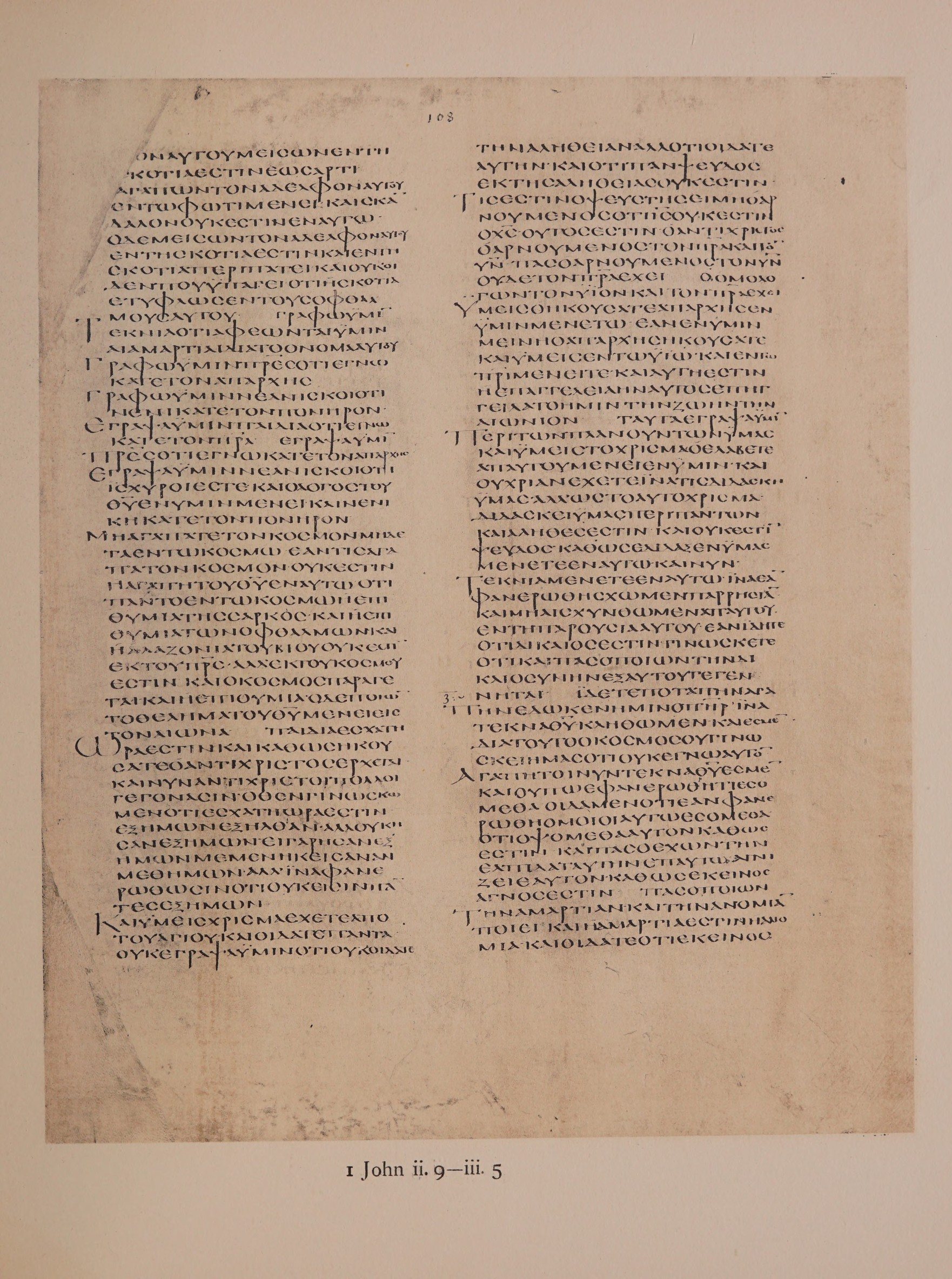
1 John 3 from Codex Alexandrinus (GA 02), a fifth-century Greek Bible held by the British Library (Royal MS 1 D. VIII). In the New Testament it is the chief witness to the Byzantine text in the Gospels and to the Alexandrian text in the rest of the New Testament. Its New Testament volume lacks Matthew 1:1-25:5, John 6:50-8:52 and 2 Corinthians 4:13-12:6.
This entry meets the strict three-criteria standard of the Theosis Library:
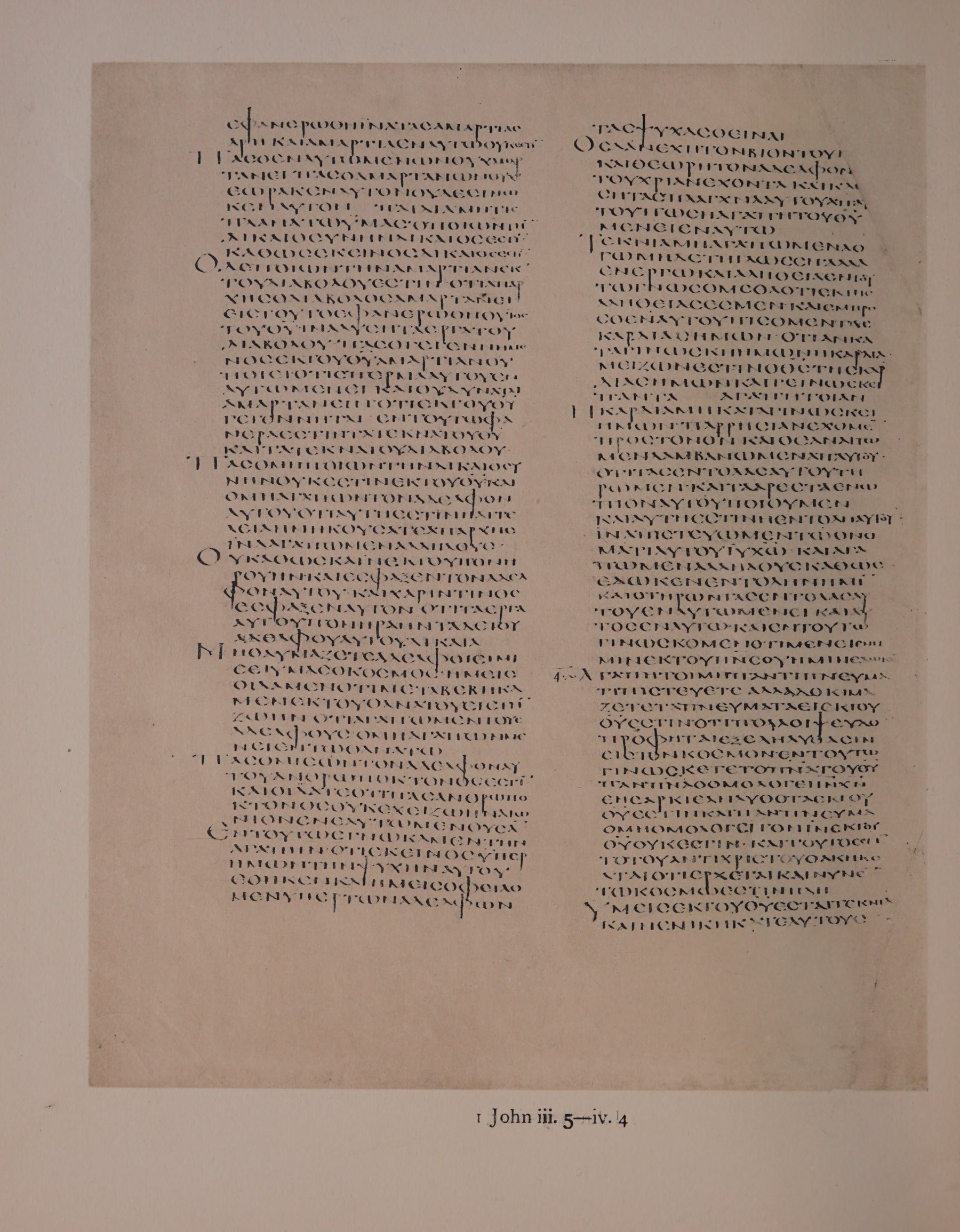
- Manuscript scan: the actual page(s) of Codex Alexandrinus containing this passage (folios 108r, 108v), reproduced from the British Museum's 1909 photographic facsimile edited by F. G. Kenyon, as digitised by the Getty Research Institute for the Internet Archive. The facsimile prints the verse range beneath each plate; that printed range was read for every page used and agrees with the INTF's NTVMR verse-level page index (CC BY 4.0). The page for each section now comes from the NTVMR transcription itself, which records the page and column on which every verse is written.
- Original text: the manuscript's own text, from a diplomatic transcription (see Greek text below), with Tischendorf's 8th critical edition (1869) for comparison.
- English translation: the King James Version (1611), retrieved verbatim from the public-domain bible-api.com endpoint.
Greek text: a diplomatic transcription of Codex Alexandrinus made by the Institut für Neutestamentliche Textforschung (INTF), Münster, for the New Testament Virtual Manuscript Room (NTVMR), published under a Creative Commons Attribution 4.0 licence. It gives the letters as the first scribe wrote them: no accents or breathings, the scribe's own spelling, and the sacred names in their contracted form (θς for θεος, ις for ιησους, κς for κυριος; the overline is not reproduced). Corrections by later hands are not shown. Letters in square brackets are not legible on the page and were restored by the transcribers, a dot under a letter marks an uncertain reading, and [...] marks text lost to damage. Beneath each section, for comparison, is Tischendorf's 8th critical edition (1869). Where the two differ, the transcription is what the manuscript says. Each section is shown with the page on which the transcription places its verses.
How was this verified? (Provenance)
Where on the image
Page from the NTVMR transcription (docID 20002): verses 1-5 on fol. 108r (facsimile leaf 177), col. 2; verse 5 continues on fol. 108v (facsimile leaf 178), col. 1 (which begins 'εφανερωθη ινα τας').
1ιδετε ποταπην αγαπην εδωκεν ημιν ο πηρ · ινα τεκνα θυ · κληθωμεν · και εσμεν · δια τουτο ο κοσμος ου γινωσκει ημας οτι ουκ εγνω αυτον 2αγαπητοι νυν τεκνα θυ εσμεν και ουπω εφανερωθη τι εσομεθα οιδαμεν οτι εαν φανερωθη ομοιοι αυτω εσομεθα · οτι οψομεθα αυτον καθως εστιν 3και πας ο εχων την ελπιδα ταυτην επ αυτω αγνιζει εαυτον · καθως εκεινος αγνος εστιν · 4πας ο ποιων την αμαρτιαν · και την ανομιαν ποιει · και η αμαρτια εστιν η ανομια · 5και οιδατε οτι εκεινος εφανερωθη ινα τας αμαρτιας αρη και αμαρτια εν αυτω ουκ εστιν
Compare: Tischendorf 8th edition (1869)
1Ἴδετε ποταπὴν ἀγάπην δέδωκεν ἡμῖν ὁ πατὴρ ἵνα τέκνα θεοῦ κληθῶμεν· καὶ ἐσμέν. διὰ τοῦτο ὁ κόσμος οὐ γινώσκει ἡμᾶς ὅτι οὐκ ἔγνω αὐτόν. 2Ἀγαπητοί, νῦν τέκνα θεοῦ ἐσμεν, καὶ οὔπω ἐφανερώθη τί ἐσόμεθα. οἴδαμεν ὅτι ἐὰν φανερωθῇ ὅμοιοι αὐτῷ ἐσόμεθα, ὅτι ὀψόμεθα αὐτὸν καθώς ἐστιν. 3καὶ πᾶς ὁ ἔχων τὴν ἐλπίδα ταύτην ἐπ’ αὐτῷ ἁγνίζει ἑαυτὸν καθὼς ἐκεῖνος ἁγνός ἐστιν. 4πᾶς ὁ ποιῶν τὴν ἁμαρτίαν καὶ τὴν ἀνομίαν ποιεῖ, καὶ ἡ ἁμαρτία ἐστὶν ἡ ἀνομία. 5καὶ οἴδατε ὅτι ἐκεῖνος ἐφανερώθη ἵνα τὰς ἁμαρτίας ἄρῃ, καὶ ἁμαρτία ἐν αὐτῷ οὐκ ἔστιν.
1Behold, what manner of love the Father hath bestowed upon us, that we should be called the sons of God: therefore the world knoweth us not, because it knew him not. 2Beloved, now are we the sons of God, and it doth not yet appear what we shall be: but we know that, when he shall appear, we shall be like him; for we shall see him as he is. 3And every man that hath this hope in him purifieth himself, even as he is pure. 4Whosoever committeth sin transgresseth also the law: for sin is the transgression of the law. 5And ye know that he was manifested to take away our sins; and in him is no sin.
Where on the image
Page from the NTVMR transcription (docID 20002): verses 6-16 on fol. 108v (facsimile leaf 178), col. 1.
6πας ο εν αυτω μενων ουχ αμαρτανει πας ο αμαρτανων ουχ εωρακεν αυτον ουδε εγνωκεν αυτον 7παιδια μη τις πλανατω υμας · ο ποιων την δικαιοσυνην δικαιος εστιν · καθως εκεινος δικαιος εστιν · 8ο δε ποιων την αμαρτιαν εκ του διαβολου εστιν · οτι απ αρχης ο διαβολος αμαρτανει · εις τουτο εφανερωθη ο υιος του θυ · ινα λυση τα εργα του διαβολου · 9πας ο γεγεννημενος εκ του θυ αμαρτιαν ου ποιει · οτι σπερμα αυτου εν αυτω μενει και ου δυναται αμαρτανειν · οτι εκ του θυ γεγεννηται · 10εν τουτω φανερα εστιν τα τεκνα του θυ και τα τεκνα του διαβολου · πας ο μη ποιων την δικαιοσυνην ουκ εστιν εκ του θυ και ο μη αγαπων τον αδελφον αυτου · 11οτι αυτη εστιν η αγγελεια ην ηκουσατε απ αρχης ινα αγαπωμεν αλληλους · 12ου καθως καιν εκ του πονηρου ην · και εσφαξεν τον αδελφον αυτου · και χαριν τινος εσφαξεν αυτον οτι τα εργα αυτου πονηρα ην τα δε του αδελφου αυτου δικαια 13μη θαυμαζετε αδελφοι ει μισει υμας ο κοσμος · 14ημεις οιδαμεν οτι μεταβεβηκαμεν εκ του θανατου εις την ζωην οτι αγαπωμεν τους αδελφους · ο μη αγαπων μενει εν τω θανατω 15πας ο μισων τον αδελφον αυτου ανθρωποκτονος εστιν · και οιδατε οτι πας ανθρωποκτονος ουκ εχει ζωην αιωνιον εν εαυτω μενουσαν · 16εν τουτω εγνωκαμεν την αγαπην · οτι εκεινος υπερ ημων την ψυχην αυτου εθηκεν και ημεις οφειλομεν υπερ των αδελφων τας ψυχας θειναι
Compare: Tischendorf 8th edition (1869)
6πᾶς ὁ ἐν αὐτῷ μένων οὐχ ἁμαρτάνει· πᾶς ὁ ἁμαρτάνων οὐχ ἑώρακεν αὐτὸν οὐδὲ ἔγνωκεν αὐτόν. 7Τεκνία, μηδεὶς πλανάτω ὑμᾶς· ὁ ποιῶν τὴν δικαιοσύνην δίκαιός ἐστιν, καθὼς ἐκεῖνος δίκαιός ἐστιν· 8ὁ ποιῶν τὴν ἁμαρτίαν ἐκ τοῦ διαβόλου ἐστίν, ὅτι ἀπ’ ἀρχῆς ὁ διάβολος ἁμαρτάνει. εἰς τοῦτο ἐφανερώθη ὁ υἱὸς τοῦ θεοῦ, ἵνα λύσῃ τὰ ἔργα τοῦ διαβόλου. 9πᾶς ὁ γεγεννημένος ἐκ τοῦ θεοῦ ἁμαρτίαν οὐ ποιεῖ, ὅτι σπέρμα αὐτοῦ ἐν αὐτῷ μένει· καὶ οὐ δύναται ἁμαρτάνειν, ὅτι ἐκ τοῦ θεοῦ γεγέννηται. 10ἐν τούτῳ φανερά ἐστιν τὰ τέκνα τοῦ θεοῦ καὶ τὰ τέκνα τοῦ διαβόλου· πᾶς ὁ μὴ ποιῶν δικαιοσύνην οὐκ ἔστιν ἐκ τοῦ θεοῦ, καὶ ὁ μὴ ἀγαπῶν τὸν ἀδελφὸν αὐτοῦ. 11ὅτι αὕτη ἐστὶν ἡ ἀγγελία ἣν ἠκούσατε ἀπ’ ἀρχῆς, ἵνα ἀγαπῶμεν ἀλλήλους· 12οὐ καθὼς Κάϊν ἐκ τοῦ πονηροῦ ἦν καὶ ἔσφαξεν τὸν ἀδελφὸν αὐτοῦ· καὶ χάριν τίνος ἔσφαξεν αὐτόν; ὅτι τὰ ἔργα αὐτοῦ πονηρὰ ἦν, τὰ δὲ τοῦ ἀδελφοῦ αὐτοῦ δίκαια. 13Καὶ μὴ θαυμάζετε, ἀδελφοί, εἰ μισεῖ ὑμᾶς ὁ κόσμος. 14ἡμεῖς οἴδαμεν ὅτι μεταβεβήκαμεν ἐκ τοῦ θανάτου εἰς τὴν ζωήν, ὅτι ἀγαπῶμεν τοὺς ἀδελφούς· ὁ μὴ ἀγαπῶν μένει ἐν τῷ θανάτῳ. 15πᾶς ὁ μισῶν τὸν ἀδελφὸν αὐτοῦ ἀνθρωποκτόνος ἐστίν, καὶ οἴδατε ὅτι πᾶς ἀνθρωποκτόνος οὐκ ἔχει ζωὴν αἰώνιον ἐν ἑαυτῷ μένουσαν. 16ἐν τούτῳ ἐγνώκαμεν τὴν ἀγάπην, ὅτι ἐκεῖνος ὑπὲρ ὑμῶν τὴν ψυχὴν αὐτοῦ ἔθηκεν· καὶ ἡμεῖς ὀφείλομεν ὑπὲρ τῶν ἀδελφῶν τὰς ψυχὰς θεῖναι.
6Whosoever abideth in him sinneth not: whosoever sinneth hath not seen him, neither known him. 7Little children, let no man deceive you: he that doeth righteousness is righteous, even as he is righteous. 8He that committeth sin is of the devil; for the devil sinneth from the beginning. For this purpose the Son of God was manifested, that he might destroy the works of the devil. 9Whosoever is born of God doth not commit sin; for his seed remaineth in him: and he cannot sin, because he is born of God. 10In this the children of God are manifest, and the children of the devil: whosoever doeth not righteousness is not of God, neither he that loveth not his brother. 11For this is the message that ye heard from the beginning, that we should love one another. 12Not as Cain, who was of that wicked one, and slew his brother. And wherefore slew he him? Because his own works were evil, and his brother’s righteous. 13Marvel not, my brethren, if the world hate you. 14We know that we have passed from death unto life, because we love the brethren. He that loveth not his brother abideth in death. 15Whosoever hateth his brother is a murderer: and ye know that no murderer hath eternal life abiding in him. 16Hereby perceive we the love of God, because he laid down his life for us: and we ought to lay down our lives for the brethren.
Where on the image
Page from the NTVMR transcription (docID 20002): verses 17-24 on fol. 108v (facsimile leaf 178), col. 2.
17ος δ αν εχη τον βιον του κ̣[οσμου] και θεωρη τον αδελφον [αυ]του χριαν εχοντα και κλε̣[ι]ση τα σπλαγχνα αυτου απ αυ̣του πως η αγαπη του θυ μενει εν αυτω 18τεκνια μη αγαπωμεν λογω μηδε τη γλωσση · αλλα εν εργω · και αληθεια · 19εν τουτω γνωσομεθα οτι εκ της αληθειας εσμεν · και εμπροσθεν αυτου πισομεν την καρδιαν ημων · 20οτι αν καταγινωσκη ημων η καρδια · μειζων εστιν ο θς της καρδιας ημων · και γεινωσκει παντα 21αγαπητοι αν η καρδια μη καταγινωσκει ημων · παρρησιαν εχομεν προς τον θν 22και ο εαν αιτωμεν λαμβανωμεν απ αυτου · οτι τας εντολας αυτου τηρωμεν · και τα αρεστα ενωπιον αυτου ποιουμεν 23και αυτη εστιν η εντολη αυτου · ινα πιστευωμεν τω ονοματι αυτου ιυ χω · και αγαπωμεν αλληλους καθως εδωκεν εντολην ημιν 24και ο τηρων τας εντολας αυτου εν αυτω μενει και αυτος εν αυτω · και εν τουτω γινωσκομεν οτι μενει εν ημιν εκ του πνς ου ημιν εδωκεν
Compare: Tischendorf 8th edition (1869)
17ὃς δ’ ἂν ἔχῃ τὸν βίον τοῦ κόσμου καὶ θεωρῇ τὸν ἀδελφὸν αὐτοῦ χρείαν ἔχοντα καὶ κλείσῃ τὰ σπλάγχνα αὐτοῦ ἀπ’ αὐτοῦ, πῶς ἡ ἀγάπη τοῦ θεοῦ μένει ἐν αὐτῷ; 18Τεκνία, μὴ ἀγαπῶμεν λόγῳ μηδὲ τῇ γλώσσῃ ἀλλὰ ἐν ἔργῳ καὶ ἀληθείᾳ. 19καὶ ἐν τούτῳ γνωσόμεθα ὅτι ἐκ τῆς ἀληθείας ἐσμέν, καὶ ἔμπροσθεν αὐτοῦ πείσομεν τὰς καρδίας ἡμῶν· 20ὅτι ἐὰν καταγινώσκῃ ἡμῶν ἡ καρδία, ὅτι μείζων ἐστὶν ὁ θεὸς τῆς καρδίας ἡμῶν καὶ γινώσκει πάντα. 21Ἀγαπητοί, ἐὰν ἡ καρδία ἡμῶν μὴ καταγινώσκῃ ἡμῶν, παρρησίαν ἔχομεν πρὸς τὸν θεόν, 22καὶ ὃ ἐὰν αἰτῶμεν λαμβάνομεν ἀπ’ αὐτοῦ, ὅτι τὰς ἐντολὰς αὐτοῦ τηροῦμεν καὶ τὰ ἀρεστὰ ἐνώπιον αὐτοῦ ποιοῦμεν. 23καὶ αὕτη ἐστὶν ἡ ἐντολὴ αὐτοῦ, ἵνα πιστεύσωμεν τῷ ὀνόματι τοῦ υἱοῦ αὐτοῦ Ἰησοῦ Χριστοῦ καὶ ἀγαπῶμεν ἀλλήλους, καθὼς ἔδωκεν ἐντολὴν ἡμῖν. 24καὶ ὁ τηρῶν τὰς ἐντολὰς αὐτοῦ ἐν αὐτῷ μένει καὶ αὐτὸς ἐν αὐτῷ· καὶ ἐν τούτῳ γινώσκομεν ὅτι μένει ἐν ἡμῖν, ἐκ τοῦ πνεύματος οὗ ἡμῖν ἔδωκεν.
17But whoso hath this world’s good, and seeth his brother have need, and shutteth up his bowels of compassion from him, how dwelleth the love of God in him? 18My little children, let us not love in word, neither in tongue; but in deed and in truth. 19And hereby we know that we are of the truth, and shall assure our hearts before him. 20For if our heart condemn us, God is greater than our heart, and knoweth all things. 21Beloved, if our heart condemn us not, then have we confidence toward God. 22And whatsoever we ask, we receive of him, because we keep his commandments, and do those things that are pleasing in his sight. 23And this is his commandment, That we should believe on the name of his Son Jesus Christ, and love one another, as he gave us commandment. 24And he that keepeth his commandments dwelleth in him, and he in him. And hereby we know that he abideth in us, by the Spirit which he hath given us.
Cite
Sources
- Source: Codex Alexandrinus page images + NTVMR transcription (CC BY 4.0) + Tischendorf 8th edition + KJV (holding institution)
- Critical edition: Codex Alexandrinus transcription, NTVMR (INTF Münster, CC BY 4.0); Tischendorf 8th edition for comparison
← previous · → next · v cycle view · l back to library