2 Corinthians, Chapter 13 (Codex Alexandrinus)
Introduction
2 Corinthians 13 from Codex Alexandrinus (GA 02), a fifth-century Greek Bible held by the British Library (Royal MS 1 D. VIII). In the New Testament it is the chief witness to the Byzantine text in the Gospels and to the Alexandrian text in the rest of the New Testament. Its New Testament volume lacks Matthew 1:1-25:5, John 6:50-8:52 and 2 Corinthians 4:13-12:6.
This entry meets the strict three-criteria standard of the Theosis Library:
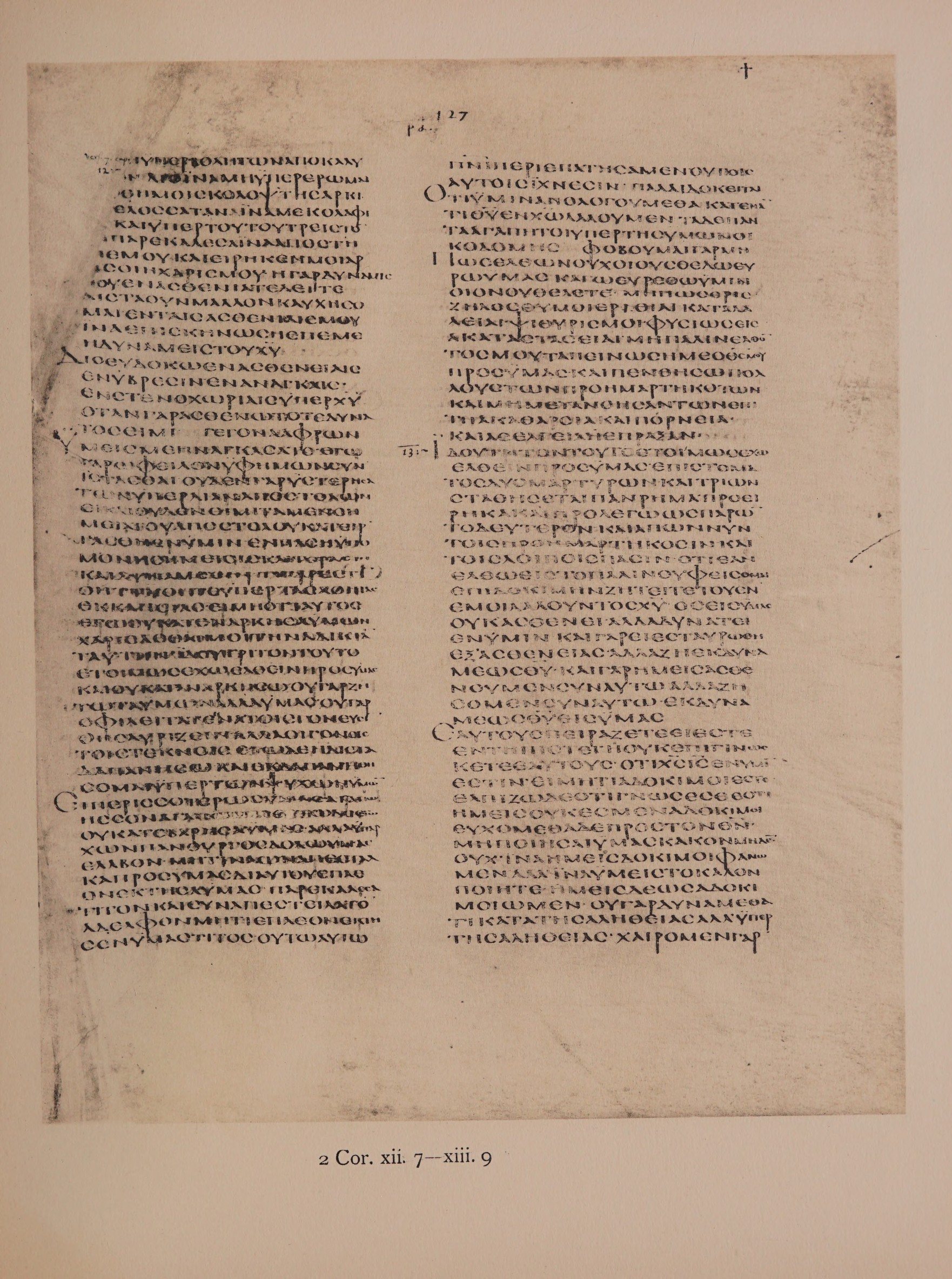
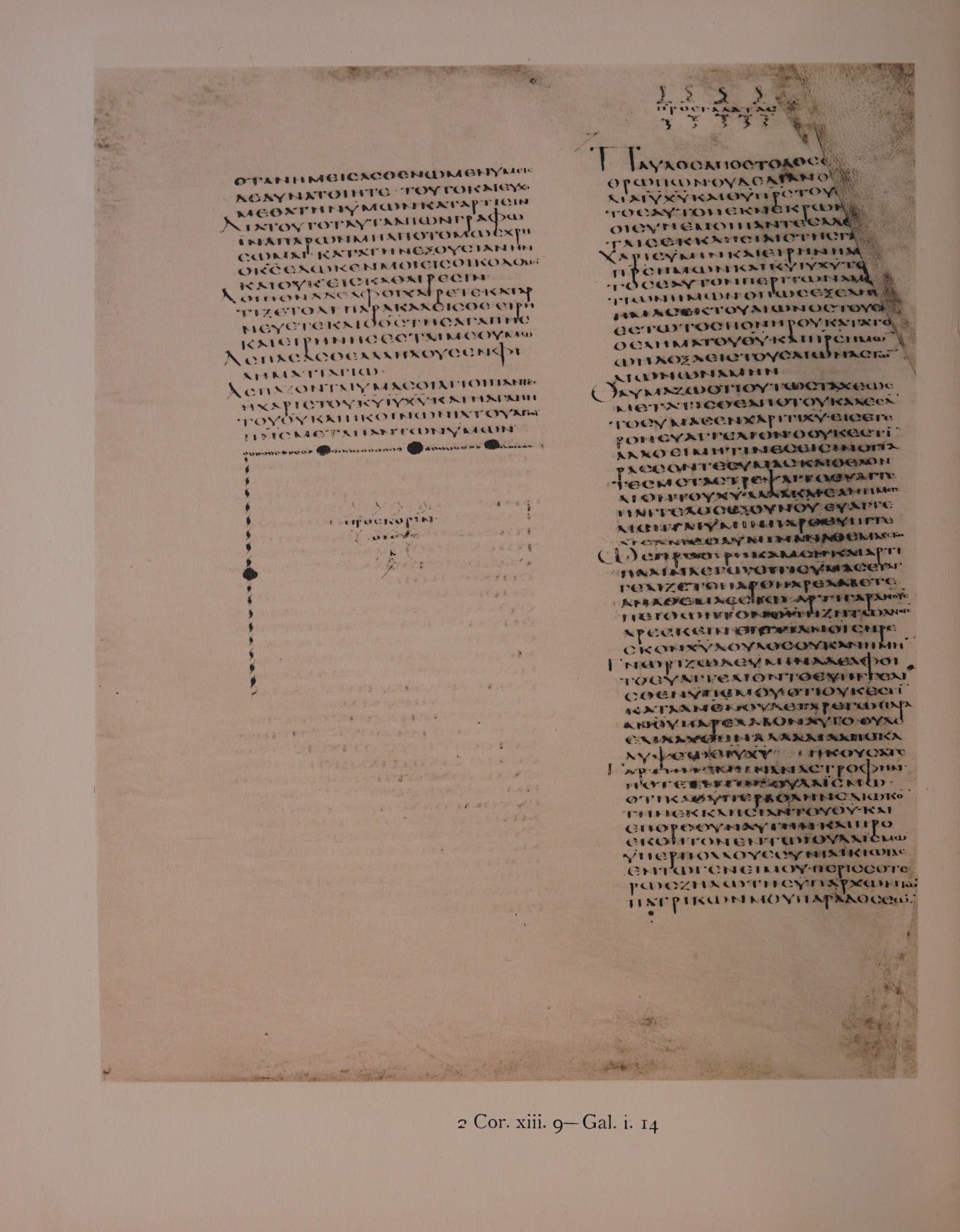
- Manuscript scan: the actual page(s) of Codex Alexandrinus containing this passage (folios 127r, 127v), reproduced from the British Museum's 1909 photographic facsimile edited by F. G. Kenyon, as digitised by the Getty Research Institute for the Internet Archive. The facsimile prints the verse range beneath each plate; that printed range was read for every page used and agrees with the INTF's NTVMR verse-level page index (CC BY 4.0). The page for each section now comes from the NTVMR transcription itself, which records the page and column on which every verse is written.
- Original text: the manuscript's own text, from a diplomatic transcription (see Greek text below), with Tischendorf's 8th critical edition (1869) for comparison.
- English translation: the King James Version (1611), retrieved verbatim from the public-domain bible-api.com endpoint.
Greek text: a diplomatic transcription of Codex Alexandrinus made by the Institut für Neutestamentliche Textforschung (INTF), Münster, for the New Testament Virtual Manuscript Room (NTVMR), published under a Creative Commons Attribution 4.0 licence. It gives the letters as the first scribe wrote them: no accents or breathings, the scribe's own spelling, and the sacred names in their contracted form (θς for θεος, ις for ιησους, κς for κυριος; the overline is not reproduced). Corrections by later hands are not shown. Letters in square brackets are not legible on the page and were restored by the transcribers, a dot under a letter marks an uncertain reading, and [...] marks text lost to damage. Beneath each section, for comparison, is Tischendorf's 8th critical edition (1869). Where the two differ, the transcription is what the manuscript says. Each section is shown with the page on which the transcription places its verses.
Numbering: The transcription and Tischendorf's comparison text (13 verses; the KJV has 14) both follow the standard Greek numbering (13:12-13); the KJV divides the same words as 13:12-14. Greek verse 13 is shown as KJV verse 14, and KJV verse 13 is part of Greek verse 12.
How was this verified? (Provenance)
Where on the image
Page from the NTVMR transcription (docID 20002): verses 1-9 on fol. 127r (facsimile leaf 215), col. 2; verse 9 continues on fol. 127v (facsimile leaf 216), col. 1 (which begins 'οταν ημεις ασθενωμεν').
1ιδου τριτον τουτο ετοιμως εχω ελθειν προς υμας · επι στοματος δυο μαρτυρων και τριων σταθησεται παν ρημα 2προειρηκα και προλεγω ως παρων το δευτερον · και απων νυν τοις προημαρτηκοσιν και τοις λοιποις πασιν · οτι εαν ελθω εις το παλιν ου φεισομαι 3επι δοκιμην ζητειτε του εν εμοι λαλουντος χυ · ος εις υμας ουκ ασθενει · αλλα δυνατει εν υμιν · 4και γαρ ει εσταυρωθη εξ ασθενειας · αλλα ζη εκ δυναμεως θυ · και γαρ ημεις ασθενουμεν συν αυτω · αλλα ζησομεν συν αυτω · εκ δυναμεως θυ εις υμας 5εαυτους πειραζετε ει εστε εν τη πιστει · η ουκ επιγινωσκετε εαυτους · οτι χς ις εν υμιν εστιν · ει μητι αδοκιμοι εστε · 6ελπιζω δε οτι γνωσεσθε οτι ημεις ουκ εσμεν αδοκιμοι 7ευχομεθα δε προς τον θν · μη ποιησαι υμας κακον μηδεν ουχ · ινα ημεις δοκιμοι φανωμεν αλλ ινα υμεις το καλον ποιητε · ημεις δε ως αδοκιμοι ωμεν · 8ου γαρ δυναμεθα τι κατα της αληθειας αλλ υπερ της αληθειας · 9χαιρομεν γαρ οταν ημεις ασθενωμεν υμεις δε δυνατοι ητε · τουτο και ευχομεθα την υμων καταρτισιν
Compare: Tischendorf 8th edition (1869)
1Τρίτον τοῦτο ἔρχομαι πρὸς ὑμᾶς· ἐπὶ στόματος δύο μαρτύρων καὶ τριῶν σταθήσεται πᾶν ῥῆμα. 2προείρηκα καὶ προλέγω ὡς παρὼν τὸ δεύτερον καὶ ἀπὼν νῦν τοῖς προημαρτηκόσιν καὶ τοῖς λοιποῖς πᾶσιν, ὅτι ἐὰν ἔλθω εἰς τὸ πάλιν οὐ φείσομαι, 3ἐπεὶ δοκιμὴν ζητεῖτε τοῦ ἐν ἐμοὶ λαλοῦντος Χριστοῦ· ὃς εἰς ὑμᾶς οὐκ ἀσθενεῖ ἀλλὰ δυνατεῖ ἐν ὑμῖν. 4καὶ γὰρ ἐσταυρώθη ἐξ ἀσθενείας, ἀλλὰ ζῇ ἐκ δυνάμεως θεοῦ. καὶ γὰρ ἡμεῖς ἀσθενοῦμεν ἐν αὐτῷ, ἀλλὰ ζήσομεν σὺν αὐτῷ ἐκ δυνάμεως θεοῦ εἰς ὑμᾶς. 5ἑαυτοὺς πειράζετε εἰ ἐστὲ ἐν τῇ πίστει, ἑαυτοὺς δοκιμάζετε· ἢ οὐκ ἐπιγινώσκετε ἑαυτοὺς ὅτι Χριστὸς Ἰησοῦς ἐν ὑμῖν; εἰ μήτι ἀδόκιμοί ἐστε. 6ἐλπίζω δὲ ὅτι γνώσεσθε ὅτι ἡμεῖς οὐκ ἐσμὲν ἀδόκιμοι. 7εὐχόμεθα δὲ πρὸς τὸν θεὸν μὴ ποιῆσαι ὑμᾶς κακὸν μηδέν, οὐχ ἵνα ἡμεῖς δόκιμοι φανῶμεν, ἀλλ’ ἵνα ὑμεῖς τὸ καλὸν ποιῆτε, ἡμεῖς δὲ ὡς ἀδόκιμοι ὦμεν. 8οὐ γὰρ δυνάμεθά τι κατὰ τῆς ἀληθείας, ἀλλὰ ὑπὲρ τῆς ἀληθείας. 9χαίρομεν γὰρ ὅταν ἡμεῖς ἀσθενῶμεν, ὑμεῖς δὲ δυνατοὶ ἦτε· τοῦτο καὶ εὐχόμεθα, τὴν ὑμῶν κατάρτισιν.
1This is the third time I am coming to you. In the mouth of two or three witnesses shall every word be established. 2I told you before, and foretell you, as if I were present, the second time; and being absent now I write to them which heretofore have sinned, and to all other, that, if I come again, I will not spare: 3Since ye seek a proof of Christ speaking in me, which to you-ward is not weak, but is mighty in you. 4For though he was crucified through weakness, yet he liveth by the power of God. For we also are weak in him, but we shall live with him by the power of God toward you. 5Examine yourselves, whether ye be in the faith; prove your own selves. Know ye not your own selves, how that Jesus Christ is in you, except ye be reprobates? 6But I trust that ye shall know that we are not reprobates. 7Now I pray to God that ye do no evil; not that we should appear approved, but that ye should do that which is honest, though we be as reprobates. 8For we can do nothing against the truth, but for the truth. 9For we are glad, when we are weak, and ye are strong: and this also we wish, even your perfection.
Where on the image
Page from the NTVMR transcription (docID 20002): verses 10-12, 14 on fol. 127v (facsimile leaf 216), col. 1. KJV verse 13 is part of the Greek verse before it.
10δια τουτο ταυτα απων γραφω ινα παρων μη αποτομως χρησωμαι · κατα την εξουσιαν ην ο κς εδωκεν μοι εις οικοδομην και ουκ εις καθαιρεσιν · 11λοιπον αδελφοι χαιρετε · καταρτιζετθαι · παρακαλεισθε · ειρηνευετε · και ο θς της αγαπης και ειρηνης εσται μεθ υμων · 12ασπασασθε αλληλους εν φιληματι αγιω · ασπαζονται υμας οι αγιοι παντες 13[these words are part of verse 12 in the Greek numbering] 14η χαρις του κυ ιυ χυ · και η αγαπη του θυ και η κοινωνια του αγιου πνς μετα παντων υμων ·
Compare: Tischendorf 8th edition (1869)
10διὰ τοῦτο ταῦτα ἀπὼν γράφω, ἵνα παρὼν μὴ ἀποτόμως χρήσωμαι κατὰ τὴν ἐξουσίαν ἣν ὁ κύριος ἔδωκέν μοι, εἰς οἰκοδομὴν καὶ οὐκ εἰς καθαίρεσιν. 11Λοιπόν, ἀδελφοί, χαίρετε, καταρτίζεσθε, παρακαλεῖσθε, τὸ αὐτὸ φρονεῖτε, εἰρηνεύετε, καὶ ὁ θεὸς τῆς ἀγάπης καὶ εἰρήνης ἔσται μεθ’ ὑμῶν. 12ἀσπάσασθε ἀλλήλους ἐν ἁγίῳ φιλήματι. ἀσπάζονται ὑμᾶς οἱ ἅγιοι πάντες. 13Ἡ χάρις τοῦ κυρίου Ἰησοῦ Χριστοῦ καὶ ἡ ἀγάπη τοῦ θεοῦ καὶ ἡ κοινωνία τοῦ ἁγίου πνεύματος μετὰ πάντων ὑμῶν.
10Therefore I write these things being absent, lest being present I should use sharpness, according to the power which the Lord hath given me to edification, and not to destruction. 11Finally, brethren, farewell. Be perfect, be of good comfort, be of one mind, live in peace; and the God of love and peace shall be with you. 12Greet one another with an holy kiss. 13All the saints salute you. 14The grace of the Lord Jesus Christ, and the love of God, and the communion of the Holy Ghost, be with you all. Amen.
Cite
Sources
- Source: Codex Alexandrinus page images + NTVMR transcription (CC BY 4.0) + Tischendorf 8th edition + KJV (holding institution)
- Critical edition: Codex Alexandrinus transcription, NTVMR (INTF Münster, CC BY 4.0); Tischendorf 8th edition for comparison
← previous · → next · v cycle view · l back to library