2 Corinthians, Chapter 12 (Codex Alexandrinus)
Introduction
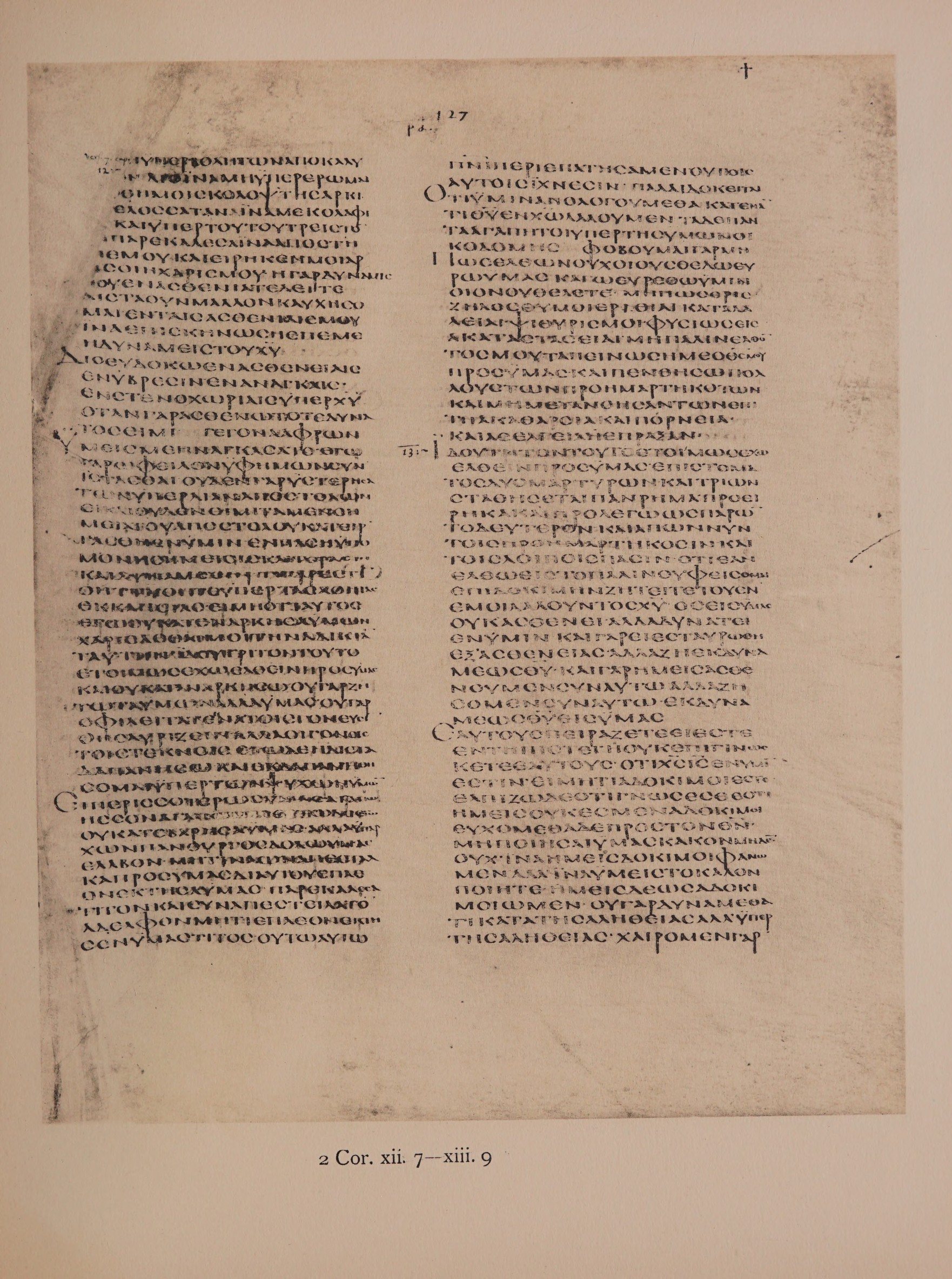
2 Corinthians 12 from Codex Alexandrinus (GA 02), a fifth-century Greek Bible held by the British Library (Royal MS 1 D. VIII). In the New Testament it is the chief witness to the Byzantine text in the Gospels and to the Alexandrian text in the rest of the New Testament. Its New Testament volume lacks Matthew 1:1-25:5, John 6:50-8:52 and 2 Corinthians 4:13-12:6.
Lacuna: verses 1-6 of this chapter are not extant in Codex Alexandrinus (the leaves are lost); only the verses that survive on the pages shown are published here.
This entry meets the strict three-criteria standard of the Theosis Library:
- Manuscript scan: the actual page(s) of Codex Alexandrinus containing this passage (folio 127r), reproduced from the British Museum's 1909 photographic facsimile edited by F. G. Kenyon, as digitised by the Getty Research Institute for the Internet Archive. The facsimile prints the verse range beneath each plate; that printed range was read for every page used and agrees with the INTF's NTVMR verse-level page index (CC BY 4.0). The page for each section now comes from the NTVMR transcription itself, which records the page and column on which every verse is written.
- Original text: the manuscript's own text, from a diplomatic transcription (see Greek text below), with Tischendorf's 8th critical edition (1869) for comparison.
- English translation: the King James Version (1611), retrieved verbatim from the public-domain bible-api.com endpoint.
Greek text: a diplomatic transcription of Codex Alexandrinus made by the Institut für Neutestamentliche Textforschung (INTF), Münster, for the New Testament Virtual Manuscript Room (NTVMR), published under a Creative Commons Attribution 4.0 licence. It gives the letters as the first scribe wrote them: no accents or breathings, the scribe's own spelling, and the sacred names in their contracted form (θς for θεος, ις for ιησους, κς for κυριος; the overline is not reproduced). Corrections by later hands are not shown. Letters in square brackets are not legible on the page and were restored by the transcribers, a dot under a letter marks an uncertain reading, and [...] marks text lost to damage. Beneath each section, for comparison, is Tischendorf's 8th critical edition (1869). Where the two differ, the transcription is what the manuscript says. Each section is shown with the page on which the transcription places its verses.
How was this verified? (Provenance)
Where on the image
Page from the NTVMR transcription (docID 20002): verses 7-18 on fol. 127r (facsimile leaf 215), col. 1.
7[και] [τ]η̣ υπερβολη των αποκαλυ[ψεω]ν διο ινα μη υπερερωμαι [εδο]θη μοι σκολοψ τη σαρκι · [αγγ]ελος σατανα ινα με κολαφι[ζη] 8και υπερ τουτου τρεις τον [κ]ν παρεκαλεσα ινα αποστη [α]π̣ εμου 9και ειρηκεν μοι αρ[κε]ι σοι η χαρις μου · η γαρ δυναμις εν ασθενια τελειτε [η]διστα ουν μαλλον καυχησομαι · εν ταις ασθενιαις μου ινα επισκηνωση επ εμε η δυναμεις του χυ 10διο ευδοκω εν ασθενειαις εν υβρεσιν εν αναγκαις · εν στενοχωριαις υπερ χυ οταν γαρ ασθενω τοτε δυνατος ειμι · 11γεγονα αφρων υμεις με ηναγκασατε · εγω γαρ ωφειλον υφ ημων συνιστασθαι · ουδεν γαρ υστερησα των υπερλιαν αποστολων ει και ουδεν ειμι 12τα μεν σημεια του αποστολου κατειργασθη εν υμιν εν παση υπομονη σημειοις και τερασιν και δυναμεσιν · 13τι γαρ εστιν ο ηττηθητε υπερ τας λοιπας εκκλησιας · ει μη οτι αυτος εγω ου κατεναρκησα υμων χαρισασθαι μοι την αδικιαν ταυτην · 14ιδου τριτον τουτο ετοιμως εχω ελθειν προς υμας και ου καταναρκησω · ου γαρ ζητω τα υμων αλλα υμας · ου γαρ οφιλει τα τενα τοις γονευσιν θησαυριζειν · αλλα οι γονεις τοις τεκνοις 15εγω δε ηδιστα δαπανησω και εκδαπανηθησομαι υπερ των ψυχων υμων ει περισσοτερως υμας αγαπω ησσον αγαπωμαι 16εσ̣τω δε εγω ου κατεβαρησα υμας · αλλα υπαρχων πανουργος δολω υμας ελαβον · 17μη τινα ων απεσταλκα προς υμας δι αυτου επλεονεκτησα υμας 18παρεκαλεσα τιτον και συναπεστειλα τον αδελφον μητι επλεονεκτησεν υμας τιτος · ου τω αυτω πνι περιεπατησαμεν ου τοις αυτοις ιχνεσιν ·
Compare: Tischendorf 8th edition (1869)
7καὶ τῇ ὑπερβολῇ τῶν ἀποκαλύψεων ἵνα μὴ ὑπεραίρωμαι, ἐδόθη μοι σκόλοψ τῇ σαρκί, ἄγγελος σατανᾶ, ἵνα με κολαφίζῃ, ἵνα μὴ ὑπεραίρωμαι. 8ὑπὲρ τούτου τρὶς τὸν κύριον παρεκάλεσα ἵνα ἀποστῇ ἀπ’ ἐμοῦ· 9καὶ εἴρηκέν μοι, ἀρκεῖ σοι ἡ χάρις μου· ἡ γὰρ δύναμις ἐν ἀσθενείᾳ τελεῖται. ἥδιστα οὖν μᾶλλον καυχήσομαι ἐν ταῖς ἀσθενείαις μου, ἵνα ἐπισκηνώσῃ ἐπ’ ἐμὲ ἡ δύναμις τοῦ Χριστοῦ. 10διὸ εὐδοκῶ ἐν ἀσθενείαις, ἐν ὕβρεσιν, ἐν ἀνάγκαις, ἐν διωγμοῖς καὶ στενοχωρίαις, ὑπὲρ Χριστοῦ· ὅταν γὰρ ἀσθενῶ, τότε δυνατός εἰμι. 11Γέγονα ἄφρων· ὑμεῖς με ἠναγκάσατε. ἐγὼ γὰρ ὤφειλον ὑφ’ ὑμῶν συνίστασθαι· οὐδὲν γὰρ ὑστέρησα τῶν ὑπερλίαν ἀποστόλων, εἰ καὶ οὐδέν εἰμι. 12τὰ μὲν σημεῖα τοῦ ἀποστόλου κατειργάσθη ἐν ὑμῖν ἐν πάσῃ ὑπομονῇ, σημείοις τε καὶ τέρασιν καὶ δυνάμεσιν. 13τί γάρ ἐστιν ὃ ἡσσώθητε ὑπὲρ τὰς λοιπὰς ἐκκλησίας, εἰ μὴ ὅτι αὐτὸς ἐγὼ οὐ κατενάρκησα ὑμῶν; χαρίσασθέ μοι τὴν ἀδικίαν ταύτην. 14ἰδοὺ τρίτον τοῦτο ἑτοίμως ἔχω ἐλθεῖν πρὸς ὑμᾶς, καὶ οὐ καταναρκήσω· οὐ γὰρ ζητῶ τὰ ὑμῶν ἀλλὰ ὑμᾶς, οὐ γὰρ ὀφείλει τὰ τέκνα τοῖς γονεῦσιν θησαυρίζειν, ἀλλὰ οἱ γονεῖς τοῖς τέκνοις. 15ἐγὼ δὲ ἥδιστα δαπανήσω καὶ ἐκδαπανηθήσομαι ὑπὲρ τῶν ψυχῶν ὑμῶν. εἰ περισσοτέρως ὑμᾶς ἀγαπῶ, ἧττον ἀγαπῶμαι; 16Ἔστω δέ, ἐγὼ οὐ κατεβάρησα ὑμᾶς· ἀλλὰ ὑπάρχων πανοῦργος δόλῳ ὑμᾶς ἔλαβον. 17μή τινα ὧν ἀπέσταλκα πρὸς ὑμᾶς, δι’ αὐτοῦ ἐπλεονέκτησα ὑμᾶς; 18παρεκάλεσα Τίτον καὶ συναπέστειλα τὸν ἀδελφόν· μήτι ἐπλεονέκτησεν ὑμᾶς Τίτος; οὐ τῷ αὐτῷ πνεύματι περιεπατήσαμεν; οὐ τοῖς αὐτοῖς ἴχνεσιν;
7And lest I should be exalted above measure through the abundance of the revelations, there was given to me a thorn in the flesh, the messenger of Satan to buffet me, lest I should be exalted above measure. 8For this thing I besought the Lord thrice, that it might depart from me. 9And he said unto me, My grace is sufficient for thee: for my strength is made perfect in weakness. Most gladly therefore will I rather glory in my infirmities, that the power of Christ may rest upon me. 10Therefore I take pleasure in infirmities, in reproaches, in necessities, in persecutions, in distresses for Christ’s sake: for when I am weak, then am I strong. 11I am become a fool in glorying; ye have compelled me: for I ought to have been commended of you: for in nothing am I behind the very chiefest apostles, though I be nothing. 12Truly the signs of an apostle were wrought among you in all patience, in signs, and wonders, and mighty deeds. 13For what is it wherein ye were inferior to other churches, except it be that I myself was not burdensome to you? forgive me this wrong. 14Behold, the third time I am ready to come to you; and I will not be burdensome to you: for I seek not yours, but you: for the children ought not to lay up for the parents, but the parents for the children. 15And I will very gladly spend and be spent for you; though the more abundantly I love you, the less I be loved. 16But be it so, I did not burden you: nevertheless, being crafty, I caught you with guile. 17Did I make a gain of you by any of them whom I sent unto you? 18I desired Titus, and with him I sent a brother. Did Titus make a gain of you? walked we not in the same spirit? walked we not in the same steps?
Where on the image
Page from the NTVMR transcription (docID 20002): verses 19-21 on fol. 127r (facsimile leaf 215), col. 2.
19παλαι δοκειται οτι υμιν απολογουμεθα κατεναντι θυ εν χω λαλουμεν τα δε παντα αγαπητοι υπερ της υμων οικοδομης 20φοβουμαι γαρ μη πως ελθων ουχ οιους θελω ευρω υμας · καγω ευρεθω υμιν οιον ου θελετε · μη πως ερις ζηλος θυμοι ερε̣ι̣θιαι καταλαλειαι ψιθυρισμοι · φυσιωσεις ακαταστασειαι · 21μη παλιν ελθοντος μου ταπεινωση με ο θς μου προς υμας · και πενθησω πολλους των προημαρτηκοτων και μη μετανοησαντων επι τη ακαθαρσια και πορνεια · και ασελγεια η επραξαν ·
Compare: Tischendorf 8th edition (1869)
19Πάλαι δοκεῖτε ὅτι ὑμῖν ἀπολογούμεθα; κατέναντι θεοῦ ἐν Χριστῷ λαλοῦμεν· τὰ δὲ πάντα, ἀγαπητοί, ὑπὲρ τῆς ὑμῶν οἰκοδομῆς. 20φοβοῦμαι γὰρ μήπως ἐλθὼν οὐχ οἵους θέλω εὕρω ὑμᾶς κἀγὼ εὑρεθῶ ὑμῖν οἷον οὐ θέλετε, μήπως ἔρις, ζῆλος, θυμοί, ἐριθείαι, καταλαλιαί, ψιθυρισμοί, φυσιώσεις, ἀκαταστασίαι· 21μὴ πάλιν ἐλθόντος μου ταπεινώσει με ὁ θεός μου πρὸς ὑμᾶς, καὶ πενθήσω πολλοὺς τῶν προημαρτηκότων καὶ μὴ μετανοησάντων ἐπὶ τῇ ἀκαθαρσίᾳ καὶ πορνείᾳ καὶ ἀσελγείᾳ ᾗ ἔπραξαν.
19Again, think ye that we excuse ourselves unto you? we speak before God in Christ: but we do all things, dearly beloved, for your edifying. 20For I fear, lest, when I come, I shall not find you such as I would, and that I shall be found unto you such as ye would not: lest there be debates, envyings, wraths, strifes, backbitings, whisperings, swellings, tumults: 21And lest, when I come again, my God will humble me among you, and that I shall bewail many which have sinned already, and have not repented of the uncleanness and fornication and lasciviousness which they have committed.
Cite
Sources
- Source: Codex Alexandrinus page images + NTVMR transcription (CC BY 4.0) + Tischendorf 8th edition + KJV (holding institution)
- Critical edition: Codex Alexandrinus transcription, NTVMR (INTF Münster, CC BY 4.0); Tischendorf 8th edition for comparison
← previous · → next · v cycle view · l back to library