2 Timothy, Chapter 2 (Codex Alexandrinus)
Introduction
2 Timothy 2 from Codex Alexandrinus (GA 02), a fifth-century Greek Bible held by the British Library (Royal MS 1 D. VIII). In the New Testament it is the chief witness to the Byzantine text in the Gospels and to the Alexandrian text in the rest of the New Testament. Its New Testament volume lacks Matthew 1:1-25:5, John 6:50-8:52 and 2 Corinthians 4:13-12:6.
This entry meets the strict three-criteria standard of the Theosis Library:
- Manuscript scan: the actual page(s) of Codex Alexandrinus containing this passage (folios 146v, 147r), reproduced from the British Museum's 1909 photographic facsimile edited by F. G. Kenyon, as digitised by the Getty Research Institute for the Internet Archive. The facsimile prints the verse range beneath each plate; that printed range was read for every page used and agrees with the INTF's NTVMR verse-level page index (CC BY 4.0). The page for each section now comes from the NTVMR transcription itself, which records the page and column on which every verse is written.
- Original text: the manuscript's own text, from a diplomatic transcription (see Greek text below), with Tischendorf's 8th critical edition (1869) for comparison.
- English translation: the King James Version (1611), retrieved verbatim from the public-domain bible-api.com endpoint.
Greek text: a diplomatic transcription of Codex Alexandrinus made by the Institut für Neutestamentliche Textforschung (INTF), Münster, for the New Testament Virtual Manuscript Room (NTVMR), published under a Creative Commons Attribution 4.0 licence. It gives the letters as the first scribe wrote them: no accents or breathings, the scribe's own spelling, and the sacred names in their contracted form (θς for θεος, ις for ιησους, κς for κυριος; the overline is not reproduced). Corrections by later hands are not shown. Letters in square brackets are not legible on the page and were restored by the transcribers, a dot under a letter marks an uncertain reading, and [...] marks text lost to damage. Beneath each section, for comparison, is Tischendorf's 8th critical edition (1869). Where the two differ, the transcription is what the manuscript says. Each section is shown with the page on which the transcription places its verses.
How was this verified? (Provenance)
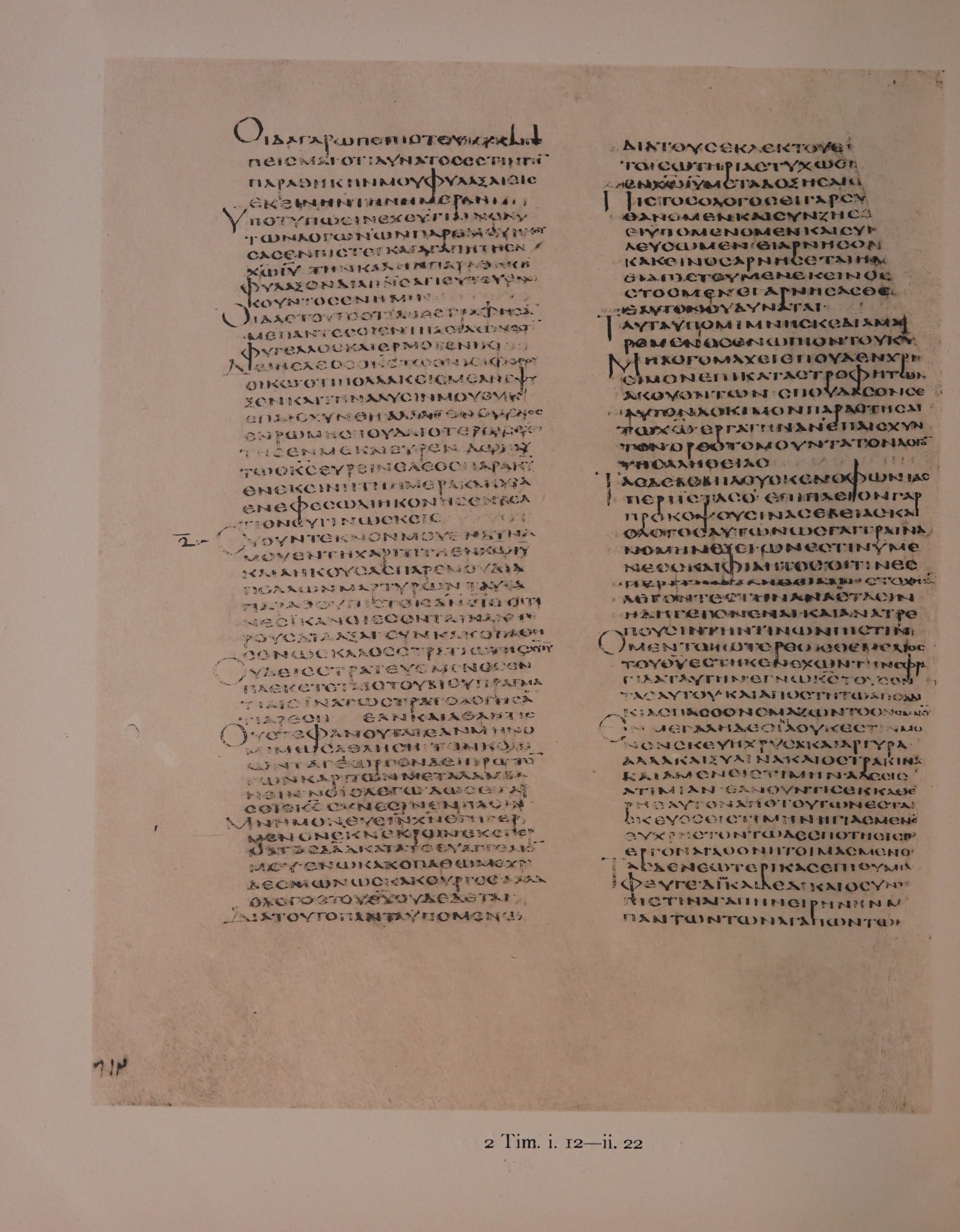
Where on the image
Page from the NTVMR transcription (docID 20002): verses 1-10 on fol. 146v (facsimile leaf 256), col. 1.
1συ ουν τεκνον μου ενδυναμου εν τη χαριτι τη εν χω ιυ 2και α ηκουσας παρ εμου δια πολλων μαρτυρων ταυτ̣α παραθου πιστοις ανοις οιτινες ικανοι εσονται και ετερους διδαξαι · 3συνκακοπαθησον ως καλος στρατιωτης χυ ιυ 4ουδεις στρατευομενος ενπλεκετε ταις του βιου πραγματιαις ινα τω στρατολογησαντι αρεση · 5εαν και αθλη τις ου στεφανουται εαν μη νομιμως αθληση · 6τον κοπιωντα γεωργον δει πρω̣τον των καρπων μεταλαμβανειν · 7νοι ο λεγω · δωσει γαρ σοι ο κς συνεσιν εν πασιν 8μνημονευε ιν χν εγηγερμενον εκ νεκρων εκ σπερμ̣ατος δαδ κατα το ευαγγελιον μου · 9εν ω κακοπαθω μεχρι δεσμων ως κακουργος · αλλα ο λογος του θυ ου δεδεται · 10δια τουτο παντα υπομενω δια τους εκλεκτους ι̣[να] [και] [αυ]τοι σωτηριας τυχωσι[ν] [της] εν χω ιυ μετα δοξης αιω̣[νιου]
Compare: Tischendorf 8th edition (1869)
1Σὺ οὖν, τέκνον μου, ἐνδυναμοῦ ἐν τῇ χάριτι τῇ ἐν Χριστῷ Ἰησοῦ, 2καὶ ἃ ἤκουσας παρ’ ἐμοῦ διὰ πολλῶν μαρτύρων, ταῦτα παράθου πιστοῖς ἀνθρώποις, οἵτινες ἱκανοὶ ἔσονται καὶ ἑτέρους διδάξαι. 3συνκακοπάθησον ὡς καλὸς στρατιώτης Χριστοῦ Ἰησοῦ. 4οὐδεὶς στρατευόμενος ἐμπλέκεται ταῖς τοῦ βίου πραγματείαις, ἵνα τῷ στρατολογήσαντι ἀρέσῃ· 5ἐὰν δὲ καὶ ἀθλῇ τις, οὐ στεφανοῦται ἐὰν μὴ νομίμως ἀθλήσῃ. 6τὸν κοπιῶντα γεωργὸν δεῖ πρῶτον τῶν καρπῶν μεταλαμβάνειν. 7νόει ὃ λέγω· δώσει γάρ σοι ὁ κύριος σύνεσιν ἐν πᾶσιν. 8Μνημόνευε Ἰησοῦν Χριστὸν ἐγηγερμένον ἐκ νεκρῶν, ἐκ σπέρματος Δαυείδ, κατὰ τὸ εὐαγγέλιόν μου· 9ἐν ᾧ κακοπαθῶ μέχρι δεσμῶν ὡς κακοῦργος, ἀλλὰ ὁ λόγος τοῦ θεοῦ οὐ δέδεται. 10διὰ τοῦτο πάντα ὑπομένω διὰ τοὺς ἐκλεκτούς, ἵνα καὶ αὐτοὶ σωτηρίας τύχωσιν τῆς ἐν Χριστῷ Ἰησοῦ μετὰ δόξης αἰωνίου.
1Thou therefore, my son, be strong in the grace that is in Christ Jesus. 2And the things that thou hast heard of me among many witnesses, the same commit thou to faithful men, who shall be able to teach others also. 3Thou therefore endure hardness, as a good soldier of Jesus Christ. 4No man that warreth entangleth himself with the affairs of this life; that he may please him who hath chosen him to be a soldier. 5And if a man also strive for masteries, yet is he not crowned, except he strive lawfully. 6The husbandman that laboureth must be first partaker of the fruits. 7Consider what I say; and the Lord give thee understanding in all things. 8Remember that Jesus Christ of the seed of David was raised from the dead according to my gospel: 9Wherein I suffer trouble, as an evil doer, even unto bonds; but the word of God is not bound. 10Therefore I endure all things for the elect’s sakes, that they may also obtain the salvation which is in Christ Jesus with eternal glory.
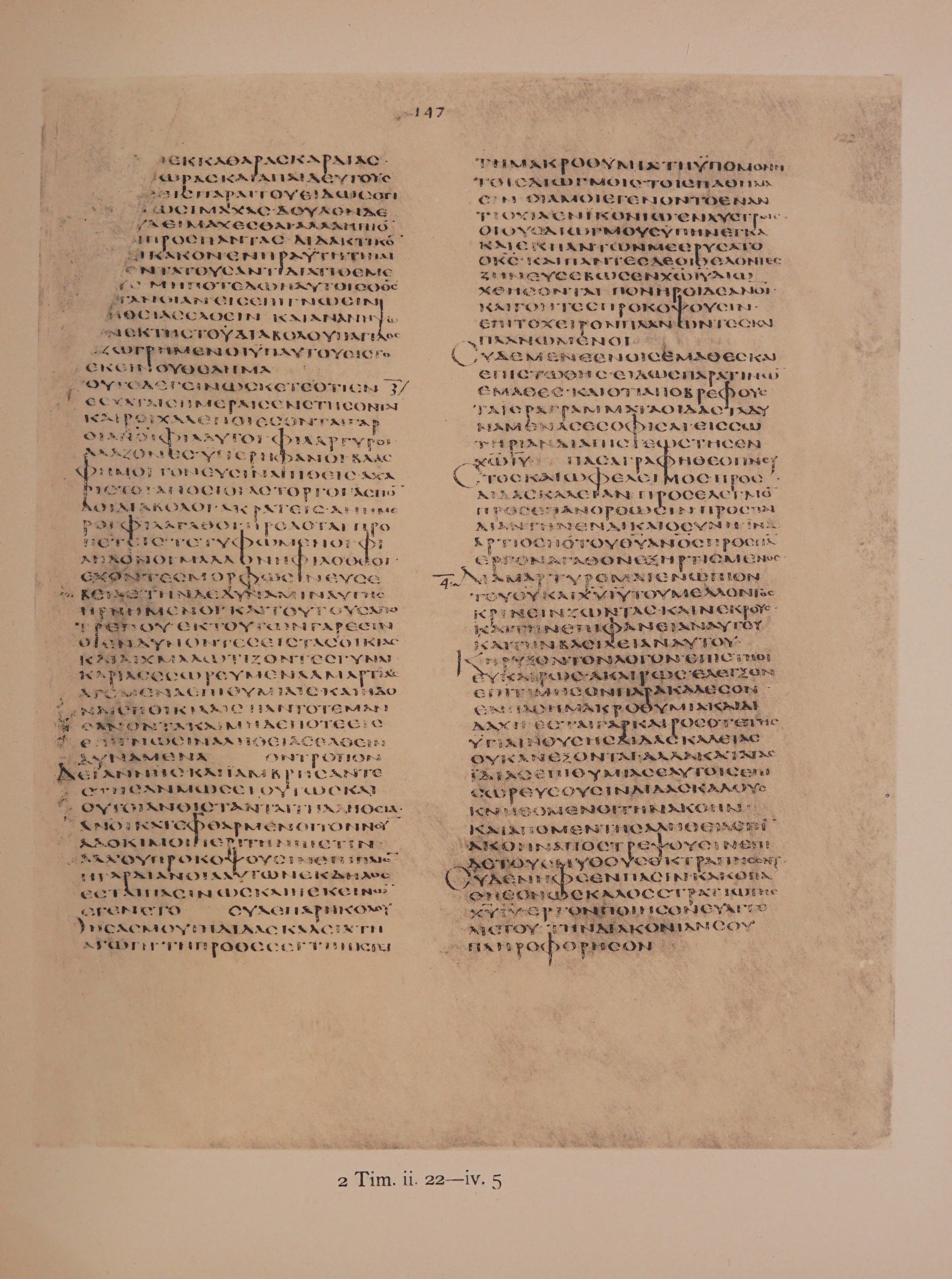
Where on the image
Page from the NTVMR transcription (docID 20002): verses 11-22 on fol. 146v (facsimile leaf 256), col. 2; verse 22 continues on fol. 147r (facsimile leaf 257), col. 1 (which begins '[τον] [κν] εκ').
11πιστος ο λογος ει γαρ συ[ναπε]θανομεν και συνζησο̣[μεν] 12ει υπομενομεν και συν̣[βασι]λευσωμεν · ει αρνησομ̣[εθα] κακεινος αρνησεται ημ̣[ας] 13ει απιστουμεν εκεινος [πι]στος μενει · αρνησασθε γ̣[αρ] εαυτον ου δυναται · 14ταυτα υπομιμνησκε διαμαρ̣[τυ]ρομενος ενωπιον του κυ μη λογομαχει επ ουδεν χρησιμον επι καταστροφη των ακουοντων · 15σπουδασον σεαυτον δοκιμον παραστησαι τω χω · εργατην ανεπαισχυντον · ορθοτομουντα τον λογον της αληθειας 16τας δε βεβηλους κενοφωνιας περιιστασο · επι πλειον γαρ προκοψουσιν ασεβειας · 17και ο λογος αυτων ως γαγγραινα νομην εξει · ων εστιν υμενεος και φιλητος · 18οιτινες περι την αληθειαν η̣στοχησ̣αν λεγοντες την αναστασιν ηδη γεγονεναι · και ανατρεπουσιν την τινων πιστιν 19ο μεν τοις στερεοις θεμελιος του θυ εστηκεν εχων την σφραγιδα ταυτην · εγνω κς τους οντας αυτου · και αποστητω απο αδικιας πας ο ονομαζων το ονομα κυ 20εν μεγαλη δε οια ουκ εστιν μονον σκευη χρυσα · και αργυρα αλλα και ξυλινα · και οστρακινα και α μεν εις τιμην · α δε εις ατιμιαν · 21εαν ουν τις εκκαθερη εαυτον απο τουτων εσται σκευος εις τιμην ηγιασμενον̣ ευχρηστον τω δεσποτη εις πα[ν] εργον αγαθον ητοιμασμενο[ν] 22τας δε νεωτερικας επιθυμια[ς] φευγε · δικαι δε δικαιοσυνη[ν] πιστιν αγαπην ειρηνην μ[ετα] παντων των αγαπωντων̣ [τον] [κν] εκ καθαρας καρδιας
Compare: Tischendorf 8th edition (1869)
11Πιστὸς ὁ λόγος· εἰ γὰρ συναπεθάνομεν, καὶ συζήσομεν· 12εἰ ὑπομένομεν, καὶ συμβασιλεύσομεν· εἰ ἀρνησόμεθα, κἀκεῖνος ἀρνήσεται ἡμᾶς· 13εἰ ἀπιστοῦμεν, ἐκεῖνος πιστὸς μένει, ἀρνήσασθαι γὰρ ἑαυτὸν οὐ δύναται. 14Ταῦτα ὑπομίμνῃσκε, διαμαρτυρόμενος ἐνώπιον τοῦ θεοῦ μὴ λογομαχεῖν, ἐπ’ οὐδὲν χρήσιμον, ἐπὶ καταστροφῇ τῶν ἀκουόντων. 15σπούδασον σεαυτὸν δόκιμον παραστῆσαι τῷ θεῷ, ἐργάτην ἀνεπαίσχυντον, ὀρθοτομοῦντα τὸν λόγον τῆς ἀληθείας. 16τὰς δὲ βεβήλους κενοφωνίας περιΐστασο· ἐπὶ πλεῖον γὰρ προκόψουσιν ἀσεβείας, 17καὶ ὁ λόγος αὐτῶν ὡς γάγγραινα νομὴν ἕξει· ὧν ἐστιν Ὑμέναιος καὶ Φίλητος, 18οἵτινες περὶ τὴν ἀλήθειαν ἠστόχησαν, λέγοντες ἀνάστασιν ἤδη γεγονέναι, καὶ ἀνατρέπουσιν τήν τινων πίστιν. 19ὁ μέντοι στερεὸς θεμέλιος τοῦ θεοῦ ἕστηκεν, ἔχων τὴν σφραγῖδα ταύτην· ἔγνω κύριος τοὺς ὄντας αὐτοῦ, καί, ἀποστήτω ἀπὸ ἀδικίας πᾶς ὁ ὀνομάζων τὸ ὄνομα κυρίου. 20ἐν μεγάλῃ δὲ οἰκίᾳ οὐκ ἔστιν μόνον σκεύη χρυσᾶ καὶ ἀργυρᾶ ἀλλὰ καὶ ξύλινα καὶ ὀστράκινα, καὶ ἃ μὲν εἰς τιμὴν ἃ δὲ εἰς ἀτιμίαν· 21ἐὰν οὖν τις ἐκκαθάρῃ ἑαυτὸν ἀπὸ τούτων, ἔσται σκεῦος εἰς τιμήν, ἡγιασμένον, εὔχρηστον τῷ δεσπότῃ, εἰς πᾶν ἔργον ἀγαθὸν ἡτοιμασμένον. 22τὰς δὲ νεωτερικὰς ἐπιθυμίας φεῦγε, δίωκε δὲ δικαιοσύνην, πίστιν, ἀγάπην, εἰρήνην μετὰ τῶν ἐπικαλουμένων τὸν κύριον ἐκ καθαρᾶς καρδίας.
11It is a faithful saying: For if we be dead with him, we shall also live with him: 12If we suffer, we shall also reign with him: if we deny him, he also will deny us: 13If we believe not, yet he abideth faithful: he cannot deny himself. 14Of these things put them in remembrance, charging them before the Lord that they strive not about words to no profit, but to the subverting of the hearers. 15Study to shew thyself approved unto God, a workman that needeth not to be ashamed, rightly dividing the word of truth. 16But shun profane and vain babblings: for they will increase unto more ungodliness. 17And their word will eat as doth a canker: of whom is Hymenaeus and Philetus; 18Who concerning the truth have erred, saying that the resurrection is past already; and overthrow the faith of some. 19Nevertheless the foundation of God standeth sure, having this seal, The Lord knoweth them that are his. And, Let every one that nameth the name of Christ depart from iniquity. 20But in a great house there are not only vessels of gold and of silver, but also of wood and of earth; and some to honour, and some to dishonour. 21If a man therefore purge himself from these, he shall be a vessel unto honour, sanctified, and meet for the master’s use, and prepared unto every good work. 22Flee also youthful lusts: but follow righteousness, faith, charity, peace, with them that call on the Lord out of a pure heart.
Where on the image
Page from the NTVMR transcription (docID 20002): verses 23-26 on fol. 147r (facsimile leaf 257), col. 1.
23[τας] [δε] [μ]ωρας και απαιδευτους [ζητησ]εις παραιτου ειδως οτι [γενν]ωσι μαχας · 24δουλον δε [κυ] [ο]υ̣ δει μαχεσθαι · αλλα ηπιον [εινα]ι προς παντας · διδακτικον [ανεξ]ικακον · 25εν πραυτητι παι[δευ]οντα τους αντιδιατιθεμε[νο]υ̣ς · μηποτε δωη αυτοις ο θς [με]τανοιαν · εις επιγνωσιν [αλ]ηθειας ελθειν · 26και αν[...]ν εκ της του διαβολου παγιδος ε̣ζωγρημενοι υπ αυτου εις το εκεινου θελημα ·
Compare: Tischendorf 8th edition (1869)
23τὰς δὲ μωρὰς καὶ ἀπαιδεύτους ζητήσεις παραιτοῦ, εἰδὼς ὅτι γεννῶσιν μάχας· 24δοῦλον δὲ κυρίου οὐ δεῖ μάχεσθαι, ἀλλὰ ἤπιον εἶναι πρὸς πάντας, διδακτικόν, ἀνεξίκακον, 25ἐν πραΰτητι παιδεύοντα τοὺς ἀντιδιατιθεμένους, μήποτε δώῃ αὐτοῖς ὁ θεὸς μετάνοιαν εἰς ἐπίγνωσιν ἀληθείας, 26καὶ ἀνανήψωσιν ἐκ τῆς τοῦ διαβόλου παγίδος, ἐζωγρημένοι ὑπ’ αὐτοῦ εἰς τὸ ἐκείνου θέλημα.
23But foolish and unlearned questions avoid, knowing that they do gender strifes. 24And the servant of the Lord must not strive; but be gentle unto all men, apt to teach, patient, 25In meekness instructing those that oppose themselves; if God peradventure will give them repentance to the acknowledging of the truth; 26And that they may recover themselves out of the snare of the devil, who are taken captive by him at his will.
Cite
Sources
- Source: Codex Alexandrinus page images + NTVMR transcription (CC BY 4.0) + Tischendorf 8th edition + KJV (holding institution)
- Critical edition: Codex Alexandrinus transcription, NTVMR (INTF Münster, CC BY 4.0); Tischendorf 8th edition for comparison
← previous · → next · v cycle view · l back to library