3 John, Chapter 1 (Codex Alexandrinus)
Introduction
3 John 1 from Codex Alexandrinus (GA 02), a fifth-century Greek Bible held by the British Library (Royal MS 1 D. VIII). In the New Testament it is the chief witness to the Byzantine text in the Gospels and to the Alexandrian text in the rest of the New Testament. Its New Testament volume lacks Matthew 1:1-25:5, John 6:50-8:52 and 2 Corinthians 4:13-12:6.
This entry meets the strict three-criteria standard of the Theosis Library:
- Manuscript scan: the actual page(s) of Codex Alexandrinus containing this passage (folio 110r), reproduced from the British Museum's 1909 photographic facsimile edited by F. G. Kenyon, as digitised by the Getty Research Institute for the Internet Archive. The facsimile prints the verse range beneath each plate; that printed range was read for every page used and agrees with the INTF's NTVMR verse-level page index (CC BY 4.0). The page for each section now comes from the NTVMR transcription itself, which records the page and column on which every verse is written.
- Original text: the manuscript's own text, from a diplomatic transcription (see Greek text below), with Tischendorf's 8th critical edition (1869) for comparison.
- English translation: the King James Version (1611), retrieved verbatim from the public-domain bible-api.com endpoint.
Greek text: a diplomatic transcription of Codex Alexandrinus made by the Institut für Neutestamentliche Textforschung (INTF), Münster, for the New Testament Virtual Manuscript Room (NTVMR), published under a Creative Commons Attribution 4.0 licence. It gives the letters as the first scribe wrote them: no accents or breathings, the scribe's own spelling, and the sacred names in their contracted form (θς for θεος, ις for ιησους, κς for κυριος; the overline is not reproduced). Corrections by later hands are not shown. Letters in square brackets are not legible on the page and were restored by the transcribers, a dot under a letter marks an uncertain reading, and [...] marks text lost to damage. Beneath each section, for comparison, is Tischendorf's 8th critical edition (1869). Where the two differ, the transcription is what the manuscript says. Each section is shown with the page on which the transcription places its verses.
Numbering: The transcription and Tischendorf's comparison text (15 verses; the KJV has 14) both follow the standard Greek numbering, which divides the KJV's verse 14 into verses 14 and 15; both are shown under verse 14.
How was this verified? (Provenance)
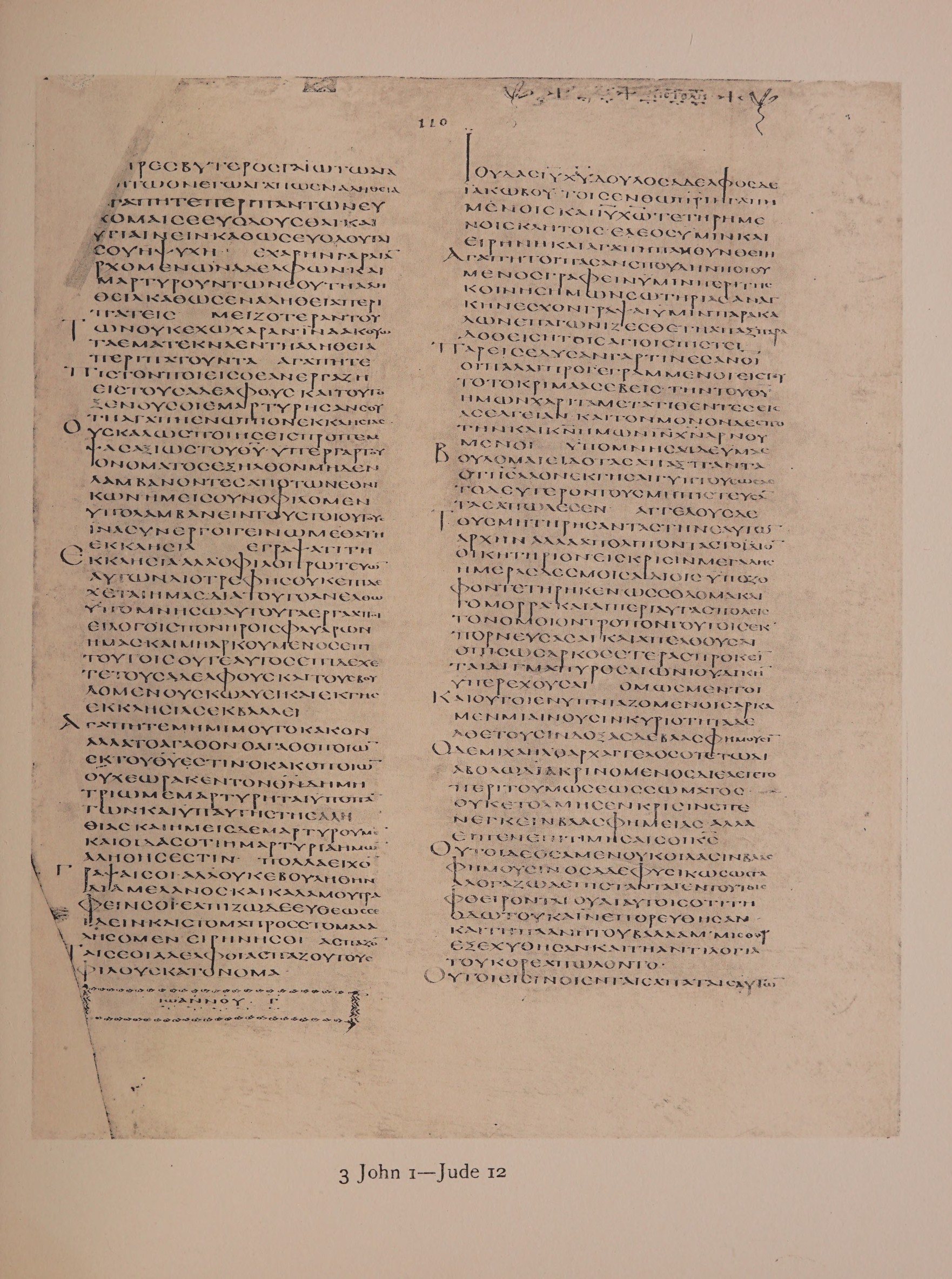
Where on the image
Page from the NTVMR transcription (docID 20002): verses 1-7 on fol. 110r (facsimile leaf 181), col. 1.
1[...] π̣ρεσβυτερος γαιω τω αγα[π]ητω ον εγω αγαπω εν αληθεια 2[α]γαπητε περι παντων ευχ̣ομαι σε ευοδουσθαι · και υγιαινειν καθως ευοδουται σου η ψυχη · 3εχαρην γαρ λιαν [ε]ρχομενων αδελφων · και μαρτυρουντων σου τη αληθεια καθως εν αληθεια περιπατεις · 4μειζοτεραν τουτων ουκ εχω χαραν · ινα ακουω τα εμα τεκνα εν τη αληθεια περιπατουντα 5αγαπητε πιστον ποιεις ο εαν εργαζη εις τους αδελφους και τουτο ξενους 6οι εμαρτυρησαν σου τη αγαπη ενωπιον εκκλησιας · ους καλως ποιησεις προπεμψας αξιως του θυ · 7υπερ γαρ του ονοματος εξηλθον μηδεν λαμβανοντες απο των εθνικων ·
Compare: Tischendorf 8th edition (1869)
1Ὁ πρεσβύτερος Γαΐῳ τῷ ἀγαπητῷ, ὃν ἐγὼ ἀγαπῶ ἐν ἀληθείᾳ. 2Ἀγαπητέ, περὶ πάντων εὔχομαί σε εὐοδοῦσθαι καὶ ὑγιαίνειν, καθὼς εὐοδοῦταί σου ἡ ψυχή. 3ἐχάρην λίαν ἐρχομένων ἀδελφῶν καὶ μαρτυρούντων σου τῇ ἀληθείᾳ, καθὼς σὺ ἐν ἀληθείᾳ περιπατεῖς. 4μειζοτέραν τούτων οὐκ ἔχω χαράν, ἵνα ἀκούω τὰ ἐμὰ τέκνα ἐν τῇ ἀληθείᾳ περιπατοῦντα. 5Ἀγαπητέ, πιστὸν ποιεῖς ὃ ἐὰν ἐργάσῃ εἰς τοὺς ἀδελφοὺς καὶ τοῦτο ξένους, 6οἳ ἐμαρτύρησάν σου τῇ ἀγάπῃ ἐνώπιον ἐκκλησίας, οὓς καλῶς ποιήσεις προπέμψας ἀξίως τοῦ θεοῦ· 7ὑπὲρ γὰρ τοῦ ὀνόματος ἐξῆλθαν μηδὲν λαμβάνοντες ἀπὸ τῶν ἐθνικῶν.
1The elder unto the wellbeloved Gaius, whom I love in the truth. 2Beloved, I wish above all things that thou mayest prosper and be in health, even as thy soul prospereth. 3For I rejoiced greatly, when the brethren came and testified of the truth that is in thee, even as thou walkest in the truth. 4I have no greater joy than to hear that my children walk in truth. 5Beloved, thou doest faithfully whatsoever thou doest to the brethren, and to strangers; 6Which have borne witness of thy charity before the church: whom if thou bring forward on their journey after a godly sort, thou shalt do well: 7Because that for his name’s sake they went forth, taking nothing of the Gentiles.
Where on the image
Page from the NTVMR transcription (docID 20002): verses 8-14 on fol. 110r (facsimile leaf 181), col. 1.
8ημεις ουν οφιλομεν υπολαμβανειν τους τοιουτους ινα συνεργοι γεινωμεθα τη εκκλησια 9εγραψα τι τη εκκλησια · αλλ ο φιλοπρωτευων αυτων διοτρεφης ουκ επιδεχεται ημας · 10δια τουτο αν ελθω υπομνησω αυτου τα εργα α ποιει λογοις πονηροις φλυαρων ημας · και μη αρκουμενος επι τουτοις ουτε αυτος επιδεχετε τους αδελφους και τους βουλομενους κωλυει · και εκ της εκκλησιας εκβαλλει · 11αγαπητε μη μιμου το κακον αλλα το αγαθον · ο αγαθοποιων εκ του θυ εστιν · ο κακοποιων ουχ εωρακεν τον θν · 12δημητριω μεμαρτυρηται υπο παντων · και υπ αυτης της ε̣κ̣κ̣λ̣η̣̣σ̣ι̣α̣ς̣ και ημεις δε μαρτυρουμεν και οιδας οτι η μαρτυρια ημων αληθης εστιν · 13πολλα ειχον γραψαι σοι · αλλ ουκ εβουληθην δια μελανος και καλαμου γραφειν σοι · 14ελπιζω δε ευθεως σε ιδειν και στομα προς στομα λαλησομεν ειρηνη σοι · ασπαζονται σε οι αδελφοι ασπαζου τους φιλους κατ ονομα ·
Compare: Tischendorf 8th edition (1869)
8ἡμεῖς οὖν ὀφείλομεν ὑπολαμβάνειν τοὺς τοιούτους, ἵνα συνεργοὶ γινώμεθα τῇ ἀληθείᾳ. 9ἔγραψά τι τῇ ἐκκλησίᾳ· ἀλλ’ ὁ φιλοπρωτεύων αὐτῶν Διοτρέφης οὐκ ἐπιδέχεται ἡμᾶς. 10διὰ τοῦτο, ἐὰν ἔλθω, ὑπομνήσω αὐτοῦ τὰ ἔργα ἃ ποιεῖ, λόγοις πονηροῖς φλυαρῶν ἡμᾶς· καὶ μὴ ἀρκούμενος ἐπὶ τούτοις οὔτε αὐτὸς ἐπιδέχεται τοὺς ἀδελφοὺς καὶ τοὺς βουλομένους κωλύει καὶ τῆς ἐκκλησίας ἐκβάλλει. 11Ἀγαπητέ, μὴ μιμοῦ τὸ κακὸν ἀλλὰ τὸ ἀγαθόν. ὁ ἀγαθοποιῶν ἐκ τοῦ θεοῦ ἐστιν· ὁ κακοποιῶν οὐχ ἑώρακεν τὸν θεόν. 12Δημητρίῳ μεμαρτύρηται ὑπὸ πάντων καὶ ὑπὸ αὐτῆς τῆς ἀληθείας· καὶ ἡμεῖς δὲ μαρτυροῦμεν, καὶ οἶδας ὅτι ἡ μαρτυρία ἡμῶν ἀληθής ἐστιν. 13Πολλὰ εἶχον γράψαι σοι, ἀλλ’ οὐ θέλω διὰ μέλανος καὶ καλάμου σοι γράφειν· 14ἐλπίζω δὲ εὐθέως σε ἰδεῖν, καὶ στόμα πρὸς στόμα λαλήσομεν. 15εἰρήνη σοι. ἀσπάζονταί σε οἱ φίλοι. ἀσπάζου τοὺς φίλους κατ’ ὄνομα.
8We therefore ought to receive such, that we might be fellowhelpers to the truth. 9I wrote unto the church: but Diotrephes, who loveth to have the preeminence among them, receiveth us not. 10Wherefore, if I come, I will remember his deeds which he doeth, prating against us with malicious words: and not content therewith, neither doth he himself receive the brethren, and forbiddeth them that would, and casteth them out of the church. 11Beloved, follow not that which is evil, but that which is good. He that doeth good is of God: but he that doeth evil hath not seen God. 12Demetrius hath good report of all men, and of the truth itself: yea, and we also bear record; and ye know that our record is true. 13I had many things to write, but I will not with ink and pen write unto thee: 14But I trust I shall shortly see thee, and we shall speak face to face. Peace be to thee. Our friends salute thee. Greet the friends by name.
Cite
Sources
- Source: Codex Alexandrinus page images + NTVMR transcription (CC BY 4.0) + Tischendorf 8th edition + KJV (holding institution)
- Critical edition: Codex Alexandrinus transcription, NTVMR (INTF Münster, CC BY 4.0); Tischendorf 8th edition for comparison
← previous · → next · v cycle view · l back to library