2 John, Chapter 1 (Codex Alexandrinus)
Introduction
2 John 1 from Codex Alexandrinus (GA 02), a fifth-century Greek Bible held by the British Library (Royal MS 1 D. VIII). In the New Testament it is the chief witness to the Byzantine text in the Gospels and to the Alexandrian text in the rest of the New Testament. Its New Testament volume lacks Matthew 1:1-25:5, John 6:50-8:52 and 2 Corinthians 4:13-12:6.
This entry meets the strict three-criteria standard of the Theosis Library:
- Manuscript scan: the actual page(s) of Codex Alexandrinus containing this passage (folio 109v), reproduced from the British Museum's 1909 photographic facsimile edited by F. G. Kenyon, as digitised by the Getty Research Institute for the Internet Archive. The facsimile prints the verse range beneath each plate; that printed range was read for every page used and agrees with the INTF's NTVMR verse-level page index (CC BY 4.0). The page for each section now comes from the NTVMR transcription itself, which records the page and column on which every verse is written.
- Original text: the manuscript's own text, from a diplomatic transcription (see Greek text below), with Tischendorf's 8th critical edition (1869) for comparison.
- English translation: the King James Version (1611), retrieved verbatim from the public-domain bible-api.com endpoint.
Greek text: a diplomatic transcription of Codex Alexandrinus made by the Institut für Neutestamentliche Textforschung (INTF), Münster, for the New Testament Virtual Manuscript Room (NTVMR), published under a Creative Commons Attribution 4.0 licence. It gives the letters as the first scribe wrote them: no accents or breathings, the scribe's own spelling, and the sacred names in their contracted form (θς for θεος, ις for ιησους, κς for κυριος; the overline is not reproduced). Corrections by later hands are not shown. Letters in square brackets are not legible on the page and were restored by the transcribers, a dot under a letter marks an uncertain reading, and [...] marks text lost to damage. Beneath each section, for comparison, is Tischendorf's 8th critical edition (1869). Where the two differ, the transcription is what the manuscript says. Each section is shown with the page on which the transcription places its verses.
How was this verified? (Provenance)
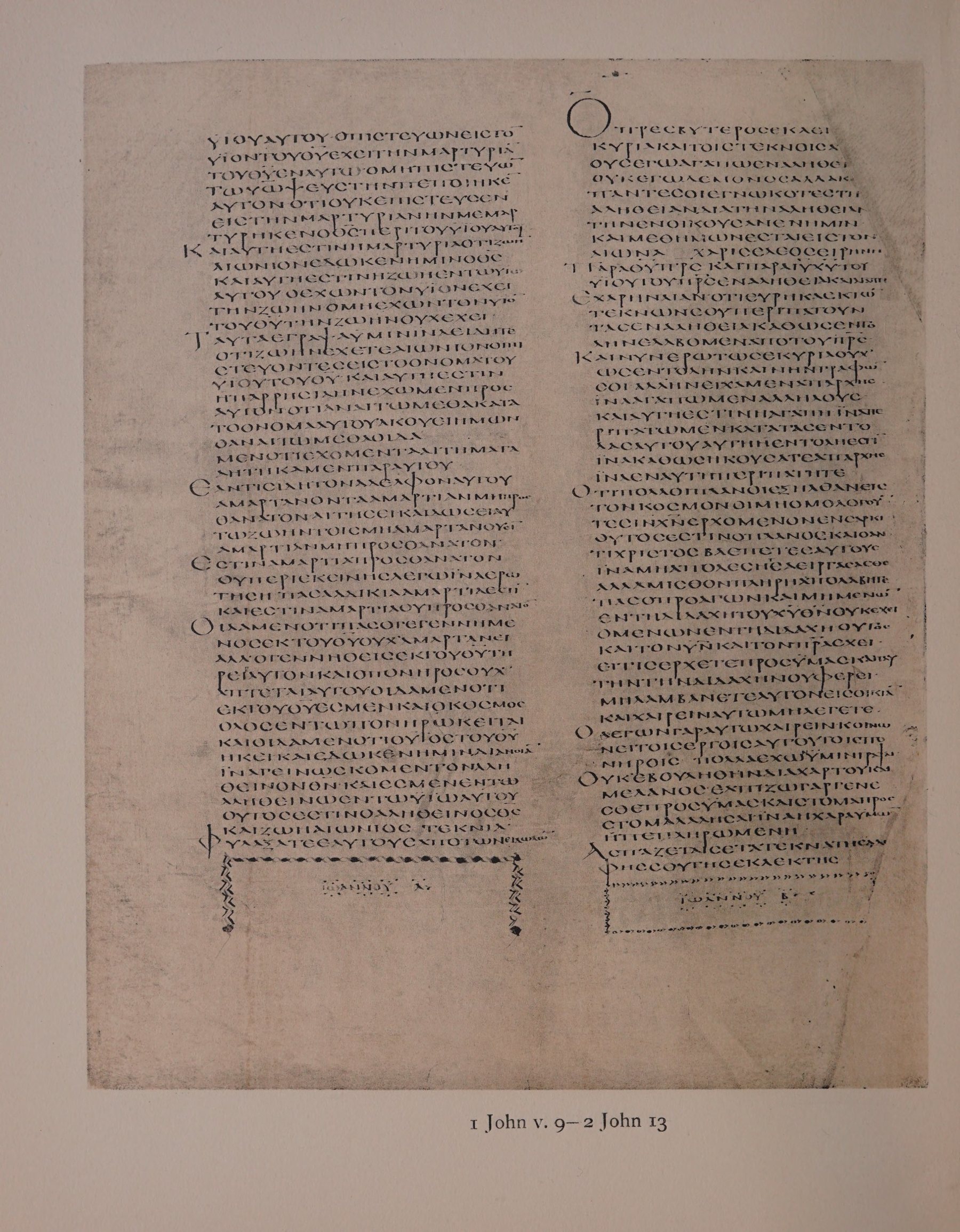
Where on the image
Page from the NTVMR transcription (docID 20002): verses 1-7 on fol. 109v (facsimile leaf 180), col. 2.
1ο πρεσβυτερος εκλεκ̣[τη] κυρια και τοις τεκνοις α[υτ...] ους εγω αγαπω εν αληθει[α] ουκ εγω δε μονος αλλα κ[αι] παντες οι εγνωκοτες τη[ν] αληθειαν 2δια την αληθειαν την ενοικουσαν εν ημιν και μεθ ημων εσται εις τον αιωνα 3χαρις ελεος ειρηνη παρα θυ πρς και παρα ιυ χυ του υιου του πρς εν αληθεια και αγαπη̣ 4εχαρην λιαν · οτι ευρηκα εκ των τεκνων σου περιπατουντας εν αληθεια καθως εντολην ελαβομεν απο του πρς · 5και νυν ερωτω σε κυρια ουχ ως εντολην καινην γραφων σοι · αλλ ην ειχαμεν απ αρχης ινα αγαπωμεν αλληλους 6και αυτη εστιν η αγαπη · ινα περιπατωμεν κατα τας εντολας αυτου αυτη η εντολη εστιν ινα καθως ηκουσατε απ αρχης ινα εν αυτη περιπατητε 7οτι πολλοι πλανοι εξηλθαν εις τον κοσμον οι μη ομολογουντες ιν χν ερχομενον εν σαρκι ουτος εστιν ο πλανος και ο αντιχριστος
Compare: Tischendorf 8th edition (1869)
1Ὁ πρεσβύτερος ἐκλεκτῇ κυρίᾳ καὶ τοῖς τέκνοις αὐτῆς, οὓς ἐγὼ ἀγαπῶ ἐν ἀληθείᾳ, καὶ οὐκ ἐγὼ μόνος ἀλλὰ καὶ πάντες οἱ ἐγνωκότες τὴν ἀλήθειαν, 2διὰ τὴν ἀλήθειαν τὴν μένουσαν ἐν ἡμῖν, καὶ μεθ’ ἡμῶν ἔσται εἰς τὸν αἰῶνα. 3ἔσται μεθ’ ἡμῶν χάρις ἔλεος εἰρήνη παρὰ θεοῦ πατρός, καὶ παρὰ Ἰησοῦ Χριστοῦ τοῦ υἱοῦ τοῦ πατρός, ἐν ἀληθείᾳ καὶ ἀγάπῃ. 4Ἐχάρην λίαν ὅτι εὕρηκα ἐκ τῶν τέκνων σου περιπατοῦντας ἐν ἀληθείᾳ, καθὼς ἐντολὴν ἐλάβομεν παρὰ τοῦ πατρός. 5καὶ νῦν ἐρωτῶ σε, Κυρία, οὐχ ὡς ἐντολὴν καινὴν γράφων σοι ἀλλὰ ἣν εἴχαμεν ἀπ’ ἀρχῆς, ἵνα ἀγαπῶμεν ἀλλήλους. 6καὶ αὕτη ἐστὶν ἡ ἀγάπη, ἵνα περιπατῶμεν κατὰ τὰς ἐντολὰς αὐτοῦ· αὕτη ἡ ἐντολή ἐστιν, ἵνα καθὼς ἠκούσατε ἀπ’ ἀρχῆς, ἵνα ἐν αὐτῇ περιπατῆτε. 7ὅτι πολλοὶ πλάνοι ἐξῆλθαν εἰς τὸν κόσμον, οἱ μὴ ὁμολογοῦντες Ἰησοῦν Χριστὸν ἐρχόμενον ἐν σαρκί· οὗτός ἐστιν ὁ πλάνος καὶ ὁ ἀντίχριστος.
1The elder unto the elect lady and her children, whom I love in the truth; and not I only, but also all they that have known the truth; 2For the truth’s sake, which dwelleth in us, and shall be with us for ever. 3Grace be with you, mercy, and peace, from God the Father, and from the Lord Jesus Christ, the Son of the Father, in truth and love. 4I rejoiced greatly that I found of thy children walking in truth, as we have received a commandment from the Father. 5And now I beseech thee, lady, not as though I wrote a new commandment unto thee, but that which we had from the beginning, that we love one another. 6And this is love, that we walk after his commandments. This is the commandment, That, as ye have heard from the beginning, ye should walk in it. 7For many deceivers are entered into the world, who confess not that Jesus Christ is come in the flesh. This is a deceiver and an antichrist.
Where on the image
Page from the NTVMR transcription (docID 20002): verses 8-13 on fol. 109v (facsimile leaf 180), col. 2.
8βλεπετε εαυτους ινα μη απολεσηε α ειργασασθε αλλα μισθον πληρη απολαβητε 9πας ο προαγων και μη μενων εν τη διδαχη του χυ θν ουκ εχει ο μενων εν τη διδαχη ουτος και τον υν και τον πρα εχει · 10ει τις ερχετε προς υμας και ταυτην την διδαχην ου φερει · μη λαμβανετε αυτον εις οικιαν και χαιρειν αυτω μη λεγετε 11ο λεγων γαρ αυτω χαιρειν · κοινωνει τοις εργοις αυτου τοις πονηροις · 12πολλα εχω υμιν γραψαι · ουκ εβουληθην δια χαρτου και μελανος · ελπιζω γαρ γενεσθε προς υμας · και στομα προς στομα λαλησαι · ινα η χαρα υμων η πεπληρωμενη · 13ασπαζεται σε τα τεκνα της αδε̣[λ]φης σου της εκλεκτης
Compare: Tischendorf 8th edition (1869)
8βλέπετε ἑαυτούς, ἵνα μὴ ἀπολέσητε ἃ εἰργάσασθε, ἀλλὰ μισθὸν πλήρη ἀπολάβητε. 9πᾶς ὁ προάγων καὶ μὴ μένων ἐν τῇ διδαχῇ τοῦ Χριστοῦ θεὸν οὐκ ἔχει· ὁ μένων ἐν τῇ διδαχῇ, οὗτος καὶ τὸν πατέρα καὶ τὸν υἱὸν ἔχει. 10εἴ τις ἔρχεται πρὸς ὑμᾶς καὶ ταύτην τὴν διδαχὴν οὐ φέρει, μὴ λαμβάνετε αὐτὸν εἰς οἰκίαν καὶ χαίρειν αὐτῷ μὴ λέγετε· 11ὁ λέγων γὰρ αὐτῷ χαίρειν κοινωνεῖ τοῖς ἔργοις αὐτοῦ τοῖς πονηροῖς. 12Πολλὰ ἔχων ὑμῖν γράφειν οὐκ ἐβουλήθην διὰ χάρτου καὶ μέλανος, ἀλλὰ ἐλπίζω γενέσθαι πρὸς ὑμᾶς καὶ στόμα πρὸς στόμα λαλῆσαι, ἵνα ἡ χαρὰ ἡμῶν πεπληρωμένη ᾖ. 13ἀσπάζεταί σε τὰ τέκνα τῆς ἀδελφῆς σου τῆς ἐκλεκτῆς.
8Look to yourselves, that we lose not those things which we have wrought, but that we receive a full reward. 9Whosoever transgresseth, and abideth not in the doctrine of Christ, hath not God. He that abideth in the doctrine of Christ, he hath both the Father and the Son. 10If there come any unto you, and bring not this doctrine, receive him not into your house, neither bid him God speed: 11For he that biddeth him God speed is partaker of his evil deeds. 12Having many things to write unto you, I would not write with paper and ink: but I trust to come unto you, and speak face to face, that our joy may be full. 13The children of thy elect sister greet thee. Amen.
Cite
Sources
- Source: Codex Alexandrinus page images + NTVMR transcription (CC BY 4.0) + Tischendorf 8th edition + KJV (holding institution)
- Critical edition: Codex Alexandrinus transcription, NTVMR (INTF Münster, CC BY 4.0); Tischendorf 8th edition for comparison
← previous · → next · v cycle view · l back to library