Acts, Chapter 23 (Codex Alexandrinus)
Introduction
Acts 23 from Codex Alexandrinus (GA 02), a fifth-century Greek Bible held by the British Library (Royal MS 1 D. VIII). In the New Testament it is the chief witness to the Byzantine text in the Gospels and to the Alexandrian text in the rest of the New Testament. Its New Testament volume lacks Matthew 1:1-25:5, John 6:50-8:52 and 2 Corinthians 4:13-12:6.
This entry meets the strict three-criteria standard of the Theosis Library:
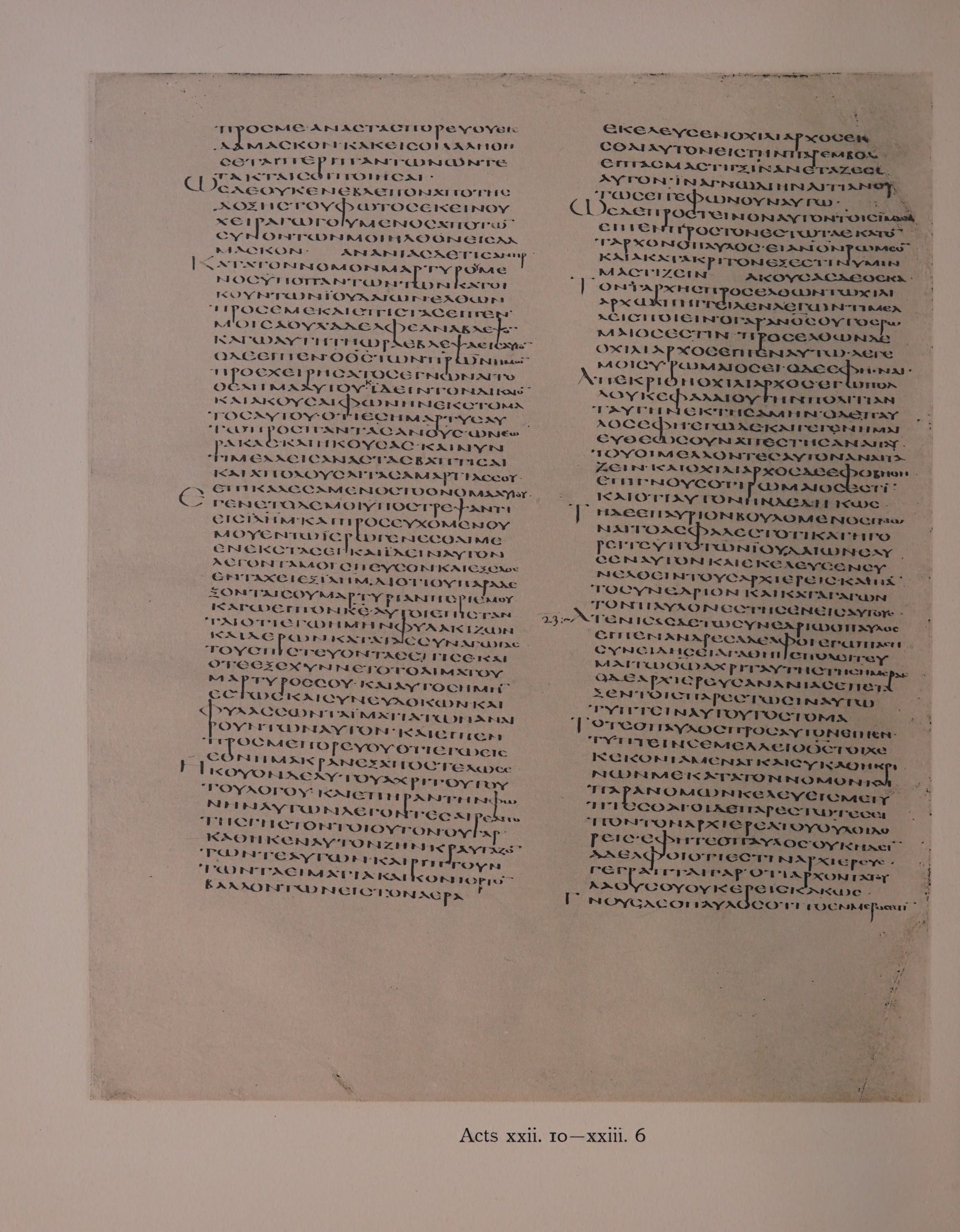
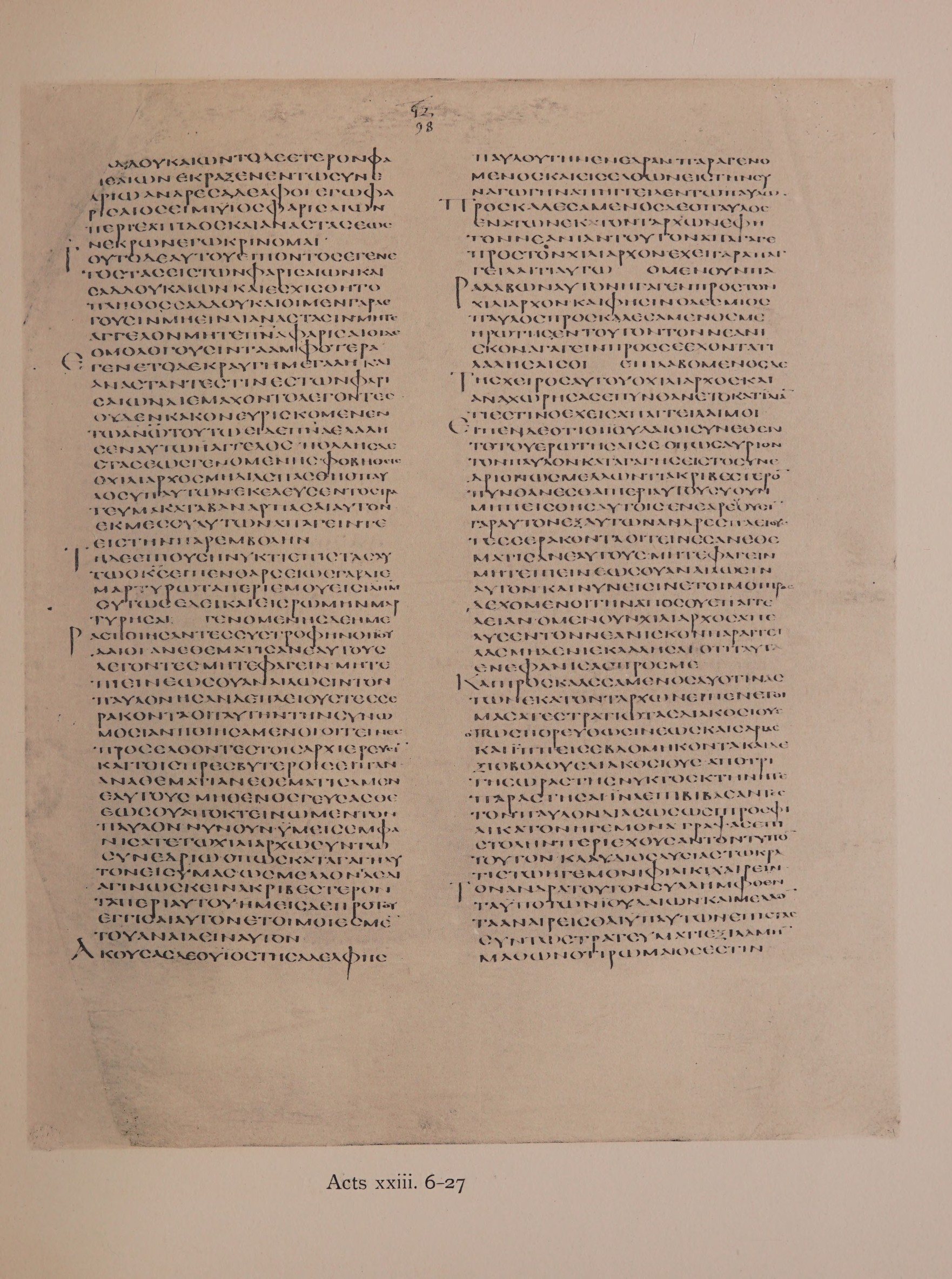
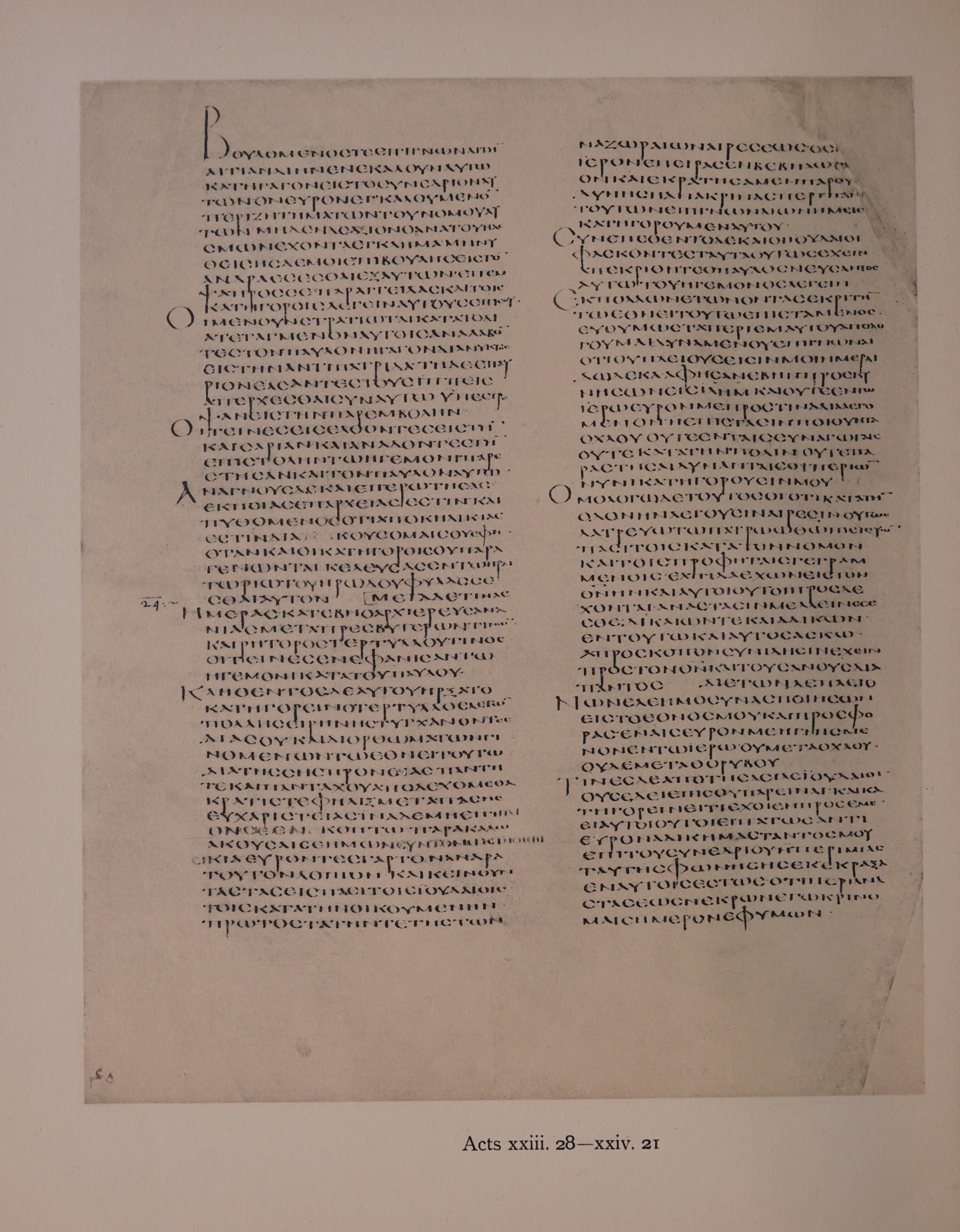
- Manuscript scan: the actual page(s) of Codex Alexandrinus containing this passage (folios 97v, 98r, 98v), reproduced from the British Museum's 1909 photographic facsimile edited by F. G. Kenyon, as digitised by the Getty Research Institute for the Internet Archive. The facsimile prints the verse range beneath each plate; that printed range was read for every page used and agrees with the INTF's NTVMR verse-level page index (CC BY 4.0). The page for each section now comes from the NTVMR transcription itself, which records the page and column on which every verse is written.
- Original text: the manuscript's own text, from a diplomatic transcription (see Greek text below), with Tischendorf's 8th critical edition (1869) for comparison.
- English translation: the King James Version (1611), retrieved verbatim from the public-domain bible-api.com endpoint.
Greek text: a diplomatic transcription of Codex Alexandrinus made by the Institut für Neutestamentliche Textforschung (INTF), Münster, for the New Testament Virtual Manuscript Room (NTVMR), published under a Creative Commons Attribution 4.0 licence. It gives the letters as the first scribe wrote them: no accents or breathings, the scribe's own spelling, and the sacred names in their contracted form (θς for θεος, ις for ιησους, κς for κυριος; the overline is not reproduced). Corrections by later hands are not shown. Letters in square brackets are not legible on the page and were restored by the transcribers, a dot under a letter marks an uncertain reading, and [...] marks text lost to damage. Beneath each section, for comparison, is Tischendorf's 8th critical edition (1869). Where the two differ, the transcription is what the manuscript says. Each section is shown with the page on which the transcription places its verses.
How was this verified? (Provenance)
Where on the image
Page from the NTVMR transcription (docID 20002): verses 1-6 on fol. 97v (facsimile leaf 156), col. 2; verse 6 continues on fol. 98r (facsimile leaf 157), col. 1 (which begins '[σ]α̣δδουκαιων το δε').
1ατενισας δε τω συνεδριω ο παυλος ειπεν ανδρες αδελφοι · εγω παση συνειδησει αγαθη πεπολειτευμαι τω θω αχρι ταυτης της ημερας 2ο δε αρχιερευς ανανιας επεταξεν τοις παρεστωσιν αυτω τυπτειν αυτου το στομα · 3τοτε ο παυλος προς αυτον ειπεν · τυπτειν σε μελλει ο θς τοιχε κεκονιαμεναι · και συ καθη κρινων με · κατα τον νομον και παρανομων κελευεις με τυπτεσθαι · 4οι δε παρεστωτες ειπον τον αρχιερεα του θυ λοιδορεις · 5εφη τε ο παυλος · ουκ ηδειν αδελφοι οτι εστιν αρχιερευς . γεγραπται γαρ · οτι αρχοντα του λαου σου ουκ ερεις κακως · 6γνους δε ο παυλος οτι το εν μερος εστιν [σ]α̣δδουκαιων το δε ετερον φα[ρ]ισαιων εκραξεν εν τω συνεδριω ανδρες αδελφοι · εγω φαρισαιος ειμι υιος φαρισαιων περι ελπιδος και αναστασεως νεκρων εγω κρινομαι ·
Compare: Tischendorf 8th edition (1869)
1ἀτενίσας δὲ τῷ συνεδρίῳ ὁ Παῦλος εἶπεν, ἄνδρες ἀδελφοί, ἐγὼ πάσῃ συνειδήσει ἀγαθῇ πεπολίτευμαι τῷ θεῷ ἄχρι ταύτης τῆς ἡμέρας. 2ὁ δὲ ἀρχιερεὺς Ἀνανίας ἐπέταξεν τοῖς παρεστῶσιν αὐτῷ τύπτειν αὐτοῦ τὸ στόμα. 3τότε ὁ Παῦλος πρὸς αὐτὸν εἶπεν· τύπτειν σε μέλλει ὁ θεός, τοῖχε κεκονιαμένε· καὶ σὺ κάθῃ κρίνων με κατὰ τὸν νόμον, καὶ παρανομῶν κελεύεις με τύπτεσθαι; 4οἱ δὲ παρεστῶτες εἶπαν, τὸν ἀρχιερέα τοῦ θεοῦ λοιδορεῖς; 5ἔφη τε ὁ Παῦλος, οὐκ ᾔδειν, ἀδελφοί, ὅτι ἐστὶν ἀρχιερεύς· γέγραπται γὰρ ὅτι ἄρχοντα τοῦ λαοῦ σου οὐκ ἐρεῖς κακῶς. 6γνοὺς δὲ ὁ Παῦλος ὅτι τὸ ἓν μέρος ἐστὶν Σαδδουκαίων τὸ δὲ ἕτερον Φαρισαίων ἔκραζεν ἐν τῷ συνεδρίῳ, ἄνδρες ἀδελφοί, ἐγὼ Φαρισαῖός εἰμι, υἱὸς Φαρισαίων· περὶ ἐλπίδος καὶ ἀναστάσεως νεκρῶν ἐγὼ κρίνομαι.
1And Paul, earnestly beholding the council, said, Men and brethren, I have lived in all good conscience before God until this day. 2And the high priest Ananias commanded them that stood by him to smite him on the mouth. 3Then said Paul unto him, God shall smite thee, thou whited wall: for sittest thou to judge me after the law, and commandest me to be smitten contrary to the law? 4And they that stood by said, Revilest thou God’s high priest? 5Then said Paul, I wist not, brethren, that he was the high priest: for it is written, Thou shalt not speak evil of the ruler of thy people. 6But when Paul perceived that the one part were Sadducees, and the other Pharisees, he cried out in the council, Men and brethren, I am a Pharisee, the son of a Pharisee: of the hope and resurrection of the dead I am called in question.
Where on the image
Page from the NTVMR transcription (docID 20002): verses 7-16 on fol. 98r (facsimile leaf 157), col. 1.
7τουτο δε αυτου ειποντος εγενετο στασεις των φαρισαιων και σαδδουκαιων και εσχισθη το πληθος · 8σαδδουκαιοι μεν γαρ λεγουσιν μη ειναι αναστασιν · μητε αγγελον μητε πνα φαρισαιοι δε ομολογουσιν τα αμφοτερα · 9εγενετο δε κραυγη μεγαλη και ανασταντες τινες των φαρισαιων διεμαχοντο λεγοντες ουδεν κακον ευρισκομεν εν τω ανω τουτω · ει δε πνα ελαλησεν αυτω η αγγελος · 10πολλης δε στασεως γενομενης · φοβηθεις ο χιλιαρχος μη διασπασθη ο παυλος υπ αυτων · εκελευσεν το στρατευμα καταβαν αρπασαι αυτον εκ μεσου αυτων απαγειν τε εις την παρεμβολην · 11τη δε επιουση νυκτι επιστας αυτω ο κς ειπεν · θαρσει ως γαρ διεμαρτυρω τα περι εμου εις ιλημ ουτω σε δει και εις ρωμην μαρτυρησαι · 12γενομενης δε ημερας ποιησαντες συστροφην οι ιουδαιοι · ανεθεματισαν εαυτους λεγοντες · μητε φαγειν · μητε πιειν εως ου αναιλωσιν τον παυλον 13ησαν δε πλειους τεσσερακοντα οι ταυτην την συνωμοσιαν ποιησαμενοι · 14οιτεινες προσελθοντες τοις αρχιερευσιν και τοις πρεσβυτεροις ειπαν · αναθεματι ανεθεματισαμεν εαυτους μηθενος γευσασθε εως ου αποκτεινωμεν τον παυλον · 15νυν ουν · υμεις εμφανισατε τω χιλιαρχω συν τω συνεδριω · οπως καταγαγη αυτον εις υμας · ως μελλονας διαγινωσκειν ακριβεστερον τα περι αυτου · ημεις δε προ του εγγισαι αυτον ετοιμοι εσμεν του αναιλειν αυτον 16ακουσας δε ο υιος της αδελφης παυλου την ενεδραν παραγενομενος και εισελθων εις την συναγωγην απηγγειλεν τω παυλω .
Compare: Tischendorf 8th edition (1869)
7τοῦτο δὲ αὐτοῦ λαλήσαντος ἐγένετο στάσις τῶν Φαρισαίων καὶ Σαδδουκαίων, καὶ ἐσχίσθη τὸ πλῆθος. 8Σαδδουκαῖοι μὲν γὰρ λέγουσιν μὴ εἶναι ἀνάστασιν μήτε ἄγγελον μήτε πνεῦμα, Φαρισαῖοι δὲ ὁμολογοῦσιν τὰ ἀμφότερα. 9ἐγένετο δὲ κραυγὴ μεγάλη, καὶ ἀναστάντες τινὲς τῶν γραμματέων τοῦ μέρους τῶν Φαρισαίων διεμάχοντο λέγοντες, οὐδὲν κακὸν εὑρίσκομεν ἐν τῷ ἀνθρώπῳ τούτῳ· εἰ δὲ πνεῦμα ἐλάλησεν αὐτῷ ἢ ἄγγελος 10πολλῆς δὲ γινομένης στάσεως φοβηθεὶς ὁ χιλίαρχος μὴ διασπασθῇ ὁ Παῦλος ὑπ’ αὐτῶν ἐκέλευσεν τὸ στράτευμα καταβὰν ἁρπάσαι αὐτὸν ἐκ μέσου αὐτῶν, ἄγειν τε εἰς τὴν παρεμβολήν. 11τῇ δὲ ἐπιούσῃ νυκτὶ ἐπιστὰς αὐτῷ ὁ κύριος εἶπεν· θάρσει· ὡς γὰρ διεμαρτύρω τὰ περὶ ἐμοῦ εἰς Ἱερουσαλήμ, οὕτω σε δεῖ καὶ εἰς Ῥώμην μαρτυρῆσαι. 12Γενομένης δὲ ἡμέρας ποιήσαντες συστροφὴν οἱ Ἰουδαῖοι ἀνεθεμάτισαν ἑαυτοὺς, λέγοντες μήτε φαγεῖν μήτε πιεῖν ἕως οὗ ἀποκτείνωσιν τὸν Παῦλον. 13ἦσαν δὲ πλείους τεσσεράκοντα οἱ ταύτην τὴν συνωμοσίαν ποιησάμενοι· 14οἵτινες προσελθόντες τοῖς ἀρχιερεῦσιν καὶ τοῖς πρεσβυτέροις εἶπαν, ἀναθέματι ἀνεθεματίσαμεν ἑαυτοὺς μηδενὸς γεύσασθαι ἕως οὗ ἀποκτείνωμεν τὸν Παῦλον. 15νῦν οὖν ὑμεῖς ἐμφανίσατε τῷ χιλιάρχῳ σὺν τῷ συνεδρίῳ ὅπως καταγάγῃ αὐτὸν εἰς ὑμᾶς ὡς μέλλοντας διαγινώσκειν ἀκριβέστερον τὰ περὶ αὐτοῦ· ἡμεῖς δὲ πρὸ τοῦ ἐγγίσαι αὐτὸν ἕτοιμοί ἐσμεν τοῦ ἀνελεῖν αὐτόν. 16Ἀκούσας δὲ ὁ υἱὸς τῆς ἀδελφῆς Παύλου τὴν ἐνέδραν παραγενόμενος καὶ εἰσελθὼν εἰς τὴν παρεμβολὴν ἀπήγγειλεν τῷ Παύλῳ.
7And when he had so said, there arose a dissension between the Pharisees and the Sadducees: and the multitude was divided. 8For the Sadducees say that there is no resurrection, neither angel, nor spirit: but the Pharisees confess both. 9And there arose a great cry: and the scribes that were of the Pharisees’ part arose, and strove, saying, We find no evil in this man: but if a spirit or an angel hath spoken to him, let us not fight against God. 10And when there arose a great dissension, the chief captain, fearing lest Paul should have been pulled in pieces of them, commanded the soldiers to go down, and to take him by force from among them, and to bring him into the castle. 11And the night following the Lord stood by him, and said, Be of good cheer, Paul: for as thou hast testified of me in Jerusalem, so must thou bear witness also at Rome. 12And when it was day, certain of the Jews banded together, and bound themselves under a curse, saying that they would neither eat nor drink till they had killed Paul. 13And they were more than forty which had made this conspiracy. 14And they came to the chief priests and elders, and said, We have bound ourselves under a great curse, that we will eat nothing until we have slain Paul. 15Now therefore ye with the council signify to the chief captain that he bring him down unto you to morrow, as though ye would enquire something more perfectly concerning him: and we, or ever he come near, are ready to kill him. 16And when Paul’s sister’s son heard of their lying in wait, he went and entered into the castle, and told Paul.
Where on the image
Page from the NTVMR transcription (docID 20002): verses 17-27 on fol. 98r (facsimile leaf 157), col. 2.
17προσκαλεσαμενος δε ο παυλος ενα των εκατονταρχων εφη τον νεανιαν τουτον απαγαγε προς τον χιλιαρχον · εχει γαρ απαγγειλαι τι αυτω · 18ο μεν ουν παραλαβων αυτον ηγαγεν προς τον χιλιαρχον · και φησιν ο δεσμιος παυλος προσκαλεσαμενος με ηρωτησεν τουτον τον νεανισκον αγαγειν προς σε εχοντα τι λαλησαι σοι 19επιλαβομενος δε της χειρος αυτου ο χιλιαρχος · και αναχωρησας επυνθανετο κατ ιδιαν τι εστιν ο εχεις απαγγειλαι μοι 20ειπεν δε οτι οι ιουδαιοι συνεθεντο του ερωτησαι σε · οπως αυριον τον παυλον καταγαγης εις το συνεδριον ως μελλων τι ακριβεστερον πυνθανεσθαι περι αυτου 21συ ουν μη πεισθης αυτοις · ενεδρεουσιν γαρ αυτον εξ αυτων ανδρες πλειους τεσσερακοντα · οιτεινες ανεθεματισαν εαυτους · μητε φαγειν μητε πιειν εως ου αναιλωσιν αυτον · και νυν εισιν ετοιμοι προσδεχομενοι την απο σου επαγγελειαν · 22ο μεν ουν χιλιαρχος απελυσεν τον νεανισκον παραγγειλας μηδενι εκλαλησαι οτι ταυτα ενεφανισας προς με · 23και προσκαλεσαμενος δυο τινας των εκατονταρχων ειπεν · ετοιμασατε στρατιωτας διακοσιους πως πορευθωσιν εως καισαριας και ιππεις εβδομηκοντα · και δεξιοβολους διακοσιους · απο τριτης ωρας της νυκτος 24κτηνη τε παραστησαι · ινα επιβιβασαντες τον παυλον διασωσωσι προς φιλικα τον ηγεμονα · 25γραψας επιστολην περιεχουσαν τον τυπον τουτον · 26κλαυδιος λυσιας τω κρατιστω ηγεμονι φιλικι χαιρειν 27τον ανδρα τουτον συλλημφθεντα υπο των ιουδαιων · και μελλοντα αναιρεισθαι υπ αυτων επιστας συν τω στρατευματι εξιλαμην μαθων οτι ρωμαιος εστιν
Compare: Tischendorf 8th edition (1869)
17προσκαλεσάμενος δὲ ὁ Παῦλος ἕνα τῶν ἑκατονταρχῶν ἔφη, τὸν νεανίαν τοῦτον ἄπαγε πρὸς τὸν χιλίαρχον, ἔχει γὰρ τι ἀπαγγεῖλαι αὐτῷ. 18ὁ μὲν οὖν παραλαβὼν αὐτὸν ἤγαγεν πρὸς τὸν χιλίαρχον καὶ φησίν, ὁ δέσμιος Παῦλος προσκαλεσάμενός με ἠρώτησεν τοῦτον τὸν νεανίσκον ἀγαγεῖν πρὸς σέ, ἔχοντά τι λαλῆσαί σοι. 19ἐπιλαβόμενος δὲ τῆς χειρὸς αὐτοῦ ὁ χιλίαρχος καὶ ἀναχωρήσας κατ’ ἰδίαν ἐπυνθάνετο, τί ἐστιν ὃ ἔχεις ἀπαγγεῖλαί μοι; 20εἶπεν δὲ ὅτι οἱ Ἰουδαῖοι συνέθεντο τοῦ ἐρωτῆσαί σε ὅπως αὔριον τὸν Παῦλον καταγάγῃς εἰς τὸ συνέδριον ὡς μέλλων τι ἀκριβέστερον πυνθάνεσθαι περὶ αὐτοῦ. 21σὺ οὖν μὴ πεισθῇς αὐτοῖς· ἐνεδρεύουσιν γὰρ αὐτὸν ἐξ αὐτῶν ἄνδρες πλείους τεσσεράκοντα, οἵτινες ἀνεθεμάτισαν ἑαυτοὺς μήτε φαγεῖν μήτε πιεῖν ἕως οὗ ἀνέλωσιν αὐτόν, καὶ νῦν εἰσιν ἕτοιμοι προσδεχόμενοι τὴν ἀπὸ σοῦ ἐπαγγελίαν. 22ὁ μὲν οὖν χιλίαρχος ἀπέλυσε τὸν νεανίσκον παραγγείλας μηδενὶ ἐκλαλῆσαι ὅτι ταῦτα ἐνεφάνισας πρός ἐμέ. 23Καὶ προσκαλεσάμενος τινας δύο τῶν ἑκατονταρχῶν εἶπεν, ἑτοιμάσατε στρατιώτας διακοσίους ὅπως πορευθῶσιν ἕως Καισαρίας, καὶ ἱππεῖς ἑβδομήκοντα καὶ δεξιολάβους διακοσίους, ἀπὸ τρίτης ὥρας τῆς νυκτός, 24κτήνη τε παραστῆσαι ἵνα ἐπιβιβάσαντες τὸν Παῦλον διασώσωσι πρὸς Φήλικα τὸν ἡγεμόνα, 25γράψας ἐπιστολὴν ἔχουσαν τὸν τύπον τοῦτον· 26Κλαύδιος Λυσίας τῷ κρατίστῳ ἡγεμόνι Φήλικι χαίρειν. 27τὸν ἄνδρα τοῦτον συλλημφθέντα ὑπὸ τῶν Ἰουδαίων καὶ μέλλοντα ἀναιρεῖσθαι ὑπ’ αὐτῶν ἐπιστὰς σὺν τῷ στρατεύματι ἐξειλάμην, μαθὼν ὅτι Ῥωμαῖός ἐστιν·
17Then Paul called one of the centurions unto him, and said, Bring this young man unto the chief captain: for he hath a certain thing to tell him. 18So he took him, and brought him to the chief captain, and said, Paul the prisoner called me unto him, and prayed me to bring this young man unto thee, who hath something to say unto thee. 19Then the chief captain took him by the hand, and went with him aside privately, and asked him, What is that thou hast to tell me? 20And he said, The Jews have agreed to desire thee that thou wouldest bring down Paul to morrow into the council, as though they would enquire somewhat of him more perfectly. 21But do not thou yield unto them: for there lie in wait for him of them more than forty men, which have bound themselves with an oath, that they will neither eat nor drink till they have killed him: and now are they ready, looking for a promise from thee. 22So the chief captain then let the young man depart, and charged him, See thou tell no man that thou hast shewed these things to me. 23And he called unto him two centurions, saying, Make ready two hundred soldiers to go to Caesarea, and horsemen threescore and ten, and spearmen two hundred, at the third hour of the night; 24And provide them beasts, that they may set Paul on, and bring him safe unto Felix the governor. 25And he wrote a letter after this manner: 26Claudius Lysias unto the most excellent governor Felix sendeth greeting. 27This man was taken of the Jews, and should have been killed of them: then came I with an army, and rescued him, having understood that he was a Roman.
Where on the image
Page from the NTVMR transcription (docID 20002): verses 28-35 on fol. 98v (facsimile leaf 158), col. 1.
28βουλομενος τε επιγνωναι την αιτιαν δι ην ενεκαλουν αυτω κατηγαγον εις το συνεδριον αυτων 29ον ευρον εγκαλουμενον περι ζητηματων του νομου αυτων · μηδεν δε αξιον θανατου η δεσμων εχοντα εγκλημα · 30μηνυθεισης δε μοι επιβουλης εις τον ανδρα εσεσθαι εξ αυτων · επεμψα προς σε παραγγειλας και τοις κατηγοροις λεγειν αυτους επι σου 31οι μεν ουν στρατιωται κατα το διατεταγμενον αυτοις αναλαβοντες τον παυλον ηγαγον δια νυκτος εις την αντιπατριδα · 32τη δε επαυριον εασαντες τους ιππεις απερχεσθαι συν αυτω υπεστρεψαν εις την παρεμβολην · 33οιτεινες εισελθοντες εις την καισαριαν · και αναδοντες την επιστολην τω ηγεμονι παρεστησαν και τον παυλον αυτω · 34αναγνους δε και επερωτηθ̣[ει]ς̣ εκ ποιας επαρχειας εστιν · και πυθομενος οτι απο κηλικιας εστιν · 35δια τ̣[ι] α̣κουσομαι σου εφη οταν και οι κατηγοροι σου παραγενωνται · κελευσας εν τω πραιτωριω του ηρωδου φυλασσεσθαι αυτον
Compare: Tischendorf 8th edition (1869)
28βουλόμενός τε ἐπιγνῶναι τὴν αἰτίαν δι’ ἣν ἐνεκάλουν αὐτῷ κατήγαγον εἰς τὸ συνέδριον αὐτῶν· 29ὃν εὗρον ἐγκαλούμενον περὶ ζητημάτων τοῦ νόμου αὐτῶν, μηδὲν δὲ ἄξιον θανάτου ἢ δεσμῶν ἔχοντα ἔγκλημα. 30μηνυθείσης δέ μοι ἐπιβουλῆς εἰς τὸν ἄνδρα ἔσεσθαι, ἐξ αὐτῶν, ἔπεμψα πρὸς σέ, παραγγείλας καὶ τοῖς κατηγόροις λέγειν αὐτοὺς ἐπὶ σοῦ. 31Οἱ μὲν οὖν στρατιῶται κατὰ τὸ διατεταγμένον αὐτοῖς ἀναλαβόντες τὸν Παῦλον ἤγαγον διὰ νυκτὸς εἰς τὴν Ἀντιπατρίδα· 32τῇ δὲ ἐπαύριον ἐάσαντες τοὺς ἱππεῖς ἀπέρχεσθαι σὺν αὐτῷ ὑπέστρεψαν εἰς τὴν παρεμβολήν· 33οἵτινες εἰσελθόντες εἰς τὴν Καισάριαν καὶ ἀναδόντες τὴν ἐπιστολὴν τῷ ἡγεμόνι παρέστησαν καὶ τὸν Παῦλον αὐτῷ. 34ἀναγνοὺς δὲ καὶ ἐπερωτήσας ἐκ ποίας ἐπαρχείας ἐστὶν καὶ πυθόμενος ὅτι ἀπὸ Κιλικίας, 35διακούσομαί σου, ἔφη, ὅταν καὶ οἱ κατήγοροί σου παραγένωνται· κελεύσας ἐν τῷ πραιτωρίῳ τοῦ Ἡρῴδου φυλάσσεσθαι αὐτόν.
28And when I would have known the cause wherefore they accused him, I brought him forth into their council: 29Whom I perceived to be accused of questions of their law, but to have nothing laid to his charge worthy of death or of bonds. 30And when it was told me how that the Jews laid wait for the man, I sent straightway to thee, and gave commandment to his accusers also to say before thee what they had against him. Farewell. 31Then the soldiers, as it was commanded them, took Paul, and brought him by night to Antipatris. 32On the morrow they left the horsemen to go with him, and returned to the castle: 33Who, when they came to Caesarea, and delivered the epistle to the governor, presented Paul also before him. 34And when the governor had read the letter, he asked of what province he was. And when he understood that he was of Cilicia; 35I will hear thee, said he, when thine accusers are also come. And he commanded him to be kept in Herod’s judgment hall.
Cite
Sources
- Source: Codex Alexandrinus page images + NTVMR transcription (CC BY 4.0) + Tischendorf 8th edition + KJV (holding institution)
- Critical edition: Codex Alexandrinus transcription, NTVMR (INTF Münster, CC BY 4.0); Tischendorf 8th edition for comparison
← previous · → next · v cycle view · l back to library