Galatians, Chapter 2 (Codex Alexandrinus)
Introduction
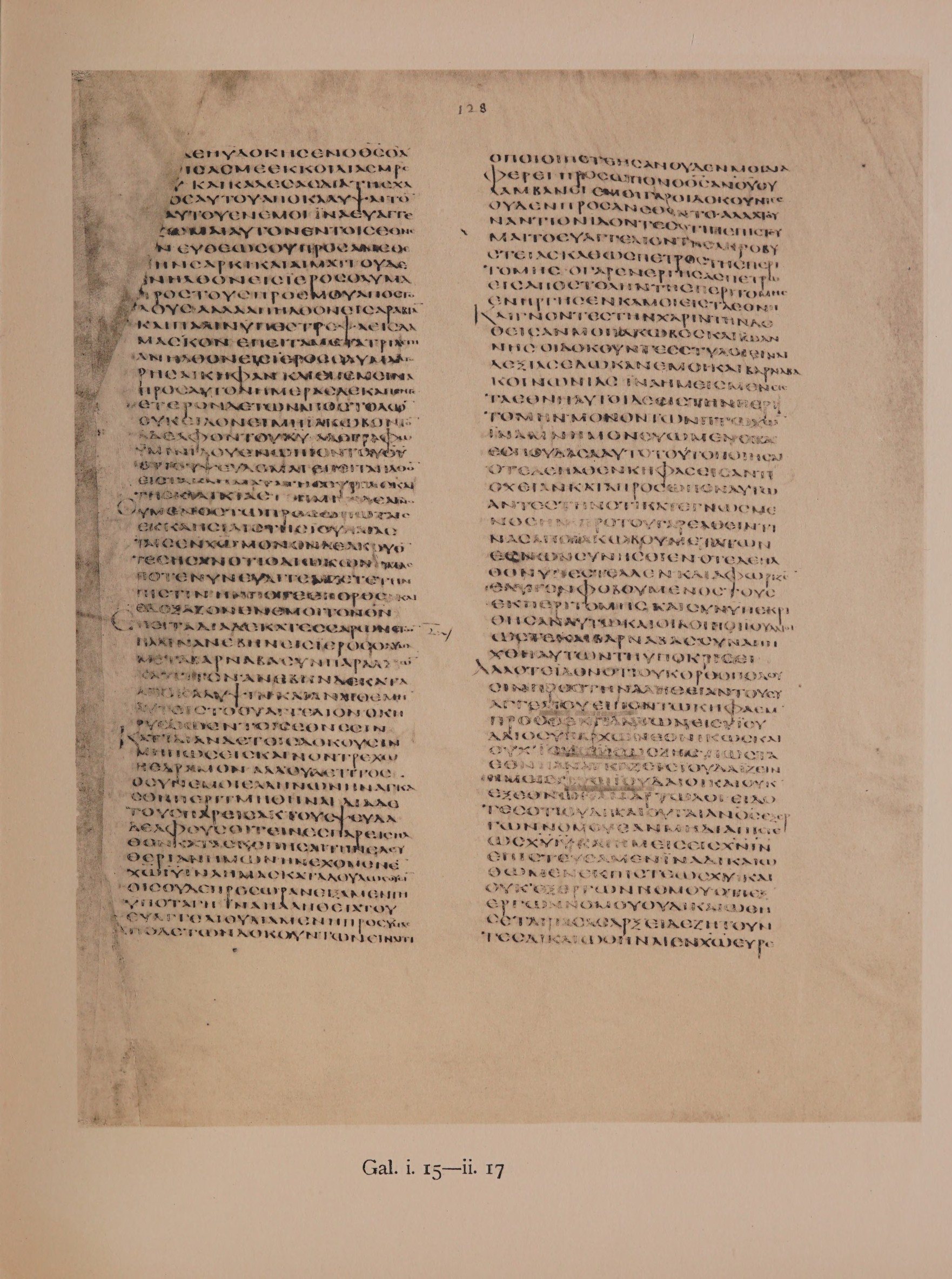
Galatians 2 from Codex Alexandrinus (GA 02), a fifth-century Greek Bible held by the British Library (Royal MS 1 D. VIII). In the New Testament it is the chief witness to the Byzantine text in the Gospels and to the Alexandrian text in the rest of the New Testament. Its New Testament volume lacks Matthew 1:1-25:5, John 6:50-8:52 and 2 Corinthians 4:13-12:6.
This entry meets the strict three-criteria standard of the Theosis Library:
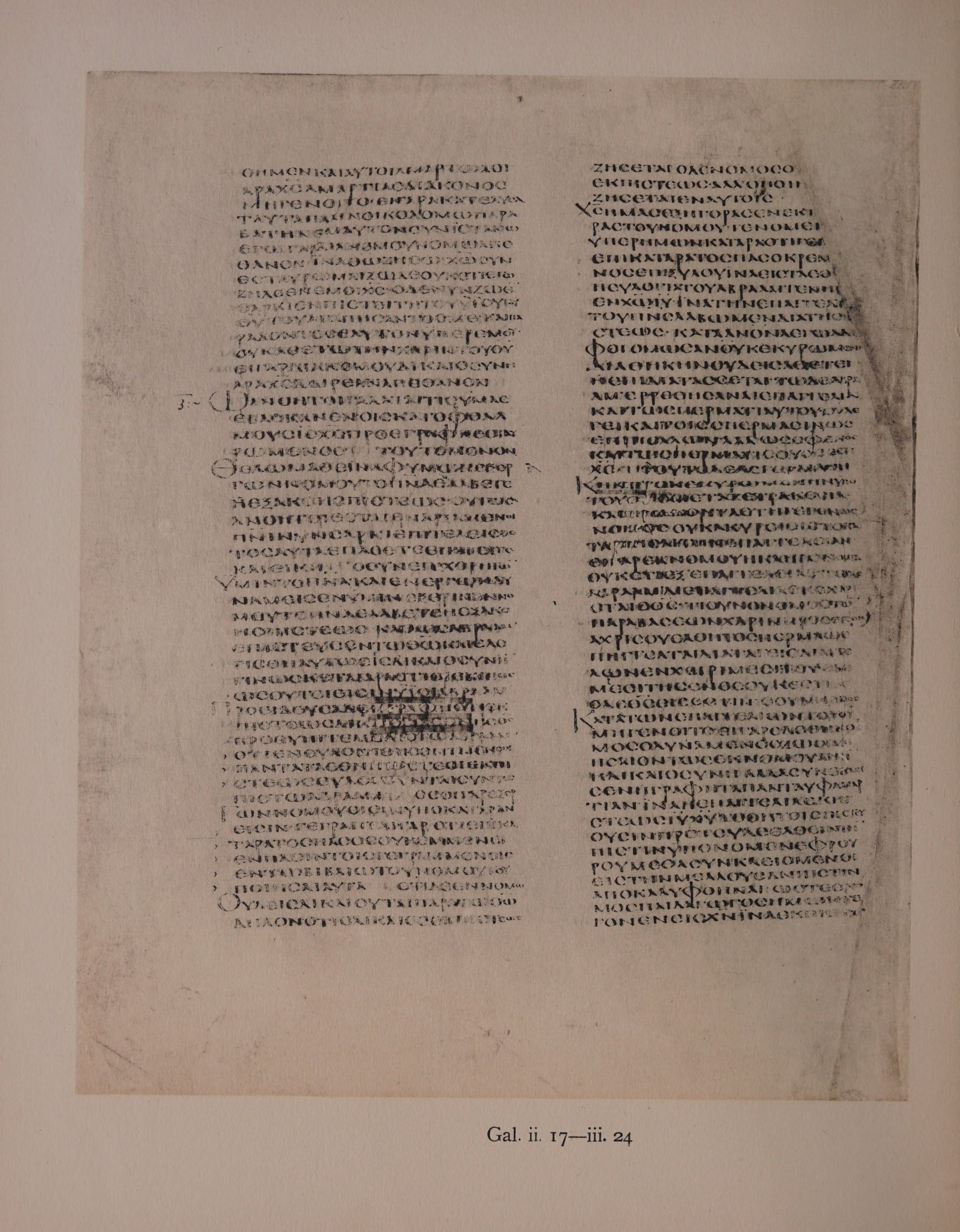
- Manuscript scan: the actual page(s) of Codex Alexandrinus containing this passage (folios 128r, 128v), reproduced from the British Museum's 1909 photographic facsimile edited by F. G. Kenyon, as digitised by the Getty Research Institute for the Internet Archive. The facsimile prints the verse range beneath each plate; that printed range was read for every page used and agrees with the INTF's NTVMR verse-level page index (CC BY 4.0). The page for each section now comes from the NTVMR transcription itself, which records the page and column on which every verse is written.
- Original text: the manuscript's own text, from a diplomatic transcription (see Greek text below), with Tischendorf's 8th critical edition (1869) for comparison.
- English translation: the King James Version (1611), retrieved verbatim from the public-domain bible-api.com endpoint.
Greek text: a diplomatic transcription of Codex Alexandrinus made by the Institut für Neutestamentliche Textforschung (INTF), Münster, for the New Testament Virtual Manuscript Room (NTVMR), published under a Creative Commons Attribution 4.0 licence. It gives the letters as the first scribe wrote them: no accents or breathings, the scribe's own spelling, and the sacred names in their contracted form (θς for θεος, ις for ιησους, κς for κυριος; the overline is not reproduced). Corrections by later hands are not shown. Letters in square brackets are not legible on the page and were restored by the transcribers, a dot under a letter marks an uncertain reading, and [...] marks text lost to damage. Beneath each section, for comparison, is Tischendorf's 8th critical edition (1869). Where the two differ, the transcription is what the manuscript says. Each section is shown with the page on which the transcription places its verses.
How was this verified? (Provenance)
Where on the image
Page from the NTVMR transcription (docID 20002): verses 1-6 on fol. 128r (facsimile leaf 217), col. 1.
1επειτα δια δεκατεσσαρων ετων παλιν ανεβην εις ιεροσολυμα μετα βαρναβα συνπαραλα̣[β]ων και̣ τιτον · 2ανεβην δε κατα αποκαλυψιν και αναιθεμην αυτοις το ευαγγελιον ο κηρυσσ̣ω εν τοις εθνεσιν κατ ιδιαν δε τοις δοκουσιν μη πως εις καινον τρεχω η εδραμον · 3αλλ ουδε τιτος ο συν εμοι ελλην ων ηναγκασθη περιτμηθηναι 4δια δε τους παρεισακτους ψευδαδελφους οιτεινες παρεισηλθον κατασκοπησαι την ελευθεριαν ημων · ην εχομεν εν χω ιυ ινα ημας καταδουλωσουσιν 5οις ουδε προς ωραν ειξαμεν τη υποταγη ινα η αληθεια του ευαγγελιου διαμενη προς υμας 6α̣πο δε των δοκουντων ειναι τι οποιοι ποτε ησαν ουδεν μοι διαφερει · προσωπον ο θς ανου ου λαμβανει εμοι γαρ οι δοκουντες ουδεν προσανεθε̣ντο ·
Compare: Tischendorf 8th edition (1869)
1Ἔπειτα διὰ δεκατεσσάρων ἐτῶν πάλιν ἀνέβην εἰς Ἱεροσόλυμα μετὰ Βαρναβᾶ, συνπαραλαβὼν καὶ Τίτον· 2ἀνέβην δὲ κατὰ ἀποκάλυψιν· καὶ ἀνεθέμην αὐτοῖς τὸ εὐαγγέλιον ὃ κηρύσσω ἐν τοῖς ἔθνεσιν, κατ’ ἰδίαν δὲ τοῖς δοκοῦσιν, μήπως εἰς κενὸν τρέχω ἢ ἔδραμον. 3ἀλλ’ οὐδὲ Τίτος ὁ σὺν ἐμοί, Ἕλλην ὤν, ἠναγκάσθη περιτμηθῆναι· 4διὰ δὲ τοὺς παρεισάκτους ψευδαδέλφους, οἵτινες παρεισῆλθον κατασκοπῆσαι τὴν ἐλευθερίαν ἡμῶν ἣν ἔχομεν ἐν Χριστῷ Ἰησοῦ, ἵνα ἡμᾶς καταδουλώσουσιν· 5οἷς οὐδὲ πρὸς ὥραν εἴξαμεν τῇ ὑποταγῇ, ἵνα ἡ ἀλήθεια τοῦ εὐαγγελίου διαμείνῃ πρὸς ὑμᾶς. 6ἀπὸ δὲ τῶν δοκούντων εἶναί τι, ὁποῖοί ποτε ἦσαν οὐδέν μοι διαφέρει· πρόσωπον ὁ θεὸς ἀνθρώπου οὐ λαμβάνει ἐμοὶ γὰρ οἱ δοκοῦντες οὐδὲν προσανέθεντο,
1Then fourteen years after I went up again to Jerusalem with Barnabas, and took Titus with me also. 2And I went up by revelation, and communicated unto them that gospel which I preach among the Gentiles, but privately to them which were of reputation, lest by any means I should run, or had run, in vain. 3But neither Titus, who was with me, being a Greek, was compelled to be circumcised: 4And that because of false brethren unawares brought in, who came in privily to spy out our liberty which we have in Christ Jesus, that they might bring us into bondage: 5To whom we gave place by subjection, no, not for an hour; that the truth of the gospel might continue with you. 6But of these who seemed to be somewhat, (whatsoever they were, it maketh no matter to me: God accepteth no man’s person:) for they who seemed to be somewhat in conference added nothing to me:
Where on the image
Page from the NTVMR transcription (docID 20002): verses 7-17 on fol. 128r (facsimile leaf 217), col. 2; verse 17 continues on fol. 128v (facsimile leaf 218), col. 1 (which begins 'θημεν και αυτοι').
7αλλα τουναντιον ιδοντες ο̣τι πεπιστευμαι το ευαγγελιον τ[...]οβυστειας καθως πετρος της περιτομης · 8ο γαρ ενεργησας πετρω εις αποστολην της περιτομης ενηργησεν καμοι εις τα εθνη 9και γνοντες την χαριν την δοθεισαν μοι ιακωβος και ιωαννης · οι δοκουντες στυλοι ειναι δεξιας εδωκαν εμοι · και βαρναβα κοινωνιας · ινα ημεις μεν εις τα εθνη · αυτοι δε εις την περιτομην · 10μονον των πτωχων ινα μνημονευωμεν ο κ̣αι̣ εσπουδασα αυτο τουτο ποιησαι · 11οτε δε ηλθεν κηφας εις αντιοχειαν κατα προσωπον αυτω αντεστην οτι κατεγνωσμενος ην · 12προ του γαρ ελθειν τινας απο ιακωβου μετα των εθνων συνησθιεν · οτε δε ηλθον υπ̣εστελλεν · και αφωριζεν εαυτον φοβουμενος τους εκ περιτομης 13και συνυπεκριθησαν αυτω και οι λοιποι ιουδαιοι · ωστε και βαρναβας συναπηχθη αυτων τη υποκρισει · 14αλλ οτε ιδον οτι ουκ ορθοποδουσιν προς την αληθειαν του ευαγγελιου ειπον τω κηφα εμπροσθεν παντων ει συ ιουδαιος υπαρχων εθνικως και ουχ ιουδ̣α̣ι̣κως ζης · πως τα εθνη αναγκαζεις ιουδαιζειν 15ημεις φυσι ιουδαιοι και ουκ εξ εθνων αμαρτωλοι · 16ειδοτες οτι ου δικαιουται ανος εξ εργων νομου εαν μη δια πιστεως χυ ιυ · και ημεις εις χν ιν επιστευσαμεν · ινα δικαιωθωμεν εκ πιστεως χυ και ουκ εξ εργων νομου · οτι εξ εργων νομου ου δικαιωθησεται πασα σαρξ 17ει δε ζητουντες δικαιωθηναι εν χω ευρεθημεν και αυτοι αμαρτωλοι αρα χς αμαρτιας διακονος μη γενοιτο ·
Compare: Tischendorf 8th edition (1869)
7ἀλλὰ τοὐναντίον ἰδόντες ὅτι πεπίστευμαι τὸ εὐαγγέλιον τῆς ἀκροβυστίας καθὼς Πέτρος τῆς περιτομῆς, 8ὁ γὰρ ἐνεργήσας Πέτρῳ εἰς ἀποστολὴν τῆς περιτομῆς ἐνήργησεν καὶ ἐμοὶ εἰς τὰ ἔθνη, 9καὶ γνόντες τὴν χάριν τὴν δοθεῖσάν μοι, Ἰάκωβος καὶ Κηφᾶς καὶ Ἰωάννης, οἱ δοκοῦντες στῦλοι εἶναι, δεξιὰς ἔδωκαν ἐμοὶ καὶ Βαρναβᾷ κοινωνίας, ἵνα ἡμεῖς εἰς τὰ ἔθνη, αὐτοὶ δὲ εἰς τὴν περιτομήν· 10μόνον τῶν πτωχῶν ἵνα μνημονεύωμεν, ὃ καὶ ἐσπούδασα αὐτὸ τοῦτο ποιῆσαι. 11Ὅτε δὲ ἦλθεν Κηφᾶς εἰς Ἀντιόχειαν, κατὰ πρόσωπον αὐτῷ ἀντέστην, ὅτι κατεγνωσμένος ἦν. 12πρὸ τοῦ γὰρ ἐλθεῖν τινας ἀπὸ Ἰακώβου μετὰ τῶν ἐθνῶν συνήσθιεν· ὅτε δὲ ἦλθον, ὑπέστελλεν καὶ ἀφώριζεν ἑαυτόν, φοβούμενος τοὺς ἐκ περιτομῆς. 13καὶ συνυπεκρίθησαν αὐτῷ καὶ οἱ λοιποὶ Ἰουδαῖοι, ὥστε καὶ Βαρναβᾶς συναπήχθη αὐτῶν τῇ ὑποκρίσει. 14ἀλλ’ ὅτε εἶδον ὅτι οὐκ ὀρθοποδοῦσιν πρὸς τὴν ἀλήθειαν τοῦ εὐαγγελίου, εἶπον τῷ Κηφᾷ ἔμπροσθεν πάντων, εἰ σὺ Ἰουδαῖος ὑπάρχων ἐθνικῶς καὶ οὐχ Ἰουδαϊκῶς ζῇς, πῶς τὰ ἔθνη ἀναγκάζεις ἰουδαΐζειν; 15ἡμεῖς φύσει Ἰουδαῖοι καὶ οὐκ ἐξ ἐθνῶν ἁμαρτωλοί, 16εἰδότες δὲ ὅτι οὐ δικαιοῦται ἄνθρωπος ἐξ ἔργων νόμου ἐὰν μὴ διὰ πίστεως Χριστοῦ Ἰησοῦ, καὶ ἡμεῖς εἰς Χριστὸν Ἰησοῦν ἐπιστεύσαμεν, ἵνα δικαιωθῶμεν ἐκ πίστεως Χριστοῦ καὶ οὐκ ἐξ ἔργων νόμου, ὅτι ἐξ ἔργων νόμου οὐ δικαιωθήσεται πᾶσα σάρξ. 17εἰ δὲ ζητοῦντες δικαιωθῆναι ἐν Χριστῷ εὑρέθημεν καὶ αὐτοὶ ἁμαρτωλοί, ἆρα Χριστὸς ἁμαρτίας διάκονος; μὴ γένοιτο.
7But contrariwise, when they saw that the gospel of the uncircumcision was committed unto me, as the gospel of the circumcision was unto Peter; 8(For he that wrought effectually in Peter to the apostleship of the circumcision, the same was mighty in me toward the Gentiles:) 9And when James, Cephas, and John, who seemed to be pillars, perceived the grace that was given unto me, they gave to me and Barnabas the right hands of fellowship; that we should go unto the heathen, and they unto the circumcision. 10Only they would that we should remember the poor; the same which I also was forward to do. 11But when Peter was come to Antioch, I withstood him to the face, because he was to be blamed. 12For before that certain came from James, he did eat with the Gentiles: but when they were come, he withdrew and separated himself, fearing them which were of the circumcision. 13And the other Jews dissembled likewise with him; insomuch that Barnabas also was carried away with their dissimulation. 14But when I saw that they walked not uprightly according to the truth of the gospel, I said unto Peter before them all, If thou, being a Jew, livest after the manner of Gentiles, and not as do the Jews, why compellest thou the Gentiles to live as do the Jews? 15We who are Jews by nature, and not sinners of the Gentiles, 16Knowing that a man is not justified by the works of the law, but by the faith of Jesus Christ, even we have believed in Jesus Christ, that we might be justified by the faith of Christ, and not by the works of the law: for by the works of the law shall no flesh be justified. 17But if, while we seek to be justified by Christ, we ourselves also are found sinners, is therefore Christ the minister of sin? God forbid.
Where on the image
Page from the NTVMR transcription (docID 20002): verses 18-21 on fol. 128v (facsimile leaf 218), col. 1.
18ει γαρ α κατελυσα ταυτα παλ̣ιν οικοδομω παραβατην εμαυτον συνιστανω 19εγω γαρ δια νομου νομω απεθανον ινα θω ζησω · χω συνεσταυρωμαι 20ζω δε ουκετι εγω ζη δε εν εμοι χς · ο δε νυν ζω εν σαρκι εν πιστει τη του υιου του θυ του αγαπησαντος με και παραδοντος εαυτον υπερ εμου · 21ουκ αθετω την χαριν του θυ ει γαρ δια νομου δικαιοσυνη αρα χς δωρεαν απεθανεν
Compare: Tischendorf 8th edition (1869)
18εἰ γὰρ ἃ κατέλυσα ταῦτα πάλιν οἰκοδομῶ, παραβάτην ἐμαυτὸν συνιστάνω. 19ἐγὼ γὰρ διὰ νόμου νόμῳ ἀπέθανον ἵνα θεῷ ζήσω. 20Χριστῷ συνεσταύρωμαι· ζῶ δὲ οὐκέτι ἐγώ, ζῇ δὲ ἐν ἐμοὶ Χριστός· ὃ δὲ νῦν ζῶ ἐν σαρκί, ἐν πίστει ζῶ τῇ τοῦ υἱοῦ τοῦ θεοῦ τοῦ ἀγαπήσαντός με καὶ παραδόντος ἑαυτὸν ὑπὲρ ἐμοῦ. 21οὐκ ἀθετῶ τὴν χάριν τοῦ θεοῦ· εἰ γὰρ διὰ νόμου δικαιοσύνη, ἄρα Χριστὸς δωρεὰν ἀπέθανεν.
18For if I build again the things which I destroyed, I make myself a transgressor. 19For I through the law am dead to the law, that I might live unto God. 20I am crucified with Christ: nevertheless I live; yet not I, but Christ liveth in me: and the life which I now live in the flesh I live by the faith of the Son of God, who loved me, and gave himself for me. 21I do not frustrate the grace of God: for if righteousness come by the law, then Christ is dead in vain.
Cite
Sources
- Source: Codex Alexandrinus page images + NTVMR transcription (CC BY 4.0) + Tischendorf 8th edition + KJV (holding institution)
- Critical edition: Codex Alexandrinus transcription, NTVMR (INTF Münster, CC BY 4.0); Tischendorf 8th edition for comparison
← previous · → next · v cycle view · l back to library