Hebrews, Chapter 10 (Codex Alexandrinus)
Introduction
Hebrews 10 from Codex Alexandrinus (GA 02), a fifth-century Greek Bible held by the British Library (Royal MS 1 D. VIII). In the New Testament it is the chief witness to the Byzantine text in the Gospels and to the Alexandrian text in the rest of the New Testament. Its New Testament volume lacks Matthew 1:1-25:5, John 6:50-8:52 and 2 Corinthians 4:13-12:6.
This entry meets the strict three-criteria standard of the Theosis Library:
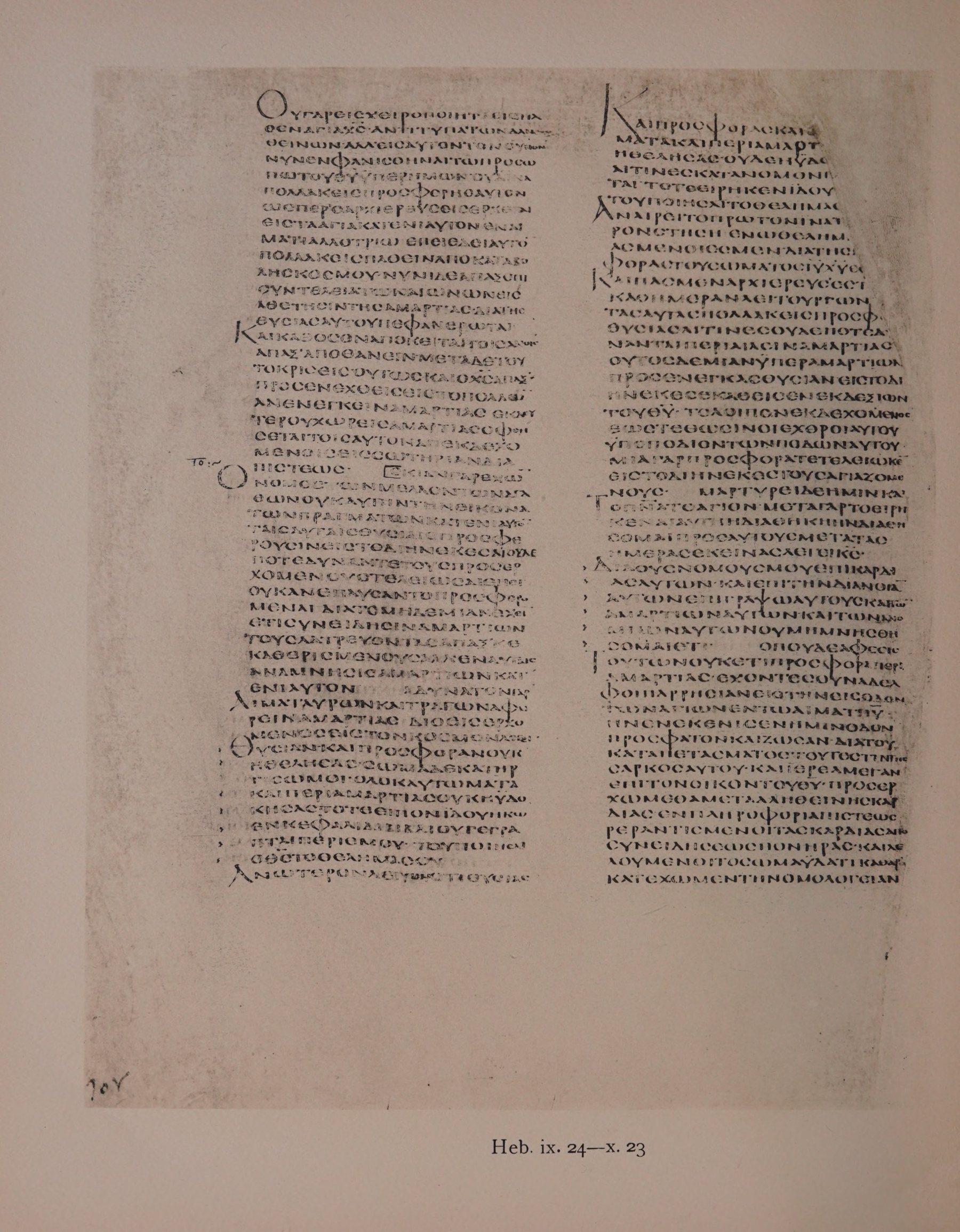
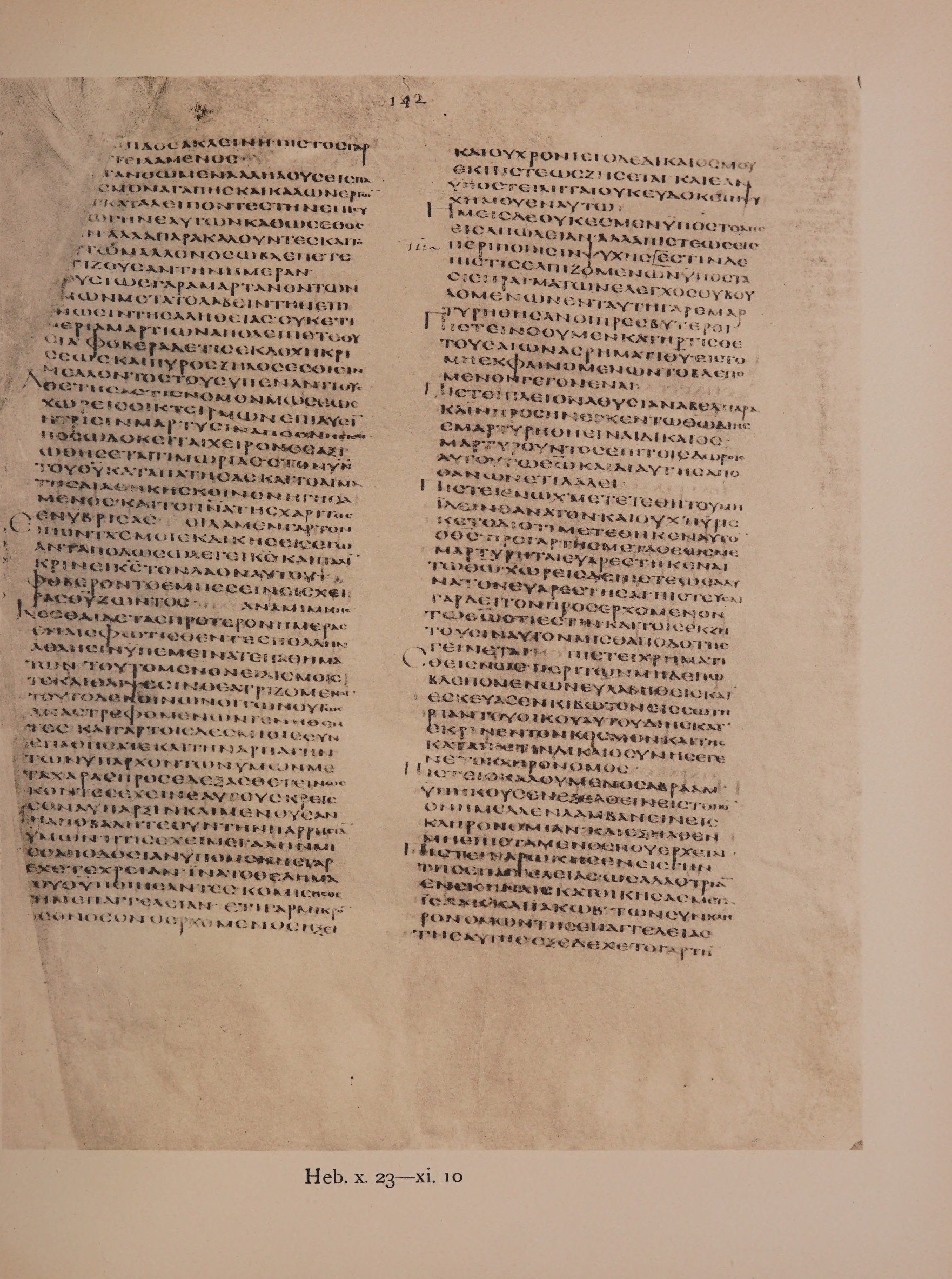
- Manuscript scan: the actual page(s) of Codex Alexandrinus containing this passage (folios 141v, 142r), reproduced from the British Museum's 1909 photographic facsimile edited by F. G. Kenyon, as digitised by the Getty Research Institute for the Internet Archive. The facsimile prints the verse range beneath each plate; that printed range was read for every page used and agrees with the INTF's NTVMR verse-level page index (CC BY 4.0). The page for each section now comes from the NTVMR transcription itself, which records the page and column on which every verse is written.
- Original text: the manuscript's own text, from a diplomatic transcription (see Greek text below), with Tischendorf's 8th critical edition (1869) for comparison.
- English translation: the King James Version (1611), retrieved verbatim from the public-domain bible-api.com endpoint.
Greek text: a diplomatic transcription of Codex Alexandrinus made by the Institut für Neutestamentliche Textforschung (INTF), Münster, for the New Testament Virtual Manuscript Room (NTVMR), published under a Creative Commons Attribution 4.0 licence. It gives the letters as the first scribe wrote them: no accents or breathings, the scribe's own spelling, and the sacred names in their contracted form (θς for θεος, ις for ιησους, κς for κυριος; the overline is not reproduced). Corrections by later hands are not shown. Letters in square brackets are not legible on the page and were restored by the transcribers, a dot under a letter marks an uncertain reading, and [...] marks text lost to damage. Beneath each section, for comparison, is Tischendorf's 8th critical edition (1869). Where the two differ, the transcription is what the manuscript says. Each section is shown with the page on which the transcription places its verses.
How was this verified? (Provenance)
Where on the image
Page from the NTVMR transcription (docID 20002): verses 1-8 on fol. 141v (facsimile leaf 246), col. 1.
1σκιαν γαρ εχων ο νομος των μελλοντων αγαθων ουκ αυτην την εικονα των πραγματων κατ ενιαυτον ταις αυταις θυσιαις προσφερουσιν εις το διηνεκες [...] ουδεποτε δυναντε τους προσερχομενους τελειωσαι 2επει ουκ αν επαυσαντο προσφερομεναι · δια το μηδεμιαν εχειν ετι συνειδησιν αμαρτιων τους λατρευοντας απαξ κεκαθερισμενους 3αλλ εν αυταις αναμνησις αμαρτιων κατ ενιαυτον · 4αδυνατον γαρ αιμα ταυρων και τραγων αφαιρειν αμαρτιας · 5διο εισερχομενος εις τον κοσμον λεγει · θυσιαν · και προσφοραν ουκ ηθελησας · σωμα δε κατηρτι̣σω μοι · 6ολοκαυτωματα και περι αμαρτιας ουκ ηυδοκησας 7τοτε ειπον ιδου ηκω εν κεφαλιδι βιβλιου γεγραπται περι εμου · του ποιησαι ο θς το θελημα σου · 8ανωτερον λεγ[...] οτι θυσιας και προσφορας και ο̣[λοκαυτω]ματα και περι αμαρτ[ιας] [ουκ] ηθελησας · ουδε ηυδο̣[κησας] αιτινες κατα νομον π̣[ροσφερον]ται ·
Compare: Tischendorf 8th edition (1869)
1Σκιὰν γὰρ ἔχων ὁ νόμος τῶν μελλόντων ἀγαθῶν, οὐκ αὐτὴν τὴν εἰκόνα τῶν πραγμάτων, κατ’ ἐνιαυτὸν ταῖς αὐταῖς θυσίαις αἷς προσφέρουσιν εἰς τὸ διηνεκὲς οὐδέποτε δύναται τοὺς προσερχομένους τελειῶσαι· 2ἐπεὶ οὐκ ἂν ἐπαύσαντο προσφερόμεναι, διὰ τὸ μηδεμίαν ἔχειν ἔτι συνείδησιν ἁμαρτιῶν τοὺς λατρεύοντας ἅπαξ κεκαθαρισμένους; 3ἀλλ’ ἐν αὐταῖς ἀνάμνησις ἁμαρτιῶν κατ’ ἐνιαυτόν, 4ἀδύνατον γὰρ αἷμα ταύρων καὶ τράγων ἀφαιρεῖν ἁμαρτίας. 5διὸ εἰσερχόμενος εἰς τὸν κόσμον λέγει, θυσίαν καὶ προσφορὰν οὐκ ἠθέλησας, σῶμα δὲ κατηρτίσω μοι· 6ὁλοκαυτώματα καὶ περὶ ἁμαρτίας οὐκ ηὐδόκησας· 7τότε εἶπον, ἰδοὺ ἥκω, ἐν κεφαλίδι βιβλίου γέγραπται περὶ ἐμοῦ, τοῦ ποιῆσαι, ὁ θεός, τὸ θέλημά σου. 8ἀνώτερον λέγων ὅτι θυσίας καὶ προσφορὰς καὶ ὁλοκαυτώματα καὶ περὶ ἁμαρτίας οὐκ ἠθέλησας οὐδὲ ηὐδόκησας, αἵτινες κατὰ νόμον προσφέρονται,
1For the law having a shadow of good things to come, and not the very image of the things, can never with those sacrifices which they offered year by year continually make the comers thereunto perfect. 2For then would they not have ceased to be offered? because that the worshippers once purged should have had no more conscience of sins. 3But in those sacrifices there is a remembrance again made of sins every year. 4For it is not possible that the blood of bulls and of goats should take away sins. 5Wherefore when he cometh into the world, he saith, Sacrifice and offering thou wouldest not, but a body hast thou prepared me: 6In burnt offerings and sacrifices for sin thou hast had no pleasure. 7Then said I, Lo, I come (in the volume of the book it is written of me,) to do thy will, O God. 8Above when he said, Sacrifice and offering and burnt offerings and offering for sin thou wouldest not, neither hadst pleasure therein; which are offered by the law;
Where on the image
Page from the NTVMR transcription (docID 20002): verses 9-16 on fol. 141v (facsimile leaf 246), col. 2.
9τοτε ειρηκεν ιδου [ηκω] του ποιησαι το θελημα σ̣[ου] αναιρει το πρωτον ινα τ[ο] [δευτε]ρον στηση · 10εν ω θελημ[ατι] [ηγι]ασμενοι εσμεν · δια της [προσ]φορας του σωματος ιυ χυ ε[φαπαξ] 11και πας μεν αρχιερευς εστ[ηκεν] καθ ημεραν λειτουργων [και] τας αυτας πολλακεις προσφ[ερων] θυσιας αιτινες ουδεποτε δυ̣νανται περιαιλειν αμαρτιας 12ουτος δε μιαν υπερ αμαρτιων̣ προσενεγκας θυσιαν · εις το διηνεκες εκαθεισεν εκ δεξιων του θυ · 13το λοιπον εκδεχομενος εως τεθωσιν οι εχθροι αυτου υποποδιον των ποδων αυτου 14μια γαρ προσφορα τετελειωκεν εις το διηνεκες τους αγιαζομενους · 15μαρτυρει δε ημιν και το πνα το αγιον · μετα γαρ το ειρηκεναι 16αυτη η διαθηκη ην διαθησομαι προς αυτους μετα τας ημερας εκεινας λεγει κς · διδους νομους μου επι καρδιας αυτων · και επι την διανοιαν αυτων επιγραψω αυτους
Compare: Tischendorf 8th edition (1869)
9τότε εἴρηκεν, ἰδοὺ ἥκω τοῦ ποιῆσαι τὸ θέλημά σου. ἀναιρεῖ τὸ πρῶτον ἵνα τὸ δεύτερον στήσῃ· 10ἐν ᾧ θελήματι ἡγιασμένοι ἐσμὲν διὰ τῆς προσφορᾶς τοῦ σώματος Ἰησοῦ Χριστοῦ ἐφάπαξ. 11Καὶ πᾶς μὲν ἱερεὺς ἕστηκεν καθ’ ἡμέραν λειτουργῶν καὶ τὰς αὐτὰς πολλάκις προσφέρων θυσίας, αἵτινες οὐδέποτε δύνανται περιελεῖν ἁμαρτίας. 12οὗτος δὲ μίαν ὑπὲρ ἁμαρτιῶν προσενέγκας θυσίαν εἰς τὸ διηνεκὲς ἐκάθισεν ἐν δεξιᾷ τοῦ θεοῦ, 13τὸ λοιπὸν ἐκδεχόμενος ἕως τεθῶσιν οἱ ἐχθροὶ αὐτοῦ ὑποπόδιον τῶν ποδῶν αὐτοῦ· 14μιᾷ γὰρ προσφορᾷ τετελείωκεν εἰς τὸ διηνεκὲς τοὺς ἁγιαζομένους. 15μαρτυρεῖ δὲ ἡμῖν καὶ τὸ πνεῦμα τὸ ἅγιον· μετὰ γὰρ τὸ εἰρηκέναι, 16αὕτη ἡ διαθήκη ἣν διαθήσομαι πρὸς αὐτοὺς μετὰ τὰς ἡμέρας ἐκείνας, λέγει κύριος, διδοὺς νόμους μου ἐπὶ καρδίας αὐτῶν, καὶ ἐπὶ τὴν διάνοιαν αὐτῶν ἐπιγράψω αὐτούς,
9Then said he, Lo, I come to do thy will, O God. He taketh away the first, that he may establish the second. 10By the which will we are sanctified through the offering of the body of Jesus Christ once for all. 11And every priest standeth daily ministering and offering oftentimes the same sacrifices, which can never take away sins: 12But this man, after he had offered one sacrifice for sins for ever, sat down on the right hand of God; 13From henceforth expecting till his enemies be made his footstool. 14For by one offering he hath perfected for ever them that are sanctified. 15Whereof the Holy Ghost also is a witness to us: for after that he had said before, 16This is the covenant that I will make with them after those days, saith the Lord, I will put my laws into their hearts, and in their minds will I write them;
Where on the image
Page from the NTVMR transcription (docID 20002): verses 17-23 on fol. 141v (facsimile leaf 246), col. 2; verse 23 continues on fol. 142r (facsimile leaf 247), col. 1 (which begins '[της] [ελ]πιδος ακλεινη').
17και των αμαρτιων αυτων · και των ανομιων αυτων ου μη μνησθησομαι ετι · 18οπου δε αφεσις τουτων ουκετι προσφορα περι αμαρτιας · 19εχοντες ουν αδελφοι παρρησιαν εις την εισοδον των αγιων εν τω αιματι ιυ · 20ην ενεκενισεν ημιν οδον προσφατον και ζωσαν · δια του καταπετασματος τουτ εστιν της σαρκος αυτου · 21και ιερεα μεγαν επι τον οικον του θυ · 22προσερχωμεθα μετα αληθεινης καρδιας εν πληροφορια πιστεως ρεραντισμενοι τας καρδιας απο συνειδησεως πονηρας · και λελουμενοι το σωμα υδατι καθαρω̣ 23κατεχωμεν την ομολογειαν [της] [ελ]πιδος ακλεινη · πιστος γαρ [ο] [επα]γ̣γειλαμενος ·
Compare: Tischendorf 8th edition (1869)
17καὶ τῶν ἁμαρτιῶν αὐτῶν καὶ τῶν ἀνομιῶν αὐτῶν οὐ μὴ μνησθήσομαι ἔτι. 18ὅπου δὲ ἄφεσις τούτων, οὐκέτι προσφορὰ περὶ ἁμαρτίας. 19Ἔχοντες οὖν, ἀδελφοί, παρρησίαν εἰς τὴν εἴσοδον τῶν ἁγίων ἐν τῷ αἵματι Ἰησοῦ, 20ἣν ἐνεκαίνισεν ἡμῖν ὁδὸν πρόσφατον καὶ ζῶσαν διὰ τοῦ καταπετάσματος, τοῦτ’ ἔστιν τῆς σαρκὸς αὐτοῦ, 21καὶ ἱερέα μέγαν ἐπὶ τὸν οἶκον τοῦ θεοῦ, 22προσερχώμεθα μετὰ ἀληθινῆς καρδίας ἐν πληροφορίᾳ πίστεως, ῥεραντισμένοι τὰς καρδίας ἀπὸ συνειδήσεως πονηρᾶς 23καὶ λελουσμένοι τὸ σῶμα ὕδατι καθαρῷ, κατέχωμεν τὴν ὁμολογίαν τῆς ἐλπίδος ἀκλινῆ, πιστὸς γὰρ ὁ ἐπαγγειλάμενος,
17And their sins and iniquities will I remember no more. 18Now where remission of these is, there is no more offering for sin. 19Having therefore, brethren, boldness to enter into the holiest by the blood of Jesus, 20By a new and living way, which he hath consecrated for us, through the veil, that is to say, his flesh; 21And having an high priest over the house of God; 22Let us draw near with a true heart in full assurance of faith, having our hearts sprinkled from an evil conscience, and our bodies washed with pure water. 23Let us hold fast the profession of our faith without wavering; (for he is faithful that promised;)
Where on the image
Page from the NTVMR transcription (docID 20002): verses 24-30 on fol. 142r (facsimile leaf 247), col. 1.
24[και] [κα]τανοωμεν αλληλους εις πα[ροξυ]σμον αγαπης και καλων εργων 25[μη] [ε]γκαταλειποντες την επισυ[ναγ]ωγην εαυτων καθως εθος [τισι]ν αλλα παρακαλουντες και το[σο]υ̣τω μαλλον οσω βλεπετε [εγ]γιζουσαν την ημεραν · 26[εκ]ουσιως γαρ αμαρτανοντων [η]μων μετα το λαβειν την επι[γ]νωσιν της αληθειας · ουκετι π̣ερι αμαρτιων απολειπετε θυσια · 27φοβερα δε τις εκδοχη κρισεως και πυρος ζηλος εσθιειν μελλοντος τους υπεναντιους 28αθετησας τις νομον μωσεως χωρεις οικτειρμων επι δυσιν η τρισιν μαρτυσιν αποθνησκει 29ποσω δοκειται χειρονος αξιωθησεται τιμωριας · ο τον υν του θυ καταπατησας και το αιμα της διαθηκης κοινον ηγησαμενος · και το πνα της χαριτος ενυβρισας · 30οιδαμεν γαρ τον ειποντα εμοι εκδικησεις εγω ανταποδωσω λεγει κς · και παλιν κρινει κς τον λαον αυτου ·
Compare: Tischendorf 8th edition (1869)
24καὶ κατανοῶμεν ἀλλήλους εἰς παροξυσμὸν ἀγάπης καὶ καλῶν ἔργων, 25μὴ ἐγκαταλείποντες τὴν ἐπισυναγωγὴν ἑαυτῶν, καθὼς ἔθος τισίν, ἀλλὰ παρακαλοῦντες, καὶ τοσούτῳ μᾶλλον ὅσῳ βλέπετε ἐγγίζουσαν τὴν ἡμέραν. 26Ἑκουσίως γὰρ ἁμαρτανόντων ἡμῶν μετὰ τὸ λαβεῖν τὴν ἐπίγνωσιν τῆς ἀληθείας, οὐκέτι περὶ ἁμαρτιῶν ἀπολείπεται θυσία, 27φοβερὰ δέ τις ἐκδοχὴ κρίσεως καὶ πυρὸς ζῆλος ἐσθίειν μέλλοντος τοὺς ὑπεναντίους. 28ἀθετήσας τις νόμον Μωϋσέως χωρὶς οἰκτιρμῶν ἐπὶ δυσὶν ἢ τρισὶν μάρτυσιν ἀποθνῄσκει· 29πόσῳ δοκεῖτε χείρονος ἀξιωθήσεται τιμωρίας ὁ τὸν υἱὸν τοῦ θεοῦ καταπατήσας, καὶ τὸ αἷμα τῆς διαθήκης κοινὸν ἡγησάμενος ἐν ᾧ ἡγιάσθη, καὶ τὸ πνεῦμα τῆς χάριτος ἐνυβρίσας; 30οἴδαμεν γὰρ τὸν εἰπόντα, ἐμοὶ ἐκδίκησις, ἐγὼ ἀνταποδώσω· καὶ πάλιν, κρινεῖ κύριος τὸν λαὸν αὐτοῦ.
24And let us consider one another to provoke unto love and to good works: 25Not forsaking the assembling of ourselves together, as the manner of some is; but exhorting one another: and so much the more, as ye see the day approaching. 26For if we sin wilfully after that we have received the knowledge of the truth, there remaineth no more sacrifice for sins, 27But a certain fearful looking for of judgment and fiery indignation, which shall devour the adversaries. 28He that despised Moses’ law died without mercy under two or three witnesses: 29Of how much sorer punishment, suppose ye, shall he be thought worthy, who hath trodden under foot the Son of God, and hath counted the blood of the covenant, wherewith he was sanctified, an unholy thing, and hath done despite unto the Spirit of grace? 30For we know him that hath said, Vengeance belongeth unto me, I will recompense, saith the Lord. And again, The Lord shall judge his people.
Where on the image
Page from the NTVMR transcription (docID 20002): verses 31-37 on fol. 142r (facsimile leaf 247), col. 1.
31φοβερον το εμπεσειν εις χειρας θυ ζωντος · 32αναμιμνησκεσθαι δε τας προτερον ημερας εν αις φωτισθεντες πολλην αθλησιν υπεμεινατε παθηματων 33τουτο μεν ονειδισμοις τε και θλιψεσιν θεατριζομενοι τουτο δε κοινωνοι των ουτως αναστρεφομενων γενηθεντες 34και γαρ τοις δεσμιοις συνεπαθησατε και την αρπαγην των υπαρχοντων υμων μετα χαρας προσεδεξασθε · γεινωσκοντες εχειν εαυτους κρεισσονα υπαρξιν και μενουσαν 35μ̣η αποβαλητε ουν την παρρησιαν υμων ητις εχει μεγαλην μισθαποδοσιαν 36υπομονης γαρ εχετε χρειαν · ινα το θελημα τ̣ου θυ ποιησαντες κομισησθε τ̣ην επαγγελειαν · 37ετι γαρ μικρον [ο]σον οσον · ο ερχομενος ηξει και ου χρονιει ·
Compare: Tischendorf 8th edition (1869)
31φοβερὸν τὸ ἐμπεσεῖν εἰς χεῖρας θεοῦ ζῶντος. 32Ἀναμιμνῄσκεσθε δὲ τὰς πρότερον ἡμέρας, ἐν αἷς φωτισθέντες πολλὴν ἄθλησιν ὑπεμείνατε παθημάτων, 33τοῦτο μὲν ὀνειδισμοῖς τε καὶ θλίψεσιν θεατριζόμενοι, τοῦτο δὲ κοινωνοὶ τῶν οὕτως ἀναστρεφομένων γενηθέντες· 34καὶ γὰρ τοῖς δεσμίοις συνεπαθήσατε, καὶ τὴν ἁρπαγὴν τῶν ὑπαρχόντων ὑμῶν μετὰ χαρᾶς προσεδέξασθε, γινώσκοντες ἔχειν ἑαυτοὺς κρείσσονα ὕπαρξιν καὶ μένουσαν. 35μὴ ἀποβάλητε οὖν τὴν παρρησίαν ὑμῶν, ἥτις ἔχει μεγάλην μισθαποδοσίαν, 36ὑπομονῆς γὰρ ἔχετε χρείαν ἵνα τὸ θέλημα τοῦ θεοῦ ποιήσαντες κομίσησθε τὴν ἐπαγγελίαν. 37ἔτι γὰρ μικρὸν ὅσον ὅσον, ὁ ἐρχόμενος ἥξει καὶ οὐ χρονίσει·
31It is a fearful thing to fall into the hands of the living God. 32But call to remembrance the former days, in which, after ye were illuminated, ye endured a great fight of afflictions; 33Partly, whilst ye were made a gazingstock both by reproaches and afflictions; and partly, whilst ye became companions of them that were so used. 34For ye had compassion of me in my bonds, and took joyfully the spoiling of your goods, knowing in yourselves that ye have in heaven a better and an enduring substance. 35Cast not away therefore your confidence, which hath great recompence of reward. 36For ye have need of patience, that, after ye have done the will of God, ye might receive the promise. 37For yet a little while, and he that shall come will come, and will not tarry.
Where on the image
Page from the NTVMR transcription (docID 20002): verses 38-39 on fol. 142r (facsimile leaf 247), col. 2.
38ο δε δικαιος μου εκ πιστεως ζησεται · και εαν υποστειληται ουκ ευδοκει η ψυχη μου εν αυτω · 39ημεις δε ουκ εσμεν υποστολης εις απωλειαν · αλλα πιστεως εις περιποιησιν ψυχης ·
Compare: Tischendorf 8th edition (1869)
38ὁ δὲ δίκαιός μου ἐκ πίστεως ζήσεται, καὶ ἐὰν ὑποστείληται, οὐκ εὐδοκεῖ ἡ ψυχή μου ἐν αὐτῷ. 39ἡμεῖς δὲ οὐκ ἐσμὲν ὑποστολῆς εἰς ἀπώλειαν, ἀλλὰ πίστεως εἰς περιποίησιν ψυχῆς.
38Now the just shall live by faith: but if any man draw back, my soul shall have no pleasure in him. 39But we are not of them who draw back unto perdition; but of them that believe to the saving of the soul.
Cite
Sources
- Source: Codex Alexandrinus page images + NTVMR transcription (CC BY 4.0) + Tischendorf 8th edition + KJV (holding institution)
- Critical edition: Codex Alexandrinus transcription, NTVMR (INTF Münster, CC BY 4.0); Tischendorf 8th edition for comparison
← previous · → next · v cycle view · l back to library