Hebrews, Chapter 4 (Codex Alexandrinus)
Introduction
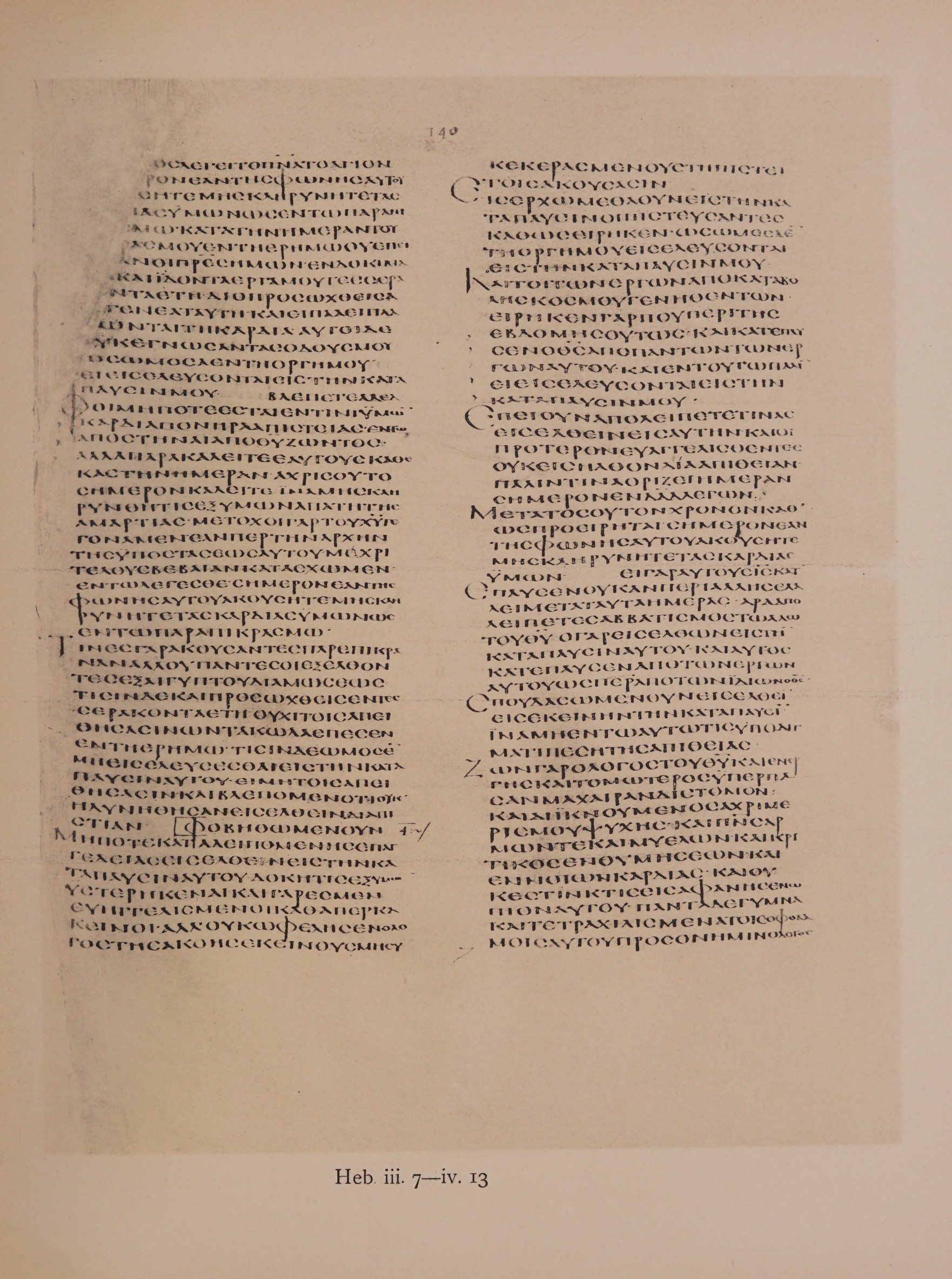
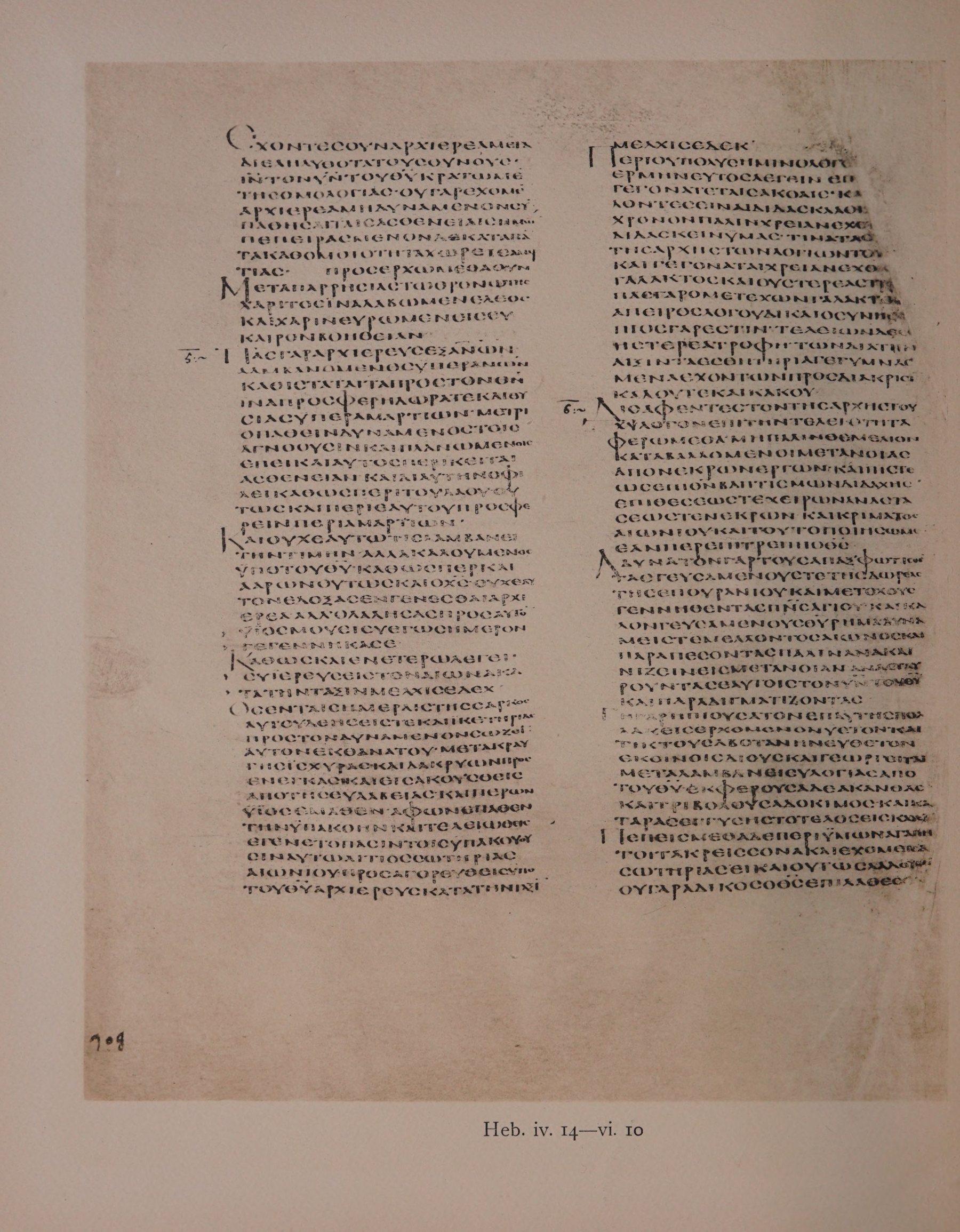
Hebrews 4 from Codex Alexandrinus (GA 02), a fifth-century Greek Bible held by the British Library (Royal MS 1 D. VIII). In the New Testament it is the chief witness to the Byzantine text in the Gospels and to the Alexandrian text in the rest of the New Testament. Its New Testament volume lacks Matthew 1:1-25:5, John 6:50-8:52 and 2 Corinthians 4:13-12:6.
This entry meets the strict three-criteria standard of the Theosis Library:
- Manuscript scan: the actual page(s) of Codex Alexandrinus containing this passage (folios 140r, 140v), reproduced from the British Museum's 1909 photographic facsimile edited by F. G. Kenyon, as digitised by the Getty Research Institute for the Internet Archive. The facsimile prints the verse range beneath each plate; that printed range was read for every page used and agrees with the INTF's NTVMR verse-level page index (CC BY 4.0). The page for each section now comes from the NTVMR transcription itself, which records the page and column on which every verse is written.
- Original text: the manuscript's own text, from a diplomatic transcription (see Greek text below), with Tischendorf's 8th critical edition (1869) for comparison.
- English translation: the King James Version (1611), retrieved verbatim from the public-domain bible-api.com endpoint.
Greek text: a diplomatic transcription of Codex Alexandrinus made by the Institut für Neutestamentliche Textforschung (INTF), Münster, for the New Testament Virtual Manuscript Room (NTVMR), published under a Creative Commons Attribution 4.0 licence. It gives the letters as the first scribe wrote them: no accents or breathings, the scribe's own spelling, and the sacred names in their contracted form (θς for θεος, ις for ιησους, κς for κυριος; the overline is not reproduced). Corrections by later hands are not shown. Letters in square brackets are not legible on the page and were restored by the transcribers, a dot under a letter marks an uncertain reading, and [...] marks text lost to damage. Beneath each section, for comparison, is Tischendorf's 8th critical edition (1869). Where the two differ, the transcription is what the manuscript says. Each section is shown with the page on which the transcription places its verses.
How was this verified? (Provenance)
Where on the image
Page from the NTVMR transcription (docID 20002): verses 1-2 on fol. 140r (facsimile leaf 241), col. 1.
1φοβηθωμεν ουν μηποτε καταλειπομενης επαγγελειας εισελθειν εις την καταπαυσιν αυτου δοκη τις εξ υμων υστερηκεναι 2και γαρ εσμεν ευηγγελισμενοι καθαπερ κακεινοι · αλλ ουκ ωφελησεν ο λογος της ακοης εκεινους μη συνκεκερασμενους τη πιστει τοις ακουσασιν
Compare: Tischendorf 8th edition (1869)
1Φοβηθῶμεν οὖν μήποτε καταλειπομένης ἐπαγγελίας εἰσελθεῖν εἰς τὴν κατάπαυσιν αὐτοῦ δοκῇ τις ἐξ ὑμῶν ὑστερηκέναι· 2καὶ γάρ ἐσμεν εὐηγγελισμένοι καθάπερ κἀκεῖνοι, ἀλλ’ οὐκ ὠφέλησεν ὁ λόγος τῆς ἀκοῆς ἐκείνους, μὴ συνκεκερασμένος τῇ πίστει τοῖς ἀκούσασιν.
1Let us therefore fear, lest, a promise being left us of entering into his rest, any of you should seem to come short of it. 2For unto us was the gospel preached, as well as unto them: but the word preached did not profit them, not being mixed with faith in them that heard it.
Where on the image
Page from the NTVMR transcription (docID 20002): verses 3-13 on fol. 140r (facsimile leaf 241), col. 2.
3εισερχωμεθα ουν εις την καταπαυσιν οι πιστευσαντες καθως ειρηκεν · ωμοσα εν τη οργη μου εισελευσονται εις την καταπαυσιν μου καιτοι των εργων απο καταβολης κοσμου γενηθεντων · 4ειρηκεν γαρ που περι της εβδομης ουτως · και κατεπαυσεν ο θς απο παντων των εργων αυτου · 5και εν τουτω παλιν ει εισελευσονται εις την καταπαυσιν μου · 6επει ουν απολειπετε τινας εισελθειν εις αυτην · και οι προτερον ευαγγελισθεντες ουκ εισηλθον δια απιθειαν · 7παλιν τινα οριζει ημεραν σημερον εν δαδ λεγων μετα τοσουτον χρονον καθως προειρηται · σημερον εαν της φωνης αυτου ακουσητε μη σκληρυνητε τας καρδιας υμων · 8ει γαρ αυτους ις κατεπαυσεν ουκ αν περι αλλης ελαλει μετα ταυτα ημερας · 9αρα απολειπετε σαββατισμος τω λαω του θυ · 10ο γαρ εισελθων εις την καταπαυσιν αυτου · και αυτος κατεπαυσεν απο των εργων αυτου ωσπερ απο των ιδιων ο θς · 11σπουδασωμεν ουν εισελθειν εις εκεινην την καταπαυσιν · ινα μη εν τω αυτω τις υποδιγματι πεση της απιθειας · 12ζων γαρ ο λογος του θυ και ενεργης και τομωτερος υπερ πασαν μαχαιραν διστομον · και διικνουμενος αχρι μερισμου ψυχης · και πνς αρμων τε και μυελων · και κριτικος ενθυμησεων · και εννοιων καρδιας · 13και ουκ εστιν κτισεις αφανης ενωπιον αυτου · παντα δε γυμνα και τετραχιλισμενα τοις οφθαλμοις αυτου προς ον ημιν ο λογος
Compare: Tischendorf 8th edition (1869)
3εἰσερχόμεθα γὰρ εἰς τὴν κατάπαυσιν οἱ πιστεύσαντες, καθὼς εἴρηκεν, ὡς ὤμοσα ἐν τῇ ὀργῇ μου, εἰ εἰσελεύσονται εἰς τὴν κατάπαυσίν μου, καίτοι τῶν ἔργων ἀπὸ καταβολῆς κόσμου γενηθέντων. 4εἴρηκεν γάρ που περὶ τῆς ἑβδόμης οὕτως, καὶ κατέπαυσεν ὁ θεὸς ἐν τῇ ἡμέρᾳ τῇ ἑβδόμῃ ἀπὸ πάντων τῶν ἔργων αὐτοῦ· 5καὶ ἐν τούτῳ πάλιν, εἰ εἰσελεύσονται εἰς τὴν κατάπαυσίν μου. 6ἐπεὶ οὖν ἀπολείπεται τινὰς εἰσελθεῖν εἰς αὐτήν, καὶ οἱ πρότερον εὐαγγελισθέντες οὐκ εἰσῆλθον δι’ ἀπείθειαν, 7πάλιν τινὰ ὁρίζει ἡμέραν, σήμερον, ἐν Δαυεὶδ λέγων μετὰ τοσοῦτον χρόνον, καθὼς προείρηται, σήμερον ἐὰν τῆς φωνῆς αὐτοῦ ἀκούσητε, μὴ σκληρύνητε τὰς καρδίας ὑμῶν. 8εἰ γὰρ αὐτοὺς Ἰησοῦς κατέπαυσεν, οὐκ ἂν περὶ ἄλλης ἐλάλει μετὰ ταῦτα ἡμέρας. 9ἄρα ἀπολείπεται σαββατισμὸς τῷ λαῷ τοῦ θεοῦ· 10ὁ γὰρ εἰσελθὼν εἰς τὴν κατάπαυσιν αὐτοῦ καὶ αὐτὸς κατέπαυσεν ἀπὸ τῶν ἔργων αὐτοῦ ὥσπερ ἀπὸ τῶν ἰδίων ὁ θεός. 11Σπουδάσωμεν οὖν εἰσελθεῖν εἰς ἐκείνην τὴν κατάπαυσιν, ἵνα μὴ ἐν τῷ αὐτῷ τις ὑποδείγματι πέσῃ τῆς ἀπειθείας. 12ζῶν γὰρ ὁ λόγος τοῦ θεοῦ καὶ ἐνεργὴς καὶ τομώτερος ὑπὲρ πᾶσαν μάχαιραν δίστομον καὶ διϊκνούμενος ἄχρι μερισμοῦ ψυχῆς καὶ πνεύματος, ἁρμῶν τε καὶ μυελῶν, καὶ κριτικὸς ἐνθυμήσεων καὶ ἐννοιῶν καρδίας· 13καὶ οὐκ ἔστιν κτίσις ἀφανὴς ἐνώπιον αὐτοῦ, πάντα δὲ γυμνὰ καὶ τετραχηλισμένα τοῖς ὀφθαλμοῖς αὐτοῦ, πρὸς ὃν ἡμῖν ὁ λόγος.
3For we which have believed do enter into rest, as he said, As I have sworn in my wrath, if they shall enter into my rest: although the works were finished from the foundation of the world. 4For he spake in a certain place of the seventh day on this wise, And God did rest the seventh day from all his works. 5And in this place again, If they shall enter into my rest. 6Seeing therefore it remaineth that some must enter therein, and they to whom it was first preached entered not in because of unbelief: 7Again, he limiteth a certain day, saying in David, To day, after so long a time; as it is said, To day if ye will hear his voice, harden not your hearts. 8For if Jesus had given them rest, then would he not afterward have spoken of another day. 9There remaineth therefore a rest to the people of God. 10For he that is entered into his rest, he also hath ceased from his own works, as God did from his. 11Let us labour therefore to enter into that rest, lest any man fall after the same example of unbelief. 12For the word of God is quick, and powerful, and sharper than any twoedged sword, piercing even to the dividing asunder of soul and spirit, and of the joints and marrow, and is a discerner of the thoughts and intents of the heart. 13Neither is there any creature that is not manifest in his sight: but all things are naked and opened unto the eyes of him with whom we have to do.
Where on the image
Page from the NTVMR transcription (docID 20002): verses 14-16 on fol. 140v (facsimile leaf 242), col. 1.
14εχοντες ουν αρχιερεα μεγα διεληλυθοτα τους ουνους · ιν τον υν του θυ κρατωμεν της ομολογιας · 15ου γαρ εχομεν αρχιερεα μη δυναμενον συνπαθησαι ταις ασθενειαις ημων πεπειρασμενον δε κατα παντα καθ ομοιοτητα χωρεις αμαρτιας · 16προσερχωμεθα ουν μετα παρρησιας τω θρονω της χαριτος ινα λαβωμεν ελεος και χαριν ευρωμεν εις ευκαιρον βοηθειαν ·
Compare: Tischendorf 8th edition (1869)
14Ἔχοντες οὖν ἀρχιερέα μέγαν διεληλυθότα τοὺς οὐρανούς, Ἰησοῦν τὸν υἱὸν τοῦ θεοῦ, κρατῶμεν τῆς ὁμολογίας· 15οὐ γὰρ ἔχομεν ἀρχιερέα μὴ δυνάμενον συνπαθῆσαι ταῖς ἀσθενείαις ἡμῶν, πεπειρασμένον δὲ κατὰ πάντα καθ’ ὁμοιότητα χωρὶς ἁμαρτίας. 16προσερχώμεθα οὖν μετὰ παρρησίας τῷ θρόνῳ τῆς χάριτος, ἵνα λάβωμεν ἔλεος καὶ χάριν εὕρωμεν εἰς εὔκαιρον βοήθειαν.
14Seeing then that we have a great high priest, that is passed into the heavens, Jesus the Son of God, let us hold fast our profession. 15For we have not an high priest which cannot be touched with the feeling of our infirmities; but was in all points tempted like as we are, yet without sin. 16Let us therefore come boldly unto the throne of grace, that we may obtain mercy, and find grace to help in time of need.
Cite
Sources
- Source: Codex Alexandrinus page images + NTVMR transcription (CC BY 4.0) + Tischendorf 8th edition + KJV (holding institution)
- Critical edition: Codex Alexandrinus transcription, NTVMR (INTF Münster, CC BY 4.0); Tischendorf 8th edition for comparison
← previous · → next · v cycle view · l back to library