Hebrews, Chapter 5 (Codex Alexandrinus)
Introduction
Hebrews 5 from Codex Alexandrinus (GA 02), a fifth-century Greek Bible held by the British Library (Royal MS 1 D. VIII). In the New Testament it is the chief witness to the Byzantine text in the Gospels and to the Alexandrian text in the rest of the New Testament. Its New Testament volume lacks Matthew 1:1-25:5, John 6:50-8:52 and 2 Corinthians 4:13-12:6.
This entry meets the strict three-criteria standard of the Theosis Library:
- Manuscript scan: the actual page(s) of Codex Alexandrinus containing this passage (folio 140v), reproduced from the British Museum's 1909 photographic facsimile edited by F. G. Kenyon, as digitised by the Getty Research Institute for the Internet Archive. The facsimile prints the verse range beneath each plate; that printed range was read for every page used and agrees with the INTF's NTVMR verse-level page index (CC BY 4.0). The page for each section now comes from the NTVMR transcription itself, which records the page and column on which every verse is written.
- Original text: the manuscript's own text, from a diplomatic transcription (see Greek text below), with Tischendorf's 8th critical edition (1869) for comparison.
- English translation: the King James Version (1611), retrieved verbatim from the public-domain bible-api.com endpoint.
Greek text: a diplomatic transcription of Codex Alexandrinus made by the Institut für Neutestamentliche Textforschung (INTF), Münster, for the New Testament Virtual Manuscript Room (NTVMR), published under a Creative Commons Attribution 4.0 licence. It gives the letters as the first scribe wrote them: no accents or breathings, the scribe's own spelling, and the sacred names in their contracted form (θς for θεος, ις for ιησους, κς for κυριος; the overline is not reproduced). Corrections by later hands are not shown. Letters in square brackets are not legible on the page and were restored by the transcribers, a dot under a letter marks an uncertain reading, and [...] marks text lost to damage. Beneath each section, for comparison, is Tischendorf's 8th critical edition (1869). Where the two differ, the transcription is what the manuscript says. Each section is shown with the page on which the transcription places its verses.
How was this verified? (Provenance)
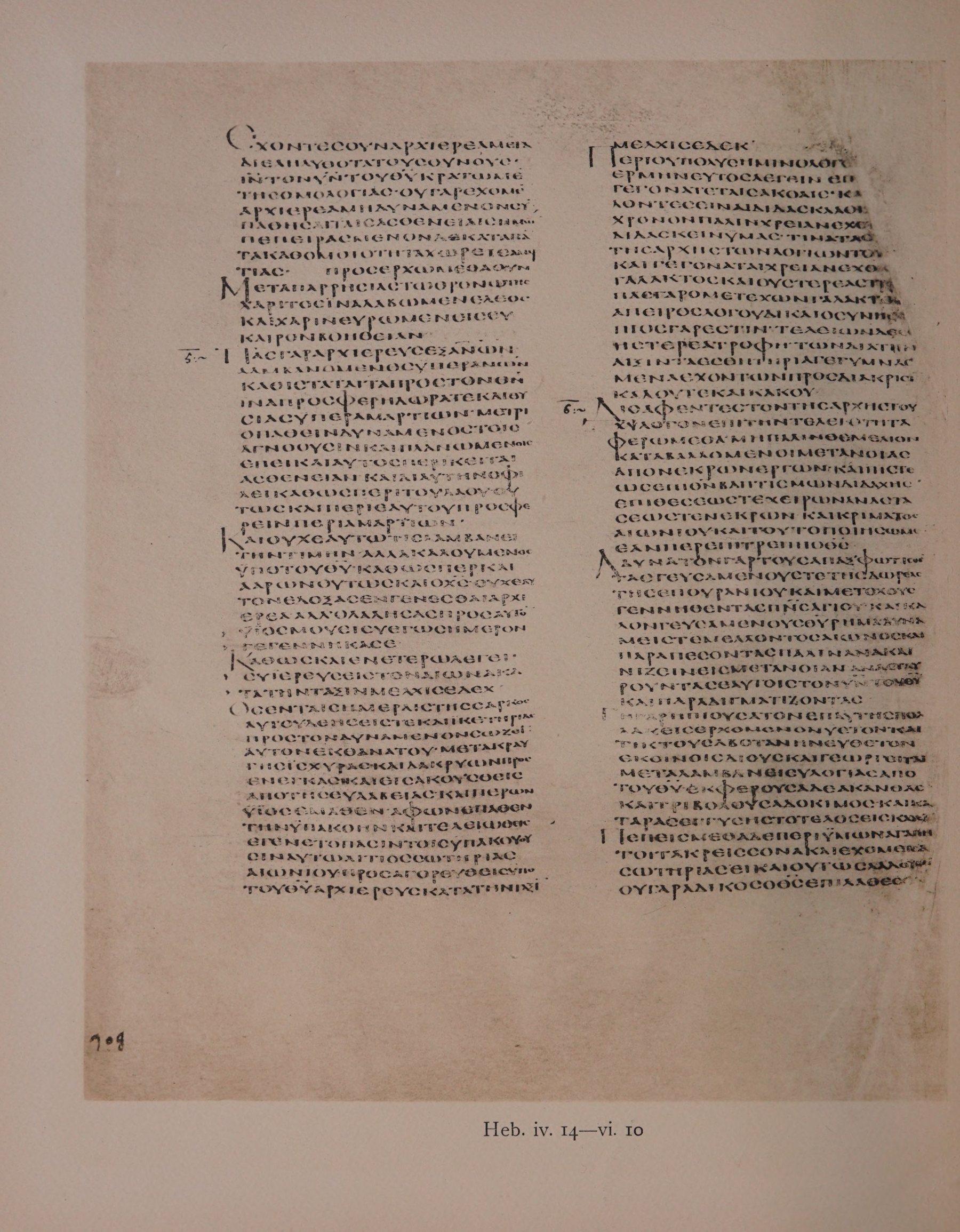
Where on the image
Page from the NTVMR transcription (docID 20002): verses 1-10 on fol. 140v (facsimile leaf 242), col. 1.
1πας γαρ αρχιερευς εξ ανων λαμβανομενος υπερ ανων καθισταται τα προς τον θν ινα προσφερη δωρα τε και θυσιας υπερ αμαρτιων · 2μετριοπαθειν δυναμενος τοις αγνοουσιν και πλανωμενοις · επει και αυτος περικειται ασθενειαν · 3και δι αυτην οφιλει καθως περι του λαου · ουτως και περι εαυτου προσφερειν περι αμαρτιων · 4και ουχ εαυτω τις λαμβανει την τιμην · αλλα καλουμενος υπο του θυ · καθωσπερ και ααρων 5ουτως και ο χς · ουχ εαυτον εδοξασεν γενεσθαι αρχιερεα · αλλ ο λαλησας προς αυτον υιος μου ει συ εγω σημερον γεγεννηκα σε · 6καθως και εν ετερω λεγει · συ ιερευς εις τον αιωνα κατα την ταξιν μελχισεδεχ 7ος εν ταις ημεραις της σαρκος αυτου δεησεις τε και ικετηριας προς τον δυναμενον σωζειν αυτον εκ θανατου · μετα κραυγης ισχυρας · και δακρυων προσενεγκας και εισακουσθεις απο της ευλαβειας · 8καιπερ ων υιος εμαθεν · αφ ων επαθεν την υπακοην 9και τελειωθεις εγενετο πασιν τοις υπακουουσιν αυτω αιτιος σωτηριας αιωνιου · 10προσαγορευθεις υπο του θυ αρχιερευς κατα την ταξιν μελχισεδεκ ·
Compare: Tischendorf 8th edition (1869)
1Πᾶς γὰρ ἀρχιερεὺς ἐξ ἀνθρώπων λαμβανόμενος ὑπὲρ ἀνθρώπων καθίσταται τὰ πρὸς τὸν θεόν, ἵνα προσφέρῃ δῶρά τε καὶ θυσίας ὑπὲρ ἁμαρτιῶν, 2μετριοπαθεῖν δυνάμενος τοῖς ἀγνοοῦσιν καὶ πλανωμένοις, ἐπεὶ καὶ αὐτὸς περίκειται ἀσθένειαν, 3καὶ δι’ αὐτὴν ὀφείλει καθὼς περὶ τοῦ λαοῦ οὕτως καὶ περὶ ἑαυτοῦ προσφέρειν περὶ ἁμαρτιῶν. 4καὶ οὐχ ἑαυτῷ τις λαμβάνει τὴν τιμήν, ἀλλὰ καλούμενος ὑπὸ τοῦ θεοῦ, καθώσπερ καὶ Ἀαρών. 5οὕτως καὶ ὁ Χριστὸς οὐχ ἑαυτὸν ἐδόξασεν γενηθῆναι ἀρχιερέα, ἀλλ’ ὁ λαλήσας πρὸς αὐτόν, υἱός μου εἶ σύ, ἐγὼ σήμερον γεγέννηκά σε· 6καθὼς καὶ ἐν ἑτέρῳ λέγει, σὺ ἱερεὺς εἰς τὸν αἰῶνα κατὰ τὴν τάξιν Μελχισέδεκ. 7ὃς ἐν ταῖς ἡμέραις τῆς σαρκὸς αὐτοῦ, δεήσεις τε καὶ ἱκετηρίας πρὸς τὸν δυνάμενον σῴζειν αὐτὸν ἐκ θανάτου μετὰ κραυγῆς ἰσχυρᾶς καὶ δακρύων προσενέγκας καὶ εἰσακουσθεὶς ἀπὸ τῆς εὐλαβείας, 8καίπερ ὢν υἱὸς ἔμαθεν ἀφ’ ὧν ἔπαθεν τὴν ὑπακοήν· 9καὶ τελειωθεὶς ἐγένετο πᾶσιν τοῖς ὑπακούουσιν αὐτῷ αἴτιος σωτηρίας αἰωνίου, 10προσαγορευθεὶς ὑπὸ τοῦ θεοῦ ἀρχιερεὺς κατὰ τὴν τάξιν Μελχισέδεκ.
1For every high priest taken from among men is ordained for men in things pertaining to God, that he may offer both gifts and sacrifices for sins: 2Who can have compassion on the ignorant, and on them that are out of the way; for that he himself also is compassed with infirmity. 3And by reason hereof he ought, as for the people, so also for himself, to offer for sins. 4And no man taketh this honour unto himself, but he that is called of God, as was Aaron. 5So also Christ glorified not himself to be made an high priest; but he that said unto him, Thou art my Son, to day have I begotten thee. 6As he saith also in another place, Thou art a priest for ever after the order of Melchisedec. 7Who in the days of his flesh, when he had offered up prayers and supplications with strong crying and tears unto him that was able to save him from death, and was heard in that he feared; 8Though he were a Son, yet learned he obedience by the things which he suffered; 9And being made perfect, he became the author of eternal salvation unto all them that obey him; 10Called of God an high priest after the order of Melchisedec.
Where on the image
Page from the NTVMR transcription (docID 20002): verses 11-14 on fol. 140v (facsimile leaf 242), col. 2.
11περι ου πολυς ημιν ο λογο̣[ς] [και] [δυσ]ερμηνευτος λεγειν επ[ει] [νωθροι] γεγονατε ταις ακοαις · 12κα[ι] [γαρ] [οφει]λοντες ειναι διδασκαλοι [δια] [τον] χρονον παλιν χρειαν εχε[τε] [του] διδασκειν υμας · τινα τα σ[τοιχεια] της αρχης των λογιων του̣ [θυ] και γεγοναται χρειαν εχο[ντες] γαλακτος και ου στερεας τρο̣[φης] 13πας γαρ ο μετεχων γαλακτο[ς] απειρος λογου δικαιοσυνης [νη]πιος γαρ εστιν · 14τελειων δε εσ̣[τιν] η στερεα τροφη · των δια την αιξιν τα εσθητηρια γεγυμνασμενα εχοντων προς διακρισιν̣ καλου τε και κακου
Compare: Tischendorf 8th edition (1869)
11Περὶ οὗ πολὺς ἡμῖν ὁ λόγος καὶ δυσερμήνευτος λέγειν, ἐπεὶ νωθροὶ γεγόνατε ταῖς ἀκοαῖς. 12καὶ γὰρ ὀφείλοντες εἶναι διδάσκαλοι διὰ τὸν χρόνον, πάλιν χρείαν ἔχετε τοῦ διδάσκειν ὑμᾶς τινὰ τὰ στοιχεῖα τῆς ἀρχῆς τῶν λογίων τοῦ θεοῦ, καὶ γεγόνατε χρείαν ἔχοντες γάλακτος, οὐ στερεᾶς τροφῆς. 13πᾶς γὰρ ὁ μετέχων γάλακτος ἄπειρος λόγου δικαιοσύνης, νήπιος γάρ ἐστιν· 14τελείων δέ ἐστιν ἡ στερεὰ τροφή, τῶν διὰ τὴν ἕξιν τὰ αἰσθητήρια γεγυμνασμένα ἐχόντων πρὸς διάκρισιν καλοῦ τε καὶ κακοῦ.
11Of whom we have many things to say, and hard to be uttered, seeing ye are dull of hearing. 12For when for the time ye ought to be teachers, ye have need that one teach you again which be the first principles of the oracles of God; and are become such as have need of milk, and not of strong meat. 13For every one that useth milk is unskilful in the word of righteousness: for he is a babe. 14But strong meat belongeth to them that are of full age, even those who by reason of use have their senses exercised to discern both good and evil.
Cite
Sources
- Source: Codex Alexandrinus page images + NTVMR transcription (CC BY 4.0) + Tischendorf 8th edition + KJV (holding institution)
- Critical edition: Codex Alexandrinus transcription, NTVMR (INTF Münster, CC BY 4.0); Tischendorf 8th edition for comparison
← previous · → next · v cycle view · l back to library