James, Chapter 3 (Codex Alexandrinus)
Introduction
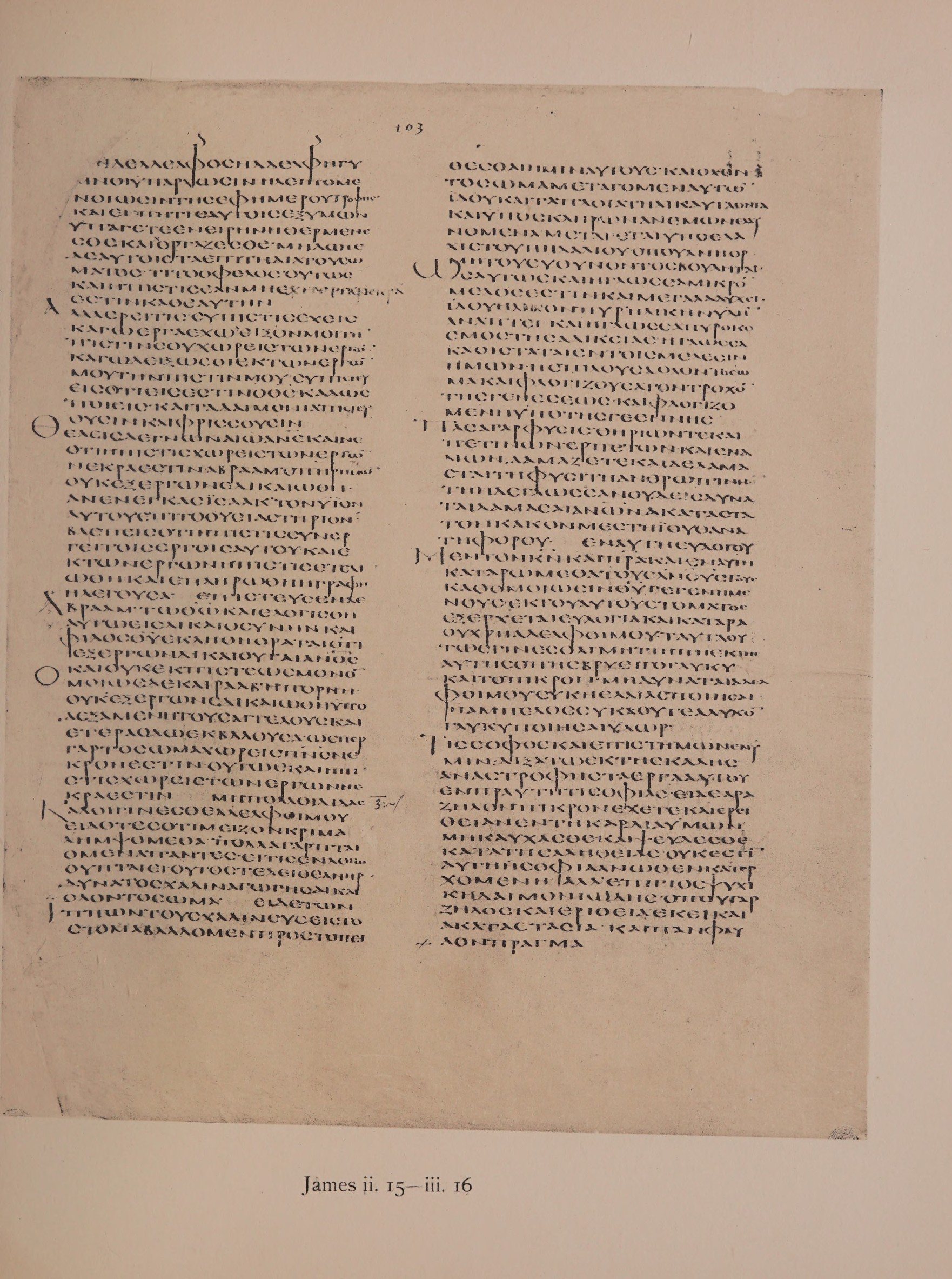
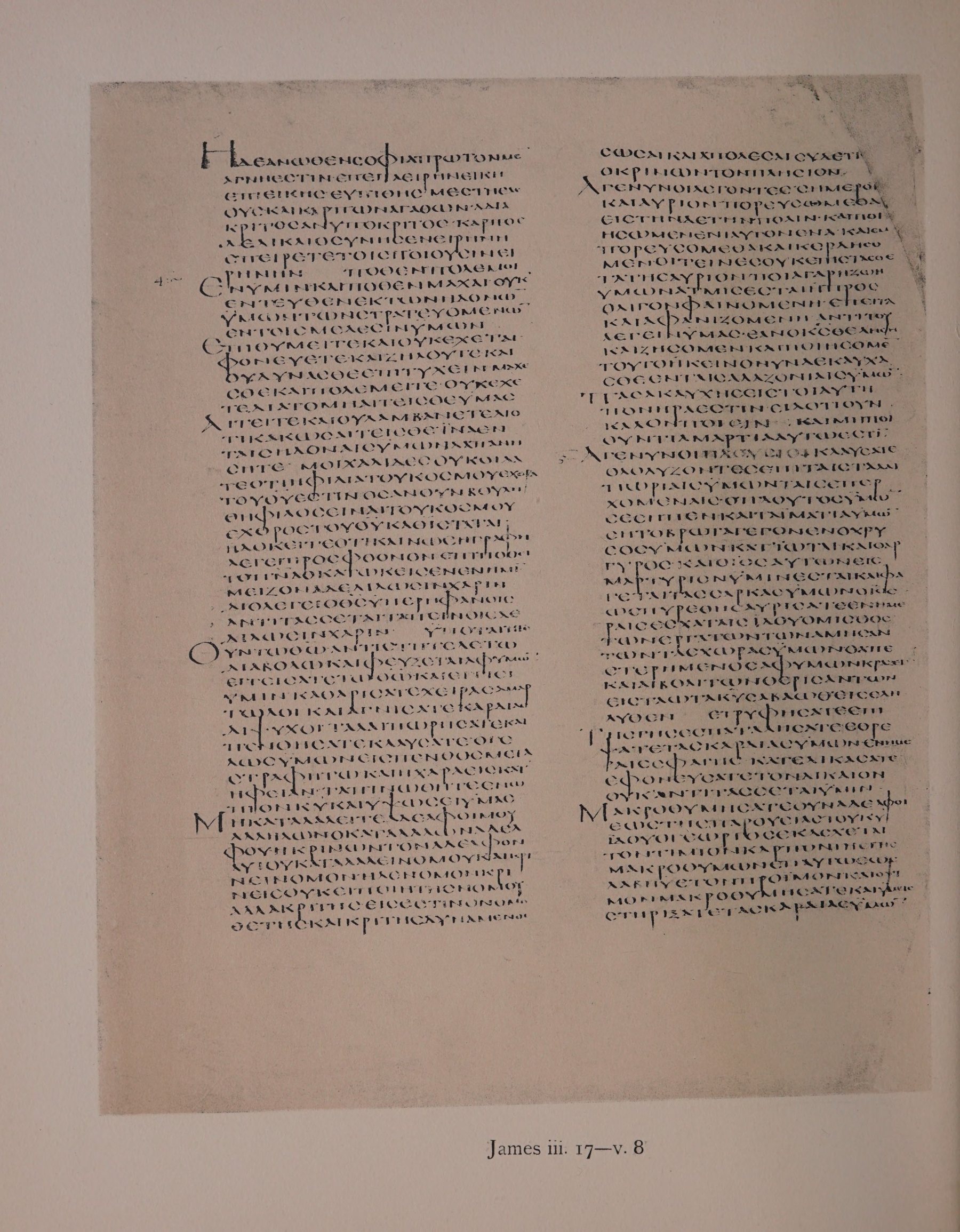
James 3 from Codex Alexandrinus (GA 02), a fifth-century Greek Bible held by the British Library (Royal MS 1 D. VIII). In the New Testament it is the chief witness to the Byzantine text in the Gospels and to the Alexandrian text in the rest of the New Testament. Its New Testament volume lacks Matthew 1:1-25:5, John 6:50-8:52 and 2 Corinthians 4:13-12:6.
This entry meets the strict three-criteria standard of the Theosis Library:
- Manuscript scan: the actual page(s) of Codex Alexandrinus containing this passage (folios 103r, 103v), reproduced from the British Museum's 1909 photographic facsimile edited by F. G. Kenyon, as digitised by the Getty Research Institute for the Internet Archive. The facsimile prints the verse range beneath each plate; that printed range was read for every page used and agrees with the INTF's NTVMR verse-level page index (CC BY 4.0). The page for each section now comes from the NTVMR transcription itself, which records the page and column on which every verse is written.
- Original text: the manuscript's own text, from a diplomatic transcription (see Greek text below), with Tischendorf's 8th critical edition (1869) for comparison.
- English translation: the King James Version (1611), retrieved verbatim from the public-domain bible-api.com endpoint.
Greek text: a diplomatic transcription of Codex Alexandrinus made by the Institut für Neutestamentliche Textforschung (INTF), Münster, for the New Testament Virtual Manuscript Room (NTVMR), published under a Creative Commons Attribution 4.0 licence. It gives the letters as the first scribe wrote them: no accents or breathings, the scribe's own spelling, and the sacred names in their contracted form (θς for θεος, ις for ιησους, κς for κυριος; the overline is not reproduced). Corrections by later hands are not shown. Letters in square brackets are not legible on the page and were restored by the transcribers, a dot under a letter marks an uncertain reading, and [...] marks text lost to damage. Beneath each section, for comparison, is Tischendorf's 8th critical edition (1869). Where the two differ, the transcription is what the manuscript says. Each section is shown with the page on which the transcription places its verses.
How was this verified? (Provenance)
Where on the image
Page from the NTVMR transcription (docID 20002): verses 1-3 on fol. 103r (facsimile leaf 167), col. 1.
1μη πολλοι διδασκαλοι γινεσθε αδελφοι μου ειδοτες οτι μειζον κριμα λημψομεθα 2πολλα γαρ πταιομεν απαντες · ει τις εν λογω ου πταιει · ουτος τελειος ανηρ δυνατος χαλιναγωγησαι και ολον το σωμα · 3ΕΙΔΕ των ιππων τους χαλινους εις το στομα βαλλομεν προς το πειθεσθαι ημιν αυτους · και ολον το σωμα μεταγομεν αυτων
Compare: Tischendorf 8th edition (1869)
1Μὴ πολλοὶ διδάσκαλοι γίνεσθε, ἀδελφοί μου, εἰδότες ὅτι μεῖζον κρίμα λημψόμεθα. 2πολλὰ γὰρ πταίομεν ἅπαντες. εἴ τις ἐν λόγῳ οὐ πταίει, οὗτος τέλειος ἀνήρ, δυνατὸς χαλιναγωγῆσαι καὶ ὅλον τὸ σῶμα. 3εἰ δὲ τῶν ἵππων τοὺς χαλινοὺς εἰς τὰ στόματα βάλλομεν εἰς τὸ πείθεσθαι αὐτοὺς ἡμῖν, καὶ ὅλον τὸ σῶμα αὐτῶν μετάγομεν.
1My brethren, be not many masters, knowing that we shall receive the greater condemnation. 2For in many things we offend all. If any man offend not in word, the same is a perfect man, and able also to bridle the whole body. 3Behold, we put bits in the horses’ mouths, that they may obey us; and we turn about their whole body.
Where on the image
Page from the NTVMR transcription (docID 20002): verses 4-10 on fol. 103r (facsimile leaf 167), col. 2.
4ιδου και τα πλοια τηλικαυτα οντα και υπο σκληρων ανεμων ελαυνομενα · μεταγεται υπο ελαχιστου πηδαλιου οπου αν η ορμη του ευθυνοντος βουληται · 5ωσαυτως και η γλωσσα μικρον μελος εστιν · και μεγαλα αυχει ιδου ο̣λι̣γ̣ον πυρ ηλικην υλην αναπτει · 6και η γλωσσα πυρ ο κοσμος της αδικειας · η γλωσσα καθισταται εν τοις μελεσιν ημων · η σπιλουσα ολον το σωμα και φλογιζουσα τον τροχον της γενεσεως · και φλογιζομενη υπο της γεεννης 7πασα γαρ φυσις · θηριων τε και πετινων · ερπετων · και εναλιων δαμαζετε και δεδαμασται τη φυσι τη ανθρωπινω̣ν 8την δε γλωσσαν ουδεις δυναται δαμασαι ανων · ακαταστατον κακον μεστη ιου θανατηφορου · 9εν αυτη ευλογουμεν τον κν και πρα · και εν αυτη καταρωμεθα τους ανους τους καθ ομοιωσιν θυ γεγενημενους · 10εκ του αυτου στοματος εξερχεται ευλογια και καταρα ου χρη αδελφοι μου ταυτα ουτως γινεσθαι ·
Compare: Tischendorf 8th edition (1869)
4ἰδοὺ καὶ τὰ πλοῖα, τηλικαῦτα ὄντα καὶ ὑπὸ ἀνέμων σκληρῶν ἐλαυνόμενα, μετάγεται ὑπὸ ἐλαχίστου πηδαλίου ὅπου ἡ ὁρμὴ τοῦ εὐθύνοντος βούλεται· 5οὕτως καὶ ἡ γλῶσσα μικρὸν μέλος ἐστὶν καὶ μεγάλα αὐχεῖ. ἰδοὺ ἡλίκον πῦρ ἡλίκην ὕλην ἀνάπτει· 6ἡ γλῶσσα πῦρ, ὁ κόσμος τῆς ἀδικίας, ἡ γλῶσσα καθίσταται ἐν τοῖς μέλεσιν ἡμῶν, ἡ σπιλοῦσα ὅλον τὸ σῶμα καὶ φλογίζουσα τὸν τροχὸν τῆς γενέσεως καὶ φλογιζομένη ὑπὸ τῆς γεέννης. 7πᾶσα γὰρ φύσις θηρίων τε καὶ πετεινῶν ἑρπετῶν τε καὶ ἐναλίων δαμάζεται καὶ δεδάμασται τῇ φύσει τῇ ἀνθρωπίνῃ· 8τὴν δὲ γλῶσσαν οὐδεὶς δύναται ἀνθρώπων δαμάσαι· ἀκατάστατον κακόν, μεστὴ ἰοῦ θανατηφόρου. 9ἐν αὐτῇ εὐλογοῦμεν τὸν κύριον καὶ πατέρα, καὶ ἐν αὐτῇ καταρώμεθα τοὺς ἀνθρώπους τοὺς καθ’ ὁμοίωσιν θεοῦ γεγονότας· 10ἐκ τοῦ αὐτοῦ στόματος ἐξέρχεται εὐλογία καὶ κατάρα. οὐ χρή, ἀδελφοί μου, ταῦτα οὕτως γίνεσθαι.
4Behold also the ships, which though they be so great, and are driven of fierce winds, yet are they turned about with a very small helm, whithersoever the governor listeth. 5Even so the tongue is a little member, and boasteth great things. Behold, how great a matter a little fire kindleth! 6And the tongue is a fire, a world of iniquity: so is the tongue among our members, that it defileth the whole body, and setteth on fire the course of nature; and it is set on fire of hell. 7For every kind of beasts, and of birds, and of serpents, and of things in the sea, is tamed, and hath been tamed of mankind: 8But the tongue can no man tame; it is an unruly evil, full of deadly poison. 9Therewith bless we God, even the Father; and therewith curse we men, which are made after the similitude of God. 10Out of the same mouth proceedeth blessing and cursing. My brethren, these things ought not so to be.
Where on the image
Page from the NTVMR transcription (docID 20002): verses 11-16 on fol. 103r (facsimile leaf 167), col. 2.
11μητι η πη εκ της αυτης οπης βρυει το γλυκυ και το πικρον · 12μη δυναται αδελφοι μου συκη ελαιας ποιησαι η αμπελος συκα · ουτε αλυκον γλυκυ ποιησαι υδωρ · 13τις σοφος και επιστημων εν υμιν · διξατω εκ της καλης αναστροφης τα εργα αυτου εν πραυτητι σοφιας · 14ει δε αρα ζηλον πικρον εχετε και ερειθειαν εν τη καρδια υμων μη καυχασθε · και ψευδεσθε κατα της αληθειας · 15ουκ εστιν αυτη η σοφια ανωθεν κατερχομενη · αλλ επιγιος ψυχικη δαιμονιωδης · 16οπου γαρ ζηλος και εριθεια · εκει και ακαταστασια · και παν φαυλον πραγμα
Compare: Tischendorf 8th edition (1869)
11μήτι ἡ πηγὴ ἐκ τῆς αὐτῆς ὀπῆς βρύει τὸ γλυκὺ καὶ τὸ πικρόν; 12μὴ δύναται, ἀδελφοί μου, συκῆ ἐλαίας ποιῆσαι ἢ ἄμπελος σῦκα; οὔτε ἁλυκὸν γλυκὺ ποιῆσαι ὕδωρ. 13Τίς σοφὸς καὶ ἐπιστήμων ἐν ὑμῖν; δειξάτω ἐκ τῆς καλῆς ἀναστροφῆς τὰ ἔργα αὐτοῦ ἐν πραΰτητι σοφίας. 14εἰ δὲ ζῆλον πικρὸν ἔχετε καὶ ἐριθείαν ἐν τῇ καρδίᾳ ὑμῶν, μὴ κατακαυχᾶσθε τῆς ἀληθείας καὶ ψεύδεσθε. 15οὐκ ἔστιν αὕτη ἡ σοφία ἄνωθεν κατερχομένη, ἀλλὰ ἐπίγειος, ψυχική, δαιμονιώδης· 16ὅπου γὰρ ζῆλος καὶ ἐριθεία, ἐκεῖ ἀκαταστασία καὶ πᾶν φαῦλον πρᾶγμα.
11Doth a fountain send forth at the same place sweet water and bitter? 12Can the fig tree, my brethren, bear olive berries? either a vine, figs? so can no fountain both yield salt water and fresh. 13Who is a wise man and endued with knowledge among you? let him shew out of a good conversation his works with meekness of wisdom. 14But if ye have bitter envying and strife in your hearts, glory not, and lie not against the truth. 15This wisdom descendeth not from above, but is earthly, sensual, devilish. 16For where envying and strife is, there is confusion and every evil work.
Where on the image
Page from the NTVMR transcription (docID 20002): verses 17-18 on fol. 103v (facsimile leaf 168), col. 1.
17η δε ανωθεν σοφια πρωτον μεν αγνη εστιν · επειτα ειρηνεικη επιεικης ευπιθης μεστη ελεους και καρπων αγαθων · αδιακριτος ανυποκριτος · 18καρπος δε δικαιοσυνης εν ειρηνη σπειρετε τοις ποιουσιν ειρηνην
Compare: Tischendorf 8th edition (1869)
17ἡ δὲ ἄνωθεν σοφία πρῶτον μὲν ἁγνή ἐστιν, ἔπειτα εἰρηνική, ἐπιεικής, εὐπειθής, μεστὴ ἐλέους καὶ καρπῶν ἀγαθῶν, ἀδιάκριτος, ἀνυπόκριτος· 18καρπὸς δὲ δικαιοσύνης ἐν εἰρήνῃ σπείρεται τοῖς ποιοῦσιν εἰρήνην.
17But the wisdom that is from above is first pure, then peaceable, gentle, and easy to be intreated, full of mercy and good fruits, without partiality, and without hypocrisy. 18And the fruit of righteousness is sown in peace of them that make peace.
Cite
Sources
- Source: Codex Alexandrinus page images + NTVMR transcription (CC BY 4.0) + Tischendorf 8th edition + KJV (holding institution)
- Critical edition: Codex Alexandrinus transcription, NTVMR (INTF Münster, CC BY 4.0); Tischendorf 8th edition for comparison
← previous · → next · v cycle view · l back to library