James, Chapter 4 (Codex Alexandrinus)
Introduction
James 4 from Codex Alexandrinus (GA 02), a fifth-century Greek Bible held by the British Library (Royal MS 1 D. VIII). In the New Testament it is the chief witness to the Byzantine text in the Gospels and to the Alexandrian text in the rest of the New Testament. Its New Testament volume lacks Matthew 1:1-25:5, John 6:50-8:52 and 2 Corinthians 4:13-12:6.
This entry meets the strict three-criteria standard of the Theosis Library:
- Manuscript scan: the actual page(s) of Codex Alexandrinus containing this passage (folio 103v), reproduced from the British Museum's 1909 photographic facsimile edited by F. G. Kenyon, as digitised by the Getty Research Institute for the Internet Archive. The facsimile prints the verse range beneath each plate; that printed range was read for every page used and agrees with the INTF's NTVMR verse-level page index (CC BY 4.0). The page for each section now comes from the NTVMR transcription itself, which records the page and column on which every verse is written.
- Original text: the manuscript's own text, from a diplomatic transcription (see Greek text below), with Tischendorf's 8th critical edition (1869) for comparison.
- English translation: the King James Version (1611), retrieved verbatim from the public-domain bible-api.com endpoint.
Greek text: a diplomatic transcription of Codex Alexandrinus made by the Institut für Neutestamentliche Textforschung (INTF), Münster, for the New Testament Virtual Manuscript Room (NTVMR), published under a Creative Commons Attribution 4.0 licence. It gives the letters as the first scribe wrote them: no accents or breathings, the scribe's own spelling, and the sacred names in their contracted form (θς for θεος, ις for ιησους, κς for κυριος; the overline is not reproduced). Corrections by later hands are not shown. Letters in square brackets are not legible on the page and were restored by the transcribers, a dot under a letter marks an uncertain reading, and [...] marks text lost to damage. Beneath each section, for comparison, is Tischendorf's 8th critical edition (1869). Where the two differ, the transcription is what the manuscript says. Each section is shown with the page on which the transcription places its verses.
How was this verified? (Provenance)
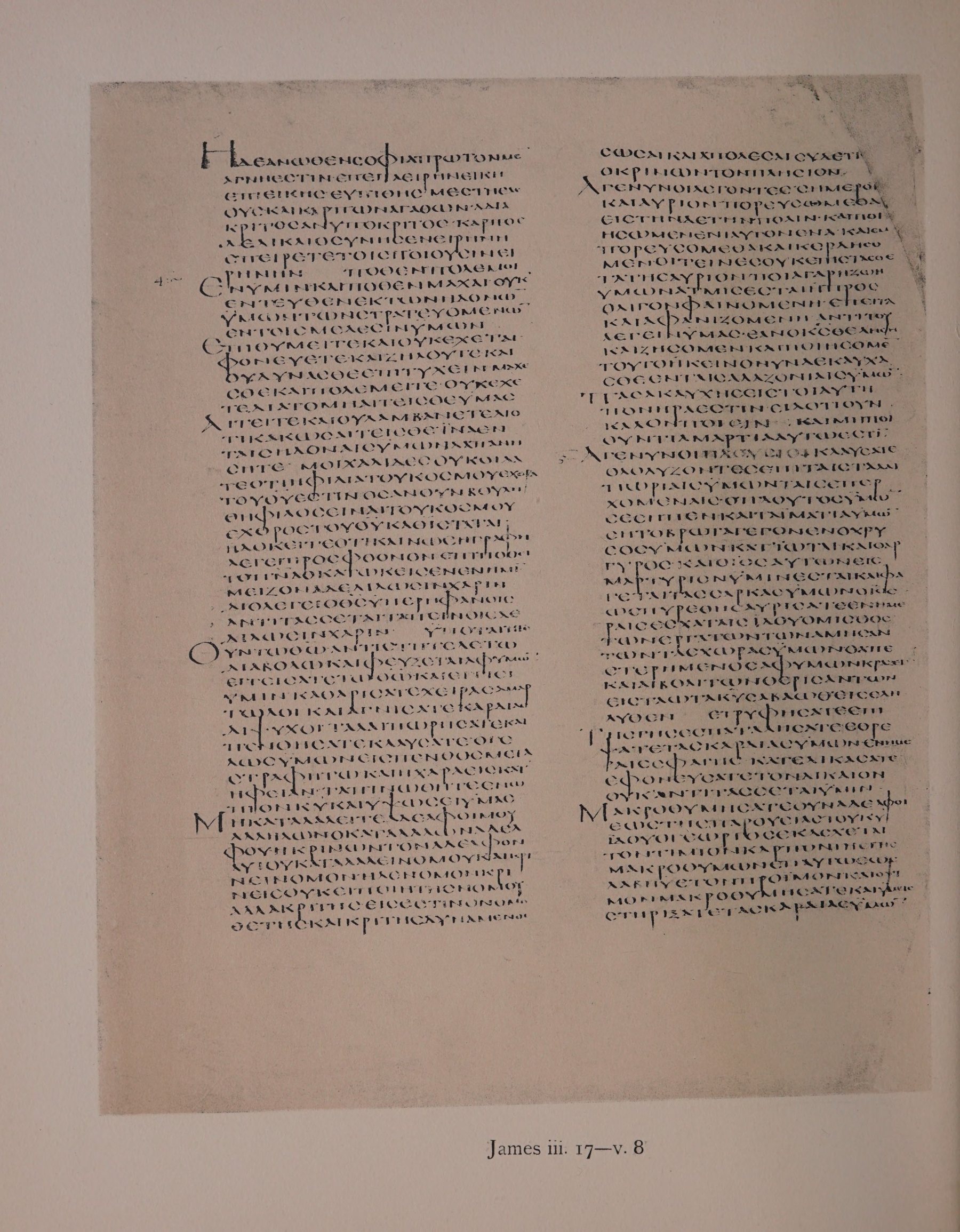
Where on the image
Page from the NTVMR transcription (docID 20002): verses 1-12 on fol. 103v (facsimile leaf 168), col. 1.
1ποθεν πολεμοι εν υμιν και ποθεν μαχαι · ουκ εντευθεν εκ των ηδονων υμων των στρατευομενων εν τοις μελεσιν υμων 2επιθυμειτε και ουκ εχεται φονευετε και ζηλουτε και ου δυνασθε επιτυχειν μαχεσθε και πολεμειτε · ουχ εχετε δια το μη αιτεισθε υμας 3αιτειτε και ου λαμβανετε διοτι κακως αιτεισθε · ινα εν ταις ηδοναις υμων δαπανησητε · 4μοιχαλιδες ουκ οιδατε οτι η φιλια του κοσμου εχθρα του θυ εστιν ος αν ουν βουληθη φιλος ειναι του κοσμου εχθρος του θυ καθισταται · 5η δοκειτε οτι καινως η γραφη λεγει προς φθονον επιποθει το πνα ο κατωκεισεν εν ημιν 6μειζονα δε διδωσιν χαριν διο λεγει ο θς υπερηφανοις αντιτασσεται ταπεινοις δε διδωσιν χαριν · 7υποταγητε ουν τω θω · αντιστητε δε τω διαβολω και φευξεται αφ υμων 8εγγεισατε τω θω και εγγιει υμιν · καθαρισατε χειρας αμαρτωλοι · και αγνισατε καρδιας διψυχοι · 9ταλαιπωρησατε και πενθησατε κλαυσατε · ο γελως υμων εις πενθος μεταστραφητω και η χαρα εις κατηφειαν · 10ταπινωθητε ενωπιον κυ και υψωσει υμας 11μη καταλαλειτε αδελφοι μου αλληλων ο καταλαλων αδελφου η κρινων τον αδελφον αυτου καταλαλει νομου και κρινει νομον · η δε νομον κρινεις ουκ ει ποιητης νομου αλλα κριτης 12εις εστιν ο νομοθετης και κριτης δυναμενος σωσαι και απολεσαι συ δε τι[ς] [ει] ο κρινων τον πλησιον
Compare: Tischendorf 8th edition (1869)
1Πόθεν πόλεμοι καὶ πόθεν μάχαι ἐν ὑμῖν; οὐκ ἐντεῦθεν, ἐκ τῶν ἡδονῶν ὑμῶν τῶν στρατευομένων ἐν τοῖς μέλεσιν ὑμῶν; 2ἐπιθυμεῖτε, καὶ οὐκ ἔχετε· φονεύετε καὶ ζηλοῦτε, καὶ οὐ δύνασθε ἐπιτυχεῖν· μάχεσθε καὶ πολεμεῖτε. καὶ οὐκ ἔχετε διὰ τὸ μὴ αἰτεῖσθαι ὑμᾶς· 3αἰτεῖτε καὶ οὐ λαμβάνετε, διότι κακῶς αἰτεῖσθε, ἵνα ἐν ταῖς ἡδοναῖς ὑμῶν δαπανήσητε. 4μοιχαλίδες, οὐκ οἴδατε ὅτι ἡ φιλία τοῦ κόσμου ἔχθρα ἐστὶν τῷ θεῷ; ὃς ἐὰν οὖν βουληθῇ φίλος εἶναι τοῦ κόσμου, ἐχθρὸς τοῦ θεοῦ καθίσταται. 5ἢ δοκεῖτε ὅτι κενῶς ἡ γραφὴ λέγει, πρὸς φθόνον ἐπιποθεῖ τὸ πνεῦμα ὃ κατῴκισεν ἐν ἡμῖν; 6μείζονα δὲ δίδωσιν χάριν· διὸ λέγει, ὁ θεὸς ὑπερηφάνοις ἀντιτάσσεται, ταπεινοῖς δὲ δίδωσιν χάριν. 7ὑποτάγητε οὖν τῷ θεῷ· ἀντίστητε δὲ τῷ διαβόλῳ, καὶ φεύξεται ἀφ’ ὑμῶν· 8ἐγγίσατε τῷ θεῷ, καὶ ἐγγιεῖ ὑμῖν. καθαρίσατε χεῖρας, ἁμαρτωλοί, καὶ ἁγνίσατε καρδίας, δίψυχοι. 9ταλαιπωρήσατε καὶ πενθήσατε, κλαύσατε· ὁ γέλως ὑμῶν εἰς πένθος μετατραπήτω καὶ ἡ χαρὰ εἰς κατήφειαν. 10ταπεινώθητε ἐνώπιον κυρίου, καὶ ὑψώσει ὑμᾶς. 11Μὴ καταλαλεῖτε ἀλλήλων, ἀδελφοί· ὁ καταλαλῶν ἀδελφοῦ ἢ κρίνων τὸν ἀδελφὸν αὐτοῦ καταλαλεῖ νόμου καὶ κρίνει νόμον· εἰ δὲ νόμον κρίνεις, οὐκ εἶ ποιητὴς νόμου ἀλλὰ κριτής. 12εἷς ἐστιν ὁ νομοθέτης καὶ κριτής, ὁ δυνάμενος σῶσαι καὶ ἀπολέσαι· σὺ δὲ τίς εἶ, ὁ κρίνων τὸν πλησίον;
1From whence come wars and fightings among you? come they not hence, even of your lusts that war in your members? 2Ye lust, and have not: ye kill, and desire to have, and cannot obtain: ye fight and war, yet ye have not, because ye ask not. 3Ye ask, and receive not, because ye ask amiss, that ye may consume it upon your lusts. 4Ye adulterers and adulteresses, know ye not that the friendship of the world is enmity with God? whosoever therefore will be a friend of the world is the enemy of God. 5Do ye think that the scripture saith in vain, The spirit that dwelleth in us lusteth to envy? 6But he giveth more grace. Wherefore he saith, God resisteth the proud, but giveth grace unto the humble. 7Submit yourselves therefore to God. Resist the devil, and he will flee from you. 8Draw nigh to God, and he will draw nigh to you. Cleanse your hands, ye sinners; and purify your hearts, ye double minded. 9Be afflicted, and mourn, and weep: let your laughter be turned to mourning, and your joy to heaviness. 10Humble yourselves in the sight of the Lord, and he shall lift you up. 11Speak not evil one of another, brethren. He that speaketh evil of his brother, and judgeth his brother, speaketh evil of the law, and judgeth the law: but if thou judge the law, thou art not a doer of the law, but a judge. 12There is one lawgiver, who is able to save and to destroy: who art thou that judgest another?
Where on the image
Page from the NTVMR transcription (docID 20002): verses 13-17 on fol. 103v (facsimile leaf 168), col. 2.
13αγε νυν οι λεγοντες · σημερο[ν] και αυριον πορευσωμεθα εις τηνδε την πολιν · και ποιησωμεν ενιαυτον ενα και εμπορευσομεθα και κερδησομεν · 14οιτεινες ουκ επιστασθε τα της αυριον ποια γαρ η ζωη υμων ατμις εσται η προς ολιγον φαινομενη · επειτα και αφανιζομενη 15αντι του λεγειν υμας · εαν ο κς θεληση και ζησομεν και ποιησομεν τουτο η κεινο 16νυν δε καυχασθε εν ταις αλαζονιαις υμων πασα καυχησεις τοιαυτη πονηρα εστιν · 17ειδοτι ουν καλον π̣ο̣ι̣η̣σ̣α̣ι̣ και μη ποιουντι αμαρτια αυτω εστιν
Compare: Tischendorf 8th edition (1869)
13Ἄγε νῦν οἱ λέγοντες, σήμερον ἢ αὔριον πορευσόμεθα εἰς τήνδε τὴν πόλιν καὶ ποιήσομεν ἐκεῖ ἐνιαυτὸν καὶ ἐμπορευσόμεθα καὶ κερδήσομεν· 14οἵτινες οὐκ ἐπίστασθε τὸ τῆς αὔριον ποία γὰρ ἡ ζωὴ ὑμῶν. ἀτμὶς γάρ ἐστε ἡ πρὸς ὀλίγον φαινομένη, ἔπειτα καὶ ἀφανιζομένη· 15ἀντὶ τοῦ λέγειν ὑμᾶς· ἐὰν ὁ κύριος θελήσῃ, καὶ ζήσομεν καὶ ποιήσομεν τοῦτο ἢ ἐκεῖνο. 16νῦν δὲ καυχᾶσθε ἐν ταῖς ἀλαζονίαις ὑμῶν· πᾶσα καύχησις τοιαύτη πονηρά ἐστιν. 17εἰδότι οὖν καλὸν ποιεῖν καὶ μὴ ποιοῦντι, ἁμαρτία αὐτῷ ἐστιν.
13Go to now, ye that say, To day or to morrow we will go into such a city, and continue there a year, and buy and sell, and get gain: 14Whereas ye know not what shall be on the morrow. For what is your life? It is even a vapour, that appeareth for a little time, and then vanisheth away. 15For that ye ought to say, If the Lord will, we shall live, and do this, or that. 16But now ye rejoice in your boastings: all such rejoicing is evil. 17Therefore to him that knoweth to do good, and doeth it not, to him it is sin.
Cite
Sources
- Source: Codex Alexandrinus page images + NTVMR transcription (CC BY 4.0) + Tischendorf 8th edition + KJV (holding institution)
- Critical edition: Codex Alexandrinus transcription, NTVMR (INTF Münster, CC BY 4.0); Tischendorf 8th edition for comparison
← previous · → next · v cycle view · l back to library