James, Chapter 5 (Codex Alexandrinus)
Introduction
James 5 from Codex Alexandrinus (GA 02), a fifth-century Greek Bible held by the British Library (Royal MS 1 D. VIII). In the New Testament it is the chief witness to the Byzantine text in the Gospels and to the Alexandrian text in the rest of the New Testament. Its New Testament volume lacks Matthew 1:1-25:5, John 6:50-8:52 and 2 Corinthians 4:13-12:6.
This entry meets the strict three-criteria standard of the Theosis Library:
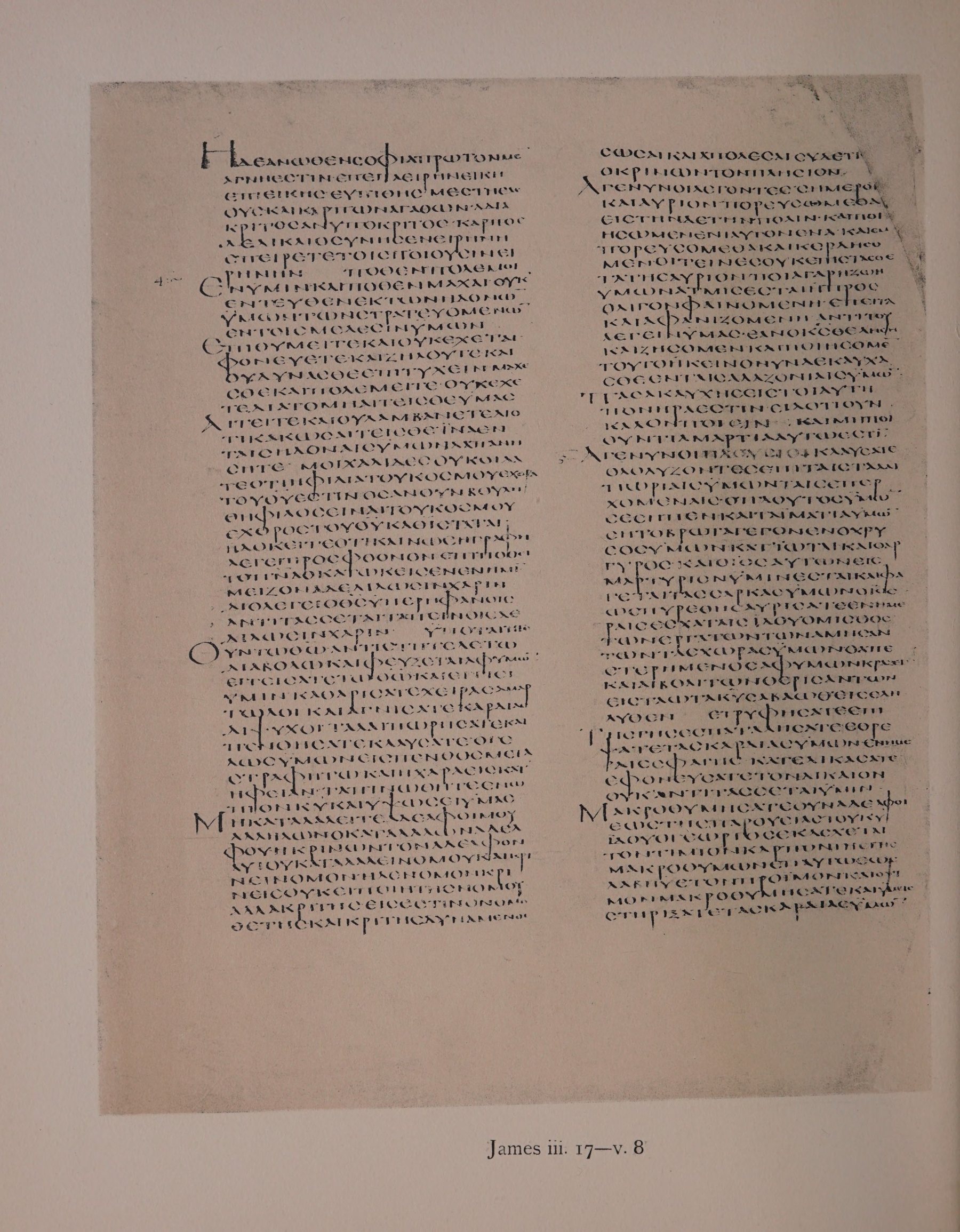
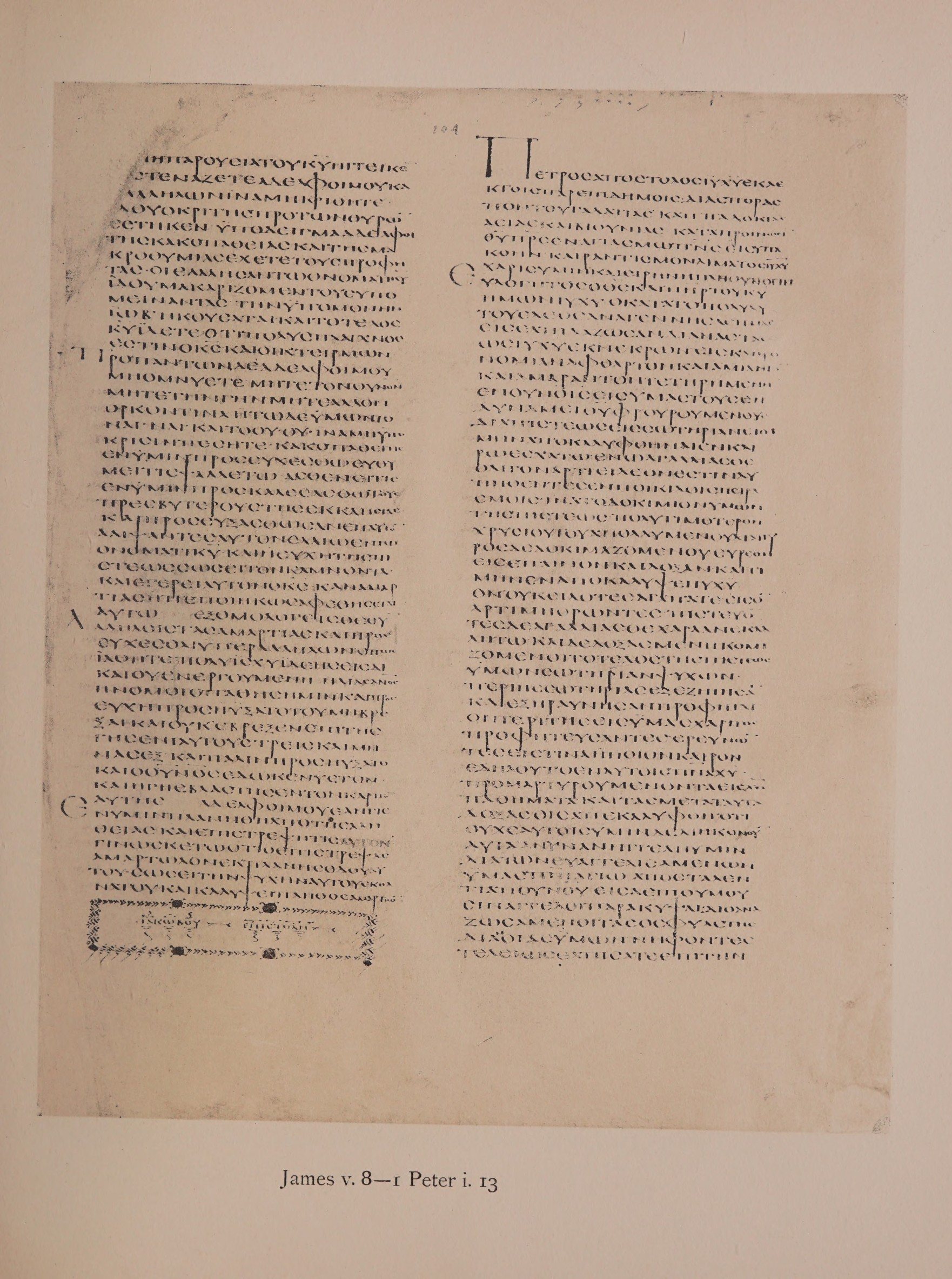
- Manuscript scan: the actual page(s) of Codex Alexandrinus containing this passage (folios 103v, 104r), reproduced from the British Museum's 1909 photographic facsimile edited by F. G. Kenyon, as digitised by the Getty Research Institute for the Internet Archive. The facsimile prints the verse range beneath each plate; that printed range was read for every page used and agrees with the INTF's NTVMR verse-level page index (CC BY 4.0). The page for each section now comes from the NTVMR transcription itself, which records the page and column on which every verse is written.
- Original text: the manuscript's own text, from a diplomatic transcription (see Greek text below), with Tischendorf's 8th critical edition (1869) for comparison.
- English translation: the King James Version (1611), retrieved verbatim from the public-domain bible-api.com endpoint.
Greek text: a diplomatic transcription of Codex Alexandrinus made by the Institut für Neutestamentliche Textforschung (INTF), Münster, for the New Testament Virtual Manuscript Room (NTVMR), published under a Creative Commons Attribution 4.0 licence. It gives the letters as the first scribe wrote them: no accents or breathings, the scribe's own spelling, and the sacred names in their contracted form (θς for θεος, ις for ιησους, κς for κυριος; the overline is not reproduced). Corrections by later hands are not shown. Letters in square brackets are not legible on the page and were restored by the transcribers, a dot under a letter marks an uncertain reading, and [...] marks text lost to damage. Beneath each section, for comparison, is Tischendorf's 8th critical edition (1869). Where the two differ, the transcription is what the manuscript says. Each section is shown with the page on which the transcription places its verses.
How was this verified? (Provenance)
Where on the image
Page from the NTVMR transcription (docID 20002): verses 1-8 on fol. 103v (facsimile leaf 168), col. 2; verse 8 continues on fol. 104r (facsimile leaf 169), col. 1 (which begins '[οτ]ι η παρουσια').
1αγε νυν οι λ̣ε̣γ̣ο̣ν̣τ̣ε̣ς̣ κλαυσατε ολολυζοντες επι ταις ταλαιπωριαις υμων ταις επερχομεναις · 2ο πλουτος υμων σεσηπεν και τα ιματια υμων σητοβρωτα γεγονεν 3ο χρυσος υμων κατιωται και ο αργυρος · και ο ιος αυτων εις μαρτυριον υμιν εσται και φαγεται τας σαρκας υμων ο ιος ως πυρ εθησαυρισατε εν ημεραις εσχαταις 4ιδου ο μισθος των εργατων των αμησαντων τας χωρας υμων ο απεστερημενος αφ υμων κραζει · και αι βοαι των θερισαντων εις τα ωτα κυ σαβαωθ εισεληλυθεν 5ετρυφησατε επι της γης εσπαταλησατε εθρεψατε τας καρδιας υμων εν ημεραις σφαγης · 6κατεδικασατε εφονευσατε τον δικαιον ουκ αντιτασσεται υμιν 7μακροθυμησατε ουν αδελφοι εως της παρουσιας του κυ ιδου ο γεωργος εκδεχεται τον τιμιον καρπον της γης μακροθυμων επ αυτω εως λαβη υετον προιμον και οψιμον · 8μακροθυμησατε και υμεις στηριξατε τας καρδιας υμων · [οτ]ι η παρουσια του κυ ηγγεικεν
Compare: Tischendorf 8th edition (1869)
1Ἄγε νῦν οἱ πλούσιοι, κλαύσατε ὀλολύζοντες ἐπὶ ταῖς ταλαιπωρίαις ὑμῶν ταῖς ἐπερχομέναις. 2ὁ πλοῦτος ὑμῶν σέσηπεν καὶ τὰ ἱμάτια ὑμῶν σητόβρωτα γέγονεν, 3ὁ χρυσὸς ὑμῶν καὶ ὁ ἄργυρος κατίωται, καὶ ὁ ἰὸς αὐτῶν εἰς μαρτύριον ὑμῖν ἔσται καὶ φάγεται τὰς σάρκας ὑμῶν ὡς πῦρ· ἐθησαυρίσατε ἐν ἐσχάταις ἡμέραις. 4ἰδοὺ ὁ μισθὸς τῶν ἐργατῶν τῶν ἀμησάντων τὰς χώρας ὑμῶν ὁ ἀφυστερημένος ἀφ’ ὑμῶν κράζει, καὶ αἱ βοαὶ τῶν θερισάντων εἰς τὰ ὦτα κυρίου σαβαὼθ εἰσελήλυθαν. 5ἐτρυφήσατε ἐπὶ τῆς γῆς καὶ ἐσπαταλήσατε, ἐθρέψατε τὰς καρδίας ὑμῶν ἐν ἡμέρᾳ σφαγῆς. 6κατεδικάσατε, ἐφονεύσατε τὸν δίκαιον. οὐκ ἀντιτάσσεται ὑμῖν. 7Μακροθυμήσατε οὖν, ἀδελφοί, ἕως τῆς παρουσίας τοῦ κυρίου. ἰδοὺ ὁ γεωργὸς ἐκδέχεται τὸν τίμιον καρπὸν τῆς γῆς, μακροθυμῶν ἐπ’ αὐτῷ ἕως λάβῃ πρόϊμον καὶ ὄψιμον. 8μακροθυμήσατε καὶ ὑμεῖς, στηρίξατε τὰς καρδίας ὑμῶν, ὅτι ἡ παρουσία τοῦ κυρίου ἤγγικεν.
1Go to now, ye rich men, weep and howl for your miseries that shall come upon you. 2Your riches are corrupted, and your garments are motheaten. 3Your gold and silver is cankered; and the rust of them shall be a witness against you, and shall eat your flesh as it were fire. Ye have heaped treasure together for the last days. 4Behold, the hire of the labourers who have reaped down your fields, which is of you kept back by fraud, crieth: and the cries of them which have reaped are entered into the ears of the Lord of sabaoth. 5Ye have lived in pleasure on the earth, and been wanton; ye have nourished your hearts, as in a day of slaughter. 6Ye have condemned and killed the just; and he doth not resist you. 7Be patient therefore, brethren, unto the coming of the Lord. Behold, the husbandman waiteth for the precious fruit of the earth, and hath long patience for it, until he receive the early and latter rain. 8Be ye also patient; stablish your hearts: for the coming of the Lord draweth nigh.
Where on the image
Page from the NTVMR transcription (docID 20002): verses 9-20 on fol. 104r (facsimile leaf 169), col. 1.
9[μη] στεναζετε αδελφοι μου κα[τ] αλληλων ινα μη κριθητε · [ι]δου ο κριτης προ των θυρων εστηκεν · 10υποδειγμα αδελφοι της κακοπαθειας και της μακροθυμιας εχετε τους προφητας · οι ελαλησαν τω ονοματι κυ 11ιδου μακαριζομεν τους υπομειναντας την υπομονην ιωβ ηκουσαται και το τελος κυ ιδετε · οτι πολυσπλαγχνος εστιν ο κς και οικτειρμων 12προ παντων δε αδελφοι μου μη ομνυετε · μητε τον ουνον μητε την γην μητε αλλον ορκον τινα ητω δε υμων το ναι · ναι · και το ου · ου · ινα μη υπο κρισιν πεσητε · 13κακοπαθει τις εν υμιν προσευχεσθω ευθυμει τις ψαλλετω · 14ασθενει τις εν υμιν προσκαλεσασθω τους πρεσβυτερους της εκκλησιας και προσευξασθωσαν επ αυτον αλιψαντες αυτον ελαιω εν τω ονοματι κυ · 15και η ευχη της πιστεως σωσει τον καμνοντα · και εγερει αυτον ο κς · καν αμαρτιας η πεποιηκως αφεθησεται αυτω 16εξομολογεισθε ουν αλληλοις τας αμαρτιας και προσευχεσθαι υπερ αλληλων οπως ιαθητε πολυ ισχυι δεησεις δικαιου ενεργουμενη 17ηλιας ανος ην ομοιοπαθης ημιν και προσευχη προσηυξατο του μη βρεξαι · και ουκ εβρεξεν επι της γης ενιαυτους τρεις και μηνας εξ · 18και παλιν προσηυξατο και ο ουνος εδωκεν υετον και η γη εβλαστησεν τον καρπον αυτης 19αδελφοι μου εαν τις εν υμιν πλανηθη απο της αληθειας και επιστρεψη τις αυτον 20γινωσκετω οτι ο επιστρεψας αμαρτωλον εκ πλανης οδου αυτου · σωσει την ψυχην αυτου εκ θανατου και καλυψει πληθος αμαρτιων ·
Compare: Tischendorf 8th edition (1869)
9μὴ στενάζετε κατ’ ἀλλήλων, ἀδελφοί, ἵνα μὴ κριθῆτε· ἰδοὺ ὁ κριτὴς πρὸ τῶν θυρῶν ἕστηκεν. 10ὑπόδειγμα λάβετε, ἀδελφοί, τῆς κακοπαθείας καὶ τῆς μακροθυμίας τοὺς προφήτας, οἳ ἐλάλησαν ἐν τῷ ὀνόματι κυρίου. 11ἰδοὺ μακαρίζομεν τοὺς ὑπομείναντας· τὴν ὑπομονὴν Ἰὼβ ἠκούσατε, καὶ τὸ τέλος κυρίου εἴδετε, ὅτι πολύσπλαγχνός ἐστιν ὁ κύριος καὶ οἰκτίρμων. 12Πρὸ πάντων δέ, ἀδελφοί μου, μὴ ὀμνύετε, μήτε τὸν οὐρανὸν μήτε τὴν γῆν μήτε ἄλλον τινὰ ὅρκον· ἤτω δὲ ὑμῶν τὸ ναὶ ναὶ καὶ τὸ οὒ οὔ, ἵνα μὴ ὑπὸ κρίσιν πέσητε. 13Κακοπαθεῖ τις ἐν ὑμῖν; προσευχέσθω· εὐθυμεῖ τις; ψαλλέτω. 14ἀσθενεῖ τις ἐν ὑμῖν; προσκαλεσάσθω τοὺς πρεσβυτέρους τῆς ἐκκλησίας, καὶ προσευξάσθωσαν ἐπ’ αὐτὸν ἀλείψαντες ἐλαίῳ ἐν τῷ ὀνόματι τοῦ κυρίου· 15καὶ ἡ εὐχὴ τῆς πίστεως σώσει τὸν κάμνοντα, καὶ ἐγερεῖ αὐτὸν ὁ κύριος· κἂν ἁμαρτίας ᾖ πεποιηκώς, ἀφεθήσεται αὐτῷ. 16ἐξομολογεῖσθε οὖν ἀλλήλοις τὰς ἁμαρτίας καὶ εὔχεσθε ὑπὲρ ἀλλήλων, ὅπως ἰαθῆτε. πολὺ ἰσχύει δέησις δικαίου ἐνεργουμένη. 17Ἠλείας ἄνθρωπος ἦν ὁμοιοπαθὴς ἡμῖν, καὶ προσευχῇ προσηύξατο τοῦ μὴ βρέξαι, καὶ οὐκ ἔβρεξεν ἐπὶ τῆς γῆς ἐνιαυτοὺς τρεῖς καὶ μῆνας ἕξ· 18καὶ πάλιν προσηύξατο, καὶ ὁ οὐρανὸς ἔδωκεν ὑετὸν καὶ ἡ γῆ ἐβλάστησεν τὸν καρπὸν αὐτῆς. 19Ἀδελφοί μου, ἐάν τις ἐν ὑμῖν πλανηθῇ ἀπὸ τῆς ἀληθείας καὶ ἐπιστρέψῃ τις αὐτόν, 20γινωσκέτω ὅτι ὁ ἐπιστρέψας ἁμαρτωλὸν ἐκ πλάνης ὁδοῦ αὐτοῦ σώσει ψυχὴν αὐτοῦ ἐκ θανάτου καὶ καλύψει πλῆθος ἁμαρτιῶν.
9Grudge not one against another, brethren, lest ye be condemned: behold, the judge standeth before the door. 10Take, my brethren, the prophets, who have spoken in the name of the Lord, for an example of suffering affliction, and of patience. 11Behold, we count them happy which endure. Ye have heard of the patience of Job, and have seen the end of the Lord; that the Lord is very pitiful, and of tender mercy. 12But above all things, my brethren, swear not, neither by heaven, neither by the earth, neither by any other oath: but let your yea be yea; and your nay, nay; lest ye fall into condemnation. 13Is any among you afflicted? let him pray. Is any merry? let him sing psalms. 14Is any sick among you? let him call for the elders of the church; and let them pray over him, anointing him with oil in the name of the Lord: 15And the prayer of faith shall save the sick, and the Lord shall raise him up; and if he have committed sins, they shall be forgiven him. 16Confess your faults one to another, and pray one for another, that ye may be healed. The effectual fervent prayer of a righteous man availeth much. 17Elias was a man subject to like passions as we are, and he prayed earnestly that it might not rain: and it rained not on the earth by the space of three years and six months. 18And he prayed again, and the heaven gave rain, and the earth brought forth her fruit. 19Brethren, if any of you do err from the truth, and one convert him; 20Let him know, that he which converteth the sinner from the error of his way shall save a soul from death, and shall hide a multitude of sins.
Cite
Sources
- Source: Codex Alexandrinus page images + NTVMR transcription (CC BY 4.0) + Tischendorf 8th edition + KJV (holding institution)
- Critical edition: Codex Alexandrinus transcription, NTVMR (INTF Münster, CC BY 4.0); Tischendorf 8th edition for comparison
← previous · → next · v cycle view · l back to library