Luke, Chapter 13 (Codex Alexandrinus)
Introduction
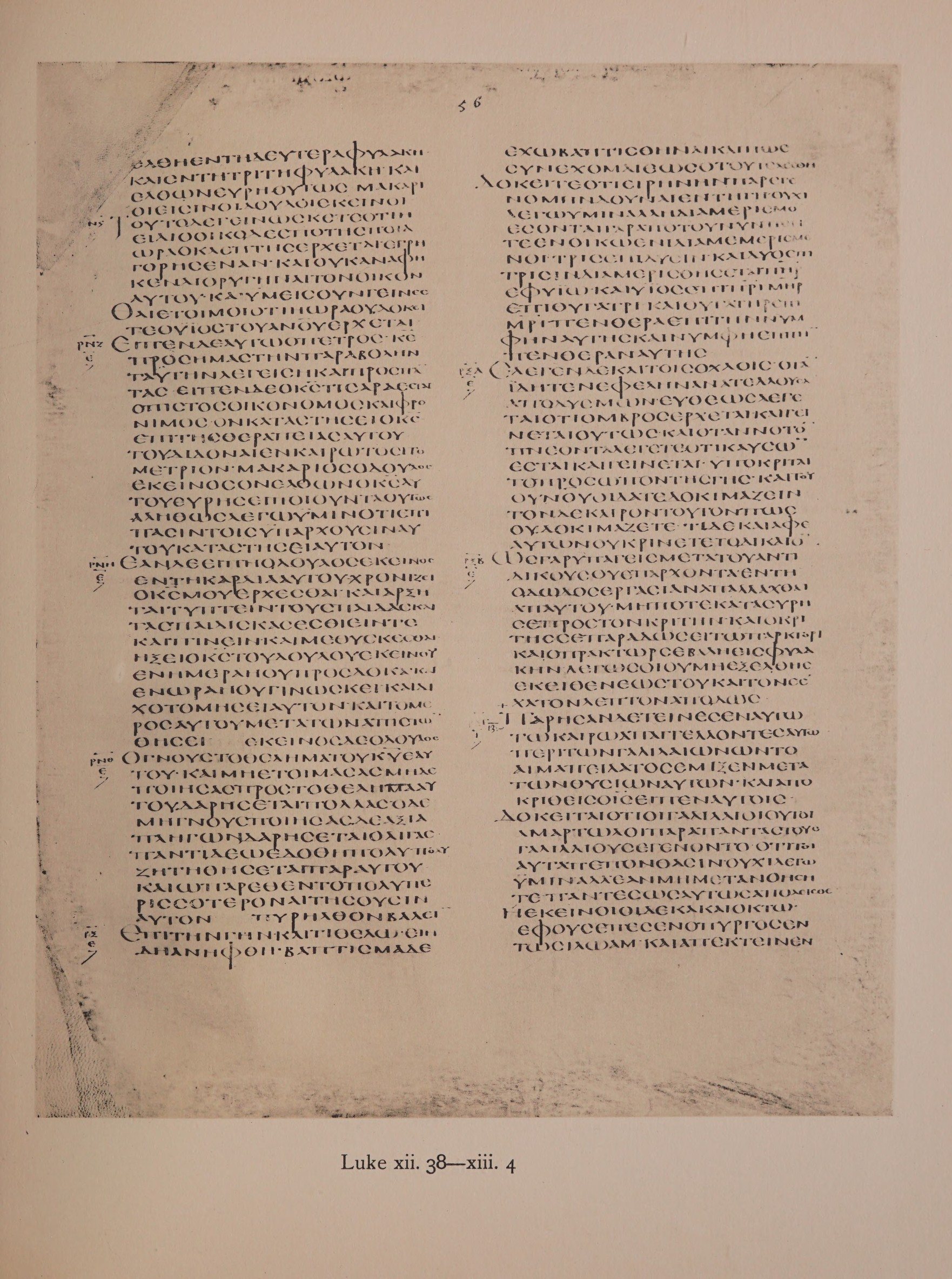
Luke 13 from Codex Alexandrinus (GA 02), a fifth-century Greek Bible held by the British Library (Royal MS 1 D. VIII). In the New Testament it is the chief witness to the Byzantine text in the Gospels and to the Alexandrian text in the rest of the New Testament. Its New Testament volume lacks Matthew 1:1-25:5, John 6:50-8:52 and 2 Corinthians 4:13-12:6.
This entry meets the strict three-criteria standard of the Theosis Library:
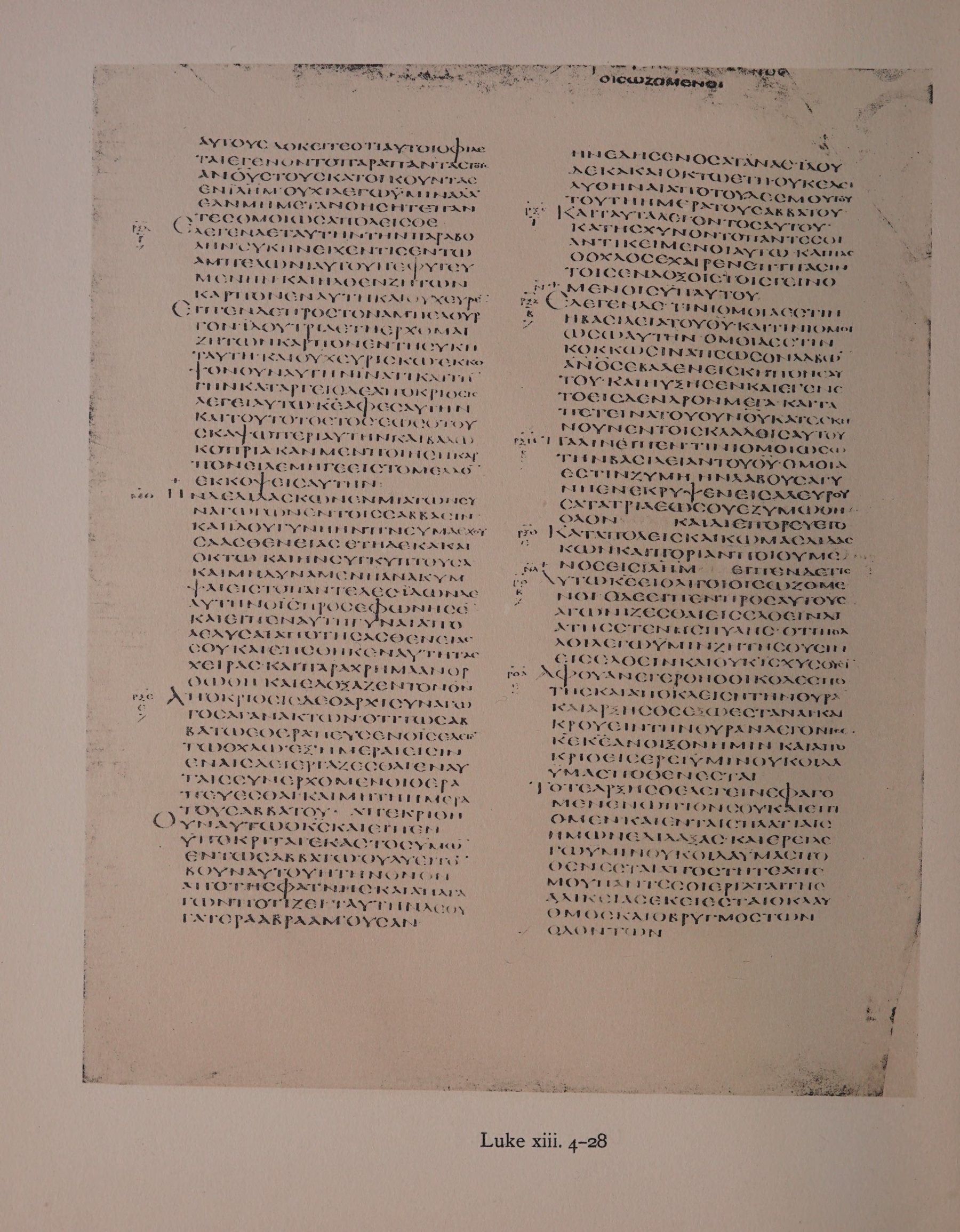
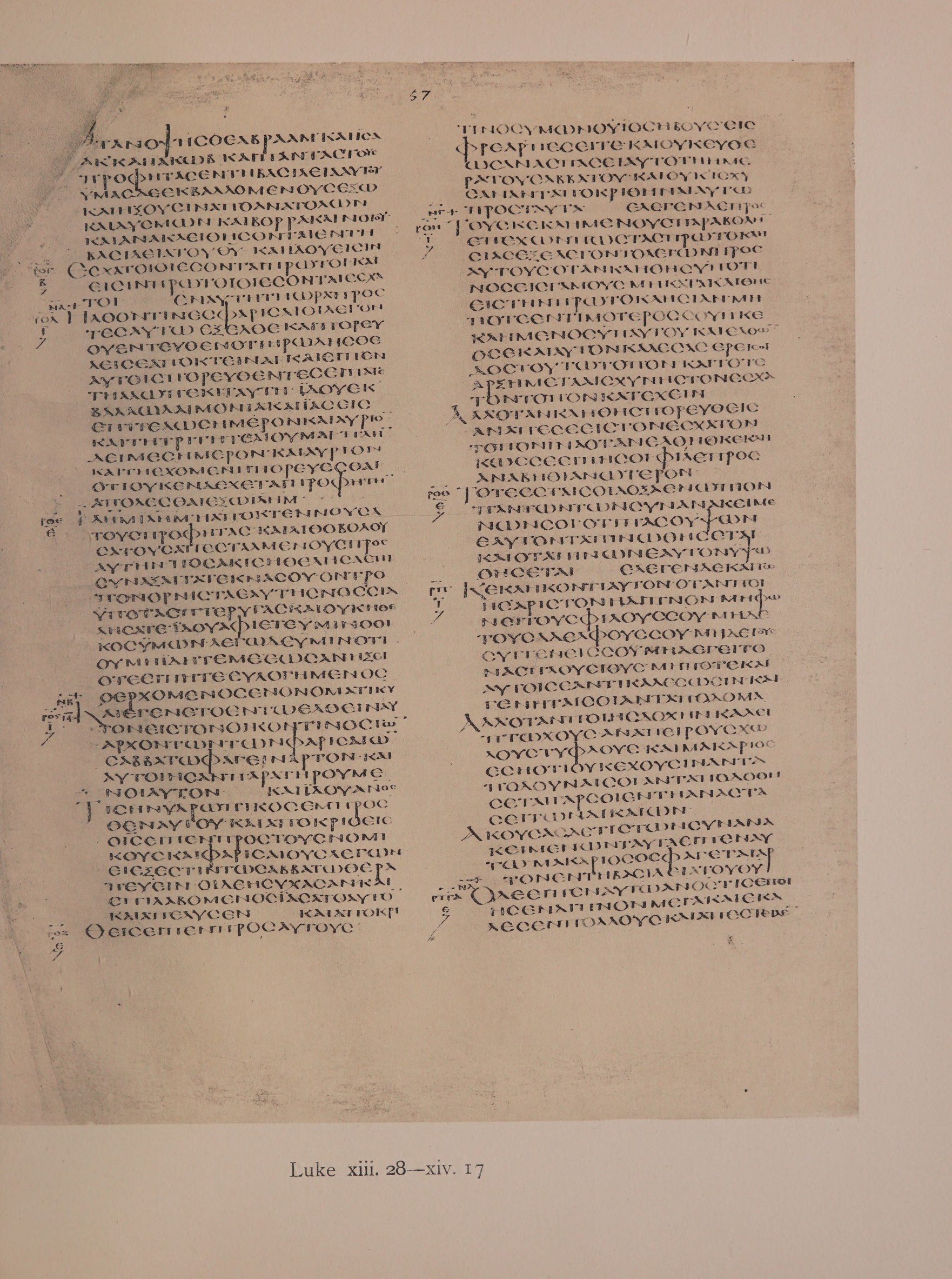
- Manuscript scan: the actual page(s) of Codex Alexandrinus containing this passage (folios 56r, 56v, 57r), reproduced from the British Museum's 1909 photographic facsimile edited by F. G. Kenyon, as digitised by the Getty Research Institute for the Internet Archive. The facsimile prints the verse range beneath each plate; that printed range was read for every page used and agrees with the INTF's NTVMR verse-level page index (CC BY 4.0). The page for each section now comes from the NTVMR transcription itself, which records the page and column on which every verse is written.
- Original text: the manuscript's own text, from a diplomatic transcription (see Greek text below), with Tischendorf's 8th critical edition (1869) for comparison.
- English translation: the King James Version (1611), retrieved verbatim from the public-domain bible-api.com endpoint.
Greek text: a diplomatic transcription of Codex Alexandrinus made by the Institut für Neutestamentliche Textforschung (INTF), Münster, for the New Testament Virtual Manuscript Room (NTVMR), published under a Creative Commons Attribution 4.0 licence. It gives the letters as the first scribe wrote them: no accents or breathings, the scribe's own spelling, and the sacred names in their contracted form (θς for θεος, ις for ιησους, κς for κυριος; the overline is not reproduced). Corrections by later hands are not shown. Letters in square brackets are not legible on the page and were restored by the transcribers, a dot under a letter marks an uncertain reading, and [...] marks text lost to damage. Beneath each section, for comparison, is Tischendorf's 8th critical edition (1869). Where the two differ, the transcription is what the manuscript says. Each section is shown with the page on which the transcription places its verses.
How was this verified? (Provenance)
Where on the image
Page from the NTVMR transcription (docID 20002): verses 1-4 on fol. 56r (facsimile leaf 77), col. 2; verse 4 continues on fol. 56v (facsimile leaf 78), col. 1 (which begins 'αυτους δοκειτε οτι').
1παρησαν δε τεινες εν αυτω τω καιρω απαγγελλοντες αυτω περι των γαλιλαιων ων το αιμα πειλατος εμα̣ξεν μετα των θυσιων αυτων · 2και αποκριθεις ο ις ειπεν αυτοις · δοκειται οτι οι γαλιλαιοι ουτοι αμαρτωλοι παρα παντας τους γαλιλαιους εγενοντο · οτι τοιαυτα πεπονθασιν · 3ουχι λεγω υμιν · αλλ εαν μη μετανοησητε · παντες ωσαυτως απολεισθε · 4η εκεινοι οι δεκα και οκτω · εφ ους επεσεν ο πυργος εν τω σιλωαμ · και απεκτεινεν αυτους δοκειτε οτι αυτοι οφιλεται εγενοντο παρα παντας τους ανους τους κατοικουντας εν ιλημ ·
Compare: Tischendorf 8th edition (1869)
1Παρῆσαν δέ τινες ἐν αὐτῷ τῷ καιρῷ ἀπαγγέλλοντες αὐτῷ περὶ τῶν Γαλιλαίων ὧν τὸ αἷμα Πειλᾶτος ἔμιξεν μετὰ τῶν θυσιῶν αὐτῶν. 2καὶ ἀποκριθεὶς εἶπεν αὐτοῖς· δοκεῖτε ὅτι οἱ Γαλιλαῖοι οὗτοι ἁμαρτωλοὶ παρὰ πάντας τοὺς Γαλιλαίους ἐγένοντο, ὅτι ταῦτα πεπόνθασιν; 3οὐχί λέγω ὑμῖν, ἀλλ’ ἐὰν μὴ μετανοῆτε, πάντες ὁμοίως ἀπολεῖσθε. 4ἢ ἐκεῖνοι οἱ δεκαοκτώ, ἐφ’ οὓς ἔπεσεν ὁ πύργος ἐν τῷ Σιλωὰμ καὶ ἀπέκτεινεν αὐτούς, δοκεῖτε ὅτι αὐτοὶ ὀφειλέται ἐγένοντο παρὰ πάντας τοὺς ἀνθρώπους τοὺς κατοικοῦντας ἐν Ἱερουσαλήμ;
1There were present at that season some that told him of the Galilaeans, whose blood Pilate had mingled with their sacrifices. 2And Jesus answering said unto them, Suppose ye that these Galilaeans were sinners above all the Galilaeans, because they suffered such things? 3I tell you, Nay: but, except ye repent, ye shall all likewise perish. 4Or those eighteen, upon whom the tower in Siloam fell, and slew them, think ye that they were sinners above all men that dwelt in Jerusalem?
Where on the image
Page from the NTVMR transcription (docID 20002): verses 5-16 on fol. 56v (facsimile leaf 78), col. 1.
5ουχι λεγω υμιν αλλ εαν μη μετανοησητε παντες ομοιως απολεισθε · 6ελεγεν δε ταυτην την παραβολην · συκην ειχεν τις εν τω αμπελωνι αυτου πεφυτευμενην · και ηλθεν ζητων καρπον εν αυτη και ουχ ευρεν · 7ειπεν δε προς τον αμπελουργον · ιδου τρια ετη ερχομαι ζητων καρπον εν τη συκη ταυτη · και ουχ ευρισκω · εκκοψον ουν αυτην ινατι και την γην καταργει · 8ο δε αποκριθεις λεγει αυτω · κε αφες αυτην και τουτο το ετος · εως οτου σκαψω περι αυτην και βαλω κοπρια · 9καν μεν ποιηση καρπον ει δε μη γε εις το μελλον εκκοψεις αυτην · 10ην δε διδασκων εν μια των συναγωγων εν τοις σαββασιν · 11και ιδου γυνη ην πνευμα εχουσα ασθενειας ετη δεκα · και οκτω · και ην συγκυπτουσα · και μη δυναμενη ανακυμψαι εις το παντελες · 12ιδων δε αυτην ο ις προσεφωνησεν και ειπεν αυτη γυναι απολελυσαι απο της ασθενειας σου 13και επεθηκεν αυτη τας χειρας · και παραχρημα ανορθωθη · και εδοξαζεν τον θν · 14αποκριθεις δε ο αρχισυναγωγος αγανακτων · οτι τω σαββατω εθεραπευσεν ο ις ελεγεν τω οχλω · εξ ημεραι εισιν εν αις δει εργαζεσθαι · εν αυταις συνερχομενοι θεραπευεσθαι · και μη τη ημερα του σαββατου · 15απεκριθη ουν αυτω ο κς και ειπεν · υποκριται · εκαστος υμων εν τω σαββατω · ου λυει τον βουν αυτου η την ονον απο της φατνης · και απαγαγων ποτιζει · 16ταυτην δε θυγατερα αβρααμ · ουσαν · ην εδησεν ο σατανας · ιδου δεκα και οκτω ετη · ουκ εδει λυθηναι απο του δεσμου τουτου τη ημερα του σαββατου ·
Compare: Tischendorf 8th edition (1869)
5οὐχί λέγω ὑμῖν, ἀλλ’ ἐὰν μὴ μετανοήσητε, πάντες ὡσαύτως ἀπολεῖσθε. 6Ἔλεγεν δὲ ταύτην τὴν παραβολήν. Συκῆν εἶχέν τις πεφυτευμένην ἐν τῷ ἀμπελῶνι αὐτοῦ, καὶ ἦλθεν ζητῶν καρπὸν ἐν αὐτῇ καὶ οὐχ εὗρεν. 7εἶπεν δὲ πρὸς τὸν ἀμπελουργόν· ἰδοὺ τρία ἔτη ἀφ’ οὗ ἔρχομαι ζητῶν καρπὸν ἐν τῇ συκῇ ταύτῃ καὶ οὐχ εὑρίσκω· ἔκκοψον αὐτήν· ἱνατί καὶ τὴν γῆν καταργεῖ; 8ὁ δὲ ἀποκριθεὶς λέγει αὐτῷ· κύριε, ἄφες αὐτὴν καὶ τοῦτο τὸ ἔτος, ἕως ὅτου σκάψω περὶ αὐτὴν καὶ βάλω κόπρια· 9κἂν μὲν ποιήσῃ καρπὸν εἰς τὸ μέλλον· εἰ δὲ μήγε, ἐκκόψεις αὐτήν. 10Ἦν δὲ διδάσκων ἐν μιᾷ τῶν συναγωγῶν ἐν τοῖς σάββασιν. 11καὶ ἰδοὺ γυνὴ πνεῦμα ἔχουσα ἀσθενείας ἔτη δεκαοκτώ, καὶ ἦν συνκύπτουσα καὶ μὴ δυναμένη ἀνακύψαι εἰς τὸ παντελές. 12ἰδὼν δὲ αὐτὴν ὁ Ἰησοῦς προσεφώνησεν καὶ εἶπεν αὐτῇ· γύναι, ἀπολέλυσαι ἀπὸ τῆς ἀσθενείας σου, 13καὶ ἐπέθηκεν αὐτῇ τὰς χεῖρας· καὶ παραχρῆμα ἀνορθώθη, καὶ ἐδόξαζεν τὸν θεόν. 14ἀποκριθεὶς δὲ ὁ ἀρχισυνάγωγος, ἀγανακτῶν ὅτι τῷ σαββάτῳ ἐθεράπευσεν ὁ Ἰησοῦς, ἔλεγεν τῷ ὄχλῳ ὅτι ἓξ ἡμέραι εἰσὶν ἐν αἷς δεῖ ἐργάζεσθαι· ἐν αὐταῖς οὖν ἐρχόμενοι θεραπεύεσθε καὶ μὴ τῇ ἡμέρᾳ τοῦ σαββάτου. 15ἀπεκρίθη δὲ αὐτῷ ὁ κύριος καὶ εἶπεν· ὑποκριταί, ἕκαστος ὑμῶν τῷ σαββάτῳ οὐ λύει τὸν βοῦν αὐτοῦ ἢ τὸν ὄνον ἀπὸ τῆς φάτνης καὶ ἀπαγαγὼν ποτίζει; 16ταύτην δὲ θυγατέρα Ἀβραὰμ οὖσαν, ἣν ἔδησεν ὁ σατανᾶς ἰδοὺ δέκα καὶ ὀκτὼ ἔτη, οὐκ ἔδει λυθῆναι ἀπὸ τοῦ δεσμοῦ τούτου τῇ ἡμέρᾳ τοῦ σαββάτου;
5I tell you, Nay: but, except ye repent, ye shall all likewise perish. 6He spake also this parable; A certain man had a fig tree planted in his vineyard; and he came and sought fruit thereon, and found none. 7Then said he unto the dresser of his vineyard, Behold, these three years I come seeking fruit on this fig tree, and find none: cut it down; why cumbereth it the ground? 8And he answering said unto him, Lord, let it alone this year also, till I shall dig about it, and dung it: 9And if it bear fruit, well: and if not, then after that thou shalt cut it down. 10And he was teaching in one of the synagogues on the sabbath. 11And, behold, there was a woman which had a spirit of infirmity eighteen years, and was bowed together, and could in no wise lift up herself. 12And when Jesus saw her, he called her to him, and said unto her, Woman, thou art loosed from thine infirmity. 13And he laid his hands on her: and immediately she was made straight, and glorified God. 14And the ruler of the synagogue answered with indignation, because that Jesus had healed on the sabbath day, and said unto the people, There are six days in which men ought to work: in them therefore come and be healed, and not on the sabbath day. 15The Lord then answered him, and said, Thou hypocrite, doth not each one of you on the sabbath loose his ox or his ass from the stall, and lead him away to watering? 16And ought not this woman, being a daughter of Abraham, whom Satan hath bound, lo, these eighteen years, be loosed from this bond on the sabbath day?
Where on the image
Page from the NTVMR transcription (docID 20002): verses 17-28 on fol. 56v (facsimile leaf 78), col. 2; verse 28 continues on fol. 57r (facsimile leaf 79), col. 1 (which begins '[ο]ταν οψησθε αβρααμ').
17και ταυτα λεγοντος αυτου · κατησχυνοντο παντες οι αντικειμενοι αυτω · και πας ο οχλος εχαιρεν επι πασιν τοις ενδοξοις τοις γεινομενοις υπ αυτου · 18ελεγεν δε · τινι ομοια εστιν η βασιλεια του θυ · και τινι ομοιωσω αυτην · 19ομοια εστιν κοκκω σιναπεως ον λαβων ανος εβαλεν εις κηπον εαυτου · και ηυξησεν και εγενετο εις δενδρον μεγα · και τα πετεινα του ουνου κατεσκηνουν εν τοις κλαδοις αυτου 20παλιν ειπεν · τινι ομοιωσω την βασιλειαν του θυ · 21ομοια εστιν ζυμη ην λαβουσα γυνη ενεκρυψεν εις αλευρου σατα τρια εως ου εζυμωθη ολον · 22και διεπορευετο κατα πολεις και κωμας διδασκων και ποριαν ποιουμενος εις ιλημ · 23ειπεν δε τις αυτω κε ει ολιγοι οι σωζομενοι · ο δε ειπεν προς αυτους 24αγωνιζεσθαι εισελθειν δια της στενης πυλης · οτι πολλοι λεγω υμιν ζητησουσιν εισελθειν και ουκ ισχυσουσιν 25αφ ου αν εγερθη ο οικοδεσποτης και αποκλειση την θυραν και αρξησθε εξω εσταναι · και κρουειν την θυραν λεγοντες κε κε ανοιξον ημιν · και αποκριθεις ερει υμιν ουκ οιδα υμας ποθεν εσται · 26τοτε αρξησθε λεγειν εφαγομεν ενωπιον σου και επιομεν · και εν ταις πλατιαις ημων εδιδαξας · 27και ερει λεγω υμιν ουκ οιδα υμας ποθεν εσται αποστητε απ εμου παντες οι εργαται της αδικειας 28εκει εσται ο κλαυθμος και ο βρυγμος των οδοντων · [ο]ταν οψησθε αβρααμ και ισαακ και ιακωβ και παντας τους προφητας εν τη βασιλεια αυτου υμας δε εκβαλλομενους εξω
Compare: Tischendorf 8th edition (1869)
17καὶ ταῦτα λέγοντος αὐτοῦ κατῃσχύνοντο πάντες οἱ ἀντικείμενοι αὐτῷ, καὶ πᾶς ὁ ὄχλος ἔχαιρεν ἐπὶ πᾶσιν τοῖς ἐνδόξοις τοῖς γινομένοις ὑπ’ αὐτοῦ. 18Ἔλεγεν οὖν· τίνι ὁμοία ἐστὶν ἡ βασιλεία τοῦ θεοῦ, καὶ τίνι ὁμοιώσω αὐτήν; 19ὁμοία ἐστὶν κόκκῳ σινάπεως, ὃν λαβὼν ἄνθρωπος ἔβαλεν εἰς κῆπον ἑαυτοῦ, καὶ ηὔξησεν καὶ ἐγένετο εἰς δένδρον, καὶ τὰ πετεινὰ τοῦ οὐρανοῦ κατεσκήνωσεν ἐν τοῖς κλάδοις αὐτοῦ. 20Καὶ πάλιν εἶπεν· τίνι ὁμοιώσω τὴν βασιλείαν τοῦ θεοῦ; 21ὁμοία ἐστὶν ζύμῃ, ἣν λαβοῦσα γυνὴ ἔκρυψεν εἰς ἀλεύρου σάτα τρία, ἕως οὗ ἐζυμώθη ὅλον. 22Καὶ διεπορεύετο κατὰ πόλεις καὶ κώμας διδάσκων καὶ πορείαν ποιούμενος εἰς Ἱεροσόλυμα. 23Εἶπεν δέ τις αὐτῷ· κύριε, εἰ ὀλίγοι οἱ σῳζόμενοι; ὁ δὲ εἶπεν πρὸς αὐτούς· 24ἀγωνίζεσθε εἰσελθεῖν διὰ τῆς στενῆς θύρας, ὅτι πολλοί, λέγω ὑμῖν, ζητήσουσιν εἰσελθεῖν καὶ οὐκ ἰσχύσουσιν. 25ἀφ’ οὗ ἂν ἐγερθῇ ὁ οἰκοδεσπότης καὶ ἀποκλείσῃ τὴν θύραν, καὶ ἄρξησθε ἔξω ἑστάναι καὶ κρούειν τὴν θύραν λέγοντες· κύριε, ἄνοιξον ἡμῖν, καὶ ἀποκριθεὶς ἐρεῖ ὑμῖν· οὐκ οἶδα ὑμᾶς πόθεν ἐστέ. 26τότε ἄρξεσθε λέγειν· ἐφάγομεν ἐνώπιόν σου καὶ ἐπίομεν, καὶ ἐν ταῖς πλατείαις ἡμῶν ἐδίδαξας· 27καὶ ἐρεῖ· λέγω ὑμῖν, οὐκ οἶδα ὑμᾶς πόθεν ἐστέ· ἀπόστητε ἀπ’ ἐμοῦ πάντες ἐργάται ἀδικίας. 28ἐκεῖ ἔσται ὁ κλαυθμὸς καὶ ὁ βρυγμὸς τῶν ὀδόντων, ὅταν ὄψεσθε Ἀβραὰμ καὶ Ἰσαὰκ καὶ Ἰακὼβ καὶ πάντας τοὺς προφήτας ἐν τῇ βασιλείᾳ τοῦ θεοῦ, ὑμᾶς δὲ ἐκβαλλομένους ἔξω.
17And when he had said these things, all his adversaries were ashamed: and all the people rejoiced for all the glorious things that were done by him. 18Then said he, Unto what is the kingdom of God like? and whereunto shall I resemble it? 19It is like a grain of mustard seed, which a man took, and cast into his garden; and it grew, and waxed a great tree; and the fowls of the air lodged in the branches of it. 20And again he said, Whereunto shall I liken the kingdom of God? 21It is like leaven, which a woman took and hid in three measures of meal, till the whole was leavened. 22And he went through the cities and villages, teaching, and journeying toward Jerusalem. 23Then said one unto him, Lord, are there few that be saved? And he said unto them, 24Strive to enter in at the strait gate: for many, I say unto you, will seek to enter in, and shall not be able. 25When once the master of the house is risen up, and hath shut to the door, and ye begin to stand without, and to knock at the door, saying, Lord, Lord, open unto us; and he shall answer and say unto you, I know you not whence ye are: 26Then shall ye begin to say, We have eaten and drunk in thy presence, and thou hast taught in our streets. 27But he shall say, I tell you, I know you not whence ye are; depart from me, all ye workers of iniquity. 28There shall be weeping and gnashing of teeth, when ye shall see Abraham, and Isaac, and Jacob, and all the prophets, in the kingdom of God, and you yourselves thrust out.
Where on the image
Page from the NTVMR transcription (docID 20002): verses 29-35 on fol. 57r (facsimile leaf 79), col. 1.
29και ηξουσιν απο ανατολων και δυσμων · και βορρα · και νοτου · και ανακλειθησονται εν τη βασιλεια του θυ · 30και ιδου εισιν εσχατοι οι εσονται πρωτοι · και εισιν πρωτοι οι εσονται εσχατοι · 31εν αυτη τη ωρα προσηλθον τινες φαρισαιοι λεγοντες αυτω εξελθε · και πορευου εντευθεν οτι ηρωδης θελει σε αποκτειναι 32και ειπεν αυτοις πορευθεντες ειπατε τη αλωπεκι ταυτη · ιδου εκβαλλω δαιμονια και ιασεις επιτελω σημερον και αυριον και τη τριτη τελιουμαι · 33πλην δει με σημερον · και αυριον και τη εχομενη πορευεσθαι οτι ουκ ενδεχεται προφητην απολεσθαι εξω ιλημ · 34ιλημ ιλημ · η αποκτεννουσα τους προφητας · και λιθοβολουσα τους απεσταλμενους προς αυτην · ποσακις ηθελησα επισυναξαι τα τεκνα σου · ον τροπον ορνις τα εαυτης νοσσια υπο τας πτερυγας και ουκ ηθελησατε · 35ιδου αφιετε υμιν ο οικος υμων · λεγω δε υμιν οτι ου μη ιδητε με · εως αν ηξει οτε ειπητε · ευλογημενος ο ερχομενος εν ονοματι κυ
Compare: Tischendorf 8th edition (1869)
29καὶ ἥξουσιν ἀπὸ ἀνατολῶν καὶ δυσμῶν καὶ Βορρᾶ καὶ νότου καὶ ἀνακλιθήσονται ἐν τῇ βασιλείᾳ τοῦ θεοῦ. 30καὶ ἰδοὺ εἰσὶν ἔσχατοι οἳ ἔσονται πρῶτοι, καὶ εἰσὶν πρῶτοι οἳ ἔσονται ἔσχατοι. 31Ἐν αὐτῇ τῇ ὥρᾳ προσῆλθάν τινες Φαρισαῖοι λέγοντες αὐτῷ· ἔξελθε καὶ πορεύου ἐντεῦθεν, ὅτι Ἡρώδης θέλει σε ἀποκτεῖναι. 32καὶ εἶπεν αὐτοῖς· πορευθέντες εἴπατε τῇ ἀλώπεκι ταύτῃ· ἰδοὺ ἐκβάλλω δαιμόνια καὶ ἰάσεις ἀποτελῶ σήμερον καὶ αὔριον, καὶ τῇ τρίτῃ τελειοῦμαι. 33πλὴν δεῖ με σήμερον καὶ αὔριον καὶ τῇ ἐχομένῃ πορεύεσθαι, ὅτι οὐκ ἐνδέχεται προφήτην ἀπολέσθαι ἔξω Ἱερουσαλήμ. 34Ἱερουσαλὴμ Ἱερουσαλήμ, ἡ ἀποκτείνουσα τοὺς προφήτας καὶ λιθοβολοῦσα τοὺς ἀπεσταλμένους πρὸς αὐτήν, ποσάκις ἠθέλησα ἐπισυνάξαι τὰ τέκνα σου ὃν τρόπον ὄρνιξ τὴν ἑαυτῆς νοσσιὰν ὑπὸ τὰς πτέρυγας, καὶ οὐκ ἠθελήσατε. 35ἰδοὺ ἀφίεται ὑμῖν ὁ οἶκος ὑμῶν. λέγω ὑμῖν ὅτι οὐ μὴ ἴδητέ με ἕως ἥξει ὅτε εἴπητε· εὐλογημένος ὁ ἐρχόμενος ἐν ὀνόματι κυρίου.
29And they shall come from the east, and from the west, and from the north, and from the south, and shall sit down in the kingdom of God. 30And, behold, there are last which shall be first, and there are first which shall be last. 31The same day there came certain of the Pharisees, saying unto him, Get thee out, and depart hence: for Herod will kill thee. 32And he said unto them, Go ye, and tell that fox, Behold, I cast out devils, and I do cures to day and to morrow, and the third day I shall be perfected. 33Nevertheless I must walk to day, and to morrow, and the day following: for it cannot be that a prophet perish out of Jerusalem. 34O Jerusalem, Jerusalem, which killest the prophets, and stonest them that are sent unto thee; how often would I have gathered thy children together, as a hen doth gather her brood under her wings, and ye would not! 35Behold, your house is left unto you desolate: and verily I say unto you, Ye shall not see me, until the time come when ye shall say, Blessed is he that cometh in the name of the Lord.
Cite
Sources
- Source: Codex Alexandrinus page images + NTVMR transcription (CC BY 4.0) + Tischendorf 8th edition + KJV (holding institution)
- Critical edition: Codex Alexandrinus transcription, NTVMR (INTF Münster, CC BY 4.0); Tischendorf 8th edition for comparison
← previous · → next · v cycle view · l back to library