Mark, Chapter 13 (Codex Alexandrinus)
Introduction
Mark 13 from Codex Alexandrinus (GA 02), a fifth-century Greek Bible held by the British Library (Royal MS 1 D. VIII). In the New Testament it is the chief witness to the Byzantine text in the Gospels and to the Alexandrian text in the rest of the New Testament. Its New Testament volume lacks Matthew 1:1-25:5, John 6:50-8:52 and 2 Corinthians 4:13-12:6.
This entry meets the strict three-criteria standard of the Theosis Library:
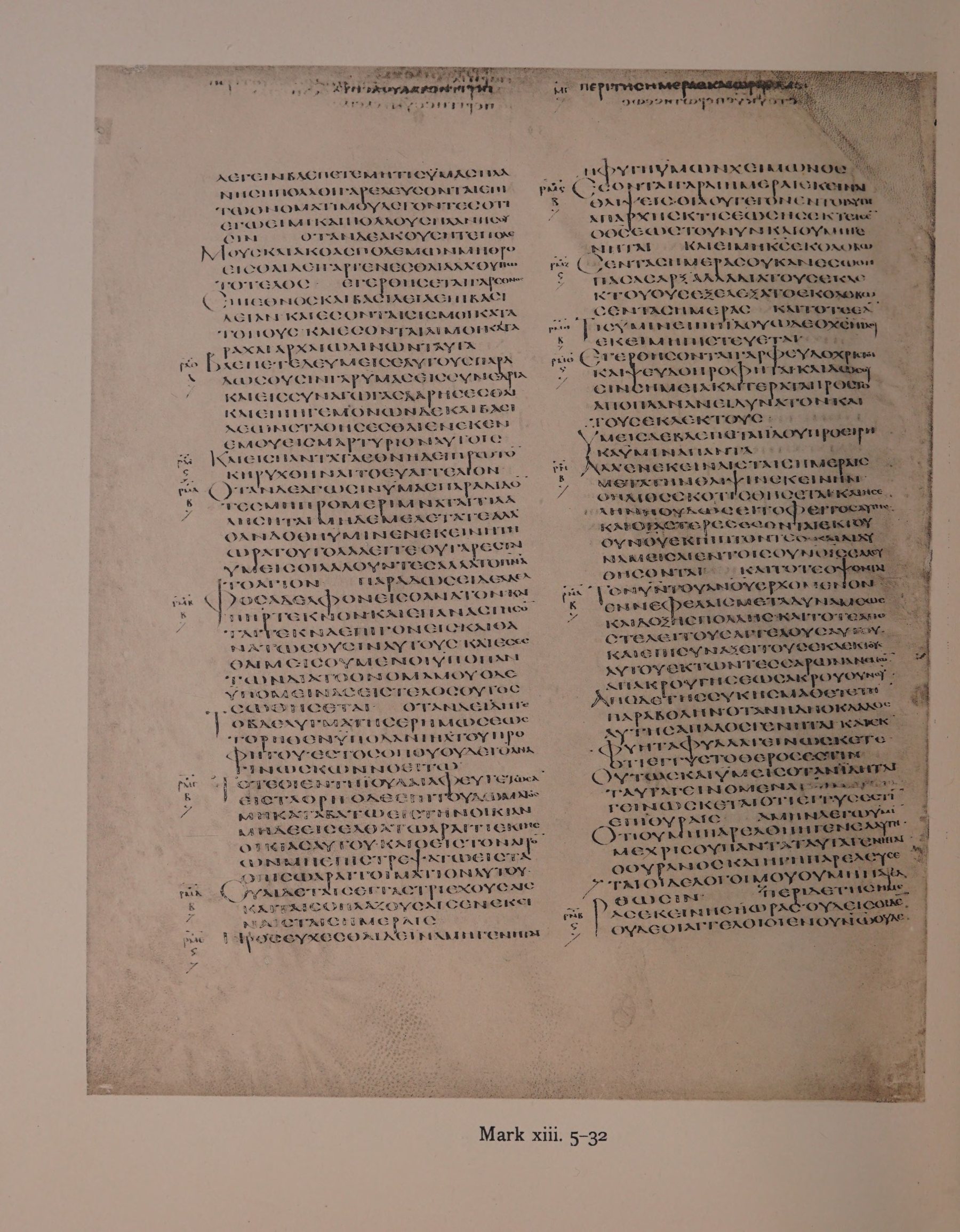
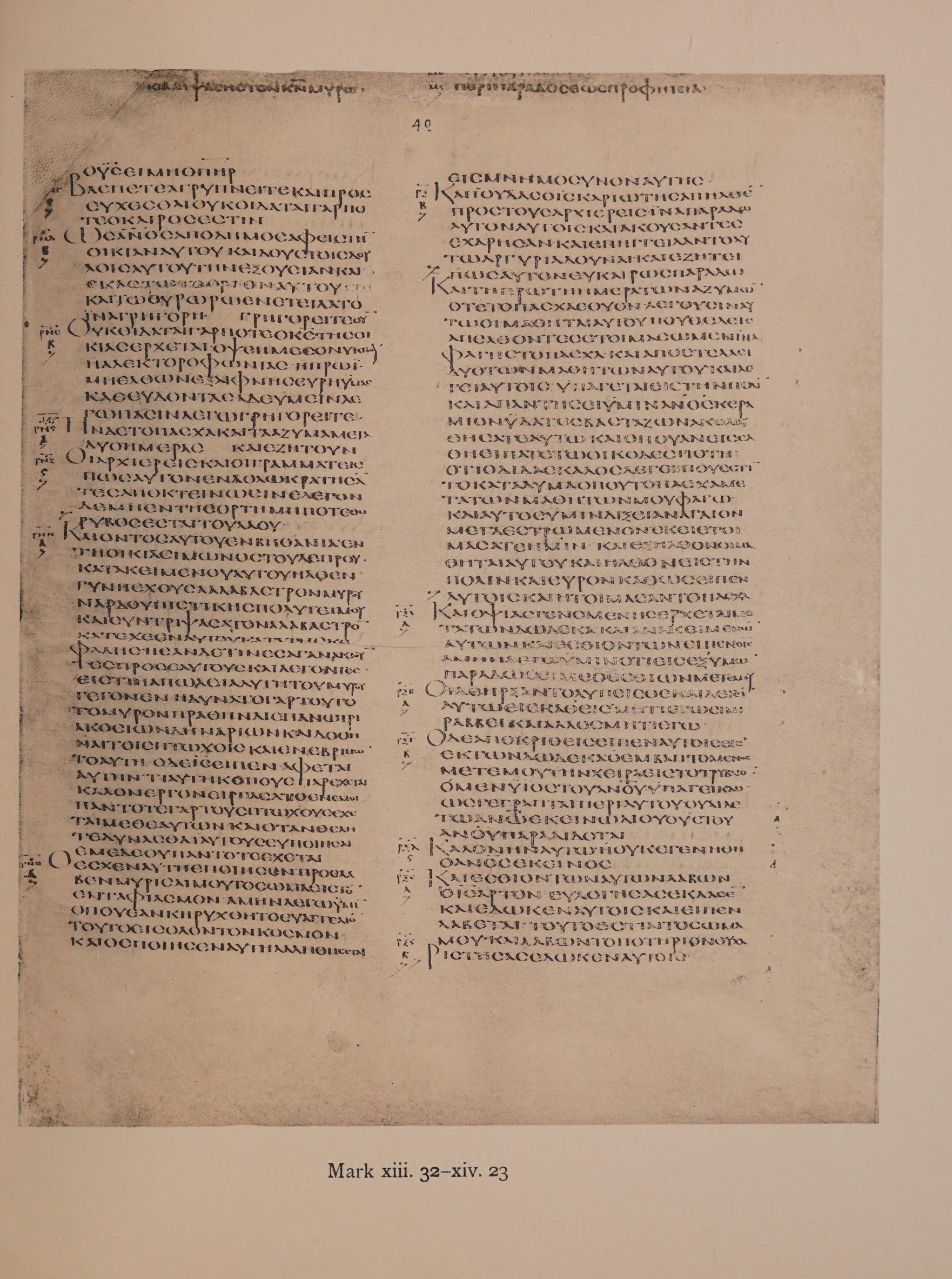
- Manuscript scan: the actual page(s) of Codex Alexandrinus containing this passage (folios 39r, 39v, 40r), reproduced from the British Museum's 1909 photographic facsimile edited by F. G. Kenyon, as digitised by the Getty Research Institute for the Internet Archive. The facsimile prints the verse range beneath each plate; that printed range was read for every page used and agrees with the INTF's NTVMR verse-level page index (CC BY 4.0). The page for each section now comes from the NTVMR transcription itself, which records the page and column on which every verse is written.
- Original text: the manuscript's own text, from a diplomatic transcription (see Greek text below), with Tischendorf's 8th critical edition (1869) for comparison.
- English translation: the King James Version (1611), retrieved verbatim from the public-domain bible-api.com endpoint.
Greek text: a diplomatic transcription of Codex Alexandrinus made by the Institut für Neutestamentliche Textforschung (INTF), Münster, for the New Testament Virtual Manuscript Room (NTVMR), published under a Creative Commons Attribution 4.0 licence. It gives the letters as the first scribe wrote them: no accents or breathings, the scribe's own spelling, and the sacred names in their contracted form (θς for θεος, ις for ιησους, κς for κυριος; the overline is not reproduced). Corrections by later hands are not shown. Letters in square brackets are not legible on the page and were restored by the transcribers, a dot under a letter marks an uncertain reading, and [...] marks text lost to damage. Beneath each section, for comparison, is Tischendorf's 8th critical edition (1869). Where the two differ, the transcription is what the manuscript says. Each section is shown with the page on which the transcription places its verses.
How was this verified? (Provenance)
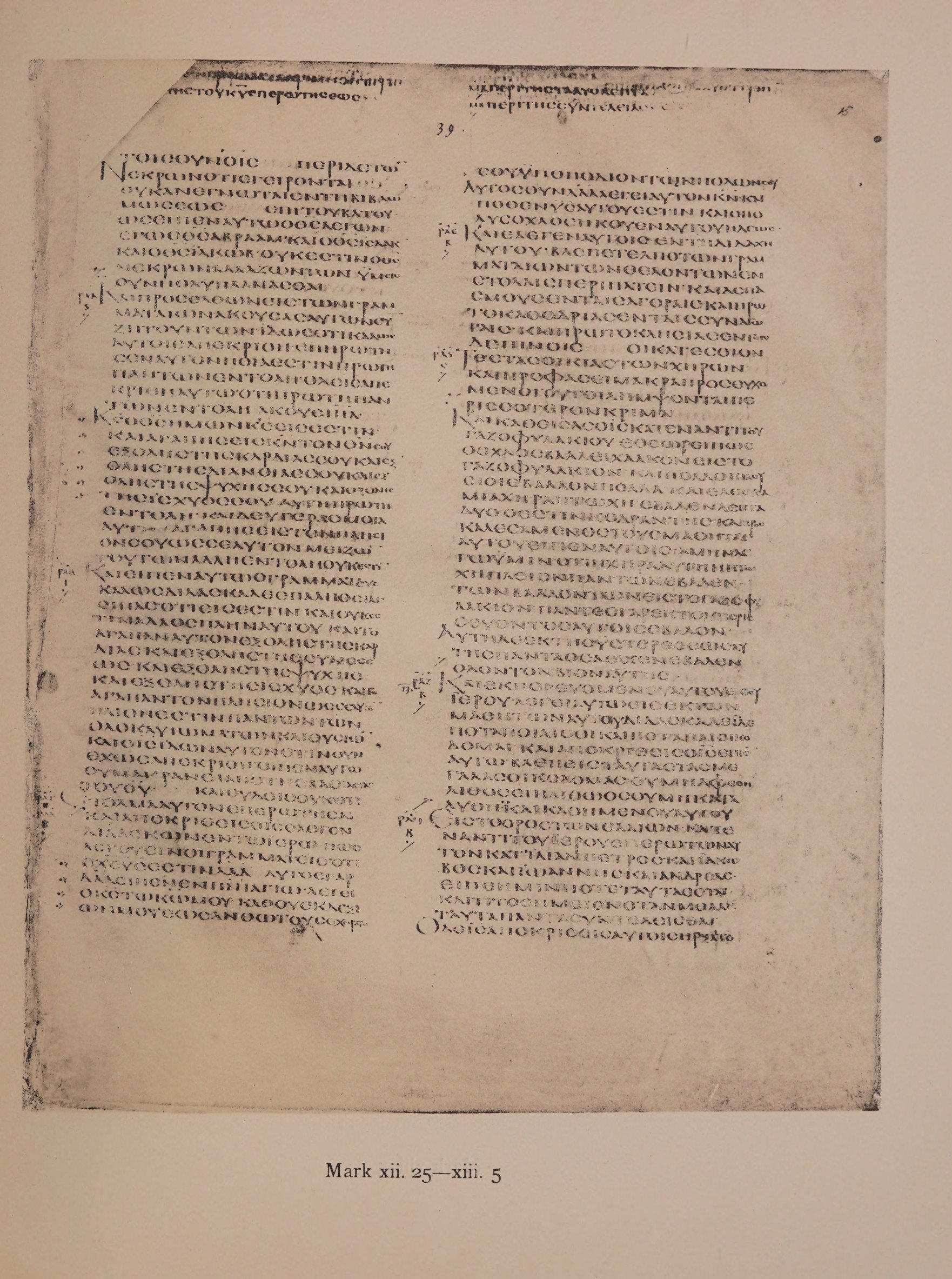
Where on the image
Page from the NTVMR transcription (docID 20002): verses 1-5 on fol. 39r (facsimile leaf 43), col. 2; verse 5 continues on fol. 39v (facsimile leaf 44), col. 1 (which begins 'λεγειν βλεπετε μη').
1και εκπορευομενου αυτου εκ του ιερου · λεγει αυτω εις εκ των μαθητων αυτω̣ διδασκαλε ιδε ποταποι λιθοι και ποταπαι οικοδομαι · 2και αποκριθεις ο ις ειπεν αυτω · βλεπεις ταυτας τας μεγαλας οικοδομας ου μη αφεθη λιθος επι λι̣θω ος ου μη καταλυθη 3και καθημενου αυτου εις το ορος των ελαιων · κατεναντι του ιερου επερωτων αυτον κατ ιδιαν πετρος · και ιακωβος και ιωαννης · και ανδρεας · 4ειπε ημιν ποτε ταυτα εσται και τι το σημειον οταν μελλη ταυτα παντα συντελεισθαι · 5ο δε ις αποκριθεις αυτοις ηρξατο λεγειν βλεπετε μη τις υμας πλανηση
Compare: Tischendorf 8th edition (1869)
1Καὶ ἐκπορευομένου αὐτοῦ ἐκ τοῦ ἱεροῦ, λέγει αὐτῷ εἷς τῶν μαθητῶν αὐτοῦ· διδάσκαλε, ἴδε ποταποὶ λίθοι καὶ ποταπαὶ οἰκοδομαί. 2καὶ ὁ Ἰησοῦς εἶπεν αὐτῷ· βλέπεις ταύτας τὰς μεγάλας οἰκοδομάς; οὐ μὴ ἀφεθῇ λίθος ἐπὶ λίθον. ὃς οὐ μὴ καταλυθῇ. 3καὶ καθημένου αὐτοῦ εἰς τὸ ὄρος τῶν ἐλαιῶν κατέναντι τοῦ ἱεροῦ, ἐπηρώτα αὐτὸν κατ’ ἰδίαν ὁ Πέτρος καὶ Ἰάκωβος καὶ Ἰωάννης καὶ Ἀνδρέας· 4εἰπὸν ἡμῖν, πότε ταῦτα ἔσται; καὶ τί τὸ σημεῖον ὅταν μέλλῃ ταῦτα συντελεῖσθαι πάντα; 5ὁ δὲ Ἰησοῦς ἤρξατο λέγειν αὐτοῖς· βλέπετε μή τις ὑμᾶς πλανήσῃ.
1And as he went out of the temple, one of his disciples saith unto him, Master, see what manner of stones and what buildings are here! 2And Jesus answering said unto him, Seest thou these great buildings? there shall not be left one stone upon another, that shall not be thrown down. 3And as he sat upon the mount of Olives over against the temple, Peter and James and John and Andrew asked him privately, 4Tell us, when shall these things be? and what shall be the sign when all these things shall be fulfilled? 5And Jesus answering them began to say, Take heed lest any man deceive you:
Where on the image
Page from the NTVMR transcription (docID 20002): verses 6-12 on fol. 39v (facsimile leaf 44), col. 1.
6πολλοι γαρ ελευσονται επι τω ονοματι μου λεγοντες οτι εγω ειμι · και πολλους πλανησουσιν · 7οταν δε ακουσητε πολεμους και ακοας πολεμων μη θροεισθαι δει γαρ γενεσθαι αλλ ουπω το τελος 8εγερθησεται γαρ εθνος επι εθνος και βασιλεια επι βασιλειαν · και εσονται σισμοι κατα τοπους · και εσονται λιμοι · κα ταραχαι · αρχαι ωδινων ταυτα 9βλεπετε δε υμεις εαυτους παραδωσουσιν γαρ υμας εις συνεδρια και εις συναγωγας δαρησεσθαι και επι ηγεμονων δε και βασιλεων σταθησεσθαι ενεκεν εμου εις μαρτυριον αυτοις 10και εις παντα τα εθνη δει πρωτον κηρυχθηναι το ευαγγελιον · 11οταν δε αγωσιν υμας παραδιδοντες μη προμεριμναται τι λαλησηται μηδε μελετατε · αλλ ο αν δοθη υμιν εν εκεινη τη ωρα τουτο λαλειτε · ου γαρ εσται υμεις οι λαλουντες αλλα το πνα το αγιον · 12παραδωσει δε αδελφος αδελφον εις θανατον · και πηρ τεκνον · και επαναστησονται τεκνα επι γονεις · και θανατωσουσιν αυτους ·
Compare: Tischendorf 8th edition (1869)
6πολλοὶ ἐλεύσονται ἐπὶ τῷ ὀνόματί μου, λέγοντες ὅτι ἐγώ εἰμι, καὶ πολλοὺς πλανήσουσιν. 7ὅταν δὲ ἀκούσητε πολέμους καὶ ἀκοὰς πολέμων, μὴ θροεῖσθε· δεῖ γενέσθαι, ἀλλ’ οὔπω τὸ τέλος. 8ἐγερθήσεται γὰρ ἔθνος ἐπ’ ἔθνος καὶ βασιλεία ἐπὶ βασιλείαν, ἔσονται σεισμοὶ κατὰ τόπους, ἔσονται λιμοί. 9ἀρχὴ ὠδίνων ταῦτα. Βλέπετε δὲ ὑμεῖς ἑαυτούς· παραδώσουσιν ὑμᾶς εἰς συνέδρια καὶ εἰς συναγωγὰς δαρήσεσθε καὶ ἐπὶ ἡγεμόνων καὶ βασιλέων σταθήσεσθε ἕνεκεν ἐμοῦ, εἰς μαρτύριον αὐτοῖς. 10καὶ εἰς πάντα τὰ ἔθνη πρῶτον δεῖ κηρυχθῆναι τὸ εὐαγγέλιον. 11καὶ ὅταν ἄγωσιν ὑμᾶς παραδιδόντες, μὴ προμεριμνᾶτε τί λαλήσητε, ἀλλ’ ὃ ἐὰν δοθῇ ὑμῖν ἐν ἐκείνῃ τῇ ὥρᾳ, τοῦτο λαλεῖτε· οὐ γάρ ἐστε ὑμεῖς οἱ λαλοῦντες, ἀλλὰ τὸ πνεῦμα τὸ ἅγιον. 12καὶ παραδώσει ἀδελφὸς ἀδελφὸν εἰς θάνατον καὶ πατὴρ τέκνον, καὶ ἐπαναστήσονται τέκνα ἐπὶ γονεῖς καὶ θανατώσουσιν αὐτούς.
6For many shall come in my name, saying, I am Christ; and shall deceive many. 7And when ye shall hear of wars and rumours of wars, be ye not troubled: for such things must needs be; but the end shall not be yet. 8For nation shall rise against nation, and kingdom against kingdom: and there shall be earthquakes in divers places, and there shall be famines and troubles: these are the beginnings of sorrows. 9But take heed to yourselves: for they shall deliver you up to councils; and in the synagogues ye shall be beaten: and ye shall be brought before rulers and kings for my sake, for a testimony against them. 10And the gospel must first be published among all nations. 11But when they shall lead you, and deliver you up, take no thought beforehand what ye shall speak, neither do ye premeditate: but whatsoever shall be given you in that hour, that speak ye: for it is not ye that speak, but the Holy Ghost. 12Now the brother shall betray the brother to death, and the father the son; and children shall rise up against their parents, and shall cause them to be put to death.
Where on the image
Page from the NTVMR transcription (docID 20002): verses 13-18 on fol. 39v (facsimile leaf 44), col. 1.
13και εσεσθαι μεισουμενοι υπο παντων δια το ονομα μου · ο δε υπομεινας εις τελος ουτος σωθησεται · 14οταν δε ιδητε το βδελυγμα της ερημωσεως το ρηθεν υπο δανιηλ του προφητου · εστος οπου ου δει ο αναγινωσκων νοειτω · τοτε οι εν τη ιουδαια φευγετωσαν εις τα ορη · 15ο δε επι του δωματος μη καταβατω εις την οικιαν μηδε εισελθατω αραι τι εκ της οικιας αυτου · 16και ο εις τον αγρον ων μη επιστρεψατω εις τα οπισω αραι το ιματιον αυτου · 17ουαι δε ταις εγγαστρι εχουσαις και ταις θηλαζουσαις εν εκειναις ταις ημεραις · 18προσευχεσθαι δε ινα μη γενηται η φυγη υμων χειμωνος
Compare: Tischendorf 8th edition (1869)
13καὶ ἔσεσθε μισούμενοι ὑπὸ πάντων διὰ τὸ ὄνομά μου· ὁ δὲ ὑπομείνας εἰς τέλος, οὗτος σωθήσεται. 14Ὅταν δὲ ἴδητε τὸ βδέλυγμα τῆς ἐρημώσεως ἑστηκότα ὅπου οὐ δεῖ, ὁ ἀναγινώσκων νοείτω, τότε οἱ ἐν τῇ Ἰουδαίᾳ φευγέτωσαν εἰς τὰ ὄρη, 15ὁ δὲ ἐπὶ τοῦ δώματος μὴ καταβάτω μηδὲ εἰσελθάτω ἆραί τι ἐκ τῆς οἰκίας αὐτοῦ, 16καὶ ὁ εἰς τὸν ἀγρὸν μὴ ἐπιστρεψάτω εἰς τὰ ὀπίσω ἆραι τὸ ἱμάτιον αὐτοῦ. 17οὐαὶ δὲ ταῖς ἐν γαστρὶ ἐχούσαις καὶ ταῖς θηλαζούσαις ἐν ἐκείναις ταῖς ἡμέραις. 18προσεύχεσθε δὲ ἵνα μὴ γένηται χειμῶνος·
13And ye shall be hated of all men for my name’s sake: but he that shall endure unto the end, the same shall be saved. 14But when ye shall see the abomination of desolation, spoken of by Daniel the prophet, standing where it ought not, (let him that readeth understand,) then let them that be in Judaea flee to the mountains: 15And let him that is on the housetop not go down into the house, neither enter therein, to take any thing out of his house: 16And let him that is in the field not turn back again for to take up his garment. 17But woe to them that are with child, and to them that give suck in those days! 18And pray ye that your flight be not in the winter.
Where on the image
Page from the NTVMR transcription (docID 20002): verses 19-25 on fol. 39v (facsimile leaf 44), col. 2.
19εσονται γαρ αι ημεραι εκειναι θλιψεις · οια ου γεγονεν τοιαυτη απ αρχης κτισεως ης εκτεισεν ο θς εως του νυν και ου μη γενηται · 20και ει μη κς εκολοβωσεν τας ημερας ουκ αν εσωθη πασα σαρξ αλλα δια τους εκλεκτου ους εξελεξατο εκολοβωσεν τας ημερας 21και τοτε εαν τις υμιν ειπη ιδου ωδε ο χς η ιδου εκει μη πιστευεται · 22εγερθησονται γαρ φευδοχριστοι και ψευδοπροφηται · και δωσουσιν σημεια · και τερατα προς το αποπλαναν ει δυνατον · και τους εκλεκτους · 23υμεις δε βλεπεται ιδου προειρηκα υμιν απαντα · 24αλλ εν εκειναις ταις ημεραις μετα την θλιψιν εκεινην ο ηλιος σκοτισθησεται · και η σεληνη ου δωσει το φεγγος αυτης · 25και οι αστερες εσονται εκ του ουνου εκπιπτοντες · και αι δυναμεις αι εν τοις ουνοις σαλευθησονται ·
Compare: Tischendorf 8th edition (1869)
19ἔσονται γὰρ αἱ ἡμέραι ἐκεῖναι θλῖψις οἵα οὐ γέγονεν τοιαύτη ἀπ’ ἀρχῆς κτίσεως, ἣν ἔκτισεν ὁ θεὸς ἕως τοῦ νῦν καὶ οὐ μὴ γένηται. 20καὶ εἰ μὴ ἐκολόβωσεν κύριος τὰς ἡμέρας, οὐκ ἂν ἐσώθη πᾶσα σάρξ· ἀλλὰ διὰ τοὺς ἐκλεκτοὺς οὓς ἐξελέξατο ἐκολόβωσεν τὰς ἡμέρας. 21καὶ τότε ἐάν τις ὑμῖν εἴπῃ· ἴδε ὧδε ὁ Χριστός, ἴδε ἐκεῖ, μὴ πιστεύετε. 22ἐγερθήσονται δὲ ψευδόχριστοι καὶ ψευδοπροφῆται καὶ ποιήσουσιν σημεῖα καὶ τέρατα πρὸς τὸ ἀποπλανᾶν, εἰ δυνατόν, τοὺς ἐκλεκτούς. 23ὑμεῖς δὲ βλέπετε· προείρηκα ὑμῖν πάντα. 24Ἀλλὰ ἐν ἐκείναις ταῖς ἡμέραις μετὰ τὴν θλῖψιν ἐκείνην ὁ ἥλιος σκοτισθήσεται, καὶ ἡ σελήνη οὐ δώσει τὸ φέγγος αὐτῆς, 25καὶ οἱ ἀστέρες ἔσονται ἐκ τοῦ οὐρανοῦ πίπτοντες, καὶ αἱ δυνάμεις αἱ ἐν τοῖς οὐρανοῖς σαλευθήσονται.
19For in those days shall be affliction, such as was not from the beginning of the creation which God created unto this time, neither shall be. 20And except that the Lord had shortened those days, no flesh should be saved: but for the elect’s sake, whom he hath chosen, he hath shortened the days. 21And then if any man shall say to you, Lo, here is Christ; or, lo, he is there; believe him not: 22For false Christs and false prophets shall rise, and shall shew signs and wonders, to seduce, if it were possible, even the elect. 23But take ye heed: behold, I have foretold you all things. 24But in those days, after that tribulation, the sun shall be darkened, and the moon shall not give her light, 25And the stars of heaven shall fall, and the powers that are in heaven shall be shaken.
Where on the image
Page from the NTVMR transcription (docID 20002): verses 26-32 on fol. 39v (facsimile leaf 44), col. 2; verse 32 continues on fol. 40r (facsimile leaf 45), col. 1 (which begins 'ο υς ει').
26και τοτε οψονται τον υν του ανου ερχομενον εν νεφελαις μετα δυναμεως και δοξης πολλης · 27και τοτε αποστελει τους αγγελους αυτου · και επισυναξει τους εκλεκτους αυτου εκ των τεσσαρων ανεμων απ ακρου γης εως ακρου ουνου 28απο δε της συκης μαθετε την παραβολην · οταν ηδη ο κλαδος αυτης απαλος γενηται · και εκφυη τα φυλλα · γεινωσκετε · οτι εγγυς το θερος εστιν 29ουτως και υμεις οταν ιδηται ταυτα γεινομενα γεινομενα γεινωσκεται οτι εγγυς εστιν επι θυραις · 30αμην λεγω υμιν οτι ου μη παρελθη η γενεα αυτη · μεχρις ου παντα ταυτα γενηται 31ο ουρανος και η γη παρελευσεται οι δε λογοι μου ου μη παρελθωσιν · 32περι δε της ημερας εκεινης η ωρας · ουδεις οιδεν ουδε οι αγγελοι οι εν ουνω ουδε ο υς ει μη ο πηρ
Compare: Tischendorf 8th edition (1869)
26καὶ τότε ὄψονται τὸν υἱὸν τοῦ ἀνθρώπου ἐρχόμενον ἐν νεφέλαις μετὰ δυνάμεως πολλῆς καὶ δόξης. 27καὶ τότε ἀποστελεῖ τοὺς ἀγγέλους καὶ ἐπισυνάξει τοὺς ἐκλεκτοὺς ἐκ τῶν τεσσάρων ἀνέμων ἀπ’ ἄκρου γῆς ἕως ἄκρου οὐρανοῦ. 28Ἀπὸ δὲ τῆς συκῆς μάθετε τὴν παραβολήν. ὅταν αὐτῆς ἤδη ὁ κλάδος ἁπαλὸς γένηται καὶ ἐκφύῃ τὰ φύλλα, γινώσκετε ὅτι ἐγγὺς τὸ θέρος ἐστίν· 29οὕτως καὶ ὑμεῖς ὅταν ἴδητε ταῦτα γινόμενα, γινώσκετε ὅτι ἐγγύς ἐστιν ἐπὶ θύραις. 30ἀμὴν λέγω ὑμῖν ὅτι οὐ μὴ παρέλθῃ ἡ γενεὰ αὕτη μέχρις οὗ ταῦτα πάντα γένηται. 31ὁ οὐρανὸς καὶ ἡ γῆ παρελεύσονται, οἱ δὲ λόγοι μου οὐ μὴ παρελεύσονται. 32Περὶ δὲ τῆς ἡμέρας ἐκείνης ἢ τῆς ὥρας οὐδεὶς οἶδεν, οὐδὲ οἱ ἄγγελοι ἐν οὐρανῷ οὐδὲ ὁ υἱός, εἰ μὴ ὁ πατήρ.
26And then shall they see the Son of man coming in the clouds with great power and glory. 27And then shall he send his angels, and shall gather together his elect from the four winds, from the uttermost part of the earth to the uttermost part of heaven. 28Now learn a parable of the fig tree; When her branch is yet tender, and putteth forth leaves, ye know that summer is near: 29So ye in like manner, when ye shall see these things come to pass, know that it is nigh, even at the doors. 30Verily I say unto you, that this generation shall not pass, till all these things be done. 31Heaven and earth shall pass away: but my words shall not pass away. 32But of that day and that hour knoweth no man, no, not the angels which are in heaven, neither the Son, but the Father.
Where on the image
Page from the NTVMR transcription (docID 20002): verses 33-37 on fol. 40r (facsimile leaf 45), col. 1.
33βλεπετε αγρυπνειτε και προσευχεσθαι ουκ οιδαται γαρ ποτε ο καιρος εστιν · 34ως ανος αποδημος αφεις την οικιαν αυτου · και δους τοις δουλοις αυτου · την εξουσιαν και θυρωρω ενετειλατο ινα γρηγορη · 35γρηγορειτε ουν ουκ οιδαται γαρ ποτε ο κς της οικιας ερχεται · οψε η μεσονυκτιου η αλεκτοροφωνιας · η πρωι · 36μη ελθων εξαιφνης ευρη υμας καθευδοντας · 37α δε υμειν λεγω πασιν λεγω γρηγορειτε ·
Compare: Tischendorf 8th edition (1869)
33βλέπετε ἀγρυπνεῖτε· οὐκ οἴδατε γὰρ πότε ὁ καιρός ἐστιν. 34ὡς ἄνθρωπος ἀπόδημος ἀφεὶς τὴν οἰκίαν αὐτοῦ καὶ δοὺς τοῖς δούλοις αὐτοῦ τὴν ἐξουσίαν, ἑκάστῳ τὸ ἔργον αὐτοῦ, καὶ τῷ θυρωρῷ ἐνετείλατο ἵνα γρηγορῇ. 35γρηγορεῖτε οὖν· οὐκ οἴδατε γὰρ πότε ὁ κύριος τῆς οἰκίας ἔρχεται, ἢ ὀψὲ ἢ μεσονύκτιον ἢ ἀλεκτοροφωνίας ἢ πρωΐ· 36μὴ ἐλθὼν ἐξαίφνης εὕρῃ ὑμᾶς καθεύδοντας. 37ὃ δὲ ὑμῖν λέγω, πᾶσιν λέγω, γρηγορεῖτε.
33Take ye heed, watch and pray: for ye know not when the time is. 34For the Son of man is as a man taking a far journey, who left his house, and gave authority to his servants, and to every man his work, and commanded the porter to watch. 35Watch ye therefore: for ye know not when the master of the house cometh, at even, or at midnight, or at the cockcrowing, or in the morning: 36Lest coming suddenly he find you sleeping. 37And what I say unto you I say unto all, Watch.
Cite
Sources
- Source: Codex Alexandrinus page images + NTVMR transcription (CC BY 4.0) + Tischendorf 8th edition + KJV (holding institution)
- Critical edition: Codex Alexandrinus transcription, NTVMR (INTF Münster, CC BY 4.0); Tischendorf 8th edition for comparison
← previous · → next · v cycle view · l back to library