Mark, Chapter 9 (Codex Alexandrinus)
Introduction
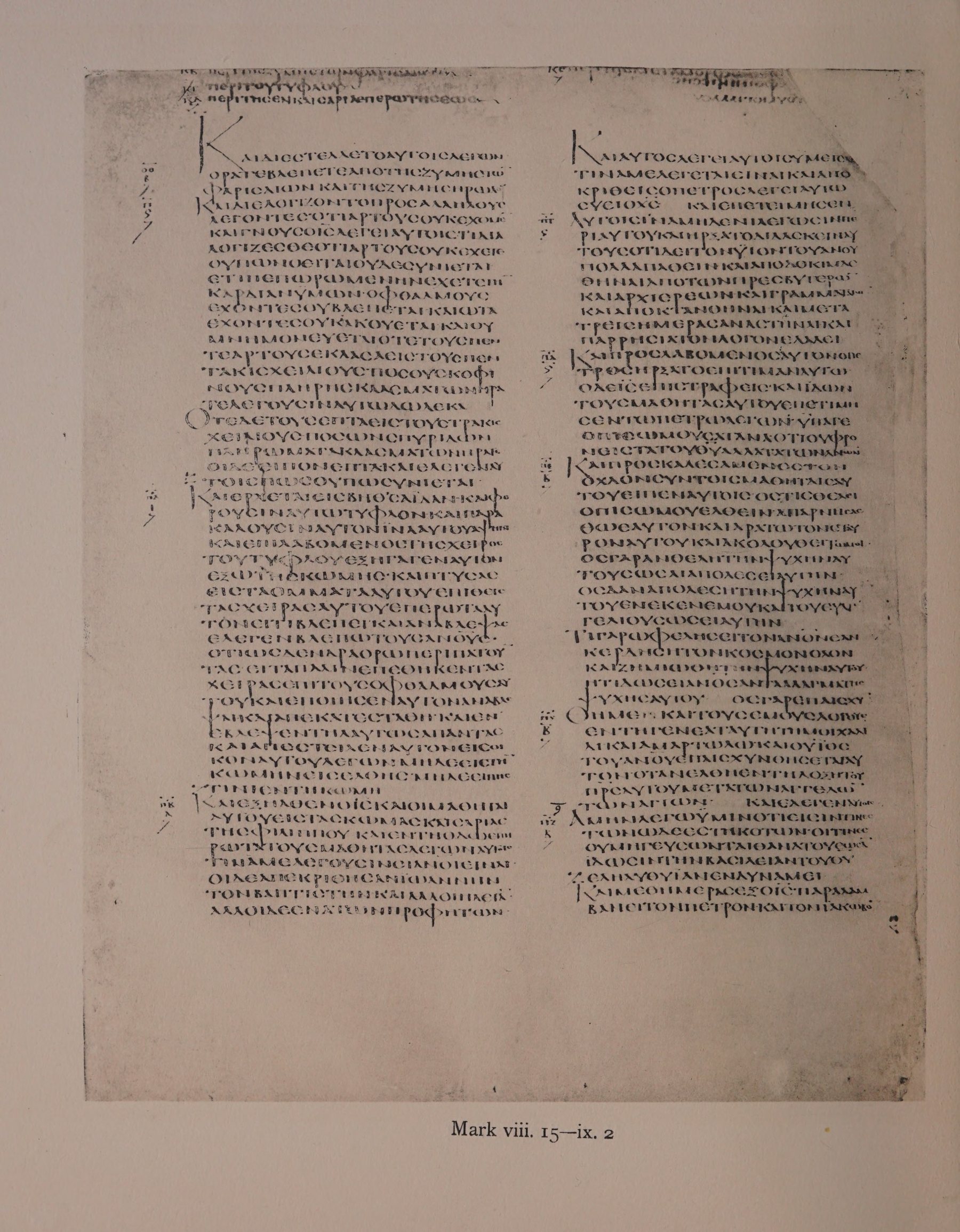
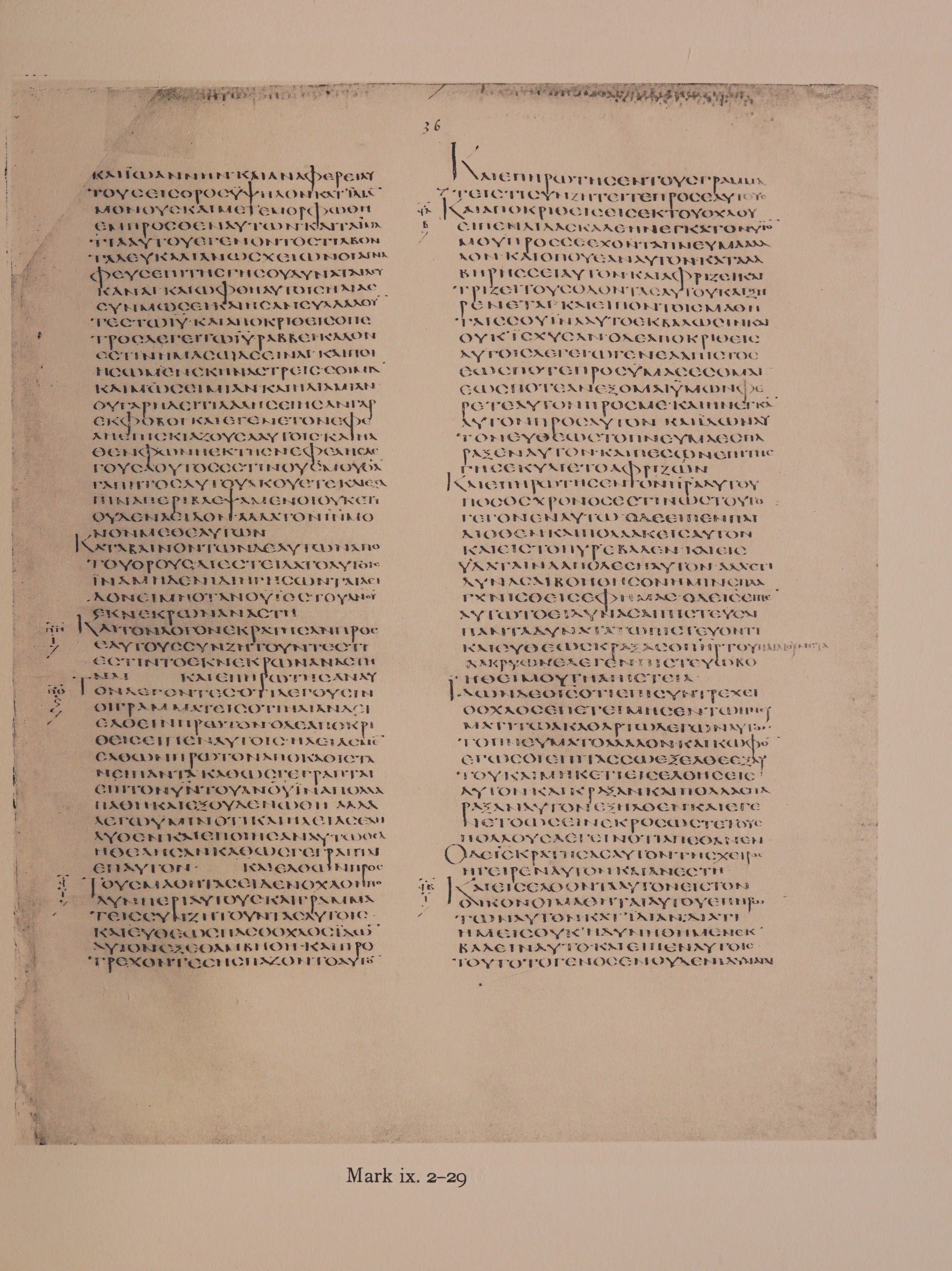
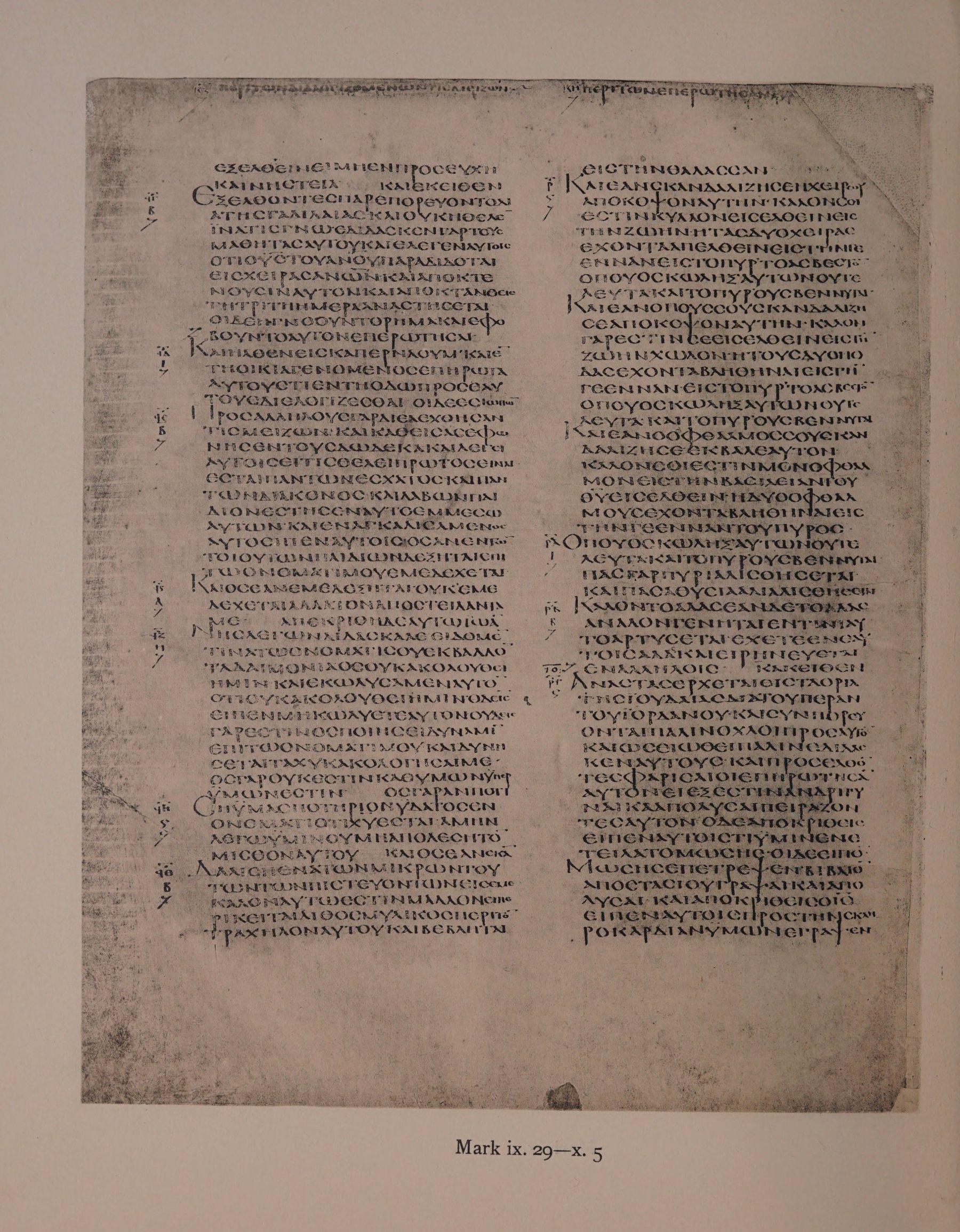
Mark 9 from Codex Alexandrinus (GA 02), a fifth-century Greek Bible held by the British Library (Royal MS 1 D. VIII). In the New Testament it is the chief witness to the Byzantine text in the Gospels and to the Alexandrian text in the rest of the New Testament. Its New Testament volume lacks Matthew 1:1-25:5, John 6:50-8:52 and 2 Corinthians 4:13-12:6.
This entry meets the strict three-criteria standard of the Theosis Library:
- Manuscript scan: the actual page(s) of Codex Alexandrinus containing this passage (folios 35v, 36r, 36v), reproduced from the British Museum's 1909 photographic facsimile edited by F. G. Kenyon, as digitised by the Getty Research Institute for the Internet Archive. The facsimile prints the verse range beneath each plate; that printed range was read for every page used and agrees with the INTF's NTVMR verse-level page index (CC BY 4.0). The page for each section now comes from the NTVMR transcription itself, which records the page and column on which every verse is written.
- Original text: the manuscript's own text, from a diplomatic transcription (see Greek text below), with Tischendorf's 8th critical edition (1869) for comparison.
- English translation: the King James Version (1611), retrieved verbatim from the public-domain bible-api.com endpoint.
Greek text: a diplomatic transcription of Codex Alexandrinus made by the Institut für Neutestamentliche Textforschung (INTF), Münster, for the New Testament Virtual Manuscript Room (NTVMR), published under a Creative Commons Attribution 4.0 licence. It gives the letters as the first scribe wrote them: no accents or breathings, the scribe's own spelling, and the sacred names in their contracted form (θς for θεος, ις for ιησους, κς for κυριος; the overline is not reproduced). Corrections by later hands are not shown. Letters in square brackets are not legible on the page and were restored by the transcribers, a dot under a letter marks an uncertain reading, and [...] marks text lost to damage. Beneath each section, for comparison, is Tischendorf's 8th critical edition (1869). Where the two differ, the transcription is what the manuscript says. Each section is shown with the page on which the transcription places its verses.
How was this verified? (Provenance)
Where on the image
Page from the NTVMR transcription (docID 20002): verses 1-2 on fol. 35v (facsimile leaf 36), col. 2; verse 2 continues on fol. 36r (facsimile leaf 37), col. 1 (which begins 'και ιωαννην ·').
1και ελεγεν αυτοις αμην λεγω υμιν οτι εισιν τινες των ωδε εστηκοτων · οιτινες ου μη γευσωνται θανατου εως αν ιδωσιν την βασιλειαν του θυ εληλυθυιαν εν δυναμει · 2και μεθ ημερας εξ ο ις παραλαμβανει τον πετρον · και τον ιακωβον και ιωαννην · και αναφερει αυτους εις ορος υψηλον κατ ιδιαν μονους και μετεμορφωθη εμπροσθεν αυτων ·
Compare: Tischendorf 8th edition (1869)
1καὶ ἔλεγεν αὐτοῖς· ἀμὴν λέγω ὑμῖν ὅτι εἰσίν τινες ὧδε τῶν ἑστηκότων οἵτινες οὐ μὴ γεύσωνται θανάτου ἕως ἂν ἴδωσιν τὴν βασιλείαν τοῦ θεοῦ ἐληλυθυῖαν ἐν δυνάμει. 2Καὶ μετὰ ἡμέρας ἓξ παραλαμβάνει ὁ Ἰησοῦς τὸν Πέτρον καὶ τὸν Ἰάκωβον καὶ τὸν Ἰωάννην, καὶ ἀναφέρει αὐτοὺς εἰς ὄρος ὑψηλὸν κατ’ ἰδίαν μόνους, καὶ μετεμορφώθη ἔμπροσθεν αὐτῶν,
1And he said unto them, Verily I say unto you, That there be some of them that stand here, which shall not taste of death, till they have seen the kingdom of God come with power. 2And after six days Jesus taketh with him Peter, and James, and John, and leadeth them up into an high mountain apart by themselves: and he was transfigured before them.
Where on the image
Page from the NTVMR transcription (docID 20002): verses 3-9 on fol. 36r (facsimile leaf 37), col. 1.
3και τα ιματια αυτου εγενοντο στιλβοντα λευκα λιαν ως χειων οια γναφευς επι της γης ου δυναται λευκαναι · 4και ωφθη αυτοις ηλιας συν μωσει · και ησαν συλλαλουντες τω ιυ · 5και αποκριθεις ο πετρος λεγει τω ιυ · ραββει · καλον εστιν ημας ωδε ειναι · και ποιησωμεν σκηνας τρεις · σοι μιαν και μωσει μιαν · και ηλια μιαν · 6ου γαρ ηδει τι λαλησει ησαν γαρ εκφοβοι · 7και εγενετο νεφελη επισκιαζουσα αυτοις · και ηλθεν φωνη εκ της νεφελης λεγουσα ουτος εστιν ο υς μου ο αγαπητος αυτου ακουετε · 8και εξαπινα περιβλεψαμενοι ουκετι ουδενα ειδον · αλλα τον ιν μονον μεθ εαυτων 9καταβαινοντων δε αυτων απο του ορους · διεστειλατο αυτοις ινα μηδενι διηγησωνται α ειδον ει μη οταν ο υιος του ανου εκ νεκρων αναστη
Compare: Tischendorf 8th edition (1869)
3καὶ τὰ ἱμάτια αὐτοῦ ἐγένετο στίλβοντα λευκὰ λίαν, οἷα γναφεὺς ἐπὶ τῆς γῆς οὐ δύναται οὕτως λευκᾶναι. 4καὶ ὤφθη αὐτοῖς Ἡλείας σὺν Μωϋσεῖ, καὶ ἦσαν συνλαλοῦντες τῷ Ἰησοῦ. 5καὶ ἀποκριθεὶς ὁ Πέτρος λέγει τῷ Ἰησοῦ· ῥαββεί, καλόν ἐστιν ἡμᾶς ὧδε εἶναι, καὶ ποιήσωμεν τρεῖς σκηνάς, σοὶ μίαν καὶ Μωϋσεῖ μίαν καὶ Ἡλείᾳ μίαν. 6οὐ γὰρ ᾔδει τί ἀποκριθῇ· ἔκφοβοι γὰρ ἐγένοντο. 7καὶ ἐγένετο νεφέλη ἐπισκιάζουσα αὐτοῖς, καὶ ἐγένετο φωνὴ ἐκ τῆς νεφέλης, οὗτός ἐστιν ὁ υἱός μου ὁ ἀγαπητός, ἀκούετε αὐτοῦ. 8καὶ ἐξάπινα περιβλεψάμενοι οὐκέτι οὐδένα εἶδον ἀλλὰ τὸν Ἰησοῦν μόνον μεθ’ ἑαυτῶν. 9Καὶ καταβαινόντων αὐτῶν ἀπὸ τοῦ ὄρους διεστείλατο αὐτοῖς ἵνα μηδενὶ ἃ εἶδον διηγήσωνται, εἰ μὴ ὅταν ὁ υἱὸς τοῦ ἀνθρώπου ἐκ νεκρῶν ἀναστῇ.
3And his raiment became shining, exceeding white as snow; so as no fuller on earth can white them. 4And there appeared unto them Elias with Moses: and they were talking with Jesus. 5And Peter answered and said to Jesus, Master, it is good for us to be here: and let us make three tabernacles; one for thee, and one for Moses, and one for Elias. 6For he wist not what to say; for they were sore afraid. 7And there was a cloud that overshadowed them: and a voice came out of the cloud, saying, This is my beloved Son: hear him. 8And suddenly, when they had looked round about, they saw no man any more, save Jesus only with themselves. 9And as they came down from the mountain, he charged them that they should tell no man what things they had seen, till the Son of man were risen from the dead.
Where on the image
Page from the NTVMR transcription (docID 20002): verses 10-15 on fol. 36r (facsimile leaf 37), col. 1.
10και τον λογον εκρατησαν προς εαυτους συνζητουντες τι εστιν το εκ νεκρων αναστηναι 11και επηρωτησαν αυτον λεγοντες · οτι λεγουσιν οι γραμματεις οτι ηλιαν δει ελθειν πρωτον · 12ο δε αποκριθεις ειπεν αυτοις · ηλειας μεν ελθων πρωτον αποκαθιστανει παντα · καθως γεγραπται επι τον υν του ανου ινα πολλα παθη · και εξουδενωθη · 13αλλα λεγω υμιν οτι και ηλειας εληλυθεν · και εποιησαν αυτω οσα ηθελησαν καθως γεγραπται επ αυτον · 14και ελθων προς τους μαθητας ειδεν οχλον πολυν περι αυτους · και γραμματεις συνζητουντας αυτοις 15και ευθεως πας ο οχλος ιδων αυτον εξεθαμβηθη · και προτρεχοντες ησπαζοντο αυτον
Compare: Tischendorf 8th edition (1869)
10καὶ τὸν λόγον ἐκράτησαν πρὸς ἑαυτοὺς συζητοῦντες τί ἐστιν τὸ ἐκ νεκρῶν ἀναστῆναι. 11καὶ ἐπηρώτων αὐτὸν λέγοντες· ὅτι λέγουσιν οἱ Φαρισαῖοι καὶ οἱ γραμματεῖς ὅτι Ἡλείαν δεῖ ἐλθεῖν πρῶτον; 12ὁ δὲ ἔφη αὐτοῖς· Ἡλείας ἐλθὼν πρῶτον ἀποκαθιστάνει πάντα. καὶ πῶς γέγραπται ἐπὶ τὸν υἱὸν τοῦ ἀνθρώπου; ἵνα πολλὰ πάθῃ καὶ ἐξουθενωθῇ. 13ἀλλὰ λέγω ὑμῖν ὅτι καὶ Ἡλείας ἐλήλυθεν, καὶ ἐποίησαν αὐτῷ ὅσα ἤθελον, καθὼς γέγραπται ἐπ’ αὐτόν. 14Καὶ ἐλθόντες πρὸς τοὺς μαθητὰς εἶδον ὄχλον πολὺν περὶ αὐτοὺς καὶ γραμματεῖς συζητοῦντας πρὸς αὐτούς. 15καὶ εὐθὺς πᾶς ὁ ὄχλος ἰδόντες αὐτὸν ἐξεθαμβήθησαν, καὶ προστρέχοντες ἠσπάζοντο αὐτόν.
10And they kept that saying with themselves, questioning one with another what the rising from the dead should mean. 11And they asked him, saying, Why say the scribes that Elias must first come? 12And he answered and told them, Elias verily cometh first, and restoreth all things; and how it is written of the Son of man, that he must suffer many things, and be set at nought. 13But I say unto you, That Elias is indeed come, and they have done unto him whatsoever they listed, as it is written of him. 14And when he came to his disciples, he saw a great multitude about them, and the scribes questioning with them. 15And straightway all the people, when they beheld him, were greatly amazed, and running to him saluted him.
Where on the image
Page from the NTVMR transcription (docID 20002): verses 16-22 on fol. 36r (facsimile leaf 37), col. 2.
16και επηρωτησεν τους γραμματεις τι συνζητειτε προς εαυτους 17και αποκριθεις εις εκ του οχλου ειπεν διδασκαλε · ηνεγκα τον υιον μου προς σε εχοντα πνευμα αλαλον · 18και οπου εαν αυτον καταλαβη ρησσει αυτον · και αφριζει και τριζει τους οδοντας αυτου και ξηρενεται · και ειπον τοις μαθηταις σου ινα αυτο εκβαλωσιν και ουκ ισχυσαν · 19ο δε αποκριθεις αυτοις λεγει · ω γενεα απιστος εως ποτε προς υμας εσομαι εως ποτε ανεξομαι υμων φερετε αυτον προς με · 20και ηνεγκαν αυτον προς αυτον · και ιδων αυτον ευθεως το πνευμα εσπαραξεν αυτον · και πεσων επι της γης εκυλιετο αφριζων 21και επηρωτησεν τον πρα αυτου ποσος χρονος εστιν ως τουτο γεγονεν αυτω · ο δε ειπεν παιδιοθεν · 22και πολλακεις αυτον και εις το πυρ εβαλεν · και εις υδατα ινα απολεση · αυτον · αλλ ετι δυνασαι βοηθησον ημιν σπλαγχνισθεις εφ ημας ·
Compare: Tischendorf 8th edition (1869)
16καὶ ἐπηρώτησεν αὐτούς· τί συζητεῖτε πρὸς αὐτούς; 17καὶ ἀπεκρίθη αὐτῷ εἷς ἐκ τοῦ ὄχλου, διδάσκαλε, ἤνεγκα τὸν υἱόν μου πρὸς σέ, ἔχοντα πνεῦμα ἄλαλον, 18καὶ ὅπου ἐὰν αὐτὸν καταλάβῃ ῥήσσει, καὶ ἀφρίζει καὶ τρίζει τοὺς ὀδόντας καὶ ξηραίνεται· καὶ εἶπα τοῖς μαθηταῖς σου ἵνα αὐτὸ ἐκβάλωσιν, καὶ οὐκ ἴσχυσαν. 19ὁ δὲ ἀποκριθεὶς αὐτοῖς λέγει· ὦ γενεὰ ἄπιστος, ἕως πότε πρὸς ὑμᾶς ἔσομαι; ἕως πότε ἀνέξομαι ὑμῶν; φέρετε αὐτὸν πρός με. 20καὶ ἤνεγκαν αὐτὸν πρὸς αὐτόν. καὶ ἰδὼν αὐτὸν, τὸ πνεῦμα εὐθὺς συνεσπάραξεν αὐτόν, καὶ πεσὼν ἐπὶ τῆς γῆς ἐκυλίετο ἀφρίζων. 21καὶ ἐπηρώτησεν τὸν πατέρα αὐτοῦ· πόσος χρόνος ἐστὶν ὡς τοῦτο γέγονεν αὐτῷ; ὁ δὲ εἶπεν· ἐκ παιδιόθεν· 22καὶ πολλάκις καὶ εἰς πῦρ αὐτὸν ἔβαλεν καὶ εἰς ὕδατα, ἵνα ἀπολέσῃ αὐτόν· ἀλλὰ εἴ τι δύνῃ, βοήθησον ἡμῖν σπλαγχνισθεὶς ἐφ’ ἡμᾶς.
16And he asked the scribes, What question ye with them? 17And one of the multitude answered and said, Master, I have brought unto thee my son, which hath a dumb spirit; 18And wheresoever he taketh him, he teareth him: and he foameth, and gnasheth with his teeth, and pineth away: and I spake to thy disciples that they should cast him out; and they could not. 19He answereth him, and saith, O faithless generation, how long shall I be with you? how long shall I suffer you? bring him unto me. 20And they brought him unto him: and when he saw him, straightway the spirit tare him; and he fell on the ground, and wallowed foaming. 21And he asked his father, How long is it ago since this came unto him? And he said, Of a child. 22And ofttimes it hath cast him into the fire, and into the waters, to destroy him: but if thou canst do any thing, have compassion on us, and help us.
Where on the image
Page from the NTVMR transcription (docID 20002): verses 23-29 on fol. 36r (facsimile leaf 37), col. 2; verse 29 continues on fol. 36v (facsimile leaf 38), col. 1 (which begins 'εξελθειν ει μη').
23ο δε ις ειπεν αυτω το ει δυνασαι πιστευσαι παντα δυνατα τω πιστευοντι 24και ευθεως κραξας ο πηρ του παιδιου ελεγεν · πιστευω βοηθει μου τη απιστεια · 25ιδων δε ο ις οτι επισυντρεχει ο οχλος επετειμησεν τω πνευματι τω ακαθαρτω λεγων αυτω · το πνευμα το αλαλον · και κωφον εγω σοι επιτασσω εξελθε εξ αυτου και μηκετι εισελθης εις αυτον · 26και κραξαν και πολλα σπαραξαν αυτον εξηλθεν · και εγενετο ωσει νεκρος ωστε τους πολλους λεγειν οτι απεθανεν 27ο δε ις κρατησας αυτον της χειρος ηγειρεν αυτον · και ανεστη · 28και εισελθοντα αυτον εις τον οικον οι μαθηται αυτου επηρωτων αυτον · κατ ιδιαν · δια τι ημεις ουκ ηδυνηθημεν εκβαλειν αυτο · 29και ειπεν αυτοις τουτο το γενος εν ουδενι δυναται εξελθειν ει μη εν προσευχη και νηστεια ·
Compare: Tischendorf 8th edition (1869)
23ὁ δὲ Ἰησοῦς εἶπεν αὐτῷ, τὸ εἰ δύνῃ; πάντα δυνατὰ τῷ πιστεύοντι. 24εὐθὺς κράξας ὁ πατὴρ τοῦ παιδίου ἔλεγεν· πιστεύω· βοήθει μου τῇ ἀπιστίᾳ. 25ἰδὼν δὲ ὁ Ἰησοῦς ὅτι ἐπισυντρέχει ὁ ὄχλος, ἐπετίμησεν τῷ πνεύματι τῷ ἀκαθάρτῳ λέγων αὐτῷ· τὸ ἄλαλον καὶ κωφὸν πνεῦμα, ἐγὼ ἐπιτάσσω σοι, ἔξελθε ἐξ αὐτοῦ καὶ μηκέτι εἰσέλθῃς εἰς αὐτόν. 26καὶ κράξας καὶ πολλὰ σπαράξας ἐξῆλθεν· καὶ ἐγένετο ὡσεὶ νεκρός, ὥστε τοὺς πολλοὺς λέγειν ὅτι ἀπέθανεν. 27ὁ δὲ Ἰησοῦς κρατήσας τῆς χειρὸς αὐτοῦ ἤγειρεν αὐτόν, καὶ ἀνέστη. 28καὶ εἰσελθόντος αὐτοῦ εἰς οἶκον οἱ μαθηταὶ αὐτοῦ κατ’ ἰδίαν ἐπηρώτων αὐτόν· ὅτι ἡμεῖς οὐκ ἠδυνήθημεν ἐκβαλεῖν αὐτό; 29καὶ εἶπεν αὐτοῖς· τοῦτο τὸ γένος ἐν οὐδενὶ δύναται ἐξελθεῖν εἰ μὴ ἐν προσευχῇ.
23Jesus said unto him, If thou canst believe, all things are possible to him that believeth. 24And straightway the father of the child cried out, and said with tears, Lord, I believe; help thou mine unbelief. 25When Jesus saw that the people came running together, he rebuked the foul spirit, saying unto him, Thou dumb and deaf spirit, I charge thee, come out of him, and enter no more into him. 26And the spirit cried, and rent him sore, and came out of him: and he was as one dead; insomuch that many said, He is dead. 27But Jesus took him by the hand, and lifted him up; and he arose. 28And when he was come into the house, his disciples asked him privately, Why could not we cast him out? 29And he said unto them, This kind can come forth by nothing, but by prayer and fasting.
Where on the image
Page from the NTVMR transcription (docID 20002): verses 30-36 on fol. 36v (facsimile leaf 38), col. 1.
30και εκειθεν εξελθοντες παρεπορευοντο δια της γαλιλαιας · και ουκ ηθελεν ινα τις γνω · 31εδιδασκεν γαρ τους μαθητας αυτου · και ελεγεν αυτοις οτι ο υς του ανου παραδιδοται εις χειρας ανων · και αποκτενουσιν αυτον · και αποκτανθεις τη τριτη ημερα αναστησεται · 32οι δε ηγνοουν το ρημα · και εφοβουντο αυτον επερωτησαι · 33και ηλθεν εις καπερναουμ · και εν τη οικια γενομενος επηρωτα αυτους τι εν τη οδω προς εαυτους διελογιζεσθαι · 34οι δε εσιωπων προς αλληλους γαρ διελεχθησαν τις μειζων · 35και καθεισας εφωνησεν τους δωδεκα · και λεγει αυτοις ει τις θελει πρωτος ειναι εσται παντων εσχατος · και παντων διακονος · 36και λαβων παιδιον εστησεν αυτο εμμεσω αυτων · και εναγκαλισαμενος αυτο ειπεν αυτοις ·
Compare: Tischendorf 8th edition (1869)
30Κἀκεῖθεν ἐξελθόντες παρεπορεύοντο διὰ τῆς Γαλιλαίας, καὶ οὐκ ἤθελεν ἵνα τις γνοῖ· 31ἐδίδασκεν γὰρ τοὺς μαθητὰς αὐτοῦ, καὶ ἔλεγεν αὐτοῖς ὅτι ὁ υἱὸς τοῦ ἀνθρώπου παραδίδοται εἰς χεῖρας ἀνθρώπων, καὶ ἀποκτενοῦσιν αὐτόν, καὶ ἀποκτανθεὶς μετὰ τρεῖς ἡμέρας ἀναστήσεται. 32οἱ δὲ ἠγνόουν τὸ ῥῆμα, καὶ ἐφοβοῦντο αὐτὸν ἐπερωτῆσαι. 33Καὶ ἦλθον εἰς Καφαρναούμ. καὶ ἐν τῇ οἰκίᾳ γενόμενος ἐπηρώτα αὐτούς· τί ἐν τῇ ὁδῷ διελογίζεσθε; 34οἱ δὲ ἐσιώπων· πρὸς ἀλλήλους γὰρ διελέχθησαν ἐν τῇ ὁδῷ τίς μείζων. 35καὶ καθίσας ἐφώνησεν τοὺς δώδεκα, καὶ λέγει αὐτοῖς· εἴ τις θέλει πρῶτος εἶναι, ἔσται πάντων ἔσχατος καὶ πάντων διάκονος. 36καὶ λαβὼν παιδίον ἔστησεν αὐτὸ ἐν μέσῳ αὐτῶν, καὶ ἐναγκαλισάμενος αὐτὸ εἶπεν αὐτοῖς·
30And they departed thence, and passed through Galilee; and he would not that any man should know it. 31For he taught his disciples, and said unto them, The Son of man is delivered into the hands of men, and they shall kill him; and after that he is killed, he shall rise the third day. 32But they understood not that saying, and were afraid to ask him. 33And he came to Capernaum: and being in the house he asked them, What was it that ye disputed among yourselves by the way? 34But they held their peace: for by the way they had disputed among themselves, who should be the greatest. 35And he sat down, and called the twelve, and saith unto them, If any man desire to be first, the same shall be last of all, and servant of all. 36And he took a child, and set him in the midst of them: and when he had taken him in his arms, he said unto them,
Where on the image
Page from the NTVMR transcription (docID 20002): verses 37-42 on fol. 36v (facsimile leaf 38), col. 1.
37ος αν εν των τοιουτων παιδιων δεξηται · επι τω ονοματι μου εμε δεχεται · και ος εαν εμε δεξηται · ουκ εμε δεχεται αλλα τον αποστειλαντα με · 38απεκριθη δε αυτω ιωαννης λεγων διδασκαλε · ειδομεν τινα τω ονοματι σου εκβαλλοντα δαιμονια · ος ουκ ακολουθει ημιν · και εκωλυσαμεν αυτον οτι ουκ ακολουθει ημιν · 39ο δε ις ειπεν μη κωλυετε αυτον ουδεις γαρ εστιν ος ποιησει δυναμιν επι τω ονοματι μου · και δυνησεται ταχυ · κακολογησαι με · 40ος γαρ ουκ εστιν καθ υμων υπερ υμων εστιν · 41ος γαρ αν ποτιση υμας ποτηριον υδατος εν ονοματι οτι χυ εσται · αμην λεγω υμιν ου μη απολεση τον μισθον αυτου · 42και ος εαν σκανδαλιση ενα των μικρων τουτων των πιστευοντων εις εμε καλον αυτω εστιν μαλλον ει περικειται λιθος μυλικος περι τον τραχηλον αυτου · και βεβληται εις την θαλασσαν ·
Compare: Tischendorf 8th edition (1869)
37ὃς ἂν ἓν τῶν παιδίων τούτων δέξηται ἐπὶ τῷ ὀνόματί μου, ἐμὲ δέχεται· καὶ ὃς ἂν ἐμὲ δέχηται, οὐκ ἐμὲ δέχεται ἀλλὰ τὸν ἀποστείλαντά με. 38Ἔφη αὐτῷ ὁ Ἰωάννης· διδάσκαλε, εἴδομέν τινα ἐν τῷ ὀνόματί σου ἐκβάλλοντα δαιμόνια, ὃς οὐκ ἀκολουθεῖ ἡμῖν, καὶ ἐκωλύομεν αὐτόν, ὅτι οὐκ ἠκολούθει ἡμῖν. 39ὁ δὲ Ἰησοῦς εἶπεν· μὴ κωλύετε αὐτόν, οὐδεὶς γάρ ἐστιν ὃς ποιήσει δύναμιν ἐπὶ τῷ ὀνόματί μου καὶ δυνήσεται ταχὺ κακολογῆσαί με· 40ὃς γὰρ οὐκ ἔστιν καθ’ ἡμῶν, ὑπὲρ ἡμῶν ἐστιν. 41ὃς γὰρ ἂν ποτίσῃ ὑμᾶς ποτήριον ὕδατος ἐν ὀνόματι μου ὅτι Χριστοῦ ἐστε, ἀμὴν λέγω ὑμῖν ὅτι οὐ μὴ ἀπολέσῃ τὸν μισθὸν αὐτοῦ. 42Καὶ ὃς ἂν σκανδαλίσῃ ἕνα τῶν μικρῶν τούτων τῶν πιστευόντων, καλόν ἐστιν αὐτῷ μᾶλλον εἰ περίκειται μύλος ὀνικὸς περὶ τὸν τράχηλον αὐτοῦ καὶ βέβληται εἰς τὴν θάλασσαν.
37Whosoever shall receive one of such children in my name, receiveth me: and whosoever shall receive me, receiveth not me, but him that sent me. 38And John answered him, saying, Master, we saw one casting out devils in thy name, and he followeth not us: and we forbad him, because he followeth not us. 39But Jesus said, Forbid him not: for there is no man which shall do a miracle in my name, that can lightly speak evil of me. 40For he that is not against us is on our part. 41For whosoever shall give you a cup of water to drink in my name, because ye belong to Christ, verily I say unto you, he shall not lose his reward. 42And whosoever shall offend one of these little ones that believe in me, it is better for him that a millstone were hanged about his neck, and he were cast into the sea.
Where on the image
Page from the NTVMR transcription (docID 20002): verses 43-50 on fol. 36v (facsimile leaf 38), col. 2.
43και εαν σκανδαλιζη σε η χειρ σου αποκοψον αυτην · καλον σοι εστιν κυλλον εισελθειν εις την ζωην · η τας δυο χειρας εχοντα απελθειν εις την γεενναν εις το πυρ το ασβεστον 44οπου ο σκωληξ αυτων ου τελευτα · και το πυρ ου σβεννυται · 45και εαν ο πους σου σκανδαλιζη σε αποκοψον αυτην · καλον γαρ εστιν σε εισελθειν εις την ζωην χωλον · η τους δυο ποδας εχοντα βληθηναι εις την γεενναν · εις το πυρ το ασβεστον 46οπου ο σκωληξ αυτων ου τελευτα · και το πυρ ου σβεννυται · 47και εαν ο οφθαλμος σου σκανδαλιζη σε · εκβαλε αυτον · καλον σοι εστιν μονοφθαλμον εις την βασιλειαν του θυ εισελθειν · η δυο οφθαλμους εχοντα · βληθηναι εις την γεενναν του πυρος · 48οπου ο σκωληξ αυτων ου τελευτα · και το πυρ ου σβεννυται · 49πας γαρ πυρι αλισθησεται · και πασα θυσια αλι αλισθησετ̣α̣ι̣ · 50καλον το αλας εαν δε το αλας αναλον γενηται εν τινι αυτο αρτυσεται · εχετε εν εαυτοις αλα και ειρηνευεται εν αλληλοις ·
Compare: Tischendorf 8th edition (1869)
43καὶ ἐὰν σκανδαλίσῃ σε ἡ χείρ σου, ἀπόκοψον αὐτήν· καλόν ἐστίν σε κυλλὸν εἰσελθεῖν εἰς τὴν ζωὴν, ἢ τὰς δύο χεῖρας ἔχοντα ἀπελθεῖν εἰς τὴν γέενναν, εἰς τὸ πῦρ τὸ ἄσβεστον. 44 45καὶ ἐὰν ὁ πούς σου σκανδαλίζῃ σε, ἀπόκοψον αὐτόν· καλόν ἐστίν σε εἰσελθεῖν εἰς τὴν ζωὴν χωλὸν ἢ τοὺς δύο πόδας ἔχοντα βληθῆναι εἰς τὴν γέενναν. 46 47καὶ ἐὰν ὁ ὀφθαλμός σου σκανδαλίζῃ σε, ἔκβαλε αὐτόν· καλόν σέ ἐστιν μονόφθαλμον εἰσελθεῖν εἰς τὴν βασιλείαν τοῦ θεοῦ, ἢ δύο ὀφθαλμοὺς ἔχοντα βληθῆναι εἰς τὴν γέενναν, 48ὅπου ὁ σκώληξ αὐτῶν οὐ τελευτᾷ καὶ τὸ πῦρ οὐ σβέννυται· 49πᾶς γὰρ πυρὶ ἁλισθήσεται. 50καλὸν τὸ ἅλα· ἐὰν δὲ τὸ ἅλα ἄναλον γένηται, ἐν τίνι αὐτὸ ἀρτύσετε; ἔχετε ἐν ἑαυτοῖς ἅλα, καὶ εἰρηνεύετε ἐν ἀλλήλοις.
43And if thy hand offend thee, cut it off: it is better for thee to enter into life maimed, than having two hands to go into hell, into the fire that never shall be quenched: 44Where their worm dieth not, and the fire is not quenched. 45And if thy foot offend thee, cut it off: it is better for thee to enter halt into life, than having two feet to be cast into hell, into the fire that never shall be quenched: 46Where their worm dieth not, and the fire is not quenched. 47And if thine eye offend thee, pluck it out: it is better for thee to enter into the kingdom of God with one eye, than having two eyes to be cast into hell fire: 48Where their worm dieth not, and the fire is not quenched. 49For every one shall be salted with fire, and every sacrifice shall be salted with salt. 50Salt is good: but if the salt have lost his saltness, wherewith will ye season it? Have salt in yourselves, and have peace one with another.
Cite
Sources
- Source: Codex Alexandrinus page images + NTVMR transcription (CC BY 4.0) + Tischendorf 8th edition + KJV (holding institution)
- Critical edition: Codex Alexandrinus transcription, NTVMR (INTF Münster, CC BY 4.0); Tischendorf 8th edition for comparison
← previous · → next · v cycle view · l back to library