Revelation, Chapter 4 (Codex Alexandrinus)
Introduction
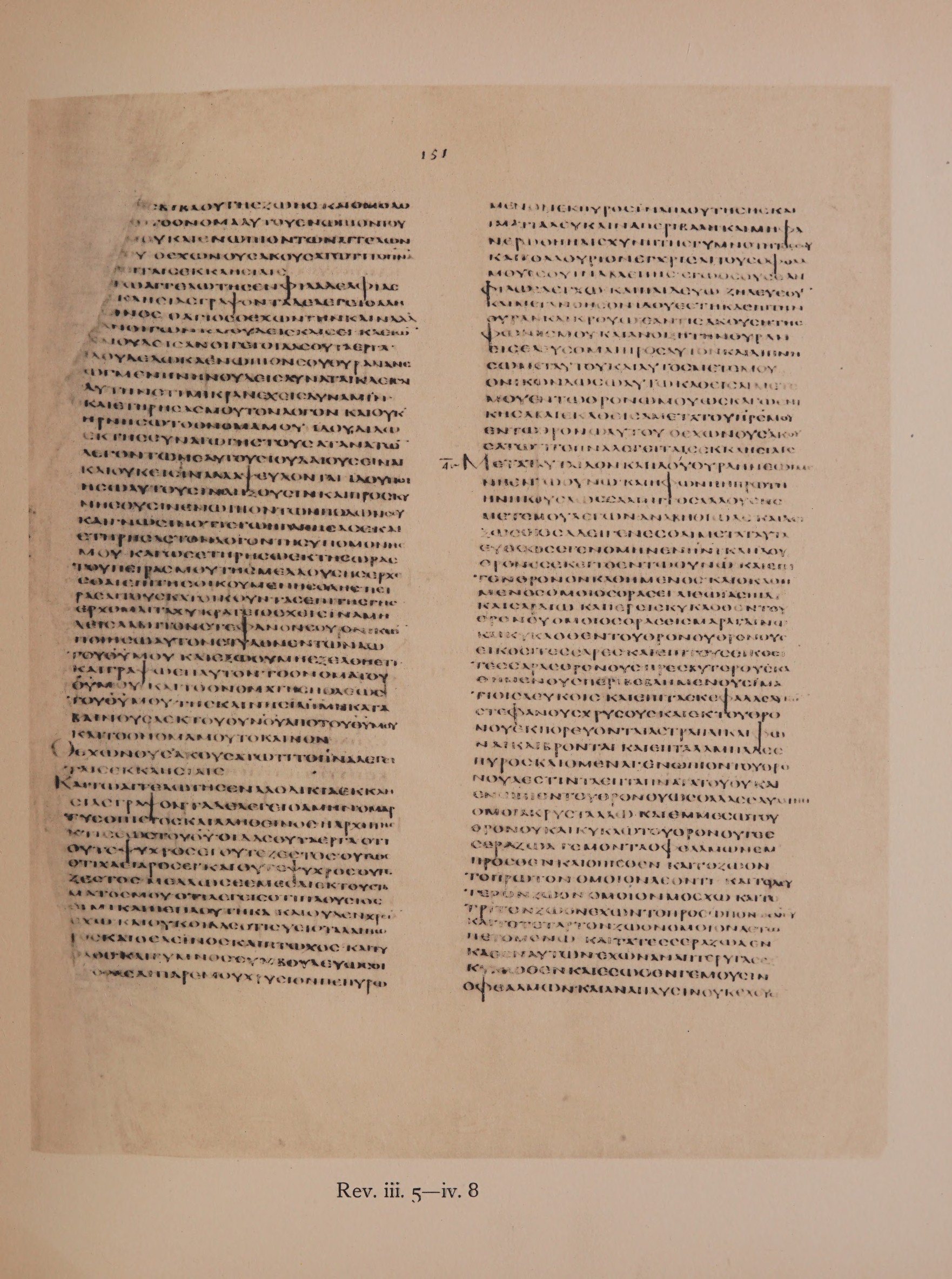
Revelation 4 from Codex Alexandrinus (GA 02), a fifth-century Greek Bible held by the British Library (Royal MS 1 D. VIII). In the New Testament it is the chief witness to the Byzantine text in the Gospels and to the Alexandrian text in the rest of the New Testament. Its New Testament volume lacks Matthew 1:1-25:5, John 6:50-8:52 and 2 Corinthians 4:13-12:6.
This entry meets the strict three-criteria standard of the Theosis Library:
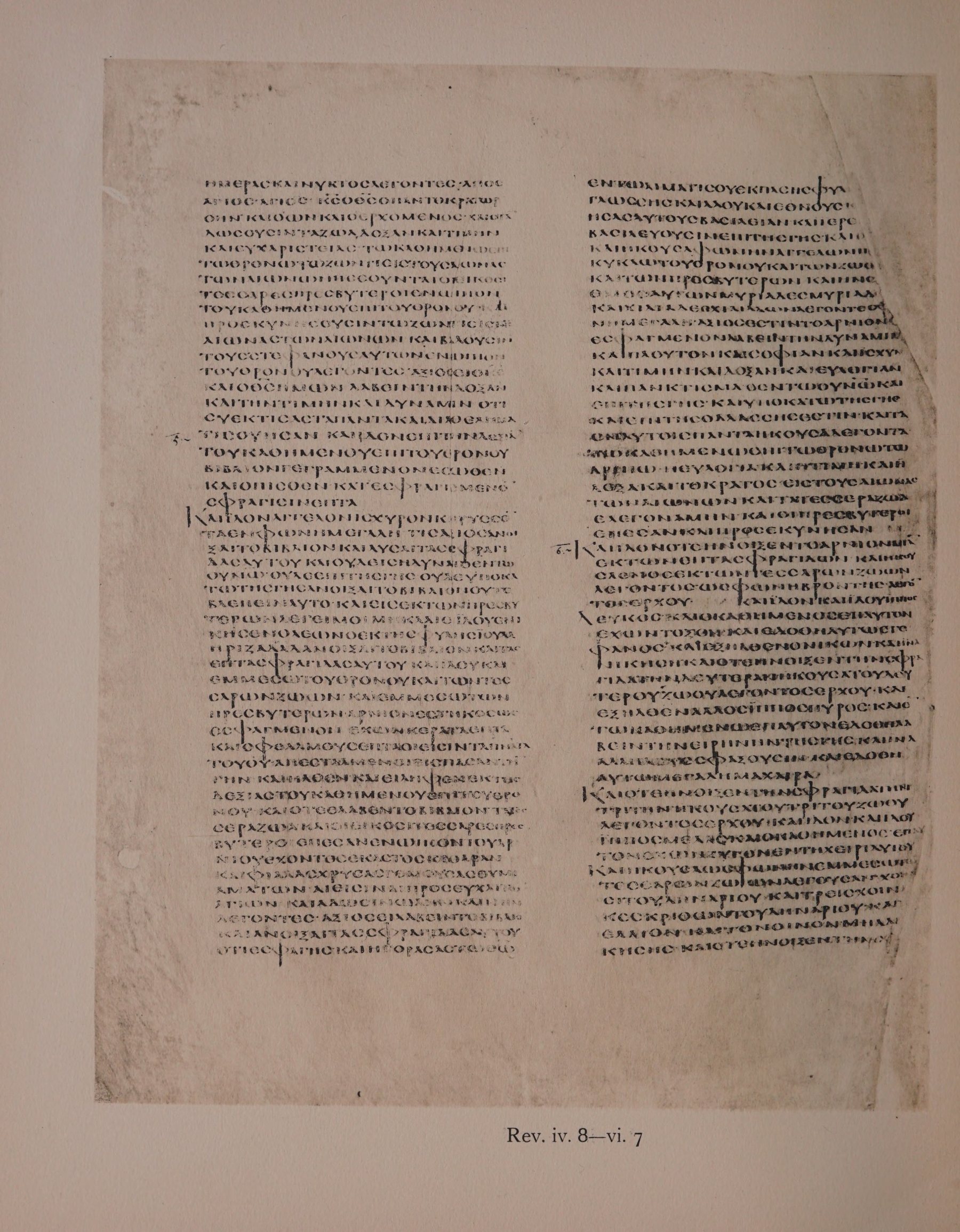
- Manuscript scan: the actual page(s) of Codex Alexandrinus containing this passage (folios 151r, 151v), reproduced from the British Museum's 1909 photographic facsimile edited by F. G. Kenyon, as digitised by the Getty Research Institute for the Internet Archive. The facsimile prints the verse range beneath each plate; that printed range was read for every page used and agrees with the INTF's NTVMR verse-level page index (CC BY 4.0). The page for each section now comes from the NTVMR transcription itself, which records the page and column on which every verse is written.
- Original text: the manuscript's own text, from a diplomatic transcription (see Greek text below), with Tischendorf's 8th critical edition (1869) for comparison.
- English translation: the King James Version (1611), retrieved verbatim from the public-domain bible-api.com endpoint.
Greek text: a diplomatic transcription of Codex Alexandrinus made by the Institut für Neutestamentliche Textforschung (INTF), Münster, for the New Testament Virtual Manuscript Room (NTVMR), published under a Creative Commons Attribution 4.0 licence. It gives the letters as the first scribe wrote them: no accents or breathings, the scribe's own spelling, and the sacred names in their contracted form (θς for θεος, ις for ιησους, κς for κυριος; the overline is not reproduced). Corrections by later hands are not shown. Letters in square brackets are not legible on the page and were restored by the transcribers, a dot under a letter marks an uncertain reading, and [...] marks text lost to damage. Beneath each section, for comparison, is Tischendorf's 8th critical edition (1869). Where the two differ, the transcription is what the manuscript says. Each section is shown with the page on which the transcription places its verses.
How was this verified? (Provenance)
Where on the image
Page from the NTVMR transcription (docID 20002): verses 1-8 on fol. 151r (facsimile leaf 265), col. 2; verse 8 continues on fol. 151v (facsimile leaf 266), col. 1 (which begins 'ημερας και νυκτος').
1μετα ταυτα ιδον · και ιδου θυρα ηνεωγμενη εν τ̣ω ουνω · και η φωνη η πρωτη ην ηκουσα ως σαλπιγγος λαλουσης μετ εμου λεγων · αναβηθι ωδε · και δειξω σοι οσα δει γενεσθαι μετα ταυτα 2ευθεως εγενομην εν πνι · και ιδου θρονος εκειτο εν τω ουνω · και επι τον θρονον καθημενος · 3και ο καθημενος ομοιος ορασει · λιθω ιασπιδι και σαρδιω και ιερεις κυκλοθεν του θρονου ομοιος ορασει σμαραγδινω 4και κυκλοθεν του θρονου θρονους εικοσι τεσσαρες · και επι τους εικοσι τεσσαρας θρονους πρεσβυτερους καθημενους περιβεβλημενους ιματιοις λευκοις · και επι τας κεφαλας αυτων στεφανους χρυσους 5και εκ του θρονου εκπορευονται αστραπαι · και φωναι και βρονται · και επτα λαμπαδες πυρος καιομεναι · ενωπιον του θρονου α εστιν τα επτα πνατα του θυ 6και ενωπιον του θρονου ως θαλασσα υαλινη ομοια κρυσταλλω και εμμεσω του θρονου και κυκλω του θρονου τεσσερα ζωα · γεμοντα οφθαλμων εμπροσθεν και οπισθεν 7και το ζωον το πρωτον ομοιον λεοντι · και το δευτερον ζωον ομοιον μοσχω · και το τριτον ζωον εχων το προσωπον ως ανου και το τεταρτον ζωον ομοιον αετω πετομενω · 8και τα τεσσερα ζωα εν καθ εν αυτων · εχων ανα πτερυγας εξ κυκλοθεν και εσωθεν γεμουσιν οφθαλμων · και αναπαυσιν ουκ εχουσιν ημερας και νυκτος λεγοντες · αγιος αγιος · αγιος · κς ο θς ο παντοκρατωρ · ο ην · και ο ων · και ο ερχομενος ·
Compare: Tischendorf 8th edition (1869)
1Μετὰ ταῦτα ἴδον, καὶ ἰδοὺ θύρα ἠνεῳγμένη ἐν τῷ οὐρανῷ, καὶ ἡ φωνὴ ἡ πρώτη ἣν ἤκουσα ὡς σάλπιγγος λαλούσης μετ’ ἐμοῦ, λέγων· ἀνάβα ὧδε, καὶ δείξω σοι ἃ δεῖ γενέσθαι μετὰ ταῦτα. 2εὐθέως ἐγενόμην ἐν πνεύματι· καὶ ἰδοὺ θρόνος ἔκειτο ἐν τῷ οὐρανῷ, καὶ ἐπὶ τὸν θρόνον καθήμενος, 3καὶ ὁ καθήμενος ὅμοιος ὁράσει λίθῳ ἰάσπιδι καὶ σαρδίῳ, καὶ ἶρις κυκλόθεν τοῦ θρόνου ὅμοιος ὁράσει σμαραγδίνῳ. 4καὶ κυκλόθεν τοῦ θρόνου θρόνους εἴκοσι τέσσαρας, καὶ ἐπὶ τοὺς θρόνους εἴκοσι τέσσαρας πρεσβυτέρους καθημένους περιβεβλημένους ἐν ἱματίοις λευκοῖς, καὶ ἐπὶ τὰς κεφαλὰς αὐτῶν στεφάνους χρυσοῦς. 5καὶ ἐκ τοῦ θρόνου ἐκπορεύονται ἀστραπαὶ καὶ φωναὶ καὶ βρονταί· καὶ ἑπτὰ λαμπάδες πυρὸς καιόμεναι ἐνώπιον τοῦ θρόνου, ἅ εἰσιν τὰ ἑπτὰ πνεύματα τοῦ θεοῦ, 6καὶ ἐνώπιον τοῦ θρόνου ὡς θάλασσα ὑαλίνη ὁμοία κρυστάλλῳ. καὶ ἐν μέσῳ τοῦ θρόνου καὶ κύκλῳ τοῦ θρόνου τέσσερα ζῷα γέμοντα ὀφθαλμῶν ἔνπροσθεν καὶ ὄπισθεν· 7καὶ τὸ ζῷον τὸ πρῶτον ὅμοιον λέοντι, καὶ τὸ δεύτερον ζῷον ὅμοιον μόσχῳ, καὶ τὸ τρίτον ζῷον ἔχων τὸ πρόσωπον ὡς ἀνθρώπου, καὶ τὸ τέταρτον ζῷον ὅμοιον ἀετῷ πετομένῳ. 8καὶ τὰ τέσσερα ζῷα, ἓν καθ’ ἓν αὐτῶν ἔχων ἀνὰ πτέρυγας ἕξ, κυκλόθεν καὶ ἔσωθεν γέμουσιν ὀφθαλμῶν· καὶ ἀνάπαυσιν οὐκ ἔχουσιν ἡμέρας καὶ νυκτὸς λέγοντες, ἅγιος ἅγιος ἅγιος κύριος ὁ θεὸς ὁ παντοκράτωρ ὁ ἦν καὶ ὁ ὢν καὶ ὁ ἐρχόμενος.
1After this I looked, and, behold, a door was opened in heaven: and the first voice which I heard was as it were of a trumpet talking with me; which said, Come up hither, and I will shew thee things which must be hereafter. 2And immediately I was in the spirit: and, behold, a throne was set in heaven, and one sat on the throne. 3And he that sat was to look upon like a jasper and a sardine stone: and there was a rainbow round about the throne, in sight like unto an emerald. 4And round about the throne were four and twenty seats: and upon the seats I saw four and twenty elders sitting, clothed in white raiment; and they had on their heads crowns of gold. 5And out of the throne proceeded lightnings and thunderings and voices: and there were seven lamps of fire burning before the throne, which are the seven Spirits of God. 6And before the throne there was a sea of glass like unto crystal: and in the midst of the throne, and round about the throne, were four beasts full of eyes before and behind. 7And the first beast was like a lion, and the second beast like a calf, and the third beast had a face as a man, and the fourth beast was like a flying eagle. 8And the four beasts had each of them six wings about him; and they were full of eyes within: and they rest not day and night, saying, Holy, holy, holy, Lord God Almighty, which was, and is, and is to come.
Where on the image
Page from the NTVMR transcription (docID 20002): verses 9-11 on fol. 151v (facsimile leaf 266), col. 1.
9και οταν δωσουσιν τα ζωα δοξαν και τιμην και ευχαριστειας · τω καθημενω επι τω θρονω τω ζωντι εις τους α[ι]ωνας των αιωνων 10πεσουνται οι εικοσι τεσσαρες πρεσβυτεροι ενωπιον του καθημενου επι του θρονου · και προσκυνησουσιν τω ζωντι εις τους αιωνας των αιωνων · και βαλουσιν τους στεφανους αυτων ενωπιον του θρονου λεγοντες · 11αξιος ει ο κς και ο θς ημων λαβειν την δοξαν και την τιμην και δυναμιν οτι συ εκτισας τα παντα και δια θεληματι σου ησαν ·
Compare: Tischendorf 8th edition (1869)
9καὶ ὅταν δώσουσιν τὰ ζῷα δόξαν καὶ τιμὴν καὶ εὐχαριστίαν τῷ καθημένῳ ἐπὶ τῷ θρόνῳ, τῷ ζῶντι εἰς τοὺς αἰῶνας τῶν αἰώνων, 10πεσοῦνται οἱ εἴκοσι τέσσαρες πρεσβύτεροι ἐνώπιον τοῦ καθημένου ἐπὶ τοῦ θρόνου καὶ προσκυνήσουσιν τῷ ζῶντι εἰς τοὺς αἰῶνας τῶν αἰώνων, καὶ βαλοῦσιν τοὺς στεφάνους αὐτῶν ἐνώπιον τοῦ θρόνου λέγοντες, 11ἄξιος εἶ, ὁ κύριος καὶ ὁ θεὸς ἡμῶν, λαβεῖν τὴν δόξαν καὶ τὴν τιμὴν καὶ τὴν δύναμιν, ὅτι σὺ ἔκτισας τὰ πάντα, καὶ διὰ τὸ θέλημά σου ἦσαν καὶ ἐκτίσθησαν.
9And when those beasts give glory and honour and thanks to him that sat on the throne, who liveth for ever and ever, 10The four and twenty elders fall down before him that sat on the throne, and worship him that liveth for ever and ever, and cast their crowns before the throne, saying, 11Thou art worthy, O Lord, to receive glory and honour and power: for thou hast created all things, and for thy pleasure they are and were created.
Cite
Sources
- Source: Codex Alexandrinus page images + NTVMR transcription (CC BY 4.0) + Tischendorf 8th edition + KJV (holding institution)
- Critical edition: Codex Alexandrinus transcription, NTVMR (INTF Münster, CC BY 4.0); Tischendorf 8th edition for comparison
← previous · → next · v cycle view · l back to library