Revelation, Chapter 6 (Codex Alexandrinus)
Introduction
Revelation 6 from Codex Alexandrinus (GA 02), a fifth-century Greek Bible held by the British Library (Royal MS 1 D. VIII). In the New Testament it is the chief witness to the Byzantine text in the Gospels and to the Alexandrian text in the rest of the New Testament. Its New Testament volume lacks Matthew 1:1-25:5, John 6:50-8:52 and 2 Corinthians 4:13-12:6.
This entry meets the strict three-criteria standard of the Theosis Library:
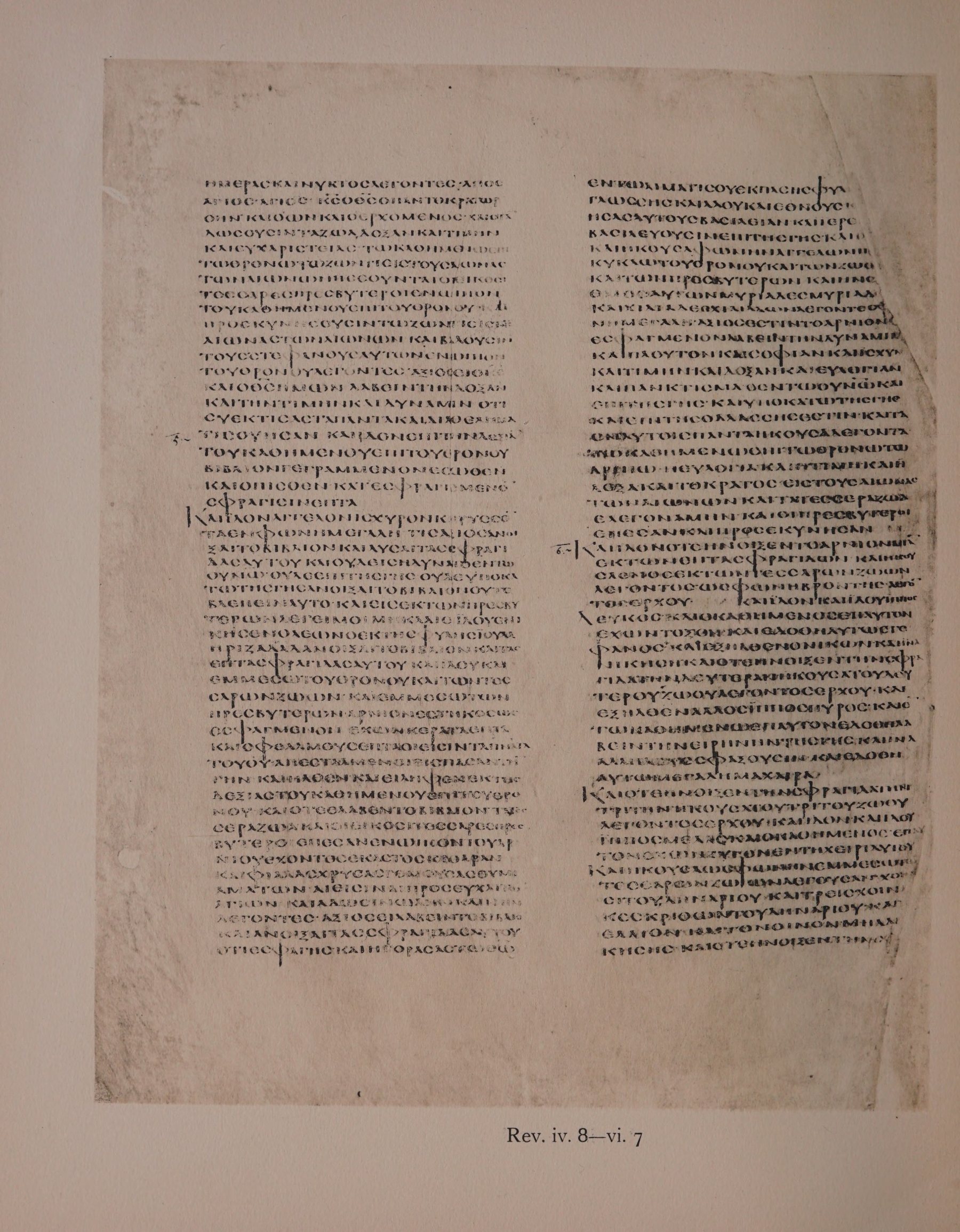
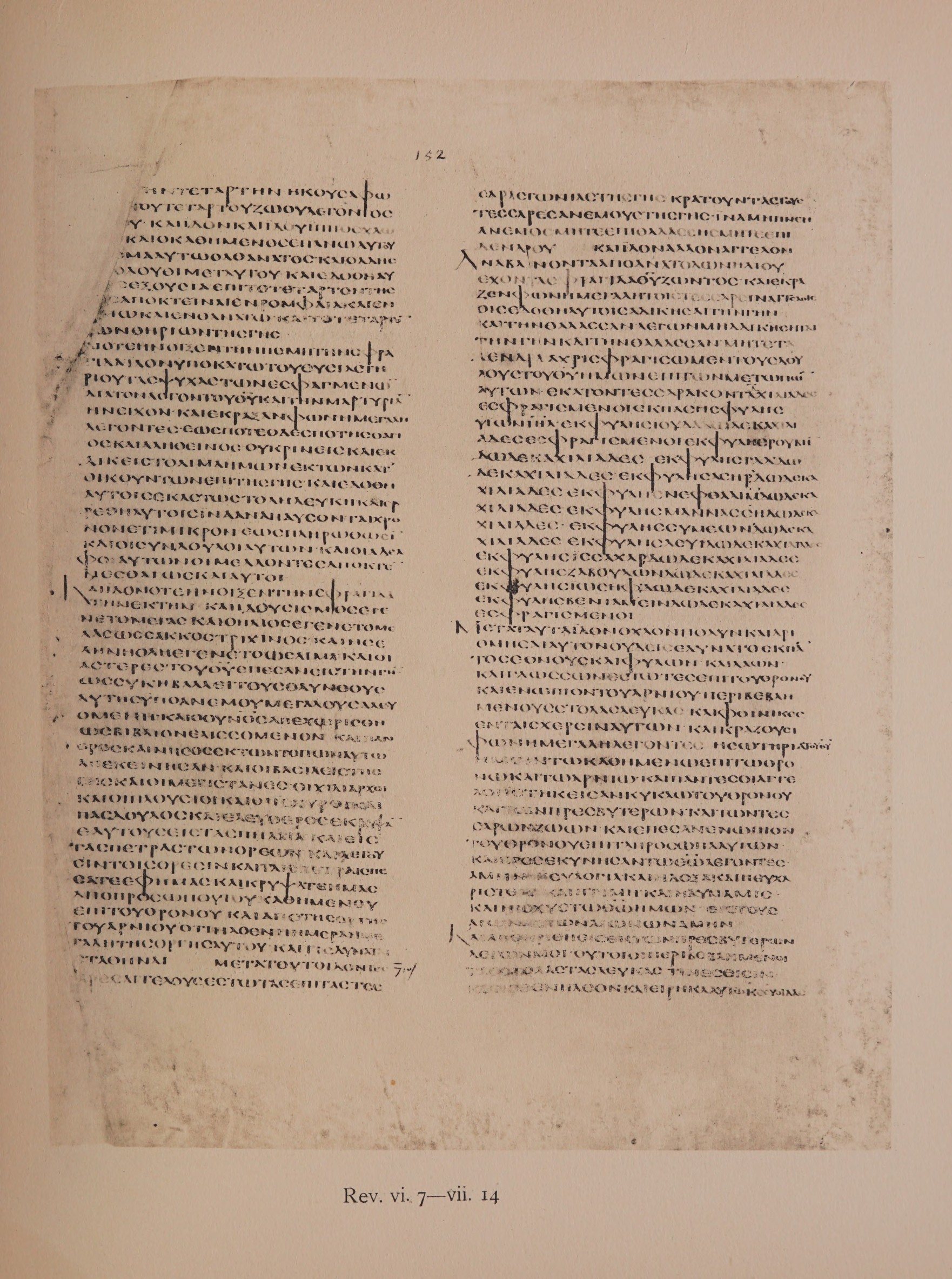
- Manuscript scan: the actual page(s) of Codex Alexandrinus containing this passage (folios 151v, 152r), reproduced from the British Museum's 1909 photographic facsimile edited by F. G. Kenyon, as digitised by the Getty Research Institute for the Internet Archive. The facsimile prints the verse range beneath each plate; that printed range was read for every page used and agrees with the INTF's NTVMR verse-level page index (CC BY 4.0). The page for each section now comes from the NTVMR transcription itself, which records the page and column on which every verse is written.
- Original text: the manuscript's own text, from a diplomatic transcription (see Greek text below), with Tischendorf's 8th critical edition (1869) for comparison.
- English translation: the King James Version (1611), retrieved verbatim from the public-domain bible-api.com endpoint.
Greek text: a diplomatic transcription of Codex Alexandrinus made by the Institut für Neutestamentliche Textforschung (INTF), Münster, for the New Testament Virtual Manuscript Room (NTVMR), published under a Creative Commons Attribution 4.0 licence. It gives the letters as the first scribe wrote them: no accents or breathings, the scribe's own spelling, and the sacred names in their contracted form (θς for θεος, ις for ιησους, κς for κυριος; the overline is not reproduced). Corrections by later hands are not shown. Letters in square brackets are not legible on the page and were restored by the transcribers, a dot under a letter marks an uncertain reading, and [...] marks text lost to damage. Beneath each section, for comparison, is Tischendorf's 8th critical edition (1869). Where the two differ, the transcription is what the manuscript says. Each section is shown with the page on which the transcription places its verses.
How was this verified? (Provenance)
Where on the image
Page from the NTVMR transcription (docID 20002): verses 1-7 on fol. 151v (facsimile leaf 266), col. 2; verse 7 continues on fol. 152r (facsimile leaf 267), col. 1 (which begins '[γιδα] [τ]ην τεταρτην').
1και ιδον οτε ηνοιξεν το αρνιον μιαν εκ των επτα σφραγιδων · και ηκουσα ενος εκ των τεσσαρων ζωων λεγοντος · ως φωνη βροντης · λεγοντος ερχου · 2και ιδον και ιδου ιππος λευκος · και ο καθημενος επ αυτον εχων τοξον · και εδοθη αυτω στεφανος · και εξηλθεν ο νικων και ινα νικηση · 3και οτε ηνοιξεν την σφραγιδα την δευτεραν ηκουσα του δευτερου ζωου λεγοντος ερχου · 4και εξηλθεν αλλος ιππος πυρος · και εν τω καθημενω επ αυτον εδοθη λαβειν την ειρηνην της γης και ινα αλληλους σφαξουσιν · και εδοθη αυτω μεγαλη μαχαιρα 5και οτε ηνοιξεν την σφραγιδα την τριτην · ηκουσα του τριτου ζωου λεγοντος ερχου · και ιδον και ιδου ιππος μελας και ο καθημενος · επ α̣υ̣τον εχων ζυγον εν τη χειρι αυτου 6και ηκουσα ως φωνην εμμεσω τω̣ν̣ τεσσαρων ζωων λεγουσαν χοι[νιξ] σιτου δηναριου και τρεις χοινικες κριθων του δηναριου και τ̣[ο] ελαιον · και τον οινον μη αδι̣κησης · 7και οτε ηνοιξεν την σφ̣[ρα][γιδα] [τ]ην τεταρτην ηκουσα φω[νην] [τ]ου τεταρτου ζωου λεγοντος [ερχο]υ ·
Compare: Tischendorf 8th edition (1869)
1Καὶ ἴδον ὅτε ἤνοιξεν τὸ ἀρνίον μίαν ἐκ τῶν ἑπτὰ σφραγίδων, καὶ ἤκουσα ἑνὸς ἐκ τῶν τεσσάρων ζώων λέγοντος ὡς φωνὴ βροντῆς, ἔρχου. 2καὶ ἴδον, καὶ ἰδοὺ ἵππος λευκός, καὶ ὁ καθήμενος ἐπ’ αὐτὸν ἔχων τόξον, καὶ ἐδόθη αὐτῷ στέφανος, καὶ ἐξῆλθεν νικῶν καὶ ἵνα νικήσῃ. 3Καὶ ὅτε ἤνοιξεν τὴν σφραγῖδα τὴν δευτέραν, ἤκουσα τοῦ δευτέρου ζώου λέγοντος, ἔρχου. 4καὶ ἐξῆλθεν ἄλλος ἵππος πυρρός, καὶ τῷ καθημένῳ ἐπ’ αὐτὸν ἐδόθη αὐτῷ λαβεῖν τὴν εἰρήνην ἐκ τῆς γῆς καὶ ἵνα ἀλλήλους σφάξουσιν, καὶ ἐδόθη αὐτῷ μάχαιρα μεγάλη. 5Καὶ ὅτε ἤνοιξεν τὴν σφραγῖδα τὴν τρίτην, ἤκουσα τοῦ τρίτου ζώου λέγοντος· ἔρχου. καὶ ἴδον, καὶ ἰδοὺ ἵππος μέλας, καὶ ὁ καθήμενος ἐπ’ αὐτὸν ἔχων ζυγὸν ἐν τῇ χειρὶ αὐτοῦ. 6καὶ ἤκουσα ὡς φωνὴν ἐν μέσῳ τῶν τεσσάρων ζώων λέγουσαν, χοῖνιξ σίτου δηναρίου, καὶ τρεῖς χοίνικες κριθῶν δηναρίου· καὶ τὸ ἔλαιον καὶ τὸν οἶνον μὴ ἀδικήσῃς. 7Καὶ ὅτε ἤνοιξεν τὴν σφραγῖδα τὴν τετάρτην, ἤκουσα φωνὴν τοῦ τετάρτου ζώου λέγοντος, ἔρχου.
1And I saw when the Lamb opened one of the seals, and I heard, as it were the noise of thunder, one of the four beasts saying, Come and see. 2And I saw, and behold a white horse: and he that sat on him had a bow; and a crown was given unto him: and he went forth conquering, and to conquer. 3And when he had opened the second seal, I heard the second beast say, Come and see. 4And there went out another horse that was red: and power was given to him that sat thereon to take peace from the earth, and that they should kill one another: and there was given unto him a great sword. 5And when he had opened the third seal, I heard the third beast say, Come and see. And I beheld, and lo a black horse; and he that sat on him had a pair of balances in his hand. 6And I heard a voice in the midst of the four beasts say, A measure of wheat for a penny, and three measures of barley for a penny; and see thou hurt not the oil and the wine. 7And when he had opened the fourth seal, I heard the voice of the fourth beast say, Come and see.
Where on the image
Page from the NTVMR transcription (docID 20002): verses 8-17 on fol. 152r (facsimile leaf 267), col. 1.
8και ιδον και ιδου ιππος χλω[ρος] και ο καθημενος επανω αυτου [ον]ο̣μα αυτω ο αθανατος · και ο αδης [ηκ]ολουθι μετ αυτου · και εδοθη αυ[τοι]ς εξουσια επι το τεταρτον της [γη]ς αποκτειναι εν ρομφαια και εν [λι]μ̣ω και εν θανατω · και το τεταρτον [τ]ων θηριων της γης · 9[κ]α̣ι οτε ηνοιξεν την πεμπτην σφραγιδα ιδον υποκατω του θυσιαστηριου τας ψυχας των εσφαγμενων δια τον λογον του θυ και την μαρτυριαν ην ειχον · 10και εκραξαν φωνη μεγαλη λεγοντες · εως ποτε ο δεσποτης ο αγιος και αληθεινος ου κρινεις και εκδικεις το αιμα ημων εκ των κατοικουντων επι της γης · 11και εδοθη αυτοις εκαστω στολη λευκη και ερρεθη αυτοις ινα αναπαυσονται χρονον ετι μικρον εως πληρωθωσιν και οι συνδουλοι αυτων · και οι αδελφοι αυτων οι μελλοντες αποκτεννεσθαι ως και αυτοι 12και ιδον οτε ηνοιξεν την σφραγιδα την εκτην · και ιδου σισμος εγενετο μεγας και ο ηλιος εγενετο μελας ως σακκος τριχινος · και η σεληνη ολη εγενετο ως αιμα · 13και οι αστερες του θυ επεσαν εις την γην ως συκη βαλλει τους ολυνθους αυτης υπο ανεμου μεγαλου σαλευομενη · 14και ο ουνος απεχωρισθη ως βιβλιον ελισσομενον και παν ορος και νησος εκ των τοπων αυτων̣ απεκεινησαν · 15και οι βασιλεις της γης και οι μεγιστανες · οι χιλιαρχοι και οι πλουσιοι και οι ισχυροι και πας δουλος και ελευθερος εκαυψαν εαυτους εις τα σπηλαια · και εις τας πετρας των ορεων · 16και λεγουσιν τοις ορεσιν και ται̣ς̣ πετραις πεσατε εφ ημας και κρυψατε ημας απο προσωπου του καθημενου επι του θρονου και απο της οργης του αρνιου 17οτι ηλθεν η ημερα η μεγαλη της οργης αυτου και τις δυναται σταθηναι
Compare: Tischendorf 8th edition (1869)
8καὶ ἴδον, καὶ ἰδοὺ ἵππος χλωρός, καὶ ὁ καθήμενος ἐπάνω αὐτοῦ ὄνομα αὐτῷ θάνατος, καὶ ὁ ᾅδης ἠκολούθει μετ’ αὐτοῦ· καὶ ἐδόθη αὐτοῖς ἐξουσία ἐπὶ τὸ τέταρτον τῆς γῆς, ἀποκτεῖναι ἐν ῥομφαίᾳ καὶ ἐν λιμῷ καὶ ἐν θανάτῳ καὶ ὑπὸ τῶν θηρίων τῆς γῆς. 9Καὶ ὅτε ἤνοιξεν τὴν πέμπτην σφραγῖδα, ἴδον ὑποκάτω τοῦ θυσιαστηρίου τὰς ψυχὰς τῶν ἐσφαγμένων διὰ τὸν λόγον τοῦ θεοῦ καὶ διὰ τὴν μαρτυρίαν ἣν εἶχον. 10καὶ ἔκραξαν φωνῇ μεγάλῃ λέγοντες, ἕως πότε, ὁ δεσπότης ὁ ἅγιος καὶ ἀληθινός, οὐ κρίνεις καὶ ἐκδικεῖς τὸ αἷμα ἡμῶν ἐκ τῶν κατοικούντων ἐπὶ τῆς γῆς; 11καὶ ἐδόθη αὐτοῖς ἑκάστῳ στολὴ λευκή, καὶ ἐρρέθη αὐτοῖς ἵνα ἀναπαύσωνται ἔτι χρόνον μικρόν, ἕως πληρώσωσιν καὶ οἱ σύνδουλοι αὐτῶν καὶ οἱ ἀδελφοὶ αὐτῶν οἱ μέλλοντες ἀποκτέννεσθαι ὡς καὶ αὐτοί. 12Καὶ ἴδον ὅτε ἤνοιξεν τὴν σφραγῖδα τὴν ἕκτην, καὶ σεισμὸς μέγας ἐγένετο, καὶ ὁ ἥλιος μέλας ἐγένετο ὡς σάκκος τρίχινος, καὶ ἡ σελήνη ὅλη ἐγένετο ὡς αἷμα, 13καὶ οἱ ἀστέρες τοῦ οὐρανοῦ ἔπεσαν εἰς τὴν γῆν, ὡς συκῆ βάλλουσα τοὺς ὀλύνθους αὐτῆς ὑπὸ ἀνέμου μεγάλου σειομένη, 14καὶ ὁ οὐρανὸς ἀπεχωρίσθη ὡς βιβλίον ἑλισσόμενον, καὶ πᾶν ὄρος καὶ νῆσος ἐκ τῶν τόπων αὐτῶν ἐκινήθησαν. 15καὶ οἱ βασιλεῖς τῆς γῆς καὶ οἱ μεγιστᾶνες καὶ οἱ χιλίαρχοι καὶ οἱ πλούσιοι καὶ οἱ ἰσχυροὶ καὶ πᾶς δοῦλος καὶ ἐλεύθερος ἔκρυψαν ἑαυτοὺς εἰς τὰ σπήλαια καὶ εἰς τὰς πέτρας τῶν ὀρέων· 16καὶ λέγουσιν τοῖς ὄρεσιν καὶ ταῖς πέτραις, πέσετε ἐφ’ ἡμᾶς καὶ κρύψατε ἡμᾶς ἀπὸ προσώπου τοῦ καθημένου ἐπὶ τῷ θρόνῳ καὶ ἀπὸ τῆς ὀργῆς τοῦ ἀρνίου, 17ὅτι ἦλθεν ἡ ἡμέρα ἡ μεγάλη τῆς ὀργῆς αὐτῶν, καὶ τίς δύναται σταθῆναι;
8And I looked, and behold a pale horse: and his name that sat on him was Death, and Hell followed with him. And power was given unto them over the fourth part of the earth, to kill with sword, and with hunger, and with death, and with the beasts of the earth. 9And when he had opened the fifth seal, I saw under the altar the souls of them that were slain for the word of God, and for the testimony which they held: 10And they cried with a loud voice, saying, How long, O Lord, holy and true, dost thou not judge and avenge our blood on them that dwell on the earth? 11And white robes were given unto every one of them; and it was said unto them, that they should rest yet for a little season, until their fellowservants also and their brethren, that should be killed as they were, should be fulfilled. 12And I beheld when he had opened the sixth seal, and, lo, there was a great earthquake; and the sun became black as sackcloth of hair, and the moon became as blood; 13And the stars of heaven fell unto the earth, even as a fig tree casteth her untimely figs, when she is shaken of a mighty wind. 14And the heaven departed as a scroll when it is rolled together; and every mountain and island were moved out of their places. 15And the kings of the earth, and the great men, and the rich men, and the chief captains, and the mighty men, and every bondman, and every free man, hid themselves in the dens and in the rocks of the mountains; 16And said to the mountains and rocks, Fall on us, and hide us from the face of him that sitteth on the throne, and from the wrath of the Lamb: 17For the great day of his wrath is come; and who shall be able to stand?
Cite
Sources
- Source: Codex Alexandrinus page images + NTVMR transcription (CC BY 4.0) + Tischendorf 8th edition + KJV (holding institution)
- Critical edition: Codex Alexandrinus transcription, NTVMR (INTF Münster, CC BY 4.0); Tischendorf 8th edition for comparison
← previous · → next · v cycle view · l back to library