Revelation, Chapter 8 (Codex Alexandrinus)
Introduction
Revelation 8 from Codex Alexandrinus (GA 02), a fifth-century Greek Bible held by the British Library (Royal MS 1 D. VIII). In the New Testament it is the chief witness to the Byzantine text in the Gospels and to the Alexandrian text in the rest of the New Testament. Its New Testament volume lacks Matthew 1:1-25:5, John 6:50-8:52 and 2 Corinthians 4:13-12:6.
This entry meets the strict three-criteria standard of the Theosis Library:
- Manuscript scan: the actual page(s) of Codex Alexandrinus containing this passage (folio 152v), reproduced from the British Museum's 1909 photographic facsimile edited by F. G. Kenyon, as digitised by the Getty Research Institute for the Internet Archive. The facsimile prints the verse range beneath each plate; that printed range was read for every page used and agrees with the INTF's NTVMR verse-level page index (CC BY 4.0). The page for each section now comes from the NTVMR transcription itself, which records the page and column on which every verse is written.
- Original text: the manuscript's own text, from a diplomatic transcription (see Greek text below), with Tischendorf's 8th critical edition (1869) for comparison.
- English translation: the King James Version (1611), retrieved verbatim from the public-domain bible-api.com endpoint.
Greek text: a diplomatic transcription of Codex Alexandrinus made by the Institut für Neutestamentliche Textforschung (INTF), Münster, for the New Testament Virtual Manuscript Room (NTVMR), published under a Creative Commons Attribution 4.0 licence. It gives the letters as the first scribe wrote them: no accents or breathings, the scribe's own spelling, and the sacred names in their contracted form (θς for θεος, ις for ιησους, κς for κυριος; the overline is not reproduced). Corrections by later hands are not shown. Letters in square brackets are not legible on the page and were restored by the transcribers, a dot under a letter marks an uncertain reading, and [...] marks text lost to damage. Beneath each section, for comparison, is Tischendorf's 8th critical edition (1869). Where the two differ, the transcription is what the manuscript says. Each section is shown with the page on which the transcription places its verses.
How was this verified? (Provenance)
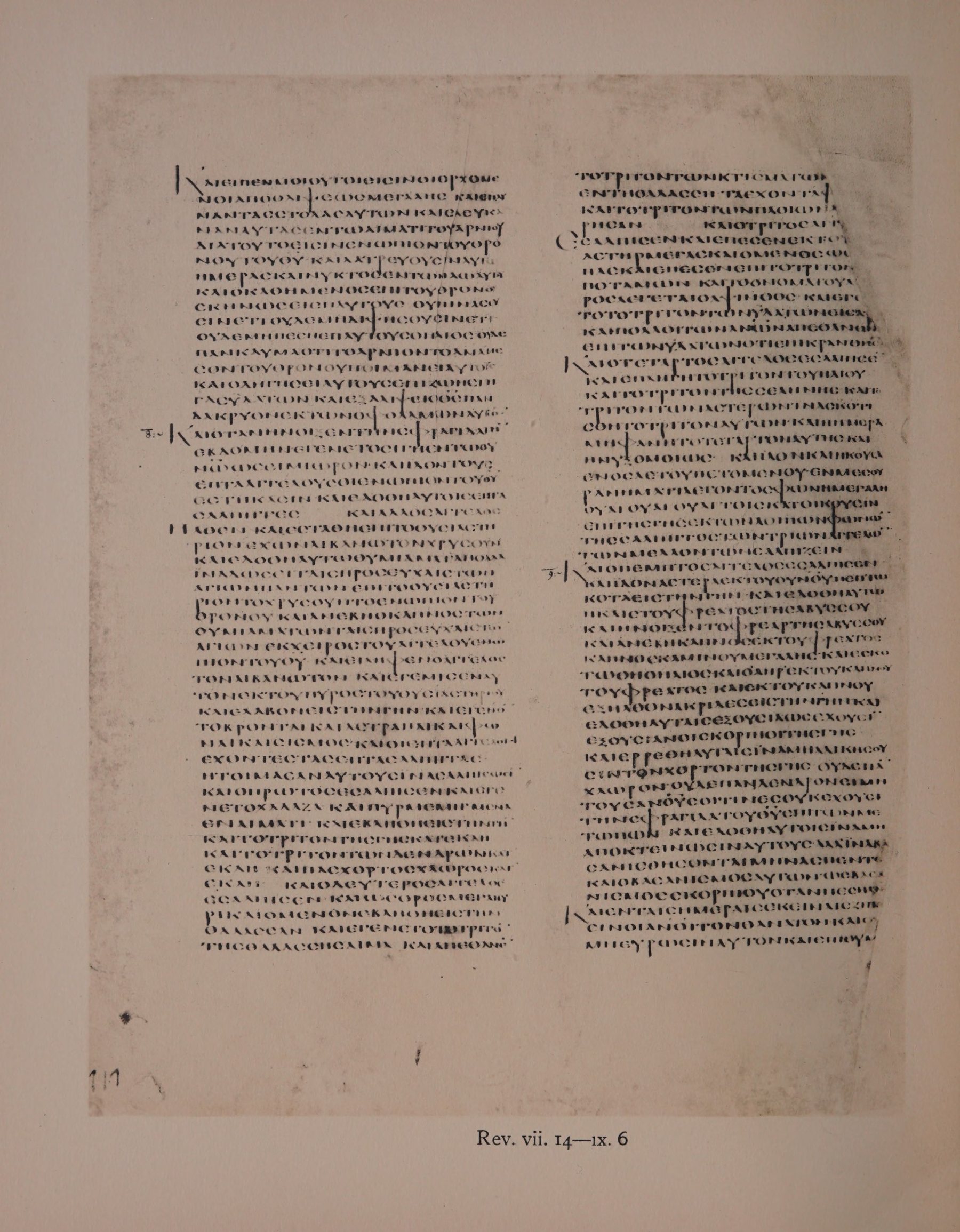
Where on the image
Page from the NTVMR transcription (docID 20002): verses 1-9 on fol. 152v (facsimile leaf 268), col. 1.
1και οταν ηνοιξεν την σφραγιδα την εβδομην · εγενετο σιγη εν τω ουνω ως ειμιωρον · 2και ιδον τους επτα αγγελους οι ενωπιον του θυ εστηκασιν · και εδοθη αυτοις επτα σαλπιγγες 3και αλλος αγγελος ηλθεν · και εσταθη επι το θυσιαστηριον · εχων λιβανωτον χρυσουν και εδοθη αυτω θυμιαματα πολλα ινα δωσει ταις προσευχαις των αγιων παντων επι το θυσιαστηριον το χρυσουν το ενωπιον του θρονου 4και ανεβη ο καπνος των θυμιαματων ταις προσευχαις των αγιων εκ χειρος του αγγελου ενωπιον του θυ · 5και ειληφεν ο αγγελος τον λιβανωτον · και εγεμισεν αυτον εκ του πυρος του θυσιαστηριου και ελαβον εις την γην · και εγενοντο βρονται και αστραπαι και φωναι και σισμος · 6και οι επτα αγγελοι οι εχοντες τας επτα σαλπιγγας · ητοιμασαν αυτους ινα σαλπισωσιν 7και ο πρωτος εσαλπισεν και εγενετο χαλαζα · και πυρ μεμιγμενα εν αιματι · και εβληθη εις την γην και το τριτον της γης κατεκαη και το τριτον των δενδρων κατεκαη · και πας χορτος χλωρος κατεκαη · 8και ο δευτερος αγγελος εσαλπισεν · και ως ορος μεγα πυρι καιομενον εβληθη εις την θαλασσαν και εγενετο το τριτον της θαλασσης αιμα · 9και απεθανεν το τριτον των κτισματων̣ [των] εν τη θαλασση τα εχοντα ψ[υχας] και το τριτον των πλοιων δ[ιεφθα]ρησαν
Compare: Tischendorf 8th edition (1869)
1Καὶ ὅταν ἤνοιξεν τὴν σφραγῖδα τὴν ἑβδόμην, ἐγένετο σιγὴ ἐν τῷ οὐρανῷ ὡς ἡμιώριον. 2καὶ ἴδον τοὺς ἑπτὰ ἀγγέλους οἳ ἐνώπιον τοῦ θεοῦ ἑστήκασιν, καὶ ἐδόθησαν αὐτοῖς ἑπτὰ σάλπιγγες. 3καὶ ἄλλος ἄγγελος ἦλθεν καὶ ἐστάθη ἐπὶ τοῦ θυσιαστηρίου ἔχων λιβανωτὸν χρυσοῦν, καὶ ἐδόθη αὐτῷ θυμιάματα πολλὰ ἵνα δώσει ταῖς προσευχαῖς τῶν ἁγίων πάντων ἐπὶ τὸ θυσιαστήριον τὸ χρυσοῦν τὸ ἐνώπιον τοῦ θρόνου. 4καὶ ἀνέβη ὁ καπνὸς τῶν θυμιαμάτων ταῖς προσευχαῖς τῶν ἁγίων ἐκ χειρὸς τοῦ ἀγγέλου ἐνώπιον τοῦ θεοῦ. 5καὶ εἴληφεν ὁ ἄγγελος τὸν λιβανωτόν, καὶ ἐγέμισεν αὐτὸν ἐκ τοῦ πυρὸς τοῦ θυσιαστηρίου καὶ ἔβαλεν εἰς τὴν γῆν· καὶ ἐγένοντο βρονταὶ καὶ φωναὶ καὶ ἀστραπαὶ καὶ σεισμός. 6Καὶ οἱ ἑπτὰ ἄγγελοι οἱ ἔχοντες τὰς ἑπτὰ σάλπιγγας ἡτοίμασαν αὐτοὺς ἵνα σαλπίσωσιν. 7καὶ ὁ πρῶτος ἐσάλπισεν· καὶ ἐγένετο χάλαζα καὶ πῦρ μεμιγμένον ἐν αἵματι, καὶ ἐβλήθη εἰς τὴν γῆν· καὶ τὸ τρίτον τῆς γῆς κατεκάη, καὶ τὸ τρίτον τῶν δένδρων κατεκάη, καὶ πᾶς χόρτος χλωρὸς κατεκάη. 8Καὶ ὁ δεύτερος ἄγγελος ἐσάλπισεν· καὶ ὡς ὄρος μέγα πυρὶ καιόμενον ἐβλήθη εἰς τὴν θάλασσαν· καὶ ἐγένετο τὸ τρίτον τῆς θαλάσσης αἷμα, 9καὶ ἀπέθανεν τὸ τρίτον τῶν κτισμάτων τῶν ἐν τῇ θαλάσσῃ, τὰ ἔχοντα ψυχάς, καὶ τὸ τρίτον τῶν πλοίων διεφθάρησαν.
1And when he had opened the seventh seal, there was silence in heaven about the space of half an hour. 2And I saw the seven angels which stood before God; and to them were given seven trumpets. 3And another angel came and stood at the altar, having a golden censer; and there was given unto him much incense, that he should offer it with the prayers of all saints upon the golden altar which was before the throne. 4And the smoke of the incense, which came with the prayers of the saints, ascended up before God out of the angel’s hand. 5And the angel took the censer, and filled it with fire of the altar, and cast it into the earth: and there were voices, and thunderings, and lightnings, and an earthquake. 6And the seven angels which had the seven trumpets prepared themselves to sound. 7The first angel sounded, and there followed hail and fire mingled with blood, and they were cast upon the earth: and the third part of trees was burnt up, and all green grass was burnt up. 8And the second angel sounded, and as it were a great mountain burning with fire was cast into the sea: and the third part of the sea became blood; 9And the third part of the creatures which were in the sea, and had life, died; and the third part of the ships were destroyed.
Where on the image
Page from the NTVMR transcription (docID 20002): verses 10-13 on fol. 152v (facsimile leaf 268), col. 2.
10και ο τριτος αγγ[ελος] εσαλπισεν και επεσεν εκ του̣ [ουνου] αστηρ μεγας καιομενος ως̣ [λαμ]πας και επεσεν επι το τριτον [των] ποταμων 11και το ονομα του α[στε]ρος λεγεται ο αψινθος · και εγε̣[νε]το το τριτον των υδατων εις αψ̣[ινθον] και πολλοι των ανων απεθανον επι των υδατων οτι επικρανθησ[αν] 12και ο τεταρτος αγγελος εσαλπισεν και επληγη το τριτον του ηλιου και το τριτον της σεληνης και το τριτον των αστερων · ινα σκοτισθη το τριτον αυτων · και η ημερα μη φανη το τεταρτον αυτης και η νυξ ομοιως · 13και ιδον και ηκουσα ενος αετου πετομενου · εν μεσουρανηματι λεγοντος φωνη μεγαλη ουαι ουαι ουαι τοις κατοικουσιν επι της γης εκ των λοιπων φωνων της σαλπιγγος των τριων αγγελων των μελλοντων σαλπιζειν
Compare: Tischendorf 8th edition (1869)
10Καὶ ὁ τρίτος ἄγγελος ἐσάλπισεν· καὶ ἔπεσεν ἐκ τοῦ οὐρανοῦ ἀστὴρ μέγας καιόμενος ὡς λαμπάς, καὶ ἔπεσεν ἐπὶ τὸ τρίτον τῶν ποταμῶν καὶ ἐπὶ τὰς πηγὰς τῶν ὑδάτων. 11καὶ τὸ ὄνομα τοῦ ἀστέρος λέγεται ὁ ἄψινθος. καὶ ἐγένετο τὸ τρίτον τῶν ὑδάτων εἰς ἄψινθον, καὶ πολλοὶ τῶν ἀνθρώπων ἀπέθανον ἐκ τῶν ὑδάτων, ὅτι ἐπικράνθησαν. 12Καὶ ὁ τέταρτος ἄγγελος ἐσάλπισεν· καὶ ἐπλήγη τὸ τρίτον τοῦ ἡλίου καὶ τὸ τρίτον τῆς σελήνης καὶ τὸ τρίτον τῶν ἀστέρων, ἵνα σκοτισθῇ τὸ τρίτον αὐτῶν καὶ ἡ ἡμέρα μὴ φάνῃ τὸ τρίτον αὐτῆς, καὶ ἡ νὺξ ὁμοίως. 13καὶ ἴδον, καὶ ἤκουσα ἑνὸς ἀετοῦ πετομένου ἐν μεσουρανήματι λέγοντος φωνῇ μεγάλῃ, οὐαὶ οὐαὶ οὐαὶ τοὺς κατοικοῦντας ἐπὶ τῆς γῆς ἐκ τῶν λοιπῶν φωνῶν τῆς σάλπιγγος τῶν τριῶν ἀγγέλων τῶν μελλόντων σαλπίζειν.
10And the third angel sounded, and there fell a great star from heaven, burning as it were a lamp, and it fell upon the third part of the rivers, and upon the fountains of waters; 11And the name of the star is called Wormwood: and the third part of the waters became wormwood; and many men died of the waters, because they were made bitter. 12And the fourth angel sounded, and the third part of the sun was smitten, and the third part of the moon, and the third part of the stars; so as the third part of them was darkened, and the day shone not for a third part of it, and the night likewise. 13And I beheld, and heard an angel flying through the midst of heaven, saying with a loud voice, Woe, woe, woe, to the inhabiters of the earth by reason of the other voices of the trumpet of the three angels, which are yet to sound!
Cite
Sources
- Source: Codex Alexandrinus page images + NTVMR transcription (CC BY 4.0) + Tischendorf 8th edition + KJV (holding institution)
- Critical edition: Codex Alexandrinus transcription, NTVMR (INTF Münster, CC BY 4.0); Tischendorf 8th edition for comparison
← previous · → next · v cycle view · l back to library