Romans, Chapter 7 (Codex Alexandrinus)
Introduction
Romans 7 from Codex Alexandrinus (GA 02), a fifth-century Greek Bible held by the British Library (Royal MS 1 D. VIII). In the New Testament it is the chief witness to the Byzantine text in the Gospels and to the Alexandrian text in the rest of the New Testament. Its New Testament volume lacks Matthew 1:1-25:5, John 6:50-8:52 and 2 Corinthians 4:13-12:6.
This entry meets the strict three-criteria standard of the Theosis Library:
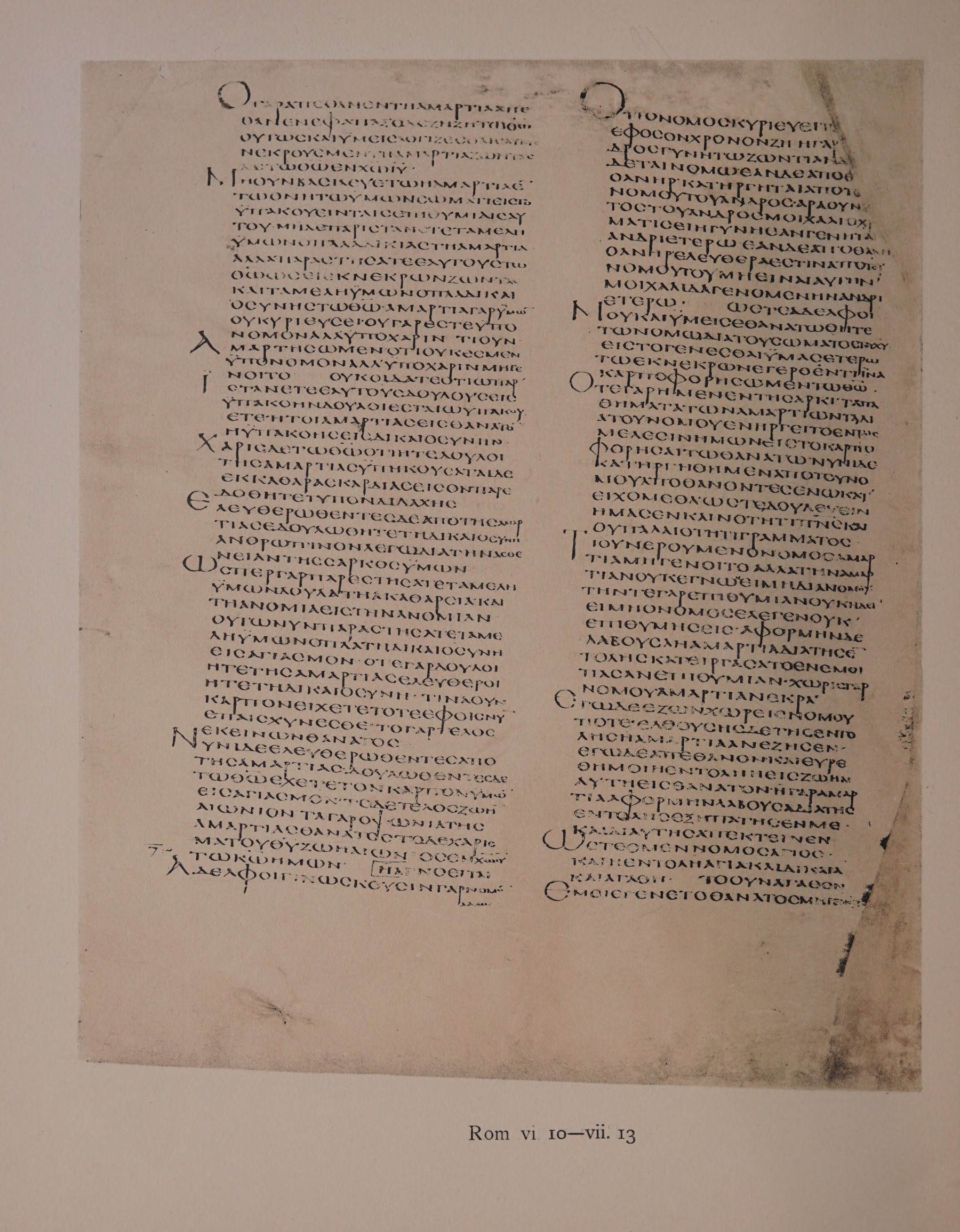
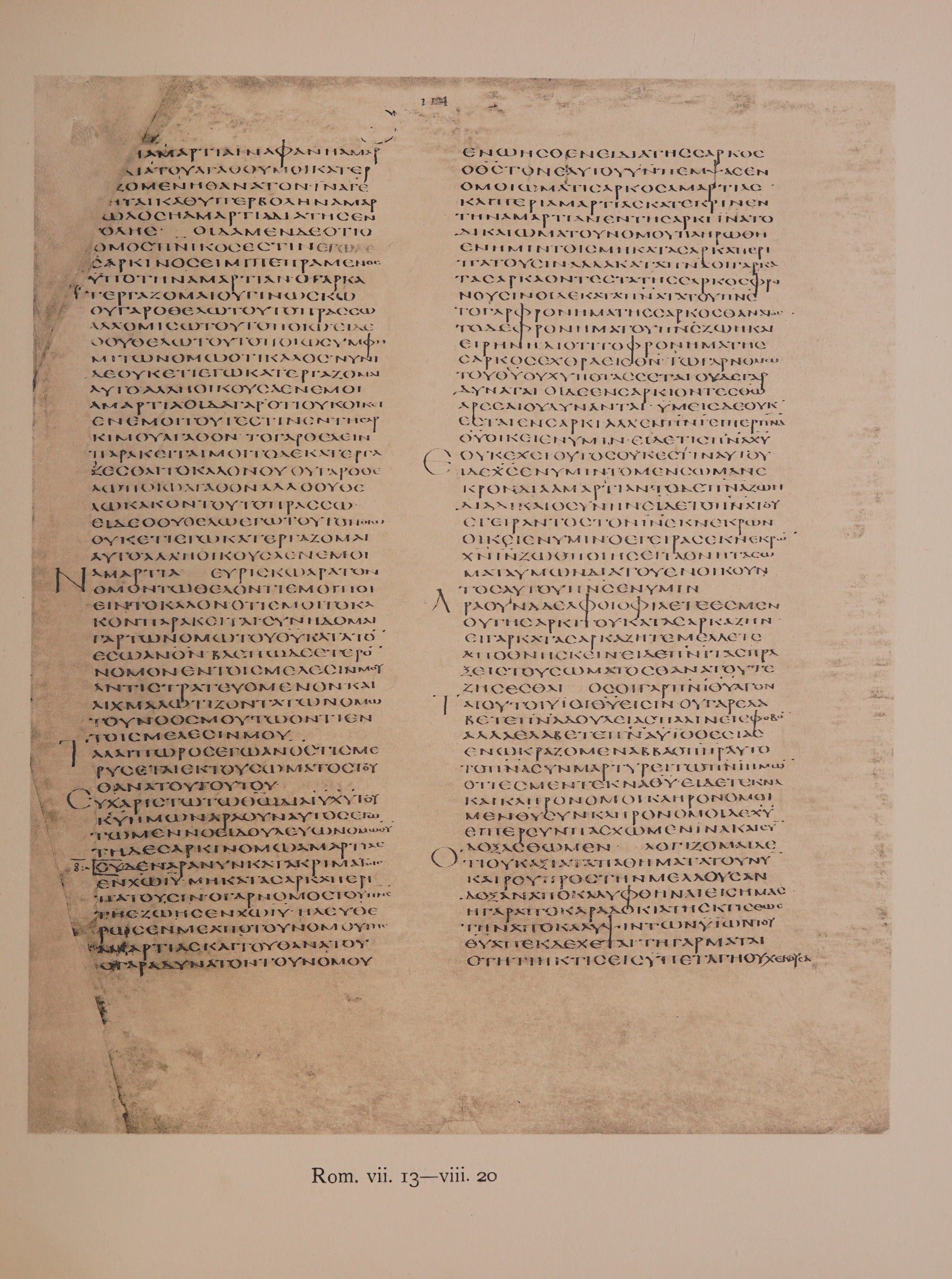
- Manuscript scan: the actual page(s) of Codex Alexandrinus containing this passage (folios 113v, 114r), reproduced from the British Museum's 1909 photographic facsimile edited by F. G. Kenyon, as digitised by the Getty Research Institute for the Internet Archive. The facsimile prints the verse range beneath each plate; that printed range was read for every page used and agrees with the INTF's NTVMR verse-level page index (CC BY 4.0). The page for each section now comes from the NTVMR transcription itself, which records the page and column on which every verse is written.
- Original text: the manuscript's own text, from a diplomatic transcription (see Greek text below), with Tischendorf's 8th critical edition (1869) for comparison.
- English translation: the King James Version (1611), retrieved verbatim from the public-domain bible-api.com endpoint.
Greek text: a diplomatic transcription of Codex Alexandrinus made by the Institut für Neutestamentliche Textforschung (INTF), Münster, for the New Testament Virtual Manuscript Room (NTVMR), published under a Creative Commons Attribution 4.0 licence. It gives the letters as the first scribe wrote them: no accents or breathings, the scribe's own spelling, and the sacred names in their contracted form (θς for θεος, ις for ιησους, κς for κυριος; the overline is not reproduced). Corrections by later hands are not shown. Letters in square brackets are not legible on the page and were restored by the transcribers, a dot under a letter marks an uncertain reading, and [...] marks text lost to damage. Beneath each section, for comparison, is Tischendorf's 8th critical edition (1869). Where the two differ, the transcription is what the manuscript says. Each section is shown with the page on which the transcription places its verses.
How was this verified? (Provenance)
Where on the image
Page from the NTVMR transcription (docID 20002): verse 1 on fol. 113v (facsimile leaf 188), col. 1.
1η αγνοειται αδελφοι γινωσκουσιν γαρ νομον λαλω οτι ο νομος κυριευει τ̣ο̣[υ] [ανου] εφ οσον χρονον ζη
Compare: Tischendorf 8th edition (1869)
1Ἢ ἀγνοεῖτε, ἀδελφοί, γινώσκουσιν γὰρ νόμον λαλῶ, ὅτι ὁ νόμος κυριεύει τοῦ ἀνθρώπου ἐφ’ ὅσον χρόνον ζῇ;
1Know ye not, brethren, (for I speak to them that know the law,) how that the law hath dominion over a man as long as he liveth?
Where on the image
Page from the NTVMR transcription (docID 20002): verses 2-13 on fol. 113v (facsimile leaf 188), col. 2; verse 13 continues on fol. 114r (facsimile leaf 189), col. 1 (which begins '[αλλ] η̣ αμαρτια').
2η γαρ [υπαν]δρος γυνη τω ζωντι ανδ[ρι] [δε]δεται νομω · εαν δε αποθ[ανη] ο ανηρ · κατηργηται απο το̣[υ] νομου του ανδρος · 3αρα ουν [ζων]τος του ανδρος μοιχαλις χρ[η]ματισει η γυνη εαν γενηται ανδρι ετερω · εαν δε αποθαν̣η ο ανηρ ελευθερα εστιν απο του νομου του μη ειναι αυτην μοιχαλιδα γενομενην ανδρι ετερω · 4ωστε αδελφοι μου και υμεις εθανατωθητε τω νομω δια του σωματος του χυ εις το γενεσθαι υμας ετερω τω εκ νεκρων εγερθεντι ινα καρποφορησωμεν τω θω 5οτε γαρ ημεν εν τη σαρκι · τα παθηματα των αμαρτιων τα δια του νομου ενηργειτο εν τοις μελεσιν ημων εις το καρποφορησαι τω θανατω · 6νυνι δε κατηργηθημεν απο του νομου αποθανοντες εν ω κατειχομεθα · ωστε δουλευειν ημας εν καινοτητι πνς και ου παλαιοτητι γραμματος · 7τι ουν ερουμεν ο νομος αμαρτια μη γενοιτο αλλα την αμαρτιαν ουκ εγνω ει μη δια νομου την τε γαρ επιθυμιαν ουκ ηδειν ει μη ο νομος ελεγεν ουκ επιθυμησεις · 8αφορμην δε λαβουσα η αμαρτια δια της εντολης κατειργασατο εν εμοι πασαν επιθυμιαν · χωρις γαρ νομου αμαρτια νεκρα · 9εγω δε εζων χωρεις νομου ποτε · ελθουσης δε της εντολης η αμαρτια ανεζησεν · 10εγω δε απεθανον · και ευρεθη μοι η εντολη η εις ζωην αυτη εις θανατον · 11η γαρ αμαρτια αφορμην λαβουσα δια της εντολης εξηπατησεν με · και δι αυτης απεκτεινεν · 12ωστε ο μεν νομος αγιος · και η εντολη αγια · και δικαια και αγαθη · 13το ουν αγαθον εμοι εγενετο θανατος μη γενοιτο [αλλ] η̣ αμαρτια ινα φανη αμαρ[τια] δια του αγαθου μοι κατερ[γα]ζ̣ομενη θανατον · ινα γε[ν]ηται καθ υπερβολην αμαρ[τ]ωλος η αμαρτια δια της εν[τ]ολης ·
Compare: Tischendorf 8th edition (1869)
2ἡ γὰρ ὕπανδρος γυνὴ τῷ ζῶντι ἀνδρὶ δέδεται νόμῳ· ἐὰν δὲ ἀποθάνῃ ὁ ἀνήρ, κατήργηται ἀπὸ τοῦ νόμου τοῦ ἀνδρός. 3ἄρα οὖν ζῶντος τοῦ ἀνδρὸς μοιχαλὶς χρηματίσει ἐὰν γένηται ἀνδρὶ ἑτέρῳ· ἐὰν δὲ ἀποθάνῃ ὁ ἀνήρ, ἐλευθέρα ἐστὶν ἀπὸ τοῦ νόμου, τοῦ μὴ εἶναι αὐτὴν μοιχαλίδα γενομένην ἀνδρὶ ἑτέρῳ. 4ὥστε, ἀδελφοί μου, καὶ ὑμεῖς ἐθανατώθητε τῷ νόμῳ διὰ τοῦ σώματος τοῦ Χριστοῦ, εἰς τὸ γενέσθαι ὑμᾶς ἑτέρῳ, τῷ ἐκ νεκρῶν ἐγερθέντι, ἵνα καρποφορήσωμεν τῷ θεῷ. 5ὅτε γὰρ ἦμεν ἐν τῇ σαρκί, τὰ παθήματα τῶν ἁμαρτιῶν τὰ διὰ τοῦ νόμου ἐνηργεῖτο ἐν τοῖς μέλεσιν ἡμῶν εἰς τὸ καρποφορῆσαι τῷ θανάτῳ· 6νυνὶ δὲ κατηργήθημεν ἀπὸ τοῦ νόμου, ἀποθανόντες ἐν ᾧ κατειχόμεθα, ὥστε δουλεύειν ἡμᾶς ἐν καινότητι πνεύματος καὶ οὐ παλαιότητι γράμματος. 7Τί οὖν ἐροῦμεν; ὁ νόμος ἁμαρτία; μὴ γένοιτο· ἀλλὰ τὴν ἁμαρτίαν οὐκ ἔγνων εἰ μὴ διὰ νόμου, τήν τε γὰρ ἐπιθυμίαν οὐκ ᾔδειν εἰ μὴ ὁ νόμος ἔλεγεν, οὐκ ἐπιθυμήσεις. 8ἀφορμὴν δὲ λαβοῦσα ἡ ἁμαρτία διὰ τῆς ἐντολῆς κατηργάσατο ἐν ἐμοὶ πᾶσαν ἐπιθυμίαν· χωρὶς γὰρ νόμου ἁμαρτία νεκρά. 9ἐγὼ δὲ ἔζων χωρὶς νόμου ποτέ· ἐλθούσης δὲ τῆς ἐντολῆς ἡ ἁμαρτία ἀνέζησεν, 10ἐγὼ δὲ ἀπέθανον, καὶ εὑρέθη μοι ἡ ἐντολὴ ἡ εἰς ζωὴν αὕτη εἰς θάνατον· 11ἡ γὰρ ἁμαρτία ἀφορμὴν λαβοῦσα διὰ τῆς ἐντολῆς ἐξηπάτησέν με καὶ δι’ αὐτῆς ἀπέκτεινεν. 12ὥστε ὁ μὲν νόμος ἅγιος, καὶ ἡ ἐντολὴ ἁγία καὶ δικαία καὶ ἀγαθή. 13τὸ οὖν ἀγαθὸν ἐμοὶ ἐγένετο θάνατος; μὴ γένοιτο· ἀλλὰ ἡ ἁμαρτία, ἵνα φανῇ ἁμαρτία, διὰ τοῦ ἀγαθοῦ μοι κατεργαζομένη θάνατον· ἵνα γένηται καθ’ ὑπερβολὴν ἁμαρτωλὸς ἡ ἁμαρτία διὰ τῆς ἐντολῆς.
2For the woman which hath an husband is bound by the law to her husband so long as he liveth; but if the husband be dead, she is loosed from the law of her husband. 3So then if, while her husband liveth, she be married to another man, she shall be called an adulteress: but if her husband be dead, she is free from that law; so that she is no adulteress, though she be married to another man. 4Wherefore, my brethren, ye also are become dead to the law by the body of Christ; that ye should be married to another, even to him who is raised from the dead, that we should bring forth fruit unto God. 5For when we were in the flesh, the motions of sins, which were by the law, did work in our members to bring forth fruit unto death. 6But now we are delivered from the law, that being dead wherein we were held; that we should serve in newness of spirit, and not in the oldness of the letter. 7What shall we say then? Is the law sin? God forbid. Nay, I had not known sin, but by the law: for I had not known lust, except the law had said, Thou shalt not covet. 8But sin, taking occasion by the commandment, wrought in me all manner of concupiscence. For without the law sin was dead. 9For I was alive without the law once: but when the commandment came, sin revived, and I died. 10And the commandment, which was ordained to life, I found to be unto death. 11For sin, taking occasion by the commandment, deceived me, and by it slew me. 12Wherefore the law is holy, and the commandment holy, and just, and good. 13Was then that which is good made death unto me? God forbid. But sin, that it might appear sin, working death in me by that which is good; that sin by the commandment might become exceeding sinful.
Where on the image
Page from the NTVMR transcription (docID 20002): verses 14-25 on fol. 114r (facsimile leaf 189), col. 1.
14οιδαμεν δε οτι ο [ν]ομος πνικος εστιν [...] σαρκινος ειμι πεπραμενος υπο την αμαρτιαν · 15ο [...] κατεργαζομαι ου γινωσκω ου γαρ ο θελω τουτο πρασσω αλλ ο μισω τουτο ποιω · 16ει δε ο ου θελω τουτο ποιω συμφημι τω νομω οτι καλος · 17νυνι δε ουκετι εγω κατεργαζομαι αυτο · αλλ η οικουσα εν εμοι αμαρτια 18οιδα γαρ οτι ουκ οικει εν εμοι τουτ εστιν εν τη σαρκι μου αγαθον · το γαρ θελειν παρακειται μοι το δε κατεργαζεσθαι το καλον ου 19ου γαρ ο θελω ποιω αγαθον · αλλ ο ου θελω κακον τουτο πρασσω · 20ει δε ο ου θελω εγω τουτο ποιω ουκετι εγω κατεργαζομαι αυτο · αλλ η οικουσα εν εμοι αμαρτια · 21ευρισκω αρα τον νομον τω θελοντι εμοι ποιειν το καλον · οτι εμοι το κακον παρακειται · 22συνηδομαι γαρ τω νομω του θυ κατα τον εσω ανον · 23βλεπω δε ετερον νομον εν τοις μελεσιν μου αντιστρατευομενον · και αιχμαλωτιζοντα τω νομω του νοος μου τω οντι εν τοις μελεσιν μου · 24ταλαιπωρος εγω ανος τις με ρυσεται εκ του σωματος του θανατου τουτου · 25ευχαριστω τω θω δια ιυ χυ του κυ ημων αρα ουν αυτος εγω τω μεν νοει δουλευω νομω θυ τη δε σαρκι νομω αμαρτιας
Compare: Tischendorf 8th edition (1869)
14οἴδαμεν γὰρ ὅτι ὁ νόμος πνευματικός ἐστιν· ἐγὼ δὲ σάρκινός εἰμι, πεπραμένος ὑπὸ τὴν ἁμαρτίαν. 15ὃ γὰρ κατεργάζομαι οὐ γινώσκω· οὐ γὰρ ὃ θέλω τοῦτο πράσσω, ἀλλ’ ὃ μισῶ τοῦτο ποιῶ. 16εἰ δὲ ὃ οὐ θέλω τοῦτο ποιῶ, σύμφημι τῷ νόμῳ ὅτι καλός. 17νυνὶ δὲ οὐκέτι ἐγὼ κατεργάζομαι αὐτὸ ἀλλὰ ἡ ἐνοικοῦσα ἐν ἐμοὶ ἁμαρτία. 18οἶδα γὰρ ὅτι οὐκ οἰκεῖ ἐν ἐμοί, τοῦτ’ ἔστιν ἐν τῇ σαρκί μου, ἀγαθόν· τὸ γὰρ θέλειν παράκειταί μοι, τὸ δὲ κατεργάζεσθαι τὸ καλὸν οὔ· 19οὐ γὰρ ὃ θέλω ποιῶ ἀγαθόν, ἀλλὰ ὃ οὐ θέλω κακὸν τοῦτο πράσσω. 20εἰ δὲ ὃ οὐ θέλω ἐγὼ τοῦτο ποιῶ, οὐκέτι ἐγὼ κατεργάζομαι αὐτὸ ἀλλὰ ἡ οἰκοῦσα ἐν ἐμοὶ ἁμαρτία. 21εὑρίσκω ἄρα τὸν νόμον τῷ θέλοντι ἐμοὶ ποιεῖν τὸ καλὸν ὅτι ἐμοὶ τὸ κακὸν παράκειται· 22συνήδομαι γὰρ τῷ νόμῳ τοῦ θεοῦ κατὰ τὸν ἔσω ἄνθρωπον, 23βλέπω δὲ ἕτερον νόμον ἐν τοῖς μέλεσίν μου ἀντιστρατευόμενον τῷ νόμῳ τοῦ νοός μου καὶ αἰχμαλωτίζοντά με ἐν τῷ νόμῳ τῆς ἁμαρτίας τῷ ὄντι ἐν τοῖς μέλεσίν μου. 24ταλαίπωρος ἐγὼ ἄνθρωπος· τίς με ῥύσεται ἐκ τοῦ σώματος τοῦ θανάτου τούτου; 25χάρις δὲ τῷ θεῷ διὰ Ἰησοῦ Χριστοῦ τοῦ κυρίου ἡμῶν. ἄρα οὖν αὐτὸς ἐγὼ τῷ νοῒ δουλεύω νόμῳ θεοῦ, τῇ δὲ σαρκὶ νόμῳ ἁμαρτίας.
14For we know that the law is spiritual: but I am carnal, sold under sin. 15For that which I do I allow not: for what I would, that do I not; but what I hate, that do I. 16If then I do that which I would not, I consent unto the law that it is good. 17Now then it is no more I that do it, but sin that dwelleth in me. 18For I know that in me (that is, in my flesh,) dwelleth no good thing: for to will is present with me; but how to perform that which is good I find not. 19For the good that I would I do not: but the evil which I would not, that I do. 20Now if I do that I would not, it is no more I that do it, but sin that dwelleth in me. 21I find then a law, that, when I would do good, evil is present with me. 22For I delight in the law of God after the inward man: 23But I see another law in my members, warring against the law of my mind, and bringing me into captivity to the law of sin which is in my members. 24O wretched man that I am! who shall deliver me from the body of this death? 25I thank God through Jesus Christ our Lord. So then with the mind I myself serve the law of God; but with the flesh the law of sin.
Cite
Sources
- Source: Codex Alexandrinus page images + NTVMR transcription (CC BY 4.0) + Tischendorf 8th edition + KJV (holding institution)
- Critical edition: Codex Alexandrinus transcription, NTVMR (INTF Münster, CC BY 4.0); Tischendorf 8th edition for comparison
← previous · → next · v cycle view · l back to library