Titus, Chapter 3 (Codex Alexandrinus)
Introduction
Titus 3 from Codex Alexandrinus (GA 02), a fifth-century Greek Bible held by the British Library (Royal MS 1 D. VIII). In the New Testament it is the chief witness to the Byzantine text in the Gospels and to the Alexandrian text in the rest of the New Testament. Its New Testament volume lacks Matthew 1:1-25:5, John 6:50-8:52 and 2 Corinthians 4:13-12:6.
This entry meets the strict three-criteria standard of the Theosis Library:
- Manuscript scan: the actual page(s) of Codex Alexandrinus containing this passage (folio 148v), reproduced from the British Museum's 1909 photographic facsimile edited by F. G. Kenyon, as digitised by the Getty Research Institute for the Internet Archive. The facsimile prints the verse range beneath each plate; that printed range was read for every page used and agrees with the INTF's NTVMR verse-level page index (CC BY 4.0). The page for each section now comes from the NTVMR transcription itself, which records the page and column on which every verse is written.
- Original text: the manuscript's own text, from a diplomatic transcription (see Greek text below), with Tischendorf's 8th critical edition (1869) for comparison.
- English translation: the King James Version (1611), retrieved verbatim from the public-domain bible-api.com endpoint.
Greek text: a diplomatic transcription of Codex Alexandrinus made by the Institut für Neutestamentliche Textforschung (INTF), Münster, for the New Testament Virtual Manuscript Room (NTVMR), published under a Creative Commons Attribution 4.0 licence. It gives the letters as the first scribe wrote them: no accents or breathings, the scribe's own spelling, and the sacred names in their contracted form (θς for θεος, ις for ιησους, κς for κυριος; the overline is not reproduced). Corrections by later hands are not shown. Letters in square brackets are not legible on the page and were restored by the transcribers, a dot under a letter marks an uncertain reading, and [...] marks text lost to damage. Beneath each section, for comparison, is Tischendorf's 8th critical edition (1869). Where the two differ, the transcription is what the manuscript says. Each section is shown with the page on which the transcription places its verses.
How was this verified? (Provenance)
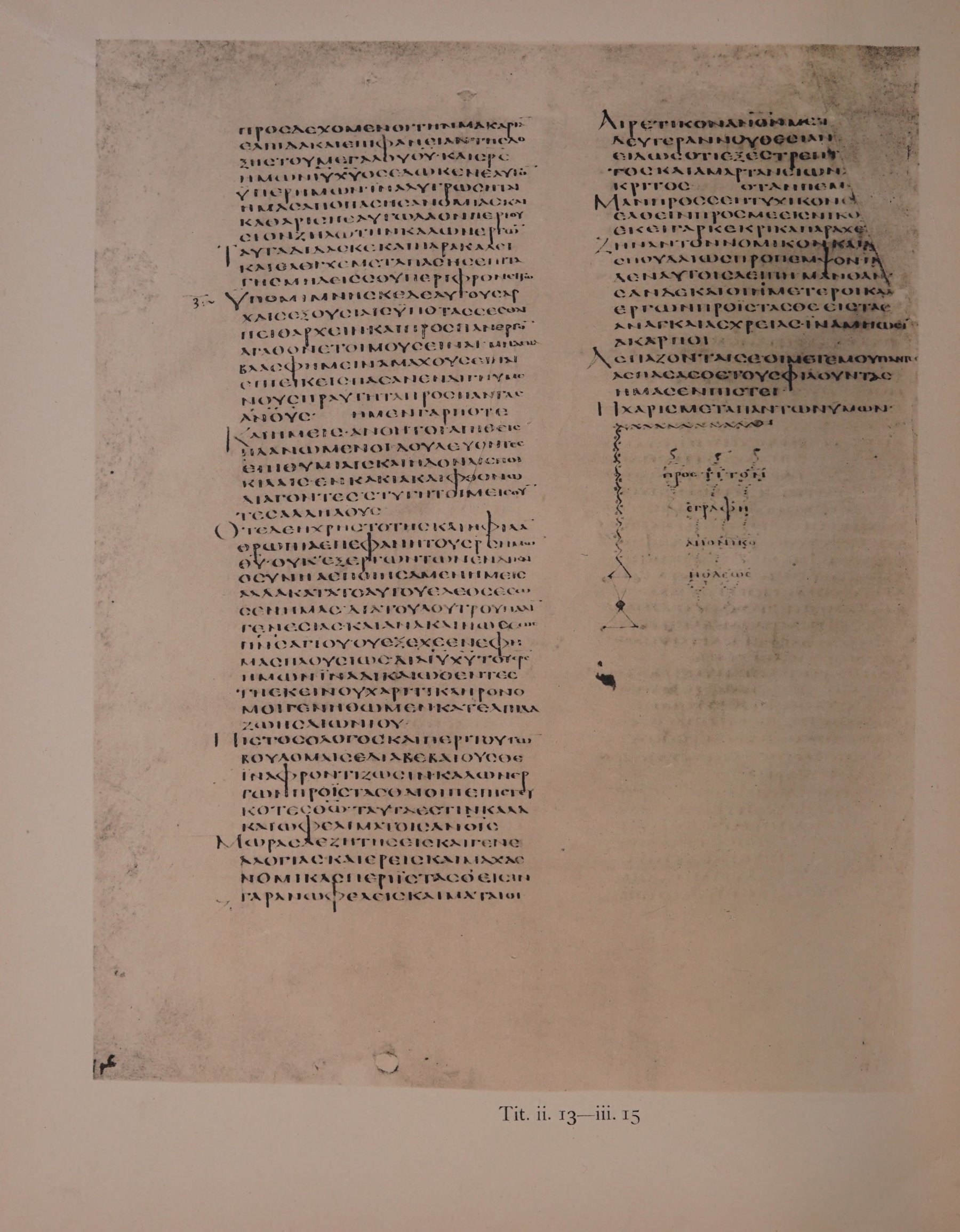
Where on the image
Page from the NTVMR transcription (docID 20002): verses 1-9 on fol. 148v (facsimile leaf 260), col. 1.
1υπομιμνησκε δε αυτους αρχαις εξουσιαις υποτασσεσθαι πειθαρχειν · και προς παν εργον αγαθον ετοιμους ειναι · 2μηδενα βλασφημειν αμαχους ειναι επιεικεις πασαν ενδιγνυμενους πραυτητα προς παντας ανους · 3ημεν γαρ ποτε και ημεις · ανοητοι · απιθεις πλανωμενοι · δουλευοντες επιθυμιαις και ηδοναις ποικιλαις · εν κακια και φθονω διαγοντες · στυγητοι μεισουντες αλληλους · 4οτε δε η χρηστοτης και η φιλανθρωπια επεφανη του σρς ημων θυ · 5ουκ εξ εργων των εν δικαιοσυνη α εποιησαμεν ημεις αλλα κατα το αυτου ελεος εσωσεν ημας · δια του λουτρου παλινγενεσιας · και ανακαινωσεως πνς αγιου · 6ου εξεχεεν εφ ημας πλουσιως · δια ιυ χυ του σρς ημων · 7ινα δικαιωθεντες τη εκεινου χαριτι κληρονομοι γενηθωμεν · κατ ελπιδα ζωης αιωνιου · 8πιστος ο λογος και περι τουτων βουλομαι σε διαβεβαιουσθε ινα φροντιζωσιν · καλων εργων προιστασθαι οι πεπιστευκοτες θω · ταυτα εστιν καλα και ωφελιμα τοις ανοις 9μωρας δε ζητησεις και γενεαλογιας · και ερεις και μαχας νομικας περιιστασο εισιν γαρ ανωφελεις και ματαιοι
Compare: Tischendorf 8th edition (1869)
1Ὑπομίμνῃσκε αὐτοὺς ἀρχαῖς ἐξουσίαις ὑποτάσσεσθαι, πειθαρχεῖν, πρὸς πᾶν ἔργον ἀγαθὸν ἑτοίμους εἶναι, 2μηδένα βλασφημεῖν, ἀμάχους εἶναι, ἐπιεικεῖς, πᾶσαν ἐνδεικνυμένους πραΰτητα πρὸς πάντας ἀνθρώπους. 3ἦμεν γάρ ποτε καὶ ἡμεῖς ἀνόητοι, ἀπειθεῖς, πλανώμενοι, δουλεύοντες ἐπιθυμίαις καὶ ἡδοναῖς ποικίλαις, ἐν κακίᾳ καὶ φθόνῳ διάγοντες, στυγητοί, μισοῦντες ἀλλήλους. 4ὅτε δὲ ἡ χρηστότης καὶ ἡ φιλανθρωπία ἐπεφάνη τοῦ σωτῆρος ἡμῶν θεοῦ, 5οὐκ ἐξ ἔργων τῶν ἐν δικαιοσύνῃ ἃ ἐποιήσαμεν ἡμεῖς ἀλλὰ κατὰ τὸ αὐτοῦ ἔλεος ἔσωσεν ἡμᾶς διὰ λουτροῦ παλινγενεσίας καὶ ἀνακαινώσεως πνεύματος ἁγίου, 6οὗ ἐξέχεεν ἐφ’ ἡμᾶς πλουσίως διὰ Ἰησοῦ Χριστοῦ τοῦ σωτῆρος ἡμῶν, 7ἵνα δικαιωθέντες τῇ ἐκείνου χάριτι κληρονόμοι γενηθῶμεν κατ’ ἐλπίδα ζωῆς αἰωνίου. 8πιστὸς ὁ λόγος, καὶ περὶ τούτων βούλομαί σε διαβεβαιοῦσθαι, ἵνα φροντίζωσιν καλῶν ἔργων προΐστασθαι οἱ πεπιστευκότες θεῷ. ταῦτά ἐστιν καλὰ καὶ ὠφέλιμα τοῖς ἀνθρώποις· 9μωρὰς δὲ ζητήσεις καὶ γενεαλογίας καὶ ἔριν καὶ μάχας νομικὰς περιΐστασο, εἰσὶν γὰρ ἀνωφελεῖς καὶ μάταιοι.
1Put them in mind to be subject to principalities and powers, to obey magistrates, to be ready to every good work, 2To speak evil of no man, to be no brawlers, but gentle, shewing all meekness unto all men. 3For we ourselves also were sometimes foolish, disobedient, deceived, serving divers lusts and pleasures, living in malice and envy, hateful, and hating one another. 4But after that the kindness and love of God our Saviour toward man appeared, 5Not by works of righteousness which we have done, but according to his mercy he saved us, by the washing of regeneration, and renewing of the Holy Ghost; 6Which he shed on us abundantly through Jesus Christ our Saviour; 7That being justified by his grace, we should be made heirs according to the hope of eternal life. 8This is a faithful saying, and these things I will that thou affirm constantly, that they which have believed in God might be careful to maintain good works. These things are good and profitable unto men. 9But avoid foolish questions, and genealogies, and contentions, and strivings about the law; for they are unprofitable and vain.
Where on the image
Page from the NTVMR transcription (docID 20002): verses 10-15 on fol. 148v (facsimile leaf 260), col. 2.
10αιρετικον ανον μετ[α] [μιαν] [και] δευτεραν νουθεσιαν [παραιτου] 11ειδως οτι εξεστρεπτ[αι] [ο] [τοιου]τος · και αμαρτανει ων α̣[υτοκατα]κριτος 12οταν πεμ[ψω] [αρτε]μαν προς σε η τυχικον σ[πουδασον] ελθειν προς με εις νικο[πολιν] εκει γαρ κεκρικα παραχε[ιμασαι] 13ζηναν τον νομικον και α[πολλων] σπουδαιως προπεμψον ιν̣[α] [μη]δεν αυτοις λειπη · 14μανθαν[ετω]σαν δε και οι ημετεροι καλ[ων] εργων προιστασθε εις τας αναγκαιας χρειας · ινα μη ωσιν̣ ακαρποι 15ασπαζονται σε οι μετ εμου παντες ασπασασθε τους φιλουντας ημας εν πιστει · η χαρις μετα παντων υμων ·
Compare: Tischendorf 8th edition (1869)
10αἱρετικὸν ἄνθρωπον μετὰ μίαν καὶ δευτέραν νουθεσίαν παραιτοῦ, 11εἰδὼς ὅτι ἐξέστραπται ὁ τοιοῦτος καὶ ἁμαρτάνει, ὢν αὐτοκατάκριτος. 12Ὅταν πέμψω Ἀρτεμᾶν πρὸς σὲ ἢ Τυχικόν, σπούδασον ἐλθεῖν πρός με εἰς Νικόπολιν, ἐκεῖ γὰρ κέκρικα παραχειμάσαι. 13Ζηνᾶν τὸν νομικὸν καὶ Ἀπολλῶν σπουδαίως πρόπεμψον, ἵνα μηδὲν αὐτοῖς λείπῃ. 14μανθανέτωσαν δὲ καὶ οἱ ἡμέτεροι καλῶν ἔργων προΐστασθαι εἰς τὰς ἀναγκαίας χρείας, ἵνα μὴ ὦσιν ἄκαρποι. 15Ἀσπάζονταί σε οἱ μετ’ ἐμοῦ πάντες. ἄσπασαι τοὺς φιλοῦντας ἡμᾶς ἐν πίστει. Ἡ χάρις μετὰ πάντων ὑμῶν.
10A man that is an heretick after the first and second admonition reject; 11Knowing that he that is such is subverted, and sinneth, being condemned of himself. 12When I shall send Artemas unto thee, or Tychicus, be diligent to come unto me to Nicopolis: for I have determined there to winter. 13Bring Zenas the lawyer and Apollos on their journey diligently, that nothing be wanting unto them. 14And let ours also learn to maintain good works for necessary uses, that they be not unfruitful. 15All that are with me salute thee. Greet them that love us in the faith. Grace be with you all. Amen.
Cite
Sources
- Source: Codex Alexandrinus page images + NTVMR transcription (CC BY 4.0) + Tischendorf 8th edition + KJV (holding institution)
- Critical edition: Codex Alexandrinus transcription, NTVMR (INTF Münster, CC BY 4.0); Tischendorf 8th edition for comparison
← previous · → next · v cycle view · l back to library