Analects, Book 1: Xue er 學而 (Kamakura-period manuscript)
Introduction
Book 1 of the Analects (論語 Lunyu), titled 學而 (Xue er) after its opening words, 16 chapters in Legge's division. It is shown on a manuscript of the Analects in the Kiyohara family collection (Seike bunko) of Kyoto University Library, two volumes in regular script, seven columns of fourteen characters to the page, main text only, with red and black Japanese reading marks. A colophon by Kiyohara Edakata dated 1550 names the copyist as his ancestor Kiyohara Yoshieda (1253-1331), which places the copy around 1300, in the late Kamakura period; the attribution is traditional. The Kiyohara were hereditary readers of the Confucian classics at the Japanese court, and their text descends from the edition of the Analects with the collected commentary of He Yan (3rd century CE): after each pair of books the scribe copied the character counts of the classic and of the commentary, although only the classic is written out. The manuscript is an Important Cultural Property of Japan.
In this copy Book 1 runs from canvas 5, left-hand page to canvas 8, right-hand page (volume 1). Each section gathers the paragraphs that begin on one page, numbered by chapter and paragraph as in Legge, and links to that page and to any page the last paragraph runs onto. The page boundaries were found by reading the first characters of every column on the photographs. The Chinese shown is the received text, from Wikisource. This manuscript differs from it in places, most often by an added or missing particle (也, 矣, 焉) or a variant character form; the differences seen at column openings are listed in the scan notes. The English is James Legge's translation of the received text.
How was this verified? (Provenance)
Where on the image
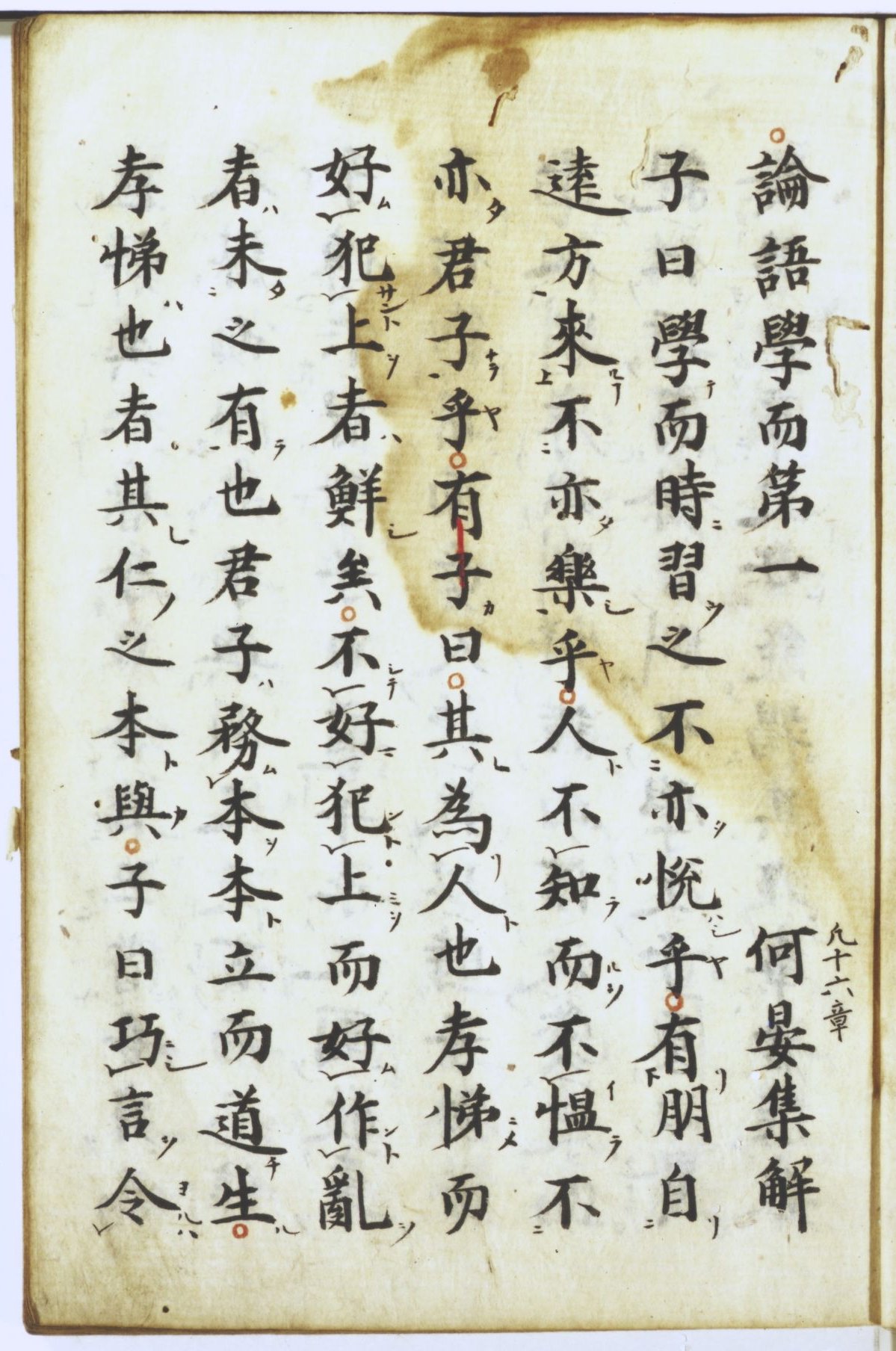
Kyoto University Library RB00007936, IIIF canvas 5, left-hand page: 7 written columns of up to 14 characters, main text only, with Japanese reading marks. Checked on the image: the first column of this book's text on this page begins ‹子曰學›, the last begins ‹孝悌也›. Column 1 carries the title 論語學而第一. 1.1.1 opens column 2. 1.3 runs on to canvas 6, right-hand page (first column ‹色鮮矣›), where the section ends. The Chinese shown is the received text (Wikisource), not a transcription of this manuscript; Legge's English translates the received text.
1.1子曰:「學而時習之,不亦說乎?
1.2有朋自遠方來,不亦樂乎?
1.3人不知而不慍,不亦君子乎?」
2.1有子曰:「其爲人也孝弟,而好犯上者,鮮矣;不好犯上,而好作亂者,未之有也。
2.2君子務本,本立而道生;孝弟也者,其爲仁之本與?」
3子曰:「巧言令色,鮮矣仁。」
1.1The Master said, 'Is it not pleasant to learn with a constant perseverance and application?
1.2'Is it not delightful to have friends coming from distant quarters?'
1.3'Is he not a man of complete virtue, who feels no discomposure though men may take no note of him?'
2.1The philosopher Yu said, 'They are few who, being filial and fraternal, are fond of offending against their superiors. There have been none, who, not liking to offend against their superiors, have been fond of stirring up confusion.
2.2'The superior man bends his attention to what is radical. That being established, all practical courses naturally grow up. Filial piety and fraternal submission!-- are they not the root of all benevolent actions?'
3The Master said, 'Fine words and an insinuating appearance are seldom associated with true virtue.'
Where on the image
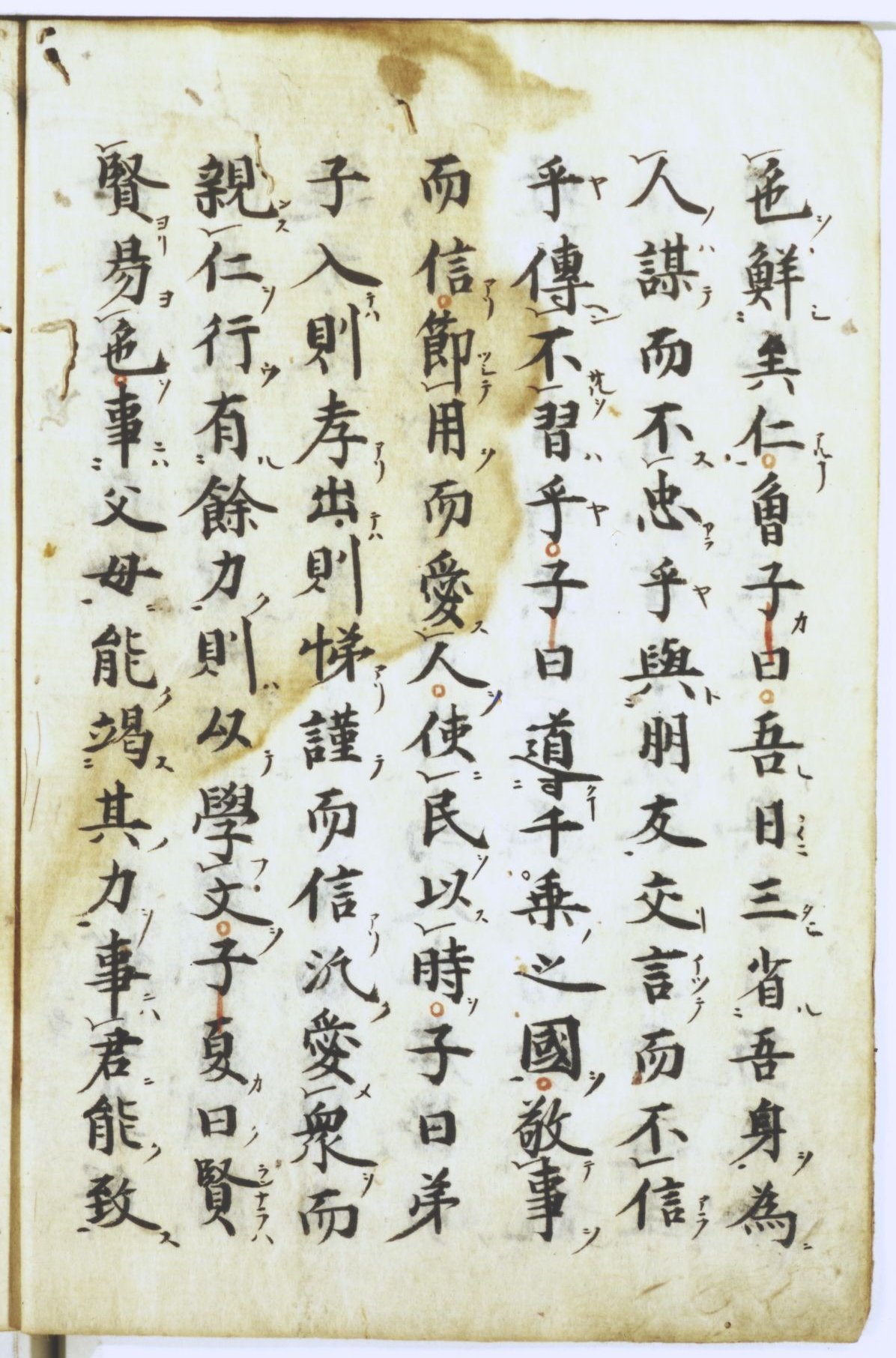
Kyoto University Library RB00007936, IIIF canvas 6, right-hand page: 7 written columns of up to 14 characters, main text only, with Japanese reading marks. Checked on the image: the first column of this book's text on this page begins ‹色鮮矣›, the last begins ‹賢易色›. 1.4 begins inside column 1 (the column opens ‹色鮮矣›), 4 characters down in the received text. Above it the page finishes 1.3, shown in the previous section. 1.7 runs on to canvas 6, left-hand page (first column ‹其身朋›), where the section ends. Column openings on these pages that differ from the received text: ‹其身朋› where the received text has ‹其身與›. The Chinese shown is the received text (Wikisource), not a transcription of this manuscript; Legge's English translates the received text.
4曾子曰:「吾日三省吾身:爲人謀而不忠乎?與朋友交而不信乎?傳不習乎?」
5子曰:「道千乘之國,敬事而信,節用而愛人,使民以時。」
6子曰:「弟子入則孝,出則弟,謹而信,汎愛眾,而親仁。行有餘力,則以學文。」
7子夏曰:「賢賢易色;事父母,能竭其力;事君,能致其身;與朋友交,言而有信;雖曰未學,吾必謂之學矣。」
4The philosopher Tsang said, 'I daily examine myself on three points:-- whether, in transacting business for others, I may have been not faithful;-- whether, in intercourse with friends, I may have been not sincere;-- whether I may have not mastered and practised the instructions of my teacher.'
5The Master said, To rule a country of a thousand chariots, there must be reverent attention to business, and sincerity; economy in expenditure, and love for men; and the employment of the people at the proper seasons.'
6The Master said, 'A youth, when at home, should be filial, and, abroad, respectful to his elders. He should be earnest and truthful. He should overflow in love to all, and cultivate the friendship of the good. When he has time and opportunity, after the performance of these things, he should employ them in polite studies.'
7Tsze-hsia said, 'If a man withdraws his mind from the love of beauty, and applies it as sincerely to the love of the virtuous; if, in serving his parents, he can exert his utmost strength; if, in serving his prince, he can devote his life; if, in his intercourse with his friends, his words are sincere:-- although men say that he has not learned, I will certainly say that he has.'
Where on the image
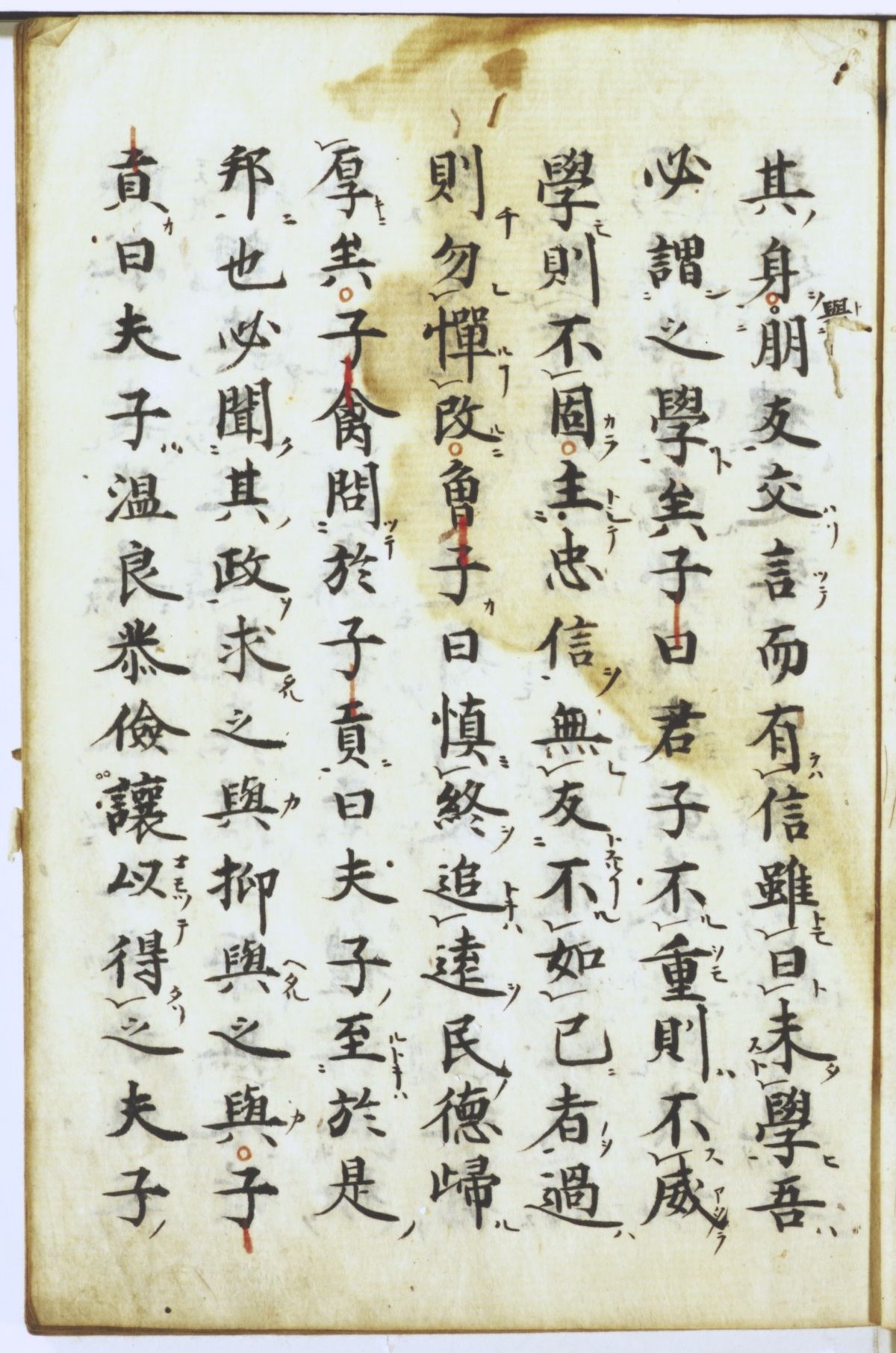
Kyoto University Library RB00007936, IIIF canvas 6, left-hand page: 7 written columns of up to 14 characters, main text only, with Japanese reading marks. Checked on the image: the first column of this book's text on this page begins ‹其身朋›, the last begins ‹貢曰夫›. 1.8.1 begins inside column 2 (the column opens ‹必謂之›), 5 characters down in the received text. Above it the page finishes 1.7, shown in the previous section. 1.10.2 runs on to canvas 7, right-hand page (first column ‹之求也›), where the section ends. Column openings on these pages that differ from the received text: ‹之求也› where the received text has ‹之求之›. The Chinese shown is the received text (Wikisource), not a transcription of this manuscript; Legge's English translates the received text.
8.1子曰:「君子不重則不威,學則不固。
8.2主忠信,
8.3無友不如己者,
8.4過則勿憚改。」
9曾子曰:「愼終追遠,民德歸厚矣。」
10.1子禽問於子貢曰:「夫子至於是邦也,必聞其政,求之與?抑與之與?」
10.2子貢曰:「夫子溫、良、恭、儉、讓以得之。夫子之求之也,其諸異乎人之求之與?」
8.1The Master said, 'If the scholar be not grave, he will not call forth any veneration, and his learning will not be solid.
8.2'Hold faithfulness and sincerity as first principles.
8.3'Have no friends not equal to yourself.
8.4'When you have faults, do not fear to abandon them.'
9The philosopher Tsang said, 'Let there be a careful attention to perform the funeral rites to parents, and let them be followed when long gone with the ceremonies of sacrifice;-- then the virtue of the people will resume its proper excellence.'
10.1Tsze-ch'in asked Tsze-kung, saying, 'When our master comes to any country, he does not fail to learn all about its government. Does he ask his information? or is it given to him?'
10.2Tsze-kung said, 'Our master is benign, upright, courteous, temperate, and complaisant, and thus he gets his information. The master's mode of asking information!-- is it not different from that of other men?'
Where on the image
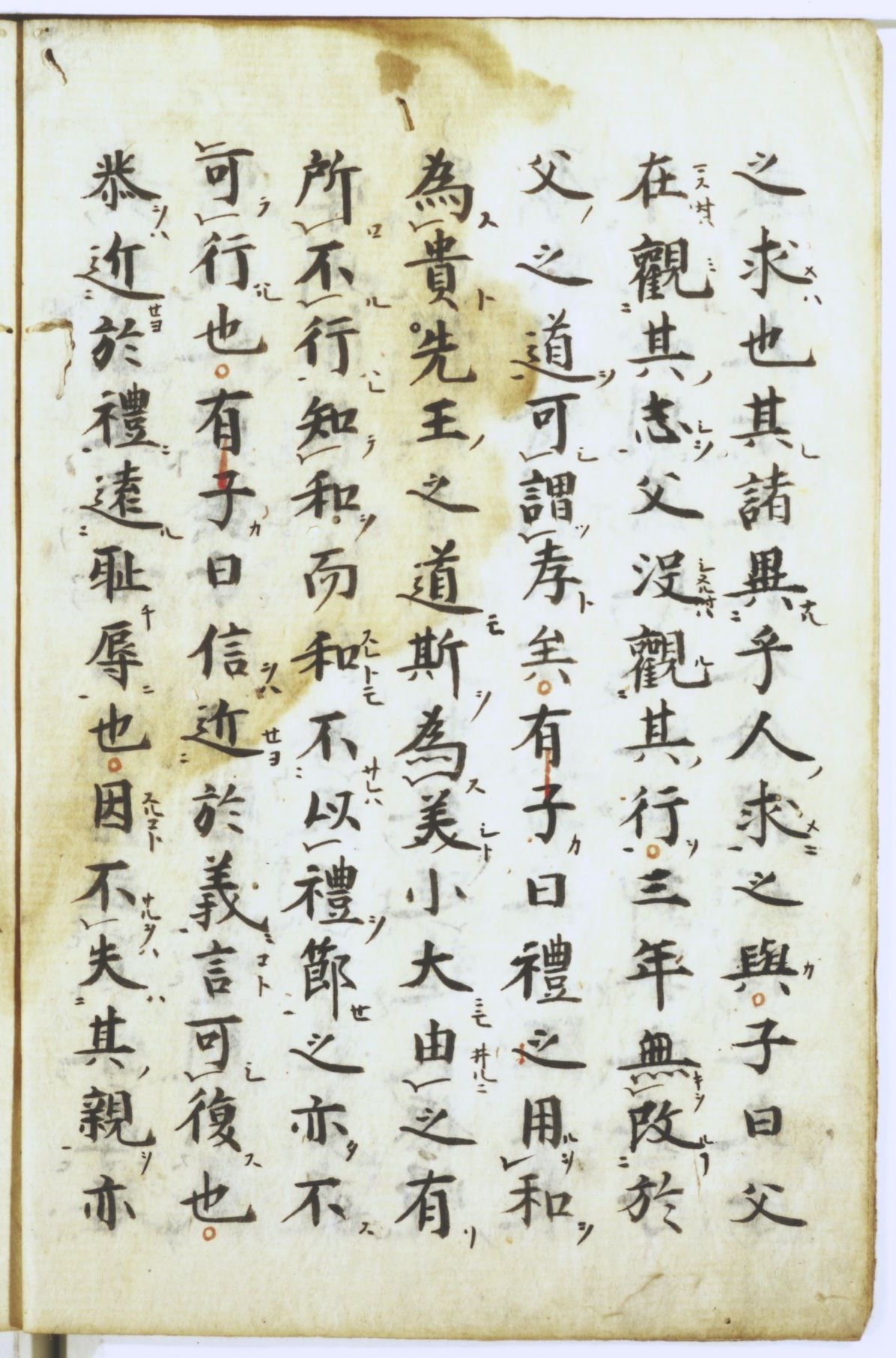
Kyoto University Library RB00007936, IIIF canvas 7, right-hand page: 7 written columns of up to 14 characters, main text only, with Japanese reading marks. Checked on the image: the first column of this book's text on this page begins ‹之求也›, the last begins ‹恭近於›. 1.11 begins inside column 1 (the column opens ‹之求也›), 13 characters down in the received text. Above it the page finishes 1.10.2, shown in the previous section. 1.13 runs on to canvas 7, left-hand page (first column ‹可宗也›), where the section ends. The Chinese shown is the received text (Wikisource), not a transcription of this manuscript; Legge's English translates the received text.
11子曰:「父在觀其志,父沒觀其行。三年無改於父之道,可謂孝矣。」
12.1有子曰:「禮之用,和爲貴;先王之道,斯爲美;小大由之。
12.2有所不行,知和而和,不以禮節之,亦不可行也。」
13有子曰:「信近於義,言可復也;恭近於禮,遠恥辱也。因不失其親,亦可宗也。」
11The Master said, 'While a man's father is alive, look at the bent of his will; when his father is dead, look at his conduct. If for three years he does not alter from the way of his father, he may be called filial.'
12.1The philosopher Yu said, 'In practising the rules of propriety, a natural ease is to be prized. In the ways prescribed by the ancient kings, this is the excellent quality, and in things small and great we follow them.
12.2'Yet it is not to be observed in all cases. If one, knowing how such ease should be prized, manifests it, without regulating it by the rules of propriety, this likewise is not to be done.'
13The philosopher Yu said, 'When agreements are made according to what is right, what is spoken can be made good. When respect is shown according to what is proper, one keeps far from shame and disgrace. When the parties upon whom a man leans are proper persons to be intimate with, he can make them his guides and masters.'
Where on the image
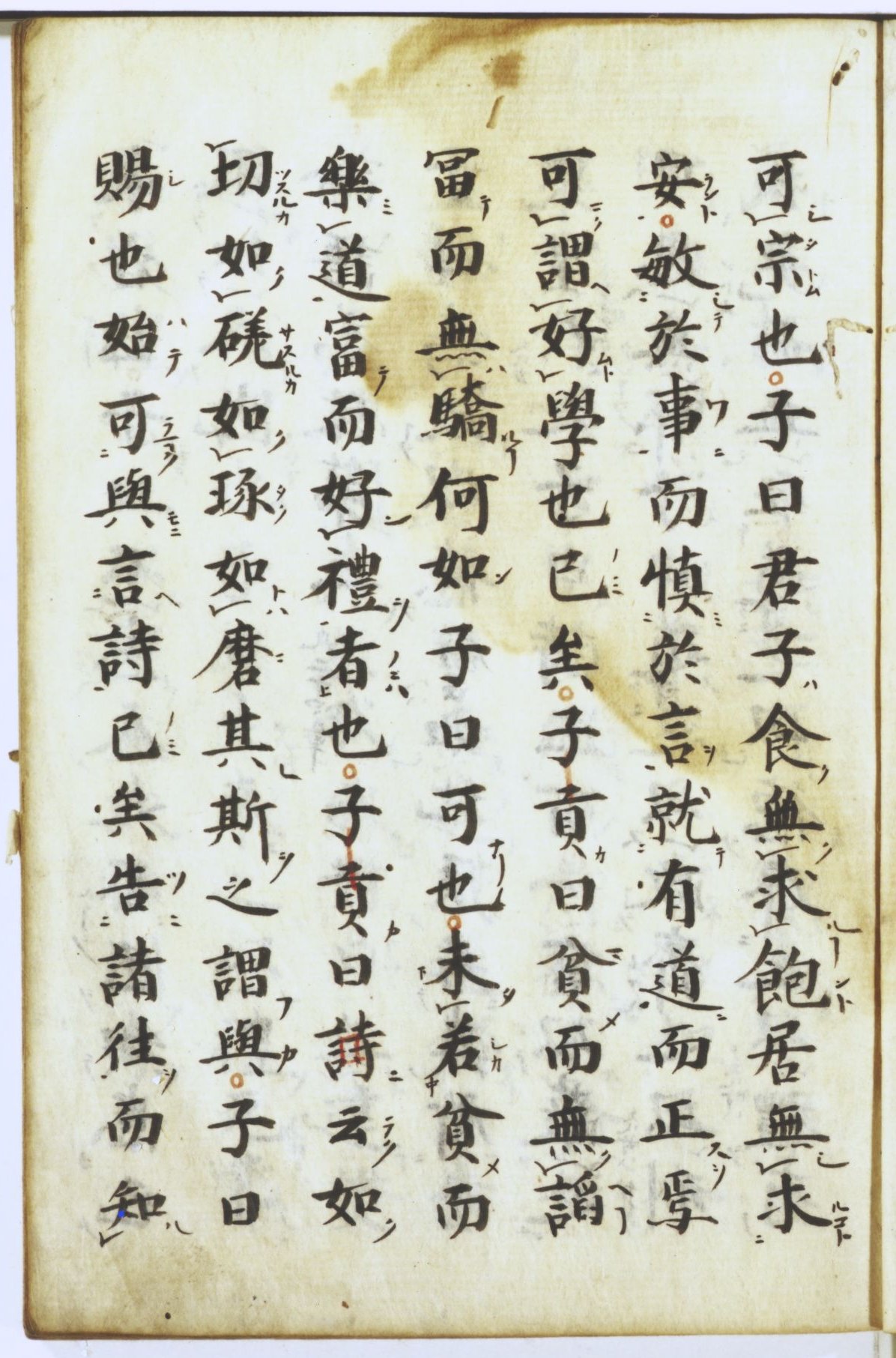
Kyoto University Library RB00007936, IIIF canvas 7, left-hand page: 7 written columns of up to 14 characters, main text only, with Japanese reading marks. Checked on the image: the first column of this book's text on this page begins ‹可宗也›, the last begins ‹賜也始›. 1.14 begins inside column 1 (the column opens ‹可宗也›), 3 characters down in the received text. Above it the page finishes 1.13, shown in the previous section. 1.15.3 runs on to canvas 8, right-hand page (first column ‹來者也›), where the section ends. Column openings on these pages that differ from the received text: ‹樂道富› where the received text has ‹樂富而›; ‹來者也› where the received text has ‹來者子›. The Chinese shown is the received text (Wikisource), not a transcription of this manuscript; Legge's English translates the received text.
14子曰:「君子食無求飽,居無求安,敏於事而愼於言,就有道而正焉:可謂好學也已。」
15.1子貢曰:「貧而無諂,富而無驕,何如?」子曰:「可也。未若貧而樂,富而好禮者也」。
15.2子貢曰:「《詩》云:『如切如磋,如琢如磨。』其斯之謂與?」
15.3子曰:「賜也,始可與言《詩》已矣!吿諸往而知來者。」
14The Master said, 'He who aims to be a man of complete virtue in his food does not seek to gratify his appetite, nor in his dwelling place does he seek the appliances of ease; he is earnest in what he is doing, and careful in his speech; he frequents the company of men of principle that he may be rectified:-- such a person may be said indeed to love to learn.'
15.1Tsze-kung said, 'What do you pronounce concerning the poor man who yet does not flatter, and the rich man who is not proud?' The Master replied, 'They will do; but they are not equal to him, who, though poor, is yet cheerful, and to him, who, though rich, loves the rules of propriety.'
15.2Tsze-kung replied, 'It is said in the Book of Poetry, "As you cut and then file, as you carve and then polish."-- The meaning is the same, I apprehend, as that which you have just expressed.'
15.3The Master said, 'With one like Ts'ze, I can begin to talk about the odes. I told him one point, and he knew its proper sequence.'
Where on the image
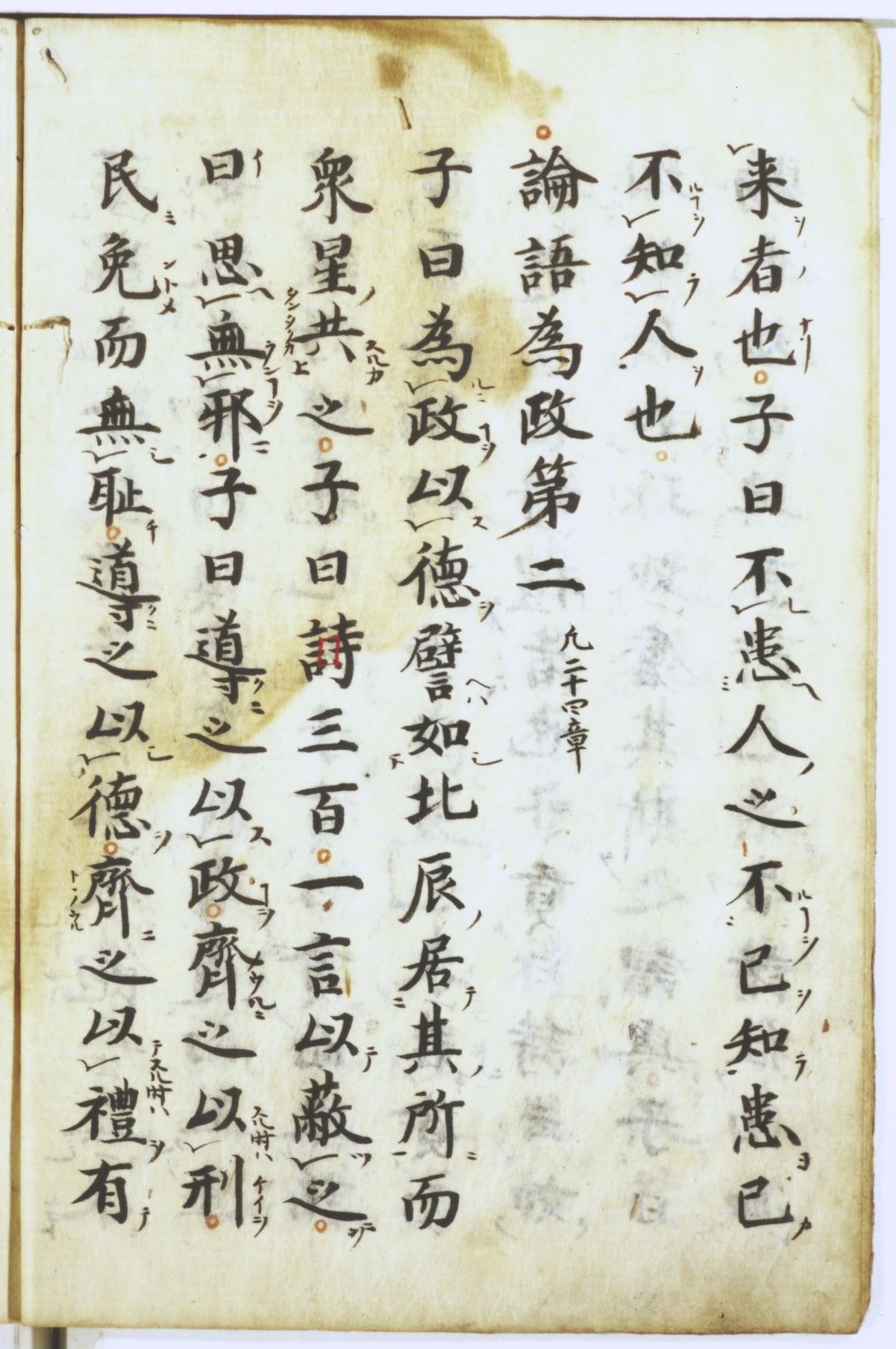
Kyoto University Library RB00007936, IIIF canvas 8, right-hand page: 7 written columns of up to 14 characters, main text only, with Japanese reading marks. Checked on the image: the first column of this book's text on this page begins ‹來者也›, the last begins ‹不知人›. Column 3 carries the title 論語為政第二. 1.16 begins inside column 1 (the column opens ‹來者也›), 2 characters down in the received text. Above it the page finishes 1.15.3, shown in the previous section. The section ends on this page. The Chinese shown is the received text (Wikisource), not a transcription of this manuscript; Legge's English translates the received text.
16子曰:「不患人之不己知,患不知人也。」
16The Master said, 'I will not be afflicted at men's not knowing me; I will be afflicted that I do not know men.'
Notes
- English: James Legge, Confucian Analects, The Chinese Classics vol. 1. Legge's chapter and paragraph numbers are kept as superscripts (chapter.paragraph).
- Legge translated the received text. Where this manuscript's wording differs, his English follows the received text shown here.
Cite
Sources
- Source: Kyoto University Library RB00007936 (Analects manuscript attributed to Kiyohara Yoshieda, c. 1300) + Wikisource received text + James Legge's English (Project Gutenberg) (holding institution)
- Critical edition: Received text (Wikisource) in Legge's chapter and paragraph division
← previous · → next · v cycle view · l back to library