Analects, Book 2: Wei zheng 爲政 (Kamakura-period manuscript)
Introduction
Book 2 of the Analects (論語 Lunyu), titled 爲政 (Wei zheng) after its opening words, 24 chapters in Legge's division. It is shown on a manuscript of the Analects in the Kiyohara family collection (Seike bunko) of Kyoto University Library, two volumes in regular script, seven columns of fourteen characters to the page, main text only, with red and black Japanese reading marks. A colophon by Kiyohara Edakata dated 1550 names the copyist as his ancestor Kiyohara Yoshieda (1253-1331), which places the copy around 1300, in the late Kamakura period; the attribution is traditional. The Kiyohara were hereditary readers of the Confucian classics at the Japanese court, and their text descends from the edition of the Analects with the collected commentary of He Yan (3rd century CE): after each pair of books the scribe copied the character counts of the classic and of the commentary, although only the classic is written out. The manuscript is an Important Cultural Property of Japan.
In this copy Book 2 runs from canvas 8, right-hand page to canvas 11, right-hand page (volume 1). Each section gathers the paragraphs that begin on one page, numbered by chapter and paragraph as in Legge, and links to that page and to any page the last paragraph runs onto. The page boundaries were found by reading the first characters of every column on the photographs. The Chinese shown is the received text, from Wikisource. This manuscript differs from it in places, most often by an added or missing particle (也, 矣, 焉) or a variant character form; the differences seen at column openings are listed in the scan notes. The English is James Legge's translation of the received text.
How was this verified? (Provenance)
Where on the image
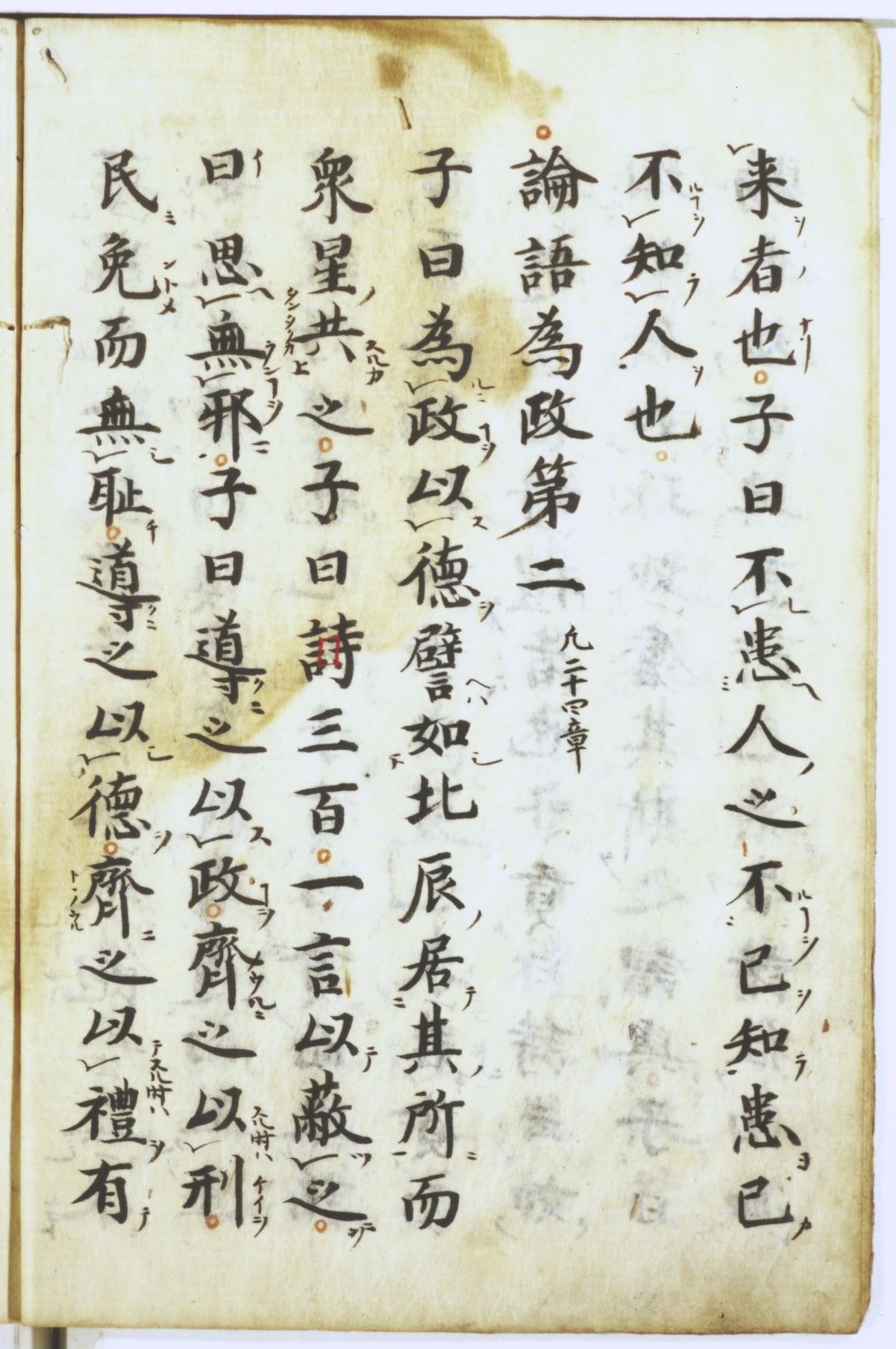
Kyoto University Library RB00007936, IIIF canvas 8, right-hand page: 7 written columns of up to 14 characters, main text only, with Japanese reading marks. Checked on the image: the first column of this book's text on this page begins ‹子曰為›, the last begins ‹民免而›. Column 3 carries the title 論語為政第二. 2.1 opens column 4. 2.3.2 runs on to canvas 8, left-hand page (first column ‹恥且格›), where the section ends. The Chinese shown is the received text (Wikisource), not a transcription of this manuscript; Legge's English translates the received text.
1子曰:「爲政以德,譬如北辰,居其所,而眾星共之。」
2子曰:「詩三百,一言以蔽之,曰思無邪。」
3.1子曰:「道之以政,齊之以刑,民免而無恥;
3.2道之以德,齊之以禮,有恥且格。」
1The Master said, 'He who exercises government by means of his virtue may be compared to the north polar star, which keeps its place and all the stars turn towards it.'
2The Master said, 'In the Book of Poetry are three hundred pieces, but the design of them all may be embraced in one sentence-- "Having no depraved thoughts."'
3.1The Master said, 'If the people be led by laws, and uniformity sought to be given them by punishments, they will try to avoid the punishment, but have no sense of shame.
3.2'If they be led by virtue, and uniformity sought to be given them by the rules of propriety, they will have the sense of shame, and moreover will become good.'
Where on the image
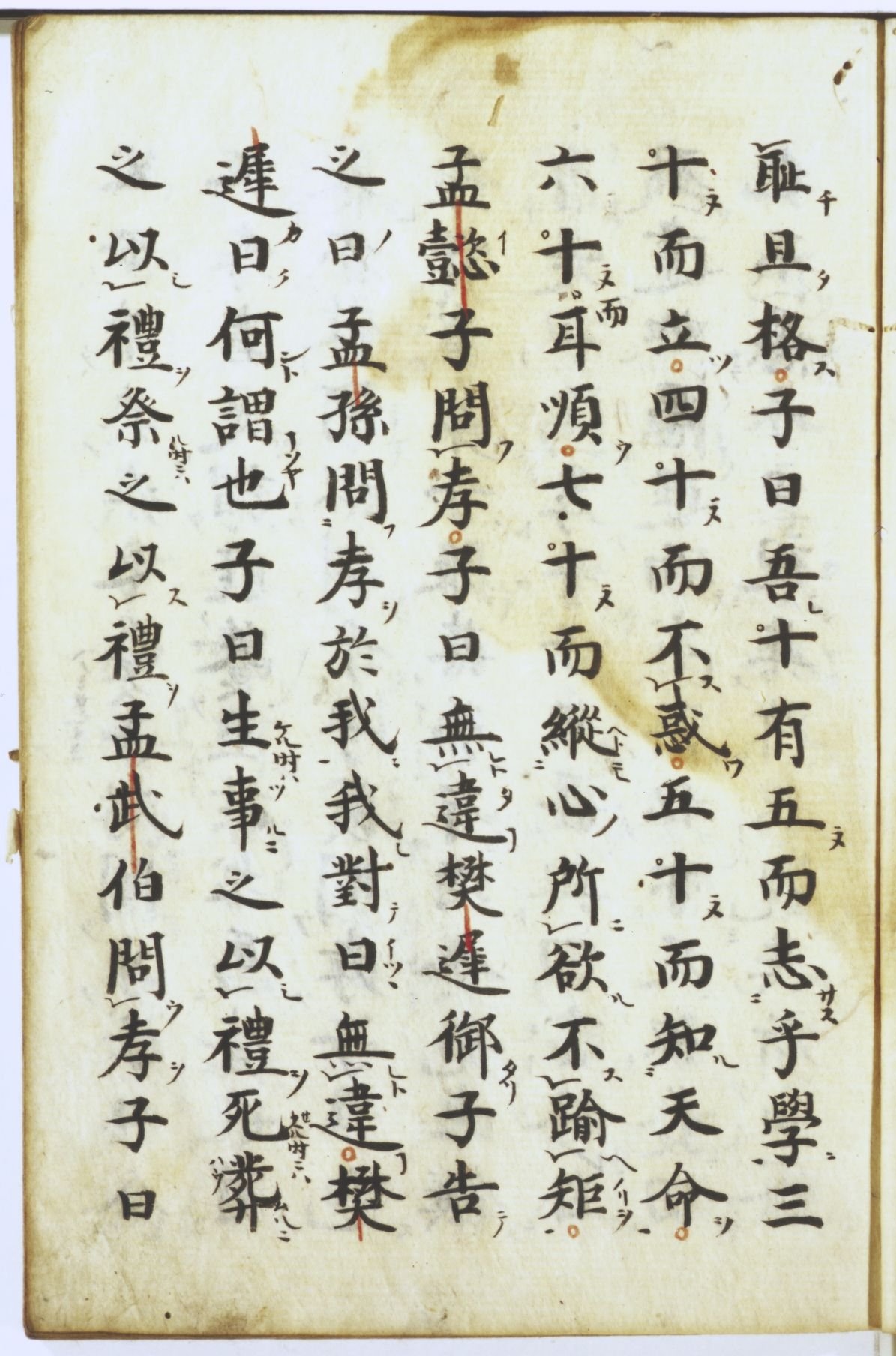
Kyoto University Library RB00007936, IIIF canvas 8, left-hand page: 7 written columns of up to 14 characters, main text only, with Japanese reading marks. Checked on the image: the first column of this book's text on this page begins ‹恥且格›, the last begins ‹之以禮›. 2.4.1 begins inside column 1 (the column opens ‹恥且格›), 3 characters down in the received text. Above it the page finishes 2.3.2, shown in the previous section. 2.6 runs on to canvas 9, right-hand page (first column ‹父母唯›), where the section ends. Column openings on these pages that differ from the received text: ‹六十耳› where the received text has ‹六十而›. The Chinese shown is the received text (Wikisource), not a transcription of this manuscript; Legge's English translates the received text.
4.1子曰:「吾十有五而志于學;
4.2三十而立;
4.3四十而不惑;
4.4五十而知天命;
4.5六十而耳順;
4.6七十而從心所欲,不踰矩。」
5.1孟懿子問孝。子曰:「無違。」
5.2樊遲御,子吿之曰:「孟孫問孝於我,我對曰:『無違。』」
5.3樊遲曰:「何謂也?」子曰:「生,事之以禮;死,葬之以禮,祭之以禮。」
6孟武伯問孝。子曰:「父母,唯其疾之憂。」
4.1The Master said, 'At fifteen, I had my mind bent on learning.
4.2'At thirty, I stood firm.
4.3'At forty, I had no doubts.
4.4'At fifty, I knew the decrees of Heaven.
4.5'At sixty, my ear was an obedient organ for the reception of truth.
4.6'At seventy, I could follow what my heart desired, without transgressing what was right.'
5.1Mang I asked what filial piety was. The Master said, 'It is not being disobedient.'
5.2Soon after, as Fan Ch'ih was driving him, the Master told him, saying, 'Mang-sun asked me what filial piety was, and I answered him,-- "not being disobedient."'
5.3Fan Ch'ih said, 'What did you mean?' The Master replied, 'That parents, when alive, be served according to propriety; that, when dead, they should be buried according to propriety; and that they should be sacrificed to according to propriety.'
6Mang Wu asked what filial piety was. The Master said, 'Parents are anxious lest their children should be sick.'
Where on the image
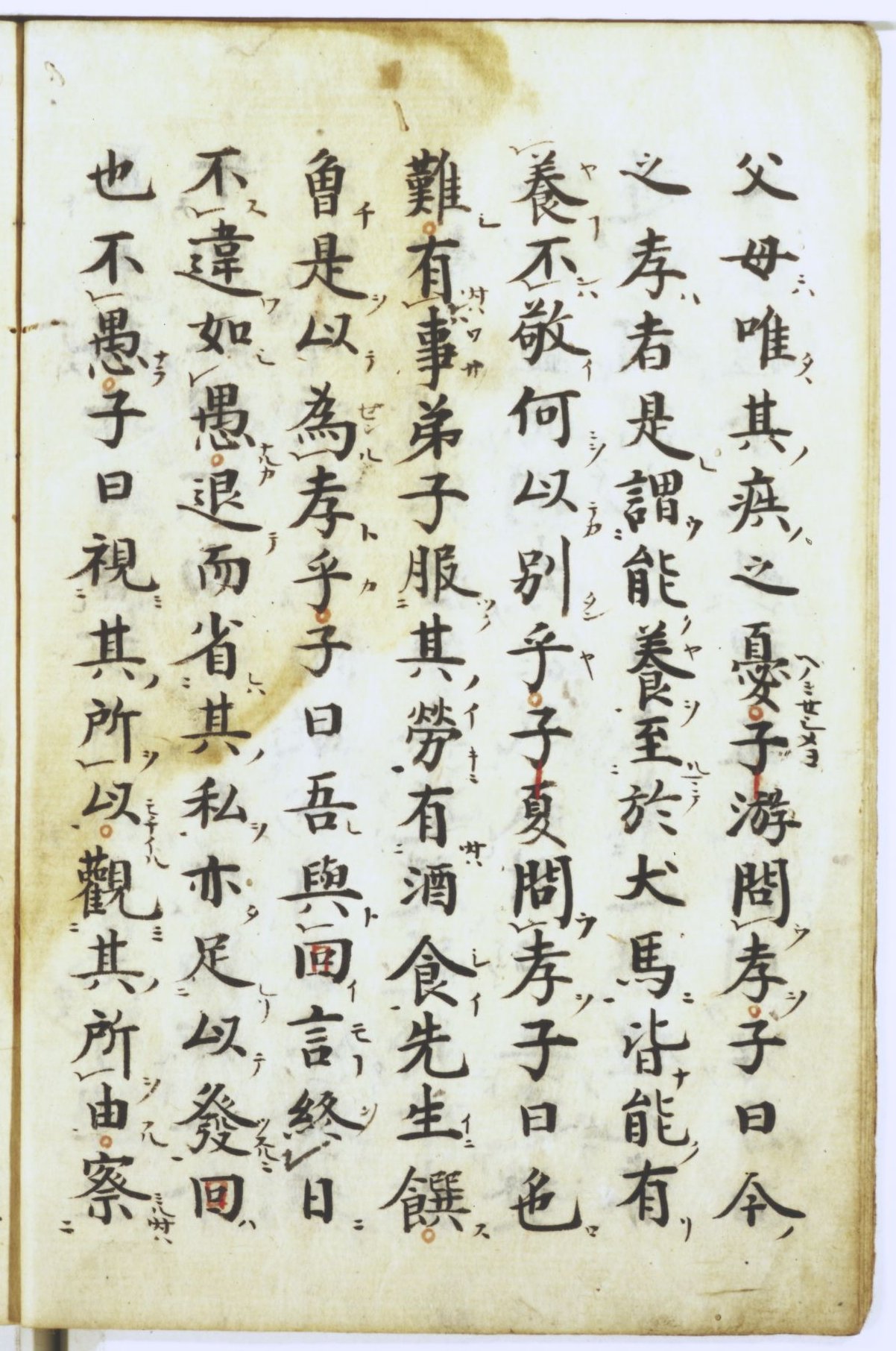
Kyoto University Library RB00007936, IIIF canvas 9, right-hand page: 7 written columns of up to 14 characters, main text only, with Japanese reading marks. Checked on the image: the first column of this book's text on this page begins ‹父母唯›, the last begins ‹也不愚›. 2.7 begins inside column 1 (the column opens ‹父母唯›), 7 characters down in the received text. Above it the page finishes 2.6, shown in the previous section. 2.10.3 runs on to canvas 9, left-hand page (first column ‹其所安›), where the section ends. The Chinese shown is the received text (Wikisource), not a transcription of this manuscript; Legge's English translates the received text.
7子游問孝。子曰:「今之孝者,是謂能養。至於犬馬,皆能有養。不敬,何以別乎?」
8子夏問孝。子曰:「色難。有事,弟子服其勞;有酒食,先生饌。曾是以爲孝乎?」
9子曰:「吾與回言終日,不違如愚。退而省其私,亦足以發。回也不愚。」
10.1子曰:「視其所以,
10.2觀其所由,
10.3察其所安,
7Tsze-yu asked what filial piety was. The Master said, 'The filial piety of now-a-days means the support of one's parents. But dogs and horses likewise are able to do something in the way of support;-- without reverence, what is there to distinguish the one support given from the other?'
8Tsze-hsia asked what filial piety was. The Master said, 'The difficulty is with the countenance. If, when their elders have any troublesome affairs, the young take the toil of them, and if, when the young have wine and food, they set them before their elders, is THIS to be considered filial piety?'
9The Master said, 'I have talked with Hui for a whole day, and he has not made any objection to anything I said;-- as if he were stupid. He has retired, and I have examined his conduct when away from me, and found him able to illustrate my teachings. Hui!-- He is not stupid.'
10.1The Master said, 'See what a man does.
10.2'Mark his motives.
10.3'Examine in what things he rests.
Where on the image
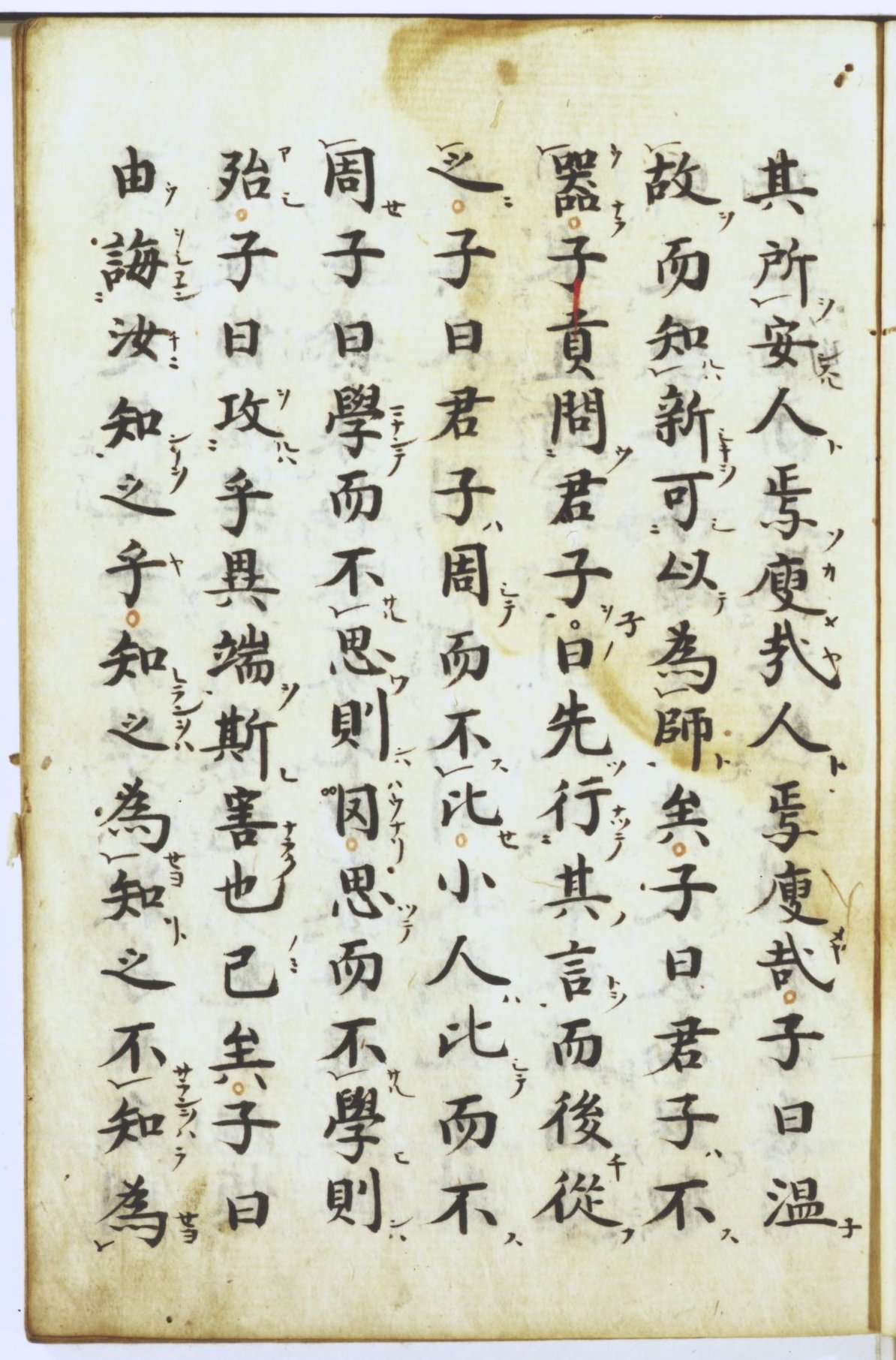
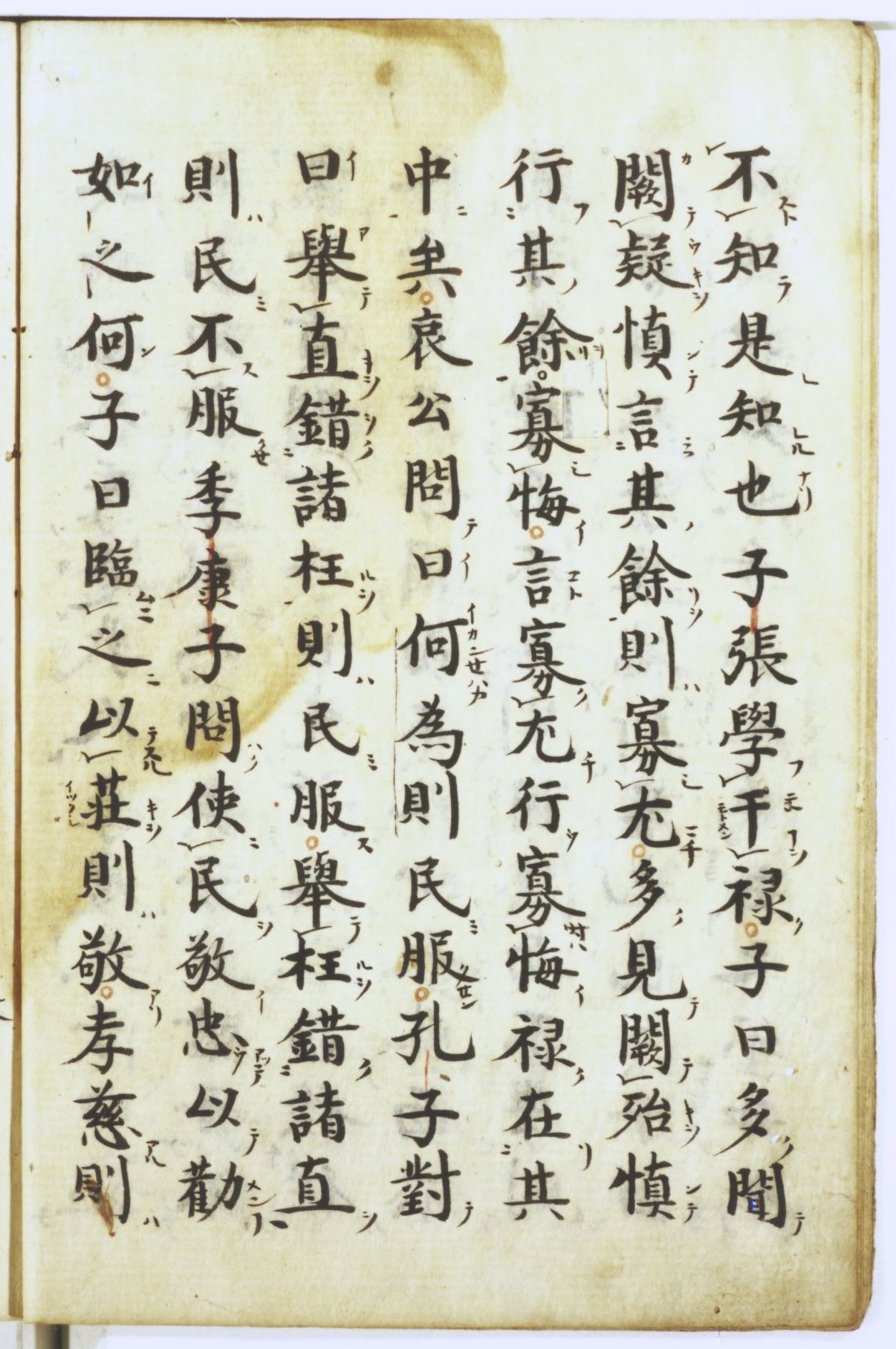
Kyoto University Library RB00007936, IIIF canvas 9, left-hand page: 7 written columns of up to 14 characters, main text only, with Japanese reading marks. Checked on the image: the first column of this book's text on this page begins ‹其所安›, the last begins ‹由誨汝›. 2.10.4 begins inside column 1 (the column opens ‹其所安›), 3 characters down in the received text. Above it the page finishes 2.10.3, shown in the previous section. 2.17 runs on to canvas 10, right-hand page (first column ‹不知是›), where the section ends. The Chinese shown is the received text (Wikisource), not a transcription of this manuscript; Legge's English translates the received text.
10.4人焉廋哉!
10.5人焉廋哉!」
11子曰:「溫故而知新,可以爲師矣。」
12子曰:「君子不器。」
13子貢問君子。子曰:「先行其言,而後從之。」
14子曰:「君子周而不比,小人比而不周。」
15子曰:「學而不思則罔,思而不學則殆。」
16子曰:「攻乎異端,斯害也已。」
17子曰:「由,誨女知之乎!知之爲知之,不知爲不知,是知也。」
10.4'How can a man conceal his character?
10.5How can a man conceal his character?'
11The Master said, 'If a man keeps cherishing his old knowledge, so as continually to be acquiring new, he may be a teacher of others.'
12The Master said, 'The accomplished scholar is not a utensil.'
13Tsze-kung asked what constituted the superior man. The Master said, 'He acts before he speaks, and afterwards speaks according to his actions.'
14The Master said, 'The superior man is catholic and no partisan. The mean man is partisan and not catholic.'
15The Master said, 'Learning without thought is labour lost; thought without learning is perilous.'
16The Master said, 'The study of strange doctrines is injurious indeed!'
17The Master said, 'Yu, shall I teach you what knowledge is? When you know a thing, to hold that you know it; and when you do not know a thing, to allow that you do not know it;-- this is knowledge.'
Where on the image
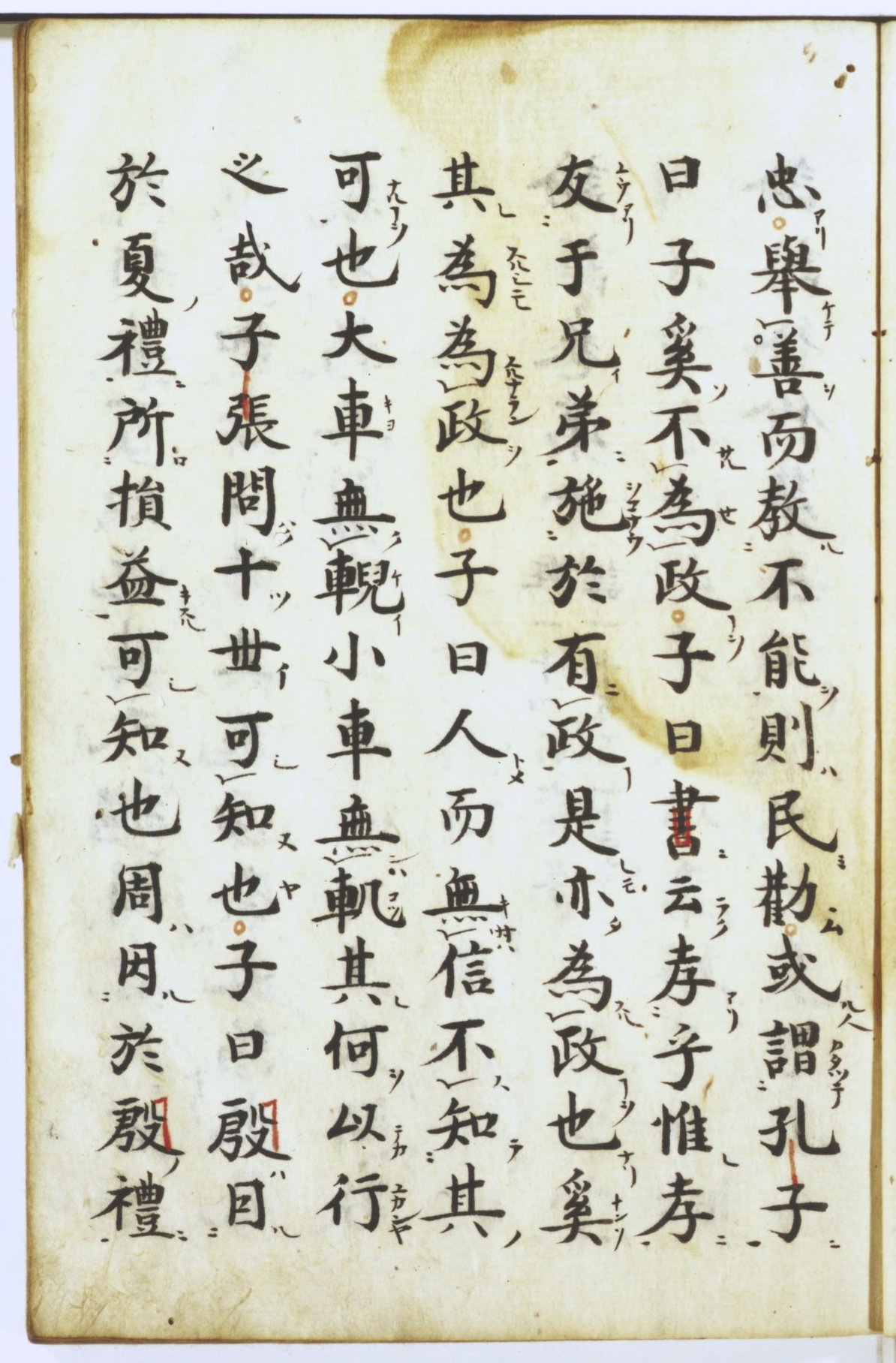
Kyoto University Library RB00007936, IIIF canvas 10, right-hand page: 7 written columns of up to 14 characters, main text only, with Japanese reading marks. Checked on the image: the first column of this book's text on this page begins ‹不知是›, the last begins ‹如之何›. 2.18.1 begins inside column 1 (the column opens ‹不知是›), 5 characters down in the received text. Above it the page finishes 2.17, shown in the previous section. 2.20 runs on to canvas 10, left-hand page (first column ‹忠舉善›), where the section ends. The Chinese shown is the received text (Wikisource), not a transcription of this manuscript; Legge's English translates the received text.
18.1子張學干祿。
18.2子曰:「多聞闕疑,愼言其餘,則寡尤;多見闕殆,愼行其餘,則寡悔。言寡尤,行寡悔,祿在其中矣。」
19哀公問曰:「何爲則民服?」孔子對曰:「擧直錯諸枉,則民服;擧枉錯諸直,則民不服。」
20季康子問:「使民敬忠以勸,如之何?」子曰:「臨之以莊,則敬;孝慈,則忠;擧善而教不能,則勸。」
18.1Tsze-chang was learning with a view to official emolument.
18.2The Master said, 'Hear much and put aside the points of which you stand in doubt, while you speak cautiously at the same time of the others:-- then you will afford few occasions for blame. See much and put aside the things which seem perilous, while you are cautious at the same time in carrying the others into practice:-- then you will have few occasions for repentance. When one gives few occasions for blame in his words, and few occasions for repentance in his conduct, he is in the way to get emolument.'
19The Duke Ai asked, saying, 'What should be done in order to secure the submission of the people?' Confucius replied, 'Advance the upright and set aside the crooked, then the people will submit. Advance the crooked and set aside the upright, then the people will not submit.'
20Chi K'ang asked how to cause the people to reverence their ruler, to be faithful to him, and to go on to nerve themselves to virtue. The Master said, 'Let him preside over them with gravity;-- then they will reverence him. Let him be filial and kind to all;-- then they will be faithful to him. Let him advance the good and teach the incompetent;-- then they will eagerly seek to be virtuous.'
Where on the image
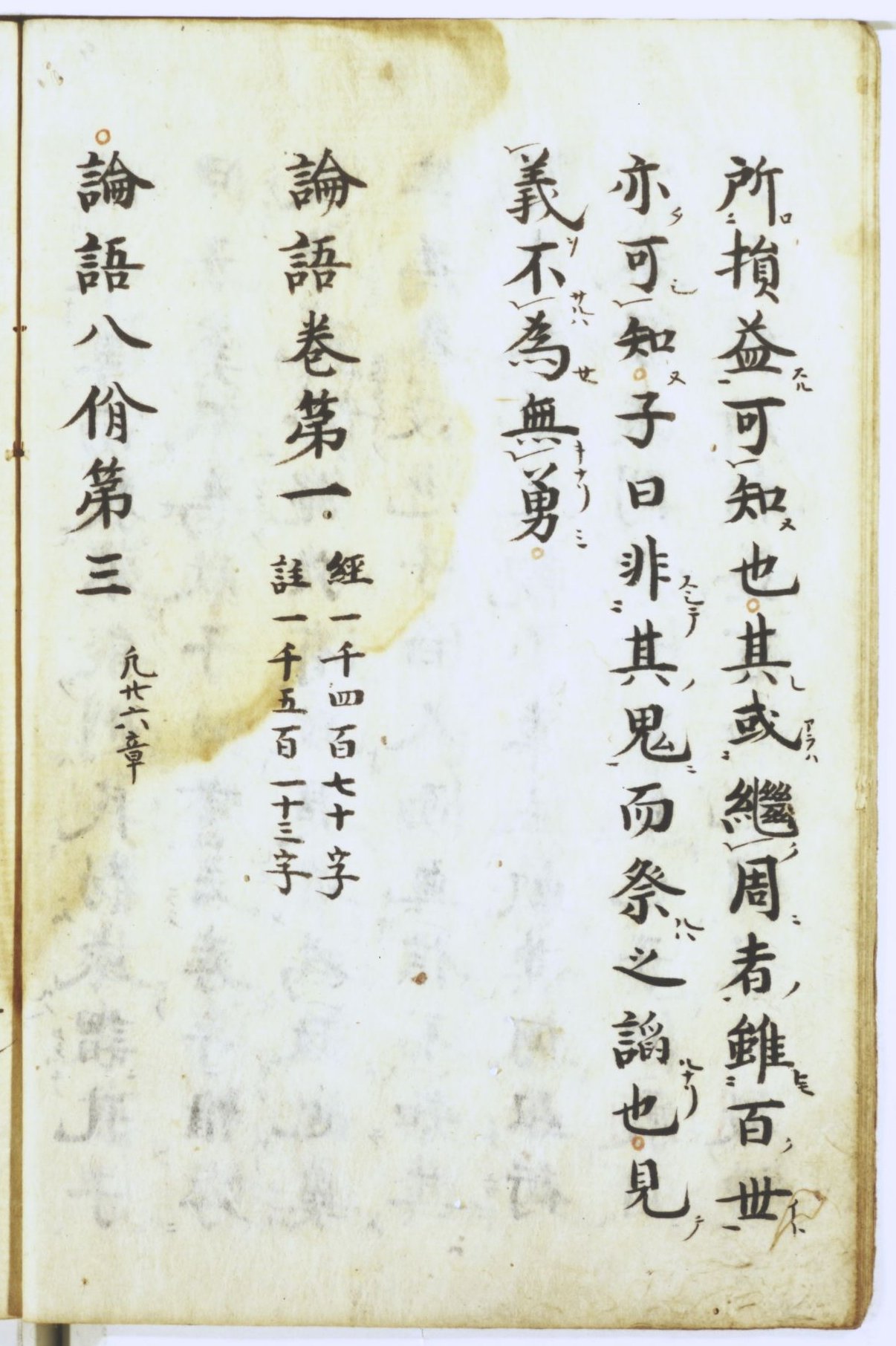
Kyoto University Library RB00007936, IIIF canvas 10, left-hand page: 7 written columns of up to 14 characters, main text only, with Japanese reading marks. Checked on the image: the first column of this book's text on this page begins ‹忠舉善›, the last begins ‹於夏禮›. 2.21.1 begins inside column 1 (the column opens ‹忠舉善›), 9 characters down in the received text. Above it the page finishes 2.20, shown in the previous section. 2.23.2 runs on to canvas 11, right-hand page (first column ‹所損益›), where the section ends. Column openings on these pages that differ from the received text: ‹亦可知› where the received text has ‹可知也›. The Chinese shown is the received text (Wikisource), not a transcription of this manuscript; Legge's English translates the received text.
21.1或謂孔子曰:「子奚不爲政?」
21.2子曰:「《書》云:『孝乎惟孝,友於兄弟。』施於有政,是亦爲政,奚其爲爲政?」
22子曰:「人而無信,不知其可也。大車無輗,小車無軏,其何以行之哉?」
23.1子張問:「十世可知也?」
23.2子曰:「殷因於夏禮,所損益可知也;周因於殷禮,所損益可知也;其或繼周者,雖百世可知也。」
21.1Some one addressed Confucius, saying, 'Sir, why are you not engaged in the government?'
21.2The Master said, 'What does the Shu-ching say of filial piety?-- "You are filial, you discharge your brotherly duties. These qualities are displayed in government." This then also constitutes the exercise of government. Why must there be THAT-- making one be in the government?'
22The Master said, 'I do not know how a man without truthfulness is to get on. How can a large carriage be made to go without the cross-bar for yoking the oxen to, or a small carriage without the arrangement for yoking the horses?'
23.1Tsze-chang asked whether the affairs of ten ages after could be known.
23.2Confucius said, 'The Yin dynasty followed the regulations of the Hsia: wherein it took from or added to them may be known. The Chau dynasty has followed the regulations of Yin: wherein it took from or added to them may be known. Some other may follow the Chau, but though it should be at the distance of a hundred ages, its affairs may be known.'
Where on the image
Kyoto University Library RB00007936, IIIF canvas 11, right-hand page: 5 written columns of up to 14 characters, main text only, with Japanese reading marks. Checked on the image: the first column of this book's text on this page begins ‹所損益›, the last begins ‹義不為›. Column 5 carries the title 論語卷第一. Column 7 carries the title 論語八佾第三. 2.24.1 begins inside column 2 (the column opens ‹亦可知›), 3 characters down in the received text. Above it the page finishes 2.23.2, shown in the previous section. The section ends on this page. The Chinese shown is the received text (Wikisource), not a transcription of this manuscript; Legge's English translates the received text.
24.1子曰:「非其鬼而祭之,諂也。
24.2見義不爲,無勇也。」
24.1The Master said, 'For a man to sacrifice to a spirit which does not belong to him is flattery.
24.2'To see what is right and not to do it is want of courage.'
Notes
- English: James Legge, Confucian Analects, The Chinese Classics vol. 1. Legge's chapter and paragraph numbers are kept as superscripts (chapter.paragraph).
- Legge translated the received text. Where this manuscript's wording differs, his English follows the received text shown here.
Cite
Sources
- Source: Kyoto University Library RB00007936 (Analects manuscript attributed to Kiyohara Yoshieda, c. 1300) + Wikisource received text + James Legge's English (Project Gutenberg) (holding institution)
- Critical edition: Received text (Wikisource) in Legge's chapter and paragraph division
← previous · → next · v cycle view · l back to library