Analects, Book 20: Yao yue 堯曰 (Kamakura-period manuscript)
Introduction
Book 20 of the Analects (論語 Lunyu), titled 堯曰 (Yao yue) after its opening words, 3 chapters in Legge's division. It is shown on a manuscript of the Analects in the Kiyohara family collection (Seike bunko) of Kyoto University Library, two volumes in regular script, seven columns of fourteen characters to the page, main text only, with red and black Japanese reading marks. A colophon by Kiyohara Edakata dated 1550 names the copyist as his ancestor Kiyohara Yoshieda (1253-1331), which places the copy around 1300, in the late Kamakura period; the attribution is traditional. The Kiyohara were hereditary readers of the Confucian classics at the Japanese court, and their text descends from the edition of the Analects with the collected commentary of He Yan (3rd century CE): after each pair of books the scribe copied the character counts of the classic and of the commentary, although only the classic is written out. The manuscript is an Important Cultural Property of Japan.
In this copy Book 20 runs from canvas 92, left-hand page to canvas 94, left-hand page (volume 2). Each section gathers the paragraphs that begin on one page, numbered by chapter and paragraph as in Legge, and links to that page and to any page the last paragraph runs onto. The page boundaries were found by reading the first characters of every column on the photographs. The Chinese shown is the received text, from Wikisource. This manuscript differs from it in places, most often by an added or missing particle (也, 矣, 焉) or a variant character form; the differences seen at column openings are listed in the scan notes. The English is James Legge's translation of the received text.
How was this verified? (Provenance)
Where on the image
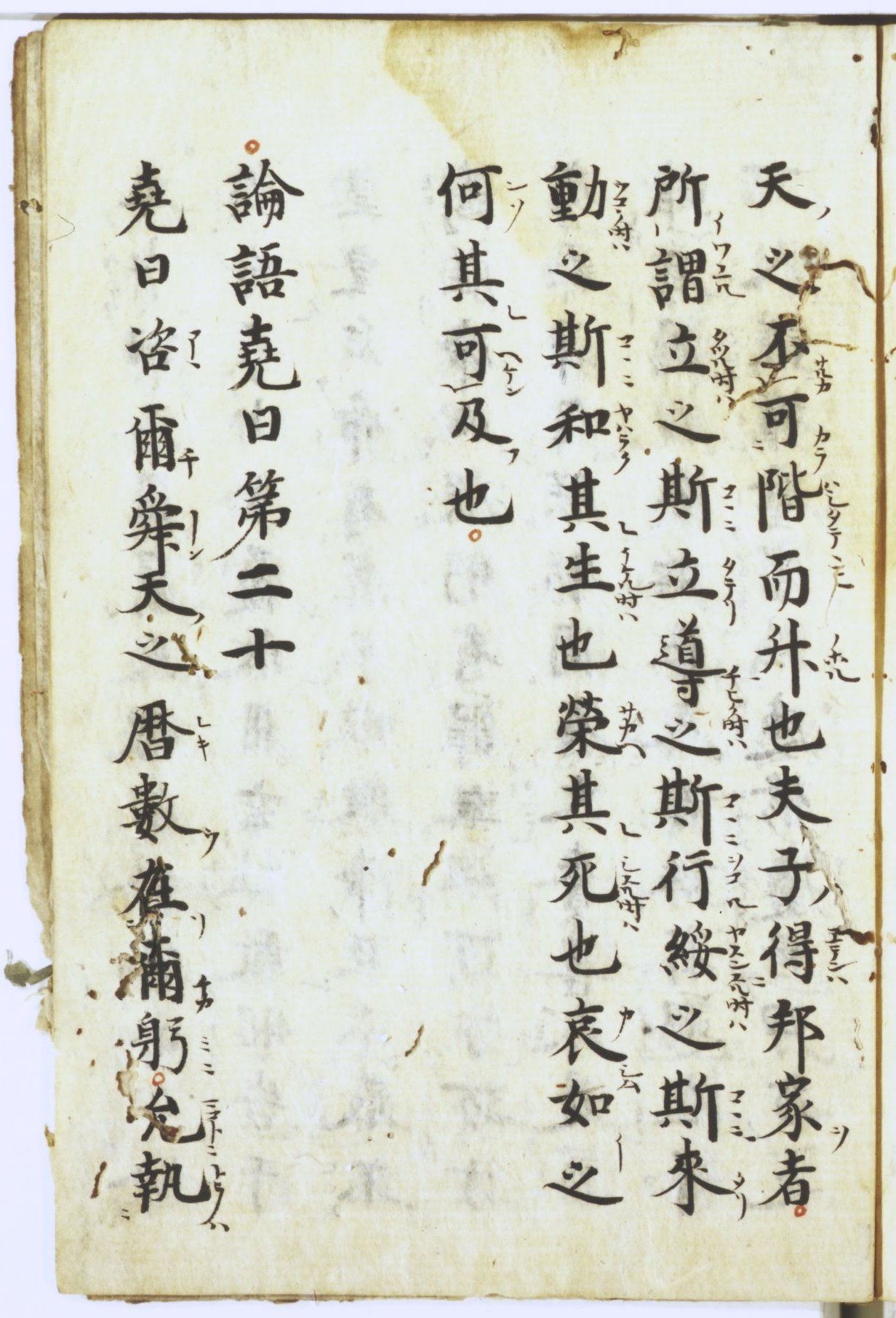
Kyoto University Library RB00007936, IIIF canvas 92, left-hand page: 6 written columns of up to 14 characters, main text only, with Japanese reading marks. Checked on the image: the first column of this book's text on this page begins ‹堯曰咨›. Column 6 carries the title 論語堯曰第二十. 20.1.1 opens column 7. 20.1.1 runs on to canvas 93, right-hand page (first column ‹其中四›), where the section ends. The Chinese shown is the received text (Wikisource), not a transcription of this manuscript; Legge's English translates the received text.
1.1堯曰:「咨!爾舜!天之曆數在爾躬,允執其中!四海困窮,天祿永終。」
1.1Yao said, 'Oh! you, Shun, the Heaven-determined order of succession now rests in your person. Sincerely hold fast the due Mean. If there shall be distress and want within the four seas, the Heavenly revenue will come to a perpetual end.'
Where on the image
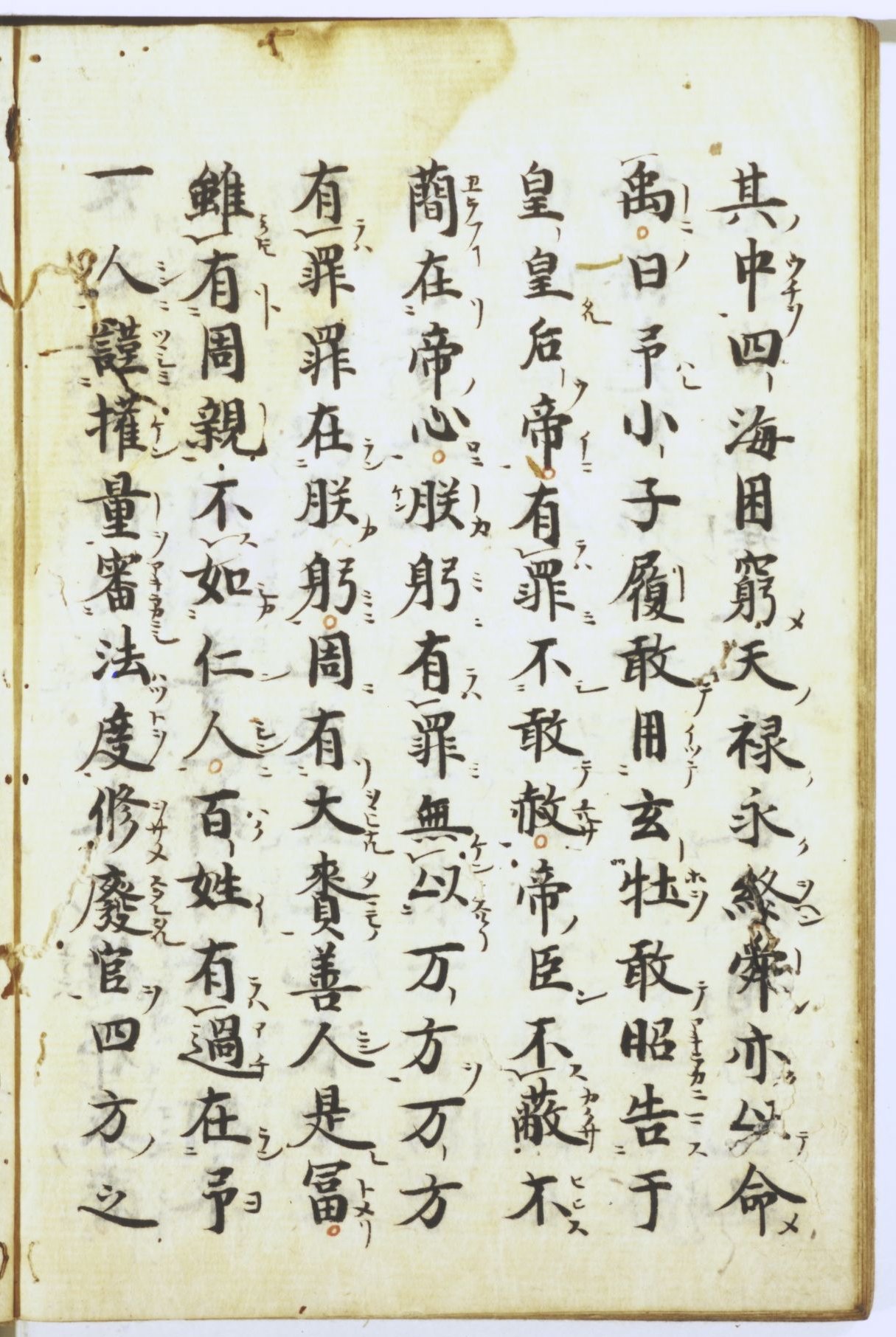
Kyoto University Library RB00007936, IIIF canvas 93, right-hand page: 7 written columns of up to 14 characters, main text only, with Japanese reading marks. Checked on the image: the first column of this book's text on this page begins ‹其中四›, the last begins ‹一人謹›. 20.1.2 begins inside column 1 (the column opens ‹其中四›), 10 characters down in the received text. Above it the page finishes 20.1.1, shown in the previous section. 20.1.6 runs on to canvas 93, left-hand page (first column ‹政行焉›), where the section ends. The Chinese shown is the received text (Wikisource), not a transcription of this manuscript; Legge's English translates the received text.
1.2舜亦以命禹。
1.3曰:「予小子履,敢用玄牡,敢昭吿于皇皇后帝:有罪不敢赦。帝臣不蔽,簡在帝心!朕躬有罪,無以萬方;萬方有罪,罪在朕躬。」
1.4「周有大賚,善人是富。」
1.5「雖有周親,不如仁人;百姓有過,在予一人。」
1.6謹權量,審法度,脩廢官,四方之政行焉。
1.2Shun also used the same language in giving charge to Yu.
1.3T'ang said, 'I the child Li, presume to use a dark-coloured victim, and presume to announce to Thee, O most great and sovereign God, that the sinner I dare not pardon, and thy ministers, O God, I do not keep in obscurity. The examination of them is by thy mind, O God. If, in my person, I commit offences, they are not to be attributed to you, the people of the myriad regions. If you in the myriad regions commit offences, these offences must rest on my person.'
1.4Chau conferred great gifts, and the good were enriched.
1.5'Although he has his near relatives, they are not equal to my virtuous men. The people are throwing blame upon me, the One man.'
1.6He carefully attended to the weights and measures, examined the body of the laws, restored the discarded officers, and the good government of the kingdom took its course.
Where on the image
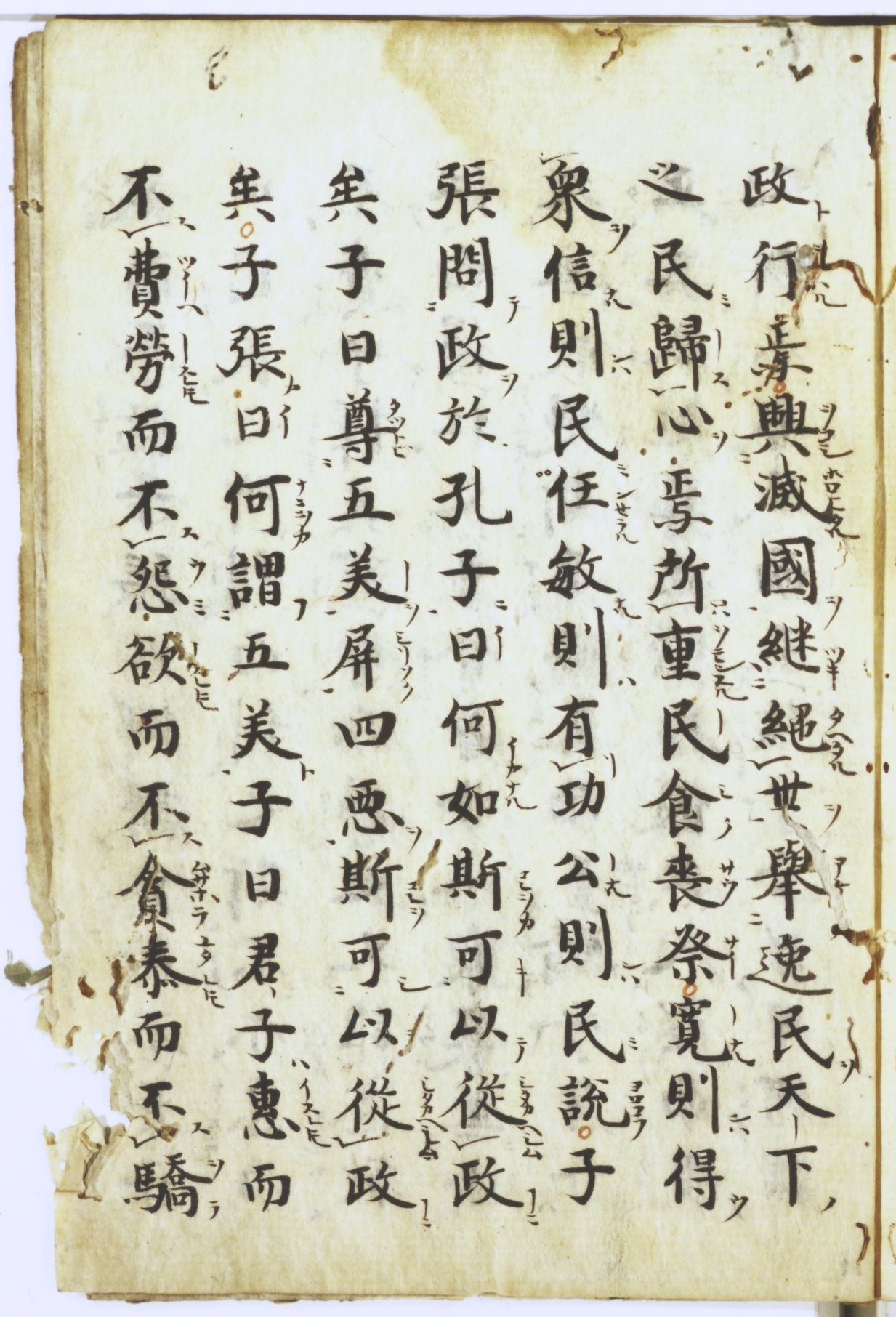
Kyoto University Library RB00007936, IIIF canvas 93, left-hand page: 7 written columns of up to 14 characters, main text only, with Japanese reading marks. Checked on the image: the first column of this book's text on this page begins ‹政行焉›, the last begins ‹不費勞›. 20.1.7 begins inside column 1 (the column opens ‹政行焉›), 3 characters down in the received text. Above it the page finishes 20.1.6, shown in the previous section. 20.2.1 runs on to canvas 94, right-hand page (first column ‹威而不›), where the section ends. Column openings on these pages that differ from the received text: ‹張問政› where the received text has ‹張問於›. The Chinese shown is the received text (Wikisource), not a transcription of this manuscript; Legge's English translates the received text.
1.7興滅國,繼絕世,擧逸民,天下之民歸心焉。
1.8所重:民、食、喪、祭。
1.9寬則得眾,信則民任焉,敏則有功,公則說。
2.1子張問於孔子曰:「何如斯可以從政矣?」子曰:「尊五美,屛四惡,斯可以從政矣。」子張曰:「何謂五美?」子曰:「君子惠而不費,勞而不怨,欲而不貪,泰而不驕,威而不猛。」
1.7He revived States that had been extinguished, restored families whose line of succession had been broken, and called to office those who had retired into obscurity, so that throughout the kingdom the hearts of the people turned towards him.
1.8What he attached chief importance to, were the food of the people, the duties of mourning, and sacrifices.
1.9By his generosity, he won all. By his sincerity, he made the people repose trust in him. By his earnest activity, his achievements were great. By his justice, all were delighted.
2.1Tsze-chang asked Confucius, saying, 'In what way should a person in authority act in order that he may conduct government properly?' The Master replied, 'Let him honour the five excellent, and banish away the four bad, things;-- then may he conduct government properly.' Tsze-chang said, 'What are meant by the five excellent things?' The Master said, 'When the person in authority is beneficent without great expenditure; when he lays tasks on the people without their repining; when he pursues what he desires without being covetous; when he maintains a dignified ease without being proud; when he is majestic without being fierce.'
Where on the image
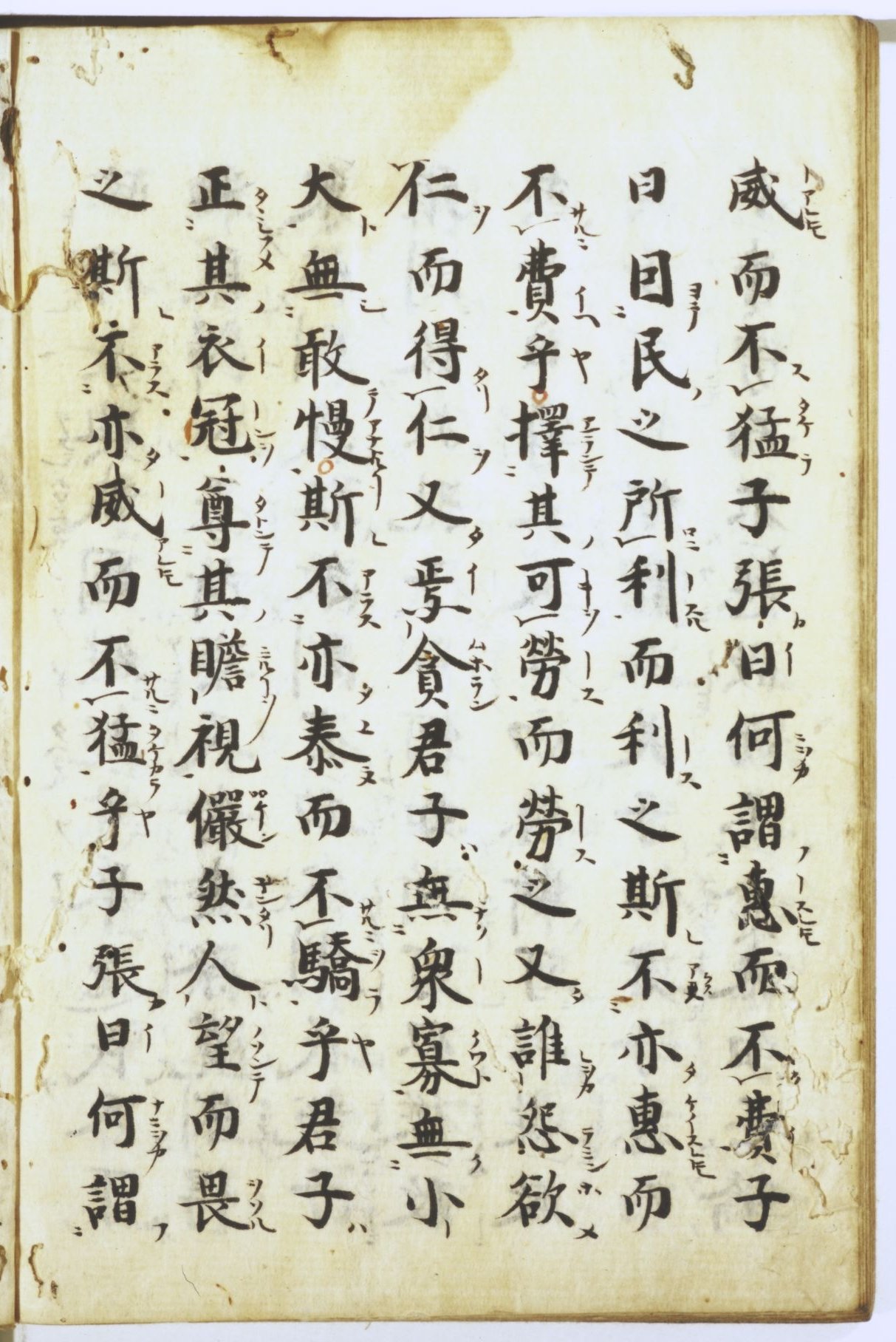
Kyoto University Library RB00007936, IIIF canvas 94, right-hand page: 7 written columns of up to 14 characters, main text only, with Japanese reading marks. Checked on the image: the first column of this book's text on this page begins ‹威而不›, the last begins ‹之斯不›. 20.2.2 begins inside column 1 (the column opens ‹威而不›), 4 characters down in the received text. Above it the page finishes 20.2.1, shown in the previous section. 20.2.3 runs on to canvas 94, left-hand page (first column ‹四惡子›), where the section ends. The Chinese shown is the received text (Wikisource), not a transcription of this manuscript; Legge's English translates the received text.
2.2子張曰:「何謂惠而不費?」子曰:「因民之所利而利之,斯不亦惠而不費乎!擇可勞而勞之,又誰怨?欲仁而得仁,又焉貪?君子無眾寡,無小大,無敢慢,斯不亦泰而不驕乎?君子正其衣冠,尊其瞻視,儼然人望而畏之,斯不亦威而不猛乎!」
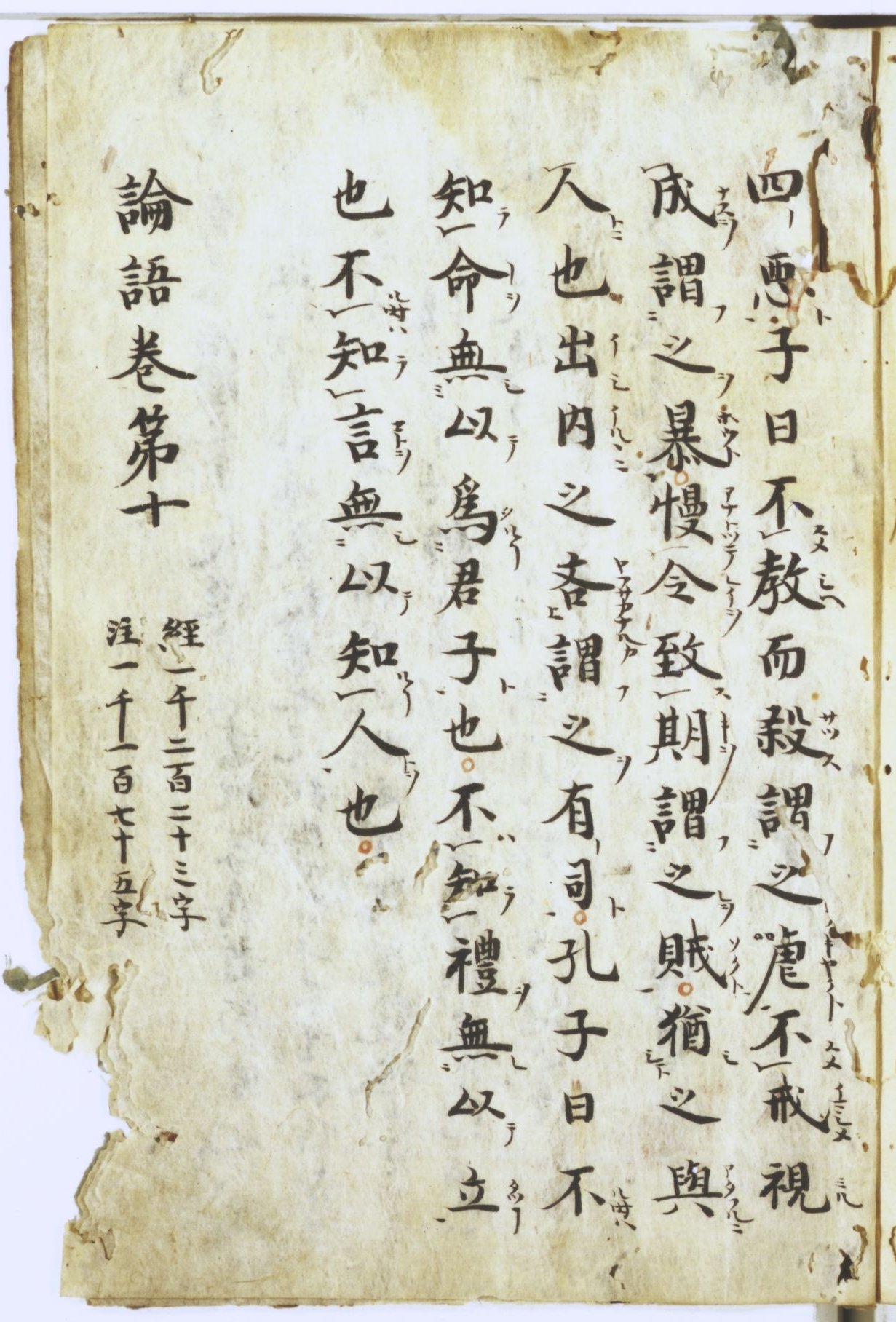
2.3子張曰:「何謂四惡?」子曰:「不教而殺謂之虐;不戒視成謂之暴;慢令致期謂之賊;猶之與人也,出納之吝,謂之有司。」
2.2Tsze-chang said, 'What is meant by being beneficent without great expenditure?' The Master replied, 'When the person in authority makes more beneficial to the people the things from which they naturally derive benefit;-- is not this being beneficent without great expenditure? When he chooses the labours which are proper, and makes them labour on them, who will repine? When his desires are set on benevolent government, and he secures it, who will accuse him of covetousness? Whether he has to do with many people or few, or with things great or small, he does not dare to indicate any disrespect;-- is not this to maintain a dignified ease without any pride? He adjusts his clothes and cap, and throws a dignity into his looks, so that, thus dignified, he is looked at with awe;-- is not this to be majestic without being fierce?'
2.3Tsze-chang then asked, 'What are meant by the four bad things?' The Master said, 'To put the people to death without having instructed them;-- this is called cruelty. To require from them, suddenly, the full tale of work, without having given them warning;-- this is called oppression. To issue orders as if without urgency, at first, and, when the time comes, to insist on them with severity;-- this is called injury. And, generally, in the giving pay or rewards to men, to do it in a stingy way;-- this is called acting the part of a mere official.'
Where on the image
Kyoto University Library RB00007936, IIIF canvas 94, left-hand page: 6 written columns of up to 14 characters, main text only, with Japanese reading marks. Checked on the image: the first column of this book's text on this page begins ‹四惡子›, the last begins ‹也不知›. Column 7 carries the title 論語卷第十. 20.3.1 begins inside column 3 (the column opens ‹入也出›), 10 characters down in the received text. Above it the page finishes 20.2.3, shown in the previous section. The section ends on this page. The Chinese shown is the received text (Wikisource), not a transcription of this manuscript; Legge's English translates the received text.
3.1子曰:「不知命,無以爲君子也;
3.2不知禮,無以立也;
3.3不知言,無以知人也。」
3.1The Master said, 'Without recognising the ordinances of Heaven, it is impossible to be a superior man.
3.2'Without an acquaintance with the rules of Propriety, it is impossible for the character to be established.
3.3'Without knowing the force of words, it is impossible to know men.'
Notes
- English: James Legge, Confucian Analects, The Chinese Classics vol. 1. Legge's chapter and paragraph numbers are kept as superscripts (chapter.paragraph).
- Legge translated the received text. Where this manuscript's wording differs, his English follows the received text shown here.
Cite
Sources
- Source: Kyoto University Library RB00007936 (Analects manuscript attributed to Kiyohara Yoshieda, c. 1300) + Wikisource received text + James Legge's English (Project Gutenberg) (holding institution)
- Critical edition: Received text (Wikisource) in Legge's chapter and paragraph division
← previous · → next · v cycle view · l back to library