Analects, Book 19: Zizhang 子張 (Kamakura-period manuscript)
Introduction
Book 19 of the Analects (論語 Lunyu), titled 子張 (Zizhang) after its opening words, 25 chapters in Legge's division. It is shown on a manuscript of the Analects in the Kiyohara family collection (Seike bunko) of Kyoto University Library, two volumes in regular script, seven columns of fourteen characters to the page, main text only, with red and black Japanese reading marks. A colophon by Kiyohara Edakata dated 1550 names the copyist as his ancestor Kiyohara Yoshieda (1253-1331), which places the copy around 1300, in the late Kamakura period; the attribution is traditional. The Kiyohara were hereditary readers of the Confucian classics at the Japanese court, and their text descends from the edition of the Analects with the collected commentary of He Yan (3rd century CE): after each pair of books the scribe copied the character counts of the classic and of the commentary, although only the classic is written out. The manuscript is an Important Cultural Property of Japan.
In this copy Book 19 runs from canvas 88, right-hand page to canvas 92, left-hand page (volume 2). Each section gathers the paragraphs that begin on one page, numbered by chapter and paragraph as in Legge, and links to that page and to any page the last paragraph runs onto. The page boundaries were found by reading the first characters of every column on the photographs. The Chinese shown is the received text, from Wikisource. This manuscript differs from it in places, most often by an added or missing particle (也, 矣, 焉) or a variant character form; the differences seen at column openings are listed in the scan notes. The English is James Legge's translation of the received text.
How was this verified? (Provenance)
Where on the image
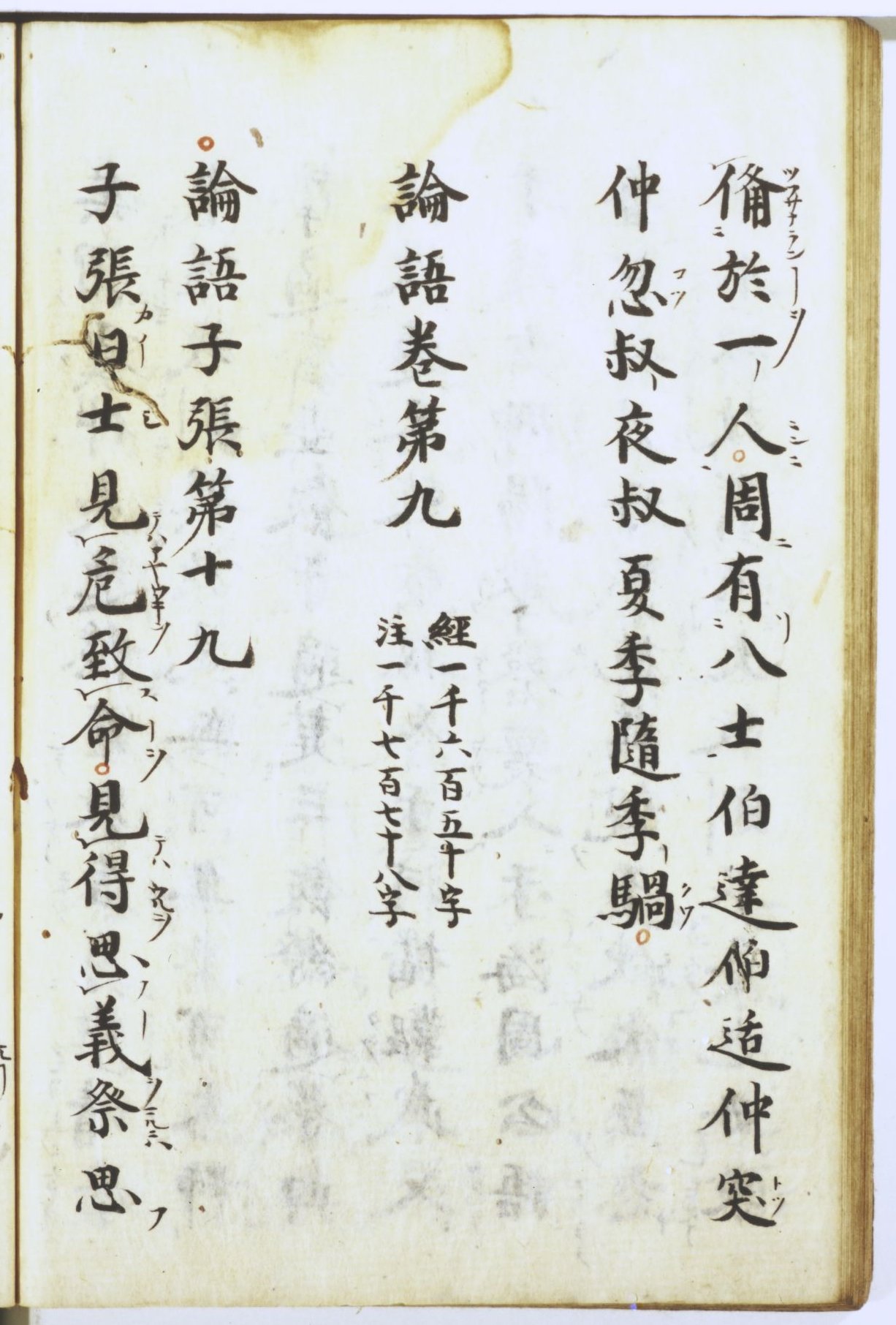
Kyoto University Library RB00007936, IIIF canvas 88, right-hand page: 5 written columns of up to 14 characters, main text only, with Japanese reading marks. Checked on the image: the first column of this book's text on this page begins ‹子張曰›. Column 4 carries the title 論語卷第九. Column 6 carries the title 論語子張第十九. 19.1 opens column 7. 19.1 runs on to canvas 88, left-hand page (first column ‹敬喪思›), where the section ends. The Chinese shown is the received text (Wikisource), not a transcription of this manuscript; Legge's English translates the received text.
1子張曰:「士見危致命,見得思義,祭思敬,喪思哀,其可已矣。」
1Tsze-chang said, 'The scholar, trained for public duty, seeing threatening danger, is prepared to sacrifice his life. When the opportunity of gain is presented to him, he thinks of righteousness. In sacrificing, his thoughts are reverential. In mourning, his thoughts are about the grief which he should feel. Such a man commands our approbation indeed.'
Where on the image
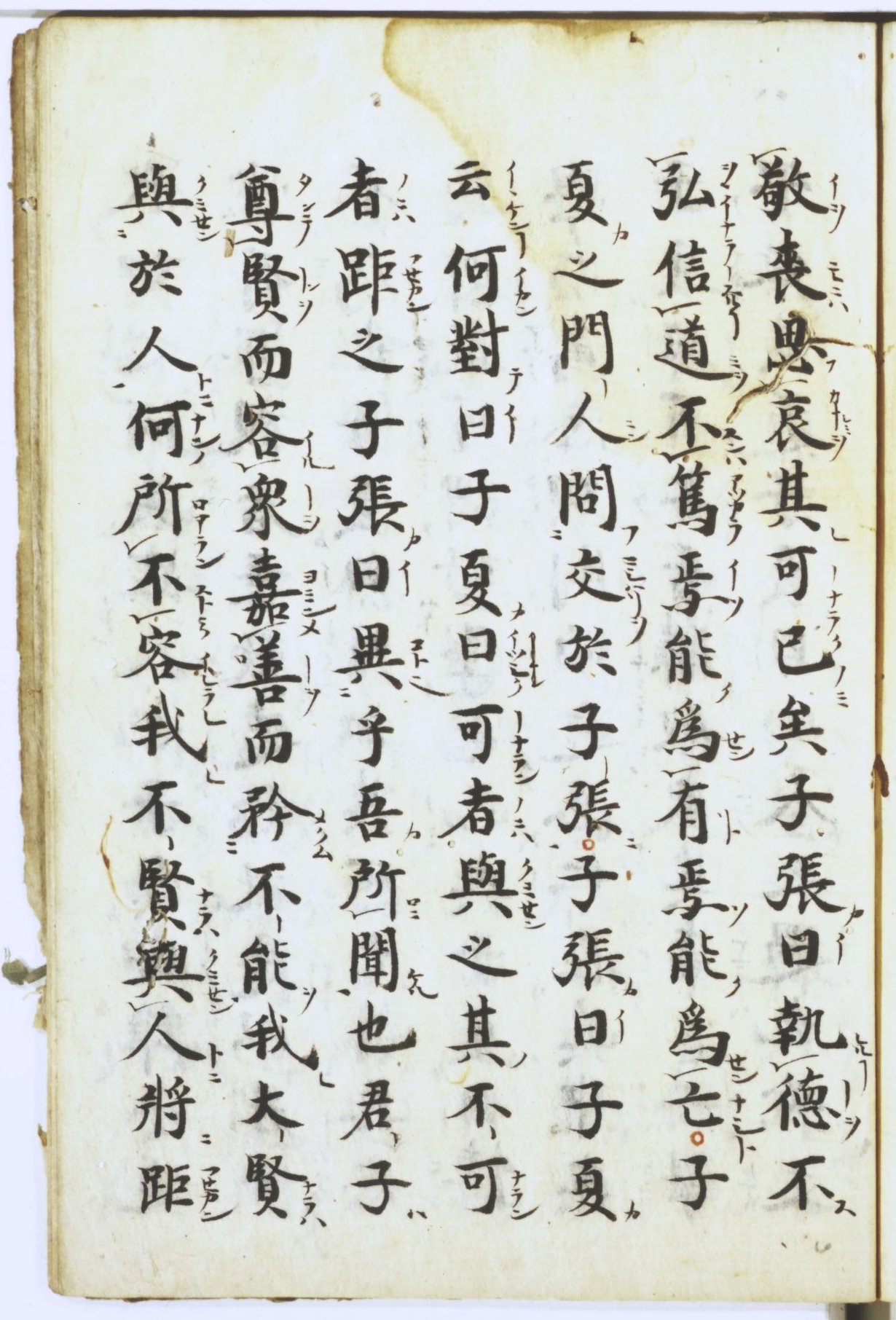
Kyoto University Library RB00007936, IIIF canvas 88, left-hand page: 7 written columns of up to 14 characters, main text only, with Japanese reading marks. Checked on the image: the first column of this book's text on this page begins ‹敬喪思›, the last begins ‹與於人›. 19.2 begins inside column 1 (the column opens ‹敬喪思›), 8 characters down in the received text. Above it the page finishes 19.1, shown in the previous section. 19.3 runs on to canvas 89, right-hand page (first column ‹我如之›), where the section ends. Column openings on these pages that differ from the received text: ‹者距之› where the received text has ‹者拒之›. The Chinese shown is the received text (Wikisource), not a transcription of this manuscript; Legge's English translates the received text.
2子張曰:「執德不弘,信道不篤,焉能爲有?焉能爲亡?」
3子夏之門人,問「交」於子張。子張曰:「子夏云何?」對曰:「子夏曰:『可者與之,其不可者拒之。』」子張曰:「異乎吾所聞;『君子尊賢而容眾,嘉善而矜不能。』我之大賢與,於人何所不容?我之不賢與,人將拒我,如之何其拒人也?」
2Tsze-chang said, 'When a man holds fast to virtue, but without seeking to enlarge it, and believes right principles, but without firm sincerity, what account can be made of his existence or non-existence?'
3The disciples of Tsze-hsia asked Tsze-chang about the principles that should characterize mutual intercourse. Tsze- chang asked, 'What does Tsze-hsia say on the subject?' They replied, 'Tsze-hsia says:-- "Associate with those who can advantage you. Put away from you those who cannot do so."' Tsze-chang observed, 'This is different from what I have learned. The superior man honours the talented and virtuous, and bears with all. He praises the good, and pities the incompetent. Am I possessed of great talents and virtue?-- who is there among men whom I will not bear with? Am I devoid of talents and virtue?-- men will put me away from them. What have we to do with the putting away of others?'
Where on the image
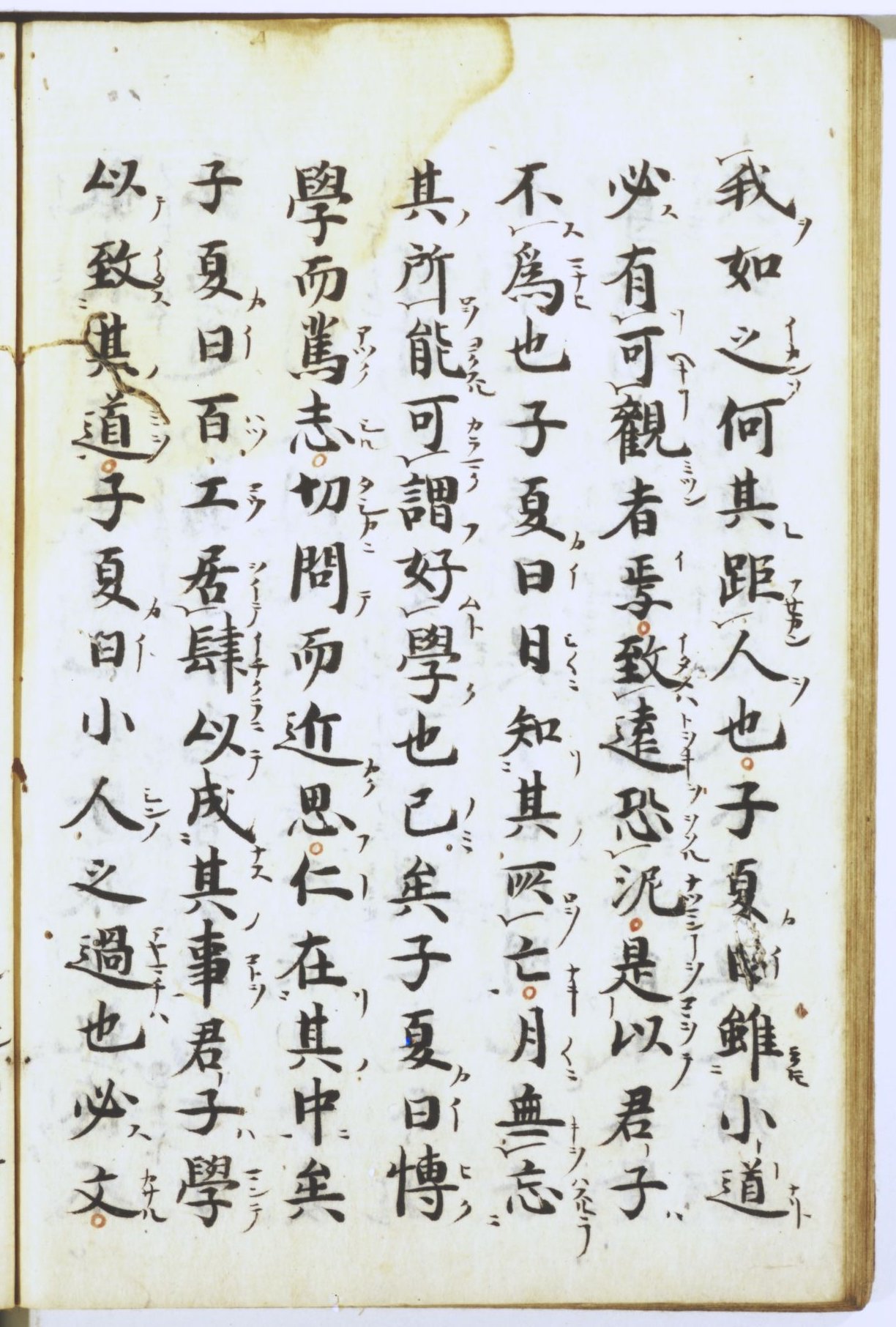
Kyoto University Library RB00007936, IIIF canvas 89, right-hand page: 7 written columns of up to 14 characters, main text only, with Japanese reading marks. Checked on the image: the first column of this book's text on this page begins ‹我如之›, the last begins ‹以致其›. 19.4 begins inside column 1 (the column opens ‹我如之›), 8 characters down in the received text. Above it the page finishes 19.3, shown in the previous section. The section ends on this page. The Chinese shown is the received text (Wikisource), not a transcription of this manuscript; Legge's English translates the received text.
4子夏曰:「雖小道,必有可觀者焉,致遠恐泥,是以君子不爲也。」
5子夏曰:「日知其所亡,月無忘其所能,可謂好學也已矣。」
6子夏曰:「博學而篤志,切問而近思,仁在其中矣。」
7子夏曰:「百工居肆以成其事,君子學以致其道。」
8子夏曰:「小人之過也必文。」
4Tsze-hsia said, 'Even in inferior studies and employments there is something worth being looked at; but if it be attempted to carry them out to what is remote, there is a danger of their proving inapplicable. Therefore, the superior man does not practise them.'
5Tsze-hsia said, 'He, who from day to day recognises what he has not yet, and from month to month does not forget what he has attained to, may be said indeed to love to learn.'
6Tsze-hsia said, 'There are learning extensively, and having a firm and sincere aim; inquiring with earnestness, and reflecting with self-application:-- virtue is in such a course.'
7Tsze-hsia said, 'Mechanics have their shops to dwell in, in order to accomplish their works. The superior man learns, in order to reach to the utmost of his principles.'
8Tsze-hsia said, 'The mean man is sure to gloss his faults.'
Where on the image
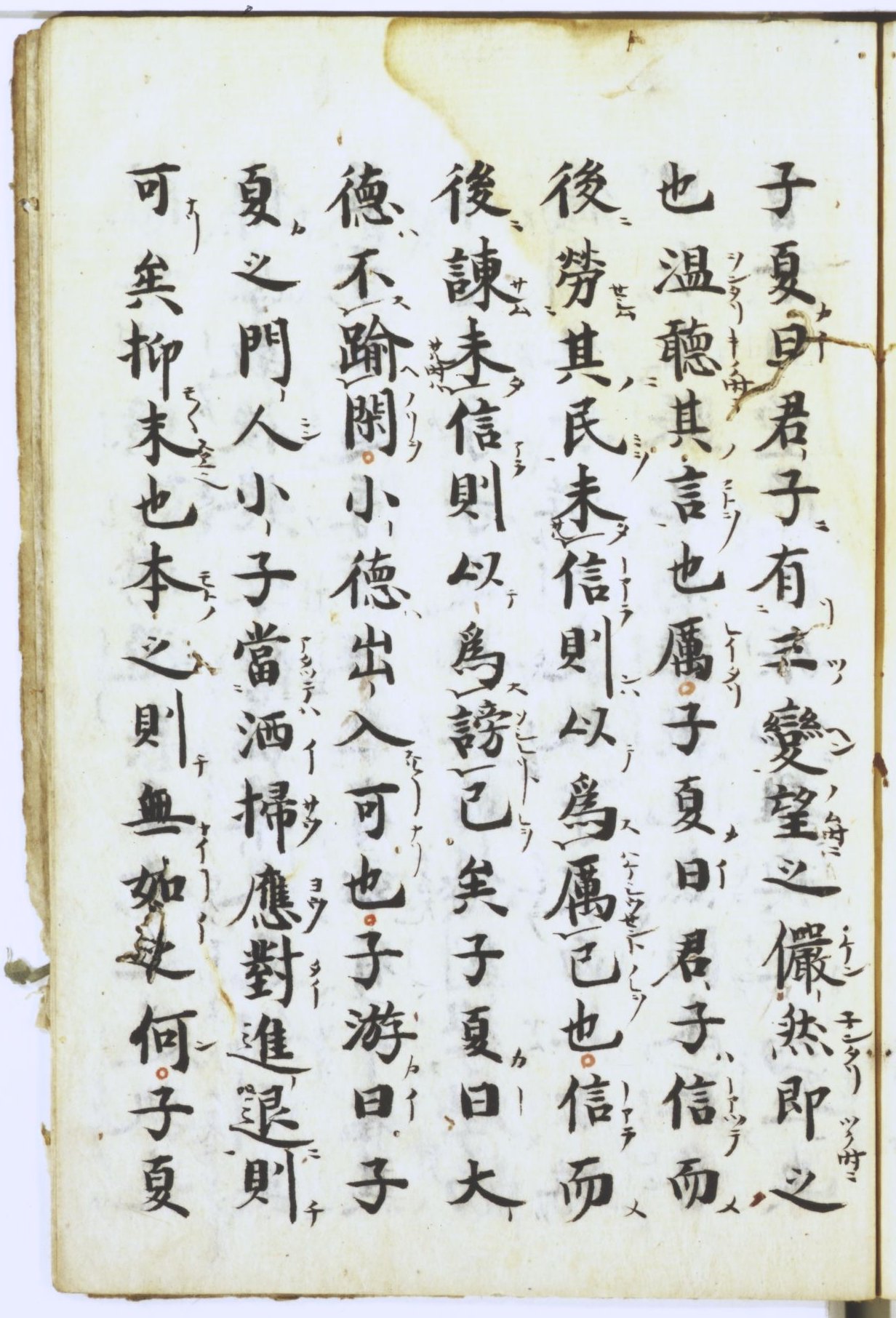
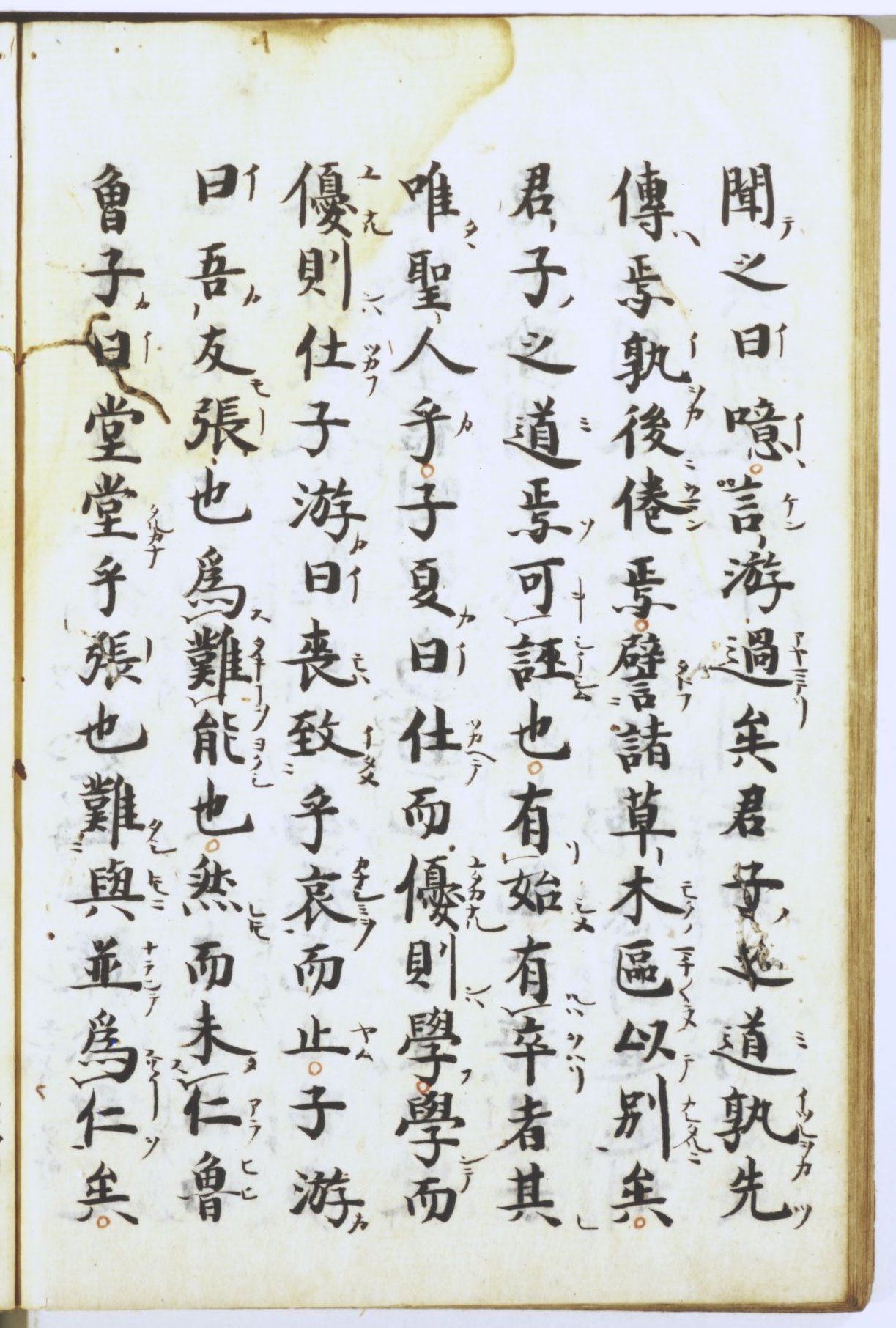
Kyoto University Library RB00007936, IIIF canvas 89, left-hand page: 7 written columns of up to 14 characters, main text only, with Japanese reading marks. Checked on the image: the first column of this book's text on this page begins ‹子夏曰君›, the last begins ‹可矣抑›. 19.9 opens column 1. 19.12.2 runs on to canvas 90, right-hand page (first column ‹聞之曰›), where the section ends. Column openings on these pages that differ from the received text: ‹唯聖人› where the received text has ‹惟聖人›. The Chinese shown is the received text (Wikisource), not a transcription of this manuscript; Legge's English translates the received text.
9子夏曰:「君子有三變:望之儼然,卽之也溫,聽其言也厲。」
10子夏曰:「君子信而後勞其民,未信則以爲厲己也。信而後諫,未信則以爲謗己也。」
11子夏曰:「大德不踰閑,小德出入可也。」
12.1子游曰:「子夏之門人小子,當洒掃應對進退則可矣,抑末也;本之則無,如之何?」
12.2子夏聞之曰:「噫!言游過矣!君子之道,孰先傳焉?孰後倦焉?譬諸草木,區以別矣。君子之道,焉可誣也?有始有卒者,其惟聖人乎!」
9Tsze-hsia said, 'The superior man undergoes three changes. Looked at from a distance, he appears stern; when approached, he is mild; when he is heard to speak, his language is firm and decided.'
10Tsze-hsia said, 'The superior man, having obtained their confidence, may then impose labours on his people. If he have not gained their confidence, they will think that he is oppressing them. Having obtained the confidence of his prince, one may then remonstrate with him. If he have not gained his confidence, the prince will think that he is vilifying him.'
11Tsze-hsia said, 'When a person does not transgress the boundary line in the great virtues, he may pass and repass it in the small virtues.'
12.1Tsze-yu said, 'The disciples and followers of Tsze-hsia, in sprinkling and sweeping the ground, in answering and replying, in advancing and receding, are sufficiently accomplished. But these are only the branches of learning, and they are left ignorant of what is essential.-- How can they be acknowledged as sufficiently taught?'
12.2Tsze-hsia heard of the remark and said, 'Alas! Yen Yu is wrong. According to the way of the superior man in teaching, what departments are there which he considers of prime importance, and delivers? what are there which he considers of secondary importance, and allows himself to be idle about? But as in the case of plants, which are assorted according to their classes, so he deals with his disciples. How can the way of a superior man be such as to make fools of any of them? Is it not the sage alone, who can unite in one the beginning and the consummation of learning?'
Where on the image
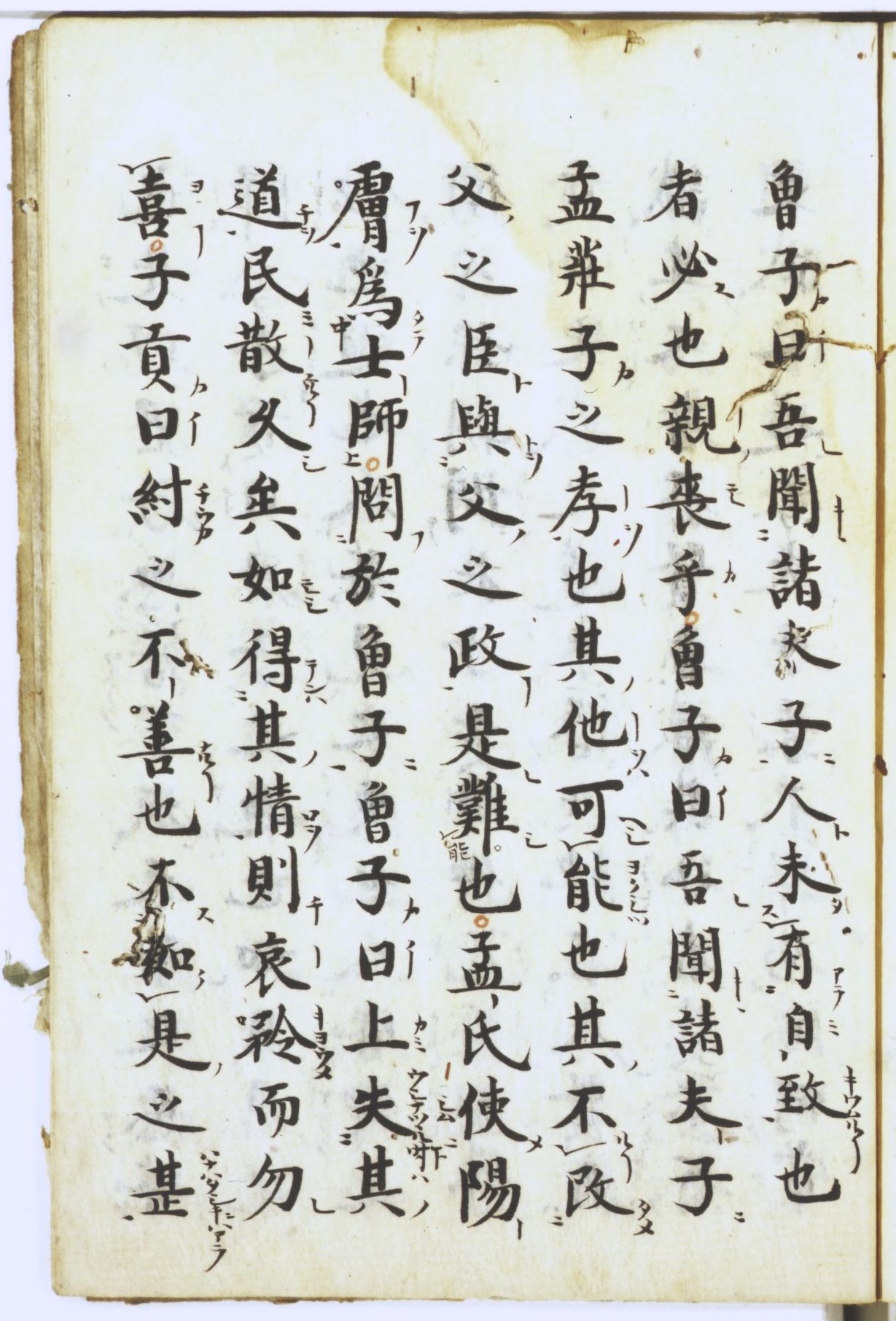
Kyoto University Library RB00007936, IIIF canvas 90, right-hand page: 7 written columns of up to 14 characters, main text only, with Japanese reading marks. Checked on the image: the first column of this book's text on this page begins ‹聞之曰›, the last begins ‹曾子曰堂›. 19.13 begins inside column 4 (the column opens ‹唯聖人›), 4 characters down in the received text. Above it the page finishes 19.12.2, shown in the previous section. The section ends on this page. The Chinese shown is the received text (Wikisource), not a transcription of this manuscript; Legge's English translates the received text.
13子夏曰:「仕而優則學,學而優則仕。」
14子游曰:「喪致乎哀而止。」
15子游曰:「吾友張也,爲難能也,然而未仁。」
16曾子曰:「堂堂乎張也,難與並爲仁矣。」
13Tsze-hsia said, 'The officer, having discharged all his duties, should devote his leisure to learning. The student, having completed his learning, should apply himself to be an officer.'
14Tsze-hsia said, 'Mourning, having been carried to the utmost degree of grief, should stop with that.'
15Tsze-hsia said, 'My friend Chang can do things which are hard to be done, but yet he is not perfectly virtuous.'
16The philosopher Tsang said, 'How imposing is the manner of Chang! It is difficult along with him to practise virtue.'
Where on the image
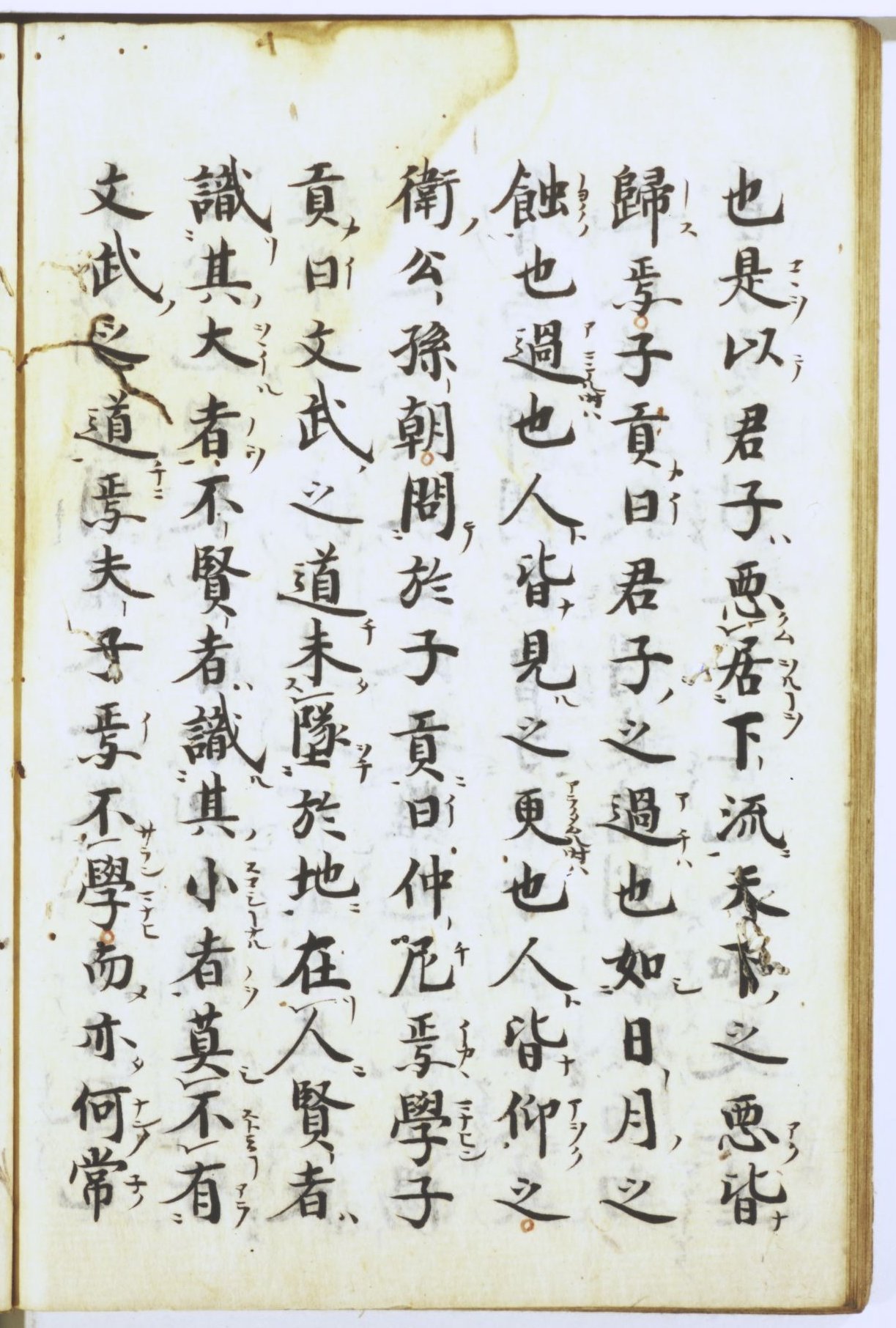
Kyoto University Library RB00007936, IIIF canvas 90, left-hand page: 7 written columns of up to 14 characters, main text only, with Japanese reading marks. Checked on the image: the first column of this book's text on this page begins ‹曾子曰吾›, the last begins ‹喜子貢›. 19.17 opens column 1. 19.20 runs on to canvas 91, right-hand page (first column ‹也是以›), where the section ends. Column openings on these pages that differ from the received text: ‹者必也› where the received text has ‹者也必›. The Chinese shown is the received text (Wikisource), not a transcription of this manuscript; Legge's English translates the received text.
17曾子曰:「吾聞諸夫子:『人未有自致者也,必也親喪乎!』」
18曾子曰:「吾聞諸夫子:『孟莊子之孝也,其他可能也,其不改父之臣,與父之政,是難能也。』」
19孟氏使陽膚爲士師,問於曾子。曾子曰:「上失其道,民散久矣!如得其情,則哀矜而勿喜。」
20子貢曰:「紂之不善,不如是之甚也。是以君子惡居下流,天下之惡皆歸焉。」
17The philosopher Tsang said, 'I heard this from our Master:-- "Men may not have shown what is in them to the full extent, and yet they will be found to do so, on occasion of mourning for their parents."'
18The philosopher Tsang said, 'I have heard this from our Master:-- "The filial piety of Mang Chwang, in other matters, was what other men are competent to, but, as seen in his not changing the ministers of his father, nor his father's mode of government, it is difficult to be attained to."'
19The chief of the Mang family having appointed Yang Fu to be chief criminal judge, the latter consulted the philosopher Tsang. Tsang said, 'The rulers have failed in their duties, and the people consequently have been disorganised, for a long time. When you have found out the truth of any accusation, be grieved for and pity them, and do not feel joy at your own ability.'
20Tsze-kung said, 'Chau's wickedness was not so great as that name implies. Therefore, the superior man hates to dwell in a low-lying situation, where all the evil of the world will flow in upon him.'
Where on the image
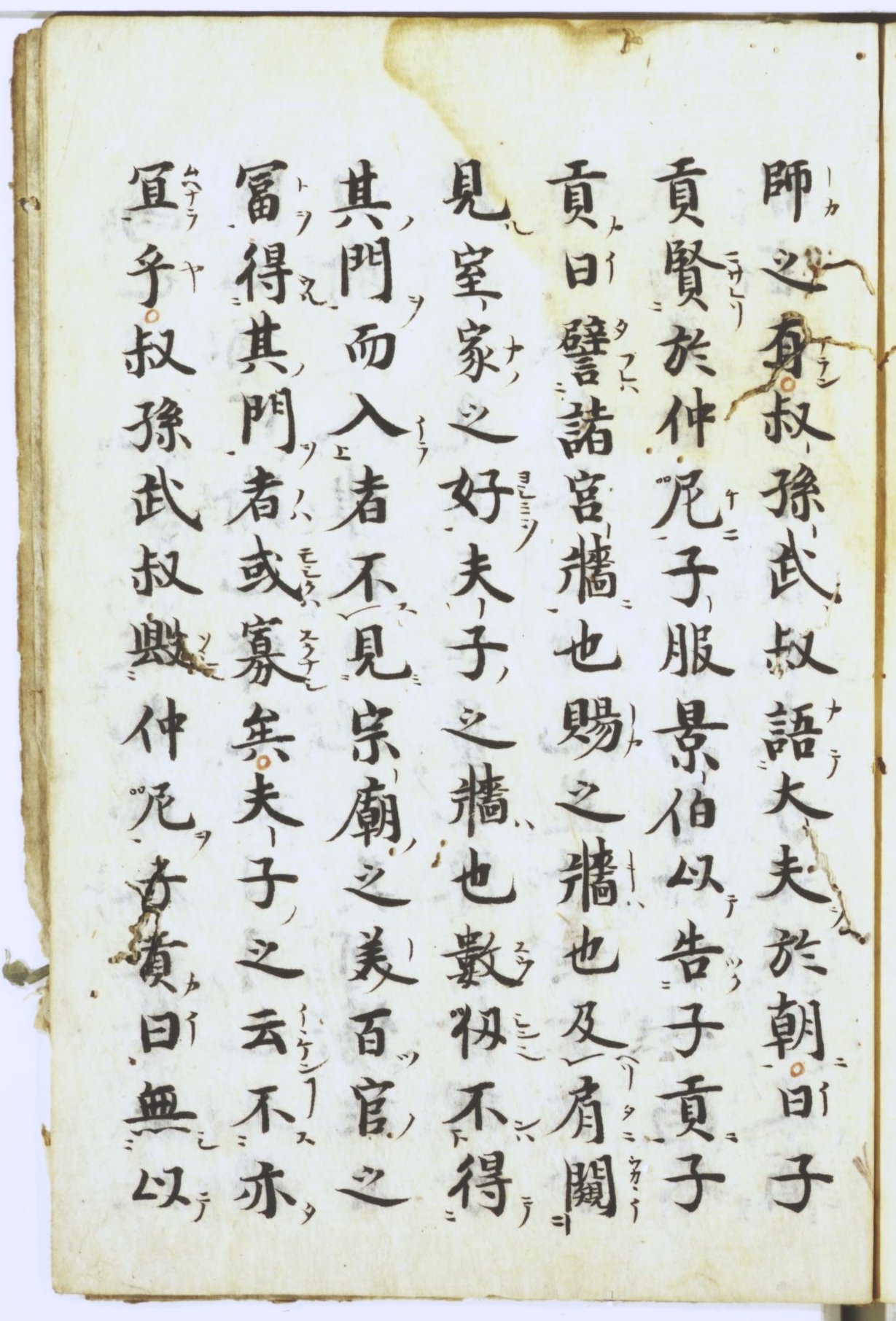
Kyoto University Library RB00007936, IIIF canvas 91, right-hand page: 7 written columns of up to 14 characters, main text only, with Japanese reading marks. Checked on the image: the first column of this book's text on this page begins ‹也是以›, the last begins ‹文武之›. 19.21 begins inside column 2 (the column opens ‹歸焉子›), 2 characters down in the received text. Above it the page finishes 19.20, shown in the previous section. 19.22.2 runs on to canvas 91, left-hand page (first column ‹師之有›), where the section ends. Column openings on these pages that differ from the received text: ‹蝕也過› where the received text has ‹食焉過›. The Chinese shown is the received text (Wikisource), not a transcription of this manuscript; Legge's English translates the received text.
21子貢曰:「君子之過也,如日月之食焉。過也,人皆見之;更也,人皆仰之。」
22.1衞公孫朝問於子貢曰:「仲尼焉學?」
22.2子貢曰:「文、武之道,未墜於地,在人。賢者識其大者,不賢者識其小者,莫不有文、武之道焉。夫子焉不學?而亦何常師之有?」
21Tsze-kung said, 'The faults of the superior man are like the eclipses of the sun and moon. He has his faults, and all men see them; he changes again, and all men look up to him.'
22.1Kung-sun Ch'ao of Wei asked Tsze-kung, saying, 'From whom did Chung-ni get his learning?'
22.2Tsze-kung replied, 'The doctrines of Wan and Wu have not yet fallen to the ground. They are to be found among men. Men of talents and virtue remember the greater principles of them, and others, not possessing such talents and virtue, remember the smaller. Thus, all possess the doctrines of Wan and Wu. Where could our Master go that he should not have an opportunity of learning them? And yet what necessity was there for his having a regular master?'
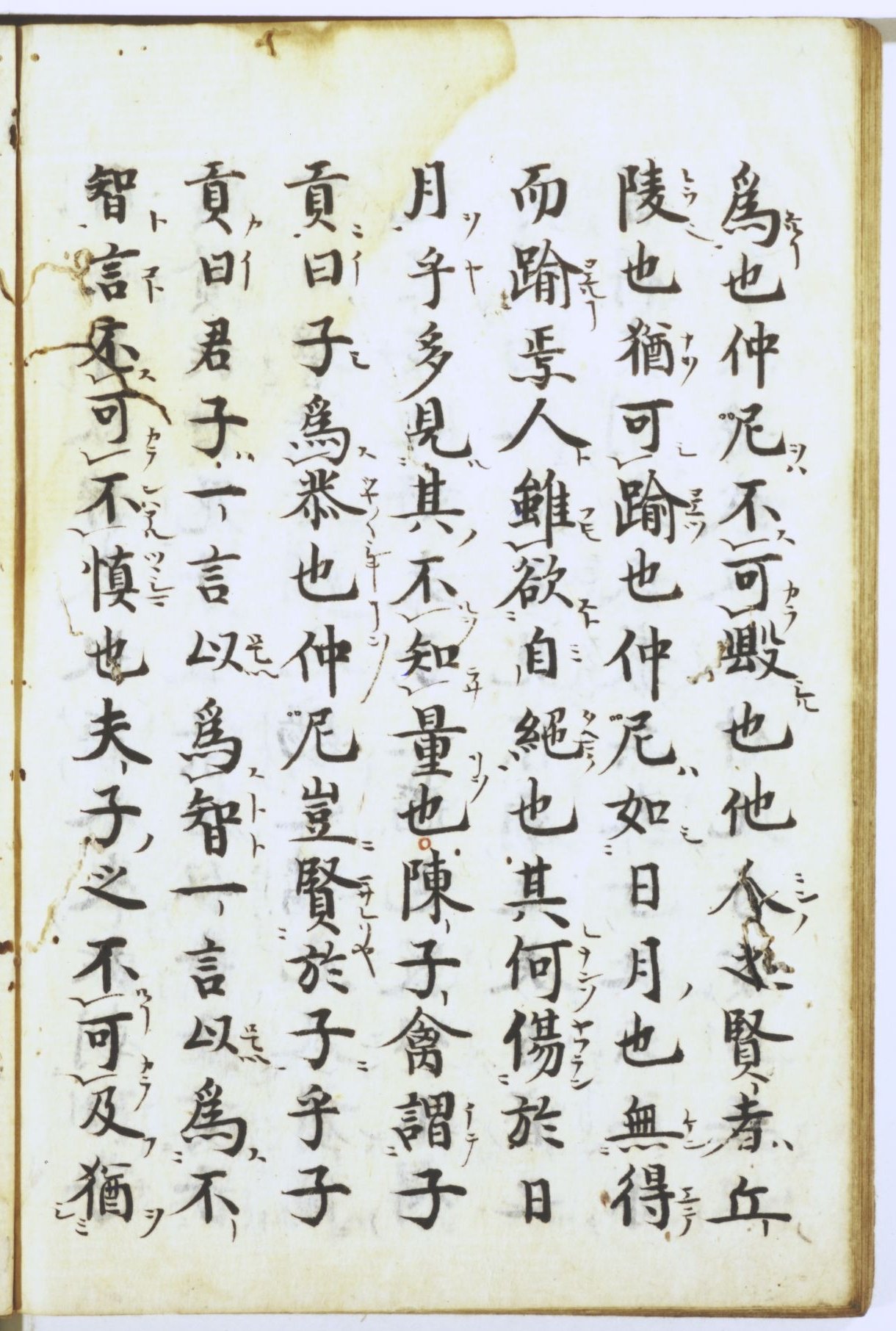
Where on the image
Kyoto University Library RB00007936, IIIF canvas 91, left-hand page: 7 written columns of up to 14 characters, main text only, with Japanese reading marks. Checked on the image: the first column of this book's text on this page begins ‹師之有›, the last begins ‹宜乎叔›. 19.23.1 begins inside column 1 (the column opens ‹師之有›), 3 characters down in the received text. Above it the page finishes 19.22.2, shown in the previous section. 19.24 runs on to canvas 92, right-hand page (first column ‹為也仲›), where the section ends. The Chinese shown is the received text (Wikisource), not a transcription of this manuscript; Legge's English translates the received text.
23.1叔孫武叔語大夫於朝,曰:「子貢賢於仲尼。」
23.2子服景伯以吿子貢。子貢曰:「譬之宮牆,賜之牆也及肩,闚見室家之好;
23.3夫子之牆數仞,不得其門而入,不見宗廟之美、百官之富。
23.4得其門者或寡矣。夫子之云,不亦宜乎!」
24叔孫武叔毀仲尼。子貢曰:「無以爲也,仲尼不可毀也。他人之賢者,丘陵也,猶可踰也;仲尼,日月也,無得而踰焉。人雖欲自絕,其何傷於日月乎?多見其不知量也!」
23.1Shu-sun Wu-shu observed to the great officers in the court, saying, 'Tsze-kung is superior to Chung-ni.'
23.2Tsze-fu Ching-po reported the observation to Tsze-kung, who said, 'Let me use the comparison of a house and its encompassing wall. My wall only reaches to the shoulders. One may peep over it, and see whatever is valuable in the apartments.
23.3'The wall of my Master is several fathoms high. If one do not find the door and enter by it, he cannot see the ancestral temple with its beauties, nor all the officers in their rich array.
23.4'But I may assume that they are few who find the door. Was not the observation of the chief only what might have been expected?'
24Shu-sun Wu-shu having spoken revilingly of Chung-ni, Tsze-kung said, 'It is of no use doing so. Chung-ni cannot be reviled. The talents and virtue of other men are hillocks and mounds which may be stepped over. Chung-ni is the sun or moon, which it is not possible to step over. Although a man may wish to cut himself off from the sage, what harm can he do to the sun or moon? He only shows that he does not know his own capacity.
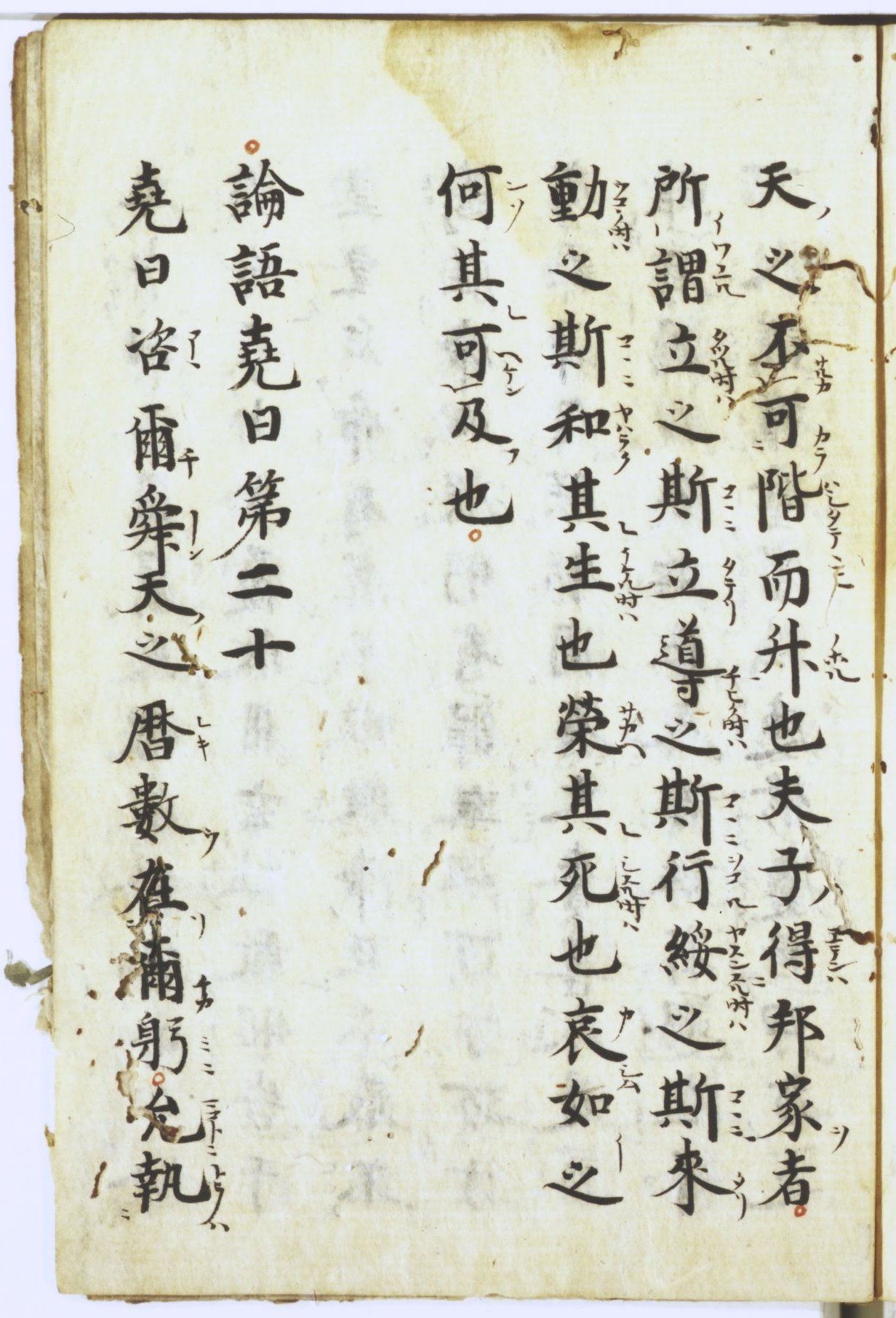
Where on the image
Kyoto University Library RB00007936, IIIF canvas 92, right-hand page: 7 written columns of up to 14 characters, main text only, with Japanese reading marks. Checked on the image: the first column of this book's text on this page begins ‹為也仲›, the last begins ‹智言不›. 19.25.1 begins inside column 4 (the column opens ‹月乎多›), 9 characters down in the received text. Above it the page finishes 19.24, shown in the previous section. 19.25.3 runs on to canvas 92, left-hand page (first column ‹天之不›), where the section ends. The Chinese shown is the received text (Wikisource), not a transcription of this manuscript; Legge's English translates the received text.
25.1陳子禽謂子貢曰:「子爲恭也,仲尼豈賢於子乎?」
25.2子貢曰:「君子一言以爲知,一言以爲不知,言不可不愼也!
25.3夫子之不可及也,猶天之不可階而升也。
25.1Ch'an Tsze-ch'in, addressing Tsze-kung, said, 'You are too modest. How can Chung-ni be said to be superior to you?'
25.2Tsze-kung said to him, 'For one word a man is often deemed to be wise, and for one word he is often deemed to be foolish. We ought to be careful indeed in what we say.
25.3'Our Master cannot be attained to, just in the same way as the heavens cannot be gone up to by the steps of a stair.
Where on the image
Kyoto University Library RB00007936, IIIF canvas 92, left-hand page: 6 written columns of up to 14 characters, main text only, with Japanese reading marks. Checked on the image: the first column of this book's text on this page begins ‹天之不›, the last begins ‹何其可›. Column 6 carries the title 論語堯曰第二十. 19.25.4 begins inside column 1 (the column opens ‹天之不›), 8 characters down in the received text. Above it the page finishes 19.25.3, shown in the previous section. The section ends on this page. The Chinese shown is the received text (Wikisource), not a transcription of this manuscript; Legge's English translates the received text.
25.4夫子之得邦家者,所謂『立之斯立,道之斯行,綏之斯來,動之斯和。其生也榮,其死也哀』。如之何其可及也?」
25.4'Were our Master in the position of the ruler of a State or the chief of a Family, we should find verified the description which has been given of a sage's rule:-- he would plant the people, and forthwith they would be established; he would lead them on, and forthwith they would follow him; he would make them happy, and forthwith multitudes would resort to his dominions; he would stimulate them, and forthwith they would be harmonious. While he lived, he would be glorious. When he died, he would be bitterly lamented. How is it possible for him to be attained to?'
Notes
- English: James Legge, Confucian Analects, The Chinese Classics vol. 1. Legge's chapter and paragraph numbers are kept as superscripts (chapter.paragraph).
- Legge translated the received text. Where this manuscript's wording differs, his English follows the received text shown here.
Cite
Sources
- Source: Kyoto University Library RB00007936 (Analects manuscript attributed to Kiyohara Yoshieda, c. 1300) + Wikisource received text + James Legge's English (Project Gutenberg) (holding institution)
- Critical edition: Received text (Wikisource) in Legge's chapter and paragraph division
← previous · → next · v cycle view · l back to library