Anzu, Standard Babylonian Tablet III: the defeat of Anzu
Introduction
Ninurta defeats and kills Anzu, recovers the Tablet of Destinies, and is praised by the gods with many names.
The Epic of Anzu tells how the lion-headed bird Anzu stole the Tablet of Destinies from Enlil, and how the god Ninurta, after other gods refused, defeated Anzu and recovered it. The Standard Babylonian version has three tablets. This page follows the line numbering of the electronic Babylonian Library edition.
How this page is built. Each section is a run of consecutive lines as written on one photographed clay tablet. For every line the eBL edition (https://www.ebl.lmu.de/corpus/L/1/10/SB/III) lists the manuscripts that carry it, with each tablet's own column and line numbers; the tablet chosen for each run is the photographed copy of the work with the most signs preserved there. Commentaries and texts that only quote a line are never chosen. School and excerpt tablets are used only for lines that no photographed library copy preserves as well, and only where they carry the line as text; their sections say so. The original text is eBL's transliteration of that tablet's signs (not a modern composite text): square brackets mark broken signs, x an illegible sign, # a damaged sign, ? an uncertain reading, and words in {braces} are determinatives; the notes give a key to every sign used on this page, and eBL's layout codes are written out in words (for example '(line break)' or '(blank space)'). Superscript numbers are the line numbers of the eBL edition, used in both the Akkadian and the English. The English is B. R. Foster's translation in the eBL edition (CC BY-NC-SA 4.0), one line of English per line of the text; italics mark uncertain renderings, as in the source. Where the tablet is broken, the English still translates the whole line of eBL's composite text; each section's note names the lines that are broken on its tablet.
Finding a line on the photograph. Each section names the tablet, the face and column, and the tablet's own line numbers (a prime, as in 5', counts from the first preserved line of a broken column). On a tablet with six columns the obverse carries columns i-iii from left to right; the reverse, turned over from bottom to top, carries columns iv-vi from right to left. The photographs often show the obverse above the reverse with the edges around them; a fragment preserves only part of this layout.
This page shows 97 of the 155 lines of the eBL edition (63%), from 4 tablets in the British Museum and Hatay Archaeology Museum: K.7923 (Nineveh), BM.38886, Ant.11000, BM.36072.
Lines not shown. 58 of the 155 lines of the eBL edition are not shown, because no photographed copy of the work used here carries them: 1-5 (no photograph in eBL: IM.95180 (Iraq Museum)); 22-40 (no photograph in eBL: IM.95180 (Iraq Museum)); b+103 (no photograph in eBL: IM.95180 (Iraq Museum)); b+118-b+131 (no photograph in eBL: IM.95180 (Iraq Museum)); b+150-b+167 (no photograph in eBL: IM.95180 (Iraq Museum)); b+168 (no manuscript preserves it). A line is shown only on a photographed tablet that carries it as text. Commentaries and other texts that quote a line (letters, rituals, god lists) are not used as witnesses, because they carry it with explanations or inside another text; tablets without a photograph in eBL are not used, because the line could not be shown on its tablet.
How was this verified? (Provenance)
Where on the image
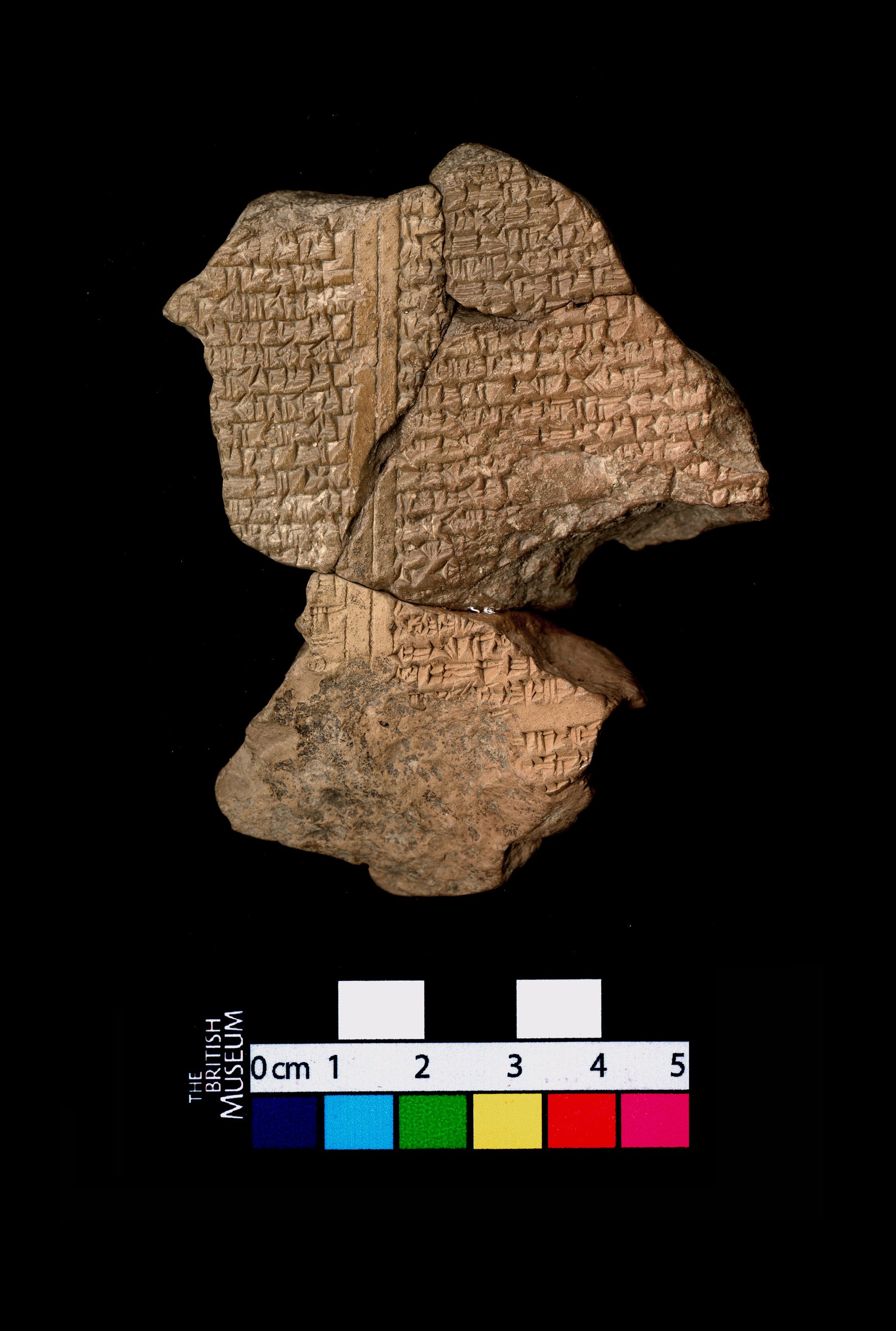
British Museum K.7923: column i, the tablet's own lines 1' to 16'. eBL's corpus edition (https://www.ebl.lmu.de/corpus/L/1/10/SB/III) attributes SB III 6-21 to this manuscript at these column and line numbers. Photograph checked: one face of a fragment of several joined pieces (eBL: K.7923+K.11565+K.14211+Sm.454), two columns with a double ruling between them, about 15 and 25 lines; no ink number visible. Consistent with eBL's columns i (16) and ii (26). On this tablet of line 6 only illegible traces (x) survive, of lines 15-16, 19-21 only one to three signs survive and lines 7-14, 17-18 are partly broken (square brackets and x in the Akkadian). The English of these lines translates eBL's composite text, so it includes words that are not preserved on this tablet but are restored from other manuscripts or by the editors. Square brackets in the English mark eBL's restorations in its composite text; words that survive on other tablets carry no brackets even where this tablet is broken.
6[x x x x x x x x x x (x x)] x
7[x x x x x x x ṣu-lu]l hur-ba-šu
8[x x x x x x x ir-ta-mu-k]u ki-lal-la-an
9[x x x x x x x x mit-h]ur me-he-e a-par-šu₂ id-di
10[x x x x x x x (x) ar₂-ka]t₃ šu-ku-di-šu
11[x x x x x x x x x šu-me-l]a u₂-ra-ʾi-im
12[x x x x x x x x x zi]-kir pi-i-šu
13[x x x x x x x x x x x x x] i#-še!(TIR)-ha-aš₂!(PA)-šu
14[x x x x x x bu]-un lib₃-bi-šu
15[x x x x x x x x] šu-ku-da
16[x x x x x x x x š]il-ta-hu
17[x x x x x x x x x x] u₂#-dal-lih ir#-hi-iṣ
18[x x x x x x x x x x x x x] u₂#-dal-lih ir#-hi-iṣ
19[x x x x x x x x x ra-p]a-aš₂#-tu₄
20[x x x x x x x x x x x x x x i-na]r-ma
21[x x x x x x x x x x x x x ut-t]ir
6A storm was [spreading out] to all four directions,
7Weapons were struck and struck in deathblows, a frightful combat,
8Both were bathed in the sweat of battle.
9Then Anzu grew tired, in the brunt of the storm he dropped his wings,
10The lord took his darts toward the back,
11He cut off his pinions, scattered them right and left.
12Once Anzu saw his feathers, that took away his (magic) words.
13When he cried “Feather to wing!” the shaft whistled toward him,
14The arrow passed through his bosom,
15He made his dart pass through pinion and wing,
16The arrow passed through his heart and lungs.
17He slew the mountains, brought mayhem upon and overran their inmost reaches,
18Ninurta slew the mountains, brought mayhem upon and overran their inmost reaches,
19His fury overran the wide earth,
20He overran the inmost reaches of the mountains, he killed wicked Anzu!
21The warrior Ninurta took back the tablet of the gods’ destinies in his hand,
Where on the image
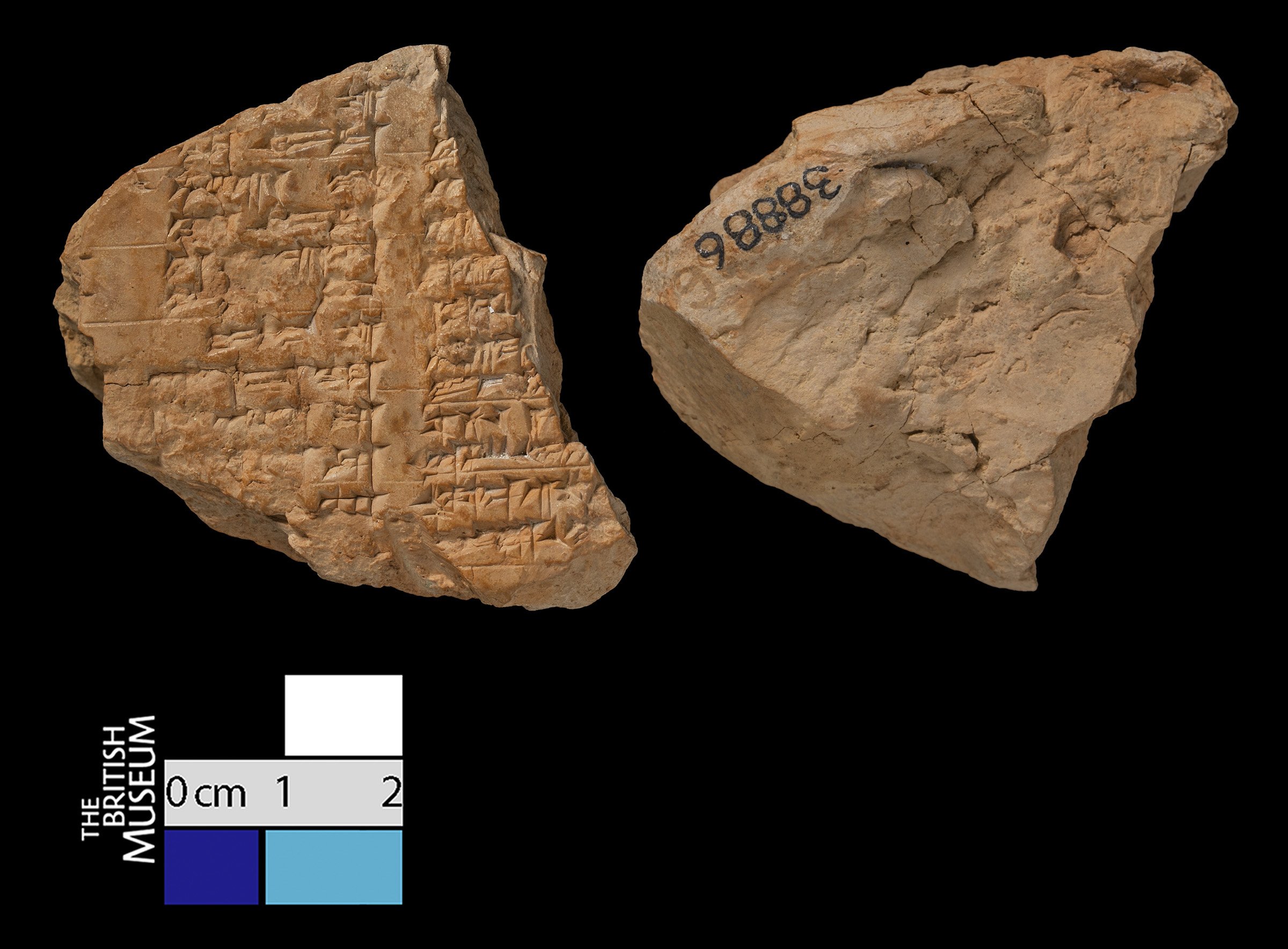
British Museum BM.38886: column i, the tablet's own lines 1' to 11'. eBL's corpus edition (https://www.ebl.lmu.de/corpus/L/1/10/SB/III) attributes SB III 41-51 to this manuscript at these column and line numbers. Photograph checked: obverse with two columns of about 10 and 11 lines, blank reverse with ink 38886, fragment about 3 cm across. Consistent with eBL's columns i (11) and ii' (12). On this tablet of lines 41-44, 47, 50-51 only one to three signs survive and lines 45-46, 48-49 are partly broken (square brackets and x in the Akkadian). The English of these lines translates eBL's composite text, so it includes words that are not preserved on this tablet but are restored from other manuscripts or by the editors. Square brackets in the English mark eBL's restorations in its composite text; words that survive on other tablets carry no brackets even where this tablet is broken. eBL gives no English for line(s) 51.
41[x x x x x (x) x x (x x) i]-zak#-kar
42[x x x x x] ka#-mi-tiš₂
43[x x x x x x x] mah-ri-ia#
44[x x x x x] ka-mi-tiš₂
45[x x x x x x x an]a ma-har# {d}+en!-lil₂
46[x x x x x DU₃-m]a i-qab#-bi
47[x x x x x (x x)] i-zak-kar
48[x x x x x x x] lu#-uš#-tap-par-ka
49[x x x x x x x (x x)] a#-na# {d}nin-urta
50[... (x x)] {d#}nin#-urta#
51[... x x]-iš#
41Saying to Nusku his courier these words,
42“Nusku, go outside,
43“Bring Birdu before me!”
44Nusku went outside,
45He brought Birdu into Enlil’s presence.
46Enlil made ready to speak,
47Saying to Birdu these words,
48“Birdu, I am sending you …
49“[…] to Ninurta,
50[…] Ninurta.
51(no English for this line in the eBL edition)
Where on the image
British Museum K.7923: column ii, the tablet's own lines 1' to 26'. eBL's corpus edition (https://www.ebl.lmu.de/corpus/L/1/10/SB/III) attributes SB III a+52-a+77 to this manuscript at these column and line numbers. Photograph checked: one face of a fragment of several joined pieces (eBL: K.7923+K.11565+K.14211+Sm.454), two columns with a double ruling between them, about 15 and 25 lines; no ink number visible. Consistent with eBL's columns i (16) and ii (26). On this tablet of lines a+52, a+74, a+77 only illegible traces (x) survive, of lines a+67-a+69, a+76 only one to three signs survive and lines a+53-a+66, a+70-a+73, a+75 are partly broken (square brackets and x in the Akkadian). The English of these lines translates eBL's composite text, so it includes words that are not preserved on this tablet but are restored from other manuscripts or by the editors. Square brackets in the English mark eBL's restorations in its composite text; words that survive on other tablets carry no brackets even where this tablet is broken. eBL gives no English for line(s) a+52.
a+52[x x] x x [...]
a+53{d#}MAŠ pa-a-šu# [x x x x x]
a+54a-na {d}bir-du a#-[ma-tu₂ x (x) x]
a+55{d}bir-du a-na DINGIR [x x x x x (x x)]
a+56mi-na-a šam-riš tal-l[i-ka x x x]
a+57{d}bir#-du pa-a-šu i-[pu-uš-ma x x x]
a+58a-na {d#}MAŠ# be#-li₂#-šu# a#-[ma-tu₂ x (x) x]
a+59be-li₂ a-na ka-a-ša₂ n[i-x x (x x)]
a+60{d#}+en#-lil₂ AD-ka iš-pu-ra-an-n[i x x (x x)]
a+61um-ma-a iš-mu-u₂ DINGI[R-MEŠ (x x)]
a+62[k]i-i ina qe₂-reb hur-sa-a-ni lem-na an-z[a-a x x x]
a+63[i]h-du-u₂# i-ri-šu u₃ i#-[li-iṣ x x x x]
a+64ina mah-ri-k[a u₂-š]a-li#-ku-ni u₃# [x x x]
a+65a-lik-šum-ma [x x x x] x iš*#-x [x]
a+66li-ih-du# x [x x x (x)] x li#-[x (x)]
a+67li-iz-zi[z?-zu? x x x x x x (x x)]
a+68liš-m[e₂-e-ma x x x x x x (x x)]
a+69{d?#}+en?#-[lil₂ x x x x x x x (x x)]
a+70{d}nin-urta# KA#-[šu DU₃-ma x x x x]
a+71mi-na-a i[p-x x x x x x (x x)]
a+72ki-i ša₂ ma-x-[x x x x x (x x)]
a+73DUB# NAM-MEŠ la u₂-x [x x x x x (x x)]
a+74[x x x] x [x x x x x (x x)]
a+75[x x x x] la a-šak-k[an x x x x x (x x)]
a+76[x x x x] x pa-ni-i[a x x x x x (x x)]
a+77[x x x x] x x [x x x x x x (x x)]
a+52(no English for this line in the eBL edition)
a+53Ninurta [made] ready to speak,
a+54[Saying] to Birdu [these words],
a+55“O Birdu, to the gods […],
a+56“Why did you come here at such a furious pace […]?”
a+57Birdu m[ade ready] to speak,
a+58[Saying] to Ninurta his lord these words,
a+59“My lord, […] to you,
a+60“Your father Enlil sent me […],
a+61“Saying, ‘The gods heard […]
a+62‘That [you killed] wicked Anzu in the innermost recesses of the mountains.’
a+63“They were joyful and glad [and their feelings were blissful],
a+64“They sent me to your presence and […],
a+65“‘Go to him and […] …
a+66“‘Let him rejoi[ce, let him dance, let him celebrate],
a+67“‘Let him stand with the gods his brethren, let him hear secret knowledge],
a+68“‘[Let him hear] the secret knowledge of the gods,
a+69“‘[Let] En[lil go with the gods his brethren and give him divine authority with the gods.’]”
a+70Ninurta [made ready to speak, saying to Birdu],
a+71“Why [surrender] the trap[pings of kingship]?
a+72“[My command has become] like that of the ki[ng of the gods].
a+73“I will not re[tum] the tablet of destinies.”
a+74[…]
a+75“[…] I will not put […]
a+76“[…] my face […]
a+77[…]
Where on the image
British Museum BM.38886: the inscribed face, the tablet's own lines 1' to 12'. eBL's corpus edition (https://www.ebl.lmu.de/corpus/L/1/10/SB/III) attributes SB III 91-102 to this manuscript at these column and line numbers. Photograph checked: obverse with two columns of about 10 and 11 lines, blank reverse with ink 38886, fragment about 3 cm across. Consistent with eBL's columns i (11) and ii' (12). On this tablet of lines 91-96, 98 only one to three signs survive and lines 97, 99-102 are partly broken (square brackets and x in the Akkadian). The English of these lines translates eBL's composite text, so it includes words that are not preserved on this tablet but are restored from other manuscripts or by the editors. Square brackets in the English mark eBL's restorations in its composite text; words that survive on other tablets carry no brackets even where this tablet is broken.
91ana?#-[ku? ...]
92tu[p?-pi? ...]
93a[n ...]
94an-za#-[a ...]
95lu#-kiš-m[a? ...]
96ana-ku?# giš x [...]
97an-za-a-ma# [...]
98i-ṭab x [...]
99ut-tar-šu₂ a-[...]
100(gloss: 10) DINGIR-MEŠ mi-x-[...]
101li-iz-zi-z[u? ...]
102[m]i?-i#-lu# u z[u?-un?-nu? ...]
91“I? [...]
92“the t[ablet of destinies(?) ...]
93“... [...]
94“Anzû [...]
95“let me remove [...]
96“I, ... [...],
97“Anzû [...].”
98Pleasant(?) is(?) [...].
99He enlarges him ... [...],
100The gods ... [...]
101“May [they] stand [...],
102High water and r[ain(?) ...]”
Where on the image
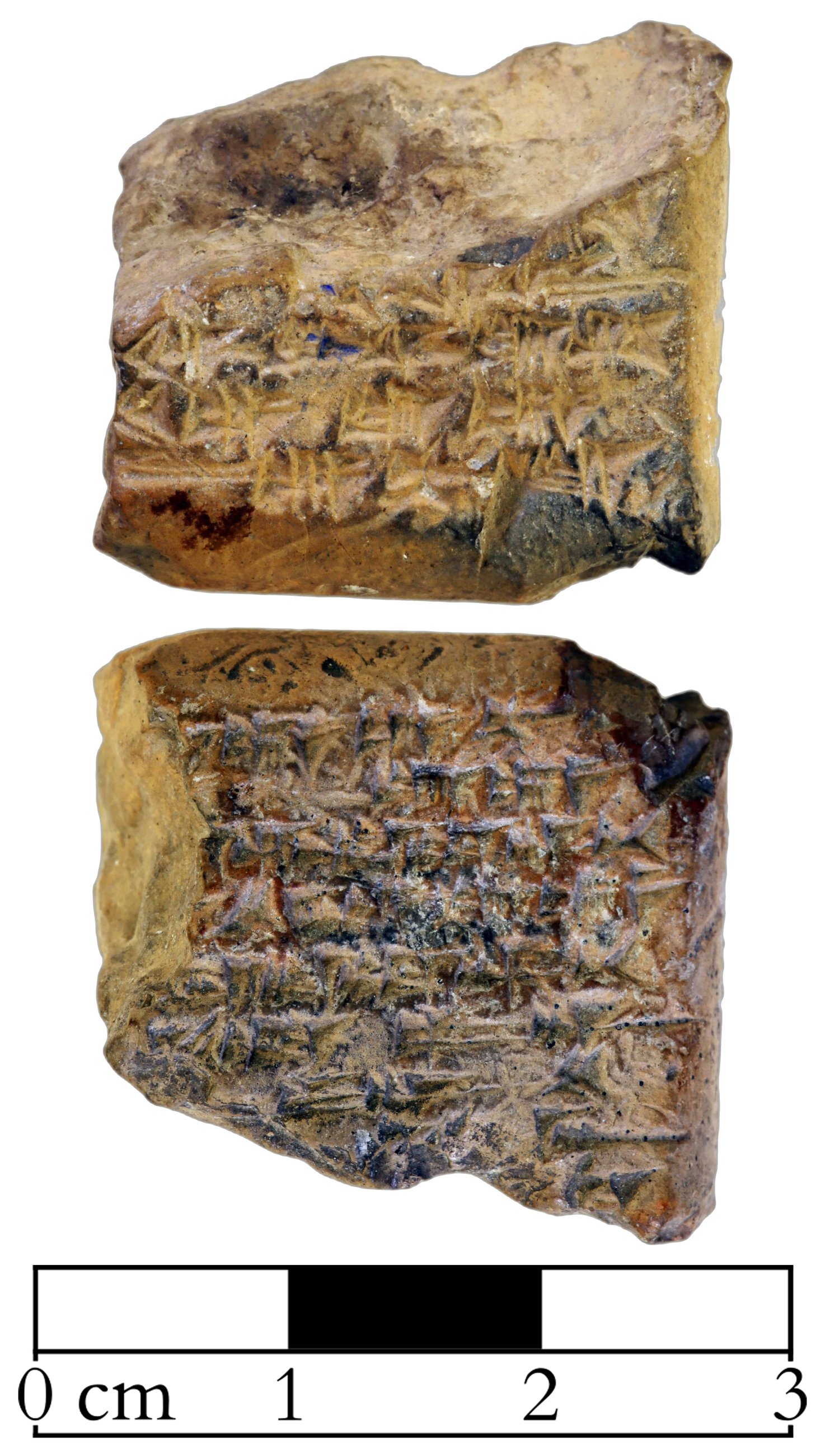
Hatay Archaeology Museum Ant.11000: obverse, the tablet's own lines 1' to 5'. eBL's corpus edition (https://www.ebl.lmu.de/corpus/L/1/10/SB/III) attributes SB III b+104-b+108 to this manuscript at these column and line numbers. Photograph checked (eBL photograph of the Hatay Archaeology Museum): both faces of a small fragment about 2.5 cm wide, no ink number visible; one face has its upper surface lost and about five lines below, the other about nine lines, the right edge kept on both. Consistent with eBL's obverse 1'-5' and reverse 1-9, all line-ends. On this tablet of lines b+104-b+105 only one to three signs survive and lines b+106-b+108 are partly broken (square brackets and x in the Akkadian). The English of these lines translates eBL's composite text, so it includes words that are not preserved on this tablet but are restored from other manuscripts or by the editors. Square brackets in the English mark eBL's restorations in its composite text; words that survive on other tablets carry no brackets even where this tablet is broken.
b+104[x x x x x x x x x x x E₂.K]UR
b+105[(x) x x x x x x x x] qar#-ra#-di
b+106[x x x x x x x x] IM.DUGUD lim-ta-ṭal
b+107[x x x x x x x x] KUR-e ta-ner
b+108[x x x x x ta-na]r dan-nu-su
b+104“[…] Anzu in Ekur.
b+105“[…] the warrior’s sign about him,
b+106“Let him look upon wicked Anzu [in] the greatness of his strength,
b+107“O warrior, you can slay mountains in your strength,
b+108“You defeated Anzu, you could slay his strength,
Where on the image
Hatay Archaeology Museum Ant.11000: reverse, the tablet's own lines 1 to 9. eBL's corpus edition (https://www.ebl.lmu.de/corpus/L/1/10/SB/III) attributes SB III b+109-b+117 to this manuscript at these column and line numbers. Photograph checked (eBL photograph of the Hatay Archaeology Museum): both faces of a small fragment about 2.5 cm wide, no ink number visible; one face has its upper surface lost and about five lines below, the other about nine lines, the right edge kept on both. Consistent with eBL's obverse 1'-5' and reverse 1-9, all line-ends. On this tablet of lines b+109-b+110, b+114-b+117 only one to three signs survive and lines b+111-b+113 are partly broken (square brackets and x in the Akkadian). The English of these lines translates eBL's composite text, so it includes words that are not preserved on this tablet but are restored from other manuscripts or by the editors. Square brackets in the English mark eBL's restorations in its composite text; words that survive on other tablets carry no brackets even where this tablet is broken.
b+109[x x x x x ta-na]r? dan-nu-[su]
b+110[x x x x x x x x] ta-ner
b+111[x x x x x x x x x x GI]R₃!?.MIN <<AŠ>> AD-ka {d}BAD
b+112[x x x x x x x x x] KUR.ME-e ta-nir
b+113[x x x x x x x x x x] GIR₂.MIN AD-ka {d}BAD
b+114[x x x x x x x x] gi-mir GARZA
b+115[x x x x x x x x x x x x] GARZA KUR
b+116[x x x x x x x x x] NAM#.MEŠ
b+117[x x x x x šu-luh-u₂]-ka#
b+109“You could slay the strength of soaring Anzu!
b+110“Because you were valiant and can slay mountains,
b+111“You have made all enemies submit before your father, Enlil,
b+112“O Ninurta, because you were valiant and can slay mountains,
b+113“You have made all enemies submit before your father, Enlil!
b+114“You have gained full lordship, each and every divine authority,
b+115“For whom besides you was divine authority made in the land?
b+116“Greatness has been given you, the dais of the gods of destinies,
b+117“They called your lustrations ‘Nisaba’,
Where on the image
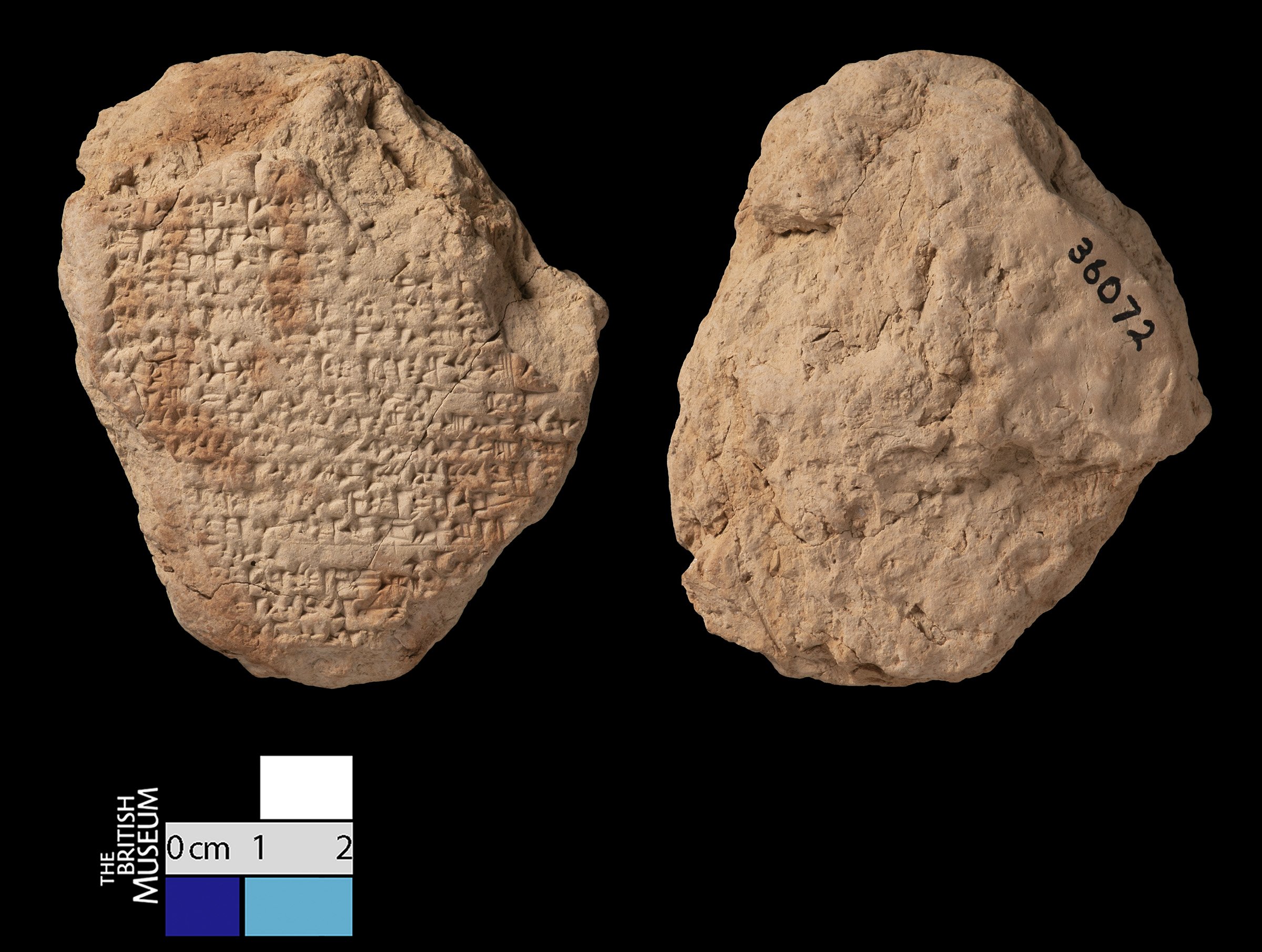
British Museum BM.36072: the inscribed face, the tablet's own lines 1' to 18'. eBL's corpus edition (https://www.ebl.lmu.de/corpus/L/1/10/SB/III) attributes SB III b+132-b+149 to this manuscript at these column and line numbers. Photograph checked: obverse with about 18 lines and a blank reverse with ink 36072. Consistent with eBL's column i' (18). On this tablet of line b+132 only one to three signs survive and lines b+133-b+149 are partly broken (square brackets and x in the Akkadian). The English of these lines translates eBL's composite text, so it includes words that are not preserved on this tablet but are restored from other manuscripts or by the editors. Square brackets in the English mark eBL's restorations in its composite text; words that survive on other tablets carry no brackets even where this tablet is broken.
b+132[x kiš{k]i?}-ma? {d#}[za-ba₄-ba₄ x x x x x x x]
b+133(gloss: 10?) x bad# te na-bat UGU# k[a-la x x x x x x x]
b+134UR.SAG# a-na šu#-tu#-[ur x x x x x x x x x]
b+135MU#-ka a-na PA#.ŠE#{ki#} id?#-[di-nu x x x x]
b+136MU-ka# {d}lugal#-mara₂#-da# SUM#-nu a#-[na x x x x]
b+137MU-ka?# ana e₂#-sikil#-la id#-din qu#-ra#-d[u x x]
b+138{d}sag-kud ina [b]u-be₂-e{ki#} ina e₂-ni[m-ma-an-ku₃]
b+139MU-ka# {d}MES#.SAG#.UNUG#{ki} im-bu-u₂ i[na x x x]
b+140[x {ur]u}u₂-tab URU {d}nin-mah AMA-[ka]
b+141[(x)] x-nu MU-ka EN BULUG#-ki# im-bu-u₂# {d}pa₄-n[i-gar-ra]
b+142[MU-k]a ina KUR im-bu-u₂# {d#}IGI.DU#-u {d}pap-sukkal a#-lik [x x]
b+143[pal-h]u šu#-tu#-ru ina DINGIR-MEŠ MU-MEŠ-ka m[a-ʾ-diš]
b+144[par?-ri-k]a-ta#-ma# le#-ʾ-a-at ra-šub-b[a-ta]
b+145[x x (x)] x-ka {d}nin#-ši-ku₃ {d}e₂-a [x x]
b+146[(x) x x b]a-ʾi-lat qa-ba[l x x x x]
b+147[x x š]u?-tu#-ru#-tu LIMMU pa-re-e# [x x x]
b+148[x x x x-t]u? MU-MEŠ-šu₂-nu i[m-bi-ka]
b+149[x x x (x)-t]i?-me i#-na# p[ur?-ru?-ri]
b+132“[In Kish] they will invoke it as ‘Zababa,’
b+133“... you are called, your valor is above all the gods,
b+134“hero, to make surpassing your divinity, I praised you […].
b+135“For Isin they gave your name ‘Lugalbanda’,
b+136“Your name ‘Lugalmarada’ they gave you for the Egishkalamma,
b+137“In the Esikilla they gave (you) your name ‘Warrior Tishpak’,
b+138“Sagkud in Bube, in the E-nimmanku,
b+139“They called your name ‘[Pis]angunuk’ in Kullab,
b+140“[In] Adab, the city of Belet-ili your mother,
b+141“they called your ... name ‘Lord of the Boundary’, Panigarra,
b+142“They called your name in the land Igišṭû, Papsukkal, the vanguard
b+143“O lord, your names are most surpassingly great and revered among the gods,
b+144“[They are matchl]ess, of awe-inspiring capacity,
b+145“[…] Ea the Leader, your father,
b+146“[Ištar], lady of battle and combat,
b+147“She gave you the four supreme, […] mules,
b+148“He called you […] their names,
b+149“[…] in […]
Notes
- Akkadian: eBL transliteration of the signs on the photographed tablet (manuscript-level ATF), not a composite text.
- English: B. R. Foster's translation in the eBL edition; it renders eBL's composite text, including restorations from other tablets.
- Line numbers: eBL edition. Each section also gives the tablet's own column and line numbers.
- Signs in the Akkadian: [ ] broken away; x illegible sign; # damaged sign; ? uncertain reading; ! sign corrected by the editor; * collated sign; ... broken signs of unknown number; ( ) signs perhaps broken away; { } determinative; << >> sign written in error by the scribe; (gloss: ...) a note written by the scribe in small signs or in the margin.
Cite
Sources
- Source: British Museum and Hatay Archaeology Museum tablet photographs + eBL manuscript transliterations (eBL corpus edition L I.10, Anzu, SB III) + English of the eBL edition (B. R. Foster (eBL edition)) (holding institution)
- Critical edition: electronic Babylonian Library, Anzu, manuscript transliterations
← previous · → next · v cycle view · l back to library