Ashoka's Queen's Edict and Kausambi Edict on the Allahabad-Kosam pillar
Introduction
The Allahabad-Kosam pillar stands in the fort of Allahabad (Prayagraj); it was probably brought there from Kausambi (Kosam), about 30 miles (48 km) upstream on the Yamuna, and also carries the long inscription of the Gupta king Samudragupta and an inscription of the Mughal emperor Jahangir. Below Ashoka's six Pillar Edicts it has two short orders of his. The Queen's Edict tells the Mahāmātras to register the gifts of the second queen, Kāluvākī, mother of Tīvala, in her own name; it is the only edict that names a wife and a son of Ashoka. The Kausambi Edict, addressed to the Mahāmātras of Kausambi, orders that a monk or nun who splits the Buddhist Saṁgha is to be dressed in white (the dress of lay people) and made to live outside the monastery; the same order is found on the Sanchi and Sarnath pillars. Much of the Kausambi Edict is lost, and both edicts are overwritten by later Nagari inscriptions. This entry gives these two edicts; the six Pillar Edicts of this pillar are not yet included.
Sources. Original text and English: E. Hultzsch, Inscriptions of Asoka. New Edition (Corpus Inscriptionum Indicarum, vol. I), Oxford: Clarendon Press for the Government of India, 1925, transcribed from the page images of the archive.org scan (public domain). Images: Hultzsch's collotype plates of inked impressions (estampages) of the Allahabad-Kosam pillar, taken on the stone for the Archaeological Survey of India. An impression is a contact copy pressed on paper from the inscribed surface itself, not a drawing; each section's image is the part of the plate that carries that text, with the plate's own numerals and line numbers in the margins.
Reading the text. Line numbers are Hultzsch's lines on the stone. Letters in square brackets are damaged or uncertain on the stone; dots mark lost letters. The capital letters in brackets, (A), (B) ..., are Hultzsch's sentence divisions and are the same in the transliteration and the English. Hultzsch's footnotes, which record other scholars' readings and his corrections, are not reproduced.
How was this verified? (Provenance)
Where on the image
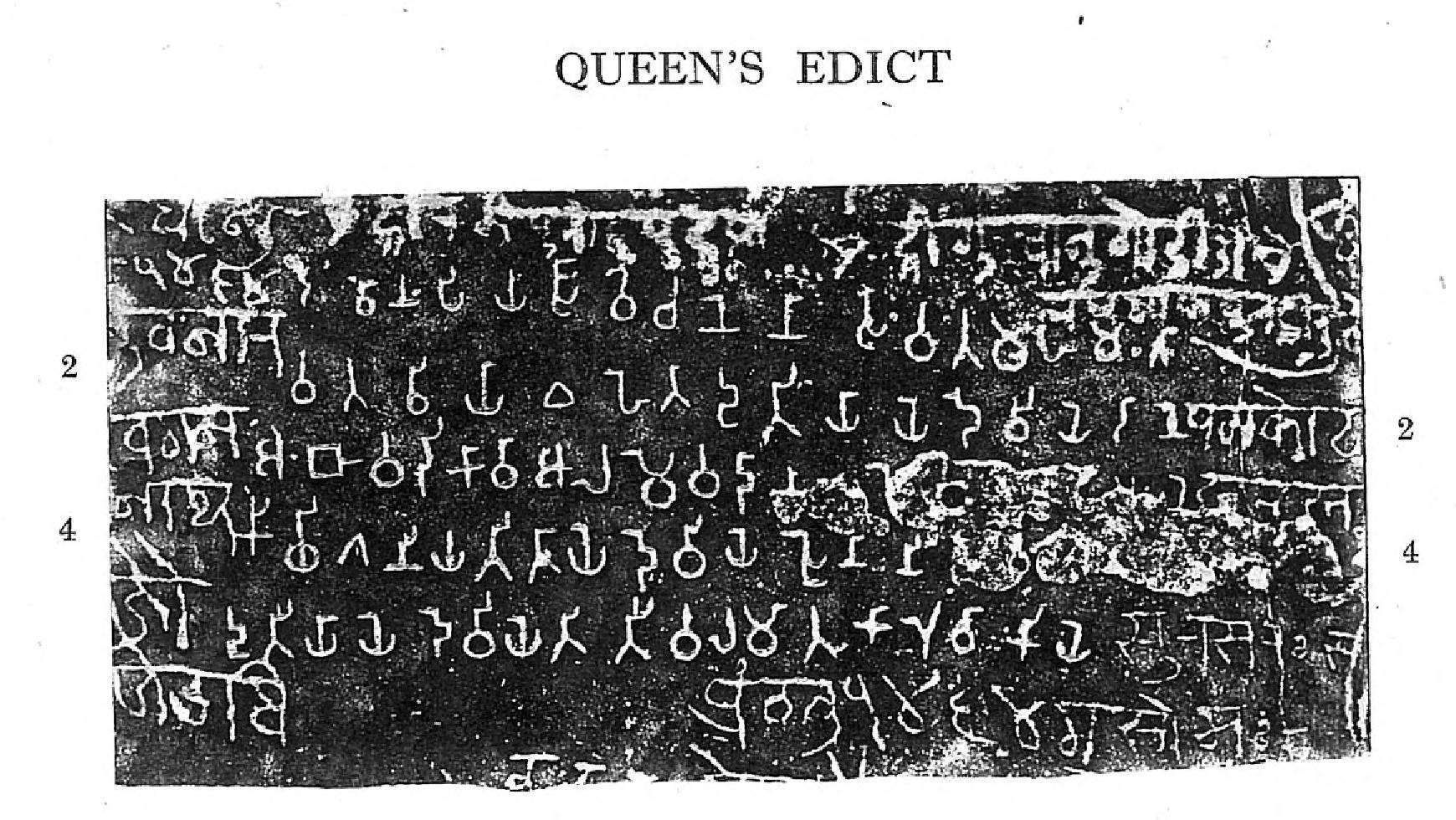
Inked impression (estampage) of the Allahabad-Kosam pillar, not a photograph of the stone: Hultzsch 1925, plate 'Allahabad-Kosam pillar; minor edicts' (page 159; archive.org leaf 331), cropped to the upper figure of the plate (headed Queen's Edict), with Hultzsch's line numbers 2 and 4 in both margins: five lines of Brahmi, the fourth broken off at the right where the impression shows a damaged patch (Hultzsch's dots). The Nagari letters scratched between and around the Brahmi lines are later additions on the pillar, not part of the edict. Checked on the image against the transcription (lines 1-5). Text and English: Hultzsch 1925, pp. 158-159 (archive.org leaves 328, 330).
1(A) Devānaṁpiyashā v[a]chanenā savata mahamatā
2vataviyā (B) e hetā dutiyāye devīye dāne
3aṁbā-vaḍikā vā ālame va dāna-[gah]e [va e vā pi a]ṁne
4kīchhi ganīyati tāye deviye she nāni (C) [he]vaṁ .. [na] ..
5dutīyāye deviye ti Tīvala-mātu Kāluvākiye
(A) At the word of Dēvānāṁpriya, the Mahāmātras everywhere have to be told (this).
(B) What gifts (have been made) here by the second queen, (viz.) either mango-groves, or gardens, or alms-houses, or whatever else, these (shall) be registered (in the name) of that queen.
(C) This (is) [the request] of the second queen, the mother of Tīvala, the Kāluvākī.
Where on the image
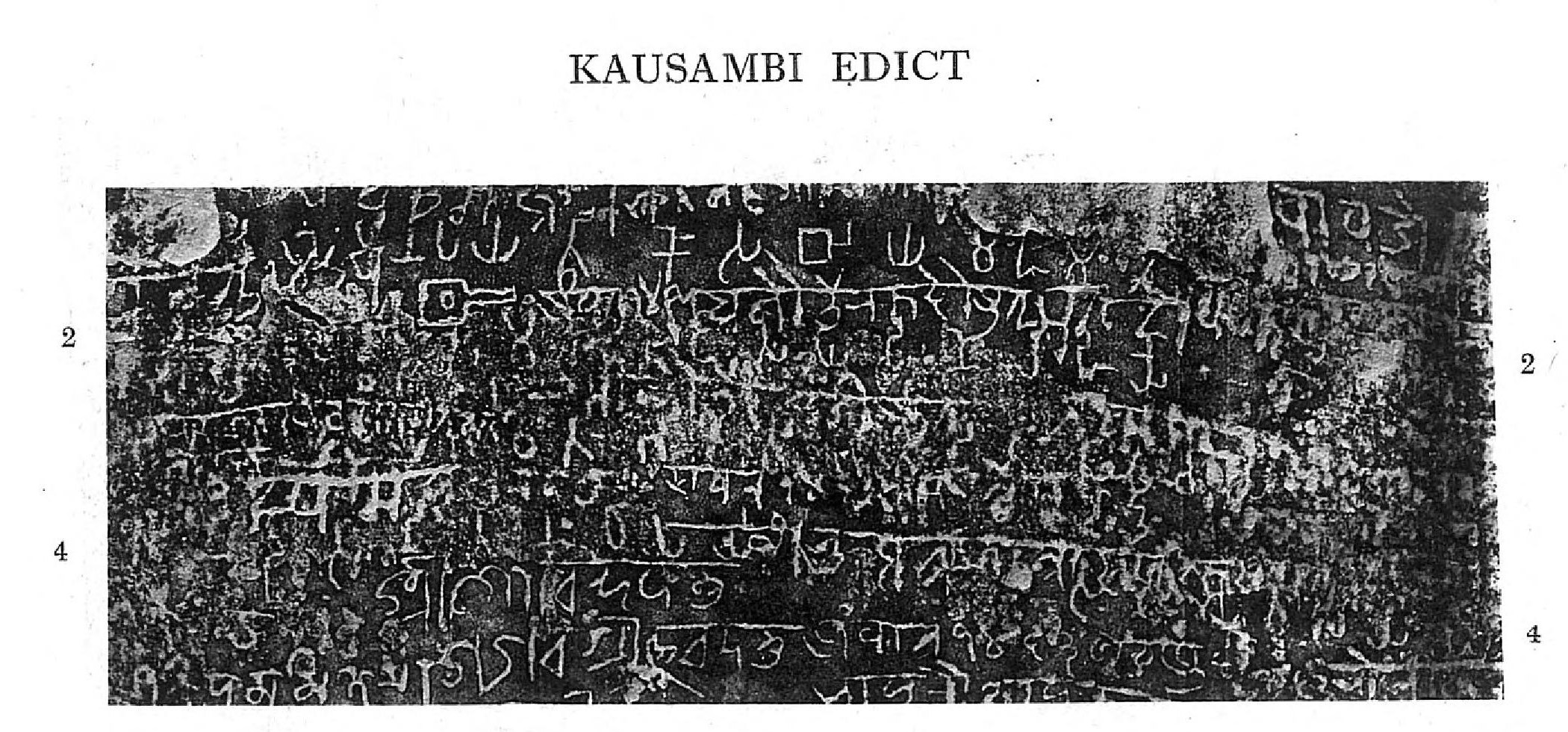
Inked impression (estampage) of the Allahabad-Kosam pillar, not a photograph of the stone: Hultzsch 1925, plate 'Allahabad-Kosam pillar; minor edicts' (page 159; archive.org leaf 331), cropped to the lower figure of the plate (headed Kausambi Edict), with Hultzsch's line numbers 2 and 4 in both margins: four lines of Brahmi, heavily overwritten by later Nagari inscriptions; the Brahmi of line 1 is the clearest, at the top. Hultzsch's text marks the beginnings of lines 2 and 3 as lost. Checked on the image against the transcription (lines 1-4). Text and English: Hultzsch 1925, pp. 159-160 (archive.org leaves 330, 332).
1(A) [Devānaṁ*][p]iye ānapayati (B) Kosaṁbiyaṁ mahām[ā]ta
2.......... [sa]ma[ge ka]ṭ[e] (D) sa[ṁ]gh[a]si no l[a]hiye
3.......... [saṁghaṁ bhā]khati bhikh[u] v[ā] bhikh[u]ni vā [se pi] chā
4[o*]dāt[ā]ni dusāni [sa]naṁdhāpayitu a[nāvā]sas[i ā]v[ā]sayiy[e]
(A) [Dēvānāṁ]priya commands (thus).
(B) The Mahāmātras at Kōsambī ..........
(C) .......... is made united.
(D) .......... should not be received into the Saṁgha.
(E) And also that monk or nun [who] shall break up the Saṁgha, should be caused to put on white robes and to reside in a non-residence.
Notes
- Hultzsch translates dhamma as 'morality'; other translators use 'Dharma' or 'righteousness'.
- Words in round brackets in the English are Hultzsch's additions for sense; words in square brackets render damaged letters.
Cite
Sources
- Source: Allahabad-Kosam pillar, Allahabad Fort, Prayagraj (Uttar Pradesh), probably brought from Kausambi, pillar inscription of Ashoka; Hultzsch's collotype plates of inked impressions (1925); Hultzsch's transliteration and English (CII I, 1925), read from the archive.org scan (holding institution)
- Critical edition: E. Hultzsch, Inscriptions of Asoka (CII I, 1925), transliteration read from the scan
← previous · → next · v cycle view · l back to library