Ashoka's Rummindei (Lumbini) pillar inscription: the birthplace of the Buddha
Introduction
The Rummindei pillar stands at Lumbini in the Nepal Terai, beside the Maya Devi temple. Its inscription, five lines of Brahmi cut high on the polished shaft, records that Ashoka came in person to worship here twenty years after his consecration (c. 249 BCE) 'because the Buddha Śākyamuni was born here', set up a stone and the pillar, and reduced the village's tax. The pillar was uncovered in 1896, and the inscription fixed the site of the Buddha's birth, named Lumbini (Lummini) in Buddhist tradition. The inscription is complete.
The section shows two images: a recent colour photograph of the inscription on the pillar, and Hultzsch's plate of an inked impression.
Sources. Original text and English: E. Hultzsch, Inscriptions of Asoka. New Edition (Corpus Inscriptionum Indicarum, vol. I), Oxford: Clarendon Press for the Government of India, 1925, transcribed from the page images of the archive.org scan (public domain). Images: Hultzsch's collotype plates of inked impressions (estampages) of the Rummindei (Lumbini) pillar, taken on the stone for the Archaeological Survey of India. An impression is a contact copy pressed on paper from the inscribed surface itself, not a drawing; each section's image is the part of the plate that carries that text, with the plate's own numerals and line numbers in the margins.
Reading the text. Line numbers are Hultzsch's lines on the stone. Letters in square brackets are damaged or uncertain on the stone; dots mark lost letters. The capital letters in brackets, (A), (B) ..., are Hultzsch's sentence divisions and are the same in the transliteration and the English. Hultzsch's footnotes, which record other scholars' readings and his corrections, are not reproduced.
How was this verified? (Provenance)
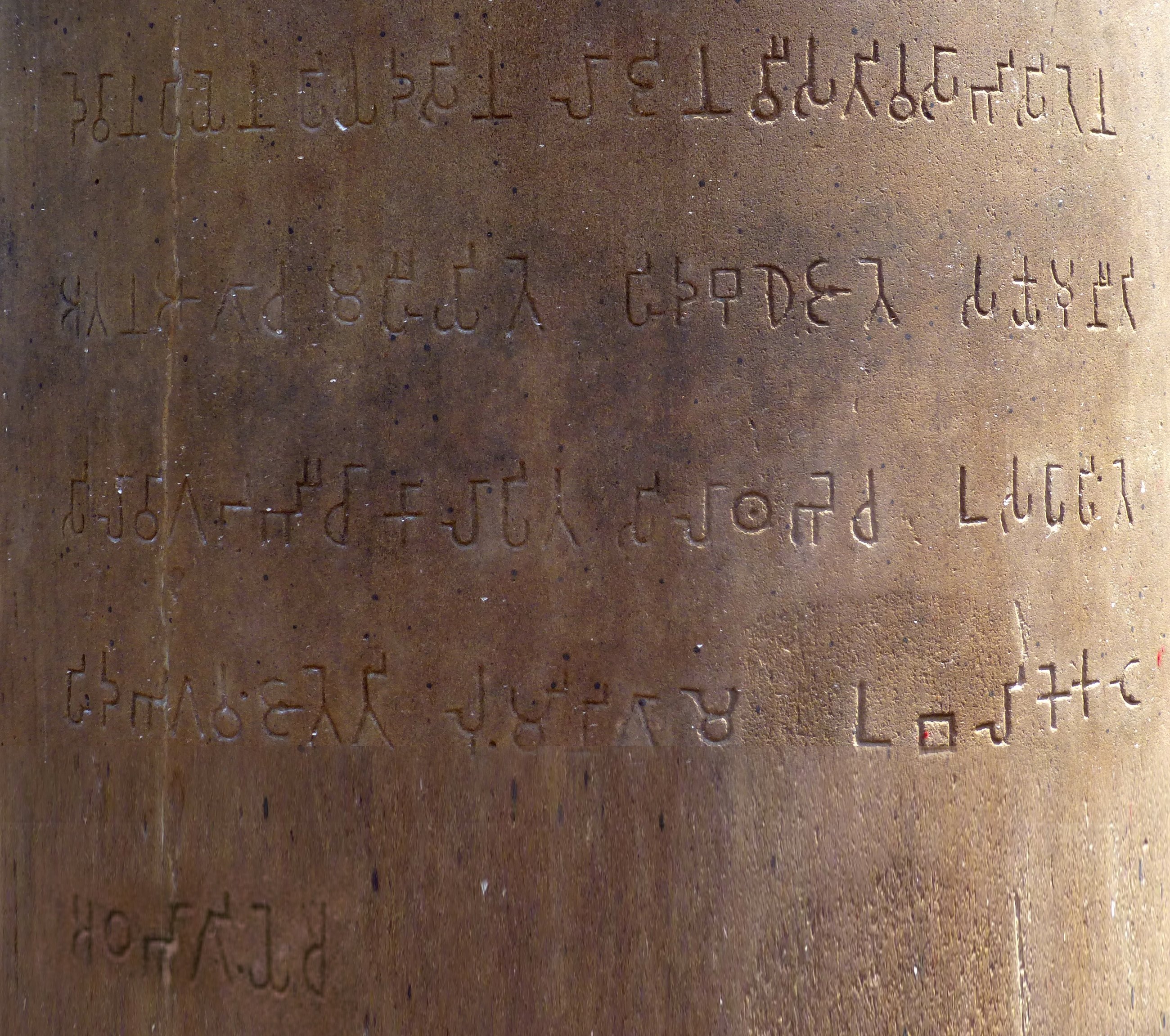
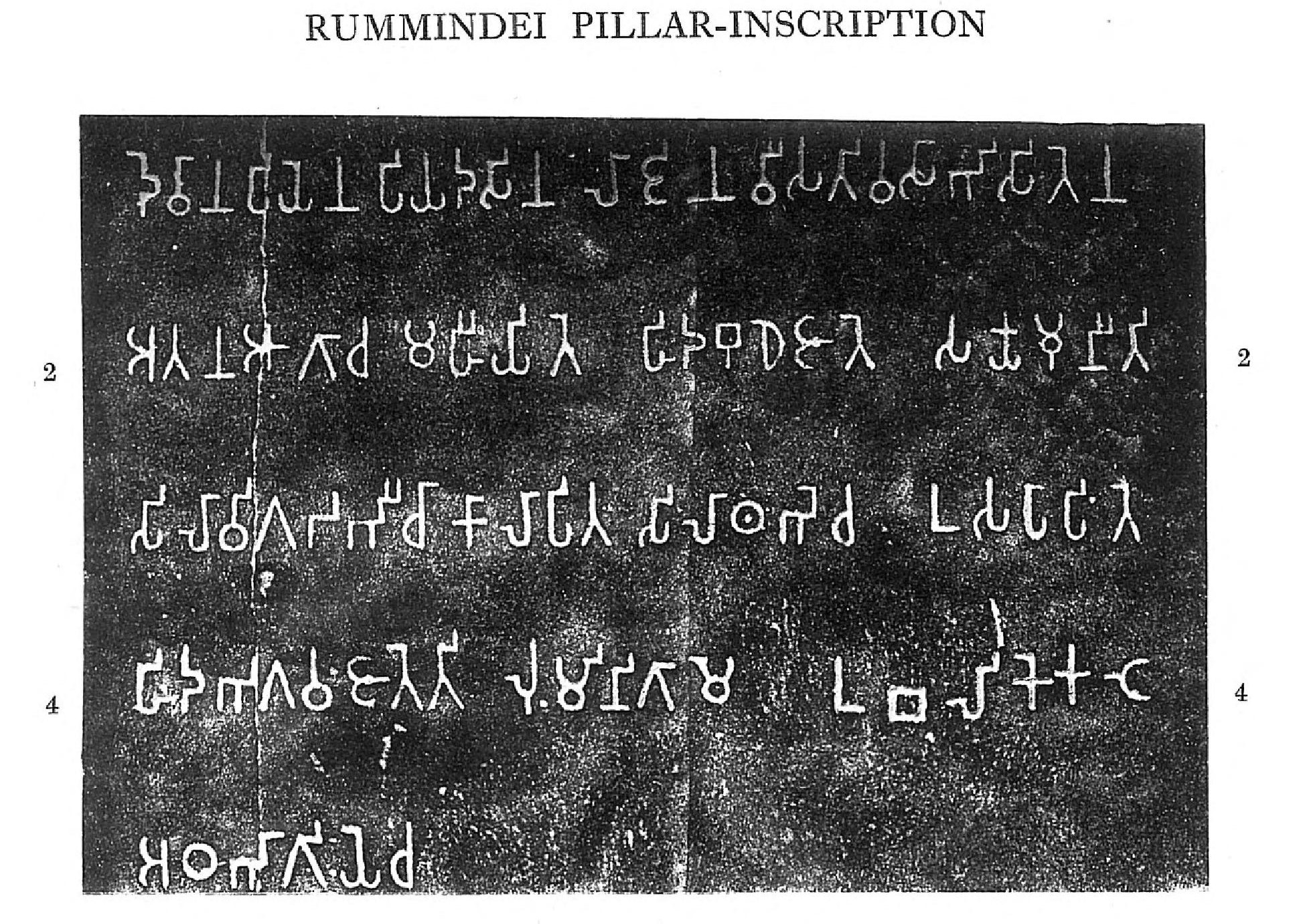
Where on the image
Photograph of the stone: Wikimedia Commons, 'Lumbini inscription (complete)', photographs by Photo Dharma (Anandajoti Bhikkhu, Penang) and Charlie Phillips, joined into one image, cropped to the five lines of the inscription. Checked on the photograph: line 1 begins with de-vā-na-pi-ye-na and ends with -bhi-si-te-na; line 2 ends sa-kya-mu-nī ti; line 4 ends u-ba-li-ke ka-ṭe; the short line 5 (a-ṭha-bhā-gi-ye cha) stands alone at the foot. The image joins two photographs: the seam runs above line 5. Inked impression (estampage) of the Rummindei (Lumbini) pillar, not a photograph of the stone: Hultzsch 1925, plate 'Rummindei pillar-inscription / Nigali Sagar pillar-inscription' (facing p. 164; archive.org leaf 339), cropped to the upper figure of the plate (headed Rummindei pillar-inscription), with the line numbers 2 and 4 in both margins: 5 lines, the last one short. Checked on the image against the transcription (lines 1-5). Text and English: Hultzsch 1925, pp. 164-165 (archive.org leaves 338, 340).
1(A) Devāna[pi]yena Piyadasina lājina vīsati-vasābhisitena
2atana āgācha mahīyite hida Budhe jāte Sakyamunī ti
3(B) silā vigaḍabhī chā kālāpita silā-thabhe cha usapāpite
4hida Bhagavaṁ jāte ti (C) Lummini-gāme ubalike kaṭe
5aṭha-bhāgiye cha
(A) When king Dēvānāṁpriya Priyadarśin had been anointed twenty years, he came himself and worshipped (this spot), because the Buddha Śākyamuni was born here.
(B) (He) both caused to be made a stone bearing a horse (?) and caused a stone pillar to be set up, (in order to show) that the Blessed one was born here.
(C) (He) made the village of Lummini free of taxes, and paying (only) an eighth share (of the produce).
Notes
- Hultzsch translates dhamma as 'morality'; other translators use 'Dharma' or 'righteousness'.
- Words in round brackets in the English are Hultzsch's additions for sense; words in square brackets render damaged letters.
Cite
Sources
- Source: Rummindei (Lumbini), Nepal, pillar inscription of Ashoka; Hultzsch's collotype plates of inked impressions (1925); photograph of the stone (Wikimedia Commons); Hultzsch's transliteration and English (CII I, 1925), read from the archive.org scan (holding institution)
- Critical edition: E. Hultzsch, Inscriptions of Asoka (CII I, 1925), transliteration read from the scan
← previous · → next · v cycle view · l back to library