Ashoka's Calcutta-Bairat (Bhabru) inscription: the edict that names Buddhist texts
Introduction
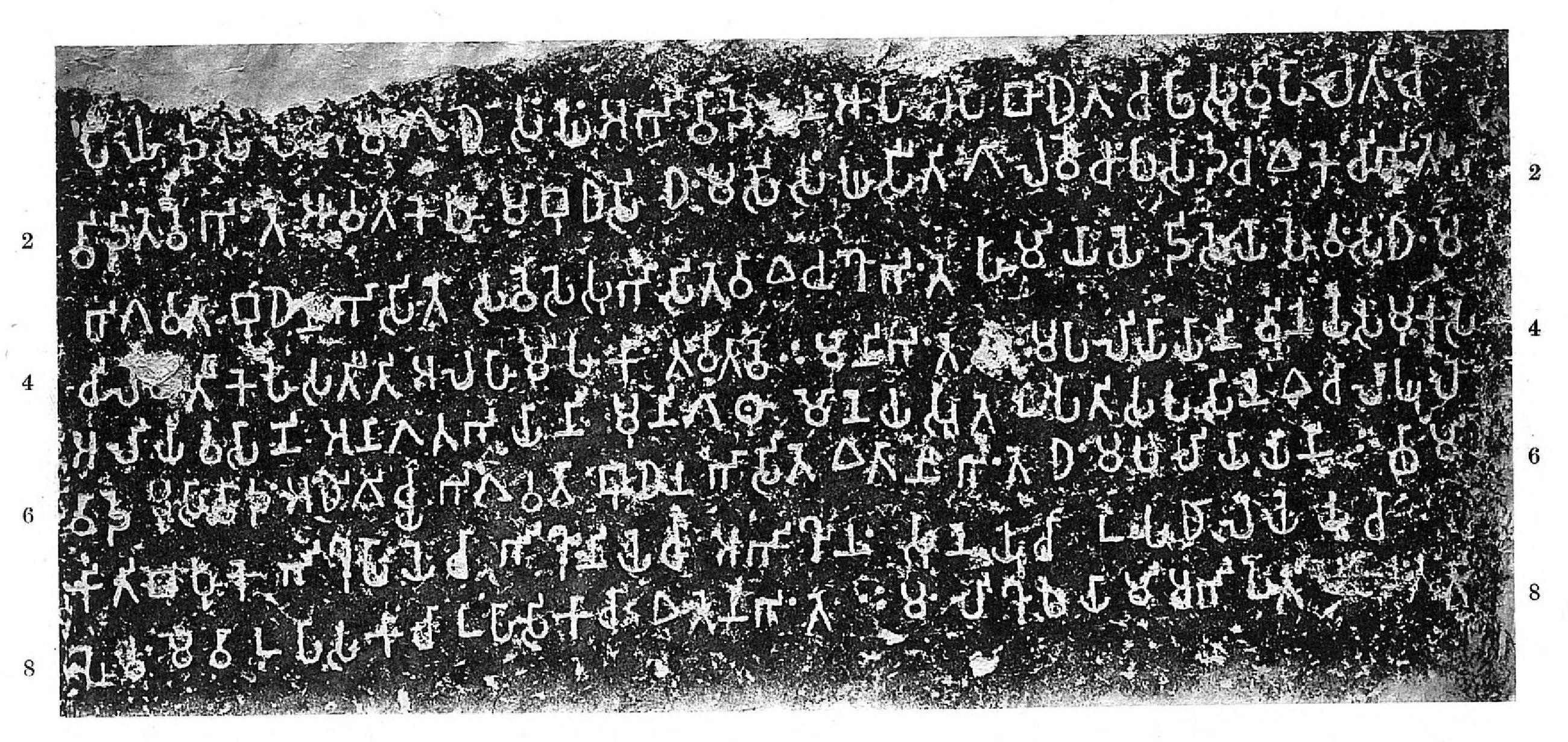
The Calcutta-Bairat inscription (also called the Bhabru edict) is on a granite block found in 1840 by Captain Burt on a hill near Bairat in Rajasthan and taken to the Asiatic Society of Bengal in Calcutta. It is a letter from 'the Magadha king Priyadarśin' to the Buddhist Saṁgha: he declares his reverence for the Buddha, the Dharma and the Saṁgha, and names seven passages of scripture that he wishes monks, nuns and lay followers to hear and reflect on. It is the only Ashokan edict that names Buddhist texts, and the earliest list of Buddhist scripture. Several of the seven have been identified with suttas of the Pali canon (for example the Lāghulovāda with the Ambalaṭṭhika-Rāhulovāda Sutta, which speaks of lying). The eight lines are complete except for a few damaged letters.
Sources. Original text and English: E. Hultzsch, Inscriptions of Asoka. New Edition (Corpus Inscriptionum Indicarum, vol. I), Oxford: Clarendon Press for the Government of India, 1925, transcribed from the page images of the archive.org scan (public domain). Images: Hultzsch's collotype plates of inked impressions (estampages) of the Calcutta-Bairat boulder, taken on the stone for the Archaeological Survey of India. An impression is a contact copy pressed on paper from the inscribed surface itself, not a drawing; each section's image is the part of the plate that carries that text, with the plate's own numerals and line numbers in the margins.
Reading the text. Line numbers are Hultzsch's lines on the stone. Letters in square brackets are damaged or uncertain on the stone; dots mark lost letters. The capital letters in brackets, (A), (B) ..., are Hultzsch's sentence divisions and are the same in the transliteration and the English. Hultzsch's footnotes, which record other scholars' readings and his corrections, are not reproduced.
How was this verified? (Provenance)
Where on the image
Inked impression (estampage) of the Calcutta-Bairat boulder, not a photograph of the stone: Hultzsch 1925, plate 'Calcutta-Bairat rock-inscription' (facing p. 173; archive.org leaf 351), cropped to the whole impression; Hultzsch prints it sideways, and the crop is turned a quarter turn clockwise so that the lines run across the image, line 1 at the top, with his line numbers 2, 4, 6, 8 now in the left and right margins: 8 lines. Checked on the image against the transcription (lines 1-8). Text and English: Hultzsch 1925, pp. 172-174 (archive.org leaves 349, 352-353).
1(A) Pr[i]yadas[i] l[ā]jā Māgadhe saṁghaṁ abhivāde[tū]naṁ āhā ap[ā]bādhataṁ cha phāsu-vihālataṁ chā
2(B) vidite v[e] bhaṁte āvatake h[a]mā Budhasi dhaṁmasi saṁghasī ti gālave chaṁ prasāde cha (C) e kechi bhaṁte
3bhagavatā Budhe[na] bhāsite sarve se subhāsite vā (D) e chu kho bhaṁte hamiyāye diseyā hevaṁ sadhaṁme
4chil[a-ṭhi]tīke hosatī ti alahāmi hakaṁ ta[ṁ] v[ā]tave (E) imāni bhaṁt[e dha]ṁma-paliyāyāni Vinaya-samukase
5Aliya-vasāṇi Anāgata-bhayāni Muni-gāthā Moneya-sūte Upatisa-pasine e chā Lāghulo-
6vāde musā-vādaṁ adhigichya bhagavatā Budhena bhāsite etāni bhaṁte dhaṁma-paliyāyāni ichhāmi
7kiṁti bahuke bhikhu-[p]āye chā bhikhuniye ch[ā] abhikhinaṁ sun[e]yu chā upadhāl[a]yeyū chā
8(F) hevaṁmevā upāsakā chā upāsikā chā (G) eteni bhaṁte imaṁ likhā[pa]yāmi abhipretaṁ me jānaṁtū ti
(A) The Māgadha king Priyadarśin, having saluted the Saṁgha, hopes they are both well and comfortable.
(B) It is known to you, Sirs, how great is my reverence and faith in the Buddha, the Dharma, (and) the Saṁgha.
(C) Whatsoever, Sirs, has been spoken by the blessed Buddha, all that is quite well spoken.
(D) But, Sirs, what would indeed appear to me (to be referred to by the words of the scripture): ‘thus the true Dharma will be of long duration’, that I feel bound to declare.
(E) The following expositions of the Dharma, Sirs, (viz.) (1) the Vinaya-samukasa, (2) the Aliya-vasas, (3) the Anāgata-bhayas, (4) the Muni-gāthās, (5) the Moneya-sūta, (6) the Upatisa-pasina, and (7) the Lāghulovāda which was spoken by the blessed Buddha concerning falsehood,—I desire, Sirs, that many groups of monks and (many) nuns may repeatedly listen to these expositions of the Dharma, and may reflect (on them).
(F) In the same way both laymen and laywomen (should act).
(G) For the following (purpose), Sirs, am I causing this to be written, (viz.) in order that they may know my intention.
Notes
- Hultzsch translates dhamma as 'morality'; other translators use 'Dharma' or 'righteousness'.
- Words in round brackets in the English are Hultzsch's additions for sense; words in square brackets render damaged letters.
Cite
Sources
- Source: Calcutta-Bairat boulder, Asiatic Society, Kolkata (found near Bairat, Rajasthan), boulder inscription of Ashoka; Hultzsch's collotype plates of inked impressions (1925); Hultzsch's transliteration and English (CII I, 1925), read from the archive.org scan (holding institution)
- Critical edition: E. Hultzsch, Inscriptions of Asoka (CII I, 1925), transliteration read from the scan
← previous · → next · v cycle view · l back to library