Ashoka's Rupnath minor rock edict: a lay follower's zeal
Introduction
The Rupnath rock lies near a shrine of Siva (the Rupnath linga) at the foot of the Kaimur hills, about 35 miles (56 km) north of Jabalpur in Madhya Pradesh. It carries the Rupnath version of Ashoka's first Minor Rock Edict, an early text known from more than a dozen sites (Sahasram, Bairat, Maski, Brahmagiri and others). In it the king says that for more than two and a half years he has been a lay follower of the Buddha (here 'a Sakya') without much zeal, but for more than a year, since he went to the Samgha, he has been very zealous; that gods and men have been brought together in India; that even a humble man who exerts himself can reach heaven; and that the proclamation is to be engraved on rocks and stone pillars. The closing words give the figure 256, which Hultzsch takes as the number of nights the king had spent on tour.
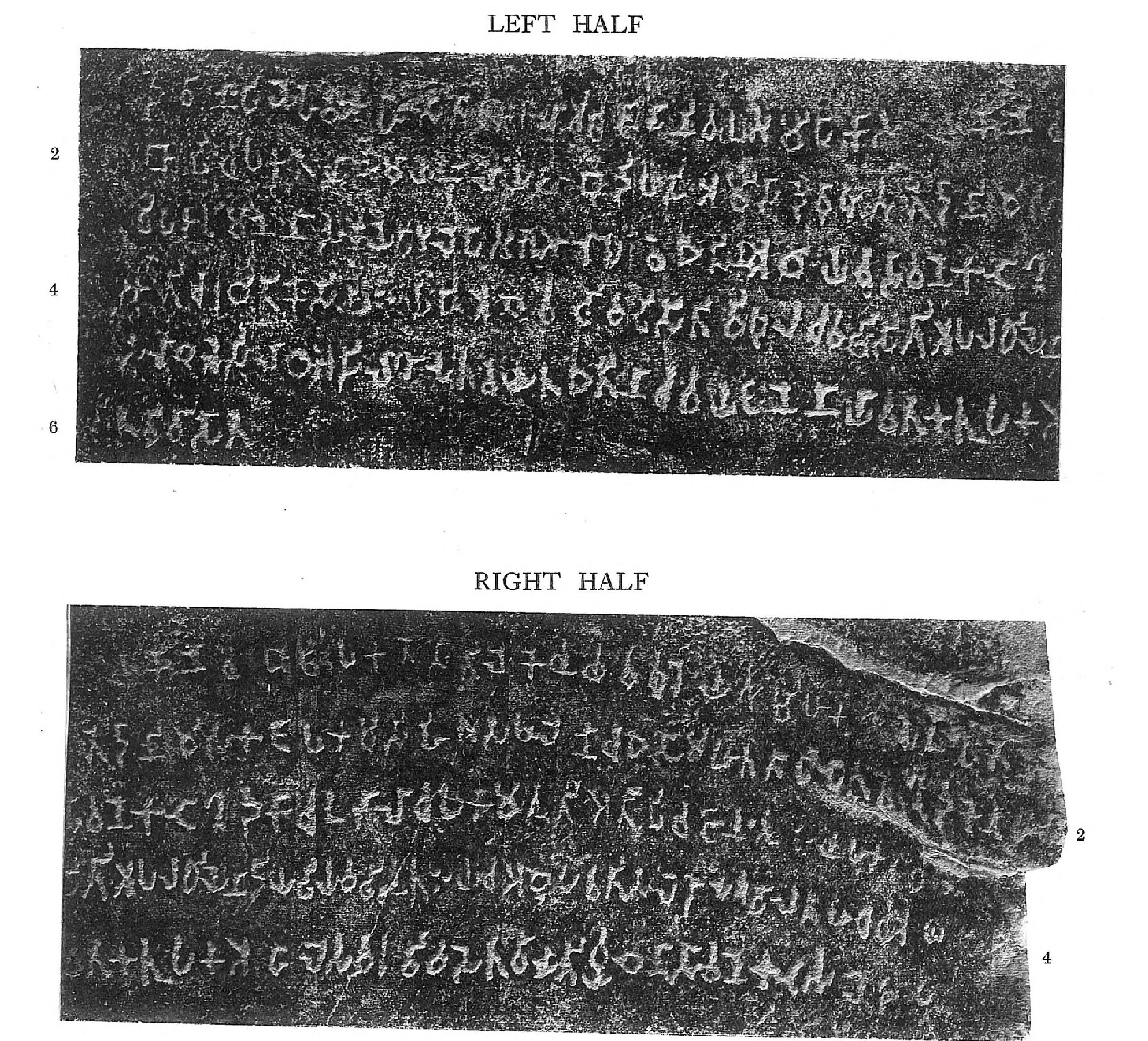
The six lines are long and the impression is printed in two halves, one above the other. Hultzsch reads all six lines; a few letters are damaged.
Sources. Original text and English: E. Hultzsch, Inscriptions of Asoka. New Edition (Corpus Inscriptionum Indicarum, vol. I), Oxford: Clarendon Press for the Government of India, 1925, transcribed from the page images of the archive.org scan (public domain). Images: Hultzsch's collotype plates of inked impressions (estampages) of the Rupnath rock, taken on the stone for the Archaeological Survey of India. An impression is a contact copy pressed on paper from the inscribed surface itself, not a drawing; each section's image is the part of the plate that carries that text, with the plate's own numerals and line numbers in the margins.
Reading the text. Line numbers are Hultzsch's lines on the stone. Letters in square brackets are damaged or uncertain on the stone; dots mark lost letters. The capital letters in brackets, (A), (B) ..., are Hultzsch's sentence divisions and are the same in the transliteration and the English. Hultzsch's footnotes, which record other scholars' readings and his corrections, are not reproduced.
How was this verified? (Provenance)
Where on the image
Inked impression (estampage) of the Rupnath rock, not a photograph of the stone: Hultzsch 1925, plate 'Rupnath rock-inscription' (facing p. 166; archive.org leaf 342), cropped to the whole plate, which holds the entire inscription in two parts: the left half of the impression (above; six rows of letters, Hultzsch's line numbers 2, 4, 6 in its left margin beside rows 2, 4 and 6) and the right half (below; five rows of letters, the line numbers 2 and 4 in its right margin beside its third and fifth rows, the rock broken away at the upper right). Checked on the image against the transcription (lines 1-6). Text and English: Hultzsch 1925, pp. 166-169 (archive.org leaves 341, 343-345).
1(A) Devānaṁpiye heva[ṁ] āhā (B) sāti[ra]kekāni aḍhati[y]āni va ya sumi prakāsa [Sa]k[e] (C) no chu bāḍhi pakate (D) sātileke chu chhavachhare ya sumi haka[ṁ] sagh[a] up[e]te
2bāḍhi ch[a] pakate (E) yā [i]māya kālāya Jaṁbudipasi amisā devā husu te dāni m[i]s[ā] kaṭā (F) pakamasi hi [e]sa phale (G) no cha esā mahatatā p[ā]potave khudakena
3pi pa[ka]mam[i]nenā sakiye pipule pā svage ārodheve (H) etiya aṭhāya cha sāvane kaṭe kh[u]dakā cha uḍālā cha pakamatu ti atā pi cha jānaṁtu iya paka[rā va]
4kiti chira-ṭhitike siyā (I) iya hi aṭhe vaḍhi vaḍhisiti vipula cha vaḍhisiti apalaḍhiyenā diyaḍhiya vaḍhisata (J) iya cha aṭhe pavatis[u] lekhāpeta vālata (K) hadha cha athi
5sālā-ṭh[abh]e silā-ṭha[ṁ]bhasi lākhāpetavaya ta (L) etinā cha vayajanenā yāvataka tupaka ahāle savara vivasetavā[ya] ti (M) vy[u]ṭhenā sāvane kaṭe (N) 200 50 6 sa-
6ta vivāsā ta
(A) Dēvānāṁpriya speaks thus.
(B) Two and a half years and somewhat more (have passed) since I am openly a Śākya.
(C) But (I had) not been very zealous.
(D) But a year and somewhat more (has passed) since I have visited the Saṁgha and have been very zealous.
(E) Those gods who during that time had been unmingled (with men) in Jambudvīpa, have now been made (by me) mingled (with them).
(F) For this is the fruit of zeal.
(G) And this cannot be reached by (persons of) high rank (alone), (but) even a lowly (person) is able to attain even the great heaven if he is zealous.
(H) And for the following purpose has (this) proclamation been issued, (that) both the lowly and the exalted may be zealous, and (that) even (my) borderers may know (it), (and) that this same zeal may be of long duration.
(I) For, this matter will (be made by me to) progress, and will (be made to) progress considerably; it will (be made to) progress to at least one and a half.
(J) And cause ye this matter to be engraved on rocks where an occasion presents itself.
(K) And (wherever) there are stone pillars here, it must be caused to be engraved on stone pillars.
(L) And according to the letter of this (proclamation) (you) must dispatch (an officer) everywhere, as far as your district (extends).
(M) (This) proclamation was issued by (me) on tour.
(N) 256 (nights) (had then been) spent on tour.
Notes
- Hultzsch translates dhamma as 'morality'; other translators use 'Dharma' or 'righteousness'.
- Words in round brackets in the English are Hultzsch's additions for sense; words in square brackets render damaged letters.
Cite
Sources
- Source: Rupnath, Jabalpur district, Madhya Pradesh, rock inscription of Ashoka; Hultzsch's collotype plates of inked impressions (1925); Hultzsch's transliteration and English (CII I, 1925), read from the archive.org scan (holding institution)
- Critical edition: E. Hultzsch, Inscriptions of Asoka (CII I, 1925), transliteration read from the scan
← previous · → next · v cycle view · l back to library