Edicts of Ashoka on the Delhi-Mirath pillar: fragments of Pillar Edicts I-VI
Introduction
The Delhi-Mirath pillar stands on the Ridge in Delhi. Like the Delhi-Topra pillar it was brought to Delhi by the sultan Firoz Shah Tughluq (r. 1351-1388), from Meerut (Mirath). An explosion broke it into pieces in the early eighteenth century; the pieces were joined and the pillar set up again in 1867. It carried the first six Pillar Edicts of Ashoka (c. 243 BCE), the same texts as the other pillars, but much of the inscribed surface is lost.
What survives: the last words of edict I and most of II and III on the north face; edict IV on the west face, where the shaft is split into two pieces and the middle of every line is lost; edict V on the south face; and two broken lines of VI. Hultzsch marks lost letters with dots and damaged ones with square brackets.
The English. Hultzsch translates the Pillar Edicts once, after his Delhi-Topra text, and prints the other pillars without a translation, since their wording is nearly the same. Each section here therefore shows his Delhi-Topra English for the same edict, limited to the sections (A), (B) ... whose words survive on this pillar. Small differences of wording between the pillars are not reflected in it, and each section's note says so.
Sources. Original text and English: E. Hultzsch, Inscriptions of Asoka. New Edition (Corpus Inscriptionum Indicarum, vol. I), Oxford: Clarendon Press for the Government of India, 1925, transcribed from the page images of the archive.org scan (public domain). Images: Hultzsch's collotype plates of inked impressions (estampages) of the Delhi-Mirath pillar, taken on the stone for the Archaeological Survey of India. An impression is a contact copy pressed on paper from the inscribed surface itself, not a drawing; each section's image is the part of the plate that carries that text, with the plate's own numerals and line numbers in the margins.
Reading the text. Line numbers are Hultzsch's lines on the stone. Letters in square brackets are damaged or uncertain on the stone; dots mark lost letters. The capital letters in brackets, (A), (B) ..., are Hultzsch's sentence divisions and are the same in the transliteration and the English. Hultzsch's footnotes, which record other scholars' readings and his corrections, are not reproduced.
How was this verified? (Provenance)
Where on the image
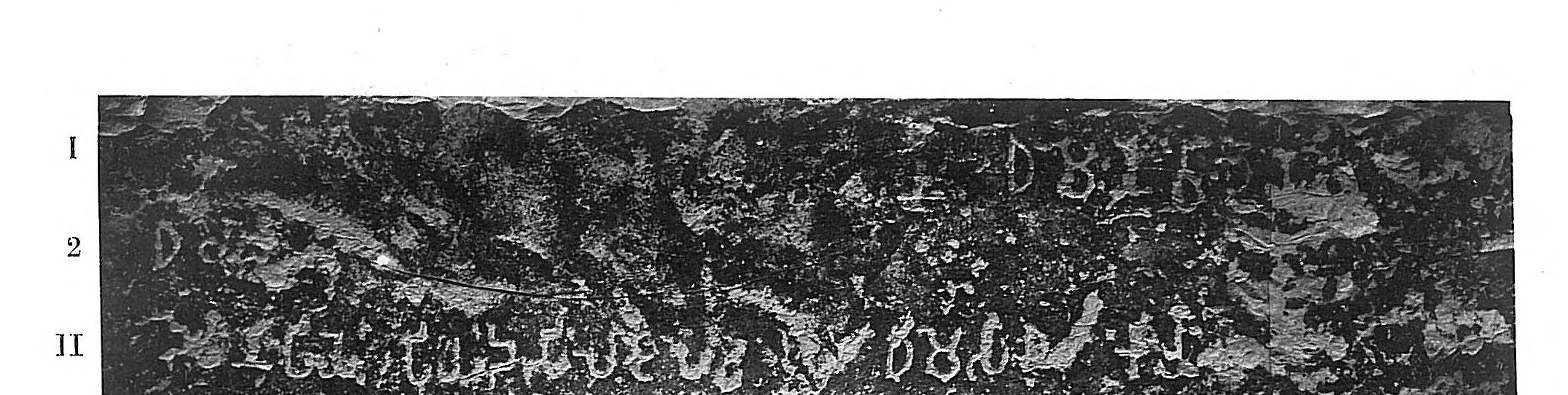
Inked impression (estampage) of the Delhi-Mirath pillar, not a photograph of the stone: Hultzsch 1925, plate 'Delhi-Mirath pillar: North face' (facing p. 138; archive.org leaf 300), cropped to the top of the north face, marked I in the left margin: the two damaged lines of the end of edict I (line 2 numbered), above the numeral II; a narrow strip of the neighbouring lines is included above and below. Checked on the image against the transcription (lines 1-2). Text: Hultzsch 1925, p. 137 (archive.org leaf 298). Hultzsch prints no English for the Delhi-Mirath pillar version. The English shown is his translation of the Delhi-Topra version of the same edict, sections (G), the sections whose words survive on this stone (Hultzsch 1925, pp. 119-120); it renders that text, so where this version differs in wording or has lost letters (dots in the transliteration), the English goes beyond what this stone shows.
1. . . . . . . . . . [naṁ] dhaṁmen[a] v[i]dh[āne]
2dha[me] . . . . . . . . . .
(G) For (their) instruction (is) this, viz. to protect according to morality, to dispose according to morality, to cause pleasure according to morality, (and) to guard (their speech) according to morality.
Where on the image
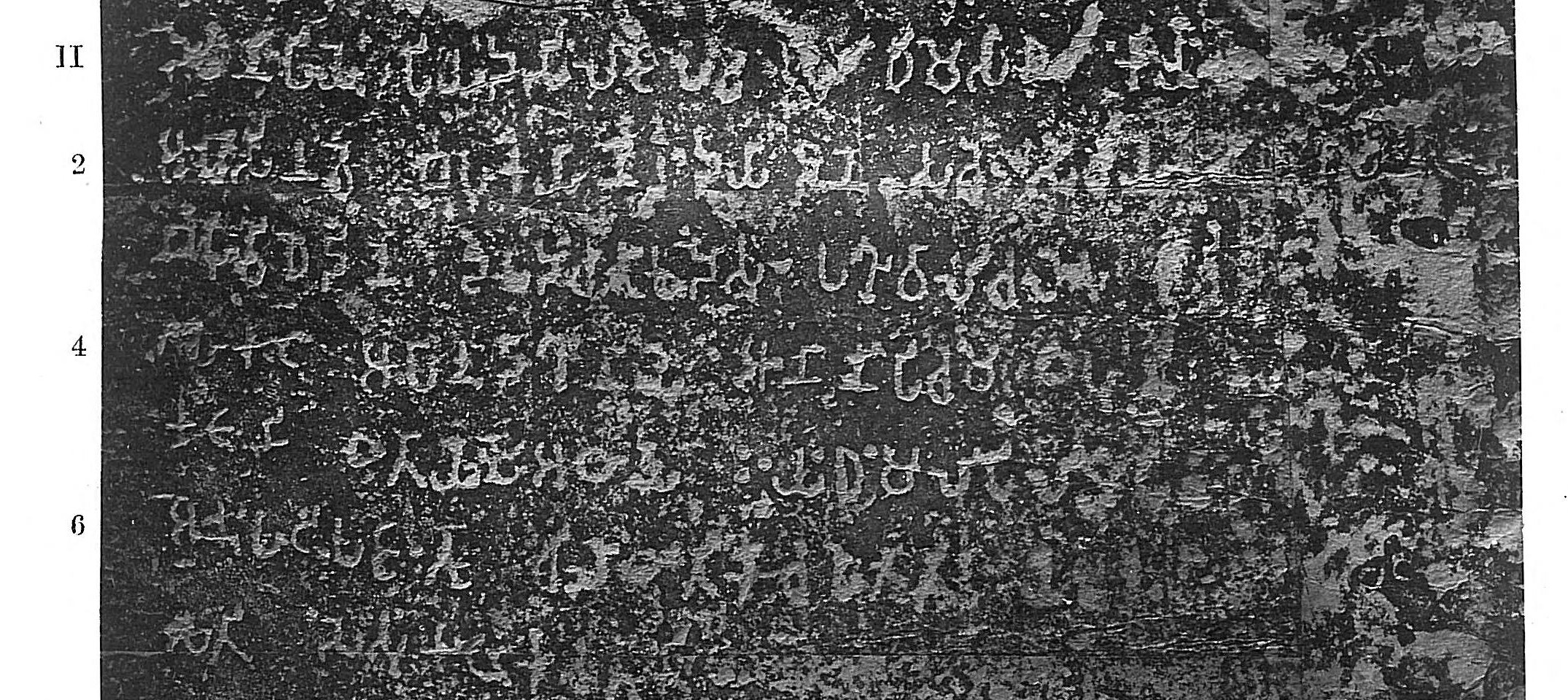
Inked impression (estampage) of the Delhi-Mirath pillar, not a photograph of the stone: Hultzsch 1925, plate 'Delhi-Mirath pillar: North face' (facing p. 138; archive.org leaf 300), cropped to the north face from the numeral II in the left margin to the row above the numeral III, numbered 2, 4, 6: 7 lines. Checked on the image against the transcription (lines 1-7). Text: Hultzsch 1925, pp. 137-138 (archive.org leaves 298-299). Hultzsch prints no English for the Delhi-Mirath pillar version. The English shown is his translation of the Delhi-Topra version of the same edict, the whole edict (Hultzsch 1925, pp. 120-121); it renders that text, so where this version differs in wording or has lost letters (dots in the transliteration), the English goes beyond what this stone shows.
1(A) De[vā]n[a]ṁpiye Piyadasi lāja [hevaṁ ā] . . (B) dh[aṁ]me s[ā]dh[u] k[iya]ṁ . . . . [m]e ti
2(C) a[pā]sinave bahu kayāne dayā dāne sache sochaye (D) [chakhu-dā]nā [pi me]
3bahuvidhe diṁne (E) du[pa]da-ch[a]tu[pa]desu pakhi-vālichale[su viv]i[dhe me anu]-
4gahe kaṭe ā pāna-dākhināye (F) a[ṁ]nāni pi cha me bah[ūni kayānāni]
5kaṭāni (G) etāye me aṭhāye iyaṁ dhaṁma-lipi li[khāpitā] . . . .
6anupaṭipajaṁtū chil[aṁ-th]itikā cha hot[ū] ti (H) ye [cha] . . . . . . . . . .
7[sa]ti se sukaṭaṁ ka[chha]tī ti
(A) King Dēvānāṁpriya Priyadarśin speaks thus.
(B) (To practise) morality is meritorious; but what does morality include?
(C) (It includes) few sins, many virtuous deeds, compassion, liberality, truthfulness, (and) purity.
(D) The gift of spiritual insight also has been bestowed by me in many ways.
(E) On bipeds and quadrupeds, on birds and aquatic animals various benefits have been conferred by me, (even) to the boon of life.
(F) And many other virtuous deeds also have been performed by me.
(G) For the following purpose was this rescript on morality caused to be written by me, (viz.) in order that (men) might conform to it, and that it might be of long duration.
(H) And he who will act thus will perform good deeds.
Where on the image
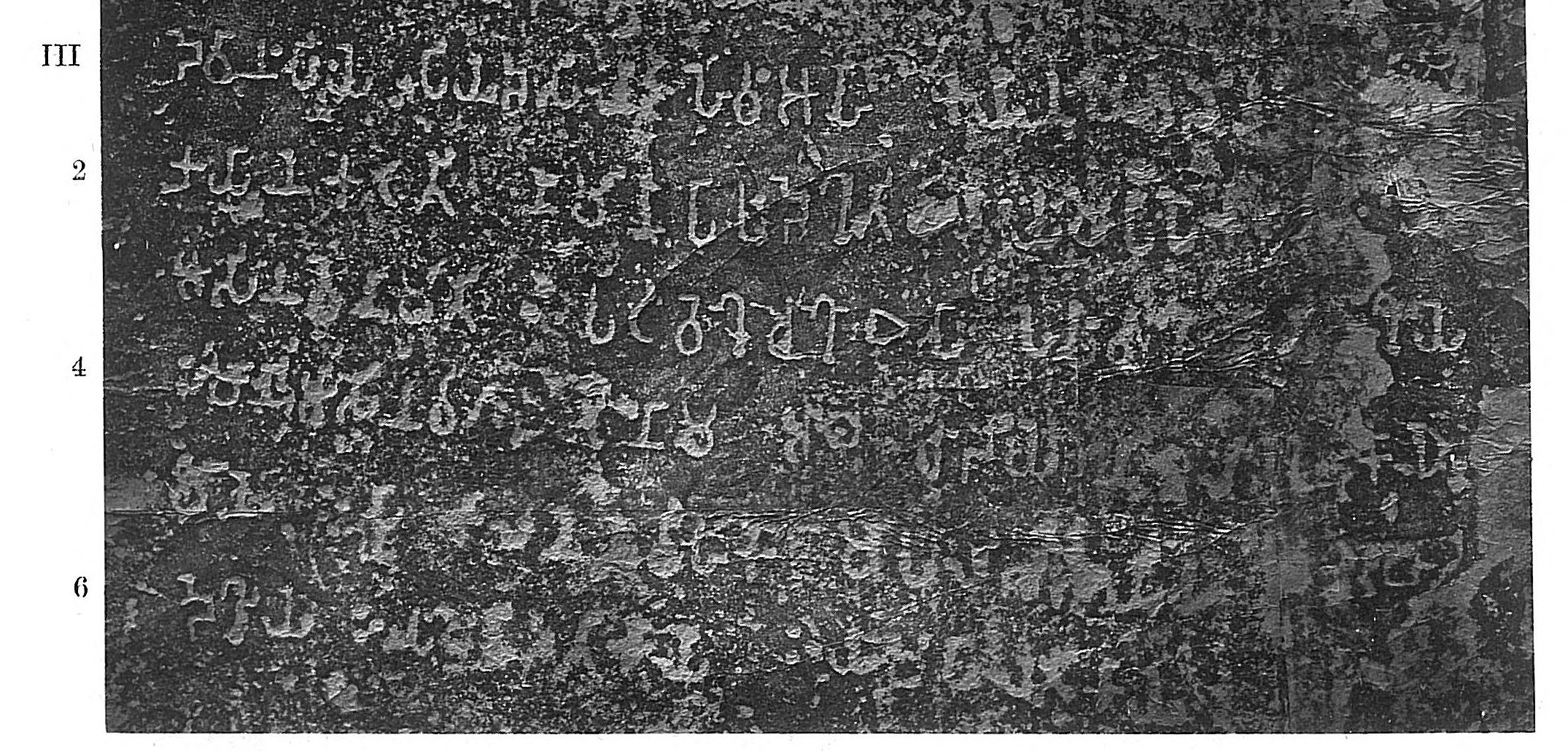
Inked impression (estampage) of the Delhi-Mirath pillar, not a photograph of the stone: Hultzsch 1925, plate 'Delhi-Mirath pillar: North face' (facing p. 138; archive.org leaf 300), cropped to the lower part of the north face, from the numeral III in the left margin to the foot of the plate, numbered 2, 4, 6: 6 lines. Checked on the image against the transcription (lines 1-6). Text: Hultzsch 1925, p. 138 (archive.org leaf 299). Hultzsch prints no English for the Delhi-Mirath pillar version. The English shown is his translation of the Delhi-Topra version of the same edict, the whole edict (Hultzsch 1925, pp. 121-122); it renders that text, so where this version differs in wording or has lost letters (dots in the transliteration), the English goes beyond what this stone shows.
1(A) Devānaṁpiye Piyadasi lāja hevaṁ āhā (B) kayānaṁm[eva de] . . . . . . . . . .
2kayāne kaṭe tī (C) no min[ā] pāpaṁ dekhati iyaṁ me pāp[e kaṭe ti iyaṁ va]
3āsinave nāmā ti (D) [du]paṭivekhe chu kho esā (E) hevaṁ chu kho [esa de]khiye
4(F) imāni āsinav[a-gāmīni] nāma atha chaṁḍ[i]ye ni[ṭhū]li[y]e k[o]dhe . . . . . .
5māne isyā kālanena [va] hakaṁ mā palibha[sa]yi[sa]ṁ (G) . . . . . bā[ḍhaṁ]
6dekhiye (H) iyaṁ me [hi]dat[i]kāye iyaṁ me pālatikāye
(A) King Dēvānāṁpriya Priyadarśin speaks thus.
(B) (Men) regard only (their) virtuous deeds, (thinking): ‘This virtuous deed has been performed by me.’
(C) They do not at all regard (their) evil deeds, (thinking): ‘This evil deed has been performed by me; this very (act) is called a sin.’
(D) Now this is indeed difficult to recognize.
(E) But indeed this ought to be regarded thus:
(F) ‘These (passions), viz. fierceness, cruelty, anger, pride, envy, are called sinful. Let me not ruin (myself) by (these) very (passions).’
(G) The following ought to be specially regarded:
(H) ‘This (action conduces) to my (happiness) in this (world), that other (action) to my (happiness) in the other (world).’
Where on the image
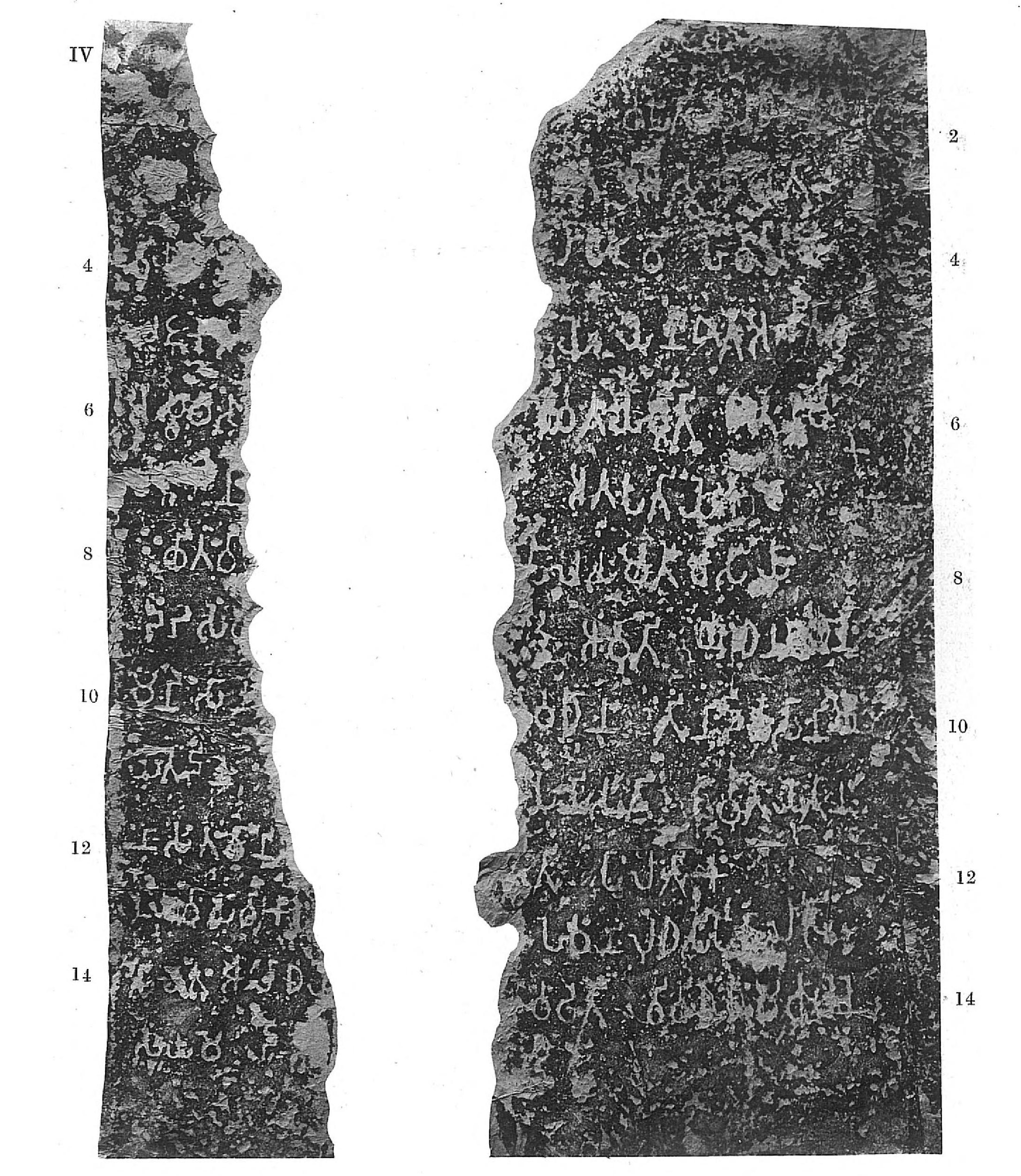
Inked impression (estampage) of the Delhi-Mirath pillar, not a photograph of the stone: Hultzsch 1925, plate 'Delhi-Mirath pillar: West face' (facing p. 139; archive.org leaf 301), cropped to the whole west face, two pieces of the broken shaft: the narrow left piece marked IV and numbered 4 to 14 in the left margin, the wider right piece numbered 2 to 14 in the right margin; 15 lines, the first lost, the middle of every line lost in the gap between the pieces (Hultzsch's dots). Checked on the image against the transcription (lines 1-15). Text: Hultzsch 1925, pp. 138-139 (archive.org leaves 299, 302). Hultzsch prints no English for the Delhi-Mirath pillar version. The English shown is his translation of the Delhi-Topra version of the same edict, sections (H) to (O), the sections whose words survive on this stone (Hultzsch 1925, pp. 123-125); it renders that text, so where this version differs in wording or has lost letters (dots in the transliteration), the English goes beyond what this stone shows.
1. . . . . . . . . .
2. . . . . . . . . . [ka] chaghaṁti [ā]lādha[y]i[tave]
3. . . . . . . . . . tu asvathe [ho]ti
4vi[ya] . . . . . . . . . . [l]i[ha]ṭave hev[aṁ mam]ā
5[la]jūk[a] . . . . . . . . . . ye (J) yen[a] ete a[bh]ītā
6asvatha saṁ . . . . . . . . . . [pa]vataye[v]ū ti [e]te[na] me
7[laj]ū[kā]n[aṁ] . . . . . . . . . . ata-patiye kaṭ[e]
8(K) ichhitavi . . . . . . . . . . [h]āla-samatā ch[a] siyā
9daṁḍa-sa[ma] . . . . . . . . . . [me] āvuti [ba]ṁdhana-[badh]ānaṁ
10munisā[naṁ] . . . . . . . . . . vadhānaṁ tiṁni di[va]sāni [m]e
11y[o]te diṁne (M) . . . . . . . . . . payisa[ṁ]ti j[ī]v[i]tāye tāna[ṁ]
12nāsaṁtaṁ [v]ā ni . . . . . . . . . . ti pālatikaṁ
13u[pa]vāsaṁ vā k[a] . . . . . . . . . . hevaṁ niludhasi pi [k]ālasi
14pā[la]taṁ ālādha[ye] . . . . . . . . . . vaḍhati vividhe dhaṁma-chal[a]ne
15saṁyame dā[na] . . . . . . . . . .
(H) And these (agents) will also exhort those (people), in order that the Lajūkas may be able to please me.
(I) For, as one feels confident after having entrusted (his) child to an intelligent nurse, (thinking): ‘The intelligent nurse will be able to keep my child well’, so the Lajūkas were appointed by me for the welfare and happiness of the country-people.
(J) In order that they should perform (their) duties, being fearless, confident, (and) unperturbed, for this (purpose) I have ordered that either rewards or punishments are left to the discretion of the Lajūkas.
(K) For the following is to be desired, (viz.) that there should be both impartiality in judicial proceedings and impartiality in punishments.
(L) And my order (reaches) even so far (that) a respite of three days is granted by me to persons lying in prison on whom punishment has been passed, (and) who have been condemned to death.
(M) (In this way) either (their) relatives will persuade those (Lajūkas) to (grant) their life, or, if there is none who persuades (them), they will bestow gifts or will undergo fasts in order to (attain happiness) in the other (world).
(N) For my desire is this, that, even when the time (of respite) has expired, they should attain (happiness) in the other (world).
(O) And various moral practices, self-control, (and) the distribution of gifts are (thus) promoted among the people.
Where on the image
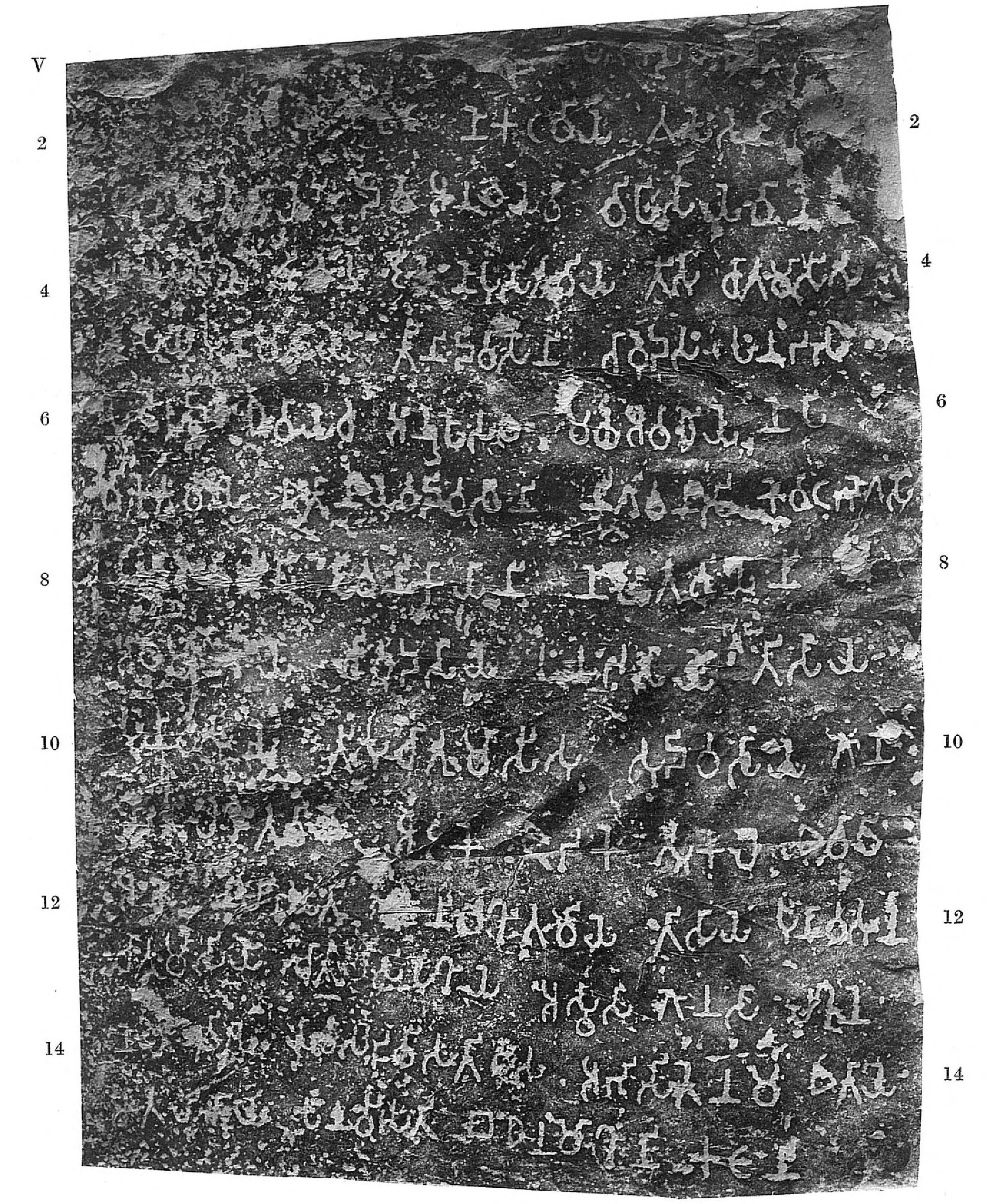
Inked impression (estampage) of the Delhi-Mirath pillar, not a photograph of the stone: Hultzsch 1925, plate 'Delhi-Mirath pillar: South face' (facing p. 140; archive.org leaf 304), cropped to the upper figure of the south-face plate, marked V and numbered 2 to 14 in both margins: 15 lines, their left ends worn (Hultzsch's dots). Checked on the image against the transcription (lines 1-15). Text: Hultzsch 1925, pp. 139-140 (archive.org leaves 302-303). Hultzsch prints no English for the Delhi-Mirath pillar version. The English shown is his translation of the Delhi-Topra version of the same edict, sections (C) to (L), the sections whose words survive on this stone (Hultzsch 1925, pp. 126-128); it renders that text, so where this version differs in wording or has lost letters (dots in the transliteration), the English goes beyond what this stone shows.
1. . . . . . . . . . [potake pi cha] k[ā]n[i]
2. . . . . . . . ke (D) [vadh]i-kukuṭe no kaṭaviye (E) tuse sajī[ve]
3. . . . . . ta[v]iye (F) dāve [a]naṭhāye vā vihisāye vā no
4[jhāpe]ta[vi]ye (G) jī[v]ena j[īv]e no pusi[ta]viye (H) tīsu chātaṁmāsīsu
5[t]isāya[ṁ] pu[ṁna]mā[si]ya[ṁ] tiṁni divasāni chāvudasaṁ paṁnaḍasaṁ
6p[a]ṭipadā dh[r]uvāye cha anuposathaṁ machhe avadhiye no pi
7viketav[i]ye (I) etān[i] yeva divasāni n[ā]ga-van[a]si kevaṭa-bhogasi
8y[āni aṁnāni] pi jīva-nikāyān[i] no [ha]ṁtaviyānī
9(J) aṭham[i-pakhā]ye [chā]vudasāye paṁ[na]ḍasāye tisāye
10punāvasune tīsu chātuṁmāsīsu sudivasāye gone
11no nīlakhitavi[y]e ajake eḷake sūkale e vā pi
12aṁ[n]e nī[la]khi[ya]ti [no] nīlakhitaviye (K) tisāye punāvasun[e]
13chātuṁmāsiye chātu[ṁ]māsi-pakhāye asvasā gonasā lakhane
14no . . . . [v]iye (L) yā[va]-saḍuvīsati-[va]sa-abhisitena me etāye
15a[ṁ]talikāye paṁnavīsati baṁdhana-mokhāni kaṭāni
(C) Those [she-goats], ewes, and sows (which are) either with young or in milk, are inviolable, and also those (of their) young ones (which are) less than six months old.
(D) Cocks must not be caponed.
(E) Husks containing living animals must not be burnt.
(F) Forests must not be burnt either uselessly or in order to destroy (living beings).
(G) Living animals must not be fed with (other) living animals.
(H) Fish are inviolable, and must not be sold, on the three Chāturmāsīs (and) on the Tishyā full-moon during three days, (viz.) the fourteenth, the fifteenth, (and) the first (tithi), and invariably on every fast-day.
(I) And during these same days also no other classes of animals which are in the elephant-park (and) in the preserves of the fishermen, must be killed.
(J) On the eighth (tithi) of (every) fortnight, on the fourteenth, on the fifteenth, on Tishyā, on Punarvasu, on the three Chāturmāsīs, (and) on festivals, bulls must not be castrated, (and) he-goats, rams, boars, and whatever other (animals) are castrated (otherwise), must not be castrated (then).
(K) On Tishyā, on Punarvasu, on the Chāturmāsīs, (and) during the fortnight of (every) Chāturmāsī, horses (and) bullocks must not be branded.
(L) Until (I had been) anointed twenty-six years, in this period the release of prisoners was ordered by me twenty-five (times).
Where on the image
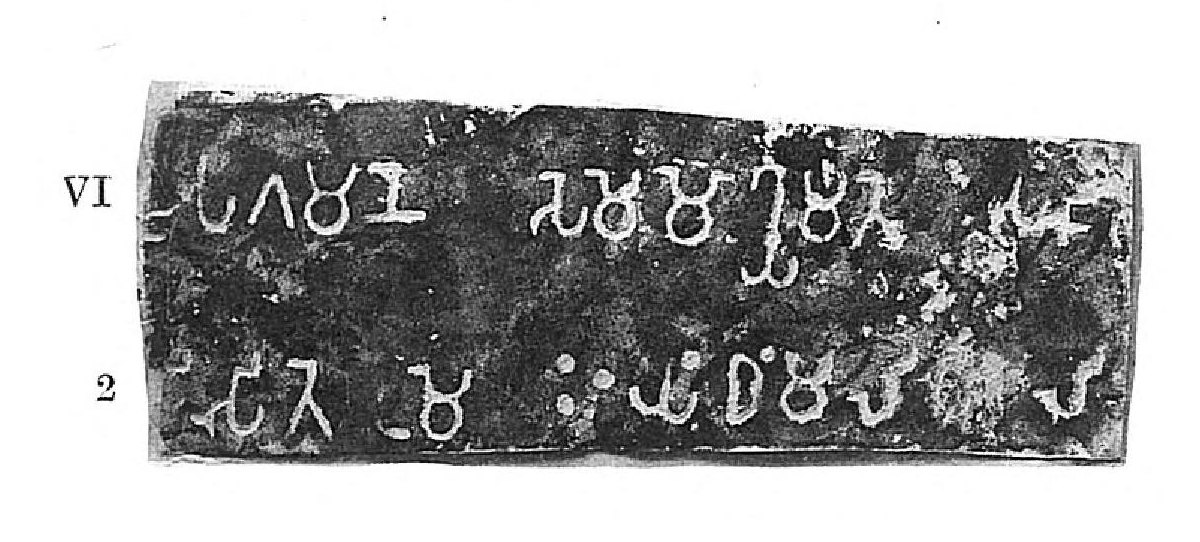
Inked impression (estampage) of the Delhi-Mirath pillar, not a photograph of the stone: Hultzsch 1925, plate 'Delhi-Mirath pillar: South face' (facing p. 140; archive.org leaf 304), cropped to the small lower figure of the south-face plate, marked VI and 2: the two surviving lines of edict VI; a narrow strip of the neighbouring lines is included above and below. Checked on the image against the transcription (lines 1-2). Text: Hultzsch 1925, p. 140 (archive.org leaf 303). Hultzsch prints no English for the Delhi-Mirath pillar version. The English shown is his translation of the Delhi-Topra version of the same edict, sections (F) to (G), the sections whose words survive on this stone (Hultzsch 1925, pp. 129-131); it renders that text, so where this version differs in wording or has lost letters (dots in the transliteration), the English goes beyond what this stone shows.
1. . . ūpagamane se me mokhya-mate (G) saḍu . . . . . . . . . .
2. . . isitena me iyaṁ dhaṁma-li[pi] li . . . . . .
(F) But this is considered by me (my) principal (duty), viz. visiting (the people) personally.
(G) (When I had been) anointed twenty-six years, this rescript on morality was caused to be written by me.
Notes
- Hultzsch translates dhamma as 'morality'; other translators use 'Dharma' or 'righteousness'.
- Words in round brackets in the English are Hultzsch's additions for sense; words in square brackets render damaged letters.
Cite
Sources
- Source: Delhi-Mirath pillar, the Ridge, Delhi (originally at Meerut, Uttar Pradesh), pillar inscription of Ashoka; Hultzsch's collotype plates of inked impressions (1925); Hultzsch's transliteration and English (CII I, 1925), read from the archive.org scan (holding institution)
- Critical edition: E. Hultzsch, Inscriptions of Asoka (CII I, 1925), transliteration read from the scan
← previous · → next · v cycle view · l back to library