Ashoka's Sahasram minor rock edict: the 256 nights on tour
Introduction
The Sahasram inscription is cut on the wall of a small cave shelter near the top of the Chandan Shahid hill, east of Sasaram (Sahasram) in Bihar. It is a version of Ashoka's first Minor Rock Edict, the text also found at Rupnath, Bairat, Maski and Brahmagiri: the king says he has been a lay follower (upāsaka) for some years without much zeal, but for more than a year has been very zealous, and that even a humble man who exerts himself can reach heaven. The Sahasram copy is the one that names the number of nights the king had spent on tour, 256, in words and in figures, and asks for the text to be cut on rocks and on stone pillars.
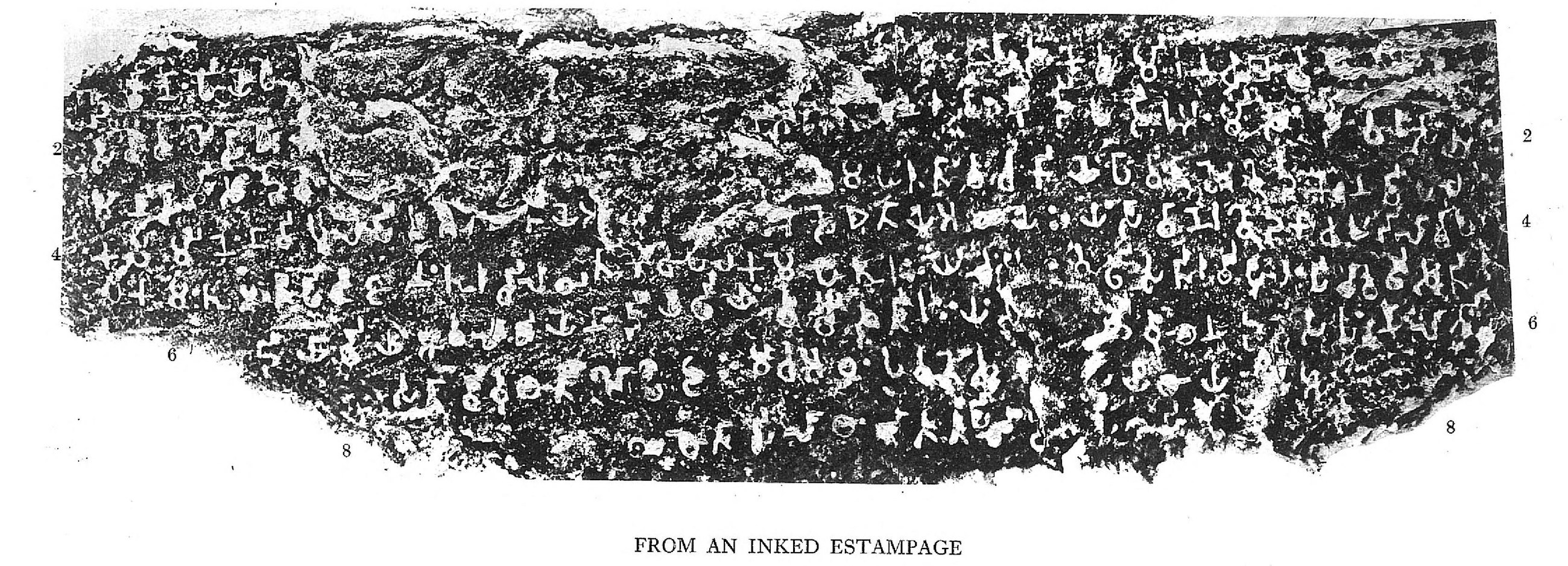
Much of the upper middle of the rock is broken away. Hultzsch prints in double brackets the letters that are now lost but could still be seen on an old photograph of the rock; single brackets mark damaged letters and dots lost ones. His plate gives two images of the rock: a photograph by J. D. Beglar and an inked impression; only the impression is shown here.
Sources. Original text and English: E. Hultzsch, Inscriptions of Asoka. New Edition (Corpus Inscriptionum Indicarum, vol. I), Oxford: Clarendon Press for the Government of India, 1925, transcribed from the page images of the archive.org scan (public domain). Images: Hultzsch's collotype plates of inked impressions (estampages) of the Sahasram rock, taken on the stone for the Archaeological Survey of India. An impression is a contact copy pressed on paper from the inscribed surface itself, not a drawing; each section's image is the part of the plate that carries that text, with the plate's own numerals and line numbers in the margins.
Reading the text. Line numbers are Hultzsch's lines on the stone. Letters in square brackets are damaged or uncertain on the stone; dots mark lost letters. The capital letters in brackets, (A), (B) ..., are Hultzsch's sentence divisions and are the same in the transliteration and the English. Hultzsch's footnotes, which record other scholars' readings and his corrections, are not reproduced.
How was this verified? (Provenance)
Where on the image
Inked impression (estampage) of the Sahasram rock, not a photograph of the stone: Hultzsch 1925, plate 'Sahasram rock-inscription (lower figure: from an inked estampage)' (page 170; archive.org leaf 347), cropped to the lower figure of the plate, captioned 'From an inked estampage' (the upper figure, 'From Mr. Beglar's photograph', is not used): eight lines, numbered 2 to 8 in both margins; the upper middle of the rock is broken away, as Hultzsch's double brackets and dots show, and line 8 is short. Checked on the image against the transcription (lines 1-8). Text and English: Hultzsch 1925, pp. 170-171 (archive.org leaves 346, 348).
1(A) Devānāṁpiye he[vaṁ] [[ā]] .......... [[iyāni savachhalā]][ni | a]ṁ upāsake sumi | (C) na chu bāḍhaṁ [palaka]ṁ[t]e
2(D) sav[a]chhale sādhi[ke] [[| aṁ]] ........ [[te]] (E) [ete][[na cha aṁta]]lena | Jaṁbudīpasi | aṁmisaṁ-[de]vā | saṁta
3munisā [m]isaṁ-deva [[kaṭā | (F) pala]] ........ [[iyaṁ phale (G) [n]o]] .... [[yaṁ]] mahatatā va chakiye pāv[a]t[a]ve | khudakena pi pala-
4kamamīnenā vipule pi s[u]ag ... [k]iye [ā][[lā]] ...... [[ve]] [|] (H) se etāye aṭh[ā]ye iyaṁ sāvāne | khudakā cha uḍālā chā pa-
5[la]kamaṁtu aṁtā pi ch[a] jānaṁtu | chila-ṭhit[īke] cha p[a]l[ā]kame hotu | (I) iya[ṁ] cha [aṭhe] vaḍhisati | vipulaṁ pi cha vaḍhisati
6diyāḍhiyaṁ aval[a]dhiyenā diy[a]ḍhiyaṁ vaḍhisati | (J) iyaṁ [[cha savane]] [v]ivuthena (K) duve sapaṁnā lāti-
7satā vivuthā ti 200 50 6 (L) ima cha aṭhaṁ pavatesu [l][[ikhā]][pa]yāthā (M) ya . . [vā] a-
8th[i] hetā silā-thaṁ[bh]ā tata pi [likhāpayatha t]i
(A) Dēvānāṁpriya [speaks] thus.
(B) .......... years since I am a lay-worshipper (upāsaka).
(C) But (I had) not been very zealous.
(D) A year and somewhat more (has passed) since ..........
(E) And men in Jambudvīpa, being during that time unmingled with the gods, have (now) been made (by me) mingled with the gods.
(F) [For] this is the fruit [of zeal].
(G) ..... cannot be reached by (persons of) high rank alone, (but) even a lowly (person) is able to attain even the great heaven if he is zealous.
(H) Now, for the following purpose (has) this proclamation (been issued), (that) both the lowly and the exalted may be zealous, and (that) even (my) borderers may know (it), and (that this) zeal may be of long duration.
(I) And this matter will (be made by me to) progress, and will (be made to) progress even considerably; it will (be made to) progress to one and a half, to at least one and a half.
(J) And this proclamation (was issued by me) on tour.
(K) Two hundred and fifty-six nights (had then been) spent on tour,—(in figures) 256.
(L) And cause ye this matter to be engraved on rocks.
(M) And where there are stone pillars here (in my dominions), there also cause (it) to be engraved.
Notes
- Hultzsch translates dhamma as 'morality'; other translators use 'Dharma' or 'righteousness'.
- Words in round brackets in the English are Hultzsch's additions for sense; words in square brackets render damaged letters.
Cite
Sources
- Source: Sahasram, Chandan Shahid hill near Sasaram (Bihar), rock inscription of Ashoka; Hultzsch's collotype plates of inked impressions (1925); Hultzsch's transliteration and English (CII I, 1925), read from the archive.org scan (holding institution)
- Critical edition: E. Hultzsch, Inscriptions of Asoka (CII I, 1925), transliteration read from the scan
← previous · → next · v cycle view · l back to library