Berossus, Babyloniaka book 1: Oannes and the creation (Alexander Polyhistor in George Syncellus)
Introduction
Berossus was a priest of Bel at Babylon who, around 290-278 BCE, wrote a history of his country in Greek for the Seleucid king Antiochus I. His three books ran from the creation of the world through the ten kings who reigned before the flood to the Neo-Babylonian kings. The work is lost. Its fullest remains reached the Byzantine chronicler George Syncellus (c. 800 AD) through a chain of excerpts: Alexander Polyhistor (1st c. BCE) summarized Berossus, Eusebius of Caesarea quoted Polyhistor, and Syncellus copied Eusebius into his Ecloga chronographica.
The manuscript shown is Paris, Bibliothèque nationale de France, grec 1711, an 11th-century copy of Syncellus' chronicle, the oldest and principal witness to the text. The images are the library's black-and-white microfilm, published on Gallica. Each section points at the page that carries it; the line numbers in the notes were counted on the images.
This entry is Polyhistor's summary of Berossus' first book: who Berossus was, the land of Babylonia, the creature Oannes, half fish and half man, who came out of the Red Sea and taught mankind letters, crafts, the founding of cities and temples, laws, geometry and agriculture, and the account of creation in which Bel cuts the woman Omoroka in two to make heaven and earth.
Not included: the summaries of Berossus that survive only in the Armenian translation of Eusebius' Chronicle (no Greek), Syncellus' own remarks on Berossus' chronology (no public-domain English translation), and the short testimonia in other authors.
How was this verified? (Provenance)
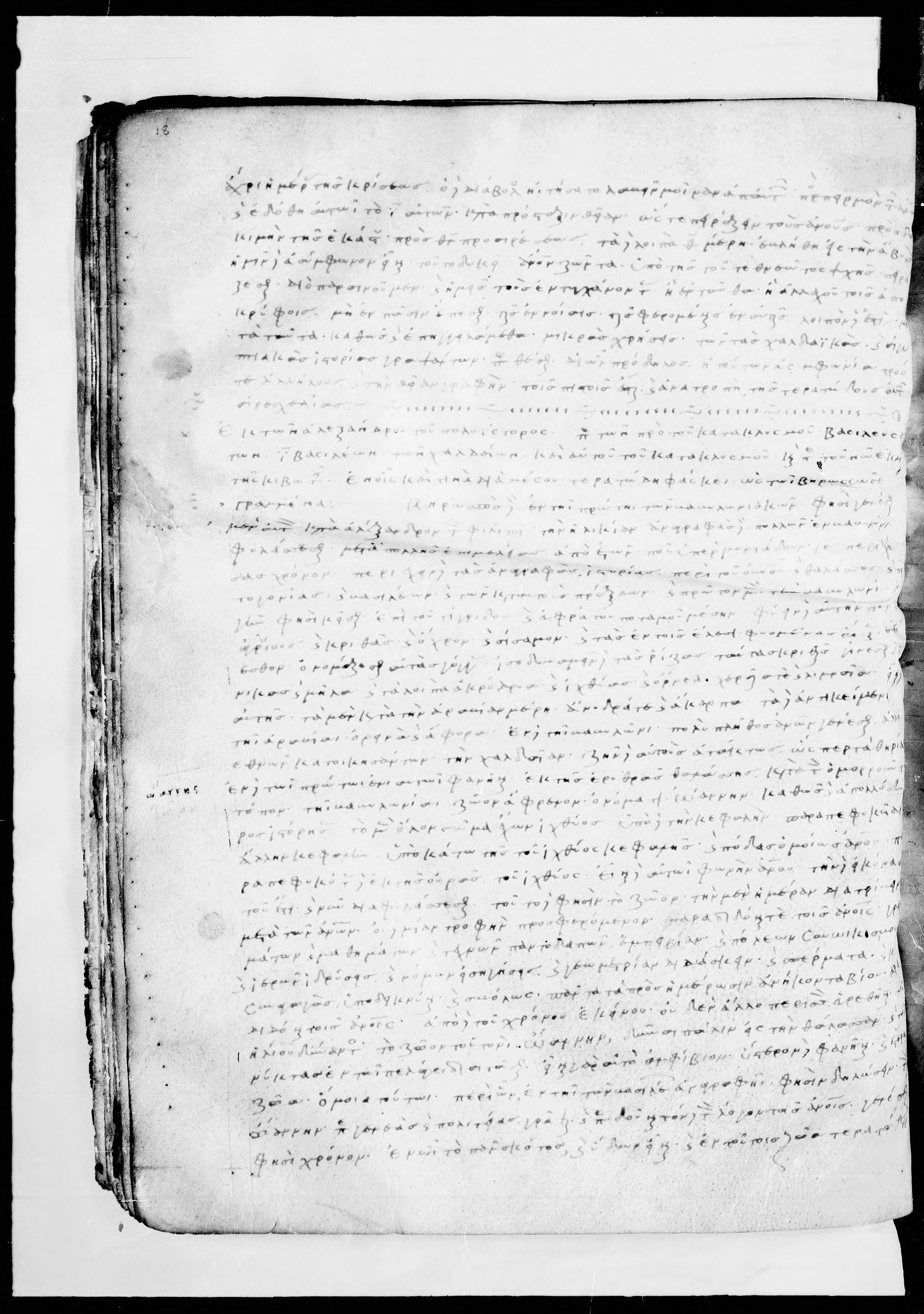
Where on the image
Paris gr. 1711, p. 18 (Gallica image f23, left page of the opening; microfilm). Below a dotted rule that closes the previous extract, line 11 opens Syncellus' heading 'Ἐκ τῶν Ἀλεξάνδρου τοῦ Πολυΐστορος περὶ τῶν πρὸ τοῦ κατακλυσμοῦ βασιλευσάντων ι´ βασιλέων' (lines 11-14). After 'γεγραμμένα:' on line 14 the text begins 'Βήρωσσος δὲ ἐν τῇ πρώτῃ τῶν Βαβυλωνιακῶν' and §1 runs to '...καὶ τῶν κατ’ αὐτοὺς πράξεων' on line 18. Checked on the image. Viewer: https://gallica.bnf.fr/ark:/12148/btv1b10723005g/f23.item The Greek shown is Müller's edited text; the copyist's wording on the page differs in places (for example the manuscript reads Κορκυραίων where Müller prints Κορδυαίων).
(Ἐκ τοῦ Ἀλεξάνδρου τοῦ Πολυΐστορος, περὶ τῶν πρὸ τοῦ κατακλυσμοῦ βασιλευσάντων δέκα βασιλέων τῶν Χαλδαίων καὶ αὐτοῦ τοῦ κατακλυσμοῦ, καὶ περὶ τοῦ Νῶε καὶ τῆς κιβωτοῦ, ἐν οἷς καί τινα διὰ μέσου τερατώδη φάσκει, ὡς τῷ Βηρώσσῳ γεγραμμένα). 1Βήρωσσος δὲ ἐν τῇ πρώτῃ τῶν Βαβυλωνιακῶν φησι γενέσθαι μὲν αὐτὸν κατὰ Ἀλέξανδρον τὸν Φιλίππου τὴν ἡλικίαν. Ἀναγραφὰς δὲ πολλῶν ἐν Βαβυλῶνι φυλάσσεσθαι μετὰ πολλῆς ἐπιμελείας ἀπὸ ἐτῶν που ὑπὲρ μυριάδων ιεʹ περιεχούσας χρόνον· περιέχειν δὲ τὰς ἀναγραφὰς ἱστορίας περὶ τοῦ οὐρανοῦ καὶ θαλάσσης καὶ πρωτογονίας καὶ βασιλέων καὶ τῶν κατ’ αὐτοὺς πράξεων.
BEROSSUS: FROM ALEXANDER POLYHISTOR. OF THE COSMOGONY AND DELUGE. 1BEROSSUS, in the first book of his history of Babylonia, informs us that he lived in the age of Alexander the son of Philip. And he mentions that there were written accounts, preserved at Babylon with the greatest care, comprehending a period of above fifteen myriads of years: and that these writings contained histories of the heaven and of the sea; of the birth of mankind; and of the kings, and of the memorable actions which they had achieved.
Where on the image
Paris gr. 1711, p. 18 (Gallica image f23, left page of the opening; microfilm). §2 begins on line 18 'καὶ πρῶτον μὲν τὴν Βαβυλωνίων γῆν' and ends on line 25 '...ζῆν δὲ αὐτοὺς ἀτάκτως ὥσπερ τὰ θηρία'. Checked on the image. Viewer: https://gallica.bnf.fr/ark:/12148/btv1b10723005g/f23.item The Greek shown is Müller's edited text; the copyist's wording on the page differs in places (for example the manuscript reads Κορκυραίων where Müller prints Κορδυαίων).
2Καὶ πρῶτον μὲν τὴν Βαβυλωνίων γῆν φησι κεῖσθαι ἐπὶ τοῦ Τίγριδος καὶ Εὐφράτου ποταμοῦ μέσην. Φύειν δὲ αὐτὴν πυροὺς ἀγρίους καὶ κριθὰς καὶ ὦχρον καὶ σήσαμον καὶ τὰς ἐν τοῖς ἕλεσι φυομένας ῥίζας ἐσθίεσθαι· ὀνομάζεσθαι αὐτὰς γόγγας· ἰσοδυναμεῖν δὲ τὰς ῥίζας ταύτας κριθαῖς. Γίνεσθαι δὲ φοίνικας καὶ μῆλα καὶ τὰ λοιπὰ ἀκρόδρυα καὶ ἰχθύας καὶ ὄρνεα χερσαῖά τε καὶ λιμναῖα. Εἶναι δὲ αὐτῆς τὰ μὲν κατὰ τὴν Ἀραβίαν μέρη ἄνυδρά τε καὶ ἄκαρπα, τὰ δὲ ἀντικείμενα τῇ Ἀραβίᾳ ὀρεινά τε καὶ ἄφορα. Ἐν δὲ τῇ Βαβυλῶνι πολὺ πλῆθος ἀνθρώπων γενέσθαι ἀλλοεθνῶν κατοικησάντων τὴν Χαλδαίαν· ζῆν δὲ αὐτοὺς ἀτάκτως ὥσπερ τὰ θηρία.
2And in the first place he describes Babylonia as a country situated between the Tigris and the Euphrates: that it abounded with wheat, and barley, and ocrus, and sesame; and that in the lakes were produced the roots called gongæ, which are fit for food, and in respect to nutriment similar to barley. That there were also palm trees and apples, and a variety of fruits; fish also and birds, both those which are merely of flight, and those which frequent the lakes. He adds, that those parts of the country which bordered upon Arabia, were without water, and barren; but that the parts which lay on the other side were both hilly and fertile. At Babylon there was (in these times) a great resort of people of various nations, who inhabited Chaldæa, and lived in a lawless manner like the beasts of the field.
Where on the image
Paris gr. 1711, p. 18 (Gallica image f23, left page of the opening; microfilm). §3 begins at the start of line 26 'ἐν δὲ τῷ πρώτῳ ἐνιαυτῷ φανῆναι ἐκ τῆς ἐρυθρᾶς θαλάσσης', with the marginal note 'ὠάννης' beside it, and ends on line 40 '...τόνδε τὸν λόγον τοῖς ἀνθρώποις'. Checked on the image. Viewer: https://gallica.bnf.fr/ark:/12148/btv1b10723005g/f23.item The Greek shown is Müller's edited text; the copyist's wording on the page differs in places (for example the manuscript reads Κορκυραίων where Müller prints Κορδυαίων).
3Ἐν δὲ τῷ πρώτῳ ἐνιαυτῷ φανῆναι ἐκ τῆς Ἐρυθρᾶς θαλάσσης κατὰ τὸν ὁμοροῦντα τόπον τῇ Βαβυλωνίᾳ ζῶον ἄφρενον ὀνόματι Ὠάννην, καθὼς καὶ Ἀπολλόδωρος ἱστόρησε, τὸ μὲν ὅλον σῶμα ἔχον ἰχθύος, ὑπὸ δὲ τὴν κεφαλὴν παραπεφυκυῖαν ἄλλην κεφαλὴν ὑποκάτω τῆς τοῦ ἰχθύος κεφαλῆς, καὶ πόδας ὁμοίως ἀνθρώπου, παραπεφυκότας δὲ ἐκ τῆς οὐρᾶς τοῦ ἰχθύος· εἶναι δὲ αὐτῷ φωνὴν ἀνθρώπου, τὴν δὲ εἰκόνα αὐτοῦ ἔτι καὶ νῦν διαφυλάσσεσθαι· τοῦτο δὲ, φησὶ, τὸ ζῶον, τὴν μὲν ἡμέραν διατρίβειν μετὰ τῶν ἀνθρώπων, οὐδεμίαν τροφὴν προσφερόμενον, παραδιδόναι τε τοῖς ἀνθρώποις γραμμάτων καὶ μαθημάτων καὶ τεχνῶν παντοδαπῶν ἐμπειρίαν, καὶ πόλεων συνοικισμοὺς καὶ ἱερῶν ἱδρύσεις, καὶ νόμων εἰσηγήσεις καὶ γεωμετρίαν διδάσκειν, καὶ σπέρματα καὶ καρπῶν συναγωγὰς ὑποδεικνύναι, καὶ συνόλως πάντα τὰ πρὸς ἡμέρωσιν ἀνήκοντα βίου παραδιδόναι τοῖς ἀνθρώποις. Ἀπὸ δὲ τοῦ χρόνου ἐκείνου οὐδὲν ἄλλο περισσὸν εὑρεθῆναι. Τοῦ δὲ ἡλίου δύναντος τὸ ζῶον τουτονὶ Ὠάννην δῦναι πάλιν εἰς τὴν θάλασσαν, καὶ τὰς νύκτας ἐν τῷ πελάγει διαιτᾶσθαι· εἶναι γὰρ αὐτὸ ἀμφίβιον. Ὕστερον δὲ φανῆναι καὶ ἕτερα ζῶα ὅμοια τούτῳ, περὶ ὧν ἐν τῇ τῶν βασιλέων ἀναγραφῇ φησι δηλώσειν. Τὸν δὲ Ὠάννην περὶ γενεᾶς καὶ πολιτείας γράψαι καὶ παραδοῦναι τόνδε τὸν λόγον τοῖς ἀνθρώποις.
3In the first year there appeared, from that part of the Erythræan sea which borders upon Babylonia, an animal destitute of reason, by name Oannes, whose whole body (according to the account of Apollodorus) was that of a fish; that under the fish's head he had another head, with feet also below, similar to those of a man, subjoined to the fish's tail. His voice too, and language, was articulate and human; and a representation of him is preserved even to this day. This Being was accustomed to pass the day among men; but took no food at that season; and he gave them an insight into letters and sciences, and arts of every kind. He taught them to construct cities, to found temples, to compile laws, and explained to them the principles of geometrical knowledge. He made them distinguish the seeds of the earth, and shewed them how to collect the fruits; in short, he instructed them in every thing which could tend to soften manners and humanize their lives. From that time, nothing material has been added by way of improvement to his instructions. And when the sun had set, this Being Oannes, retired again into the sea, and passed the night in the deep; for he was amphibious. After this there appeared other animals like Oannes, of which Berossus proposes to give an account when he comes to the history of the kings. Moreover Oannes wrote concerning the generation of mankind; and of their civil polity; and the following is the purport of what he said:
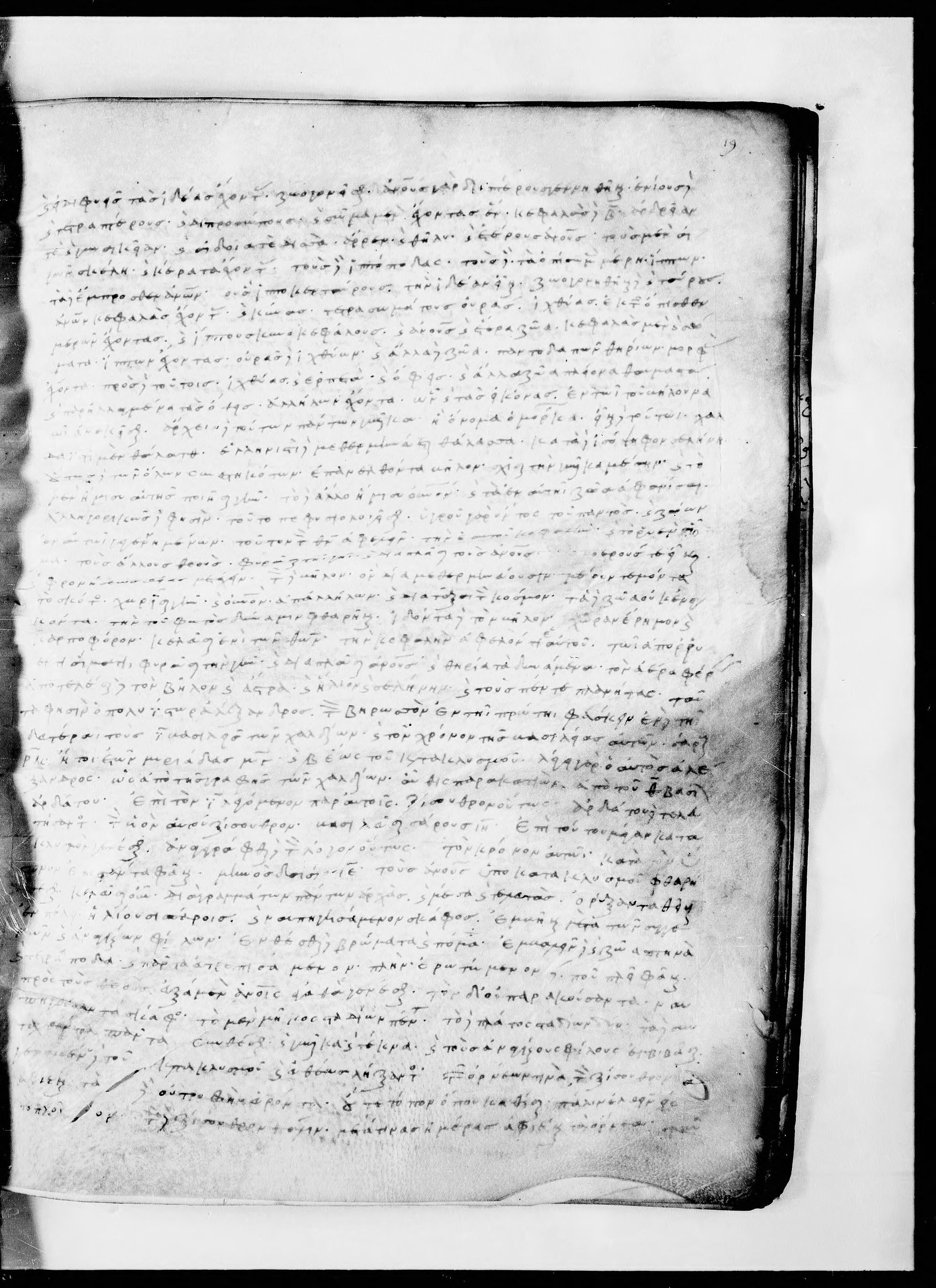
Where on the image
Paris gr. 1711, p. 18 (Gallica image f23, left page of the opening; microfilm). §4 begins at the end of line 40 of p. 18 'γε-|νέσθαι φησὶ χρόνον ἐν ᾧ τὸ πᾶν σκότος'; p. 18 ends '...ζῶα τερατώδη', and p. 19 begins 'καὶ εἰδιφυεῖς τὰς ἰδέας ἔχοντα ζωογονεῖσθαι'. The section ends on p. 19 line 12 '...κατὰ δὲ ἰσόψηφον σελήνη', which the manuscript has in the running text. Checked on the image. Viewer: https://gallica.bnf.fr/ark:/12148/btv1b10723005g/f23.item Paris gr. 1711, p. 19 (Gallica image f23, right page of the opening; microfilm). Checked on the image. Viewer: https://gallica.bnf.fr/ark:/12148/btv1b10723005g/f23.item The Greek shown is Müller's edited text; the copyist's wording on the page differs in places (for example the manuscript reads Κορκυραίων where Müller prints Κορδυαίων).
4Γενέσθαι φησὶ χρόνον, ἐν ᾧ τὸ πᾶν σκότος καὶ ὕδωρ εἶναι καὶ ἐν τούτοις ζῶα τερατώδη, καὶ εἰδιφυεῖς τὰς ἰδέας ἔχοντα ζωογονεῖσθαι. Ἀνθρώπους γὰρ διπτέρους γεννηθῆναι, ἐνίους δὲ καὶ τετραπτέρους καὶ διπροσώπους· καὶ σῶμα μὲν ἔχοντας ἓν, κεφαλὰς δὲ δύο, ἀνδρείαν τε καὶ γυναικείαν, καὶ αἰδοῖά τε δισσὰ, ἄρρεν καὶ θῆλυ· καὶ ἑτέρους ἀνθρώπους τοὺς μὲν αἰγῶν σκέλη καὶ κέρατα ἔχοντας, τοὺς δὲ ἱππόποδας, τοὺς δὲ τὰ ὀπίσω μὲν μέρη ἵππων, τὰ δὲ ἔμπροσθεν ἀνθρώπων, οὓς ἱπποκενταύρους τὴν ἰδέαν εἶναι. Ζωογονηθῆναι δὲ καὶ ταύρους ἀνθρώπων κεφαλὰς ἔχοντας καὶ κύνας τετρασωμάτους, οὐρὰς ἰχθύος ἐκ τῶν ὄπισθεν μερῶν ἔχοντας, καὶ ἵππους κυνοκεφάλους, καὶ ἀνθρώπους, καὶ ἕτερα ζῶα κεφαλὰς μὲν καὶ σώματα ἵππων ἔχοντα, οὐρὰς δὲ ἰχθύων, καὶ ἄλλα δὲ ζῶα παντοδαπῶν θηρίων μορφὰς ἔχοντα. Πρὸς δὲ τούτοις ἰχθύας καὶ ἑρπετὰ καὶ ὄφεις καὶ ἄλλα ζῶα πλείονα θαυμαστὰ καὶ παρηλλαγμένα τὰς ὄψεις ἀλλήλων ἔχοντα· ὧν καὶ τὰς εἰκόνας ἐν τῷ τοῦ Βήλου ναῷ ἀνακεῖσθαι. Ἄρχειν δὲ τούτων πάντων γυναῖκα ᾗ ὄνομα Ὁμόρωκα· εἶναι δὲ τοῦτο Χαλδαϊστὶ μὲν Θαλάτθ, Ἑλληνιστὶ δὲ μεθερμηνεύεσθαι θάλασσα, [κατὰ δὲ ἰσόψηφον σελήνη].
4"There was a time in which there existed nothing but darkness and an abyss of waters, wherein resided most hideous beings, which were produced of a two-fold principle. There appeared men, some of whom were furnished with two wings, others with four, and with two faces. They had one body but two heads: the one that of a man, the other of a woman: and likewise in their several organs both male and female. Other human figures were to be seen with the legs and horns of goats: some had horses' feet: while others united the hind quarters of a horse with the body of a man, resembling in shape the hippocentaurs. Bulls likewise were bred there with the heads of men; and dogs with fourfold bodies, terminated in their extremities with the tails of fishes: horses also with the heads of dogs: men too and other animals, with the heads and bodies of horses and the tails of fishes. In short, there were creatures in which were combined the limbs of every species of animals. In addition to these, fishes, reptiles, serpents, with other monstrous animals, which assumed each other's shape and countenance. Of all which were preserved delineations in the temple of Belus at Babylon. The person, who presided over them, was a woman named Omoroca; which in the Chaldæan language is Thalatth; in Greek Thalassa, the sea; but which might equally be interpreted the Moon.
Where on the image
Paris gr. 1711, p. 19 (Gallica image f23, right page of the opening; microfilm). §5 begins on line 13 'οὕτως δὲ τῶν ὅλων συνεστηκότων ἐπανελθόντα' and ends on line 18 '...φρονήσεως θείας μετέχειν'. Checked on the image. Viewer: https://gallica.bnf.fr/ark:/12148/btv1b10723005g/f23.item The Greek shown is Müller's edited text; the copyist's wording on the page differs in places (for example the manuscript reads Κορκυραίων where Müller prints Κορδυαίων).
5Οὕτως δὲ τῶν ὅλων συνεστηκότων ἐπανελθόντα Βῆλον σχίσαι τὴν γυναῖκα μέσην, καὶ τὸ μὲν ἥμισυ αὐτῆς ποιῆσαι γῆν, τὸ δὲ ἄλλο ἥμισυ οὐρανὸν, καὶ τὰ ἐν αὐτῇ ζῶα ἀφανίσαι. Ἀλληγορικῶς δέ φησι τοῦτο πεφυσιολογῆσθαι. Ὑγροῦ γὰρ ὄντος τοῦ παντὸς καὶ ζώων ἐν αὐτῷ γεγενημένων, τοῦτον τὸν θεὸν ἀφελεῖν τὴν ἑαυτοῦ κεφαλὴν, καὶ τὸ ῥυὲν αἷμα τοὺς ἄλλους θεοὺς φυρᾶσαι τῇ γῇ, καὶ διαπλάσαι τοὺς ἀνθρώπους· δι’ ὃ νοερούς τε εἶναι καὶ φρονήσεως θείας μετέχειν.
5All things being in this situation, Belus came, and cut the woman asunder: and of one half of her he formed the earth, and of the other half the heavens; and at the same time destroyed the animals within her. All this (he says) was an allegorical description of nature. For, the whole universe consisting of moisture, and animals being continually generated therein, the deity above-mentioned took off his own head: upon which the other gods mixed the blood, as it gushed out, with the earth; and from thence were formed men. On this account it is that they are rational, and partake of divine knowledge.
Where on the image
Paris gr. 1711, p. 19 (Gallica image f23, right page of the opening; microfilm). §6 begins on line 18 'τὸν δὲ Βῆλον ὃν Δία μεθερμηνεύουσι' and ends on line 24 'ταῦ-|τά φησιν ὁ Πολυΐστωρ Ἀλέξανδρος τὸν Βήρωσσον ἐν τῇ πρώτῃ φάσκειν'. Checked on the image. Viewer: https://gallica.bnf.fr/ark:/12148/btv1b10723005g/f23.item The Greek shown is Müller's edited text; the copyist's wording on the page differs in places (for example the manuscript reads Κορκυραίων where Müller prints Κορδυαίων).
6Τὸν δὲ Βῆλον, ὃν Δία μεθερμηνεύουσι, μέσον τεμόντα τὸ σκότος χωρίσαι γῆν καὶ οὐρανὸν ἀπ’ ἀλλήλων, καὶ διατάξαι τὸν κόσμον· τὰ δὲ ζῶα οὐκ ἐνεγκόντα τὴν τοῦ φωτὸς δύναμιν φθαρῆναι. Ἰδόντα δὲ τὸν Βῆλον χώραν ἔρημον καὶ καρποφόρον κελεῦσαι ἑνὶ τῶν θεῶν τὴν κεφαλὴν ἀφελόντι ἑαυτοῦ τῷ ἀπορρυέντι αἵματι φυρᾶσαι τὴν γῆν καὶ διαπλάσαι ἀνθρώπους καὶ θηρία τὰ δυνάμενα τὸν ἀέρα φέρειν· ἀποτελέσαι δὲ τὸν Βῆλον καὶ ἄστρα καὶ ἥλιον καὶ σελήνην καὶ τοὺς πέντε πλανήτας. Ταῦτά φησιν ὁ Πολυΐστωρ Ἀλέξανδρος τὸν Βήρωσσον ἐν τῇ πρώτῃ φάσκειν.
6This Belus, by whom they signify Jupiter, divided the darkness, and separated the Heavens from the Earth, and reduced the universe to order. But the animals, not being able to bear the prevalence of light, died. Belus upon this, seeing a vast space unoccupied, though by nature fruitful, commanded one of the gods to take off his head, and to mix the blood with the earth; and from thence to form other men and animals, which should be capable of bearing the air. Belus formed also the stars, and the sun, and the moon, and the five planets. (Such, according to Polyhistor Alexander, is the account which Berossus gives in his first book.)
Notes
- Greek: C. Müller, Fragmenta Historicorum Graecorum (1848-1851), text taken from the Digital Fragmenta Historicorum Graecorum and proofread against Müller's printed pages. Müller's notes on variant readings, printed in parentheses inside the text, are left out; his square brackets mark words he took to be additions by the excerptors.
- English: I. P. Cory, Ancient Fragments (2nd ed., 1832). Cory sometimes follows readings of the Armenian translation of Eusebius or older editors rather than the Greek printed here, so a few phrases differ from the Greek. His footnotes and source references are omitted. The capitalized heading at the start of the English is Cory's own heading; Syncellus' Greek heading is not translated by Cory.
- The manuscript's wording differs from Müller's edited text in small details. The Greek is the edition, not a transcription of the page.
- In §2 Müller prints ἄφορα ('barren'); Cory translates the older reading εὔφορα ('fertile'). In §4 Müller brackets 'κατὰ δὲ ἰσόψηφον σελήνη' as an addition by Syncellus; the manuscript has it in the running text.
Cite
Sources
- Source: Paris gr. 1711 (George Syncellus, 11th c.) via Gallica + Greek of C. Müller, FHG (DFHG, proofread) + English of I. P. Cory, Ancient Fragments (1832) (holding institution)
- Critical edition: C. Müller, FHG II and IV (via DFHG, proofread); B. Niese 1889 (Perseus)
← previous · → next · v cycle view · l back to library