John, Chapter 3 (Codex Bezae)
Introduction
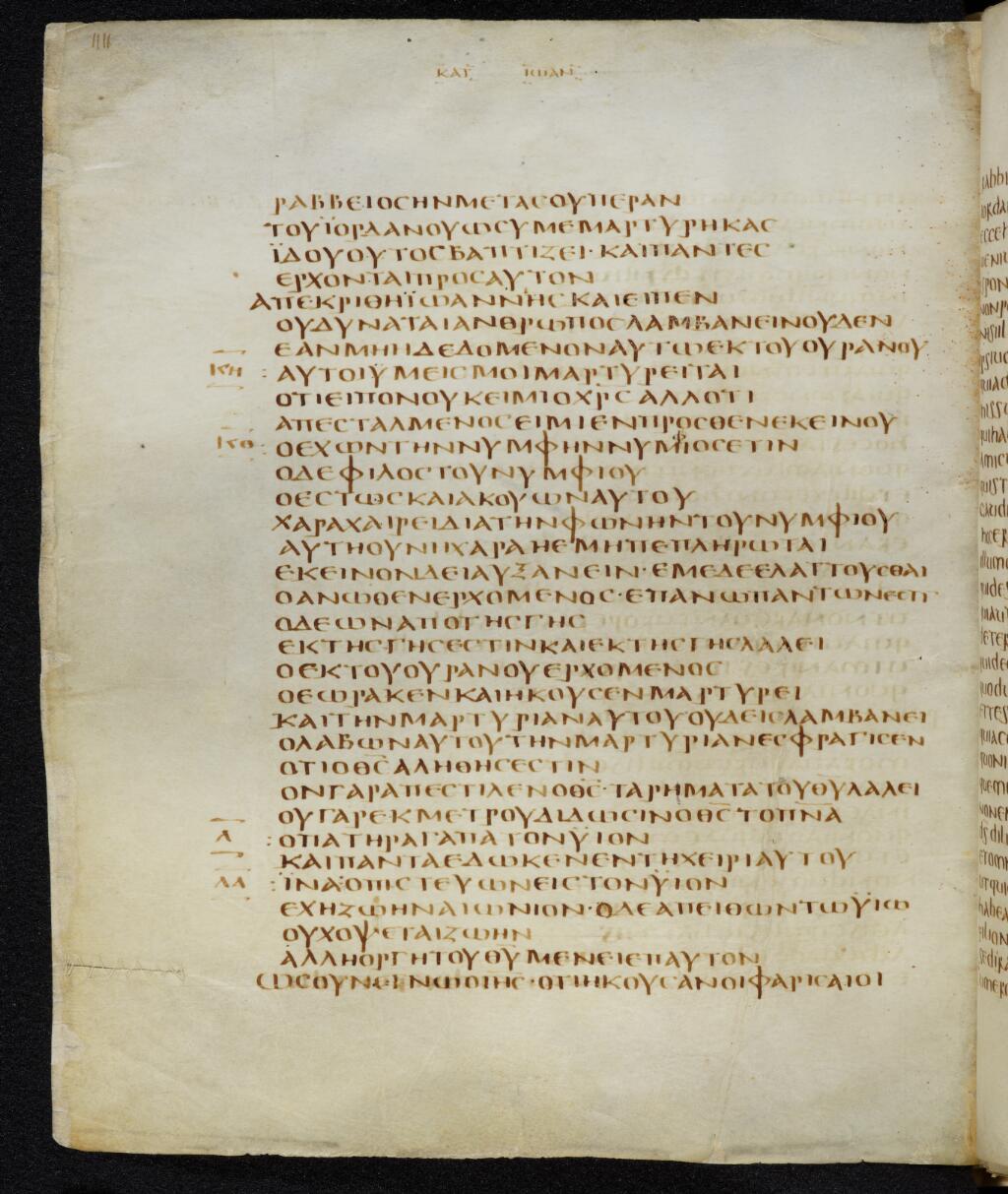
John 3 from Codex Bezae (Codex Cantabrigiensis, 5th c.), the most important Western text manuscript. A bilingual Greek/Latin codex containing the Gospels and Acts, held at Cambridge University Library.
Codex Bezae is bilingual: at each opening the Greek is on the left-hand (verso) page and the Latin on the facing right-hand (recto) page. Only the Greek pages are shown here; the Latin column is not included.
Greek text: a diplomatic transcription of Codex Bezae made by the Institut für Neutestamentliche Textforschung (INTF), Münster, for the New Testament Virtual Manuscript Room (NTVMR), published under a Creative Commons Attribution 4.0 licence. It gives the letters as the first scribe wrote them: no accents or breathings, the scribe's own spelling, and the sacred names in their contracted form (θς for θεος, ις for ιησους, κς for κυριος; the overline is not reproduced). Corrections by later hands are not shown. Letters in square brackets are not legible on the page and were restored by the transcribers, a dot under a letter marks an uncertain reading, and [...] marks text lost to damage. Beneath each section, for comparison, is Tischendorf's 8th critical edition (1869). Where the two differ, the transcription is what the manuscript says. Each section is shown with the page on which the transcription places its verses.
What survives and what is shown: Codex Bezae has lost leaves. In the Greek pages Matthew 1:1-20 (to μη φοβηθης), 6:20-9:2, 27:2-12 and John 1:16-3:26 are missing in whole or in part: Matthew 1:20, 6:20, 9:2, 27:12, John 1:16 and 3:26 survive only in part, and Matthew 27:2 only as a torn fragment. The surviving part of each edge verse is marked in both columns, and the verses in between are not shown. A few leaves were replaced by a later scribe; pages from these supplementary leaves are marked "supplement". This library so far shows only Matthew and John from the codex; its Mark, Luke and Acts are not included.
How was this verified? (Provenance)
Where on the image
Page from the NTVMR transcription (docID 20005): verses 26-36 on fol. 113v.
26[the beginning of this verse is lost with the missing leaves (John 1:16-3:26)] ραββει ος ην μετα σου περαν του ιορδανου ω συ μεμαρτυρηκας ιδου ουτος βαπτιζει · και παντες ερχονται προς αυτον 27απεκριθη ιωαννης και ειπεν ου δυναται ανθρωπος λαμβανειν ουδεν εαν μη η δεδομενον αυτω εκ του ουρανου 28αυτοι υμεις μοι μαρτυρειται οτι ειπον ουκ ειμι ο χρς αλλ οτι απεσταλμενος ειμι ενπροσθεν εκεινου 29ο εχων την νυμφην νυμιος ετιν ο δε φιλος του νυμφιου ο εστως και ακουων αυτου χαρα χαιρει δια την φωνην του νυμφιου αυτη ουν η χαρα η εμη πεπληρωται 30εκεινον δει αυξανειν · εμε δε ελαττουσθαι 31ο ανωθεν ερχομενος · επανω παντων εστιν ο δε ων απο της γης εκ της γης εστιν και εκ της γης λαλει ο εκ του ουρανου ερχομενος 32ο εωρακεν και ηκουσεν μαρτυρει και την μαρτυριαν αυτου ουδεις λαμβανει 33ο λαβων αυτου την μαρτυριαν εσφραγισεν οτι ο θς αληθης εστιν 34ον γαρ απεστιλεν ο θς · τα ρηματα του θυ λαλει ου γαρ εκ μετρου διδωσιν ο θς το πνα 35ο πατηρ αγαπα τον υιον και παντα εδωκεν εν τη χειρι αυτου 36ινα ο πιστευων εις τον υιον εχη ζωην αιωνιον · δ δε απειθων τω υιω ουχ οψεται ζωην αλλ η οργη του θυ μενει επ αυτον
Compare: Tischendorf 8th edition (1869)
26καὶ ἦλθον πρὸς τὸν Ἰωάννην καὶ εἶπον αὐτῷ· ῥαββεί, ὃς ἦν μετὰ σοῦ πέραν τοῦ Ἰορδάνου, ᾧ σὺ μεμαρτύρηκας, ἴδε οὗτος βαπτίζει καὶ πάντες ἔρχονται πρὸς αὐτόν. 27ἀπεκρίθη Ἰωάννης καὶ εἶπεν· οὐ δύναται ἄνθρωπος λαμβάνειν οὐδέν ἐὰν μὴ ᾖ δεδομένον αὐτῷ ἐκ τοῦ οὐρανοῦ. 28αὐτοὶ ὑμεῖς μοι μαρτυρεῖτε ὅτι εἶπον· οὐκ εἰμὶ ἐγὼ ὁ Χριστός, ἀλλ’ ὅτι ἀπεσταλμένος εἰμὶ ἔμπροσθεν ἐκείνου. 29ὁ ἔχων τὴν νύμφην νυμφίος ἐστίν· ὁ δὲ φίλος τοῦ νυμφίου, ὁ ἑστηκὼς καὶ ἀκούων αὐτοῦ, χαρᾷ χαίρει διὰ τὴν φωνὴν τοῦ νυμφίου. αὕτη οὖν ἡ χαρὰ ἡ ἐμὴ πεπλήρωται. 30ἐκεῖνον δεῖ αὐξάνειν, ἐμὲ δὲ ἐλαττοῦσθαι. 31ὁ ἄνωθεν ἐρχόμενος ἐπάνω πάντων ἐστίν· ὁ ὢν ἐκ τῆς γῆς ἐκ τῆς γῆς ἐστιν καὶ ἐκ τῆς γῆς λαλεῖ. ὁ ἐκ τοῦ οὐρανοῦ ἐρχόμενος 32ὃ ἑώρακεν καὶ ἤκουσεν μαρτυρεῖ, καὶ τὴν μαρτυρίαν αὐτοῦ οὐδεὶς λαμβάνει. 33ὁ λαβὼν αὐτοῦ τὴν μαρτυρίαν ἐσφράγισεν ὅτι ὁ θεὸς ἀληθής ἐστιν. 34ὃν γὰρ ἀπέστειλεν ὁ θεός, τὰ ῥήματα τοῦ θεοῦ λαλεῖ· οὐ γὰρ ἐκ μέτρου δίδωσιν τὸ πνεῦμα. 35ὁ πατὴρ ἀγαπᾷ τὸν υἱόν, καὶ πάντα δέδωκεν ἐν τῇ χειρὶ αὐτοῦ. 36ὁ πιστεύων εἰς τὸν υἱὸν ἔχει ζωὴν αἰώνιον· ὁ ἀπειθῶν τῷ υἱῷ οὐκ ὄψεται ζωήν, ἀλλ’ ἡ ὀργὴ τοῦ θεοῦ μένει ἐπ’ αὐτόν,
26[The beginning of this verse, "And they came unto John, and said unto him,", is lost with the missing leaves.] Rabbi, he that was with thee beyond Jordan, to whom thou barest witness, behold, the same baptizeth, and all men come to him. 27John answered and said, A man can receive nothing, except it be given him from heaven. 28Ye yourselves bear me witness, that I said, I am not the Christ, but that I am sent before him. 29He that hath the bride is the bridegroom: but the friend of the bridegroom, which standeth and heareth him, rejoiceth greatly because of the bridegroom’s voice: this my joy therefore is fulfilled. 30He must increase, but I must decrease. 31He that cometh from above is above all: he that is of the earth is earthly, and speaketh of the earth: he that cometh from heaven is above all. 32And what he hath seen and heard, that he testifieth; and no man receiveth his testimony. 33He that hath received his testimony hath set to his seal that God is true. 34For he whom God hath sent speaketh the words of God: for God giveth not the Spirit by measure unto him. 35The Father loveth the Son, and hath given all things into his hand. 36He that believeth on the Son hath everlasting life: and he that believeth not the Son shall not see life; but the wrath of God abideth on him.
Notes
- Codex Bezae is bilingual: at each opening the Greek is on the left-hand (verso) page and the Latin on the facing right-hand (recto) page. Only the Greek pages are shown here; the Latin column is not included.
Cite
Sources
- Source: Codex Bezae page images + NTVMR transcription (CC BY 4.0) + Tischendorf 8th edition + KJV (holding institution)
- Critical edition: Codex Bezae transcription, NTVMR (INTF Münster, CC BY 4.0); Tischendorf 8th edition for comparison
← previous · → next · v cycle view · l back to library