Matthew, Chapter 11 (Codex Bezae)
Introduction
Matthew 11 from Codex Bezae (Codex Cantabrigiensis, 5th c.), the most important Western text manuscript. A bilingual Greek/Latin codex containing the Gospels and Acts, held at Cambridge University Library.
Codex Bezae is bilingual: at each opening the Greek is on the left-hand (verso) page and the Latin on the facing right-hand (recto) page. Only the Greek pages are shown here; the Latin column is not included.
Greek text: a diplomatic transcription of Codex Bezae made by the Institut für Neutestamentliche Textforschung (INTF), Münster, for the New Testament Virtual Manuscript Room (NTVMR), published under a Creative Commons Attribution 4.0 licence. It gives the letters as the first scribe wrote them: no accents or breathings, the scribe's own spelling, and the sacred names in their contracted form (θς for θεος, ις for ιησους, κς for κυριος; the overline is not reproduced). Corrections by later hands are not shown. Letters in square brackets are not legible on the page and were restored by the transcribers, a dot under a letter marks an uncertain reading, and [...] marks text lost to damage. Beneath each section, for comparison, is Tischendorf's 8th critical edition (1869). Where the two differ, the transcription is what the manuscript says. Each section is shown with the page on which the transcription places its verses.
What survives and what is shown: Codex Bezae has lost leaves. In the Greek pages Matthew 1:1-20 (to μη φοβηθης), 6:20-9:2, 27:2-12 and John 1:16-3:26 are missing in whole or in part: Matthew 1:20, 6:20, 9:2, 27:12, John 1:16 and 3:26 survive only in part, and Matthew 27:2 only as a torn fragment. The surviving part of each edge verse is marked in both columns, and the verses in between are not shown. A few leaves were replaced by a later scribe; pages from these supplementary leaves are marked "supplement". This library so far shows only Matthew and John from the codex; its Mark, Luke and Acts are not included.
How was this verified? (Provenance)
Where on the image
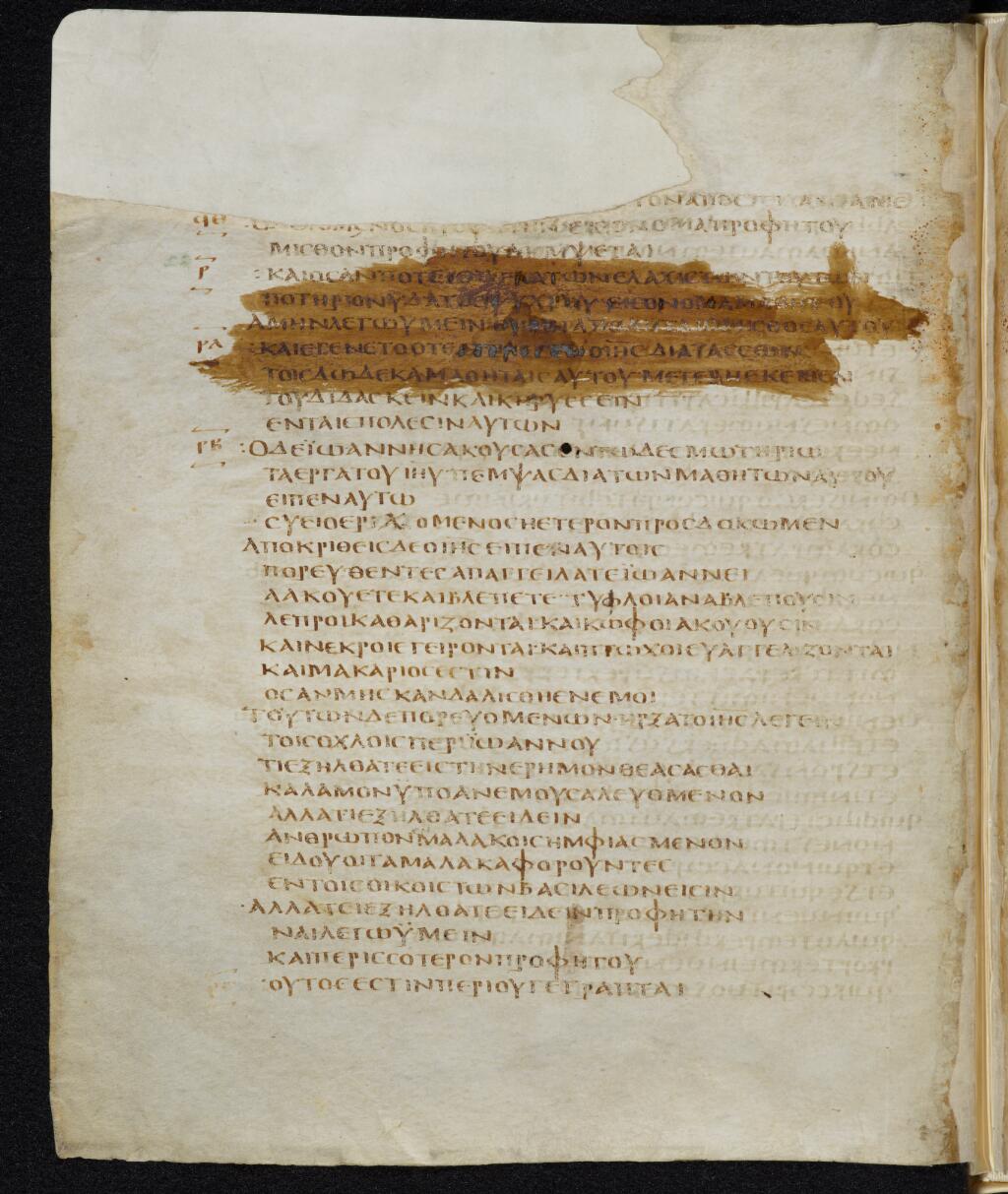
Page from the NTVMR transcription (docID 20005): verses 1-10 on fol. 32v; verse 10 continues on fol. 33v (which begins 'ιδου εγω αποστελλω').
1και εγενετο οτε ε̣τε̣λ̣ε̣σ̣[ε]ν̣ ο ιης διατασσων τοις δωδεκα μαθητ̣αις αυτου μετεβ̣η εκειθεν του διδασκειν και κηρυσσειν εν ταις πολεσιν αυτων 2ο δε ιωαννης ακουσας εν τω δεσμωτηριω τα εργα του ιηυ πεμψας δια των μαθητων αυτου 3ειπεν αυτω συ ει ο εργ̣α̣ζ̣ομενος η ετερον προσδοκωμεν 4αποκριθεις δε ο ιης ειπεν αυτοις πορευθεντες απαγγειλατε ιωαννει α ακουετε και βλεπετε · 5τυβλοι αναβλεπουσιν λεπροι καθαριζονται · και κωφοι ακουουσιν και νεκροι εγειρονται · και πτωχοι ευαγγελιζονται 6και μακαριος εστιν ος αν μη σκανδαλισθη εν εμοι 7τουτων δε πορευομενων · ηρξατο ιης λεγειν τοις οχλοις περι ιωαννου τι εξηλθατε εις την ερημον θεασασθαι καλαμον υπο ανεμου σαλευομενον 8αλλα τι εξηλθατε ειδειν ανθρωπον μαλακοις ημφιασμενον ειδου οι τα μαλακα φορουντες εν τοις οικοις των βασιλεων εισιν 9αλλα τει εξηλθατε ειδειν προφητην ναι λεγω υμειν και περισσοτερον προφητου · 10ουτος εστιν περι ου γεγραπται ιδου εγω αποστελλω τον ανγελον μου προ προσωπου σου · ος κατασκευασει την οδον σου ενπροσθεν σου
Compare: Tischendorf 8th edition (1869)
1Καὶ ἐγένετο ὅτε ἐτέλεσεν ὁ Ἰησοῦς διατάσσων τοῖς δώδεκα μαθηταῖς αὐτοῦ, μετέβη ἐκεῖθεν τοῦ διδάσκειν καὶ κηρύσσειν ἐν ταῖς πόλεσιν αὐτῶν. 2Ὁ δὲ Ἰωάννης ἀκούσας ἐν τῷ δεσμωτηρίῳ τὰ ἔργα τοῦ Χριστοῦ, πέμψας διὰ τῶν μαθητῶν αὐτοῦ 3εἶπεν αὐτῷ· σὺ εἶ ὁ ἐρχόμενος ἢ ἕτερον προσδοκῶμεν; 4καὶ ἀποκριθεὶς ὁ Ἰησοῦς εἶπεν αὐτοῖς· πορευθέντες ἀπαγγείλατε Ἰωάννῃ ἃ ἀκούετε καὶ βλέπετε· 5τυφλοὶ ἀναβλέπουσιν καὶ χωλοὶ περιπατοῦσιν, λεπροὶ καθαρίζονται καὶ κωφοὶ ἀκούουσιν, καὶ νεκροὶ ἐγείρονται καὶ πτωχοὶ εὐαγγελίζονται· 6καὶ μακάριός ἐστιν ὃς ἐὰν μὴ σκανδαλισθῇ ἐν ἐμοί. 7Τούτων δὲ πορευομένων ἤρξατο ὁ Ἰησοῦς λέγειν τοῖς ὄχλοις περὶ Ἰωάννου· τί ἐξήλθατε εἰς τὴν ἔρημον θεάσασθαι; κάλαμον ὑπὸ ἀνέμου σαλευόμενον; 8ἀλλὰ τί ἐξήλθατε ἰδεῖν; ἄνθρωπον ἐν μαλακοῖς ἠμφιεσμένον; ἰδοὺ οἱ τὰ μαλακὰ φοροῦντες ἐν τοῖς οἴκοις τῶν βασιλέων. 9ἀλλὰ τί ἐξήλθατε; προφήτην ἰδεῖν; ναί λέγω ὑμῖν, καὶ περισσότερον προφήτου. 10οὗτός ἐστιν περὶ οὗ γέγραπται· ἰδοὺ ἐγὼ ἀποστέλλω τὸν ἄγγελόν μου πρὸ προσώπου σου, ὃς κατασκευάσει τὴν ὁδόν σου ἔμπροσθέν σου.
1And it came to pass, when Jesus had made an end of commanding his twelve disciples, he departed thence to teach and to preach in their cities. 2Now when John had heard in the prison the works of Christ, he sent two of his disciples, 3And said unto him, Art thou he that should come, or do we look for another? 4Jesus answered and said unto them, Go and shew John again those things which ye do hear and see: 5The blind receive their sight, and the lame walk, the lepers are cleansed, and the deaf hear, the dead are raised up, and the poor have the gospel preached to them. 6And blessed is he, whosoever shall not be offended in me. 7And as they departed, Jesus began to say unto the multitudes concerning John, What went ye out into the wilderness to see? A reed shaken with the wind? 8But what went ye out for to see? A man clothed in soft raiment? behold, they that wear soft clothing are in kings’ houses. 9But what went ye out for to see? A prophet? yea, I say unto you, and more than a prophet. 10For this is he, of whom it is written, Behold, I send my messenger before thy face, which shall prepare thy way before thee.
Where on the image
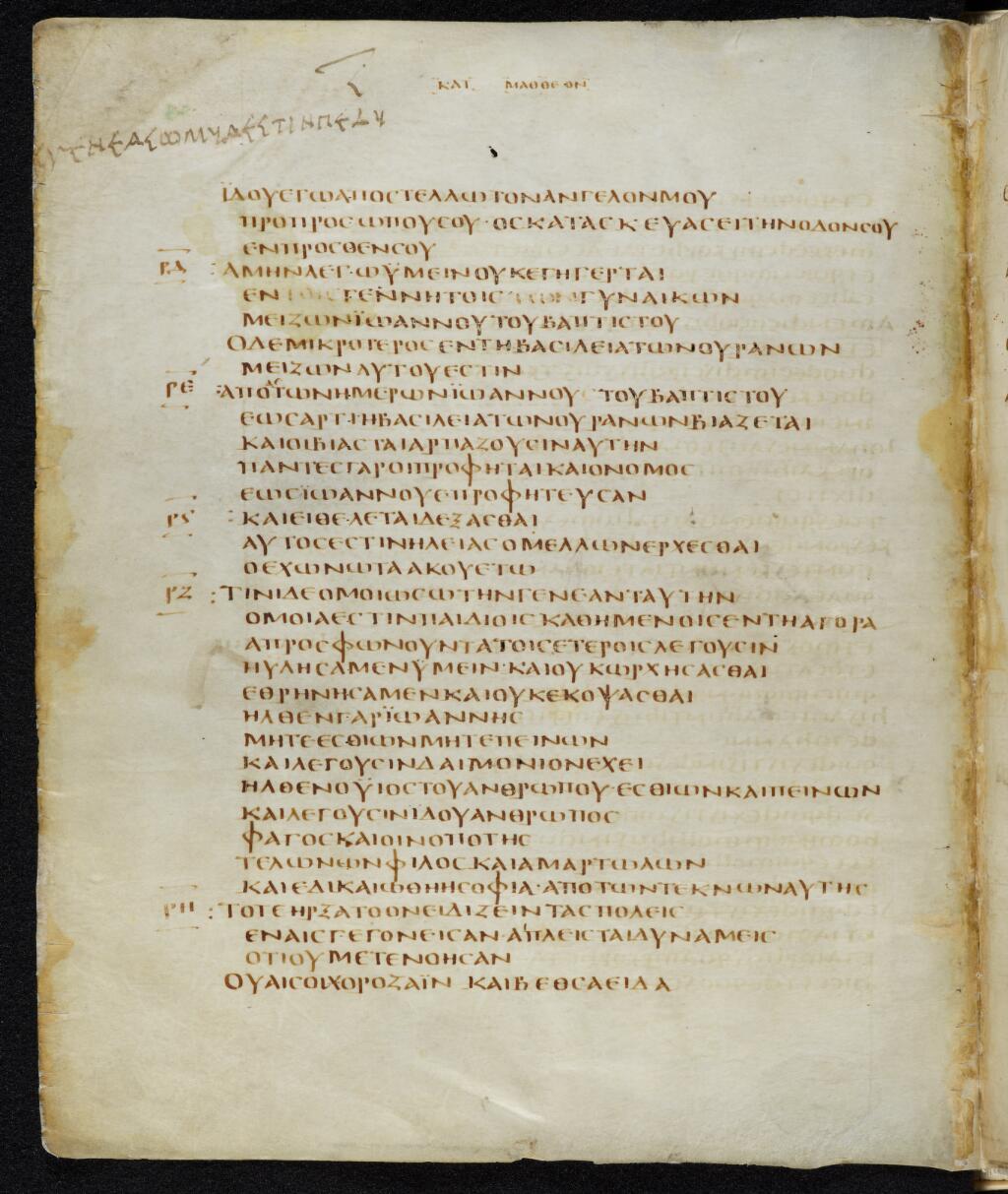
Page from the NTVMR transcription (docID 20005): verses 11-21 on fol. 33v; verse 21 continues on fol. 34v (which begins 'οτι ει εν').
11αμην λεγω υμειν ουκ εγηγερται εν τοις γεννητοις των γυναικων μειζων ιωαννου του βαπτιστου ο δε μικροτερος εν τη βασιλεια των ουρανων μειζων αυτου εστιν 12απο των ημερων ιωαννους του βαπτιστου εως αρτι · η βασιλεια των ουρανων βιαζεται και οι βιασται αρπαζουσιν αυτην 13παντες γαρ οι προφηται και ο νομος εως ιωαννου επροφητευσαν 14και ει θελεται δεξασθαι αυτος εστιν ηλειας ο μελλων ερχεσθαι 15ο εχων ωτα ακουετω 16τινι δε ομοιωσω την γενεαν ταυτην ομοια εστιν παιδιοις καθημενοις εν τη αγορα α προσφωνουντα τοις ετεροις 17λεγουσιν ηυλησαμεν υμειν · και ουκ ωρχησασθαι εθρηνησαμεν και ουκ εκοψασθαι 18ηλθεν γαρ ιωαννης μητε εσθιων μητε πεινων και λεγουσιν δαιμονιον εχει 19ηλθεν ο υιος του ανθρωπου εσθιων και πεινων και λεγουσιν ιδου ανθρωπος φαγος και οινοποτης τελωνων φιλος και αμαρτωλων και εδικαιωθη η σοφια · απο των τεκνων αυτης 20τοτε ηρξατο ονειδιζειν τας πολεις εν αις γεγονεισαν α πλεισται δυναμεις οτι ου μετενοησαν 21ουαι σοι χοροζαιν και βεθσαειδα οτι ει εν τυρω και σιδωνει · εγεγονεισαν αι δυναμεις · αι γενομεναι εν υμειν παλαι αν εν σακκω και σποδω μετενοησαν
Compare: Tischendorf 8th edition (1869)
11ἀμὴν λέγω ὑμῖν, οὐκ ἐγήγερται ἐν γεννητοῖς γυναικῶν μείζων Ἰωάννου τοῦ βαπτιστοῦ· ὁ δὲ μικρότερος ἐν τῇ βασιλείᾳ τῶν οὐρανῶν μείζων αὐτοῦ ἐστιν. 12ἀπὸ δὲ τῶν ἡμερῶν Ἰωάννου τοῦ βαπτιστοῦ ἕως ἄρτι ἡ βασιλεία τῶν οὐρανῶν βιάζεται, καὶ βιασταὶ ἁρπάζουσιν αὐτήν. 13πάντες γὰρ οἱ προφῆται καὶ ὁ νόμος ἕως Ἰωάννου ἐπροφήτευσαν, 14καὶ εἰ θέλετε δέξασθαι, αὐτός ἐστιν Ἡλείας ὁ μέλλων ἔρχεσθαι. 15ὁ ἔχων ὦτα ἀκουέτω. 16Τίνι δὲ ὁμοιώσω τὴν γενεὰν ταύτην; ὁμοία ἐστὶν παιδίοις καθημένοις ἐν ταῖς ἀγοραῖς ἃ προσφωνοῦντα τοῖς ἑτέροις 17λέγουσιν· ηὐλήσαμεν ὑμῖν καὶ οὐκ ὠρχήσασθε· ἐθρηνήσαμεν καὶ οὐκ ἐκόψασθε. 18ἦλθεν γὰρ Ἰωάννης μήτε ἐσθίων μήτε πίνων, καὶ λέγουσιν, δαιμόνιον ἔχει· 19ἦλθεν ὁ υἱὸς τοῦ ἀνθρώπου ἐσθίων καὶ πίνων, καὶ λέγουσιν· ἰδοὺ ἄνθρωπος φάγος καὶ οἰνοπότης, τελωνῶν φίλος καὶ ἁμαρτωλῶν. καὶ ἐδικαιώθη ἡ σοφία ἀπὸ τῶν ἔργων αὐτῆς. 20Τότε ἤρξατο ὀνειδίζειν τὰς πόλεις ἐν αἷς ἐγένοντο αἱ πλεῖσται δυνάμεις αὐτοῦ, ὅτι οὐ μετενόησαν· 21οὐαί σοι, Χοραζείν, οὐαί σοι, Βηθσαϊδάν, ὅτι εἰ ἐν Τύρῳ καὶ Σιδῶνι ἐγένοντο αἱ δυνάμεις αἱ γενόμεναι ἐν ὑμῖν, πάλαι ἂν ἐν σάκκῳ καὶ σποδῷ μετενόησαν.
11Verily I say unto you, Among them that are born of women there hath not risen a greater than John the Baptist: notwithstanding he that is least in the kingdom of heaven is greater than he. 12And from the days of John the Baptist until now the kingdom of heaven suffereth violence, and the violent take it by force. 13For all the prophets and the law prophesied until John. 14And if ye will receive it, this is Elias, which was for to come. 15He that hath ears to hear, let him hear. 16But whereunto shall I liken this generation? It is like unto children sitting in the markets, and calling unto their fellows, 17And saying, We have piped unto you, and ye have not danced; we have mourned unto you, and ye have not lamented. 18For John came neither eating nor drinking, and they say, He hath a devil. 19The Son of man came eating and drinking, and they say, Behold a man gluttonous, and a winebibber, a friend of publicans and sinners. But wisdom is justified of her children. 20Then began he to upbraid the cities wherein most of his mighty works were done, because they repented not: 21Woe unto thee, Chorazin! woe unto thee, Bethsaida! for if the mighty works, which were done in you, had been done in Tyre and Sidon, they would have repented long ago in sackcloth and ashes.
Where on the image
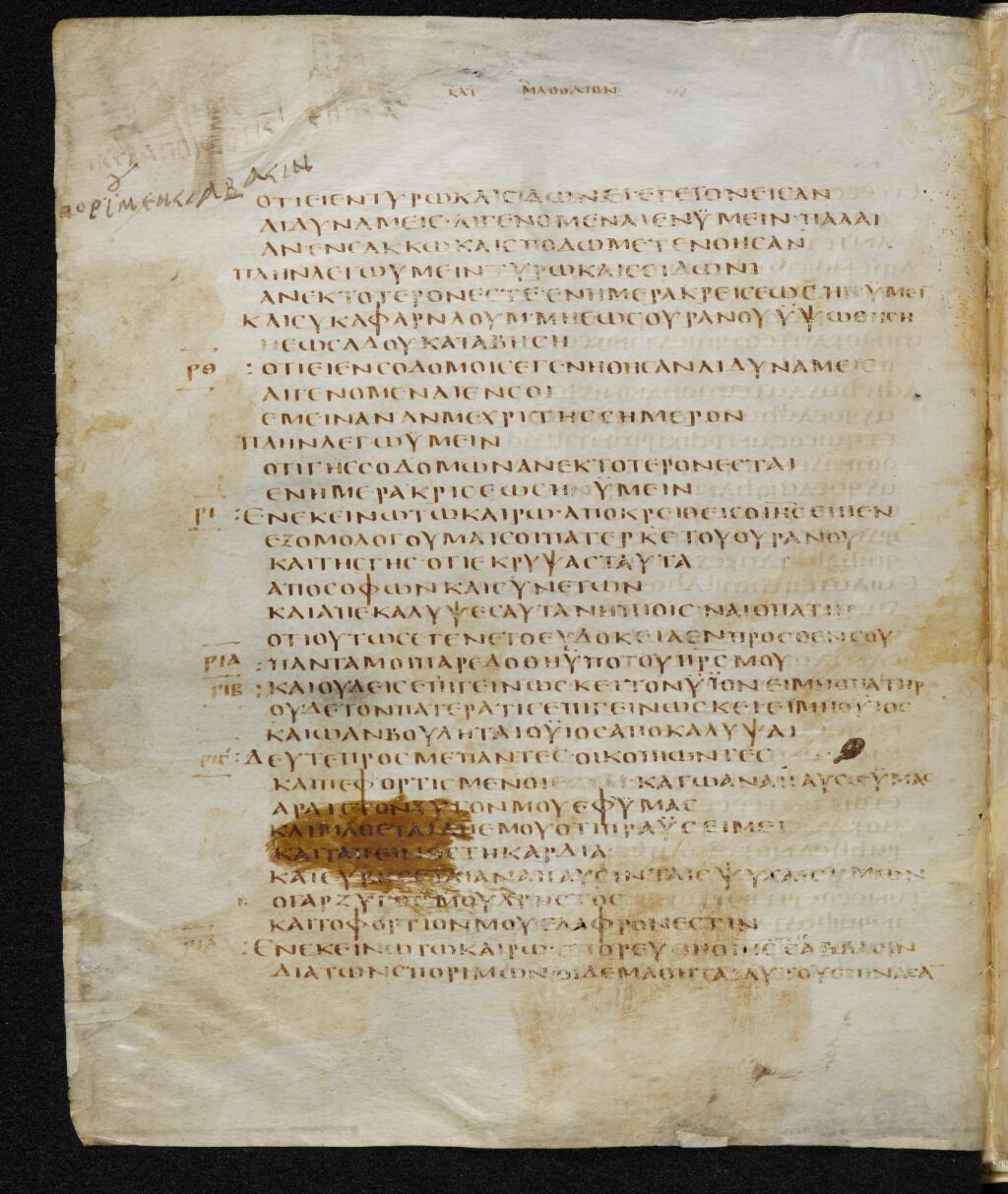
Page from the NTVMR transcription (docID 20005): verses 22-30 on fol. 34v.
22πλην λεγω υμειν τυρω και σειδωνι ανεκτοτερον εστε · εν ημερα κρεισεως ην υμειν 23και συ καφαρναουμ · μη εως ουρανου υψωθηση η εως αδου καταβηση οτι ει εν σοδομοις εγενηθησαν αι δυναμεις · αι γενομεναι εν σοι εμειναν αν μεχρι της σημερον 24πλην λεγω υμειν οτι γης σοδομων ανεκτοτερον εσται εν ημερα κρισεως ην υμειν 25εν εκεινω τω καιρω · αποκρειθεις ο ιης ειπεν · εξομολογουμαι σοι πατερ κε του ουρανου και της γης · οτι εκρυψας ταυτα απο σοφων και συνετων · και απεκαλυψες αυτα νηπιοις 26ναι ο πατηρ οτι ουτως εγενετο ευδοκεια ενπροσθεν σου 27παντα μοι παρεδοθη υπο του πρς μου και ουδεις επιγεινωσκει τον υιον ει μη ο πατηρ ουδε τον πατερα τις επιγεινωσκει ει μη ο υιος και ω αν βουληται ο υιος αποκαλυψαι · 28δευτε προς με παντες οι κοπιωντες και πεφορτισμενοι εσται καγω αναπαυσω̣ υμας 29αρατε τον ζυγον μου εφ υμας και μαθεται απ εμου οτι πραυς ειμει και ταπεινος τη καρδια · και ευρησεται αναπαυσιν ταις ψυχαις υ̣μων 30ο γαρ ζυγος μου χρηστος και το φορτιον μου ελαφρον εστιν
Compare: Tischendorf 8th edition (1869)
22πλὴν λέγω ὑμῖν, Τύρῳ καὶ Σιδῶνι ἀνεκτότερον ἔσται ἐν ἡμέρᾳ κρίσεως ἢ ὑμῖν. 23καὶ σύ, Καφαρναούμ, μὴ ἕως οὐρανοῦ ὑψωθήσῃ; ἕως ᾅδου καταβιβασθήσῃ, ὅτι εἰ ἐν Σοδόμοις ἐγενήθησαν αἱ δυνάμεις αἱ γενόμεναι ἐν σοί, ἔμεινεν ἂν μέχρι τῆς σήμερον. 24πλὴν λέγω ὑμῖν ὅτι γῇ Σοδόμων ἀνεκτότερον ἔσται ἐν ἡμέρᾳ κρίσεως ἢ σοί. 25Ἐν ἐκείνῳ τῷ καιρῷ ἀποκριθεὶς ὁ Ἰησοῦς εἶπεν· ἐξομολογοῦμαί σοι, πάτερ, κύριε τοῦ οὐρανοῦ καὶ τῆς γῆς, ὅτι ἔκρυψας ταῦτα ἀπὸ σοφῶν καὶ συνετῶν, καὶ ἀπεκάλυψας αὐτὰ νηπίοις· 26ναί ὁ πατήρ, ὅτι οὕτως εὐδοκία ἐγένετο ἔμπροσθέν σου. 27Πάντα μοι παρεδόθη ὑπὸ τοῦ πατρός μου, καὶ οὐδεὶς ἐπιγινώσκει τὸν υἱὸν εἰ μὴ ὁ πατήρ, οὐδὲ τὸν πατέρα τις ἐπιγινώσκει εἰ μὴ ὁ υἱὸς καὶ ᾧ ἐὰν βούληται ὁ υἱὸς ἀποκαλύψαι. 28Δεῦτε πρός με πάντες οἱ κοπιῶντες καὶ πεφορτισμένοι, κἀγὼ ἀναπαύσω ὑμᾶς. 29ἄρατε τὸν ζυγόν μου ἐφ’ ὑμᾶς καὶ μάθετε ἀπ’ ἐμοῦ, ὅτι πραΰς εἰμι καὶ ταπεινὸς τῇ καρδίᾳ, καὶ εὑρήσετε ἀνάπαυσιν ταῖς ψυχαῖς ὑμῶν· 30ὁ γὰρ ζυγός μου χρηστὸς καὶ τὸ φορτίον μου ἐλαφρόν ἐστιν.
22But I say unto you, It shall be more tolerable for Tyre and Sidon at the day of judgment, than for you. 23And thou, Capernaum, which art exalted unto heaven, shalt be brought down to hell: for if the mighty works, which have been done in thee, had been done in Sodom, it would have remained until this day. 24But I say unto you, That it shall be more tolerable for the land of Sodom in the day of judgment, than for thee. 25At that time Jesus answered and said, I thank thee, O Father, Lord of heaven and earth, because thou hast hid these things from the wise and prudent, and hast revealed them unto babes. 26Even so, Father: for so it seemed good in thy sight. 27All things are delivered unto me of my Father: and no man knoweth the Son, but the Father; neither knoweth any man the Father, save the Son, and he to whomsoever the Son will reveal him. 28Come unto me, all ye that labour and are heavy laden, and I will give you rest. 29Take my yoke upon you, and learn of me; for I am meek and lowly in heart: and ye shall find rest unto your souls. 30For my yoke is easy, and my burden is light.
Notes
- Codex Bezae is bilingual: at each opening the Greek is on the left-hand (verso) page and the Latin on the facing right-hand (recto) page. Only the Greek pages are shown here; the Latin column is not included.
Cite
Sources
- Source: Codex Bezae page images + NTVMR transcription (CC BY 4.0) + Tischendorf 8th edition + KJV (holding institution)
- Critical edition: Codex Bezae transcription, NTVMR (INTF Münster, CC BY 4.0); Tischendorf 8th edition for comparison
← previous · → next · v cycle view · l back to library