Matthew, Chapter 18 (Codex Bezae)
Introduction
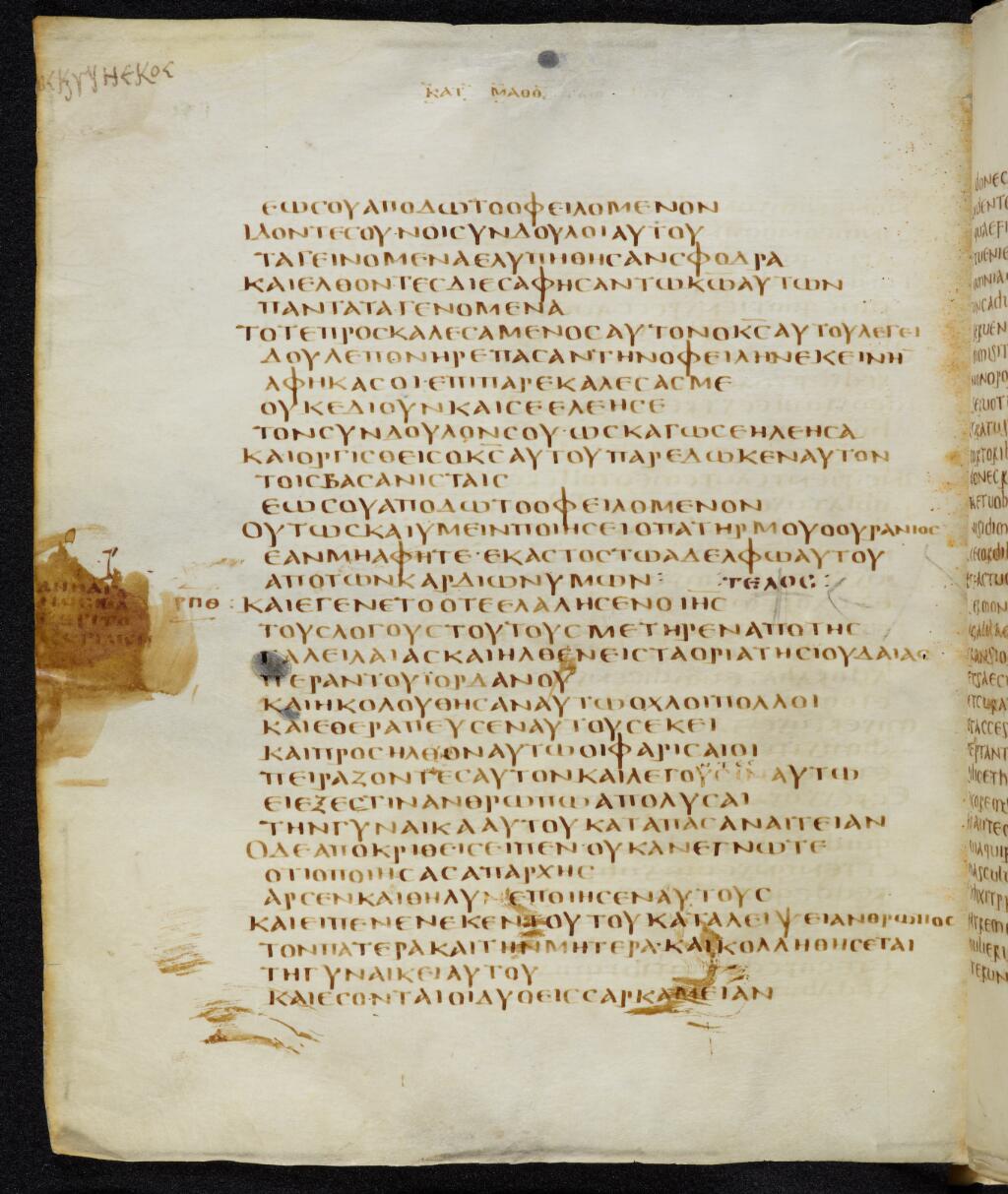
Matthew 18 from Codex Bezae (Codex Cantabrigiensis, 5th c.), the most important Western text manuscript. A bilingual Greek/Latin codex containing the Gospels and Acts, held at Cambridge University Library.
Codex Bezae is bilingual: at each opening the Greek is on the left-hand (verso) page and the Latin on the facing right-hand (recto) page. Only the Greek pages are shown here; the Latin column is not included.
Greek text: a diplomatic transcription of Codex Bezae made by the Institut für Neutestamentliche Textforschung (INTF), Münster, for the New Testament Virtual Manuscript Room (NTVMR), published under a Creative Commons Attribution 4.0 licence. It gives the letters as the first scribe wrote them: no accents or breathings, the scribe's own spelling, and the sacred names in their contracted form (θς for θεος, ις for ιησους, κς for κυριος; the overline is not reproduced). Corrections by later hands are not shown. Letters in square brackets are not legible on the page and were restored by the transcribers, a dot under a letter marks an uncertain reading, and [...] marks text lost to damage. Beneath each section, for comparison, is Tischendorf's 8th critical edition (1869). Where the two differ, the transcription is what the manuscript says. Each section is shown with the page on which the transcription places its verses.
What survives and what is shown: Codex Bezae has lost leaves. In the Greek pages Matthew 1:1-20 (to μη φοβηθης), 6:20-9:2, 27:2-12 and John 1:16-3:26 are missing in whole or in part: Matthew 1:20, 6:20, 9:2, 27:12, John 1:16 and 3:26 survive only in part, and Matthew 27:2 only as a torn fragment. The surviving part of each edge verse is marked in both columns, and the verses in between are not shown. A few leaves were replaced by a later scribe; pages from these supplementary leaves are marked "supplement". This library so far shows only Matthew and John from the codex; its Mark, Luke and Acts are not included.
How was this verified? (Provenance)
Where on the image
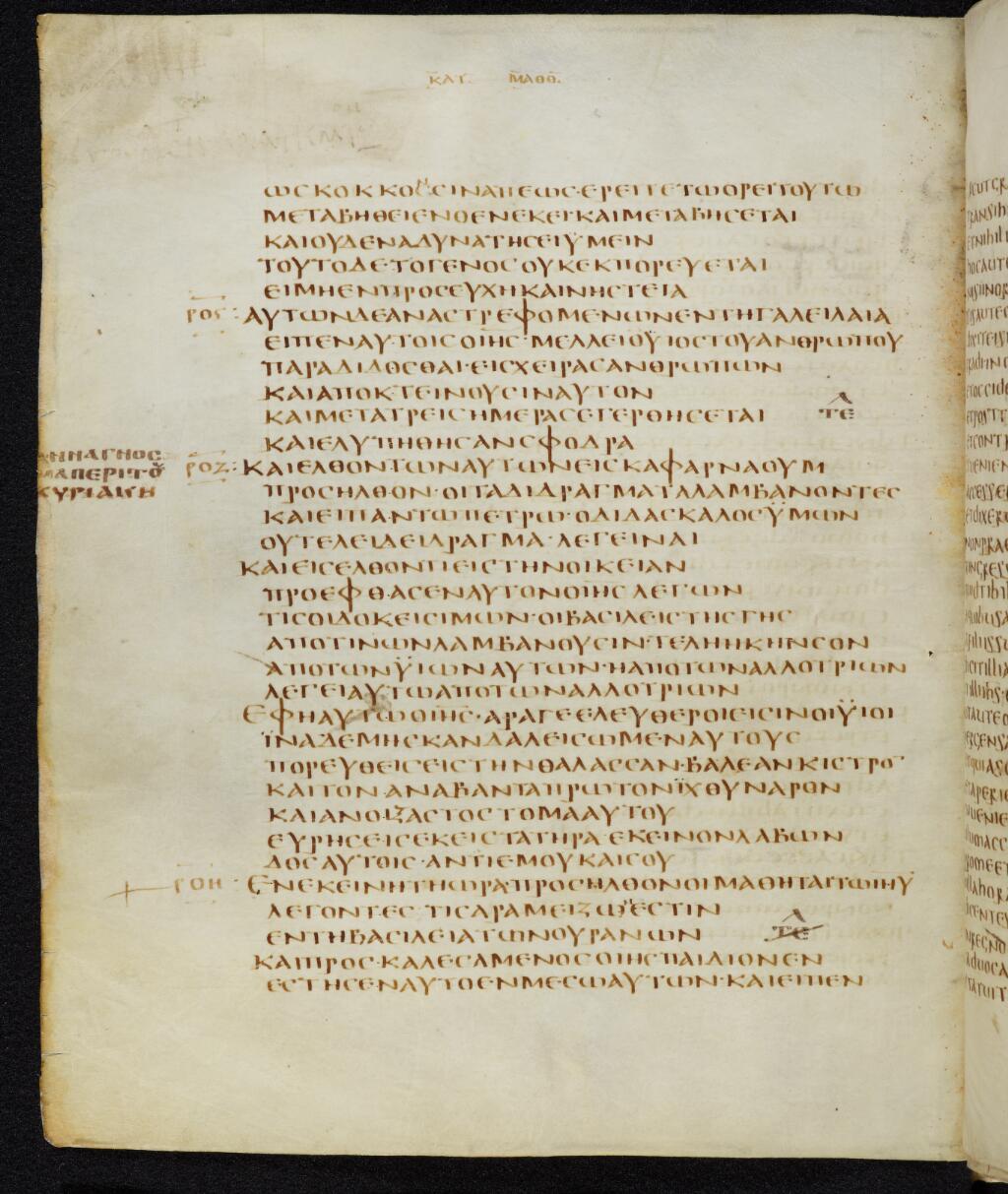
Page from the NTVMR transcription (docID 20005): verses 1-3 on fol. 57v; verse 3 continues on fol. 58v (which begins 'αμην λεγω υμειν').
1εν εκεινη τη ωρα · προσηλθον οι μαθηται τω ιηυ λεγοντες · τις αρα μειζω εστιν εν τη βασιλεια των ουρανων 2και προσκαλεσαμενος ο ιης παιδιον εν εστησεν αυτο εν μεσω αυτων · 3και ειπεν αμην λεγω υμειν · εαν μη στραφηται και γενησθε ως τα παιδια · ου μη εισελθητε εις την βασιλειαν των ουρανων
Compare: Tischendorf 8th edition (1869)
1Ἐν ἐκείνῃ τῇ ὥρᾳ προσῆλθον οἱ μαθηταὶ τῷ Ἰησοῦ λέγοντες· τίς ἄρα μείζων ἐστὶν ἐν τῇ βασιλείᾳ τῶν οὐρανῶν; 2καὶ προσκαλεσάμενος παιδίον ἔστησεν αὐτὸ ἐν μέσῳ αὐτῶν 3καὶ εἶπεν· ἀμὴν λέγω ὑμῖν, ἐὰν μὴ στραφῆτε καὶ γένησθε ὡς τὰ παιδία, οὐ μὴ εἰσέλθητε εἰς τὴν βασιλείαν τῶν οὐρανῶν.
1At the same time came the disciples unto Jesus, saying, Who is the greatest in the kingdom of heaven? 2And Jesus called a little child unto him, and set him in the midst of them, 3And said, Verily I say unto you, Except ye be converted, and become as little children, ye shall not enter into the kingdom of heaven.
Where on the image
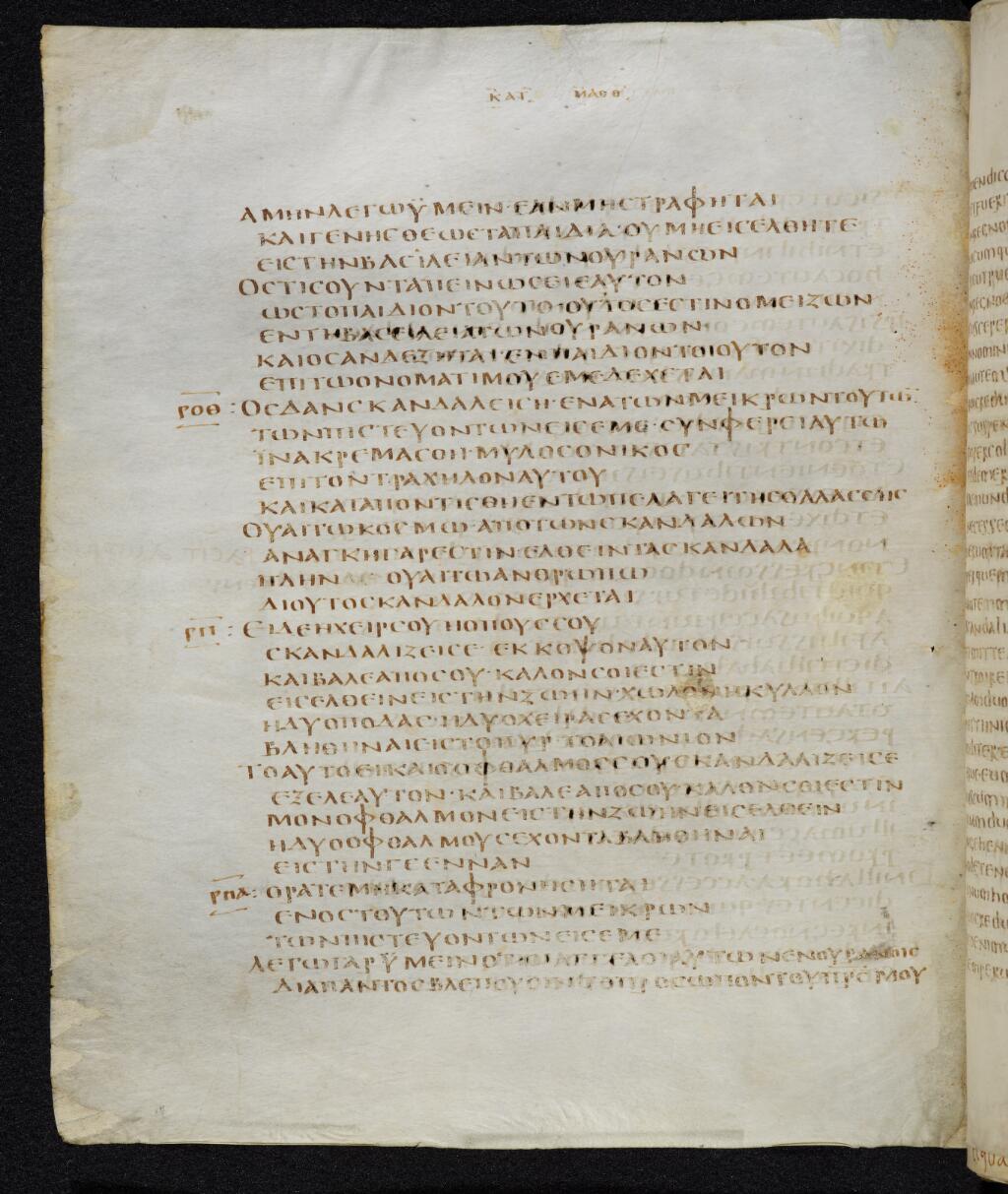
Page from the NTVMR transcription (docID 20005): verses 4-10 on fol. 58v; verse 10 continues on fol. 59v (which begins 'του εν τοις').
4οστις ουν ταπεινωσει εαυτον ως το παιδιον τουτο · ουτος εστιν ο μειζων εν τη βασειλεια των ουρανων 5και ος αν δεξηται · εν παιδιον τοιουτον επι τω ονοματι μου εμε δεχεται 6ος δ αν σκανδαλειση · ενα των μεικρων τουτων των πιστευοντων εις εμε · συνφερει αυτω ινα κρεμασθη · μυλος ονικος επι τον τραχηλον αυτου και καταποντισθη εν τω πελαγει της θαλασσης 7ουαι τω κοσμω · απο των σκανδαλων αναγκη γαρ εστιν · ελθειν τα σκανδαλα πλην δε ουαι τω ανθρωπω δι ου το σκανδαλον ερχεται 8ει δε η χειρ σου η ο πους σου σκανδαλιζει σε · εκκοψον αυτον και βαλε απο σου · καλον σοι εστιν εισελθειν εις την ζωην · χωλον η κυλλον η δυο ποδας · η δυο χειρας εχοντα βληθηναι εις το πυρ το αιωνιον 9το αυτο ει και ο οφθαλμος σου σκανδαλιζει σε εξελε αυτον · και βαλε απο σου καλον σοι εστιν μονοφθαλμον εις την ζωην εισελθειν η δυο οφθαλμους εχοντα βληθηναι εις την γεενναν 10ορατε μη καταφρονησηται ενος τουτων των μεικρων των πιστευοντων εις εμε λεγω γαρ υμειν οτι οι αγγελοι αυτων εν ουρανοις δια παντος βλεπουσιν το προσωπον του πρς μου του εν τοις ουρανοις
Compare: Tischendorf 8th edition (1869)
4ὅστις οὖν ταπεινώσει ἑαυτὸν ὡς τὸ παιδίον τοῦτο, οὗτός ἐστιν ὁ μείζων ἐν τῇ βασιλείᾳ τῶν οὐρανῶν. 5καὶ ὃς ἐὰν δέξηται ἓν παιδίον τοιοῦτο ἐπὶ τῷ ὀνόματί μου, ἐμὲ δέχεται. 6ὃς δ’ ἂν σκανδαλίσῃ ἕνα τῶν μικρῶν τούτων τῶν πιστευόντων εἰς ἐμέ, συμφέρει αὐτῷ ἵνα κρεμασθῇ μύλος ὀνικὸς περὶ τὸν τράχηλον αὐτοῦ καὶ καταποντισθῇ ἐν τῷ πελάγει τῆς θαλάσσης. 7Οὐαὶ τῷ κόσμῳ ἀπὸ τῶν σκανδάλων· ἀνάγκη γὰρ ἐστιν ἐλθεῖν τὰ σκάνδαλα, πλὴν οὐαὶ τῷ ἀνθρώπῳ δι’ οὗ τὸ σκάνδαλον ἔρχεται. 8εἰ δὲ ἡ χείρ σου ἢ ὁ πούς σου σκανδαλίζει σε, ἔκκοψον αὐτὸν καὶ βάλε ἀπὸ σοῦ· καλόν σοί ἐστιν εἰσελθεῖν εἰς τὴν ζωὴν κυλλὸν ἢ χωλόν, ἢ δύο χεῖρας ἢ δύο πόδας ἔχοντα βληθῆναι εἰς τὸ πῦρ τὸ αἰώνιον. 9καὶ εἰ ὁ ὀφθαλμός σου σκανδαλίζει σε, ἔξελε αὐτὸν καὶ βάλε ἀπὸ σοῦ· καλόν σοί ἐστιν μονόφθαλμον εἰς τὴν ζωὴν εἰσελθεῖν, ἢ δύο ὀφθαλμοὺς ἔχοντα βληθῆναι εἰς τὴν γέενναν τοῦ πυρός. 10Ὁρᾶτε μὴ καταφρονήσητε ἑνὸς τῶν μικρῶν τούτων· λέγω γὰρ ὑμῖν ὅτι οἱ ἄγγελοι αὐτῶν ἐν οὐρανοῖς διὰ παντὸς βλέπουσιν τὸ πρόσωπον τοῦ πατρός μου τοῦ ἐν οὐρανοῖς.
4Whosoever therefore shall humble himself as this little child, the same is greatest in the kingdom of heaven. 5And whoso shall receive one such little child in my name receiveth me. 6But whoso shall offend one of these little ones which believe in me, it were better for him that a millstone were hanged about his neck, and that he were drowned in the depth of the sea. 7Woe unto the world because of offences! for it must needs be that offences come; but woe to that man by whom the offence cometh! 8Wherefore if thy hand or thy foot offend thee, cut them off, and cast them from thee: it is better for thee to enter into life halt or maimed, rather than having two hands or two feet to be cast into everlasting fire. 9And if thine eye offend thee, pluck it out, and cast it from thee: it is better for thee to enter into life with one eye, rather than having two eyes to be cast into hell fire. 10Take heed that ye despise not one of these little ones; for I say unto you, That in heaven their angels do always behold the face of my Father which is in heaven.
Where on the image
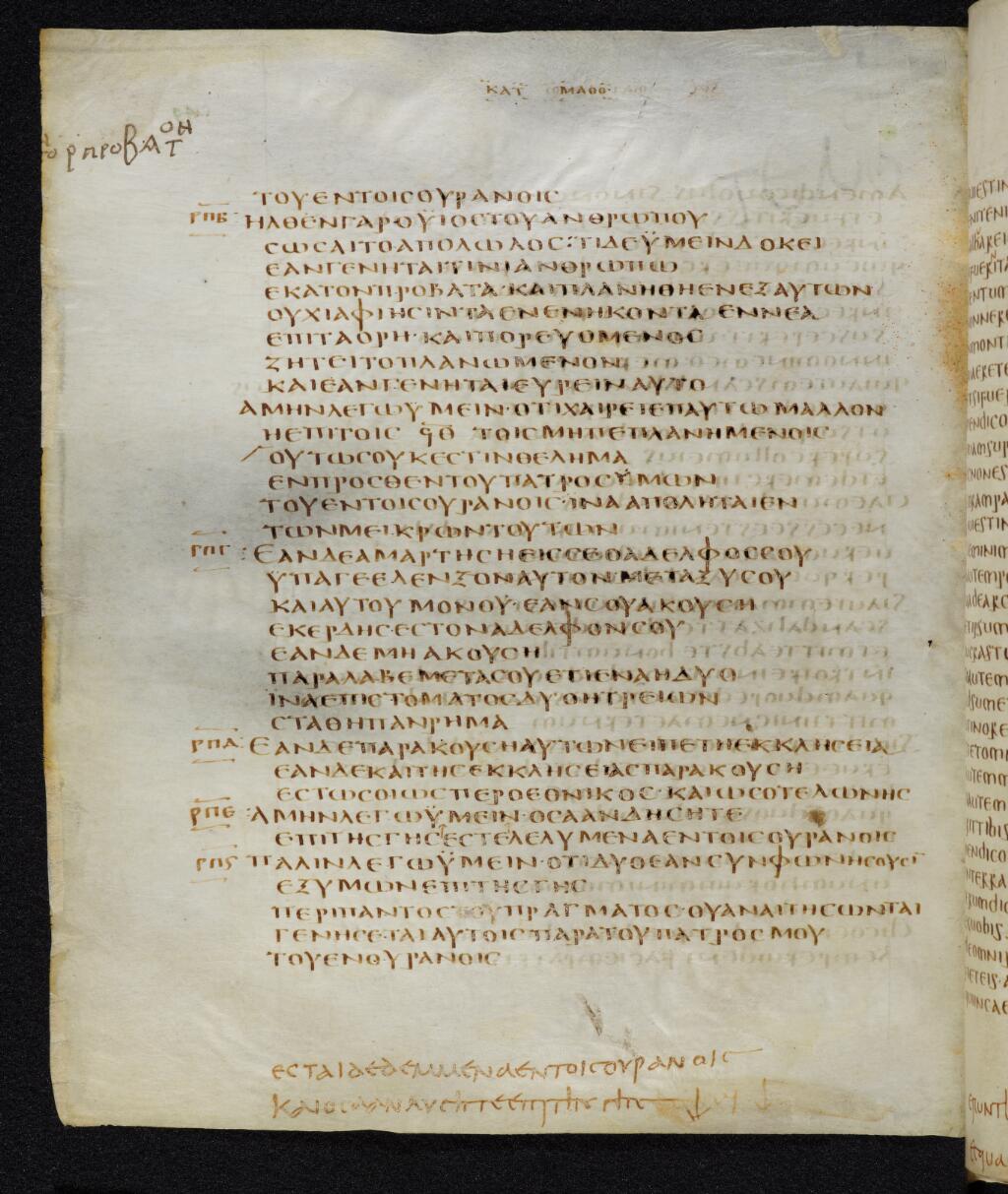
Page from the NTVMR transcription (docID 20005): verses 11-19 on fol. 59v.
11ηλθεν γαρ ο υιος του ανθρωπου σωσαι το απολωλος · 12τι δε υμειν δοκει εαν γενηται τινι ανθρωπω εκατον προβατα · και πλανηθη εν εξ αυτων ουχι αφιησιν τα ενενηκοντα εννεα επι τα ορη · και πορευομενος ζητει το πλανωμενον 13και εαν γενηται ευρειν αυτο αμην λεγω υμειν · οτι χαιρει επ αυτω μαλλον η επι τοις ϙθ τοις μη πεπλανημενοις 14ουτως ουκ εστιν θελημα ενπροσθεν του πατρος ημων του εν τοις ουρανοις · ινα αποληται εν των μεικρων τουτων 15εαν δε αμαρτηση εις σε ο αδελφος σου υπαγε ελενξον αυτον · μεταξυ σου και αυτου μονου · εαν σου ακουση εκερδησες τον αδελφον σου 16εαν δε μη ακουση παραλαβε μετα σου ετι ενα η δυο ινα επι στοματος δυο η τρειων σταθη παν ρημα 17εαν δε παρακουση αυτων ειπε τη εκκλησεια εαν δε και της εκκλησειας παρακουση εστω σοι ωσπερ ο εθνικος · και ως ο τελωνης 18αμην λεγω υμειν · οσα αν δησητε επι της γης εστε λελυμενα εν τοις ουρανοις 19παλιν λεγω υμειν · οτι δυο εαν συνφωνησουσιν εξ υμων επι της γης περι παντος του πραγματος · ου αν αιτησωνται γενησεται αυτοις παρα του πατρος μου του εν ουρανοις
Compare: Tischendorf 8th edition (1869)
12Τί ὑμῖν δοκεῖ; ἐὰν γένηταί τινι ἀνθρώπῳ ἑκατὸν πρόβατα καὶ πλανηθῇ ἓν ἐξ αὐτῶν, οὐχὶ ἀφεὶς τὰ ἐνενήκοντα ἐννέα ἐπὶ τὰ ὄρη πορευθεὶς ζητεῖ τὸ πλανώμενον; 13καὶ ἐὰν γένηται εὑρεῖν αὐτό, ἀμὴν λέγω ὑμῖν ὅτι χαίρει ἐπ’ αὐτῷ μᾶλλον ἢ ἐπὶ τοῖς ἐνενήκοντα ἐννέα τοῖς μὴ πεπλανημένοις. 14οὕτως οὐκ ἔστιν θέλημα ἔμπροσθεν τοῦ πατρὸς ὑμῶν τοῦ ἐν οὐρανοῖς ἵνα ἀπόληται ἓν τῶν μικρῶν τούτων. 15Ἐὰν δὲ ἁμαρτήσῃ ὁ ἀδελφός σου, ὕπαγε ἔλεγξον αὐτὸν μεταξὺ σοῦ καὶ αὐτοῦ μόνου· ἐάν σου ἀκούσῃ, ἐκέρδησας τὸν ἀδελφόν σου. 16ἐὰν δὲ μὴ ἀκούσῃ, παράλαβε μετὰ σεαυτοῦ ἔτι ἕνα ἢ δύο, ἵνα ἐπὶ στόματος δύο μαρτύρων ἢ τριῶν σταθῇ πᾶν ῥῆμα. 17ἐὰν δὲ παρακούσῃ αὐτῶν, εἰπὸν τῇ ἐκκλησίᾳ· ἐὰν δὲ καὶ τῆς ἐκκλησίας παρακούσῃ, ἔστω σοι ὥσπερ ὁ ἐθνικὸς καὶ ὁ τελώνης. 18Ἀμὴν λέγω ὑμῖν, ὅσα ἐὰν δήσητε ἐπὶ τῆς γῆς ἔσται δεδεμένα ἐν οὐρανῷ καὶ ὅσα ἐὰν λύσητε ἐπὶ τῆς γῆς ἔσται λελυμένα ἐν οὐρανῷ. 19Πάλιν λέγω ὑμῖν ὅτι ἐὰν δύο συμφωνήσουσιν ἐξ ὑμῶν ἐπὶ τῆς γῆς περὶ παντὸς πράγματος οὗ ἐὰν αἰτήσωνται, γενήσεται αὐτοῖς παρὰ τοῦ πατρός μου τοῦ ἐν οὐρανοῖς.
11For the Son of man is come to save that which was lost. 12How think ye? if a man have an hundred sheep, and one of them be gone astray, doth he not leave the ninety and nine, and goeth into the mountains, and seeketh that which is gone astray? 13And if so be that he find it, verily I say unto you, he rejoiceth more of that sheep, than of the ninety and nine which went not astray. 14Even so it is not the will of your Father which is in heaven, that one of these little ones should perish. 15Moreover if thy brother shall trespass against thee, go and tell him his fault between thee and him alone: if he shall hear thee, thou hast gained thy brother. 16But if he will not hear thee, then take with thee one or two more, that in the mouth of two or three witnesses every word may be established. 17And if he shall neglect to hear them, tell it unto the church: but if he neglect to hear the church, let him be unto thee as an heathen man and a publican. 18Verily I say unto you, Whatsoever ye shall bind on earth shall be bound in heaven: and whatsoever ye shall loose on earth shall be loosed in heaven. 19Again I say unto you, That if two of you shall agree on earth as touching any thing that they shall ask, it shall be done for them of my Father which is in heaven.
Where on the image
Page from the NTVMR transcription (docID 20005): verses 20-30 on fol. 60v; verse 30 continues on fol. 61v (which begins 'εως ου αποδω').
20ουκ εισιν γαρ δυο η τρεις συνηγμενοι εις το εμον ονομα παρ οις ουκ ειμει εν μεσω αυτων 21τοτε προσελθων πετρος ειπεν αυτω κε ποσακεις αμαρτησει εις εμε ο αδελφος μου και αφησω αυτω εως επτακις 22λεγει αυτω ο ιης · ου λεγω σοι εως επτακις αλλα εως εβδομηκοντακις επτακις 23δια τουτο ωμοιωθη η βασιλεια των ουρανων ανθρωπω βασιλει · ος ηθελησεν συναραι λογον μετα των δουλων αυτου 24αρξαμενου δε αυτου συναιρειν προσηχθη αυτω εις οφειλετης μυριων ταλαντων 25μη εχοντος δε αυτου αποδουναι εκελευσεν αυτον ο κς πραθηναι και την γυναικα αυτου και τα τεκνα · και παντα οσα ειχεν · και αποθηναι 26πεσων δε ο δουλος εκεινος προσεκυνει αυτω λεγων · μακροθυμησον επ εμε και παντα αποδωσω 27σπλανχνισθεις δε ο κς του δουλου εκεινου απελυσεν αυτον και το δανιον αφηκεν αυτω 28εξελθων δε ο δουλος εκεινος ευρεν ενα των συνδουλων αυτου ος ωφειλεν αυτω δηναρια ρ και κρατησας αυτον επνειγεν λεγων αποδος ει τι οφειλεις 29πεσων ουν ο συνδουλος αυτου παρεκαλει αυτον λεγων μακροθυμησον επ εμε καγω αποδωσω σοι · 30ο δε ουκ ηθελησεν αλλα απελθων εβαλεν αυτον εις φυλακην εως ου αποδω το οφειλομενον
Compare: Tischendorf 8th edition (1869)
20οὗ γάρ εἰσιν δύο ἢ τρεῖς συνηγμένοι εἰς τὸ ἐμὸν ὄνομα, ἐκεῖ εἰμι ἐν μέσῳ αὐτῶν. 21Τότε προσελθὼν ὁ Πέτρος εἶπεν αὐτῷ· κύριε, ποσάκις ἁμαρτήσει εἰς ἐμὲ ὁ ἀδελφός μου καὶ ἀφήσω αὐτῷ; ἕως ἑπτάκις; 22λέγει αὐτῷ ὁ Ἰησοῦς· οὐ λέγω σοι ἕως ἑπτάκις, ἀλλ’ ἕως ἑβδομηκοντάκις ἑπτά. 23διὰ τοῦτο ὡμοιώθη ἡ βασιλεία τῶν οὐρανῶν ἀνθρώπῳ βασιλεῖ, ὃς ἠθέλησεν συνᾶραι λόγον μετὰ τῶν δούλων αὐτοῦ. 24ἀρξαμένου δὲ αὐτοῦ συναίρειν προσηνέχθη εἷς αὐτῷ ὀφειλέτης μυρίων ταλάντων. 25μὴ ἔχοντος δὲ αὐτοῦ ἀποδοῦναι, ἐκέλευσεν αὐτὸν ὁ κύριος πραθῆναι καὶ τὴν γυναῖκα καὶ τὰ τέκνα καὶ πάντα ὅσα εἶχεν, καὶ ἀποδοθῆναι. 26πεσὼν οὖν ὁ δοῦλος ἐκεῖνος προσεκύνει αὐτῷ λέγων· μακροθύμησον ἐπ’ ἐμοί, καὶ πάντα ἀποδώσω σοι. 27σπλαγχνισθεὶς δὲ ὁ κύριος τοῦ δούλου ἐκείνου ἀπέλυσεν αὐτόν, καὶ τὸ δάνειον ἀφῆκεν αὐτῷ. 28ἐξελθὼν δὲ ὁ δοῦλος ἐκεῖνος εὗρεν ἕνα τῶν συνδούλων αὐτοῦ ὃς ὤφειλεν αὐτῷ ἑκατὸν δηνάρια, καὶ κρατήσας αὐτὸν ἔπνιγεν λέγων· ἀπόδος εἴ τι ὀφείλεις. 29πεσὼν οὖν ὁ σύνδουλος αὐτοῦ παρεκάλει αὐτὸν λέγων, μακροθύμησον ἐπ’ ἐμοί, καὶ ἀποδώσω σοι. 30ὁ δὲ οὐκ ἤθελεν, ἀλλὰ ἀπελθὼν ἔβαλεν αὐτὸν εἰς φυλακὴν ἕως ἀποδῷ τὸ ὀφειλόμενον.
20For where two or three are gathered together in my name, there am I in the midst of them. 21Then came Peter to him, and said, Lord, how oft shall my brother sin against me, and I forgive him? till seven times? 22Jesus saith unto him, I say not unto thee, Until seven times: but, Until seventy times seven. 23Therefore is the kingdom of heaven likened unto a certain king, which would take account of his servants. 24And when he had begun to reckon, one was brought unto him, which owed him ten thousand talents. 25But forasmuch as he had not to pay, his lord commanded him to be sold, and his wife, and children, and all that he had, and payment to be made. 26The servant therefore fell down, and worshipped him, saying, Lord, have patience with me, and I will pay thee all. 27Then the lord of that servant was moved with compassion, and loosed him, and forgave him the debt. 28But the same servant went out, and found one of his fellowservants, which owed him an hundred pence: and he laid hands on him, and took him by the throat, saying, Pay me that thou owest. 29And his fellowservant fell down at his feet, and besought him, saying, Have patience with me, and I will pay thee all. 30And he would not: but went and cast him into prison, till he should pay the debt.
Where on the image
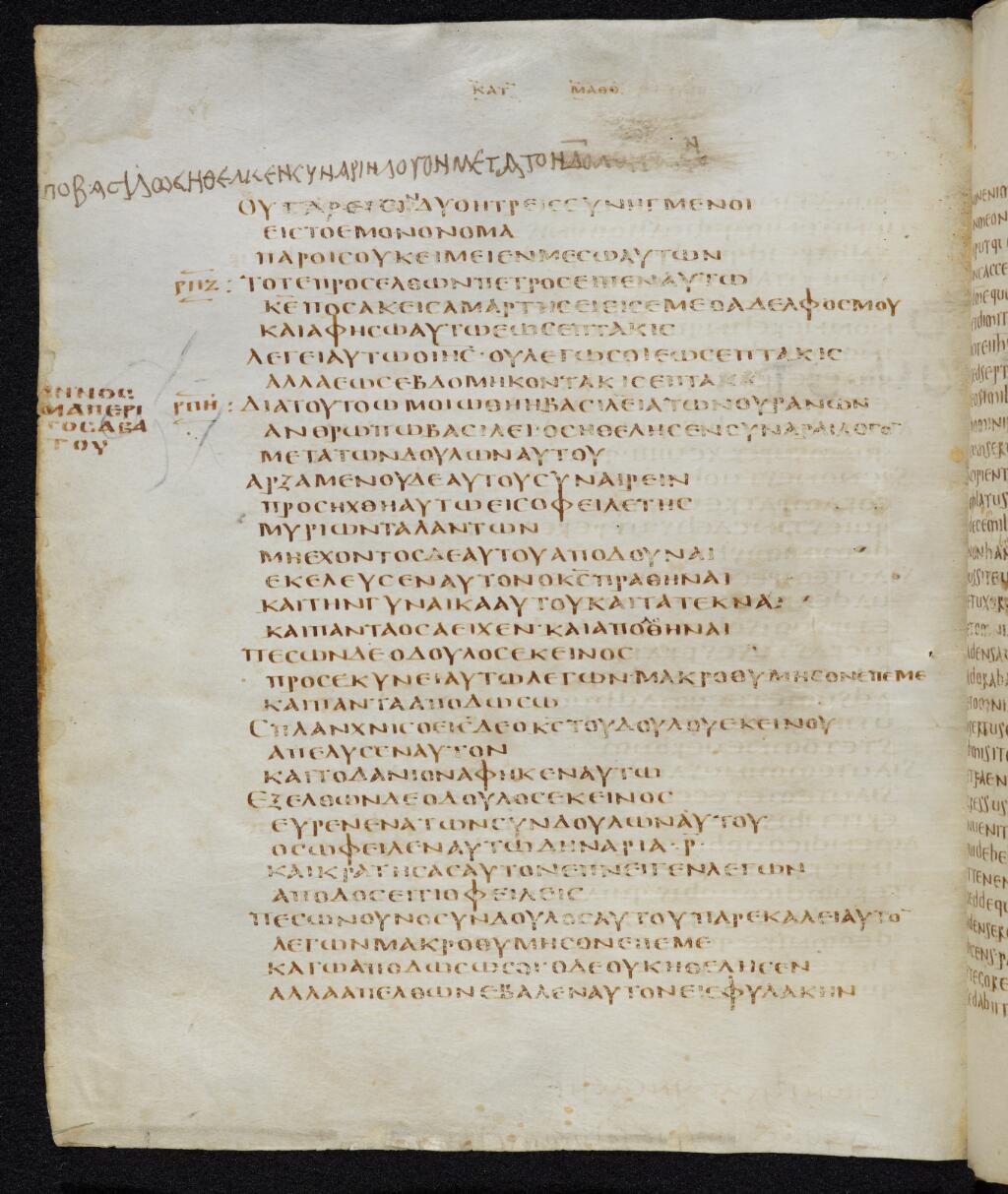
Page from the NTVMR transcription (docID 20005): verses 31-35 on fol. 61v.
31ιδοντες ουν οι συνδουλοι αυτου τα γεινομενα ελυπηθησαν σφοδρα και ελθοντες διεσαφησαν τω κω αυτων παντα τα γενομενα 32τοτε προσκαλεσαμενος αυτον ο κς αυτου λεγει δουλε πονηρε πασαν την οφειλην εκεινην αφηκα σοι · επι παρεκαλεσας με 33ουκ εδι ουν και σε ελεησε τον συνδουλον σου · ως καγω σε ηλεησα 34και οργισθεις ο κς αυτου παρεδωκεν αυτον τοις βασανισταις εως ου αποδω το οφειλομενον 35ουτως και υμειν ποιησει ο πατηρ μου ο ουρανιος εαν μη αφητε · εκαστος τω αδελφω αυτου απο των καρδιων υμων ·
Compare: Tischendorf 8th edition (1869)
31ἰδόντες οὖν οἱ σύνδουλοι αὐτοῦ τὰ γενόμενα ἐλυπήθησαν σφόδρα, καὶ ἐλθόντες διεσάφησαν τῷ κυρίῳ ἑαυτῶν πάντα τὰ γενόμενα. 32τότε προσκαλεσάμενος αὐτὸν ὁ κύριος αὐτοῦ λέγει αὐτῷ· δοῦλε πονηρέ, πᾶσαν τὴν ὀφειλὴν ἐκείνην ἀφῆκά σοι, ἐπεὶ παρεκάλεσάς με· 33οὐκ ἔδει καὶ σὲ ἐλεῆσαι τὸν σύνδουλόν σου, ὡς κἀγὼ σὲ ἠλέησα; 34καὶ ὀργισθεὶς ὁ κύριος αὐτοῦ παρέδωκεν αὐτὸν τοῖς βασανισταῖς ἕως οὗ ἀποδῷ πᾶν τὸ ὀφειλόμενον αὐτῷ. 35οὕτως καὶ ὁ πατήρ μου ὁ οὐράνιος ποιήσει ὑμῖν, ἐὰν μὴ ἀφῆτε ἕκαστος τῷ ἀδελφῷ αὐτοῦ ἀπὸ τῶν καρδιῶν ὑμῶν.
31So when his fellowservants saw what was done, they were very sorry, and came and told unto their lord all that was done. 32Then his lord, after that he had called him, said unto him, O thou wicked servant, I forgave thee all that debt, because thou desiredst me: 33Shouldest not thou also have had compassion on thy fellowservant, even as I had pity on thee? 34And his lord was wroth, and delivered him to the tormentors, till he should pay all that was due unto him. 35So likewise shall my heavenly Father do also unto you, if ye from your hearts forgive not every one his brother their trespasses.
Notes
- Codex Bezae is bilingual: at each opening the Greek is on the left-hand (verso) page and the Latin on the facing right-hand (recto) page. Only the Greek pages are shown here; the Latin column is not included.
Cite
Sources
- Source: Codex Bezae page images + NTVMR transcription (CC BY 4.0) + Tischendorf 8th edition + KJV (holding institution)
- Critical edition: Codex Bezae transcription, NTVMR (INTF Münster, CC BY 4.0); Tischendorf 8th edition for comparison
← previous · → next · v cycle view · l back to library